Recognition: unknown
A single power law for the TRAPPIST-1 flare distribution across four orders of magnitude in energy
Pith reviewed 2026-05-08 15:37 UTC · model grok-4.3
The pith
TRAPPIST-1 flares obey a single power law from 10^29 to 10^33 erg after bandpass conversion and sensitivity corrections.
A machine-rendered reading of the paper's core claim, the machinery that carries it, and where it could break.
Core claim
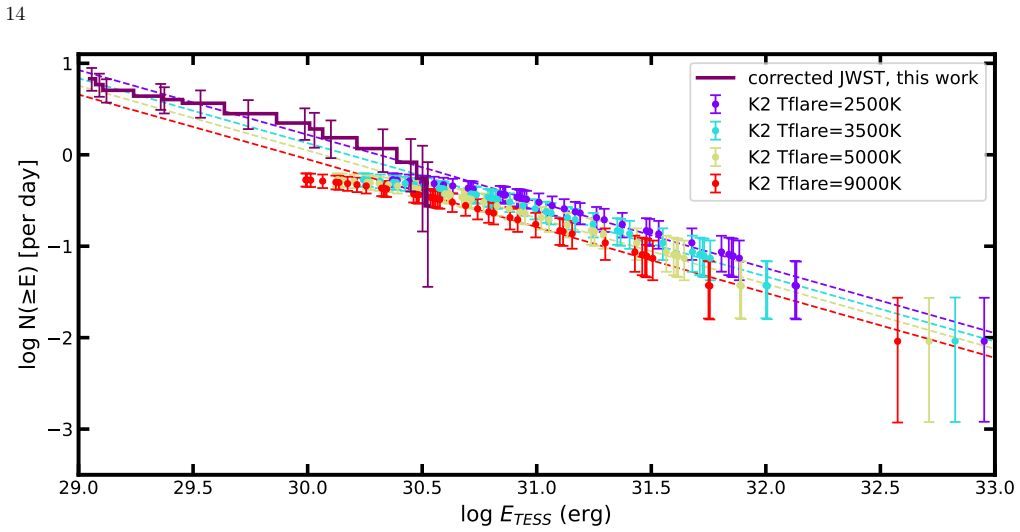
After correcting for flare-detection sensitivities, the combined JWST+K2 cumulative FFD is consistent with a single power law, N(≥E_TESS)∝E_TESS^{-β}, with β=0.753 over E_TESS≃10^{29}-10^{33} erg. The slope of the distribution indicates that the time-averaged flare energy budget is dominated by rare, high-energy events rather than by the more numerous low-energy flares.
What carries the argument
The cumulative flare frequency distribution expressed as a power law in TESS-equivalent energy, obtained by unifying JWST spectroscopy and K2 photometry through conversion assuming a 3500 K flare blackbody.
Load-bearing premise
A single 3500 K blackbody continuum converts both JWST and Kepler flare energies into the TESS bandpass accurately, and detection-efficiency corrections can be applied uniformly across the datasets without residual bias.
What would settle it
A statistically significant change in the fitted power-law index when new observations extend the energy range below 10^29 erg or above 10^33 erg, or when repeating the analysis with a different assumed flare temperature produces an inconsistent slope.
Figures


read the original abstract
TRAPPIST-1 is an ultra-cool dwarf that flares frequently. These flares shape the surrounding planets' high-energy irradiation environments, with consequences for atmospheric chemistry and escape, and they can contaminate transmission spectroscopy of those planets. A quantitative flare-frequency distribution (FFD) spanning the full energy range is therefore essential for both interpreting JWST spectra and modeling the planets' irradiation histories. Here we present a unified FFD over four orders of magnitude in energy by jointly analyzing $\approx$87\,hr of JWST/NIRISS and JWST/NIRSpec time-series spectroscopy together with $\approx$74\,days of \textit{Kepler}/K2 photometry. To enable a consistent comparison across these heterogeneous datasets, we convert all events to energies in the TESS bandpass. For the Kepler-to-TESS conversion we adopt a cooler flare continuum appropriate for ultra-cool dwarfs ($T_{\rm flare}=3500$\,K). After correcting for flare-detection sensitivities, the combined JWST+K2 cumulative FFD is consistent with a single power law, $N(\ge E_\mathrm{TESS})\propto E_\mathrm{TESS}^{-\beta}$, with $\beta=0.753$ over $E_{\rm TESS}\simeq10^{29}$-$10^{33}$\,erg. The slope of the distribution indicates that the time-averaged flare energy budget is dominated by rare, high-energy events rather than by the more numerous low-energy flares. This bandpass-consistent FFD provides a practical basis for JWST transit-spectroscopy planning and for modeling the flare-driven irradiation environment of the TRAPPIST-1 planets.
Editorial analysis
A structured set of objections, weighed in public.
Referee Report
Summary. The manuscript combines ~87 hr of JWST/NIRISS+NIRSpec spectroscopy with ~74 days of K2 photometry for TRAPPIST-1, converts all detected flares to TESS-band energies using a fixed 3500 K blackbody continuum, applies flare-detection sensitivity corrections, and reports that the combined cumulative FFD is consistent with a single power law N(≥E_TESS) ∝ E_TESS^{-β} with β=0.753 over E_TESS ≃ 10^{29}–10^{33} erg. The slope implies that the time-averaged flare energy budget is dominated by rare high-energy events.
Significance. If the single-power-law result holds after the stated corrections, the work supplies a practical, bandpass-consistent FFD spanning four orders of magnitude that can be used directly for JWST transit-spectroscopy planning and for modeling the cumulative high-energy irradiation history of the TRAPPIST-1 planets. The multi-instrument approach and explicit conversion to a common bandpass are strengths that increase the utility of the result.
major comments (2)
- [Abstract / methods section] Abstract and methods: the claim that the combined JWST+K2 cumulative FFD is 'consistent with a single power law' after sensitivity corrections rests on unshown quantitative steps; no derivation or validation of the detection-efficiency corrections is provided, nor are uncertainties or error bars reported on β. These omissions are load-bearing because the central conclusion depends on the corrections aligning the heterogeneous datasets without residual bias.
- [Abstract / energy conversion] Energy conversion procedure (abstract): adoption of a single fixed T_flare = 3500 K blackbody for both JWST spectroscopic and K2 photometric events is stated without a sensitivity test. If real flares exhibit temperature or spectral-shape variations, the high-energy JWST points could shift relative to the K2 points on the E_TESS axis, potentially masking an intrinsically broken distribution; this assumption therefore requires explicit validation before the single-slope claim can be considered robust.
minor comments (2)
- [Abstract] The abstract states the energy range as E_TESS ≃ 10^{29}–10^{33} erg but does not specify how the lower and upper bounds were determined from the combined datasets.
- [Abstract] Notation for the power-law index (β) and the cumulative distribution N(≥E) should be defined explicitly on first use to avoid ambiguity with other common flare-distribution conventions.
Simulated Author's Rebuttal
We thank the referee for the constructive and detailed comments. We address each major comment below and have revised the manuscript to provide the requested quantitative details and robustness tests.
read point-by-point responses
-
Referee: [Abstract / methods section] Abstract and methods: the claim that the combined JWST+K2 cumulative FFD is 'consistent with a single power law' after sensitivity corrections rests on unshown quantitative steps; no derivation or validation of the detection-efficiency corrections is provided, nor are uncertainties or error bars reported on β. These omissions are load-bearing because the central conclusion depends on the corrections aligning the heterogeneous datasets without residual bias.
Authors: We agree that the original submission did not provide a full derivation of the detection-efficiency corrections or report uncertainties on β. In the revised manuscript we have added a dedicated Methods subsection that describes the Monte Carlo simulations used to compute detection efficiency versus energy for the JWST spectroscopic and K2 photometric datasets, including the injected-flare recovery tests and the resulting efficiency curves. We also now report the formal uncertainty on the maximum-likelihood power-law index β. These additions make the alignment of the two datasets and the single-power-law conclusion quantitatively explicit. revision: yes
-
Referee: [Abstract / energy conversion] Energy conversion procedure (abstract): adoption of a single fixed T_flare = 3500 K blackbody for both JWST spectroscopic and K2 photometric events is stated without a sensitivity test. If real flares exhibit temperature or spectral-shape variations, the high-energy JWST points could shift relative to the K2 points on the E_TESS axis, potentially masking an intrinsically broken distribution; this assumption therefore requires explicit validation before the single-slope claim can be considered robust.
Authors: The fixed T_flare = 3500 K follows the value adopted in prior ultra-cool-dwarf flare studies. We nevertheless accept that an explicit sensitivity test is required. In the revised manuscript we have added a new subsection and accompanying figure that recomputes all flare energies for T_flare = 3000 K and 4000 K. The resulting cumulative FFDs remain consistent with a single power law over the full four-order-of-magnitude range, and the fitted index changes by less than the original uncertainty. This demonstrates that the single-slope result is not an artifact of the temperature choice. revision: yes
Circularity Check
No significant circularity detected
full rationale
The paper adopts a fixed 3500 K blackbody temperature for converting JWST and K2 flare energies to the TESS bandpass, applies detection-efficiency corrections to the external observational datasets, and fits the power-law index β directly to the resulting combined cumulative FFD. The reported consistency with a single power law (β = 0.753 over four orders of magnitude) is an empirical outcome of this data-driven fit rather than a self-referential prediction or quantity forced by construction. No self-definitional loops, load-bearing self-citations, uniqueness theorems imported from prior author work, or smuggled ansatzes appear in the derivation chain. The central claim remains an independent description of the processed observations.
Axiom & Free-Parameter Ledger
free parameters (2)
- flare continuum temperature
- power-law index beta
axioms (1)
- domain assumption Flare events detected in JWST NIRISS/NIRSpec and Kepler/K2 can be placed on a common energy scale after bandpass conversion and detection-efficiency correction.
Reference graph
Works this paper leans on
-
[1]
Sun-like stars produce superflares roughly once per century. Science , keywords =. doi:10.1126/science.adl5441 , archivePrefix =. 2412.12265 , primaryClass =
-
[2]
A new catalogue of solar flare events from soft X-ray GOES signal in the period 1986-2020. Adv. Space Res. , keywords =. doi:10.1016/j.asr.2022.11.020 , archivePrefix =. 2211.10189 , primaryClass =
-
[3]
Kepler Flares. II. The Temporal Morphology of White-light Flares on GJ 1243. , keywords =. doi:10.1088/0004-637X/797/2/122 , archivePrefix =. 1411.3723 , primaryClass =
-
[4]
2024, JOSS, 9, 6898, doi: 10.21105/joss.06898
exoTEDRF: An EXOplanet Transit and Eclipse Data Reduction Framework. The Journal of Open Source Software , keywords =. doi:10.21105/joss.06898 , archivePrefix =. 2407.17541 , primaryClass =
-
[5]
2023, Monthly Notices of the Royal Astronomical Society, 524, 835, doi: 10.1093/mnras/stad1762
Awesome SOSS: transmission spectroscopy of WASP-96b with NIRISS/SOSS. , keywords =. doi:10.1093/mnras/stad1762 , archivePrefix =. 2305.17001 , primaryClass =
-
[6]
2025, ApJL, 985, L10, doi: 10.3847/2041-8213/add010
Escaping Helium and a Highly Muted Spectrum Suggest a Metal-enriched Atmosphere on Sub-Neptune GJ 3090 b from JWST Transit Spectroscopy. , keywords =. doi:10.3847/2041-8213/add010 , archivePrefix =. 2504.20428 , primaryClass =
-
[7]
D., Radica, M., Welbanks, L., et al
Early Release Science of the exoplanet WASP-39b with JWST NIRISS. , keywords =. doi:10.1038/s41586-022-05674-1 , archivePrefix =. 2211.10493 , primaryClass =
-
[8]
, archivePrefix = "arXiv", eprint =
Techniques and Review of Absolute Flux Calibration from the Ultraviolet to the Mid-Infrared. , keywords =. doi:10.1086/677655 , archivePrefix =. 1406.1707 , primaryClass =
-
[9]
New Grids of Pure-hydrogen White Dwarf NLTE Model Atmospheres and the HST/STIS Flux Calibration. , keywords =. doi:10.3847/1538-3881/ab94b4 , archivePrefix =. 2005.10945 , primaryClass =
-
[10]
How Do Spitzer IRAC Fluxes Compare to HST CALSPEC?. , keywords =. doi:10.3847/1538-3881/ac6fe1 , archivePrefix =. 2205.08322 , primaryClass =
-
[11]
Faint White Dwarf Flux Standards: Data and Models. , keywords =. doi:10.3847/1538-3881/ad93d8 , archivePrefix =. 2411.09049 , primaryClass =
-
[12]
Absolute Flux Calibration (A Dwarfs)
-
[13]
Molecular Hydrogen Controls the Temperatures of Flares on TRAPPIST-1. , keywords =. doi:10.3847/2041-8213/ae328b , archivePrefix =. 2601.00386 , primaryClass =
-
[14]
B., Sobeck, C., Haas, M., et al
The K2 Mission: Characterization and Early Results. , keywords =. doi:10.1086/676406 , archivePrefix =. 1402.5163 , primaryClass =
-
[15]
doi:10.1117/1.JATIS.1.1.014003 , eid =
Transiting Exoplanet Survey Satellite (TESS). Journal of Astronomical Telescopes, Instruments, and Systems , year = 2015, month = jan, volume =. doi:10.1117/1.JATIS.1.1.014003 , adsurl =
-
[16]
J., Koch, D., Basri, G., et al
Kepler Planet-Detection Mission: Introduction and First Results. Science , keywords =. doi:10.1126/science.1185402 , adsurl =
-
[17]
Separating Flare and Secondary Atmospheric Signals with RADYN Modeling of Near-infrared JWST Transmission Spectroscopy Observations of TRAPPIST-1. , keywords =. doi:10.3847/2041-8213/ae1960 , archivePrefix =. 2512.04265 , primaryClass =
-
[18]
Flares on TRAPPIST-1 Reveal the Spectrum of Magnetic Features on Its Surface. , keywords =. doi:10.3847/2041-8213/adf841 , archivePrefix =. 2508.04793 , primaryClass =
-
[19]
The Transit Light Source Effect: False Spectral Features and Incorrect Densities for M-dwarf Transiting Planets. , keywords =. doi:10.3847/1538-4357/aaa08c , archivePrefix =. 1711.05691 , primaryClass =
-
[20]
2025, ApJL, 979, L5, doi: 10.3847/2041-8213/ada381
Promise and Peril: Stellar Contamination and Strict Limits on the Atmosphere Composition of TRAPPIST-1 c from JWST NIRISS Transmission Spectra. , keywords =. doi:10.3847/2041-8213/ada381 , archivePrefix =. 2409.19333 , primaryClass =
-
[21]
2023, ApJL, 955, L22, doi: 10.3847/2041-8213/acf7c4
Atmospheric Reconnaissance of TRAPPIST-1 b with JWST/NIRISS: Evidence for Strong Stellar Contamination in the Transmission Spectra. , keywords =. doi:10.3847/2041-8213/acf7c4 , archivePrefix =. 2309.07047 , primaryClass =
-
[22]
First JWST thermal phase curves of temperate terrestrial exoplanets reveal no thick atmosphere around TRAPPIST-1 b and c. arXiv e-prints , keywords =. doi:10.48550/arXiv.2509.02128 , archivePrefix =. 2509.02128 , primaryClass =
-
[23]
Disentangling the Planet from the Star in Late-Type M Dwarfs: A Case Study of TRAPPIST-1g. , keywords =. doi:10.3847/1538-3881/aaf04d , archivePrefix =. 1811.04877 , primaryClass =
-
[24]
HST/WFC3 transmission spectroscopy of the cold rocky planet TRAPPIST-1h. , keywords =. doi:10.1051/0004-6361/202142603 , archivePrefix =. 2203.13698 , primaryClass =
-
[25]
2017, Nature Astronomy, 1, 0129, doi: 10.1038/s41550-017-0129
A seven-planet resonant chain in TRAPPIST-1. Nature Astronomy , keywords =. doi:10.1038/s41550-017-0129 , archivePrefix =. 1703.04166 , primaryClass =
-
[26]
Seven temperate terrestrial planets around the nearby ultracool dwarf star TRAPPIST-1. , keywords =. doi:10.1038/nature21360 , archivePrefix =. 1703.01424 , primaryClass =
-
[27]
doi:10.1051/0004-6361/202243869 , keywords =
Lower-than-expected flare temperatures for TRAPPIST-1. , keywords =. doi:10.1051/0004-6361/202243869 , archivePrefix =. 2210.11103 , primaryClass =
-
[28]
Characterizing Temperatures of Flares on the M Dwarf Wolf 359 from Simultaneous Multiband Optical Observations. , keywords =. doi:10.3847/1538-3881/ae0c0a , archivePrefix =. 2509.21505 , primaryClass =
-
[29]
emcee: The MCMC Hammer. , keywords =. doi:10.1086/670067 , archivePrefix =. 1202.3665 , primaryClass =
-
[30]
TRAPPIST-1: Global results of the Spitzer Exploration Science Program Red Worlds. , keywords =. doi:10.1051/0004-6361/201937392 , archivePrefix =. 2006.13826 , primaryClass =
-
[31]
K2 Ultracool Dwarfs Survey. III. White Light Flares Are Ubiquitous in M6-L0 Dwarfs. , keywords =. doi:10.3847/1538-4357/aab8fe , archivePrefix =. 1803.07708 , primaryClass =
-
[32]
Hubble's Multi-Year Search for Exospheres in the TRAPPIST-1 System Reveals Frequent Microflares. arXiv e-prints , keywords =. doi:10.48550/arXiv.2506.12140 , archivePrefix =. 2506.12140 , primaryClass =
-
[33]
Computing in Science & Engineering9(3), 90–95 (2007) https://doi.org/10.1109/MCSE.2007.55
Matplotlib: A 2D Graphics Environment. Computing in Science and Engineering , keywords =. doi:10.1109/MCSE.2007.55 , adsurl =
-
[34]
C., Varoquaux G., 2011, @doi [Computing in Science Engineering] 10.1109/MCSE.2011.37 , 13, 22
S. van der Walt and S. C. Colbert and G. Varoquaux , journal=. The NumPy Array: A Structure for Efficient Numerical Computation , year=. doi:10.1109/MCSE.2011.37 , ISSN=
-
[35]
and Haberland, Matt and Reddy, Tyler and Cournapeau, David and Burovski, Evgeni and Peterson, Pearu and Weckesser, Warren and Bright, Jonathan and
Virtanen, Pauli and Gommers, Ralf and Oliphant, Travis E. and Haberland, Matt and Reddy, Tyler and Cournapeau, David and Burovski, Evgeni and Peterson, Pearu and Weckesser, Warren and Bright, Jonathan and. Nature Methods , year =
-
[36]
Llamaradas Estelares: Modeling the Morphology of White-light Flares. , keywords =. doi:10.3847/1538-3881/ac6fe6 , archivePrefix =. 2205.05706 , primaryClass =
-
[37]
The Sun as a star: observations of white-light flares. , keywords =. doi:10.1051/0004-6361/201015930 , archivePrefix =. 1103.3125 , primaryClass =
-
[38]
doi:10.1051/0004-6361/202040098 , keywords =
Activity of TRAPPIST-1 analog stars observed with TESS. , keywords =. doi:10.1051/0004-6361/202040098 , archivePrefix =. 2103.13540 , primaryClass =
-
[39]
The Kepler Catalog of Stellar Flares. , keywords =. doi:10.3847/0004-637X/829/1/23 , archivePrefix =. 1607.03494 , primaryClass =
-
[40]
Self-organized Criticality in Stellar Flares. , keywords =. doi:10.3847/1538-4357/abdec7 , archivePrefix =. 2106.06490 , primaryClass =
-
[41]
Testing Self-organized Criticality across the Main Sequence Using Stellar Flares from TESS. , keywords =. doi:10.3847/2041-8213/ac4b5e , archivePrefix =. 2109.07011 , primaryClass =
-
[42]
The Flaring Activity of M Dwarfs in the Kepler Field. , keywords =. doi:10.3847/1538-4357/aa8ea2 , adsurl =
-
[43]
doi:10.1051/0004-6361/201937350 , keywords =
Rotation-activity relations and flares of M dwarfs with K2 long- and short-cadence data. , keywords =. doi:10.1051/0004-6361/201937350 , archivePrefix =. 2003.11937 , primaryClass =
-
[44]
Kepler Flares. I. Active and Inactive M Dwarfs. , keywords =. doi:10.1088/0004-637X/797/2/121 , archivePrefix =. 1410.7779 , primaryClass =
-
[45]
Stellar Flares from the First TESS Data Release: Exploring a New Sample of M Dwarfs. , keywords =. doi:10.3847/1538-3881/ab5d3a , archivePrefix =. 1901.00443 , primaryClass =
-
[46]
Flare Statistics for Young Stars from a Convolutional Neural Network Analysis of TESS Data. , keywords =. doi:10.3847/1538-3881/abac0a , archivePrefix =. 2005.07710 , primaryClass =
-
[47]
Frequent Flaring in the TRAPPIST-1 System Unsuited for Life?. , keywords =. doi:10.3847/1538-4357/aa6f05 , archivePrefix =. 1703.10130 , primaryClass =
-
[48]
2015, Publications of the Astronomical Society of the Pacific, 127, 1161, doi: 10.1086/683602
batman: BAsic Transit Model cAlculatioN in Python. , keywords =. doi:10.1086/683602 , archivePrefix =. 1507.08285 , primaryClass =
-
[49]
Characterizing the Near-infrared Spectra of Flares from TRAPPIST-1 during JWST Transit Spectroscopy Observations. , keywords =. doi:10.3847/1538-4357/acfe75 , archivePrefix =. 2310.03792 , primaryClass =
-
[50]
The Stellar Activity of TRAPPIST-1 and Consequences for the Planetary Atmospheres. , keywords =. doi:10.3847/1538-4357/aa991e , archivePrefix =. 1711.02676 , primaryClass =
-
[51]
The Near-infrared Transmission Spectra of TRAPPIST-1 Planets b, c, d, e, f, and g and Stellar Contamination in Multi-epoch Transit Spectra. , keywords =. doi:10.3847/1538-3881/aade4f , archivePrefix =. 1802.02086 , primaryClass =
-
[52]
Possible Bright Starspots on TRAPPIST-1. , keywords =. doi:10.3847/1538-4357/aab6a5 , archivePrefix =. 1803.04543 , primaryClass =
-
[53]
Temperate Earth-sized planets transiting a nearby ultracool dwarf star. , keywords =. doi:10.1038/nature17448 , archivePrefix =. 1605.07211 , primaryClass =
-
[54]
Strict Limits on Potential Secondary Atmospheres on the Temperate Rocky Exo-Earth TRAPPIST-1 d. , keywords =. doi:10.3847/1538-4357/adf207 , archivePrefix =. 2508.08416 , primaryClass =
-
[55]
Stellar Contamination Correction Using Back-to-back Transits of TRAPPIST-1 b and c. , keywords =. doi:10.3847/2041-8213/ada5c7 , archivePrefix =. 2412.16541 , primaryClass =
-
[56]
H., Espinoza, N., Boehm, V., et al
JWST TRAPPIST-1 e/b Program: Motivation and first observations. arXiv e-prints , keywords =. doi:10.48550/arXiv.2512.07695 , archivePrefix =. 2512.07695 , primaryClass =
-
[57]
JWST-TST DREAMS: NIRSpec/PRISM Transmission Spectroscopy of the Habitable Zone Planet TRAPPIST-1 e. , keywords =. doi:10.3847/2041-8213/adf42e , archivePrefix =. 2509.05414 , primaryClass =
-
[58]
2025, ApJL, 990, L53, doi: 10.3847/2041-8213/adf62e
JWST-TST DREAMS: Secondary Atmosphere Constraints for the Habitable Zone Planet TRAPPIST-1 e. , keywords =. doi:10.3847/2041-8213/adf62e , archivePrefix =. 2509.05407 , primaryClass =
-
[59]
doi:10.3847/2041-8213/aa79ed , keywords =
The Threatening Magnetic and Plasma Environment of the TRAPPIST-1 Planets. , keywords =. doi:10.3847/2041-8213/aa79ed , archivePrefix =. 1706.04617 , primaryClass =
-
[60]
Summary of the content and survey properties
Gaia Data Release 3. Summary of the content and survey properties. , keywords =. doi:10.1051/0004-6361/202243940 , archivePrefix =. 2208.00211 , primaryClass =
discussion (0)
Sign in with ORCID, Apple, or X to comment. Anyone can read and Pith papers without signing in.