Recognition: 2 theorem links
· Lean TheoremX-ray spectroscopy mass constraints on V1674 Her: the fastest nova does not have a near-Chandrasekhar white dwarf
Pith reviewed 2026-05-11 00:48 UTC · model grok-4.3
The pith
X-ray spectroscopy and timing analysis show the white dwarf in the fastest nova V1674 Her has a mass of about 1.1 solar masses.
A machine-rendered reading of the paper's core claim, the machinery that carries it, and where it could break.
Core claim
Under the assumption that the accretion disk is truncated at the co-rotation radius, broadband X-ray spectral fitting gives a white dwarf mass of 1.09^{+0.07}_{-0.06} solar masses for V1674 Her; timing analysis of the X-ray power spectrum independently yields 1.12 ± 0.06 solar masses. These values are significantly lower than those predicted by empirical decline-time relations for its t2 of about one day, showing that the fastest novae need not host near-Chandrasekhar white dwarfs.
What carries the argument
Post-shock accretion column model that incorporates the temperature gradient along the flow and Compton reflection from the white dwarf surface, combined with the co-rotation radius assumption that links the observed spin period to the magnetospheric radius.
If this is right
- Empirical relations between nova decline time and white dwarf mass can overestimate the mass in the fastest systems.
- Nova eruption timescales must depend on additional parameters such as accretion rate or binary geometry.
- V1674 Her lies at the upper end of the magnetic field distribution for intermediate polars.
- Direct X-ray constraints are needed to calibrate mass estimates for other rapidly evolving novae.
Where Pith is reading between the lines
- Similar X-ray studies of other fast novae could show that many decline-time masses are inflated.
- The rapid optical decline of V1674 Her may be driven more by its accretion rate or magnetic geometry than by white dwarf mass alone.
- Population models of nova progenitors may need to incorporate a wider range of white dwarf masses for the shortest-timescale events.
Load-bearing premise
The accretion disk is truncated precisely at the co-rotation radius, so the observed spin period directly sets the magnetospheric radius used to convert the fitted X-ray parameters into a white dwarf mass.
What would settle it
An independent mass determination for the white dwarf in V1674 Her that returns a value above 1.25 solar masses would falsify the X-ray-derived mass.
Figures




read the original abstract
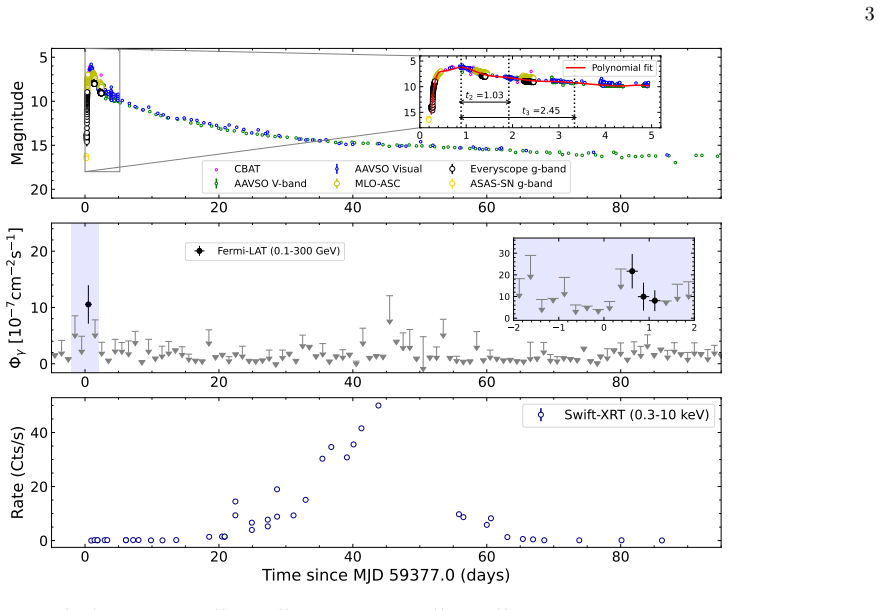
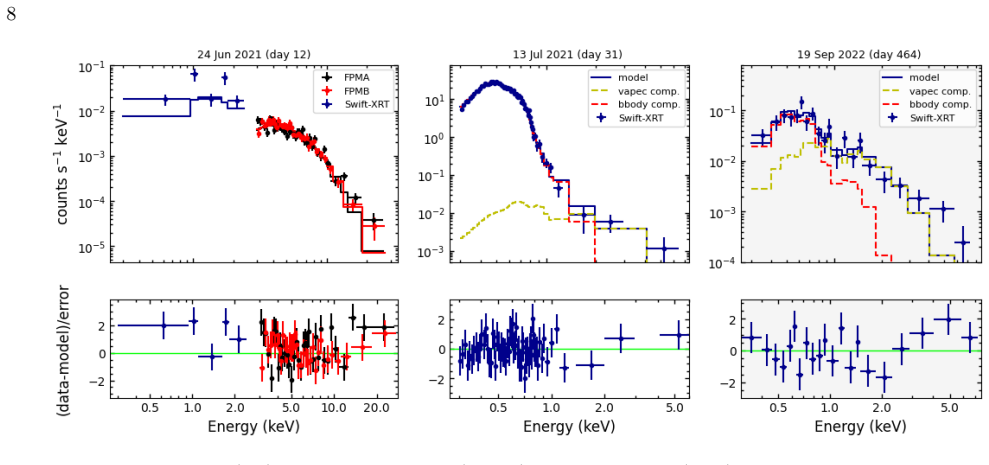
V1674 Her (Nova Her 2021) is the fastest classical nova ever recorded, with an optical decline time of $t_2 \sim 1$ day, typically interpreted as evidence for a white dwarf mass close to the Chandrasekhar limit. We present a broadband X-ray study of V1674 Her combining contemporaneous XMM-Newton and NuSTAR observations in quiescence to directly constrain the white dwarf mass and magnetic field strength. The hard X-ray emission is modeled using a physically motivated post-shock accretion column model that accounts for the temperature gradient in the flow and reflection from the white dwarf surface. Under the assumption that the accretion disk is truncated at the co-rotation radius, we obtain a white dwarf mass of $M = 1.09^{+0.07}_{-0.06}\,M_\odot$. An independent constraint derived from timing analysis of the X-ray power spectrum yields a consistent value of $M = 1.12 \pm 0.06\,M_\odot$. These values are significantly lower than those inferred from empirical decline-time relations, suggesting that such relations may overestimate white dwarf masses in extreme fast novae. From the inferred accretion rate and magnetospheric radius, we estimate a surface magnetic field strength of $B = 21.3^{+6.6}_{-5.7}\,(\mathrm{stat})^{+12.9}_{-8.1}\,(\mathrm{sys})\,\mathrm{MG}$, placing V1674 Her at the high end of the magnetic field distribution for intermediate polars. Our results demonstrate that even the fastest novae do not necessarily host near-Chandrasekhar white dwarfs, highlighting the importance of direct X-ray constraints and suggesting that additional parameters beyond white dwarf mass play a key role in setting nova timescales.
Editorial analysis
A structured set of objections, weighed in public.
Referee Report
Summary. The manuscript reports broadband X-ray observations of V1674 Her (Nova Her 2021), the fastest classical nova, using contemporaneous XMM-Newton and NuSTAR data in quiescence. The hard X-ray emission is modeled with a physically motivated post-shock accretion column that incorporates the temperature gradient and reflection from the white dwarf surface. Under the assumption that the accretion disk truncates at the co-rotation radius, spectral fitting yields M_WD = 1.09^{+0.07}_{-0.06} M_⊙; an independent timing analysis of the X-ray power spectrum gives a consistent M_WD = 1.12 ± 0.06 M_⊙. These values are lower than those inferred from empirical decline-time relations, and the authors estimate a surface magnetic field B ≈ 21 MG, placing the system at the high end of the intermediate-polar distribution.
Significance. If the co-rotation truncation assumption holds, the result demonstrates that even the fastest novae need not host near-Chandrasekhar white dwarfs, implying that decline-time relations can overestimate masses when additional parameters (such as magnetic field strength) are important. The convergence of two methods that both rely on the same accretion geometry framework provides internal consistency, and the use of a detailed physical model rather than purely empirical relations is a clear strength. The work has direct implications for nova population synthesis and the role of magnetism in outburst timescales.
major comments (2)
- [Abstract, §3 (spectral modeling), §4 (timing analysis)] The central mass values in both the spectral and timing analyses depend on setting the disk truncation radius equal to the co-rotation radius r_co = (G M P_spin² / 4π²)^{1/3}. This fixes the magnetospheric radius used to normalize the specific accretion rate and reflection component in the post-shock column model (§3) and interprets the power-spectrum break frequency as the Keplerian frequency at r_co (§4). If truncation occurs at r_m ≠ r_co (plausible for a post-nova system not yet in spin equilibrium), both reported masses shift by amounts comparable to the quoted uncertainties, as the skeptic note correctly identifies. The manuscript should add a quantitative sensitivity test or independent check (e.g., spin-period derivative or multi-wavelength r_in constraint) to assess robustness.
- [Abstract and §3] The abstract and modeling sections provide insufficient detail on validation of the post-shock accretion column model, the full error budget (including systematic contributions from the co-rotation assumption), and explicit tests of the co-rotation truncation. Without these, it is difficult to judge whether the quoted statistical uncertainties fully capture the dominant systematic risks.
minor comments (2)
- [Abstract] The abstract would benefit from a brief statement of the key model assumptions and the range of systematic uncertainties to improve readability for a broad audience.
- [Results section / tables] Notation for the magnetic field uncertainties (statistical vs. systematic) is clear in the abstract but should be repeated explicitly in the relevant results table or figure caption for consistency.
Simulated Author's Rebuttal
We thank the referee for their careful and constructive review of our manuscript. The comments correctly identify the central role of the co-rotation truncation assumption and the need for greater transparency on model validation and systematics. We address each point below and will incorporate the requested material in the revised version.
read point-by-point responses
-
Referee: The central mass values in both the spectral and timing analyses depend on setting the disk truncation radius equal to the co-rotation radius r_co = (G M P_spin² / 4π²)^{1/3}. This fixes the magnetospheric radius used to normalize the specific accretion rate and reflection component in the post-shock column model (§3) and interprets the power-spectrum break frequency as the Keplerian frequency at r_co (§4). If truncation occurs at r_m ≠ r_co (plausible for a post-nova system not yet in spin equilibrium), both reported masses shift by amounts comparable to the quoted uncertainties. The manuscript should add a quantitative sensitivity test or independent check (e.g., spin-period derivative or multi-wavelength r_in constraint) to assess robustness.
Authors: We agree that the co-rotation assumption is central and that deviations at the factor-of-two level could shift the masses by amounts comparable to the reported uncertainties. In the revised manuscript we will add a quantitative sensitivity analysis in both §3 and §4, showing the range of M_WD obtained when the truncation radius is varied from 0.5 r_co to 2 r_co while keeping all other model parameters fixed. This will make the dependence explicit and allow readers to assess robustness directly. A spin-period derivative or independent multi-wavelength r_in measurement would require new long-baseline or multi-epoch data not present in the current XMM-Newton/NuSTAR observations; we will state this limitation clearly and justify why the co-rotation assumption remains the most physically motivated choice given the observed spin period and accretion rate. revision: yes
-
Referee: The abstract and modeling sections provide insufficient detail on validation of the post-shock accretion column model, the full error budget (including systematic contributions from the co-rotation assumption), and explicit tests of the co-rotation truncation. Without these, it is difficult to judge whether the quoted statistical uncertainties fully capture the dominant systematic risks.
Authors: We will expand the abstract and §3 to include additional validation details for the post-shock column model, citing its prior successful use on other intermediate polars and reporting our own checks (fit statistics, parameter degeneracies, and reflection-component consistency). The error budget will be updated to quote both statistical and systematic uncertainties, with the latter now incorporating the range obtained from the truncation-radius sensitivity test. Explicit discussion of the co-rotation assumption and the results of the sensitivity test will be added to the text so that the dominant systematic contribution is transparent. revision: yes
- Direct independent verification of the inner-disk radius via multi-wavelength observations or a measurement of the white-dwarf spin-period derivative, both of which would require new observational data beyond the scope of the present study.
Circularity Check
No circularity: masses obtained via explicit model fits under stated assumption
full rationale
The paper's central results are obtained by fitting a post-shock accretion column model to broadband X-ray data and by analyzing the X-ray power spectrum, both under the explicitly stated assumption that the disk truncates at the co-rotation radius. This assumption supplies an external relation between the independently measured spin period and the inner radius; it does not define the output mass in terms of itself. The spectral fit constrains M through the shock temperature gradient, reflection component, and normalization, while the timing result supplies a separate numerical value from the break frequency. No self-citations appear in the load-bearing steps, no parameters are fitted to a subset and then relabeled as predictions, and no uniqueness theorems or ansatzes are imported from prior author work. The derivation remains self-contained against the observed spectra and timing data once the geometric assumption is granted.
Axiom & Free-Parameter Ledger
free parameters (2)
- white dwarf mass
- surface magnetic field strength
axioms (1)
- domain assumption Accretion disk is truncated at the co-rotation radius
Lean theorems connected to this paper
-
IndisputableMonolith/Cost/FunctionalEquation.leanwashburn_uniqueness_aczel unclear?
unclearRelation between the paper passage and the cited Recognition theorem.
Under the assumption that the accretion disk is truncated at the co-rotation radius, we obtain a white dwarf mass of M = 1.09^{+0.07}_{-0.06} M_⊙. An independent constraint derived from timing analysis of the X-ray power spectrum yields a consistent value of M = 1.12 ± 0.06 M_⊙.
-
IndisputableMonolith/Foundation/RealityFromDistinction.leanreality_from_one_distinction unclear?
unclearRelation between the paper passage and the cited Recognition theorem.
The post-shock region emission model (ipolar30kk, Suleimanov et al. 2025) calculates hard X-ray spectra as a function of white dwarf mass (M) and magnetosphere radius (R_M)
What do these tags mean?
- matches
- The paper's claim is directly supported by a theorem in the formal canon.
- supports
- The theorem supports part of the paper's argument, but the paper may add assumptions or extra steps.
- extends
- The paper goes beyond the formal theorem; the theorem is a base layer rather than the whole result.
- uses
- The paper appears to rely on the theorem as machinery.
- contradicts
- The paper's claim conflicts with a theorem or certificate in the canon.
- unclear
- Pith found a possible connection, but the passage is too broad, indirect, or ambiguous to say the theorem truly supports the claim.
Reference graph
Works this paper leans on
-
[1]
G., Gil-Pons, P., C´ orsico, A
Althaus, L. G., Gil-Pons, P., C´ orsico, A. H., et al. 2021, A&A, 646, A30, doi: 10.1051/0004-6361/202038930
-
[2]
Anzolin, G., de Martino, D., Bonnet-Bidaud, J. M., et al. 2008, A&A, 489, 1243, doi: 10.1051/0004-6361:200810402
-
[3]
Arnaud, K. A. 1996, in Astronomical Society of the Pacific Conference Series, Vol. 101, Astronomical Data Analysis Software and Systems V, ed. G. H. Jacoby & J. Barnes, 17
1996
-
[4]
V., Chomiuk, L., et al
Aydi, E., Sokolovsky, K. V., Chomiuk, L., et al. 2020, Nature Astronomy, 4
2020
-
[5]
Bagnulo, S., & Landstreet, J. D. 2022, ApJL, 935, L12, doi: 10.3847/2041-8213/ac84d3
-
[6]
Bhargava, Y., Dewangan, G. C., Anupama, G. C., et al. 2024, MNRAS, 528, 28, doi: 10.1093/mnras/stad3870
-
[7]
Cropper, M., Wu, K., Ramsay, G., & Kocabiyik, A. 1999, MNRAS, 306, 684, doi: 10.1046/j.1365-8711.1999.02570.x
-
[8]
Lau, H. H. B. 2015, MNRAS, 446, 2599, doi: 10.1093/mnras/stu2180
-
[9]
Drake, J. J., Ness, J.-U., Page, K. L., et al. 2021, ApJL, 922, L42, doi: 10.3847/2041-8213/ac34fd
-
[10]
Evans, P. A., & Hellier, C. 2007, ApJ, 663, 1277, doi: 10.1086/518552
-
[11]
2009, MNRAS, 398, 515, doi: 10.1111/j.1365-2966.2009.14895.x
Evans, P. A., Beardmore, A. P., Page, K. L., et al. 2009, MNRAS, 397, 1177, doi: 10.1111/j.1365-2966.2009.14913.x
-
[12]
Ferrario, L., Bailey, J., & Wickramasinghe, D. T. 1993, MNRAS, 262, 285, doi: 10.1093/mnras/262.2.285
-
[13]
Ferrario, L., de Martino, D., & G¨ ansicke, B. T. 2015, SSRv, 191, 111, doi: 10.1007/s11214-015-0152-0
-
[14]
W., Mori, K., Bridges, G., et al
Filor, L. W., Mori, K., Bridges, G., et al. 2025, ApJ, 987, 53, doi: 10.3847/1538-4357/add403
-
[15]
2001, PASP, 113, 409, doi: 10.1086/319535
Fontaine, G., Brassard, P., & Bergeron, P. 2001, PASP, 113, 409, doi: 10.1086/319535
-
[16]
Frank, J., King, A., & Raine, D. J. 2002, Accretion Power in Astrophysics: Third Edition
2002
-
[17]
Fujimoto, M. Y. 1982, ApJ, 257, 752, doi: 10.1086/160029
-
[18]
1995, A&A, 297, L37
Haberl, F., & Motch, C. 1995, A&A, 297, L37
1995
-
[19]
Dubovsky, P. A. 2024, MNRAS, 527, 1405, doi: 10.1093/mnras/stad3295
-
[20]
Hart, K., Shappee, B. J., Hey, D., et al. 2023, arXiv e-prints, arXiv:2304.03791, doi: 10.48550/arXiv.2304.03791 HI4PI Collaboration, Ben Bekhti, N., Fl¨ oer, L., et al. 2016, A&A, 594, A116, doi: 10.1051/0004-6361/201629178
-
[21]
Hillman, Y., Prialnik, D., Kovetz, A., & Shara, M. M. 2016, ApJ, 819, 168, doi: 10.3847/0004-637X/819/2/168
-
[22]
2001, A&A, 365, L1, doi: 10.1051/0004-6361:20000036 Jos´ e, J., & Hernanz, M
Jansen, F., Lumb, D., Altieri, B., et al. 2001, A&A, 365, L1, doi: 10.1051/0004-6361:20000036 Jos´ e, J., & Hernanz, M. 2025, A&A, 698, A251, doi: 10.1051/0004-6361/202553762
-
[23]
2020, PASJ, 72, 82, doi: 10.1093/pasj/psaa071
Kato, M., & Hachisu, I. 2020, PASJ, 72, 82, doi: 10.1093/pasj/psaa071
-
[24]
Katz, J. I. 1977, ApJ, 215, 265, doi: 10.1086/155355
-
[25]
C., Bergeron, P., Genest-Beaulieu, C., & Rowell, N
Kilic, M., Hambly, N. C., Bergeron, P., Genest-Beaulieu, C., & Rowell, N. 2018, MNRAS, 479, L113, doi: 10.1093/mnrasl/sly110
-
[26]
King, A. R., & Shaviv, G. 1984, MNRAS, 211, 883, doi: 10.1093/mnras/211.4.883
-
[27]
2014, in Society of Photo-Optical Instrumentation Engineers (SPIE) Conference Series, Vol
Kavanaugh, D. 2014, in Society of Photo-Optical Instrumentation Engineers (SPIE) Conference Series, Vol. 9145, Ground-based and Airborne Telescopes V, ed. L. M. Stepp, R. Gilmozzi, & H. J. Hall, 91450Z, doi: 10.1117/12.2057031
-
[28]
Leahy, D. A., Darbro, W., Elsner, R. F., et al. 1983, ApJ, 266, 160, doi: 10.1086/160766
-
[29]
C.-C., Fan, J.-L., Hu, C.-P., Takata, J., & Li, K.-L
Lin, L. C.-C., Fan, J.-L., Hu, C.-P., Takata, J., & Li, K.-L. 2022, MNRAS, 517, L97, doi: 10.1093/mnrasl/slac117
-
[30]
Lomb, N. R. 1976, Ap&SS, 39, 447, doi: 10.1007/BF00648343
-
[31]
Luna, G. J. M., Lima, I. J., & Orio, M. 2024, Boletin de la Asociacion Argentina de Astronomia La Plata Argentina, 65, 60, doi: 10.48550/arXiv.2310.02220
-
[32]
J., Beardmore, A., Mukai, K., et al
Maccarone, T. J., Beardmore, A., Mukai, K., et al. 2021, The Astronomer’s Telegram, 14776, 1
2021
-
[33]
Magdziarz, P., & Zdziarski, A. A. 1995, MNRAS, 273, 837, doi: 10.1093/mnras/273.3.837
-
[34]
v., et al
Mroz, P., Burdge, K., Roestel, J. v., et al. 2021, The Astronomer’s Telegram, 14720, 1
2021
-
[35]
2017, PASP, 129, 062001, doi: 10.1088/1538-3873/aa6736
Mukai, K. 2017, PASP, 129, 062001, doi: 10.1088/1538-3873/aa6736
-
[36]
2015, ApJL, 807, L30, doi: 10.1088/2041-8205/807/2/L30
Mukai, K., Rana, V., Bernardini, F., & de Martino, D. 2015, ApJL, 807, L30, doi: 10.1088/2041-8205/807/2/L30
-
[37]
1972, ApJ, 175, 417, doi: 10.1086/151568
Nauenberg, M. 1972, ApJ, 175, 417, doi: 10.1086/151568
-
[38]
Norton, A. J., Wynn, G. A., & Somerscales, R. V. 2004, ApJ, 614, 349, doi: 10.1086/423333
-
[39]
2001, A&A, 373, 542, doi: 10.1051/0004-6361:20010537
Orio, M., Covington, J., & ¨Ogelman, H. 2001, A&A, 373, 542, doi: 10.1051/0004-6361:20010537
-
[40]
2022, ApJ, 932, 45, doi: 10.3847/1538-4357/ac63be
Orio, M., Gendreau, K., Giese, M., et al. 2022, ApJ, 932, 45, doi: 10.3847/1538-4357/ac63be
-
[41]
Pala, A. F., G¨ ansicke, B. T., Breedt, E., et al. 2020, MNRAS, 494, 3799, doi: 10.1093/mnras/staa764
-
[42]
Park, T., Kashyap, V., Siemiginowska, A., et al. 2006, Astrophysical Journal, 652, 610, doi: 10.1086/507406 17
-
[43]
1994, PASP, 106, 209, doi: 10.1086/133375
Patterson, J. 1994, PASP, 106, 209, doi: 10.1086/133375
-
[44]
2021, The Astronomer’s Telegram, 14856, 1
Kemp, J. 2021, The Astronomer’s Telegram, 14856, 1
2021
-
[45]
Quimby, R. M., Metzger, B. D., Shen, K. J., et al. 2024, ApJ, 977, 17, doi: 10.3847/1538-4357/ad887f
-
[46]
Quimby, R. M., Shafter, A. W., & Corbett, H. 2021, Research Notes of the American Astronomical Society, 5, 160, doi: 10.3847/2515-5172/ac14c0
-
[47]
2008b, MNRAS, 389, 989, doi: 10.1111/j.1365-2966.2008.13627.x
Baskill, D. 2008, MNRAS, 387, 1157, doi: 10.1111/j.1365-2966.2008.13299.x
-
[48]
2010, A&A, 513, A63, doi: 10.1051/0004-6361/200913355
Revnivtsev, M., Burenin, R., Bikmaev, I., et al. 2010, A&A, 513, A63, doi: 10.1051/0004-6361/200913355
-
[49]
Thefractionofbinarysystemsinthecoreof13low-densityGalactic globularclusters,
Ramsay, G. 2007, MNRAS, 379, 779, doi: 10.1111/j.1365-2966.2007.11958.x
-
[50]
Scargle, J. D. 1982, ApJ, 263, 835, doi: 10.1086/160554
-
[51]
Schaefer, B. E. 2025, ApJ, 993, 232, doi: 10.3847/1538-4357/ae0616
-
[52]
E., Shugarov, S
Schmidt, R. E., Shugarov, S. Y., & Afonina, M. D. 2021, JAAVSO, 49, 257
2021
-
[53]
Z., et al
Shappee, B., Prieto, J., Stanek, K. Z., et al. 2014, in American Astronomical Society Meeting Abstracts, Vol. 223, American Astronomical Society Meeting Abstracts #223, 236.03
2014
-
[54]
Shara, M. M. 1981, ApJ, 243, 926, doi: 10.1086/158657
-
[55]
2021, Peremennye Zvezdy, 41, 4, doi: 10.24412/2221-0474-2021-41-14-18
Shugarov, S., & Afonina, M. 2021, Peremennye Zvezdy, 41, 4, doi: 10.24412/2221-0474-2021-41-14-18
-
[56]
Raymond, J. C. 2001, ApJL, 556, L91, doi: 10.1086/322992
-
[57]
V., Mukai, K., Chomiuk, L., et al
Sokolovsky, K. V., Mukai, K., Chomiuk, L., et al. 2020, MNRAS, 497, 2569, doi: 10.1093/mnras/staa2104
-
[58]
Sokolovsky, K. V., Johnson, T. J., Buson, S., et al. 2023, MNRAS, 521, 5453, doi: 10.1093/mnras/stad887 Str¨ uder, L., Briel, U., Dennerl, K., et al. 2001, A&A, 365, L18, doi: 10.1051/0004-6361:20000066
-
[59]
Suleimanov, V., Doroshenko, V., Ducci, L., Zhukov, G. V., & Werner, K. 2016, A&A, 591, A35, doi: 10.1051/0004-6361/201628301
-
[60]
F., Doroshenko, V., & Werner, K
Suleimanov, V. F., Doroshenko, V., & Werner, K. 2019, MNRAS, 482, 3622, doi: 10.1093/mnras/sty2952
-
[61]
F., Ducci, L., Doroshenko, V., & Werner, K
Suleimanov, V. F., Ducci, L., Doroshenko, V., & Werner, K. 2025, A&A, 700, A180, doi: 10.1051/0004-6361/202554368
-
[62]
2023, ApJ, 954, 138, doi: 10.3847/1538-4357/ace90c
Vermette, B., Salcedo, C., Mori, K., et al. 2023, ApJ, 954, 138, doi: 10.3847/1538-4357/ace90c
-
[63]
M., Woodward, C
Wagner, R. M., Woodward, C. E., Starrfield, S., Banerjee, D. P. K., & Evans, A. 2021, The Astronomer’s Telegram, 14746, 1
2021
-
[64]
M., Woodward, C
Wagner, R. M., Woodward, C. E., Starrfield, S., & Rupert, J. 2022, The Astronomer’s Telegram, 15312, 1
2022
-
[65]
1995, Cataclysmic variable stars, Vol
Warner, B. 1995, Cataclysmic variable stars, Vol. 28
1995
-
[66]
1990, ARA&A, 28, 103, doi: 10.1146/annurev.aa.28.090190.00053510.1146/ annurev.astro.28.1.103
Weidemann, V. 1990, ARA&A, 28, 103, doi: 10.1146/annurev.aa.28.090190.00053510.1146/ annurev.astro.28.1.103
work page doi:10.1146/annurev.aa.28.090190.00053510.1146/ 1990
-
[67]
On the Absorption of X-rays in the Interstellar Medium
Wilms, J., Allen, A., & McCray, R. 2000, ApJ, 542, 914, doi: 10.1086/317016
work page internal anchor Pith review doi:10.1086/317016 2000
-
[68]
2017, in International Cosmic Ray Conference, Vol
Wood, M., Caputo, R., Charles, E., et al. 2017, in International Cosmic Ray Conference, Vol. 301, 35th International Cosmic Ray Conference (ICRC2017), 824, doi: 10.22323/1.301.0824
-
[69]
Woodward, C. E., Banerjee, D. P. K., Geballe, T. R., et al. 2021, ApJL, 922, L10, doi: 10.3847/2041-8213/ac3518
-
[70]
1994, ApJ, 426, 664, doi: 10.1086/174103
Wu, K., Chanmugam, G., & Shaviv, G. 1994, ApJ, 426, 664, doi: 10.1086/174103
-
[71]
Yaron, O., Prialnik, D., Shara, M. M., & Kovetz, A. 2005, ApJ, 623, 398, doi: 10.1086/428435
discussion (0)
Sign in with ORCID, Apple, or X to comment. Anyone can read and Pith papers without signing in.