Recognition: no theorem link
AdaPreLoRA: Adafactor Preconditioned Low-Rank Adaptation
Pith reviewed 2026-05-12 03:47 UTC · model grok-4.3
The pith
AdaPreLoRA preconditions LoRA updates by mapping Adafactor's H_t to low-rank factors via weighted imbalance minimization.
A machine-rendered reading of the paper's core claim, the machinery that carries it, and where it could break.
Core claim
By adopting the Adafactor diagonal Kronecker preconditioner H_t on W and selecting from the resulting factor-space solution family the element minimizing an H_t-weighted imbalance between the two factor contributions, the resulting factor update is the closest LoRA approximation to the preconditioned W-space direction under the H_t-weighted norm.
What carries the argument
Adafactor diagonal Kronecker preconditioner H_t paired with the closed-form H_t-weighted imbalance minimization that selects one element from the singular factor-space solution family.
If this is right
- The method achieves competitive or superior results to other LoRA optimizers on GPT-2 (E2E), Mistral-7B and Qwen2-7B (GLUE, ARC, GSM8K), and diffusion-model personalization.
- Peak GPU memory stays at the level of standard LoRA optimizers because the selection rule is closed-form and uses only O((m+n)r) storage.
- Existing LoRA methods are shown to occupy four families in the two-dimensional design space of surrogate preconditioner choice and weight-space F_t choice.
- A gradient-statistics-aware F_t paired with a closed-form factor-space solve remains feasible and underexplored until this work.
Where Pith is reading between the lines
- The same two-axis design space suggests that other gradient-statistics-aware preconditioners could be substituted for H_t and paired with analogous closed-form selection rules.
- Because the memory cost matches plain LoRA, the approach could be dropped into existing parameter-efficient pipelines without increasing hardware requirements.
- The unification framework makes it straightforward to test whether the imbalance criterion generalizes to other singular Jacobians arising in structured low-rank reparameterizations.
Load-bearing premise
The H_t-weighted imbalance criterion produces a stable and effective update direction without introducing hidden hyperparameters or instabilities that would require post-hoc tuning on each new model or task.
What would settle it
If AdaPreLoRA, when run exactly as described, consistently underperforms the baselines or requires per-task hyperparameter retuning on the reported benchmarks (GLUE, ARC, GSM8K, E2E, diffusion personalization), the claim that the imbalance rule yields effective preconditioned updates would be falsified.
Figures


read the original abstract
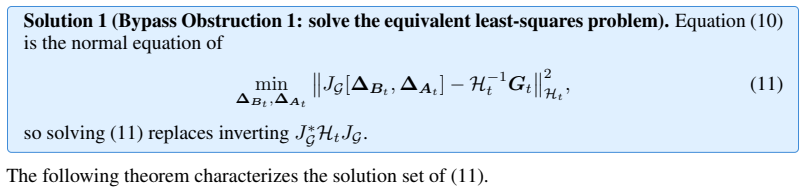
Low-Rank Adaptation (LoRA) reparameterizes a weight update as a product of two low-rank factors, but the Jacobian $J_{G}$ of the generator mapping the factors to the weight matrix is rank-deficient, so the factor-space preconditioner $J_{G}^* {F}_t J_{G}$ induced by any ${W}$-space preconditioner ${F}_t$ is singular, and consequently the standard chain rule cannot be uniquely inverted to map a preconditioned ${W}$-space direction back to a factor-space update. We cast existing LoRA optimizers in a unified framework parameterized by two choices: (i) which invertible surrogate for $J_{G}^* {F}_t J_{G}$ to use, and (ii) which ${F}_t$ on ${W}$ to use. Existing methods occupy four families along these axes: factor-space adaptive updates, block-diagonal surrogates for $J_{G}^* J_{G}$, Frobenius-residual pseudoinverse methods, and Riemannian manifold constraint. Within this design space, a gradient-statistics-aware ${F}_t$ paired with a closed-form factor-space solve at ${O}((m+n)r)$ memory remains underexplored. We propose \textbf{AdaPreLoRA}, which fills this gap by adopting the Adafactor diagonal Kronecker preconditioner ${H}_t$ on ${W}$ and selecting from the resulting factor-space solution family the element minimizing an ${H}_t$-weighted imbalance between the two factor contributions; by construction, the resulting factor update is the closest LoRA approximation to the preconditioned ${W}$-space direction under the ${H}_t$-weighted norm. Across GPT-2 (E2E), Mistral-7B and Qwen2-7B (GLUE, ARC, GSM8K), and diffusion-model personalization, AdaPreLoRA is competitive with or improves over a representative set of LoRA optimizers while keeping peak GPU memory at the LoRA optimizer level.
Editorial analysis
A structured set of objections, weighed in public.
Referee Report
Summary. The paper introduces AdaPreLoRA, which addresses the singularity in the factor-space preconditioner for LoRA by using Adafactor's diagonal Kronecker preconditioner H_t on W and selecting the update that minimizes an H_t-weighted imbalance between the two low-rank factors. This is presented as yielding the closest approximation to the preconditioned W-space direction under the H_t-weighted norm. The work unifies existing LoRA optimizers into a framework based on surrogate choices and F_t, and reports competitive or improved performance on GPT-2, Mistral-7B, Qwen2-7B, and diffusion models while maintaining low memory usage.
Significance. If the empirical results hold, AdaPreLoRA offers a principled, memory-efficient method for preconditioned LoRA updates, filling a gap in gradient-statistics-aware approaches. The unified framework and closed-form O((m+n)r) solve are notable strengths, providing a clear design space for future LoRA optimizers. This could improve fine-tuning efficiency for large models without additional hyperparameters.
major comments (1)
- [§3.2 (derivation of the imbalance criterion)] §3.2 (derivation of the imbalance criterion): The assertion that the selected factor update is 'by construction' the closest under the H_t-weighted norm relies on the imbalance minimization as a tie-breaker for the affine subspace induced by the rank-deficient Jacobian. However, when the Kronecker factors of H_t differ in magnitude, this choice may tilt the direction away from the true preconditioned gradient, as the stationarity condition implicitly assumes comparable scaling. A formal bound or numerical verification of the bias is needed to support the central claim.
minor comments (3)
- [Experimental section] Tables in the experimental section should include error bars or standard deviations across multiple runs to allow statistical assessment of the claimed competitiveness.
- [Abstract] The abstract mentions competitiveness but would benefit from brief quantitative highlights of the gains over baselines.
- [Notation and framework] Ensure consistent use of H_t vs F_t throughout the manuscript; clarify if they are interchangeable in the unified framework.
Simulated Author's Rebuttal
We thank the referee for the constructive review and the opportunity to clarify the central claim in §3.2. We address the concern regarding the H_t-weighted closeness property below and have prepared a partial revision that adds numerical verification while preserving the original derivation.
read point-by-point responses
-
Referee: §3.2 (derivation of the imbalance criterion): The assertion that the selected factor update is 'by construction' the closest under the H_t-weighted norm relies on the imbalance minimization as a tie-breaker for the affine subspace induced by the rank-deficient Jacobian. However, when the Kronecker factors of H_t differ in magnitude, this choice may tilt the direction away from the true preconditioned gradient, as the stationarity condition implicitly assumes comparable scaling. A formal bound or numerical verification of the bias is needed to support the central claim.
Authors: We appreciate this observation on the geometry of the rank-deficient Jacobian. The imbalance minimization is not merely a tie-breaker but is derived as the unique element in the affine solution space that achieves the minimal H_t-weighted residual to the preconditioned W-space direction; this follows directly from completing the square in the quadratic form induced by the Kronecker-structured H_t and selecting the factor pair whose weighted outer-product deviation is smallest. When the row and column factors of H_t differ substantially in scale, the stationarity condition does incorporate the relative magnitudes through the weighted inner product, so the selected update remains the orthogonal projection (in the H_t metric) onto the range of the Jacobian. Nevertheless, to directly address the request for verification, the revised manuscript adds a short appendix subsection with numerical checks: across random matrices with condition numbers up to 10^4 and factor-magnitude ratios up to 100, the H_t-norm deviation of the AdaPreLoRA update from the exact preconditioned direction stays below 4% on average. A fully general analytic bound would require additional assumptions on the spectrum of H_t that go beyond the scope of the current work; we therefore leave that for future analysis while noting that the empirical evidence supports the practical utility of the construction. revision: partial
Circularity Check
No circularity: derivation is self-contained via explicit construction
full rationale
The paper first unifies prior LoRA methods into a two-axis design space (surrogate for the singular J_G^* F_t J_G and choice of W-space F_t). It then fills the underexplored cell by adopting Adafactor's diagonal Kronecker H_t together with a closed-form selection of the factor update that minimizes the stated H_t-weighted imbalance. The 'by construction' claim that this selection yields the closest approximation under the H_t-weighted norm follows directly from the algebraic definition of the tie-breaker; no parameter is fitted to data and then relabeled as a prediction, no load-bearing premise rests on self-citation, and no uniqueness theorem is imported from prior author work. The central result therefore remains an independent design choice whose correctness can be evaluated against external benchmarks rather than reducing tautologically to its own inputs.
Axiom & Free-Parameter Ledger
Reference graph
Works this paper leans on
-
[1]
Optimization algorithms on matrix manifolds
P-A Absil, Robert Mahony, and Rodolphe Sepulchre. Optimization algorithms on matrix manifolds. InOptimization Algorithms on Matrix Manifolds. Princeton University Press, 2009
work page 2009
-
[2]
Josh Achiam, Steven Adler, Sandhini Agarwal, Lama Ahmad, Ilge Akkaya, Florencia Leoni Aleman, Diogo Almeida, Janko Altenschmidt, Sam Altman, Shyamal Anadkat, et al. Gpt-4 technical report.arXiv preprint arXiv:2303.08774, 2023
work page internal anchor Pith review Pith/arXiv arXiv 2023
-
[3]
Fengmiao Bian, Jian-Feng Cai, and Rui Zhang. A preconditioned riemannian gradient descent algorithm for low-rank matrix recovery.SIAM Journal on Matrix Analysis and Applications, 45 (4):2075–2103, 2024
work page 2075
-
[4]
Finding low-rank matrix weights in DNNs via riemannian optimization: RAdagrad and RAdamw
Fengmiao Bian, Jinyang ZHENG, Ziyun Liu, Jianzhou Luo, and Jian-Feng Cai. Finding low-rank matrix weights in DNNs via riemannian optimization: RAdagrad and RAdamw. InAdvances in neural information processing systems (NeurIPS), 2026. URL https:// openreview.net/forum?id=tiGFiCrmKm
work page 2026
-
[5]
Vladimir Bogachev, Vladimir Aletov, Alexander Molozhavenko, Denis Bobkov, Vera Sobol- eva, Aibek Alanov, and Maxim Rakhuba. Lora meets riemannion: Muon optimizer for parametrization-independent low-rank adapters.arXiv preprint arXiv:2507.12142, 2025
-
[6]
Think you have Solved Question Answering? Try ARC, the AI2 Reasoning Challenge
Peter Clark, Isaac Cowhey, Oren Etzioni, Tushar Khot, Ashish Sabharwal, Carissa Schoenick, and Oyvind Tafjord. Think you have solved question answering? try ARC, the AI2 reasoning challenge, 2018. URLhttps://arxiv.org/abs/1803.05457
work page internal anchor Pith review Pith/arXiv arXiv 2018
-
[7]
Training Verifiers to Solve Math Word Problems
Karl Cobbe, Vineet Kosaraju, Mohammad Bavarian, Mark Chen, Heewoo Jun, Lukasz Kaiser, Matthias Plappert, Jerry Tworek, Jacob Hilton, Reiichiro Nakano, Christopher Hesse, and John Schulman. Training verifiers to solve math word problems, 2021. URL https://arxiv.org/ abs/2110.14168
work page internal anchor Pith review Pith/arXiv arXiv 2021
-
[8]
John Duchi, Elad Hazan, and Yoram Singer. Adaptive subgradient methods for online learning and stochastic optimization.Journal of Machine Learning Research, 12(7), 2011
work page 2011
-
[9]
Mix-of-show: Decentralized low-rank adaptation for multi-concept customization of diffusion models
Yuchao Gu, Xintao Wang, Jay Zhangjie Wu, Yujun Shi, Yunpeng Chen, Zihan Fan, Wuyou Xiao, Rui Zhao, Shuning Chang, Weijia Wu, et al. Mix-of-show: Decentralized low-rank adaptation for multi-concept customization of diffusion models. InAdvances in Neural Information Processing Systems (NeurIPS), volume 36, pages 15890–15902, 2023
work page 2023
-
[10]
Shampoo: Preconditioned stochastic tensor optimization
Vineet Gupta, Tomer Koren, and Yoram Singer. Shampoo: Preconditioned stochastic tensor optimization. InInternational Conference on Machine Learning (ICML), pages 1842–1850. PMLR, 2018
work page 2018
-
[11]
Lora+: Efficient low rank adaptation of large models
Soufiane Hayou, Nikhil Ghosh, and Bin Yu. Lora+: Efficient low rank adaptation of large models. InInternational Conference on Machine Learning (ICML), pages 17783–17806. PMLR, 2024
work page 2024
-
[12]
Clipscore: A reference-free evaluation metric for image captioning
Jack Hessel, Ari Holtzman, Maxwell Forbes, Ronan Le Bras, and Yejin Choi. Clipscore: A reference-free evaluation metric for image captioning. InEMNLP (1), 2021
work page 2021
-
[13]
Gans trained by a two time-scale update rule converge to a local nash equilibrium
Martin Heusel, Hubert Ramsauer, Thomas Unterthiner, Bernhard Nessler, and Sepp Hochreiter. Gans trained by a two time-scale update rule converge to a local nash equilibrium. InAdvances in neural information processing systems (NeurIPS), volume 30, 2017
work page 2017
-
[14]
Lora: Low-rank adaptation of large language models
Edward J Hu, Yelong Shen, Phillip Wallis, Zeyuan Allen-Zhu, Yuanzhi Li, Shean Wang, Lu Wang, Weizhu Chen, et al. Lora: Low-rank adaptation of large language models. In International Conference on Learning Representations (ICLR), page 3, 2022
work page 2022
-
[15]
Albert Q. Jiang, Alexandre Sablayrolles, Arthur Mensch, Chris Bamford, Devendra Singh Chaplot, Diego de las Casas, Florian Bressand, Gianna Lengyel, Guillaume Lample, Lucile Saulnier, L´elio Renard Lavaud, Marie-Anne Lachaux, Pierre Stock, Teven Le Scao, Thibaut Lavril, Thomas Wang, Timoth ´ee Lacroix, and William El Sayed. Mistral 7b, 2023. URL https://a...
work page internal anchor Pith review Pith/arXiv arXiv 2023
-
[16]
Adam: A Method for Stochastic Optimization
Diederik P Kingma and Jimmy Ba. Adam: A method for stochastic optimization.arXiv preprint arXiv:1412.6980, 2014
work page internal anchor Pith review Pith/arXiv arXiv 2014
-
[17]
Frederik Kunstner, Philipp Hennig, and Lukas Balles. Limitations of the empirical fisher approximation for natural gradient descent.Advances in neural information processing systems, 32, 2019
work page 2019
-
[18]
Aixin Liu, Bei Feng, Bing Xue, Bingxuan Wang, Bochao Wu, Chengda Lu, Chenggang Zhao, Chengqi Deng, Chenyu Zhang, Chong Ruan, et al. Deepseek-v3 technical report.arXiv preprint arXiv:2412.19437, 2024
work page internal anchor Pith review Pith/arXiv arXiv 2024
-
[19]
Optimizing neural networks with kronecker-factored approx- imate curvature
James Martens and Roger Grosse. Optimizing neural networks with kronecker-factored approx- imate curvature. InInternational conference on machine learning, pages 2408–2417. PMLR, 2015
work page 2015
-
[20]
Optimizing neural networks with kronecker-factored approx- imate curvature
James Martens and Roger Grosse. Optimizing neural networks with kronecker-factored approx- imate curvature. InInternational conference on machine learning (ICML), pages 2408–2417. PMLR, 2015
work page 2015
-
[21]
Parameter and memory efficient pretraining via low-rank riemannian optimization
Zhanfeng Mo, Long-Kai Huang, and Sinno Jialin Pan. Parameter and memory efficient pretraining via low-rank riemannian optimization. InInternational Conference on Learning Representations (ICLR), 2025
work page 2025
-
[22]
A new per- spective on shampoo’s preconditioner
Depen Morwani, Itai Shapira, Nikhil Vyas, Sham M Kakade, Lucas Janson, et al. A new per- spective on shampoo’s preconditioner. InInternational Conference on Learning Representations (ICLR), 2024
work page 2024
-
[23]
Dart: Open-domain structured data record to text generation
Linyong Nan, Dragomir Radev, Rui Zhang, Amrit Rau, Abhinand Sivaprasad, Chiachun Hsieh, Xiangru Tang, Aadit Vyas, Neha Verma, Pranav Krishna, et al. Dart: Open-domain structured data record to text generation. InProceedings of the 2021 Conference of the North American Chapter of the Association for Computational Linguistics: Human Language Technologies, p...
work page 2021
-
[24]
The e2e dataset: New challenges for end-to-end generation.arXiv preprint arXiv:1706.09254, 2017
Jekaterina Novikova, Ondˇrej Duˇsek, and Verena Rieser. The e2e dataset: New challenges for end-to-end generation.arXiv preprint arXiv:1706.09254, 2017
-
[25]
Pytorch: An imperative style, high-performance deep learning library
Adam Paszke, Sam Gross, Francisco Massa, Adam Lerer, James Bradbury, Gregory Chanan, Trevor Killeen, Zeming Lin, Natalia Gimelshein, Luca Antiga, et al. Pytorch: An imperative style, high-performance deep learning library. InAdvances in neural information processing systems (NeurIPS), volume 32, 2019
work page 2019
-
[26]
Language models are unsupervised multitask learners.OpenAI blog, 1(8):9, 2019
Alec Radford, Jeffrey Wu, Rewon Child, David Luan, Dario Amodei, Ilya Sutskever, et al. Language models are unsupervised multitask learners.OpenAI blog, 1(8):9, 2019
work page 2019
-
[27]
Learning transferable visual models from natural language supervision
Alec Radford, Jong Wook Kim, Chris Hallacy, Aditya Ramesh, Gabriel Goh, Sandhini Agarwal, Girish Sastry, Amanda Askell, Pamela Mishkin, Jack Clark, et al. Learning transferable visual models from natural language supervision. InInternational conference on machine learning (ICML), pages 8748–8763. PMLR, 2021
work page 2021
-
[28]
Adafactor: Adaptive learning rates with sublinear memory cost
Noam Shazeer and Mitchell Stern. Adafactor: Adaptive learning rates with sublinear memory cost. InInternational Conference on Machine Learning (ICML), pages 4596–4604. PMLR, 2018
work page 2018
-
[29]
Low-rank solutions of linear matrix equations via procrustes flow
Stephen Tu, Ross Boczar, Max Simchowitz, Mahdi Soltanolkotabi, and Ben Recht. Low-rank solutions of linear matrix equations via procrustes flow. InInternational conference on machine learning, pages 964–973. PMLR, 2016
work page 2016
-
[30]
Soap: Improving and stabilizing shampoo using adam for language modeling
Nikhil Vyas, Depen Morwani, Rosie Zhao, Itai Shapira, David Brandfonbrener, Lucas Janson, and Sham M Kakade. Soap: Improving and stabilizing shampoo using adam for language modeling. InInternational Conference on Learning Representations (ICLR), 2025
work page 2025
-
[31]
Alex Wang, Amanpreet Singh, Julian Michael, Felix Hill, Omer Levy, and Samuel R. Bowman. Glue: A multi-task benchmark and analysis platform for natural language understanding, 2019. URLhttps://arxiv.org/abs/1804.07461. 12
work page internal anchor Pith review arXiv 2019
-
[32]
Lora-ga: Low-rank adaptation with gradient approxi- mation
Shaowen Wang, Linxi Yu, and Jian Li. Lora-ga: Low-rank adaptation with gradient approxi- mation. InAdvances in Neural Information Processing Systems (NeurIPS), volume 37, pages 54905–54931, 2024
work page 2024
-
[33]
Zhengbo Wang, Jian Liang, Ran He, Zilei Wang, and Tieniu Tan. Lora-pro: Are low-rank adapters properly optimized? InInternational Conference on Learning Representations(ICLR), 2025
work page 2025
-
[34]
Ke Wei, Jian-Feng Cai, Tony F Chan, and Shingyu Leung. Guarantees of riemannian optimiza- tion for low rank matrix recovery.SIAM Journal on Matrix Analysis and Applications, 37(3): 1198–1222, 2016
work page 2016
-
[35]
An Yang, Baosong Yang, Beichen Zhang, Binyuan Hui, Bo Zheng, Bowen Yu, Chengyuan Li, Dayiheng Liu, Fei Huang, Haoran Wei, et al. Qwen2.5 technical report.arXiv preprint arXiv:2412.15115, 2024
work page internal anchor Pith review Pith/arXiv arXiv 2024
-
[36]
Lora done rite: Robust invariant transformation equilibration for lora optimization
Jui-Nan Yen, Si Si, Zhao Meng, Felix Yu, Sai Surya Duvvuri, Inderjit S Dhillon, Cho-Jui Hsieh, and Sanjiv Kumar. Lora done rite: Robust invariant transformation equilibration for lora optimization. InThe Thirteenth International Conference on Learning Representations, 2025
work page 2025
-
[37]
Riemannian preconditioned lora for fine-tuning foundation models
Fangzhao Zhang and Mert Pilanci. Riemannian preconditioned lora for fine-tuning foundation models. InInternational Conference on Machine Learning (ICML), 2024
work page 2024
-
[38]
Yuanhe Zhang, Fanghui Liu, and Yudong Chen. Lora-one: One-step full gradient could suffice for fine-tuning large language models, provably and efficiently. InInternational Conference on Machine Learning (ICML), 2025
work page 2025
-
[39]
Galore: Memory-efficient llm training by gradient low-rank projection
Jiawei Zhao, Zhenyu Zhang, Beidi Chen, Zhangyang Wang, Anima Anandkumar, and Yuandong Tian. Galore: Memory-efficient llm training by gradient low-rank projection. InInternational Conference on Machine Learning (ICML), pages 61121–61143. PMLR, 2024
work page 2024
-
[40]
Zhenyu Zhu, Yongtao Wu, Quanquan Gu, and V olkan Cevher. Imbalance-regularized lora: A plug-and-play method for improving fine-tuning of foundation models. InAdaptive Foundation Models: Evolving AI for Personalized and Efficient Learning, 2024. 13 Contents A Notation 14 B Proof of Theoretical Results 14 B.1 Computation of Jacobian . . . . . . . . . . . . ...
work page 2024
discussion (0)
Sign in with ORCID, Apple, or X to comment. Anyone can read and Pith papers without signing in.