Recognition: 2 theorem links
· Lean TheoremThe MaNGA Low-mass disks HUnt for CO (MaLHUCO) Survey
Pith reviewed 2026-05-12 02:23 UTC · model grok-4.3
The pith
The Kennicutt-Schmidt law between molecular gas mass and star formation rate remains linear down to low stellar masses.
A machine-rendered reading of the paper's core claim, the machinery that carries it, and where it could break.
Core claim
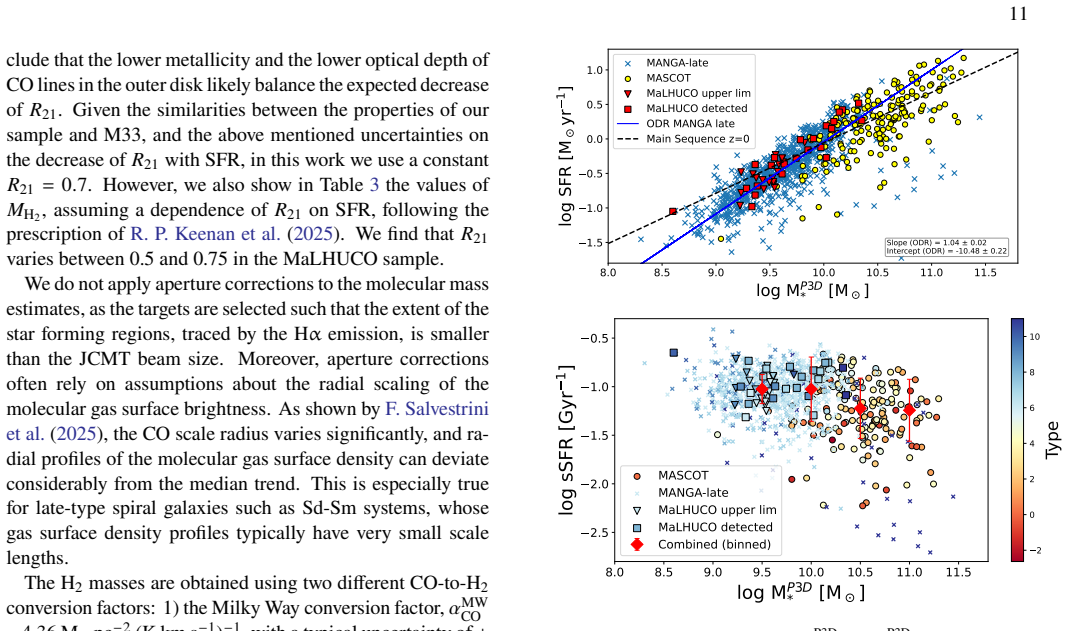
The molecular gas mass - star formation rate relation remains linear down to low stellar masses. Mean molecular gas depletion time is slightly shorter in low-mass late-type galaxies than in more massive systems. The 12 μm luminosity exhibits a tight linear correlation with CO line emission and therefore provides a robust tracer of global molecular gas content. The HI-to-stellar mass ratio decreases with stellar mass while the molecular fraction increases, marking the shift toward molecular-dominated interstellar medium.
What carries the argument
The Kennicutt-Schmidt law tested on H2 masses derived from CO(2-1) detections using both constant Galactic and metallicity-dependent CO-to-H2 conversion factors in a sample of 42 low-mass Scd or later disk galaxies.
If this is right
- The basic efficiency with which molecular gas turns into stars does not change across a wide range of galaxy stellar masses.
- Low-mass disks convert their molecular reservoirs into stars on shorter average timescales than massive disks.
- The interstellar medium shifts from atomic-dominated to molecular-dominated as stellar mass grows along the galaxy sequence.
- 12 μm luminosity can serve as a practical proxy for total molecular gas mass in low-mass star-forming disks.
Where Pith is reading between the lines
- If the linear relation holds, galaxy evolution models can apply the same molecular-gas-based star formation prescription to both low-mass and high-mass systems without mass-dependent adjustments.
- The assumption that metallicity-dependent conversion factors suffice could be tested by comparing CO-based masses against dust-based or gamma-ray-based H2 estimates in the same low-mass objects.
- Extending similar CO mapping to still lower stellar masses or to galaxies with lower metallicities would show whether the relation eventually breaks.
Load-bearing premise
The CO-to-H2 conversion factor, whether held constant or made metallicity-dependent, accurately recovers the true molecular gas mass and the 42-galaxy sample represents the broader low-mass late-type disk population.
What would settle it
A statistically significant departure from linearity in the molecular gas mass versus star formation rate relation when measured in an independent, larger sample of low-mass galaxies, or direct H2 masses from dust emission or other tracers that systematically disagree with the CO-derived values.
Figures




read the original abstract
We present James Clerk Maxwell Telescope (JCMT) observations of the $^{12}$CO(J = 2-1) emission of 42 low-mass, star-forming disk galaxies of morphological type Scd or later from the Mapping Nearby Galaxies at Apache Point Observatory (MaNGA) survey. The sample, which probes the M33-like stellar-mass regime, is complemented with metallicities, star formation rates, and \hi\ masses used to investigate the star formation process and to test scaling relations involving molecular gas mass in low-mass systems. We detect CO emission in 55% of the sample and derive H$_2$ masses using both a constant Galactic and a metallicity-dependent CO-to-H$_2$ conversion factor. The 12 $\mu$m luminosity, which includes polycyclic aromatic hydrocarbon features, exhibits a tight linear correlation with the CO line emission, making it a robust tracer of global molecular gas content. The molecular gas mass - star formation rate relation, i.e. the Kennicutt-Schmidt law, is the most fundamental one and it is found to remain linear down to low stellar masses. We also find that the mean molecular gas depletion time is slightly shorter in low-mass late-type galaxies than in more massive systems, consistent with their higher specific star formation rates. Finally, while the specific molecular gas mass ($M_{\rm H_2}/M_*$) shows no significant dependence on stellar mass and a large intrinsic scatter, the HI-to-stellar mass ratio ($M_{\rm HI}/M_*$) decreases with increasing stellar mass and molecular fraction ($M_{\rm H_2}/M_{\rm gas}$), highlighting the progressive transition from atomic- to molecular-dominated interstellar medium along the galaxy population.
Editorial analysis
A structured set of objections, weighed in public.
Referee Report
Summary. The manuscript reports JCMT CO(2-1) observations of 42 low-mass (M33-like), late-type (Scd or later) MaNGA disk galaxies. CO is detected in 55% of the sample. Molecular gas masses are derived using both a constant Galactic X_CO and a metallicity-dependent conversion factor. The authors find that the global Kennicutt-Schmidt relation (M_H2 versus SFR) remains linear at low stellar masses, that 12 μm luminosity correlates tightly with CO emission, that molecular depletion times are slightly shorter than in higher-mass systems, and that M_H2/M_* shows no strong stellar-mass trend while M_HI/M_* decreases with mass.
Significance. If the derived M_H2 values are unbiased, the work supplies rare CO data in the low-mass regime and supports a mass-independent star-formation efficiency down to M_* ~ 10^9 M_⊙. The MaNGA ancillary metallicities and SFRs allow direct testing of scaling relations that are otherwise poorly constrained below the typical CO survey limits. The 12 μm–CO correlation offers a potentially useful ancillary tracer.
major comments (2)
- [Abstract and H2 mass derivation section] Abstract and the section deriving H2 masses: the central claim that the Kennicutt-Schmidt relation remains linear rests on M_H2 values obtained with both a constant Galactic X_CO and a metallicity-dependent prescription. No quantitative test is shown of how the choice of conversion factor (or its extrapolation to the lowest metallicities in the sample) alters the fitted slope or the treatment of the 45% upper limits. A systematic mass-dependent bias in the adopted X_CO would move the observed relation toward unity even if the true relation is not linear.
- [Depletion time results paragraph] The paragraph reporting the mean molecular depletion time: the statement that depletion times are slightly shorter in low-mass late-type galaxies than in more massive systems is derived directly from the same M_H2 values. Without an independent cross-check (dust continuum, [C I], or virial masses) in the M33-like metallicity range, the result inherits the same conversion-factor uncertainty that affects the linearity claim.
minor comments (2)
- [Sample selection paragraph] The sample selection from the parent MaNGA catalog (exact stellar-mass and morphological cuts, completeness corrections) should be stated more explicitly so that readers can assess representativeness of the 42-galaxy subset.
- [Figure captions] Figure captions and text should consistently label which panels or points use the constant versus metallicity-dependent X_CO so that the two cases can be compared directly.
Simulated Author's Rebuttal
We thank the referee for their careful and constructive review of our manuscript. The comments raise important points about the robustness of our conclusions to the choice of CO-to-H2 conversion factor. We address each major comment below and outline the revisions we will make.
read point-by-point responses
-
Referee: [Abstract and H2 mass derivation section] Abstract and the section deriving H2 masses: the central claim that the Kennicutt-Schmidt relation remains linear rests on M_H2 values obtained with both a constant Galactic X_CO and a metallicity-dependent prescription. No quantitative test is shown of how the choice of conversion factor (or its extrapolation to the lowest metallicities in the sample) alters the fitted slope or the treatment of the 45% upper limits. A systematic mass-dependent bias in the adopted X_CO would move the observed relation toward unity even if the true relation is not linear.
Authors: We agree that a quantitative assessment of the impact of X_CO choice on the fitted slope and upper-limit treatment is needed. In the revised manuscript we will add a new subsection and accompanying figure that directly compares the Kennicutt-Schmidt relation obtained with the constant Galactic X_CO versus the metallicity-dependent prescription. This will include linear fits performed with and without the 45% upper limits (using appropriate censored-data methods) and will quantify the change in slope and scatter. We will also discuss the range of metallicities in the sample and the extrapolation of the metallicity-dependent factor, showing that any residual mass-dependent bias is unlikely to be large enough to force linearity given the observed consistency with the independent 12 μm tracer. revision: yes
-
Referee: [Depletion time results paragraph] The paragraph reporting the mean molecular depletion time: the statement that depletion times are slightly shorter in low-mass late-type galaxies than in more massive systems is derived directly from the same M_H2 values. Without an independent cross-check (dust continuum, [C I], or virial masses) in the M33-like metallicity range, the result inherits the same conversion-factor uncertainty that affects the linearity claim.
Authors: We acknowledge that the reported depletion times rely on the same M_H2 estimates and therefore carry the same X_CO uncertainties. Independent cross-checks (dust continuum, [C I], or virial masses) are not available for this specific low-mass sample. In the revision we will expand the relevant paragraph and discussion section to explicitly state this limitation, compare our depletion times to literature values obtained with alternative methods where possible, and note that the shorter times remain consistent with the higher specific star-formation rates measured for these galaxies. We will also add a brief sensitivity test showing how the mean depletion time changes when the two X_CO prescriptions are used. revision: partial
- Independent cross-checks of M_H2 (via dust continuum, [C I], or virial masses) do not exist for this sample in the M33-like metallicity regime, preventing a direct empirical validation of the adopted conversion factors.
Circularity Check
No circularity: purely observational survey reporting empirical correlations from new data.
full rationale
The paper reports JCMT CO(2-1) observations of 42 MaNGA low-mass disks, derives M_H2 via standard (constant or metallicity-dependent) X_CO prescriptions, and presents direct empirical relations including the linearity of the global M_H2-SFR (Kennicutt-Schmidt) relation down to low stellar mass. No first-principles derivations, fitted parameters renamed as predictions, self-citations used as load-bearing uniqueness theorems, or ansatzes smuggled via prior work appear in the chain. All scaling relations are measured outcomes, not tautological reductions of the inputs. The 55% detection rate and handling of upper limits are standard observational choices, not circular by construction.
Axiom & Free-Parameter Ledger
free parameters (1)
- CO-to-H2 conversion factor
axioms (2)
- domain assumption Standard assumptions for converting observed CO(2-1) integrated intensity to molecular hydrogen column density
- domain assumption MaNGA-derived metallicities, SFRs, and HI masses are accurate and directly comparable to the new CO measurements
Lean theorems connected to this paper
-
IndisputableMonolith/Cost/FunctionalEquation.leanwashburn_uniqueness_aczel unclear?
unclearRelation between the paper passage and the cited Recognition theorem.
The molecular gas mass - star formation rate relation, i.e. the Kennicutt-Schmidt law, is the most fundamental one and it is found to remain linear down to low stellar masses.
-
IndisputableMonolith/Foundation/AlphaCoordinateFixation.leanJ_uniquely_calibrated_via_higher_derivative unclear?
unclearRelation between the paper passage and the cited Recognition theorem.
We detect CO emission in 55% of the sample and derive H2 masses using both a constant Galactic and a metallicity-dependent CO-to-H2 conversion factor.
What do these tags mean?
- matches
- The paper's claim is directly supported by a theorem in the formal canon.
- supports
- The theorem supports part of the paper's argument, but the paper may add assumptions or extra steps.
- extends
- The paper goes beyond the formal theorem; the theorem is a base layer rather than the whole result.
- uses
- The paper appears to rely on the theorem as machinery.
- contradicts
- The paper's claim conflicts with a theorem or certificate in the canon.
- unclear
- Pith found a possible connection, but the passage is too broad, indirect, or ambiguous to say the theorem truly supports the claim.
Reference graph
Works this paper leans on
-
[1]
Abdurro’uf, Accetta, K., Aerts, C., et al. 2022, ApJS, 259, 35, doi: 10.3847/1538-4365/ac4414
-
[2]
Accurso, G., Saintonge, A., Catinella, B., et al. 2017, MNRAS, 470, 4750, doi: 10.1093/mnras/stx1556
-
[3]
Arora, N., Stone, C., Courteau, S., & Jarrett, T. H. 2021, MNRAS, 505, 3135, doi: 10.1093/mnras/stab1430
-
[4]
1994, in Mass-Transfer Induced Activity in Galaxies, ed
Athanassoula, E. 1994, in Mass-Transfer Induced Activity in Galaxies, ed. I. Shlosman, 143
work page 1994
-
[5]
Athanassoula, E., Machado, R. E. G., & Rodionov, S. A. 2013, MNRAS, 429, 1949, doi: 10.1093/mnras/sts452
-
[6]
M., Maiolino, R., Belfiore, F., et al
Baker, W. M., Maiolino, R., Belfiore, F., et al. 2023, MNRAS, 518, 4767, doi: 10.1093/mnras/stac3413
-
[7]
K., Glazebrook K., Brinkmann J., Ivezi \'c Z ., Lupton R
Baldry, I. K., Glazebrook, K., Brinkmann, J., et al. 2004, ApJ, 600, 681, doi: 10.1086/380092
-
[8]
Baldwin, J. A., Phillips, M. M., & Terlevich, R. 1981, PASP, 93, 5, doi: 10.1086/130766
-
[9]
Barnes, J. E., & Hernquist, L. E. 1991, ApJL, 370, L65, doi: 10.1086/185978
-
[10]
Barrera-Ballesteros, J. K., Utomo, D., Bolatto, A. D., et al. 2020, MNRAS, 492, 2651, doi: 10.1093/mnras/stz3553
-
[11]
2018, MNRAS, 477, 3014, doi: 10.1093/mnras/sty768
Belfiore, F., Maiolino, R., Bundy, K., et al. 2018, MNRAS, 477, 3014, doi: 10.1093/mnras/sty768
-
[12]
2010, AJ, 140, 1194, doi: 10.1088/0004-6256/136/6/2846
Bigiel, F., Leroy, A., Walter, F., et al. 2008, AJ, 136, 2846, doi: 10.1088/0004-6256/136/6/2846
-
[13]
Bigiel, F., Leroy, A. K., Walter, F., et al. 2011, ApJL, 730, L13, doi: 10.1088/2041-8205/730/2/L13
-
[14]
2006, ApJ, 650, 933, doi: 10.1086/505417
Blitz, L., & Rosolowsky, E. 2006, ApJ, 650, 933, doi: 10.1086/505417
-
[15]
and Wolfire, Mark and Leroy, Adam K
Bolatto, A. D., Wolfire, M., & Leroy, A. K. 2013, ARA&A, 51, 207, doi: 10.1146/annurev-astro-082812-140944
work page internal anchor Pith review doi:10.1146/annurev-astro-082812-140944 2013
-
[16]
2014, A&A, 564, A66, doi: 10.1051/0004-6361/201322312
Boselli, A., Cortese, L., Boquien, M., et al. 2014, A&A, 564, A66, doi: 10.1051/0004-6361/201322312
-
[17]
2002, Ap&SS, 281, 127, doi: 10.1023/A:1019599512232
Boselli, A., Lequeux, J., & Gavazzi, G. 2002, Ap&SS, 281, 127, doi: 10.1023/A:1019599512232
-
[18]
Brinchmann, J., Charlot, S., White, S. D. M., et al. 2004, MNRAS, 351, 1151, doi: 10.1111/j.1365-2966.2004.07881.x
-
[19]
Overview of the SDSS-IV MaNGA Survey: Mapping Nearby Galaxies at Apache Point Observatory
Bundy, K., Bershady, M. A., Law, D. R., et al. 2015, ApJ, 798, 7, doi: 10.1088/0004-637X/798/1/7
-
[20]
R., Avila-Reese, V., Rodr´ıguez-Puebla, A., Hern´andez-Toledo, H., & Papastergis, E
Calette, A. R., Avila-Reese, V., Rodr´ıguez-Puebla, A., Hern´andez-Toledo, H., & Papastergis, E. 2018, RMxAA, 54, 443, doi: 10.48550/arXiv.1803.07692 Cano-D´ıaz, M., S´anchez, S. F., Zibetti, S., et al. 2016, ApJL, 821, L26, doi: 10.3847/2041-8205/821/2/L26
-
[21]
2020, A&A, 633, A100, doi: 10.1051/0004-6361/201936665
Casasola, V., Bianchi, S., De Vis, P., et al. 2020, A&A, 633, A100, doi: 10.1051/0004-6361/201936665
-
[22]
2018, MNRAS, 476, 875, doi: 10.1093/mnras/sty089
Catinella, B., Saintonge, A., Janowiecki, S., et al. 2018, MNRAS, 476, 875, doi: 10.1093/mnras/sty089
-
[23]
2023, ApJL, 944, L11, doi: 10.3847/2041-8213/acadd7
Chastenet, J., Sutter, J., Sandstrom, K., et al. 2023, ApJL, 944, L11, doi: 10.3847/2041-8213/acadd7
-
[24]
2019, MNRAS, 484, 5192, doi: 10.1093/mnras/stz349
Chown, R., Li, C., Athanassoula, E., et al. 2019, MNRAS, 484, 5192, doi: 10.1093/mnras/stz349
-
[25]
2017, A&A, 604, A53, doi: 10.1051/0004-6361/201730605
Cicone, C., Bothwell, M., Wagg, J., et al. 2017, A&A, 604, A53, doi: 10.1051/0004-6361/201730605
-
[26]
Cluver, M. E., Jarrett, T. H., Dale, D. A., et al. 2017, ApJ, 850, 68, doi: 10.3847/1538-4357/aa92c7
-
[27]
Cluver, M. E., Jarrett, T. H., Hopkins, A. M., et al. 2014, ApJ, 782, 90, doi: 10.1088/0004-637X/782/2/90
-
[28]
2019, MNRAS, 486, L91, doi: 10.1093/mnrasl/slz065
Concas, A., & Popesso, P. 2019, MNRAS, 486, L91, doi: 10.1093/mnrasl/slz065
-
[29]
2025, A&A, 700, A57, doi: 10.1051/0004-6361/202555408
Corbelli, E., Elmegreen, B., Ellison, S., & Bianchi, S. 2025, A&A, 700, A57, doi: 10.1051/0004-6361/202555408
-
[30]
2014, A&A, 572, A23, doi: 10.1051/0004-6361/201424033
Corbelli, E., Thilker, D., Zibetti, S., Giovanardi, C., & Salucci, P. 2014, A&A, 572, A23, doi: 10.1051/0004-6361/201424033
-
[31]
2012, A&A, 542, A32, doi: 10.1051/0004-6361/201117329
Corbelli, E., Bianchi, S., Cortese, L., et al. 2012, A&A, 542, A32, doi: 10.1051/0004-6361/201117329
-
[32]
2012, A&A, 540, A52, doi: 10.1051/0004-6361/201118499
Cortese, L., Ciesla, L., Boselli, A., et al. 2012, A&A, 540, A52, doi: 10.1051/0004-6361/201118499
-
[33]
2019, MNRAS, 482, 1618, doi: 10.1093/mnras/sty2777
Cortzen, I., Garrett, J., Magdis, G., et al. 2019, MNRAS, 482, 1618, doi: 10.1093/mnras/sty2777
-
[34]
Cutri, R. M., Wright, E. L., Conrow, T., et al. 2013, Explanatory Supplement to the AllWISE Data Release Products,, Explanatory Supplement to the AllWISE Data Release Products, by R. M. Cutri et al
work page 2013
-
[35]
Dame, T. M., Hartmann, D., & Thaddeus, P. 2001, ApJ, 547, 792, doi: 10.1086/318388 21
-
[36]
I., Nersesian, A., Baes, M., et al
Davies, J. I., Nersesian, A., Baes, M., et al. 2019, A&A, 626, A63, doi: 10.1051/0004-6361/201935547
-
[37]
2016, ApJ, 833, 70, doi: 10.3847/1538-4357/833/1/70
Decarli, R., Walter, F., Aravena, M., et al. 2016, ApJ, 833, 70, doi: 10.3847/1538-4357/833/1/70
-
[38]
2020, ApJ, 902, 110, doi: 10.3847/1538-4357/abaa3b den Brok, J., Oakes, E
Decarli, R., Aravena, M., Boogaard, L., et al. 2020, ApJ, 902, 110, doi: 10.3847/1538-4357/abaa3b den Brok, J., Oakes, E. K., Leroy, A. K., et al. 2025, ApJ, 988, 162, doi: 10.3847/1538-4357/addf4c
-
[39]
2021, ApJ, 907, 114, doi: 10.3847/1538-4357/abd17c
Dou, J., Peng, Y., Renzini, A., et al. 2021, ApJ, 907, 114, doi: 10.3847/1538-4357/abd17c
-
[40]
Druard, C., Braine, J., Schuster, K. F., et al. 2014, A&A, 567, A118, doi: 10.1051/0004-6361/201423682
-
[41]
Ellison, S. L., Pan, H.-A., Bluck, A. F. L., et al. 2024, MNRAS, 527, 10201, doi: 10.1093/mnras/stad3778
-
[42]
Elmegreen, B. G. 1993, ApJ, 411, 170, doi: 10.1086/172816
-
[43]
Elmegreen, B. G., Hunter, D. A., & Corbelli, E. 2026, ApJ, 997, 235, doi: 10.3847/1538-4357/ae2c52
-
[44]
Fu, J., Kauffmann, G., Li, C., & Guo, Q. 2012, MNRAS, 424, 2701, doi: 10.1111/j.1365-2966.2012.21356.x
-
[45]
Galliano, F., Galametz, M., & Jones, A. P. 2018, ARA&A, 56, 673, doi: 10.1146/annurev-astro-081817-051900
-
[46]
2021, A&A, 649, A18, doi: 10.1051/0004-6361/202039701
Galliano, F., Nersesian, A., Bianchi, S., et al. 2021, A&A, 649, A18, doi: 10.1051/0004-6361/202039701
-
[47]
2022, ApJ, 940, 133, doi: 10.3847/1538-4357/ac9af1
Gao, Y., Tan, Q.-H., Gao, Y., et al. 2022, ApJ, 940, 133, doi: 10.3847/1538-4357/ac9af1
-
[48]
2019, ApJ, 887, 172, doi: 10.3847/1538-4357/ab557c
Gao, Y., Xiao, T., Li, C., et al. 2019, ApJ, 887, 172, doi: 10.3847/1538-4357/ab557c
-
[49]
Goddy, J., Stark, D. V., & Masters, K. L. 2020, Research Notes of the American Astronomical Society, 4, 3, doi: 10.3847/2515-5172/ab66bd
-
[50]
Grossi, M., Corbelli, E., Bizzocchi, L., et al. 2016, A&A, 590, A27, doi: 10.1051/0004-6361/201628123
-
[51]
Gunn, J. E., Siegmund, W. A., Mannery, E. J., et al. 2006, AJ, 131, 2332, doi: 10.1086/500975
-
[52]
Guo, K., Zheng, X. Z., Wang, T., & Fu, H. 2015, ApJL, 808, L49, doi: 10.1088/2041-8205/808/2/L49
-
[53]
2024, A&A, 687, A244, doi: 10.1051/0004-6361/202449773
Hagedorn, B., Cicone, C., Sarzi, M., et al. 2024, A&A, 687, A244, doi: 10.1051/0004-6361/202449773
-
[54]
Haynes, M. P., Giovanelli, R., Kent, B. R., et al. 2018, ApJ, 861, 49, doi: 10.3847/1538-4357/aac956
-
[55]
Hollenbach, D., & Salpeter, E. E. 1971, ApJ, 163, 155, doi: 10.1086/150754
-
[56]
2014, MNRAS, 443, 1329, doi: 10.1093/mnras/stu1232
Huang, M.-L., & Kauffmann, G. 2014, MNRAS, 443, 1329, doi: 10.1093/mnras/stu1232
-
[57]
P., Giovanelli, R., & Brinchmann, J
Huang, S., Haynes, M. P., Giovanelli, R., & Brinchmann, J. 2012, ApJ, 756, 113, doi: 10.1088/0004-637X/756/2/113
-
[58]
K., Tortora, C., Ginolfi, M., & Schneider, R
Hunt, L. K., Tortora, C., Ginolfi, M., & Schneider, R. 2020, A&A, 643, A180, doi: 10.1051/0004-6361/202039021
-
[59]
K., Garc´ıa-Burillo, S., Casasola, V., et al
Hunt, L. K., Garc´ıa-Burillo, S., Casasola, V., et al. 2015, A&A, 583, A114, doi: 10.1051/0004-6361/201526553
-
[60]
Israel, F. P. 1997, A&A, 328, 471, doi: 10.48550/arXiv.astro-ph/9709194
-
[61]
Jackson, D. C., Cannon, J. M., Skillman, E. D., et al. 2006, ApJ, 646, 192, doi: 10.1086/504707
-
[62]
Jarrett, T. H., Cluver, M. E., Taylor, E. N., et al. 2023, ApJ, 946, 95, doi: 10.3847/1538-4357/acb68f
-
[63]
2015, Astronomy and Computing, 9, 40, doi: 10.1016/j.ascom.2014.10.005
Jenness, T., & Economou, F. 2015, Astronomy and Computing, 9, 40, doi: 10.1016/j.ascom.2014.10.005
-
[64]
2015, ApJ, 799, 92, doi: 10.1088/0004-637X/799/1/92
Jiang, X.-J., Wang, Z., Gu, Q., Wang, J., & Zhang, Z.-Y. 2015, ApJ, 799, 92, doi: 10.1088/0004-637X/799/1/92
-
[65]
Kauffmann, G., Heckman, T. M., Tremonti, C., et al. 2003, MNRAS, 346, 1055, doi: 10.1111/j.1365-2966.2003.07154.x
-
[66]
Keenan, R. P., Marrone, D. P., & Keating, G. K. 2025, ApJ, 979, 228, doi: 10.3847/1538-4357/ada361
-
[67]
Kelly, B. C. 2007, ApJ, 665, 1489, doi: 10.1086/519947
-
[68]
1998, ApJ, 498, 541, doi: 10.1086/305588
Kennicutt, Robert C., J. 1998, ApJ, 498, 541, doi: 10.1086/305588
-
[69]
Krumholz, M. R., McKee, C. F., & Tumlinson, J. 2009, ApJ, 693, 216, doi: 10.1088/0004-637X/693/1/216
-
[70]
2007, PASJ, 59, 117, doi: 10.1093/pasj/59.1.117
Kuno, N., Sato, N., Nakanishi, H., et al. 2007, PASJ, 59, 117, doi: 10.1093/pasj/59.1.117
-
[71]
Lee, L. L., F¨orster Schreiber, N. M., Herrera-Camus, R., et al. 2025, A&A, 701, A260, doi: 10.1051/0004-6361/202555362
-
[72]
2025, PASA, 42, e046, doi: 10.1017/pasa.2025.30
Lee, S., Catinella, B., Westmeier, T., et al. 2025, PASA, 42, e046, doi: 10.1017/pasa.2025.30
-
[73]
Leroy, A., Bolatto, A. D., Simon, J. D., & Blitz, L. 2005, ApJ, 625, 763, doi: 10.1086/429578
-
[74]
K., Walter, F., Sandstrom, K., et al
Leroy, A. K., Walter, F., Sandstrom, K., et al. 2013, AJ, 146, 19, doi: 10.1088/0004-6256/146/2/19
-
[75]
Leroy, A. K., Bolatto, A. D., Sandstrom, K., et al. 2023, ApJL, 944, L10, doi: 10.3847/2041-8213/acab01
-
[76]
Lin, L., Pan, H.-A., Ellison, S. L., et al. 2019, ApJL, 884, L33, doi: 10.3847/2041-8213/ab4815
-
[77]
2022, in Society of Photo-Optical Instrumentation Engineers (SPIE) Conference
Liu, K.-Y., Bintley, D., Berthold, R., et al. 2022, in Society of Photo-Optical Instrumentation Engineers (SPIE) Conference
work page 2022
-
[78]
Series, Vol. 12190, Millimeter, Submillimeter, and Far-Infrared Detectors and Instrumentation for Astronomy XI, ed. J. Zmuidzinas & J.-R. Gao, 1219031, doi: 10.1117/12.2628389
-
[79]
Lombardi, M., Alves, J., & Lada, C. J. 2006, A&A, 454, 781, doi: 10.1051/0004-6361:20042474
-
[80]
, archivePrefix = "arXiv", eprint =
Madau, P., & Dickinson, M. 2014, ARA&A, 52, 415, doi: 10.1146/annurev-astro-081811-125615
work page internal anchor Pith review doi:10.1146/annurev-astro-081811-125615 2014
discussion (0)
Sign in with ORCID, Apple, or X to comment. Anyone can read and Pith papers without signing in.