Recognition: 2 theorem links
· Lean TheoremThe DAWN of World-Action Interactive Models
Pith reviewed 2026-05-13 02:00 UTC · model grok-4.3
The pith
Coupling world prediction with action denoising through mutual feedback in latent space produces safer and more effective autonomous driving plans.
A machine-rendered reading of the paper's core claim, the machinery that carries it, and where it could break.
Core claim
The authors claim that formalizing World-Action Interactive Models and instantiating them as DAWN, which couples a World Predictor with a World-Conditioned Action Denoiser so that each recursively refines the other in latent space via short explicit rollouts, delivers strong planning performance together with favorable safety results across multiple autonomous driving benchmarks and thereby demonstrates that interactive world-action generation is a principled route to actionable world models.
What carries the argument
The reciprocal conditioning loop between the World Predictor and World-Conditioned Action Denoiser during inference, which allows each to update the other inside a compact semantic latent space.
If this is right
- The interactive approach achieves strong planning performance on multiple autonomous driving benchmarks.
- It produces favorable safety-related results in complex interactive scenes.
- Only a short latent rollout suffices to generate long-horizon trajectories.
- The method avoids the computational cost of full future rollout in pixel space.
Where Pith is reading between the lines
- Similar mutual conditioning could be applied to other embodied tasks where actions and environmental responses are tightly interdependent.
- The success of brief latent refinement suggests that exhaustive future simulation may be unnecessary for many planning problems.
- Multi-agent interaction settings could adopt the same reciprocal generation mechanism to model mutual dependencies more directly.
Load-bearing premise
That a short explicit latent rollout with mutual conditioning between world predictor and action denoiser captures the necessary reciprocity without requiring full future rollout or pixel-space simulation.
What would settle it
Running the model with the feedback loop disabled and observing no drop in planning accuracy or safety metrics on standard interactive driving test sets would show that the mutual conditioning is not required.
Figures



read the original abstract
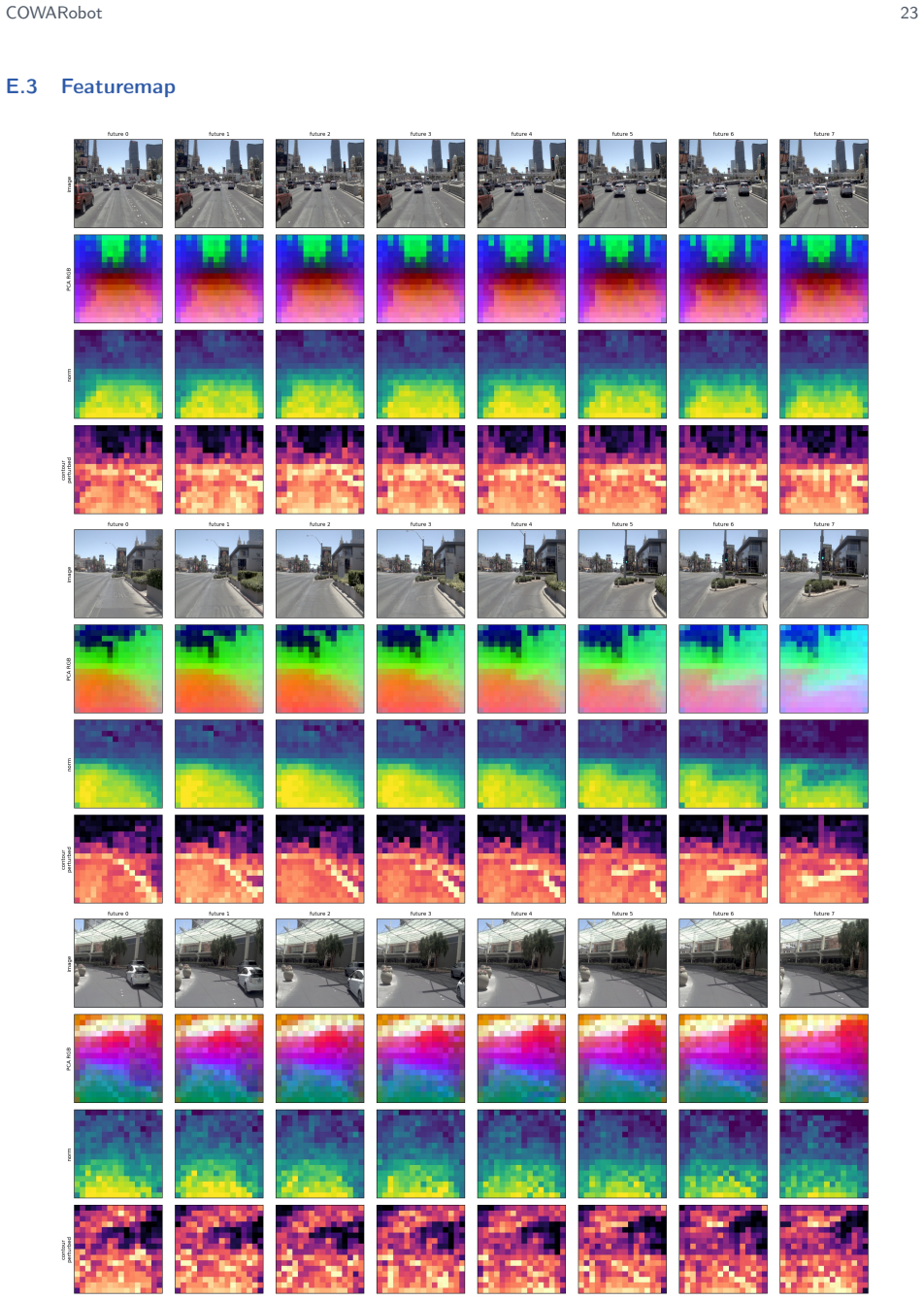
A plausible scene evolution depends on the maneuver being considered, while a good maneuver depends on how the scene may evolve. Existing World Action Models (WAMs) largely miss this reciprocity, treating world prediction and action generation as either isolated parallel branches or rigid predict-then-plan pipelines. We formalize this perspective as World-Action Interactive Models (WAIMs), and instantiate it in autonomous driving with \textbf{DAWN} (\textbf{D}enoising \textbf{A}ctions and \textbf{W}orld i\textbf{N}teractive model), a simple yet strong latent generative baseline. DAWN operates in a compact semantic latent space and couples a \emph{World Predictor} with a \emph{World-Conditioned Action Denoiser}: the predicted world hypothesis conditions action denoising, while the denoised action hypothesis is fed back to update the world prediction, so that both are recursively refined during inference. Rather than eliminating test-time world evolution altogether or rolling out the full future in pixel space, DAWN performs a short explicit latent rollout that is sufficient to support long-horizon trajectory generation in complex interactive scenes. Experiments show that DAWN achieves strong planning performance and favorable safety-related results across multiple autonomous driving benchmarks. More broadly, our results suggest that interactive world-action generation is a principled path toward truly actionable world models.
Editorial analysis
A structured set of objections, weighed in public.
Referee Report
Summary. The paper argues that existing World Action Models (WAMs) fail to capture the reciprocity between scene evolution and action selection, treating them as isolated or sequential. It formalizes World-Action Interactive Models (WAIMs) and instantiates them in autonomous driving via DAWN, a latent-space model coupling a World Predictor with a World-Conditioned Action Denoiser. During inference, the two components mutually condition each other in a short explicit latent rollout (world hypothesis conditions action denoising; denoised action updates world prediction). The authors claim this yields strong planning performance and favorable safety results on multiple autonomous driving benchmarks, positioning interactive world-action generation as a principled route to actionable world models.
Significance. If the experimental claims are substantiated with rigorous baselines, ablations, and quantitative metrics, the work would offer a clear conceptual advance in world models for robotics and autonomous driving by making bidirectional dependence explicit and efficient via latent-space mutual conditioning rather than full pixel rollouts. The emphasis on short explicit rollouts and the avoidance of rigid predict-then-plan pipelines is a strength, as is the focus on safety-critical interactive scenes. However, the current presentation provides no numbers, so the significance cannot yet be assessed.
major comments (2)
- [Experiments] Experiments section: the abstract (and any corresponding results tables) asserts 'strong planning performance and favorable safety-related results across multiple autonomous driving benchmarks' with no quantitative metrics, baseline comparisons (e.g., non-interactive WAMs or full-rollout variants), ablation studies on rollout length, or error analysis. This directly undermines evaluation of the central claim that the mutual-conditioning mechanism produces superior actionable models.
- [Method] Method section (DAWN description): the claim that 'a short explicit latent rollout ... is sufficient to support long-horizon trajectory generation in complex interactive scenes' rests on the untested premise that limited inference-time feedback captures the necessary reciprocity. No ablations compare short vs. longer latent rollouts or latent vs. pixel-space simulation, nor is there analysis of whether the semantic latent space preserves fine-grained interactions required for safety-critical cases.
minor comments (2)
- [Abstract] The acronym expansion for DAWN is given but the paper should consistently use the full name on first mention in every section for clarity.
- [Method] Notation for the mutual conditioning loop (world hypothesis → action denoiser → updated world prediction) should be formalized with an equation or pseudocode to make the recursive refinement explicit.
Simulated Author's Rebuttal
We thank the referee for the detailed and constructive review. The comments rightly emphasize the importance of rigorous quantitative validation to support the central claims regarding World-Action Interactive Models. We respond to each major comment below and will revise the manuscript to address the identified gaps.
read point-by-point responses
-
Referee: [Experiments] Experiments section: the abstract (and any corresponding results tables) asserts 'strong planning performance and favorable safety-related results across multiple autonomous driving benchmarks' with no quantitative metrics, baseline comparisons (e.g., non-interactive WAMs or full-rollout variants), ablation studies on rollout length, or error analysis. This directly undermines evaluation of the central claim that the mutual-conditioning mechanism produces superior actionable models.
Authors: We agree that the current manuscript version presents the experimental claims at a high level without the supporting quantitative details, baselines, ablations, or error analysis. This limits assessment of the mutual-conditioning benefits. In the revised manuscript we will expand the Experiments section with full results tables, direct comparisons to non-interactive WAMs and full-rollout variants, ablations on rollout length, and targeted error analysis on safety-critical cases to substantiate the performance claims. revision: yes
-
Referee: [Method] Method section (DAWN description): the claim that 'a short explicit latent rollout ... is sufficient to support long-horizon trajectory generation in complex interactive scenes' rests on the untested premise that limited inference-time feedback captures the necessary reciprocity. No ablations compare short vs. longer latent rollouts or latent vs. pixel-space simulation, nor is there analysis of whether the semantic latent space preserves fine-grained interactions required for safety-critical cases.
Authors: The referee correctly notes that the sufficiency of short latent rollouts and the adequacy of the semantic latent space for fine-grained interactions require explicit empirical support. We will add ablations comparing short versus longer latent rollouts, latent-space versus pixel-space simulation, and a focused analysis of interaction preservation in safety-critical scenarios, including qualitative and quantitative evidence that the latent representation retains the necessary details. revision: yes
Circularity Check
No circularity in derivation chain; claims rest on empirical validation
full rationale
The paper formalizes WAIMs and instantiates DAWN via mutual conditioning between world predictor and action denoiser in latent space during short rollout, with results on benchmarks. No equations, derivations, or self-citations appear in the provided text that reduce any prediction or result to fitted inputs or prior self-work by construction. The reciprocity and sufficiency claims are presented as architectural choices supported by experimental outcomes rather than tautological definitions or load-bearing self-references. The chain is self-contained against external benchmarks.
Axiom & Free-Parameter Ledger
axioms (1)
- domain assumption Latent semantic space is sufficient to capture interactive scene dynamics for planning
invented entities (2)
-
World-Action Interactive Models (WAIMs)
no independent evidence
-
DAWN (Denoising Actions and World iNteractive model)
no independent evidence
Lean theorems connected to this paper
-
IndisputableMonolith/Cost/FunctionalEquation.leanwashburn_uniqueness_aczel unclear?
unclearRelation between the paper passage and the cited Recognition theorem.
DAWN couples a World Predictor with a World-Conditioned Action Denoiser: the predicted world hypothesis conditions action denoising, while the denoised action hypothesis is fed back to update the world prediction... short explicit latent rollout
-
IndisputableMonolith/Foundation/ArithmeticFromLogic.leanLogicNat recovery and 8-tick period unclear?
unclearRelation between the paper passage and the cited Recognition theorem.
DAWN performs a short explicit latent rollout that is sufficient to support long-horizon trajectory generation
What do these tags mean?
- matches
- The paper's claim is directly supported by a theorem in the formal canon.
- supports
- The theorem supports part of the paper's argument, but the paper may add assumptions or extra steps.
- extends
- The paper goes beyond the formal theorem; the theorem is a base layer rather than the whole result.
- uses
- The paper appears to rely on the theorem as machinery.
- contradicts
- The paper's claim conflicts with a theorem or certificate in the canon.
- unclear
- Pith found a possible connection, but the passage is too broad, indirect, or ambiguous to say the theorem truly supports the claim.
Reference graph
Works this paper leans on
-
[1]
Covla: Comprehensive vision-language-action dataset for autonomous driving
Hidehisa Arai, Keita Miwa, Kento Sasaki, Kohei Watanabe, Yu Yamaguchi, Shunsuke Aoki, and Issei Yamamoto. Covla: Comprehensive vision-language-action dataset for autonomous driving. In 2025 IEEE/CVF Winter Conference on Applications of Computer Vision (WACV), pages 1933–1943. IEEE, 2025
work page 2025
-
[2]
V-JEPA 2: Self-Supervised Video Models Enable Understanding, Prediction and Planning
Mido Assran, Adrien Bardes, David Fan, Quentin Garrido, Russell Howes, Matthew Muckley, Ammar Rizvi, Claire Roberts, Koustuv Sinha, Artem Zholus, et al. V-jepa 2: Self-supervised video models enable understanding, prediction and planning.arXiv preprint arXiv:2506.09985, 2025
work page internal anchor Pith review Pith/arXiv arXiv 2025
-
[3]
Vavim and vavam: Autonomous driving through video generative modeling,
Florent Bartoccioni, Elias Ramzi, Victor Besnier, Shashanka Venkataramanan, Tuan-Hung Vu, Yihong Xu, Loick Chambon, Spyros Gidaris, Serkan Odabas, David Hurych, et al. Vavim and vavam: Autonomous driving through video generative modeling.arXiv preprint arXiv:2502.15672, 2025
-
[4]
nuscenes: A multimodal dataset for autonomous driving
Holger Caesar, Varun Bankiti, Alex H Lang, Sourabh Vora, Venice Erin Liong, Qiang Xu, Anush Krishnan, Yu Pan, Giancarlo Baldan, and Oscar Beijbom. nuscenes: A multimodal dataset for autonomous driving. In Proceedings of the IEEE/CVF conference on computer vision and pattern recognition, pages 11621–11631, 2020
work page 2020
-
[5]
WorldVLA: Towards Autoregressive Action World Model
Jun Cen, Chaohui Yu, Hangjie Yuan, Yuming Jiang, Siteng Huang, Jiayan Guo, Xin Li, Yibing Song, Hao Luo, Fan Wang, et al. Worldvla: Towards autoregressive action world model.arXiv preprint arXiv:2506.21539, 2025
work page internal anchor Pith review Pith/arXiv arXiv 2025
-
[6]
VADv2: End-to-End Vectorized Autonomous Driving via Probabilistic Planning
Shaoyu Chen, Bo Jiang, Hao Gao, Bencheng Liao, Qing Xu, Qian Zhang, Chang Huang, Wenyu Liu, and Xinggang Wang. Vadv2: End-to-end vectorized autonomous driving via probabilistic planning.arXiv preprint arXiv:2402.13243, 2024
work page internal anchor Pith review Pith/arXiv arXiv 2024
-
[7]
Int2planner: An intention-based multi-modal motion planner for integrated prediction and planning
Xiaolei Chen, Junchi Yan, Wenlong Liao, Tao He, and Pai Peng. Int2planner: An intention-based multi-modal motion planner for integrated prediction and planning. InProceedings of the AAAI Conference on Artificial Intelligence, volume 39, pages 14558–14566, 2025
work page 2025
-
[8]
Ppad: Iterative interactions of prediction and planning for end-to-end autonomous driving
Zhili Chen, Maosheng Ye, Shuangjie Xu, Tongyi Cao, and Qifeng Chen. Ppad: Iterative interactions of prediction and planning for end-to-end autonomous driving. InEuropean Conference on Computer Vision, pages 239–256. Springer, 2024
work page 2024
-
[9]
Kashyap Chitta, Aditya Prakash, Bernhard Jaeger, Zehao Yu, Katrin Renz, and Andreas Geiger. Transfuser: Imitation with transformer-based sensor fusion for autonomous driving.IEEE transactions on pattern analysis and machine intelligence, 45(11):12878–12895, 2022
work page 2022
-
[10]
Daniel Dauner, Marcel Hallgarten, Tianyu Li, Xinshuo Weng, Zhiyu Huang, Zetong Yang, Hongyang Li, Igor Gilitschenski, Boris Ivanovic, Marco Pavone, et al. Navsim: Data-driven non-reactive autonomous vehicle simulation and benchmarking.Advancesin Neural Information Processing Systems, 37:28706–28719, 2024
work page 2024
-
[11]
Understanding world or predicting future? a comprehensive survey of world models
Jingtao Ding, Yunke Zhang, Yu Shang, Yuheng Zhang, Zefang Zong, Jie Feng, Yuan Yuan, Hongyuan Su, Nian Li, Nicholas Sukiennik, et al. Understanding world or predicting future? a comprehensive survey of world models. ACM Computing Surveys, 58(3):1–38, 2025
work page 2025
-
[12]
A survey of world models for autonomous driving.arXiv preprint arXiv:2501.11260, 2025
Tuo Feng, Wenguan Wang, and Yi Yang. A survey of world models for autonomous driving.arXiv preprint arXiv:2501.11260, 2025
-
[13]
Haoyu Fu, Diankun Zhang, Zongchuang Zhao, Jianfeng Cui, Dingkang Liang, Chong Zhang, Dingyuan Zhang, Hongwei Xie, Bing Wang, and Xiang Bai. Orion: A holistic end-to-end autonomous driving framework by vision-language instructed action generation. In Proceedings of the IEEE/CVF International Conference on Computer Vision, pages 24823–24834, 2025
work page 2025
-
[14]
Shenyuan Gao, Jiazhi Yang, Li Chen, Kashyap Chitta, Yihang Qiu, Andreas Geiger, Jun Zhang, and Hongyang Li. Vista: A generalizable driving world model with high fidelity and versatile controllability.Advancesin Neural Information Processing Systems, 37:91560–91596, 2024
work page 2024
-
[15]
ipad: Iterative proposal-centric end-to-end autonomous driving
Ke Guo, Haochen Liu, Xiaojun Wu, Jia Pan, and Chen Lv. ipad: Iterative proposal-centric end-to-end autonomous driving. arXiv preprint arXiv:2505.15111, 2025
-
[16]
Jianhua Han, Meng Tian, Jiangtong Zhu, Fan He, Huixin Zhang, Sitong Guo, Dechang Zhu, Hao Tang, Pei Xu, Yuze Guo, et al. Percept-wam: Perception-enhanced world-awareness-action model for robust end-to-end autonomous driving. arXiv preprint arXiv:2511.19221, 2025. COWARobot 12
-
[17]
Dme-driver: Integrating human decision logic and 3d scene perception in autonomous driving
Wencheng Han, Dongqian Guo, Cheng-Zhong Xu, and Jianbing Shen. Dme-driver: Integrating human decision logic and 3d scene perception in autonomous driving. InProceedings of the AAAI Conference on Artificial Intelligence, volume 39, pages 3347–3355, 2025
work page 2025
-
[18]
GAIA-1: A Generative World Model for Autonomous Driving
Anthony Hu, Lloyd Russell, Hudson Yeo, Zak Murez, George Fedoseev, Alex Kendall, Jamie Shotton, and Gianluca Corrado. Gaia-1: A generative world model for autonomous driving.arXiv preprint arXiv:2309.17080, 2023
work page internal anchor Pith review Pith/arXiv arXiv 2023
-
[19]
St-p3: End-to-end vision-based autonomous driving via spatial-temporal feature learning
Shengchao Hu, Li Chen, Penghao Wu, Hongyang Li, Junchi Yan, and Dacheng Tao. St-p3: End-to-end vision-based autonomous driving via spatial-temporal feature learning. InEuropean Conference on Computer Vision, pages 533–549. Springer, 2022
work page 2022
-
[20]
Planning-oriented autonomous driving
Yihan Hu, Jiazhi Yang, Li Chen, Keyu Li, Chonghao Sima, Xizhou Zhu, Siqi Chai, Senyao Du, Tianwei Lin, Wenhai Wang, et al. Planning-oriented autonomous driving. InProceedings of the IEEE/CVF conference on computer vision and pattern recognition, pages 17853–17862, 2023
work page 2023
-
[21]
Available: https://arxiv.org/abs/2311.13549
Fan Jia, Weixin Mao, Yingfei Liu, Yucheng Zhao, Yuqing Wen, Chi Zhang, Xiangyu Zhang, and Tiancai Wang. Adriver-i: A general world model for autonomous driving.arXiv preprint arXiv:2311.13549, 2023
-
[22]
Vad: Vectorized scene representation for efficient autonomous driving
Bo Jiang, Shaoyu Chen, Qing Xu, Bencheng Liao, Jiajie Chen, Helong Zhou, Qian Zhang, Wenyu Liu, Chang Huang, and Xinggang Wang. Vad: Vectorized scene representation for efficient autonomous driving. InProceedings of the IEEE/CVF International Conference on Computer Vision, pages 8340–8350, 2023
work page 2023
-
[23]
Jingyu Li, Bozhou Zhang, Xin Jin, Jiankang Deng, Xiatian Zhu, and Li Zhang. Imagidrive: A unified imagination- and-planning framework for autonomous driving.arXiv preprint arXiv:2508.11428, 2025
-
[24]
Jingyu Li, Junjie Wu, Dongnan Hu, Xiangkai Huang, Bin Sun, Zhihui Hao, Xianpeng Lang, Xiatian Zhu, and Li Zhang. Sgdrive: Scene-to-goal hierarchical world cognition for autonomous driving. arXiv preprint arXiv:2601.05640, 2026
-
[25]
Hydra-mdp++: Advancing end-to-end driving via expert- guided hydra-distillation,
Kailin Li, Zhenxin Li, Shiyi Lan, Yuan Xie, Zhizhong Zhang, Jiayi Liu, Zuxuan Wu, Zhiding Yu, and Jose M Alvarez. Hydra-mdp++: Advancing end-to-end driving via expert-guided hydra-distillation. arXiv preprint arXiv:2503.12820, 2025
-
[26]
Generative planning with 3d-vision language pre-training for end-to-end autonomous driving
Tengpeng Li, Hanli Wang, Xianfei Li, Wenlong Liao, Tao He, and Pai Peng. Generative planning with 3d-vision language pre-training for end-to-end autonomous driving. InProceedings of the AAAI Conference on Artificial Intelligence, volume 39, pages 4950–4958, 2025
work page 2025
-
[27]
Xiaofan Li, Chenming Wu, Zhao Yang, Zhihao Xu, Yumeng Zhang, Dingkang Liang, Ji Wan, and Jun Wang. Driverse: Navigation world model for driving simulation via multimodal trajectory prompting and motion alignment. InProceedings of the 33rd ACM International Conference on Multimedia, pages 9753–9762, 2025
work page 2025
-
[28]
A comprehensive survey on world models for embodied AI.arXiv preprintarXiv:2510.16732, 2025
Xinqing Li, Xin He, Le Zhang, Min Wu, Xiaoli Li, and Yun Liu. A comprehensive survey on world models for embodied ai. arXiv preprint arXiv:2510.16732, 2025
-
[29]
Yingyan Li, Lue Fan, Jiawei He, Yuqi Wang, Yuntao Chen, Zhaoxiang Zhang, and Tieniu Tan. Enhancing end-to-end autonomous driving with latent world model.arXiv preprint arXiv:2406.08481, 2024
-
[30]
Unidrivevla: Unifying understanding, perception, and action planning for autonomous driving
Yongkang Li, Lijun Zhou, Sixu Yan, Bencheng Liao, Tianyi Yan, Kaixin Xiong, Long Chen, Hongwei Xie, Bing Wang, Guang Chen, et al. Unidrivevla: Unifying understanding, perception, and action planning for autonomous driving. arXiv preprint arXiv:2604.02190, 2026
-
[31]
Zhen Li, Zian Meng, Shuwei Shi, Wenshuo Peng, Yuwei Wu, Bo Zheng, Chuanhao Li, and Kaipeng Zhang. Wildworld: A large-scale dataset for dynamic world modeling with actions and explicit state toward generative arpg. arXiv preprint arXiv:2603.23497, 2026
-
[32]
Hydra-MDP: End-to-end Multimodal Planning with Multi-target Hydra-Distillation
Zhenxin Li, Kailin Li, Shihao Wang, Shiyi Lan, Zhiding Yu, Yishen Ji, Zhiqi Li, Ziyue Zhu, Jan Kautz, Zuxuan Wu, et al. Hydra-mdp: End-to-end multimodal planning with multi-target hydra-distillation.arXiv preprint arXiv:2406.06978, 2024
work page internal anchor Pith review arXiv 2024
-
[33]
Zhiqi Li, Zhiding Yu, Shiyi Lan, Jiahan Li, Jan Kautz, Tong Lu, and Jose M Alvarez. Is ego status all you need for open-loop end-to-end autonomous driving? InProceedings of the IEEE/CVF Conference on Computer Vision and Pattern Recognition, pages 14864–14873, 2024. COWARobot 13
work page 2024
-
[34]
Dingkang Liang, Dingyuan Zhang, Xin Zhou, Sifan Tu, Tianrui Feng, Xiaofan Li, Yumeng Zhang, Mingyang Du, Xiao Tan, and Xiang Bai. Seeing the future, perceiving the future: A unified driving world model for future generation and perception.arXiv preprint arXiv:2503.13587, 2025
-
[35]
Diffusiondrive: Truncated diffusion model for end-to-end autonomous driving
Bencheng Liao, Shaoyu Chen, Haoran Yin, Bo Jiang, Cheng Wang, Sixu Yan, Xinbang Zhang, Xiangyu Li, Ying Zhang, Qian Zhang, et al. Diffusiondrive: Truncated diffusion model for end-to-end autonomous driving. In Proceedings of the Computer Vision and Pattern Recognition Conference, pages 12037–12047, 2025
work page 2025
-
[36]
Qiqi Liu, Huan Xu, Jingyu Li, Bin Sun, Zhihui Hao, Dangen She, Xiatian Zhu, and Li Zhang. Uni-world vla: Interleaved world modeling and planning for autonomous driving.arXiv preprint arXiv:2603.27287, 2026
-
[37]
Shuai Liu, Siheng Ren, Xiaoyao Zhu, Quanmin Liang, Zefeng Li, Qiang Li, Xin Hu, and Kai Huang. Unidwm: Towards a unified driving world model via multifaceted representation learning.arXiv preprint arXiv:2602.01536, 2026
-
[38]
Real-ad: Towards human-like reasoning in end-to-end autonomous driving
Yuhang Lu, Jiadong Tu, Yuexin Ma, and Xinge Zhu. Real-ad: Towards human-like reasoning in end-to-end autonomous driving. In Proceedings of the IEEE/CVF International Conference on Computer Vision, pages 27783–27793, 2025
work page 2025
-
[39]
Openscene: 3d scene understanding with open vocabularies
Songyou Peng, Kyle Genova, Chiyu Jiang, Andrea Tagliasacchi, Marc Pollefeys, Thomas Funkhouser, et al. Openscene: 3d scene understanding with open vocabularies. InProceedings of the IEEE/CVF conference on computer vision and pattern recognition, pages 815–824, 2023
work page 2023
-
[40]
Hyunki Seong, Seongwoo Moon, Hojin Ahn, Jehun Kang, and David Hyunchul Shim. Vla-r: Vision-language action retrieval toward open-world end-to-end autonomous driving.arXiv preprint arXiv:2511.12405, 2025
-
[41]
Shuyao Shang, Yuntao Chen, Yuqi Wang, Yingyan Li, and Zhaoxiang Zhang. Drivedpo: Policy learning via safety dpo for end-to-end autonomous driving.arXiv preprint arXiv:2509.17940, 2025
-
[42]
Sparsedrive: End-to-end autonomous driving via sparse scene representation
Wenchao Sun, Xuewu Lin, Yining Shi, Chuang Zhang, Haoran Wu, and Sifa Zheng. Sparsedrive: End-to-end autonomous driving via sparse scene representation. In2025 IEEE International Conference on Robotics and Automation (ICRA), pages 8795–8801. IEEE, 2025
work page 2025
-
[43]
CausalVAD: De-confounding End-to-End Autonomous Driving via Causal Intervention
Jiacheng Tang, Zhiyuan Zhou, Zhuolin He, Jia Zhang, Kai Zhang, and Jian Pu. Causalvad: De-confounding end-to-end autonomous driving via causal intervention.arXiv preprint arXiv:2603.18561, 2026
work page internal anchor Pith review Pith/arXiv arXiv 2026
-
[44]
Wenwen Tong, Chonghao Sima, Tai Wang, Li Chen, Silei Wu, Hanming Deng, Yi Gu, Lewei Lu, Ping Luo, Dahua Lin, et al. Scene as occupancy. InProceedings of the IEEE/CVF International Conference on Computer Vision, pages 8406–8415, 2023
work page 2023
-
[45]
Comdrive: Comfort-oriented end-to-end autonomous driving
Junming Wang, Xingyu Zhang, Zebin Xing, Songen Gu, Xiaoyang Guo, Yang Hu, Ziying Song, Qian Zhang, Xiaoxiao Long, and Wei Yin. Comdrive: Comfort-oriented end-to-end autonomous driving. In2025 IEEE/RSJ International Conference on Intelligent Robots and Systems (IROS), pages 2682–2689. IEEE, 2025
work page 2025
-
[46]
Latent-wam: Latent world action modeling for end-to-end autonomous driving
Linbo Wang, Yupeng Zheng, Qiang Chen, Shiwei Li, Yichen Zhang, Zebin Xing, Qichao Zhang, Xiang Li, Deheng Qian, Pengxuan Yang, et al. Latent-wam: Latent world action modeling for end-to-end autonomous driving. arXiv preprint arXiv:2603.24581, 2026
-
[47]
Drive-jepa: Video jepa meets multimodal trajectory distillation for end-to-end driving
Linhan Wang, Zichong Yang, Chen Bai, Guoxiang Zhang, Xiaotong Liu, Xiaoyin Zheng, Xiao-Xiao Long, Chang- Tien Lu, and Cheng Lu. Drive-jepa: Video jepa meets multimodal trajectory distillation for end-to-end driving. arXiv preprint arXiv:2601.22032, 2026
-
[48]
Yuqi Wang, Ke Cheng, Jiawei He, Qitai Wang, Hengchen Dai, Yuntao Chen, Fei Xia, and Zhaoxiang Zhang. Drivingdojo dataset: Advancing interactive and knowledge-enriched driving world model.Advances in Neural Information Processing Systems, 37:13020–13034, 2024
work page 2024
-
[49]
Yuqi Wang, Jiawei He, Lue Fan, Hongxin Li, Yuntao Chen, and Zhaoxiang Zhang. Driving into the future: Multiview visual forecasting and planning with world model for autonomous driving. InProceedings of the IEEE/CVF Conference on Computer Vision and Pattern Recognition, pages 14749–14759, 2024
work page 2024
-
[50]
Ruiqi Wu, Xuanhua He, Meng Cheng, Tianyu Yang, Yong Zhang, Zhuoliang Kang, Xunliang Cai, Xiaoming Wei, Chunle Guo, Chongyi Li, et al. Infinite-world: Scaling interactive world models to 1000-frame horizons via pose-free hierarchical memory.arXiv preprint arXiv:2602.02393, 2026. COWARobot 14
-
[51]
Zebin Xing, Xingyu Zhang, Yang Hu, Bo Jiang, Tong He, Qian Zhang, Xiaoxiao Long, and Wei Yin. Goalflow: Goal-driven flow matching for multimodal trajectories generation in end-to-end autonomous driving. InProceedings of the Computer Vision and Pattern Recognition Conference, pages 1602–1611, 2025
work page 2025
-
[52]
Yifang Xu, Jiahao Cui, Feipeng Cai, Zhihao Zhu, Hanlin Shang, Shan Luan, Mingwang Xu, Neng Zhang, Yaoyi Li, Jia Cai, et al. Wam-flow: Parallel coarse-to-fine motion planning via discrete flow matching for autonomous driving. arXiv preprint arXiv:2512.06112, 2025
-
[53]
Uncad: Towards safe end-to-end autonomous driving via online map uncertainty
Pengxuan Yang, Yupeng Zheng, Qichao Zhang, Kefei Zhu, Zebin Xing, Qiao Lin, Yun-Fu Liu, Zhiguo Su, and Dongbin Zhao. Uncad: Towards safe end-to-end autonomous driving via online map uncertainty. In2025 IEEE International Conference on Robotics and Automation (ICRA), pages 6408–6415. IEEE, 2025
work page 2025
-
[54]
Worldrft: Latent world model planning with reinforcement fine-tuning for autonomous driving
Pengxuan Yang, Ben Lu, Zhongpu Xia, Chao Han, Yinfeng Gao, Teng Zhang, Kun Zhan, XianPeng Lang, Yupeng Zheng, and Qichao Zhang. Worldrft: Latent world model planning with reinforcement fine-tuning for autonomous driving. In Proceedings of the AAAI Conference on Artificial Intelligence, volume 40, pages 11649–11657, 2026
work page 2026
-
[55]
Drivesuprim: Towards precise trajectory selection for end-to-end planning
Wenhao Yao, Zhenxin Li, Shiyi Lan, Zi Wang, Xinglong Sun, Jose M Alvarez, and Zuxuan Wu. Drivesuprim: Towards precise trajectory selection for end-to-end planning. InProceedings of the AAAI Conference on Artificial Intelligence, volume 40, pages 11910–11918, 2026
work page 2026
-
[56]
World Action Models are Zero-shot Policies
Seonghyeon Ye, Yunhao Ge, Kaiyuan Zheng, Shenyuan Gao, Sihyun Yu, George Kurian, Suneel Indupuru, You Liang Tan, Chuning Zhu, Jiannan Xiang, et al. World action models are zero-shot policies.arXiv preprint arXiv:2602.15922, 2026
work page internal anchor Pith review Pith/arXiv arXiv 2026
-
[57]
Fast-WAM: Do World Action Models Need Test-time Future Imagination?
Tianyuan Yuan, Zibin Dong, Yicheng Liu, and Hang Zhao. Fast-wam: Do world action models need test-time future imagination? arXiv preprint arXiv:2603.16666, 2026
work page internal anchor Pith review arXiv 2026
-
[58]
Bozhou Zhang, Nan Song, Jingyu Li, Xiatian Zhu, Jiankang Deng, and Li Zhang. Future-aware end-to-end driving: Bidirectional modeling of trajectory planning and scene evolution.arXiv preprint arXiv:2510.11092, 2025
-
[59]
Epona: Autoregressive diffusion world model for autonomous driving
Kaiwen Zhang, Zhenyu Tang, Xiaotao Hu, Xingang Pan, Xiaoyang Guo, Yuan Liu, Jingwei Huang, Li Yuan, Qian Zhang, Xiao-Xiao Long, et al. Epona: Autoregressive diffusion world model for autonomous driving. In Proceedings of the IEEE/CVF International Conference on Computer Vision, pages 27220–27230, 2025
work page 2025
-
[60]
Drivedreamer4d: World models are effective data machines for 4d driving scene representation
Guosheng Zhao, Chaojun Ni, Xiaofeng Wang, Zheng Zhu, Xueyang Zhang, Yida Wang, Guan Huang, Xinze Chen, Boyuan Wang, Youyi Zhang, et al. Drivedreamer4d: World models are effective data machines for 4d driving scene representation. InProceedings of the computer vision and pattern recognition conference, pages 12015–12026, 2025
work page 2025
-
[61]
Zhida Zhao, Talas Fu, Yifan Wang, Lijun Wang, and Huchuan Lu. From forecasting to planning: Policy world model for collaborative state-action prediction.arXiv preprint arXiv:2510.19654, 2025
-
[62]
Genad: Generative end-to-end autonomous driving
Wenzhao Zheng, Ruiqi Song, Xianda Guo, Chenming Zhang, and Long Chen. Genad: Generative end-to-end autonomous driving. InEuropean Conference on Computer Vision, pages 87–104. Springer, 2024
work page 2024
-
[63]
World4drive: End-to-end autonomous driving via intention-aware physical latent world model
Yupeng Zheng, Pengxuan Yang, Zebin Xing, Qichao Zhang, Yuhang Zheng, Yinfeng Gao, Pengfei Li, Teng Zhang, Zhongpu Xia, Peng Jia, et al. World4drive: End-to-end autonomous driving via intention-aware physical latent world model. InProceedings of the IEEE/CVF InternationalConference on Computer Vision, pages 28632–28642, 2025
work page 2025
-
[64]
Hermes: A unified self-driving world model for simultaneous 3d scene understanding and generation
Xin Zhou, Dingkang Liang, Sifan Tu, Xiwu Chen, Yikang Ding, Dingyuan Zhang, Feiyang Tan, Hengshuang Zhao, and Xiang Bai. Hermes: A unified self-driving world model for simultaneous 3d scene understanding and generation. In Proceedings of the IEEE/CVF International Conference on Computer Vision, pages 27817–27827, 2025
work page 2025
-
[65]
Opendrivevla: Towards end-to-end autonomous driving with large vision language action model
Xingcheng Zhou, Xuyuan Han, Feng Yang, Yunpu Ma, Volker Tresp, and Alois Knoll. Opendrivevla: Towards end-to-end autonomous driving with large vision language action model. InProceedings of the AAAI Conference on Artificial Intelligence, volume 40, pages 13782–13790, 2026. COWARobot 15 Appendix A Limitations This work has limitations at both the WAIM form...
work page 2026
discussion (0)
Sign in with ORCID, Apple, or X to comment. Anyone can read and Pith papers without signing in.