Recognition: no theorem link
Necessary conditions for causality from linearized stability at ultra-high boosts
Pith reviewed 2026-05-13 04:32 UTC · model grok-4.3
The pith
Linear stability at near-luminal boosts determines full causality conditions in relativistic hydrodynamics
A machine-rendered reading of the paper's core claim, the machinery that carries it, and where it could break.
Core claim
The central discovery is that the Lorentz-invariant stability property of causal theories leads to gamma-suppression in boosted frames, making stability at zero wavenumber adequate for ensuring causality conditions even at non-zero momenta at ultra-high boosts.
What carries the argument
Gamma-suppression of higher-order terms in the dispersion relation at large Lorentz boosts, arising from the Lorentz-invariant stability of causal theories.
If this is right
- The method provides an efficient derivation of necessary causality conditions in conformal MIS theory.
- It operates entirely within the regime of hydrodynamic validity.
- Generalizes to any relativistic hydrodynamic system satisfying the stability property.
Where Pith is reading between the lines
- This technique could reduce computational effort in scanning parameter spaces for causal hydrodynamic models used in heavy ion collision simulations.
- Future work might apply it to non-conformal or viscous fluids beyond MIS.
- Direct numerical checks of dispersion relations at intermediate boosts could confirm the suppression onset.
Load-bearing premise
Causal theories exhibit Lorentz-invariant stability that produces gamma-suppression of higher terms in the dispersion relation at large boosts.
What would settle it
Finding a causal relativistic hydrodynamic theory whose dispersion relation does not exhibit gamma-suppression at high boosts, or one that passes homogeneous stability but violates causality at finite momentum, would falsify the approach.
Figures
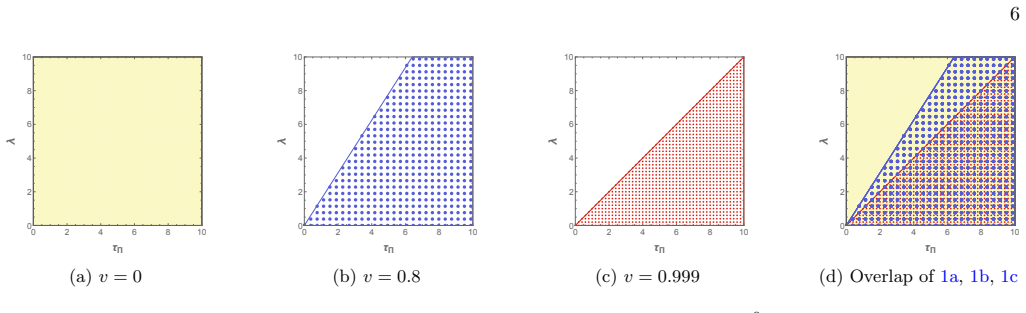


read the original abstract
In this work, we provide a novel method to constrain the causal parameter space of a relativistic hydrodynamic system exclusively from its linear stability analysis at non-zero momenta. Our approach exploits the Lorentz-invariant stability property of causal theories. In boosted frames, the dispersion relation exhibits a feature that we call ``$\gamma$-suppression,'' whereby the higher-order terms in the wavenumber expansion are increasingly suppressed beyond leading order at large boosts. As a consequence, at near-luminal values of Lorentz boost, stability criteria at the spatially homogeneous limit are sufficient to identify the region of the parameter space that satisfies the necessary conditions of causality, even at non-zero momenta. After presenting the general hydrodynamic framework, we test the method in conformal M\"uller-Israel-Stewart theory and show that it provides an efficient way of deriving the necessary conditions of causality while remaining within the low-energy regime of hydrodynamic validity.
Editorial analysis
A structured set of objections, weighed in public.
Referee Report
Summary. The paper presents a method to constrain the causal parameter space of relativistic hydrodynamic theories using only linearized stability analysis at the spatially homogeneous limit (k'=0) in ultra-high-boost frames. It exploits the Lorentz-invariant stability of causal theories, which induces a γ-suppression of higher-order terms in the boosted-frame dispersion relation at large Lorentz factors. Consequently, stability criteria evaluated at k'=0 become sufficient to identify the full region of parameter space satisfying necessary causality conditions, even for non-zero momenta. The approach is illustrated in conformal Müller-Israel-Stewart theory, where it yields the known causality bounds while remaining within the hydrodynamic regime.
Significance. If the central claim holds, the method offers a practical shortcut for deriving necessary causality constraints in higher-order hydrodynamics without exhaustive momentum-space scans, which is valuable given the growing complexity of transport coefficients in modern formulations. The explicit demonstration in conformal MIS theory and the emphasis on staying within low-energy validity are strengths. However, the result's utility depends on whether γ-suppression is robust enough near causality boundaries to preclude finite-k' instabilities.
major comments (2)
- [Abstract and general framework] Abstract and the general framework section: The assertion that γ-suppression renders stability at k'=0 sufficient for all momenta rests on the leading term dominating the sign of Im(ω') uniformly. Near the causality boundary, subleading O(k'^2) and higher coefficients could grow with γ or with hydrodynamic transport coefficients, potentially allowing instabilities at small but finite k' that are missed by the homogeneous limit. This requires an explicit bound showing that the suppression factor outpaces any growth in the coefficients.
- [Conformal MIS test] Conformal MIS test section: The derivation of the boosted dispersion relation and the explicit verification of γ-suppression for the O(k'^2) term should be provided, including the scaling with γ and the transport coefficients. Without this, it is unclear whether the method recovers the full necessary causality conditions or only a subset.
minor comments (2)
- [General framework] Clarify the precise definition of 'near-luminal' boosts (e.g., a minimum γ value) and the regime of validity for the hydrodynamic approximation at those boosts.
- [Conformal MIS test] Add a brief comparison table or plot showing the parameter-space region obtained via the new method versus the full causality analysis at finite k.
Simulated Author's Rebuttal
We thank the referee for the careful reading and constructive comments on our manuscript. We appreciate the opportunity to address the concerns regarding the robustness of the γ-suppression argument and the explicitness of the conformal MIS demonstration. We respond to each major comment below and will revise the manuscript to incorporate the requested clarifications and bounds.
read point-by-point responses
-
Referee: [Abstract and general framework] Abstract and the general framework section: The assertion that γ-suppression renders stability at k'=0 sufficient for all momenta rests on the leading term dominating the sign of Im(ω') uniformly. Near the causality boundary, subleading O(k'^2) and higher coefficients could grow with γ or with hydrodynamic transport coefficients, potentially allowing instabilities at small but finite k' that are missed by the homogeneous limit. This requires an explicit bound showing that the suppression factor outpaces any growth in the coefficients.
Authors: We acknowledge the referee's valid concern that near causality boundaries the subleading coefficients might grow sufficiently to undermine the dominance of the leading term. In the general framework we establish that the leading contribution to Im(ω') scales as 1/γ while higher-order terms acquire additional 1/γ factors from the Lorentz transformation of the wave vector. To make this rigorous, the revised manuscript will include an explicit bound on the remainder terms, demonstrating that for boosts large enough to remain inside the hydrodynamic regime the leading term controls the sign of Im(ω') uniformly, even when transport coefficients approach their causality limits. revision: yes
-
Referee: [Conformal MIS test] Conformal MIS test section: The derivation of the boosted dispersion relation and the explicit verification of γ-suppression for the O(k'^2) term should be provided, including the scaling with γ and the transport coefficients. Without this, it is unclear whether the method recovers the full necessary causality conditions or only a subset.
Authors: We agree that the conformal MIS section would benefit from a more detailed expansion. The manuscript already obtains the boosted-frame dispersion relation by Lorentz-transforming the rest-frame quadratic equation and then takes the large-γ limit at k'=0. In the revision we will insert the intermediate steps of this transformation, followed by the explicit O(k'^2) expansion of Im(ω'). The coefficients will be written out in terms of the shear relaxation time τ_π and the conformal equation of state, making the γ-suppression factors manifest and confirming that the resulting stability condition at k'=0 reproduces the complete known causality bounds for conformal MIS theory. revision: yes
Circularity Check
No circularity; derivation uses external stability property and explicit verification in MIS theory
full rationale
The paper's central method exploits the Lorentz-invariant stability property of causal theories to identify γ-suppression of higher-order terms in the boosted-frame dispersion relation. Stability criteria at k'=0 are then shown to suffice for necessary causality conditions at finite momenta near luminal boosts. This is tested by direct substitution into the conformal Müller-Israel-Stewart hydrodynamic equations and dispersion relation, without any parameter fitting, self-referential definition, or load-bearing self-citation that reduces the result to its inputs. The derivation chain remains independent of the target causality region and is externally falsifiable via the explicit MIS calculation.
Axiom & Free-Parameter Ledger
axioms (2)
- domain assumption Causal relativistic hydrodynamic theories possess Lorentz-invariant linear stability properties.
- domain assumption The dispersion relation in boosted frames exhibits gamma-suppression of higher-order wavenumber terms.
Reference graph
Works this paper leans on
-
[1]
In the boosted frame, the mode frequencyωis ob- tained not merely in a power series ofk, but rather in a series of (k/γ), i.e., expanded in an infinite se- ries of the wavenumber suppressed by the Lorentz factorγ
-
[2]
For the non-hydrodynamic modes in (8), each co- efficientα ∗ n is itself an infinite series in (va 0). The coefficients of this nested series include the LRF coefficientsa n ranging fromn= 0 to∞, i.e., the knowledge of the LRF modes to their entirety. IV. BOOSTED DISPERSION MODES OF THE MIS THEOR Y The dispersion spectra of any given theory in the LRF can...
-
[3]
MIS-Shear: Non-hydro-mode The non-hydrodynamic coefficientsα ∗ n for the MIS shear-channel tilln= 6 are: α∗ 0 = i λv2 −τ π , α ∗ 1 = 2λv λv2 −τ π , α ∗ 2 =i λ , α ∗ 3 = 2λ2v , α ∗ 4 =−iλ 2 5λv2 −τ π , α∗ 5 = 2λ3v 3τπ −7λv 2 , α ∗ 6 = 2iλ3 τ 2 π + 21λ2v4 −14λτ πv2 . (A2)
-
[4]
MIS-Shear: Hydro-mode The hydrodynamic coefficients ˜an for the MIS shear-channel tilln= 6 are: ˜a1 =−v ,˜a 2 =− iλ γ2 ,˜a 3 =− 2λ2v γ2 ,˜a 4 = iλ2 5λv2 −τ π γ2 ˜a5 = 2λ3v 7λv2 −3τ π γ2 ,˜a 6 =− 2iλ3 τ 2 π + 21λ2v4 −14λτ πv2 γ2 . (A3)
-
[5]
MIS-Sound: Non-hydro-mode The non-hydrodynamic coefficientsα ∗ n for the MIS sound-channel tilln= 6 are: α∗ 0 =− i v2 −3 v2(4λ+τ π)−3τ π , α ∗ 1 =− 24λv (v2 −3) (v 2(4λ+τ π)−3τ π) , α ∗ 2 =− 36iλ v2 + 1 (v2 −3) 3 , α∗ 3 =− 48λv τπ v4 −9 + 2λ 2v4 + 15v2 + 9 (v2 −3) 5 , α∗ 4 = 12iλ (v2 −3) 7 h 81τπ(τπ −4λ) + 5v 8(4λ+τ π)2 + 420λv6(4λ+τ π) + 126v4(4λ−τ π)(10...
-
[6]
MIS-Sound: Hydro-modes The hydrodynamic coefficients ˜an for the MIS sound-channel frequenciesω ± tilln= 6 are: ˜a1 = 2v v2 −3 ∓ √ 3 γ2 (v2 −3) ,˜a 2 = 18iλ v2 + 1 γ2 (v2 −3) 3 ± 2i √ 3λv v2 + 9 γ2 (v2 −3) 3 , ˜a3 = 24λv γ2 (v2 −3) 5 h τπ v4 −9 + 2λ 2v4 + 15v2 + 9 i ± 2 √ 3λ γ2 (v2 −3) 5 h τπ v2 −3 v4 + 18v2 + 9 + 3λ v6 + 35v4 + 75v2 + 9 i , ˜a4 =− 6iλ γ2...
-
[7]
(B2) is approximated as (ω−vk){i+γτ π(ω−vk)}= 0.(B3) The first parenthesis of Eq
MIS shear channel For the MIS shear channel, the dispersion relation reads γ τπ −λ 2 ω2 +{i−2γvk(τ π −λ)}ω+ −ivk+γk 2 τπv2 −λ = 0,(B1) which can be expressed as (ω−vk){i+γτ π(ω−vk)} −γλ(ωv−k) 2 = 0.(B2) At the limit,λ→0, Eq. (B2) is approximated as (ω−vk){i+γτ π(ω−vk)}= 0.(B3) The first parenthesis of Eq. (B3) provides only hydrodynamic modes with the exa...
-
[8]
MIS sound channel For the MIS sound channel, the dispersion relation reads A0 3ω3 + A0 2 +A 1 2k ω2 + A1 1k+A 2 1k2 ω+ A2 0k2 +A 3 0k3 = 0,(B6) where A0 3 =τ π − 4λ 3 + τπ 3 v2 , A 0 2 =i 1 γ 1− v2 3 , A 1 2 = 8λ 3 − 7τπ 3 v+ 4λ 3 + τπ 3 v3 , A 1 1 =−i 1 γ 4 3 v , A2 1 =− 4λ 3 + τπ 3 + 7τπ 3 − 8λ 3 v2 , A 2 0 =i 1 γ v2 − 1 3 , A 3 0 =−τ πv3 + 4λ 3 + τπ 3 ...
-
[9]
Fluid mechanics: Volume 6 (course of theoretical physics),
L. D. Landau and E. M. Lifshitz, “Fluid mechanics: Volume 6 (course of theoretical physics),” Elsevier Science : Amsterdam (1987)
work page 1987
-
[10]
Relativistic viscous hydrodynamics, conformal invariance, and holography,
R. Baier, P. Romatschke, D. T. Son, A. O. Starinets, and M. A. Stephanov, “Relativistic viscous hydrodynamics, conformal invariance, and holography,” JHEP04(2008) 100,arXiv:0712.2451 [hep-th]
-
[11]
Hydrodynamic Models for Heavy Ion Collisions,
P. Huovinen and P. V. Ruuskanen, “Hydrodynamic Models for Heavy Ion Collisions,” Ann. Rev. Nucl. Part. Sci.56(2006) 163–206,arXiv:nucl-th/0605008
-
[12]
Collective flow and viscosity in relativistic heavy-ion collisions
U. Heinz and R. Snellings, “Collective flow and viscosity in relativistic heavy-ion collisions,” Ann. Rev. Nucl. Part. Sci.63(2013) 123–151,arXiv:1301.2826 [nucl-th]
work page Pith review arXiv 2013
-
[13]
Hydrodynamic Modeling of Heavy-Ion Collisions
C. Gale, S. Jeon, and B. Schenke, “Hydrodynamic Modeling of Heavy-Ion Collisions,” Int. J. Mod. Phys. A 28(2013) 1340011,arXiv:1301.5893 [nucl-th]
work page Pith review arXiv 2013
-
[14]
Properties of hot and dense matter from relativistic heavy ion collisions,
P. Braun-Munzinger, V. Koch, T. Sch¨ afer, and J. Stachel, “Properties of hot and dense matter from relativistic heavy ion collisions,” Phys. Rept.621 (2016) 76–126,arXiv:1510.00442 [nucl-th]
-
[15]
Relativistic fluid dynamics: physics for many different scales,
N. Andersson and G. L. Comer, “Relativistic fluid dynamics: physics for many different scales,” Living Rev. Rel.24no. 1, (2021) 3,arXiv:2008.12069 [gr-qc]
-
[16]
Hydrodynamics of galactic dark matter,
L. G. Cabral-Rosetti, T. Matos, D. Nunez, and R. A. Sussman, “Hydrodynamics of galactic dark matter,” Class. Quant. Grav.19(2002) 3603–3616, arXiv:gr-qc/0112044
-
[17]
Causality and the Dispersion Relation: Logical Foundations,
J. S. Toll, “Causality and the Dispersion Relation: Logical Foundations,” Phys. Rev.104(1956) 1760–1770
work page 1956
-
[18]
Stability and causality in dissipative relativistic fluids,
W. A. Hiscock and L. Lindblom, “Stability and causality in dissipative relativistic fluids,” Annals Phys. 151(1983) 466–496
work page 1983
-
[19]
Generic instabilities in first-order dissipative relativistic fluid theories,
W. A. Hiscock and L. Lindblom, “Generic instabilities in first-order dissipative relativistic fluid theories,” Phys. Rev. D31(1985) 725–733
work page 1985
-
[20]
Stability and causality in the Israel-Stewart energy frame theory,
T. S. Olson, “Stability and causality in the Israel-Stewart energy frame theory,” Annals Phys.199 (1990) 18
work page 1990
-
[21]
New Developments in Relativistic Viscous Hydrodynamics,
P. Romatschke, “New Developments in Relativistic Viscous Hydrodynamics,” Int. J. Mod. Phys. E19 (2010) 1–53,arXiv:0902.3663 [hep-ph]
-
[22]
Lectures on hydrodynamic fluctuations in relativistic theories,
P. Kovtun, “Lectures on hydrodynamic fluctuations in relativistic theories,” J. Phys. A45(2012) 473001, arXiv:1205.5040 [hep-th]
-
[23]
Linear plane waves in dissipative relativistic fluids,
W. A. Hiscock and L. Lindblom, “Linear plane waves in dissipative relativistic fluids,” Phys. Rev. D35(1987) 3723–3732
work page 1987
-
[24]
Causality and existence of solutions of relativistic viscous fluid dynamics with gravity,
F. S. Bemfica, M. M. Disconzi, and J. Noronha, “Causality and existence of solutions of relativistic viscous fluid dynamics with gravity,” Phys. Rev. D98 no. 10, (2018) 104064,arXiv:1708.06255 [gr-qc]
-
[25]
Stability and Causality in relativistic dissipative hydrodynamics,
G. S. Denicol, T. Kodama, T. Koide, and P. Mota, “Stability and Causality in relativistic dissipative hydrodynamics,” J. Phys. G35(2008) 115102, arXiv:0807.3120 [hep-ph]
-
[26]
Does stability of relativistic dissipative fluid dynamics imply causality?,
S. Pu, T. Koide, and D. H. Rischke, “Does stability of relativistic dissipative fluid dynamics imply causality?,” Phys. Rev. D81(2010) 114039,arXiv:0907.3906 [hep-ph]
-
[27]
Linear stability of Israel-Stewart theory in the presence of net-charge diffusion,
C. V. Brito and G. S. Denicol, “Linear stability of Israel-Stewart theory in the presence of net-charge diffusion,” Phys. Rev. D102no. 11, (2020) 116009, arXiv:2007.16141 [nucl-th]
-
[28]
Nonlinear Causality of General First-Order Relativistic Viscous Hydrodynamics,
F. S. Bemfica, M. M. Disconzi, M. M. Disconzi, J. Noronha, and J. Noronha, “Nonlinear Causality of General First-Order Relativistic Viscous Hydrodynamics,” Phys. Rev. D100no. 10, (2019) 104020,arXiv:1907.12695 [gr-qc]. [Erratum: Phys.Rev.D 105, 069902 (2022)]
-
[29]
First-Order General-Relativistic Viscous Fluid Dynamics,
F. S. Bemfica, M. M. Disconzi, and J. Noronha, “First-Order General-Relativistic Viscous Fluid Dynamics,” Phys. Rev. X12no. 2, (2022) 021044, arXiv:2009.11388 [gr-qc]
-
[30]
First-order relativistic hydrodynamics is stable,
P. Kovtun, “First-order relativistic hydrodynamics is stable,” JHEP10(2019) 034,arXiv:1907.08191 [hep-th]
-
[31]
Stable and causal relativistic Navier-Stokes equations,
R. E. Hoult and P. Kovtun, “Stable and causal relativistic Navier-Stokes equations,” JHEP06(2020) 067,arXiv:2004.04102 [hep-th]
-
[32]
R. Biswas, S. Mitra, and V. Roy, “Is first-order relativistic hydrodynamics in a general frame stable and causal for arbitrary interactions?,” Phys. Rev. D106 no. 1, (2022) L011501,arXiv:2202.08685 [nucl-th]. 18
-
[33]
An expedition to the islands of stability in the first-order causal hydrodynamics,
R. Biswas, S. Mitra, and V. Roy, “An expedition to the islands of stability in the first-order causal hydrodynamics,” Phys. Lett. B838(2023) 137725, arXiv:2211.11358 [nucl-th]
-
[34]
Rigorous Bounds on Transport from Causality,
M. P. Heller, A. Serantes, M. Spali´ nski, and B. Withers, “Rigorous Bounds on Transport from Causality,” Phys. Rev. Lett.130no. 26, (2023) 261601, arXiv:2212.07434 [hep-th]
-
[35]
Can We Make Sense of Dissipation without Causality?,
L. Gavassino, “Can We Make Sense of Dissipation without Causality?,” Phys. Rev. X12no. 4, (2022) 041001,arXiv:2111.05254 [gr-qc]
-
[36]
Bounds on transport from hydrodynamic stability,
L. Gavassino, “Bounds on transport from hydrodynamic stability,” Phys. Lett. B840(2023) 137854, arXiv:2301.06651 [hep-th]
-
[37]
Dispersion Relations Alone Cannot Guarantee Causality,
L. Gavassino, M. M. Disconzi, and J. Noronha, “Dispersion Relations Alone Cannot Guarantee Causality,” Phys. Rev. Lett.132no. 16, (2024) 162301, arXiv:2307.05987 [hep-th]
-
[38]
Thermodynamic Stability Implies Causality,
L. Gavassino, M. Antonelli, and B. Haskell, “Thermodynamic Stability Implies Causality,” Phys. Rev. Lett.128no. 1, (2022) 010606,arXiv:2105.14621 [gr-qc]
-
[39]
Stability and causality criteria in linear mode analysis: Stability means causality,
D.-L. Wang and S. Pu, “Stability and causality criteria in linear mode analysis: Stability means causality,” Phys. Rev. D109no. 3, (2024) L031504, arXiv:2309.11708 [hep-th]
-
[40]
Causality and classical dispersion relations,
R. E. Hoult and P. Kovtun, “Causality and classical dispersion relations,” Phys. Rev. D109no. 4, (2024) 046018,arXiv:2309.11703 [hep-th]
-
[41]
Causal and stable superfluid hydrodynamics,
R. E. Hoult and A. Shukla, “Causal and stable superfluid hydrodynamics,” JHEP04(2025) 172, arXiv:2410.22855 [hep-th]
-
[42]
Do faster-than-light group velocities imply violation of causality?,
R. Fox, C. G. Kuper, and S. G. Lipson, “Do faster-than-light group velocities imply violation of causality?,” Nature223(1969) 597
work page 1969
-
[43]
E. Krotscheck and W. Kundt, “Causality criteria,” Communications in Mathematical Physics60(1978) 171–180
work page 1978
-
[44]
P. Romatschke and U. Romatschke, Relativistic Fluid Dynamics In and Out of Equilibrium. Cambridge Monographs on Mathematical Physics. Cambridge University Press, 5, 2019. arXiv:1712.05815 [nucl-th]
work page Pith review arXiv 2019
-
[45]
Hydrodynamic Gradient Expansion in Gauge Theory Plasmas,
M. P. Heller, R. A. Janik, and P. Witaszczyk, “Hydrodynamic Gradient Expansion in Gauge Theory Plasmas,” Phys. Rev. Lett.110no. 21, (2013) 211602, arXiv:1302.0697 [hep-th]
-
[46]
Hydrodynamics Beyond the Gradient Expansion: Resurgence and Resummation
M. P. Heller and M. Spalinski, “Hydrodynamics Beyond the Gradient Expansion: Resurgence and Resummation,” Phys. Rev. Lett.115no. 7, (2015) 072501,arXiv:1503.07514 [hep-th]
work page Pith review arXiv 2015
-
[47]
Field redefinition and its impact in relativistic hydrodynamics,
S. Bhattacharyya, S. Mitra, S. Roy, and R. Singh, “Field redefinition and its impact in relativistic hydrodynamics,” Phys. Rev. D111no. 1, (2025) 014034,arXiv:2409.15387 [nucl-th]
-
[48]
Stochastic relativistic advection diffusion equation from the Metropolis algorithm,
G. Ba¸ sar, J. Bhambure, R. Singh, and D. Teaney, “Stochastic relativistic advection diffusion equation from the Metropolis algorithm,” Phys. Rev. C 110no. 4, (2024) 044903,arXiv:2403.04185 [nucl-th]
-
[49]
Relativistic viscous hydrodynamics in the density frame: Numerical tests and comparisons,
J. Bhambure, A. Mazeliauskas, J.-F. Paquet, R. Singh, M. Singh, D. Teaney, and F. Zhou, “Relativistic viscous hydrodynamics in the density frame: Numerical tests and comparisons,” Phys. Rev. C111no. 6, (2025) 064910,arXiv:2412.10303 [nucl-th]
-
[50]
Noncovariant parabolic theories of relativistic diffusion,
L. Gavassino, “Noncovariant parabolic theories of relativistic diffusion,” Phys. Rev. D112no. 3, (2025) 034026,arXiv:2505.18815 [gr-qc]
-
[51]
Causality criteria from stability analysis at ultrahigh boost,
S. Roy and S. Mitra, “Causality criteria from stability analysis at ultrahigh boost,” Phys. Rev. D110no. 1, (2024) 016012,arXiv:2306.07564 [hep-th]
-
[52]
S. Bhattacharyya, S. Mitra, S. Roy, and R. Singh, “Relativistic Dispersion Spectra across Lorentz boosted frames: Spurious modes and the enigma of causality,” (12, 2025) ,arXiv:2512.12450 [hep-th]
-
[53]
Nonstationary irreversible thermodynamics: A Causal relativistic theory,
W. Israel, “Nonstationary irreversible thermodynamics: A Causal relativistic theory,” Annals Phys.100(1976) 310–331
work page 1976
-
[54]
Transient relativistic thermodynamics and kinetic theory,
W. Israel and J. M. Stewart, “Transient relativistic thermodynamics and kinetic theory,” Annals Phys.118 (1979) 341–372
work page 1979
-
[55]
Zum Paradoxon der Warmeleitungstheorie,
I. Muller, “Zum Paradoxon der Warmeleitungstheorie,” Z. Phys.198(1967) 329–344
work page 1967
-
[56]
Causality, Analyticity and an IR Obstruction to UV Completion
A. Adams, N. Arkani-Hamed, S. Dubovsky, A. Nicolis, and R. Rattazzi, “Causality, analyticity and an IR obstruction to UV completion,” JHEP10(2006) 014, arXiv:hep-th/0602178
work page Pith review arXiv 2006
-
[57]
Causality in curved spacetimes: The speed of light and gravity,
C. de Rham and A. J. Tolley, “Causality in curved spacetimes: The speed of light and gravity,” Phys. Rev. D102no. 8, (2020) 084048,arXiv:2007.01847 [hep-th]
-
[58]
Causal effective field theories,
M. Carrillo Gonzalez, C. de Rham, V. Pozsgay, and A. J. Tolley, “Causal effective field theories,” Phys. Rev. D106no. 10, (2022) 105018,arXiv:2207.03491 [hep-th]
- [59]
discussion (0)
Sign in with ORCID, Apple, or X to comment. Anyone can read and Pith papers without signing in.