Recognition: 2 theorem links
· Lean TheoremBootstrapping Giant Graviton Correlators
Pith reviewed 2026-05-15 02:42 UTC · model grok-4.3
The pith
Bootstrap conditions from hidden symmetry and cusp limits fix mixed giant-graviton correlators through three loops in large-N N=4 SYM.
A machine-rendered reading of the paper's core claim, the machinery that carries it, and where it could break.
Core claim
The ten-dimensional hidden symmetry together with the double-triangle and triangle rules in the cusp and OPE limits, supplemented by integrated correlators from supersymmetric localization, fix the coefficients of the labelled f-graph expansion of the integrand for ⟨G G O O⟩ and thereby determine the correlator through three loops. The same data set determines the three-loop correction for the maximal-determinant operator after reproducing all previously known lower-order results.
What carries the argument
A basis of labelled f-graphs (including non-planar topologies) whose coefficients are fixed by ten-dimensional hidden symmetry, cusp/OPE double-triangle rules, and localization-integrated correlators.
If this is right
- The full three-loop integrand for the maximal-determinant giant-graviton correlator is now known.
- The same bootstrap data determine correlators involving generic chiral primaries O_k.
- The method passes additional non-trivial consistency checks beyond the input conditions.
- The loop integrand remains uniquely fixed even after inclusion of non-planar f-graph topologies required by the heavy operators.
Where Pith is reading between the lines
- If the bootstrap continues to work at four loops it would give the first strong-coupling test of holographic correlators involving two giant gravitons.
- The same hidden-symmetry and localization inputs might fix mixed correlators with other half-BPS operators of dimension order N.
- Agreement with a future direct calculation at three loops would confirm that the ten-dimensional symmetry persists without modification in this sector.
Load-bearing premise
The ten-dimensional hidden symmetry and the double-triangle and triangle rules extracted from cusp and OPE limits receive no additional corrections at three loops.
What would settle it
A direct three-loop Feynman-diagram computation for the maximal-determinant operator that produces a result differing from the bootstrapped three-loop correction.
Figures

read the original abstract
We develop bootstrap methods for mixed heavy-light four-point correlators $\langle GGOO\rangle$ in $\mathcal N=4$ super-Yang--Mills theory at large $N$, where $O\equiv {\cal O}_2$ is the chiral primary operator in the stress-tensor multiplet and $G$ are (dual) giant graviton operators with dimension of order $N$, including the maximal determinant case. The loop integrand is expanded in a basis of labelled $f$-graphs -- necessarily including non-planar topologies due to the dimension-$N$ nature of the giant gravitons -- and the coefficients are fixed by various bootstrap conditions including double-triangle and triangle rules in the cusp and OPE limits, integrated correlators from supersymmetric localization, and a ten-dimensional hidden symmetry, the latter also allowing extension to correlators involving generic chiral primaries $\mathcal{O}_k$. Together, these inputs uniquely determine the correlator through three loops, passing further non-trivial consistency checks. For the maximal determinant operator, we reproduce the known results through two loops and obtain the full three-loop correction.
Editorial analysis
A structured set of objections, weighed in public.
Referee Report
Summary. The manuscript develops bootstrap methods for mixed heavy-light four-point correlators ⟨GGOO⟩ in N=4 SYM at large N, with G giant graviton operators of dimension ~N (including the maximal determinant case) and O the stress-tensor multiplet chiral primary. The loop integrand is expanded in a basis of labelled f-graphs that includes non-planar topologies; coefficients are fixed by double-triangle and triangle rules in the cusp and OPE limits, integrated correlators from supersymmetric localization, and a ten-dimensional hidden symmetry that also extends the method to generic O_k. The central claim is that these inputs uniquely determine the correlator through three loops, passing consistency checks, while reproducing known two-loop results for the maximal determinant operator and supplying its three-loop correction.
Significance. If the bootstrap conditions prove complete and unmodified at three loops, the work supplies a concrete advance in computing higher-loop correlators involving heavy operators, furnishing non-planar data and a new three-loop term that can be compared with AdS/CFT expectations. The reproduction of two-loop results and the extension via 10d symmetry are concrete strengths that would be valuable for the literature on giant-graviton correlators.
major comments (2)
- [Abstract] Abstract: the statement that the listed inputs 'uniquely determine the correlator through three loops' is load-bearing yet rests on the unverified assumption that the ten-dimensional hidden symmetry and the double-triangle/triangle rules receive no additional corrections or missing structures at three loops for operators of dimension ~N; no explicit test for such deformations is supplied.
- [Results section] Results for the maximal determinant operator: the three-loop correction is presented without reported uncertainties, cross-checks against independent localization data, or explicit verification that post-hoc exclusions were not required, which is necessary to substantiate the uniqueness claim given the circularity risk between localization inputs and the target correlator.
minor comments (1)
- [Section 2] The notation and labelling convention for the non-planar f-graphs should be illustrated with at least one explicit example to aid readability.
Simulated Author's Rebuttal
We thank the referee for their careful reading of the manuscript and for the constructive comments. We address each major comment point by point below, proposing revisions where appropriate to strengthen the presentation while preserving the technical content.
read point-by-point responses
-
Referee: [Abstract] Abstract: the statement that the listed inputs 'uniquely determine the correlator through three loops' is load-bearing yet rests on the unverified assumption that the ten-dimensional hidden symmetry and the double-triangle/triangle rules receive no additional corrections or missing structures at three loops for operators of dimension ~N; no explicit test for such deformations is supplied.
Authors: We agree that the uniqueness claim would be strengthened by an explicit discussion of the assumptions. The f-graph basis is complete by construction at three loops, the double-triangle and triangle rules follow from the same superconformal Ward identities that hold at lower orders, and the ten-dimensional hidden symmetry is a direct consequence of the PSU(2,2|4) algebra with no known order-dependent deformations. Nevertheless, to address the concern we will revise the abstract to qualify the uniqueness statement as holding under these established conditions and add a short paragraph in the introduction explaining why additional structures are not expected, based on the absence of such deformations in the two-loop case and the rigidity of the labelled f-graph expansion. revision: partial
-
Referee: [Results section] Results for the maximal determinant operator: the three-loop correction is presented without reported uncertainties, cross-checks against independent localization data, or explicit verification that post-hoc exclusions were not required, which is necessary to substantiate the uniqueness claim given the circularity risk between localization inputs and the target correlator.
Authors: The three-loop coefficient is fixed by solving the over-determined linear system arising from the full set of bootstrap conditions; the localization integrals enter only as a subset of linear constraints and are independent of the OPE/cusp data. We have explicitly verified that the unique solution satisfies every condition without any post-hoc removal of basis elements. We will add to the results section a statement confirming that no exclusions were required, a brief remark on the numerical precision of the localization integrals, and a note that the inputs are non-circular because the integrated correlator is obtained from a different supersymmetric observable. Independent three-loop localization data for this specific correlator is not available in the literature, so further external cross-checks cannot be performed at present. revision: yes
- Independent three-loop localization data for the maximal-determinant correlator is not available in the literature, preventing additional external cross-checks beyond the bootstrap consistency tests already performed.
Circularity Check
No circularity: bootstrap inputs are independent external constraints
full rationale
The paper expands the loop integrand in a basis of labelled f-graphs and fixes coefficients using double-triangle/triangle rules in cusp/OPE limits, integrated correlators from supersymmetric localization, and ten-dimensional hidden symmetry. It reproduces known two-loop results for the maximal determinant operator before obtaining the three-loop correction, with additional consistency checks. No quoted equation or step reduces a prediction to a fitted input by construction, nor does any load-bearing premise collapse to a self-citation chain or self-definition. The inputs are treated as independent data or symmetry assumptions external to the three-loop target, satisfying the requirement for a self-contained derivation.
Axiom & Free-Parameter Ledger
axioms (2)
- domain assumption Ten-dimensional hidden symmetry holds for the correlators
- domain assumption Double-triangle and triangle rules are valid in cusp and OPE limits at three loops
Lean theorems connected to this paper
-
IndisputableMonolith/Foundation/RealityFromDistinction.leanreality_from_one_distinction unclear?
unclearRelation between the paper passage and the cited Recognition theorem.
The loop integrand is expanded in a basis of labelled f-graphs... coefficients are fixed by... double-triangle and triangle rules in the cusp and OPE limits, integrated correlators from supersymmetric localization, and a ten-dimensional hidden symmetry
-
IndisputableMonolith/Cost/FunctionalEquation.leanwashburn_uniqueness_aczel unclear?
unclearRelation between the paper passage and the cited Recognition theorem.
F4+ℓ = Σ c(ℓ)n f(ℓ)n ... with non-planar topologies
What do these tags mean?
- matches
- The paper's claim is directly supported by a theorem in the formal canon.
- supports
- The theorem supports part of the paper's argument, but the paper may add assumptions or extra steps.
- extends
- The paper goes beyond the formal theorem; the theorem is a base layer rather than the whole result.
- uses
- The paper appears to rely on the theorem as machinery.
- contradicts
- The paper's claim conflicts with a theorem or certificate in the canon.
- unclear
- Pith found a possible connection, but the passage is too broad, indirect, or ambiguous to say the theorem truly supports the claim.
Reference graph
Works this paper leans on
-
[1]
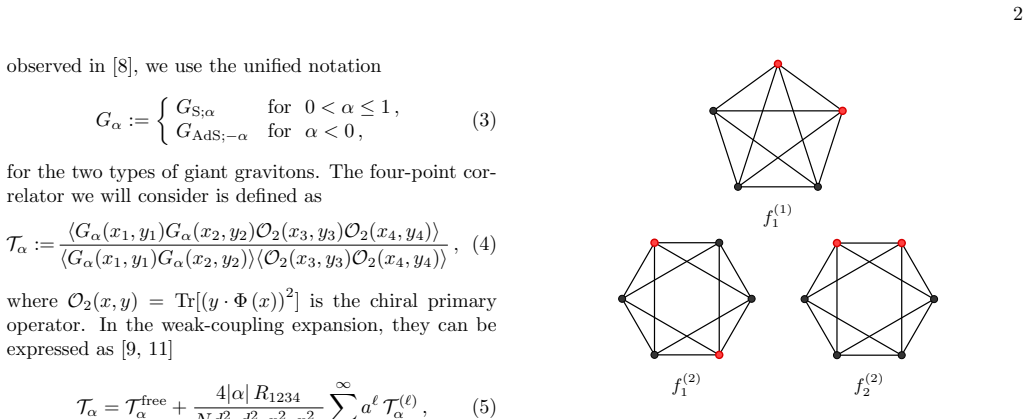
The integrandF 4+ℓ can be constructed through the chiral Lagrangian-insertion procedure, as has been done for⟨O 2O2O2O2⟩[6, 12]. In this way,F 4+ℓ can be expressed in terms off-graphs, however, unlike the case of⟨O 2O2O2O2⟩, due to the in- sertion of two giant gravitons,F 4+ℓ has reduced permu- tation symmetryS 2 ×S 2+ℓ; we will denote such more generalf-...
-
[2]
Invasion of the Giant Gravitons from Anti-de Sitter Space
John McGreevy, Leonard Susskind, and Nicolaos Toum- bas, “Invasion of the giant gravitons from Anti-de Sitter space,” JHEP06, 008 (2000), arXiv:hep-th/0003075
work page internal anchor Pith review Pith/arXiv arXiv 2000
-
[3]
Large branes in AdS and their field theory dual
Akikazu Hashimoto, Shinji Hirano, and N. Itzhaki, “Large branes in AdS and their field theory dual,” JHEP 08, 051 (2000), arXiv:hep-th/0008016
work page internal anchor Pith review Pith/arXiv arXiv 2000
-
[4]
Exact Correlators of Giant Gravitons from dual N=4 SYM
Steve Corley, Antal Jevicki, and Sanjaye Ramgoolam, “Exact correlators of giant gravitons from dual N=4 SYM theory,” Adv. Theor. Math. Phys.5, 809–839 (2002), arXiv:hep-th/0111222
work page internal anchor Pith review Pith/arXiv arXiv 2002
-
[5]
Gi- ant Graviton Correlators as Defect Systems,
Junding Chen, Yunfeng Jiang, and Xinan Zhou, “Gi- ant Graviton Correlators as Defect Systems,” Phys. Rev. Lett.135, 081602 (2025), arXiv:2503.22987 [hep-th]
-
[6]
All giant graviton two-point functions at two-loops,
Yu Wu, Yunfeng Jiang, Chang Liu, and Yang Zhang, “All giant graviton two-point functions at two-loops,” JHEP03, 097 (2026), arXiv:2509.23161 [hep-th]
-
[7]
Hidden symmetry of four-point correlation functions and amplitudes in N=4 SYM
Burkhard Eden, Paul Heslop, Gregory P. Korchemsky, and Emery Sokatchev, “Hidden symmetry of four-point correlation functions and amplitudes in N=4 SYM,” Nucl. Phys. B862, 193–231 (2012), arXiv:1108.3557 [hep-th]
work page internal anchor Pith review Pith/arXiv arXiv 2012
-
[8]
Song He, Canxin Shi, Yichao Tang, and Yao-Qi Zhang, “The cusp limit of correlators and a new graphical boot- strap for correlators/amplitudes to eleven loops,” JHEP 03, 192 (2025), arXiv:2410.09859 [hep-th]
-
[9]
Universality of giant graviton corre- lators,
Augustus Brown, Daniele Dorigoni, Francesco Galvagno, and Congkao Wen, “Universality of giant graviton corre- lators,” JHEP11, 034 (2025), arXiv:2508.15657 [hep-th]
-
[10]
Partial non-renormalisation of the stress-tensor four-point function in N=4 SYM and AdS/CFT
Burkhard Eden, Anastasios C. Petkou, Christian Schu- bert, and Emery Sokatchev, “Partial nonrenormaliza- tion of the stress tensor four point function in N=4 SYM and AdS / CFT,” Nucl. Phys. B607, 191–212 (2001), arXiv:hep-th/0009106
work page internal anchor Pith review Pith/arXiv arXiv 2001
-
[11]
Structure constants inN= 4 SYM at finite cou- pling as worldsheet g-function,
Yunfeng Jiang, Shota Komatsu, and Edoardo Vescovi, “Structure constants inN= 4 SYM at finite cou- pling as worldsheet g-function,” JHEP07, 037 (2020), arXiv:1906.07733 [hep-th]
-
[12]
Superconformal Ward Identities and their Solution
M. Nirschl and H. Osborn, “Superconformal Ward iden- tities and their solution,” Nucl. Phys. B711, 409–479 (2005), arXiv:hep-th/0407060
work page internal anchor Pith review Pith/arXiv arXiv 2005
-
[13]
Burkhard Eden, Paul Heslop, Gregory P. Korchemsky, and Emery Sokatchev, “Constructing the correlation function of four stress-tensor multiplets and the four- particle amplitude in N=4 SYM,” Nucl. Phys. B862, 450–503 (2012), arXiv:1201.5329 [hep-th]
work page internal anchor Pith review Pith/arXiv arXiv 2012
-
[14]
Giant correlators at quantum level,
Yunfeng Jiang, Yu Wu, and Yang Zhang, “Giant correlators at quantum level,” JHEP05, 345 (2024), arXiv:2311.16791 [hep-th]
-
[15]
Four-point correlator of planar supersymmetric Yang-Mills theory at twelve loops,
Jacob L. Bourjaily, Song He, Canxin Shi, and Yichao Tang, “Four-point correlator of planar supersymmetric Yang-Mills theory at twelve loops,” Phys. Rev. D112, 126029 (2025), arXiv:2503.15593 [hep-th]
-
[16]
Amplitudes and Correlators to Ten Loops Using Simple, Graphical Bootstraps
Jacob L. Bourjaily, Paul Heslop, and Vuong-Viet Tran, “Amplitudes and Correlators to Ten Loops Using Simple, Graphical Bootstraps,” JHEP11, 125 (2016), arXiv:1609.00007 [hep-th]
work page internal anchor Pith review Pith/arXiv arXiv 2016
-
[17]
Wrapping at four loops in N=4 SYM
F. Fiamberti, A. Santambrogio, C. Sieg, and D. Zanon, “Wrapping at four loops in N=4 SYM,” Phys. Lett. B 666, 100–105 (2008), arXiv:0712.3522 [hep-th]
work page internal anchor Pith review Pith/arXiv arXiv 2008
-
[18]
As we will show, this condition is not needed to determine the correlators up to two loops; it first becomes useful at three loops. We also assume that at tree and one-loop level there is a single unprotected operator (or several operators with degenerateγ G′) that dominates the OPE limit
-
[19]
Integrated corre- lators inN= 4 super Yang-Mills and periods,
Congkao Wen and Shun-Qing Zhang, “Integrated corre- lators inN= 4 super Yang-Mills and periods,” JHEP 05, 126 (2022), arXiv:2203.01890 [hep-th]
-
[20]
Integrated correlators inN= 4 SYM be- yond localisation,
Augustus Brown, Paul Heslop, Congkao Wen, and Haitian Xie, “Integrated correlators inN= 4 SYM be- yond localisation,” Phys. Rev. Lett.132, 101602 (2024), arXiv:2308.07219 [hep-th]
-
[21]
N= 4 Super-Yang-Mills correlators at strong coupling from string theory and localization,
Damon J. Binder, Shai M. Chester, Silviu S. Pufu, and Yifan Wang, “N= 4 Super-Yang-Mills correlators at strong coupling from string theory and localization,” JHEP12, 119 (2019), arXiv:1902.06263 [hep-th]
-
[22]
Far beyond the 11 planar limit in strongly-coupledN= 4 SYM,
Shai M. Chester and Silviu S. Pufu, “Far beyond the 11 planar limit in strongly-coupledN= 4 SYM,” JHEP 01, 103 (2021), arXiv:2003.08412 [hep-th]
-
[23]
Conformal Four Point Functions and the Operator Product Expansion
F. A. Dolan and H. Osborn, “Conformal four point func- tions and the operator product expansion,” Nucl. Phys. B599, 459–496 (2001), arXiv:hep-th/0011040
work page internal anchor Pith review Pith/arXiv arXiv 2001
-
[24]
Three-loop universal structure constants in N=4 susy Yang-Mills theory
Burkhard Eden, “Three-loop universal structure con- stants in N=4 supersymmetric Yang-Mills theory,” (2012), arXiv:1207.3112 [hep-th]
work page internal anchor Pith review Pith/arXiv arXiv 2012
-
[25]
The package HarmonicSums: Computer Algebra and Analytic aspects of Nested Sums
Jakob Ablinger, “The package HarmonicSums: Com- puter Algebra and Analytic aspects of Nested Sums,” PoSLL2014, 019 (2014), arXiv:1407.6180 [cs.SC]
work page internal anchor Pith review Pith/arXiv arXiv 2014
-
[26]
De- fect Approach to Giant Graviton Dynamics,
Junding Chen, Yunfeng Jiang, and Xinan Zhou, “De- fect Approach to Giant Graviton Dynamics,” (2026), arXiv:2602.13570 [hep-th]
-
[27]
Ten dimen- sional symmetry ofN= 4 SYM correlators,
Simon Caron-Huot and Frank Coronado, “Ten dimen- sional symmetry ofN= 4 SYM correlators,” JHEP03, 151 (2022), arXiv:2106.03892 [hep-th]
-
[28]
Open-Closed- Open Triality for Heavy Operators I: All-Loop Inte- grands,
Frank Coronado and Shota Komatsu, “Open-Closed- Open Triality for Heavy Operators I: All-Loop Inte- grands,” (2026), to appear
work page 2026
-
[29]
Since theOO-channel OPE only involves the anomalous dimension of the Konishi operator, which does not receive 1/Ncorrections up to three loops [16], this analysis also applies at finiteN, provided one uses the corresponding finite-Nintegrated correlators, as in [?]
-
[30]
The result is in agreement with an independent compu- tation of [27] using twistor Feynman rules [?]. As com- mented earlier, this confirms the 10-dimensional hidden symmetry for generic giant gravitons at two loops
-
[31]
We thank Frank Coro- nado for private communication on this point
This large-spin behavior is consistent with an indepen- dent light-cone bootstrap analysis. We thank Frank Coro- nado for private communication on this point
-
[32]
Many of thesef-graph periods at four loops, includ- ing non-planar ones, have been obtained in [?] and were used to verify the localization computation for ⟨O2O2O2O2⟩beyond the planar limit
-
[33]
Coulomb branch and integrability,
Frank Coronado, Shota Komatsu, and Konstantin Zarembo, “Coulomb branch and integrability,” JHEP10, 143 (2025), arXiv:2506.07222 [hep-th]
-
[34]
Large charge ’t Hooft limit ofN= 4 super-Yang-Mills,
Jo˜ ao Caetano, Shota Komatsu, and Yifan Wang, “Large charge ’t Hooft limit ofN= 4 super-Yang-Mills,” JHEP 02, 047 (2024), arXiv:2306.00929 [hep-th]
-
[35]
Large charge meets semiclassics inN= 4 super Yang-Mills,
Augustus Brown, Francesco Galvagno, Alba Grassi, Cristoforo Iossa, and Congkao Wen, “Large charge meets semiclassics inN= 4 super Yang-Mills,” JHEP06, 223 (2025), arXiv:2503.02028 [hep-th]
-
[36]
All-loop Heavy-Heavy-Light-Light correlators in N= 4 super Yang-Mills theory,
Augustus Brown, Francesco Galvagno, and Congkao Wen, “All-loop Heavy-Heavy-Light-Light correlators in N= 4 super Yang-Mills theory,” JHEP10, 171 (2024), arXiv:2407.02250 [hep-th]
-
[37]
On the large charge sector in the critical O(N) model at large N,
Simone Giombi and Jonah Hyman, “On the large charge sector in the critical O(N) model at large N,” JHEP09, 184 (2021), arXiv:2011.11622 [hep-th]
-
[38]
Exact properties of an integrated correlator inN= 4 SU(N) SYM,
Daniele Dorigoni, Michael B. Green, and Congkao Wen, “Exact properties of an integrated correlator inN= 4 SU(N) SYM,” JHEP05, 089 (2021), arXiv:2102.09537 [hep-th]
-
[39]
math.fau.de/person/oliver-schnetz/
Oliver Schnetz,HyperlogProcedures,https://www. math.fau.de/person/oliver-schnetz/
discussion (0)
Sign in with ORCID, Apple, or X to comment. Anyone can read and Pith papers without signing in.