Deforming the Trail: Baseline Quantum Circuitry for SU(2)_k Lattice Gauge Theory
Pith reviewed 2026-06-30 20:09 UTC · model grok-4.3
The pith
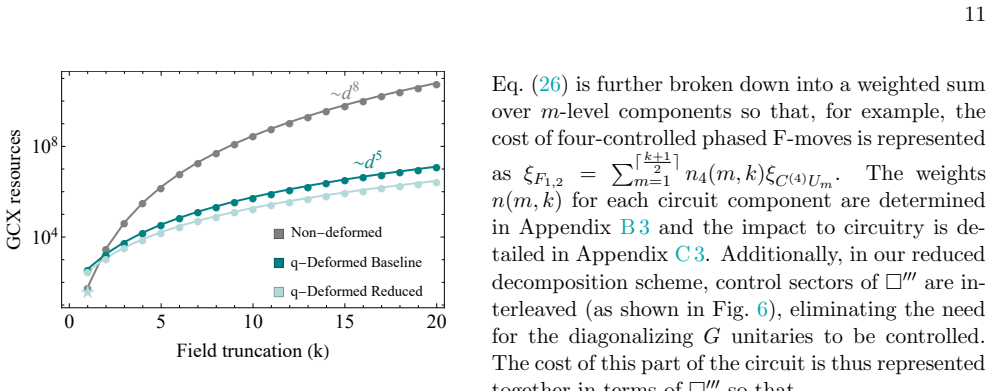
q-deformation of SU(2) lattice gauge theory reduces generalized-controlled-X gate counts from O(d^8) to O(d^5) while preserving physical Hilbert-space scaling.
A machine-rendered reading of the paper's core claim, the machinery that carries it, and where it could break.
Core claim
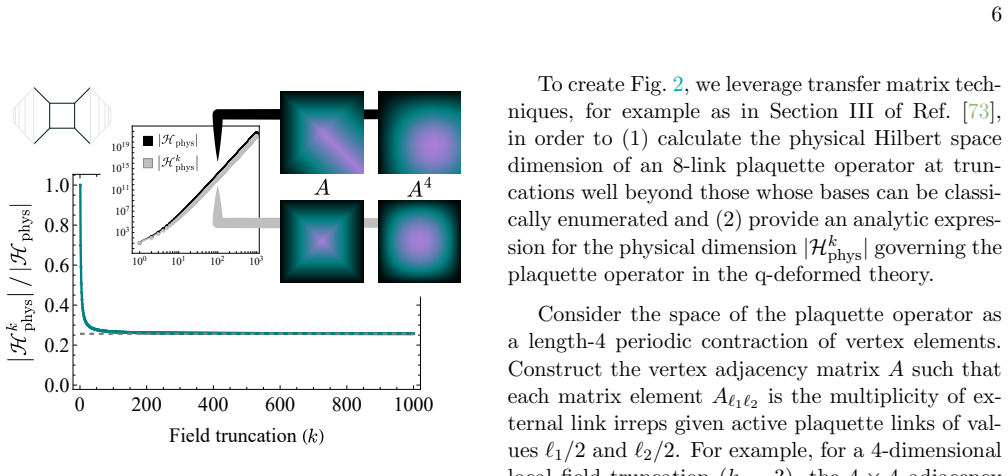
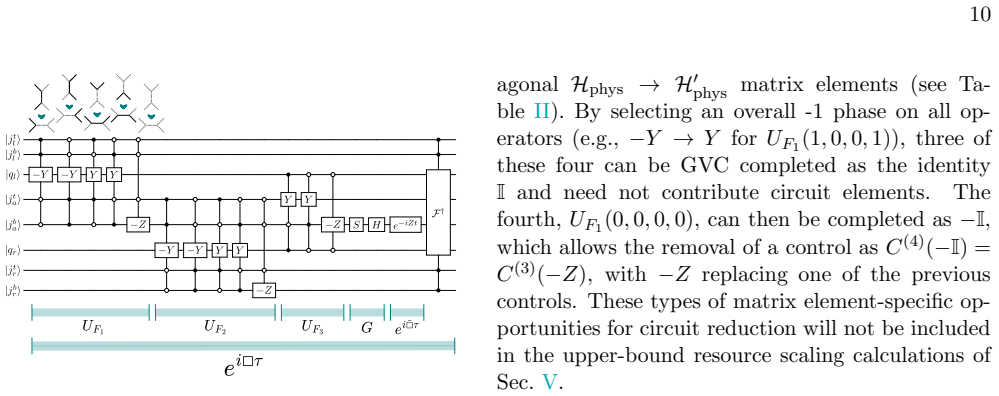
For the SU(2)_k Yang-Mills pure-gauge theory, a constructive strategy of gauge-variant completions extends the physical unitarity of the plaquette operator to the entire computational Hilbert space, leading to well-defined time-evolution unitaries. Leveraging basic circuit decompositions and symmetries of the diagonalized plaquette operator yields resource upper bounds on generalized-controlled-X two-qudit gates that scale as O(d^5) rather than O(d^8). The stronger q-deformed gauge constraint produces a physical Hilbert-space dimension that scales identically with truncation level d but multiplied by the constant factor 0.2563(5).
What carries the argument
The q-deformed plaquette operator obtained by recontracting vertex pairs, completed by gauge-variant operators that enforce unitarity on the full space.
If this is right
- Time-evolution operators for the deformed theory become concrete targets for further circuit optimization on quantum hardware.
- The same deformation strategy can be applied at every vertex and plaquette without changing the leading d-scaling of the physical subspace.
- Flux configurations exhibit an inversion symmetry under the deformation, altering interaction strengths at all length scales.
- Resource estimates for simulating pure SU(2) gauge theory on quantum computers improve by three powers of the truncation parameter.
Where Pith is reading between the lines
- The reduced gate scaling may allow simulations of larger lattices or higher representations before hardware limits are reached.
- The constant factor in the physical-state count offers a direct numerical benchmark for comparing deformed and undeformed truncations in other gauge groups.
- Because the deformation softens the gauge constraint at vertices, extensions to dynamical matter fields could be tested by checking whether the same unitarity restoration still holds.
Load-bearing premise
The q-deformed gauge constraint together with the gauge-variant completions truly extend physical unitarity to every state in the computational space while still giving a reliable truncation of the original theory.
What would settle it
An explicit circuit implementation for d greater than 5 whose two-qudit gate count exceeds the stated O(d^5) upper bound, or a direct count of physical states whose ratio to the non-deformed count deviates from 0.2563(5) by more than a few percent.
Figures
read the original abstract
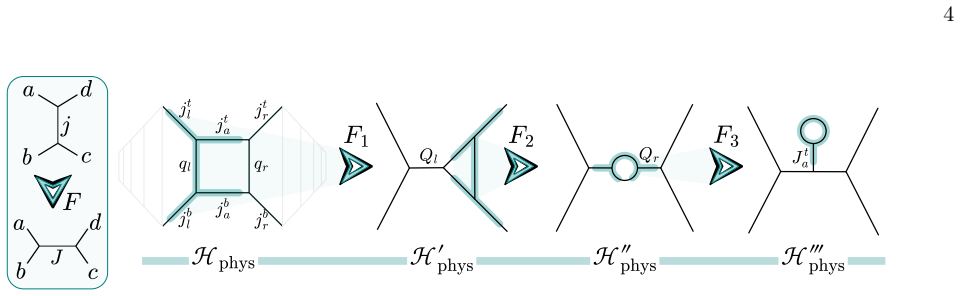
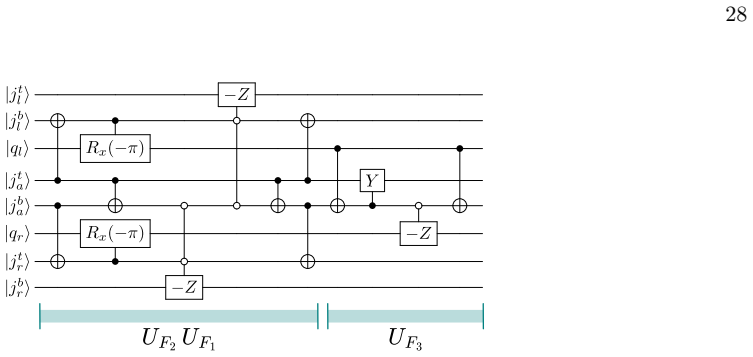
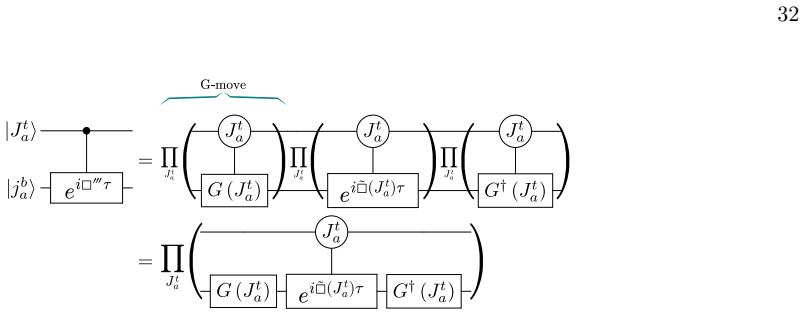
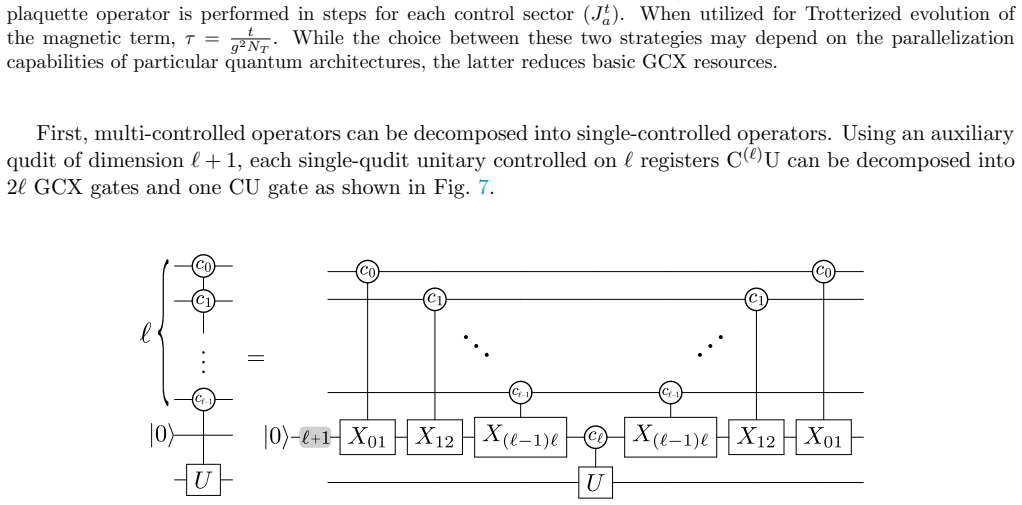
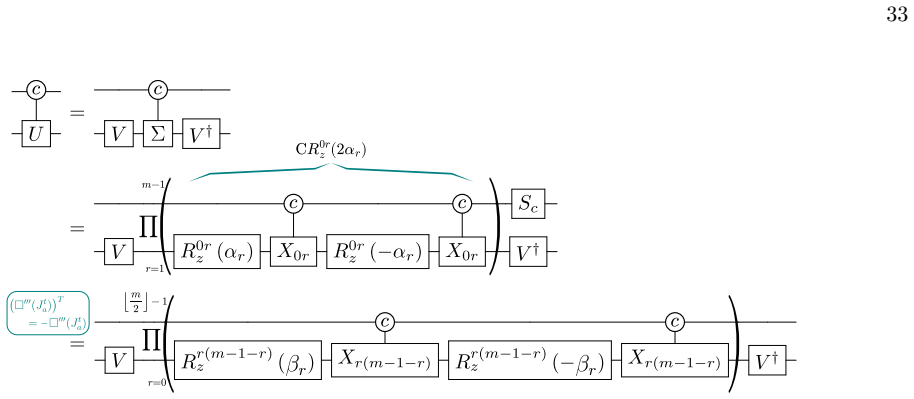
Quantifying quantum resources for simulating the fundamental forces of Nature is sensitive to the mapping of gauge fields onto finite quantum computational architectures. When locally truncating lattice gauge theories in the irreducible representation basis, it has been proposed to further deform the theory via quantum groups. The purpose of this deformation is (1) to provide an infinite tower of finite-dimensional ($d = k+1$) groups systematically approximating the infinite-dimensional gauge links and (2) to restore the physical unitarity of a plaquette operator diagonalization procedure analytically derived from the field continuum by recontracting vertex pairs. For the SU(2)$_k$ Yang-Mills pure-gauge theory, we provide a constructive strategy of gauge-variant completions to extend this unitarity to the entire computational Hilbert space, leading to well-defined time evolution unitaries as targets for optimized circuit synthesis. Leveraging basic circuit decompositions and symmetries of the diagonalized plaquette operator, we report resource upper-bounds on the generalized-controlled-X two-qudit gates for arbitrary local truncation $d$, reducing estimates and scaling relative to the non-deformed theory by three polynomial powers from $O(d^8)$ to $O(d^5)$. Examining the stronger q-deformed gauge constraint, which softens the total flux at vertices, we show that the physical Hilbert space dimension of the deformed plaquette operator scales equivalently to its non-deformed counterpart with a constant factor $0.2563(5)$. Thus, despite affecting interactions at all scales as exemplified by the observed flux hierarchy inversion symmetry, q-deformation continues to pass scrutiny as a reliable truncation offering advantages in quantum circuit synthesis.
Editorial analysis
A structured set of objections, weighed in public.
Referee Report
Summary. The manuscript develops a q-deformation of SU(2)_k pure-gauge lattice theory via quantum groups. It supplies an explicit constructive strategy for gauge-variant completions that extend physical unitarity from the deformed plaquette operator to the full computational Hilbert space. Leveraging symmetries of the diagonalized plaquette operator and basic circuit decompositions, the work derives resource upper bounds on generalized-controlled-X two-qudit gates that scale as O(d^5) for arbitrary truncation dimension d (improving on the O(d^8) scaling of the undeformed theory). It further reports that the physical Hilbert-space dimension of the deformed plaquette operator scales identically to the undeformed case up to a constant prefactor 0.2563(5).
Significance. If the constructions and bounds hold, the paper supplies a concrete route to polynomial resource reduction in quantum circuit synthesis for lattice gauge theories while preserving truncation reliability. The explicit gauge-variant completion strategy and the symmetry-based gate-count arguments constitute verifiable strengths that directly support the claimed advantages over non-deformed formulations.
minor comments (1)
- The numerical evaluation yielding the prefactor 0.2563(5) would benefit from an explicit statement of the range of d values sampled and the precise counting procedure used to obtain the physical subspace dimension.
Simulated Author's Rebuttal
We thank the referee for their positive assessment of the manuscript and for recommending acceptance. The referee's summary accurately reflects the core contributions regarding the q-deformation of SU(2)_k lattice gauge theory, the gauge-variant completion strategy, the O(d^5) resource bounds, and the Hilbert-space scaling analysis.
Circularity Check
No significant circularity identified
full rationale
The derivation chain consists of explicit constructive strategies for gauge-variant completions to extend unitarity under the q-deformed constraint, symmetry-based circuit decompositions yielding the O(d^5) gate bound, and direct numerical evaluation of the physical Hilbert-space dimension scaling factor 0.2563(5). None of these steps reduce by definition or construction to fitted inputs, self-citations, or ansatzes imported from the same authors; all are presented as independent outputs from the stated mappings and decompositions. The paper is therefore self-contained against external benchmarks with no load-bearing circular steps.
Axiom & Free-Parameter Ledger
axioms (1)
- domain assumption Quantum group deformation provides finite-dimensional (d = k+1) irreducible representations that systematically approximate infinite-dimensional gauge links.
Forward citations
Cited by 2 Pith papers
-
SU(2) gauge theory with fermions on a semi-simple cubic lattice
Introduces the semi-simple cubic (ssc) lattice for 3D SU(2) gauge theory with staggered fermions, reducing qubit count and streamlining Gauss's law for quantum hardware.
-
Photonic Analog Quantum Simulation of (1+1)-Dimensional $U(1)$ Lattice Gauge Theory with Dynamical Matter
A mapping of the Jaynes-Cummings-Hubbard model onto the spin-1/2 Quantum Link Model via tuned polaritonic resonances in cavity arrays enables analog simulation of U(1) LGT dynamics with matter, verified by exact diago...
Reference graph
Works this paper leans on
-
[1]
Z. Davoudi, I. Raychowdhury, and A. Shaw, Search for efficient formulations for Hamiltonian simulation of non-Abelian lattice gauge theories, Phys. Rev. D 104, 074505 (2021), arXiv:2009.11802 [hep-lat]
- [2]
-
[3]
Aidelsburgeret al., Cold atoms meet lat- tice gauge theory, Phil
M. Aidelsburgeret al., Cold atoms meet lat- tice gauge theory, Phil. Trans. Roy. Soc. Lond. A380, 20210064 (2021), arXiv:2106.03063 [cond- mat.quant-gas]
- [4]
- [5]
- [6]
-
[7]
A Formulation of Lattice Gauge Theories for Quantum Simulations
E. Zohar and M. Burrello, Formulation of lattice gauge theories for quantum simulations, Phys. Rev. D91, 054506 (2015), arXiv:1409.3085 [quant-ph]
work page internal anchor Pith review Pith/arXiv arXiv 2015
-
[8]
I. Raychowdhury and J. R. Stryker, Loop, string, and hadron dynamics in SU(2) Hamiltonian lattice gauge theories, Phys. Rev. D101, 114502 (2020), arXiv:1912.06133 [hep-lat]
-
[9]
M. Kreshchuk, W. M. Kirby, G. Goldstein, H. Beau- chemin, and P. J. Love, Quantum simulation of quantum field theory in the light-front formulation, Phys. Rev. A105, 032418 (2022), arXiv:2002.04016 [quant-ph]
-
[10]
U.-J. Wiese, From quantum link models to D-theory: a resource efficient framework for the quantum sim- ulation and computation of gauge theories, Phil. Trans. A. Math. Phys. Eng. Sci.380, 20210068 (2021), arXiv:2107.09335 [hep-lat]
-
[11]
A. Alexandru, P. F. Bedaque, R. Brett, and H. Lamm, Spectrum of digitized QCD: Glueballs in a S(1080) gauge theory, Phys. Rev. D105, 114508 (2022), arXiv:2112.08482 [hep-lat]
- [12]
-
[13]
D. Gonz´ alez-Cuadra, T. V. Zache, J. Carrasco, B. Kraus, and P. Zoller, Hardware Efficient Quan- tum Simulation of Non-Abelian Gauge Theories with Qudits on Rydberg Platforms, Phys. Rev. Lett.129, 160501 (2022), arXiv:2203.15541 [quant-ph]
-
[14]
Simulating lattice gauge theories on a quantum computer
T. Byrnes and Y. Yamamoto, Simulating lattice gauge theories on a quantum computer, Phys. Rev. A73, 022328 (2006), arXiv:quant-ph/0510027
work page internal anchor Pith review Pith/arXiv arXiv 2006
-
[15]
A. Ciavarella, N. Klco, and M. J. Savage, Trailhead for quantum simulation of SU(3) Yang-Mills lattice gauge theory in the local multiplet basis, Phys. Rev. D103, 094501 (2021), arXiv:2101.10227 [quant-ph]
- [16]
-
[17]
A cold-atom quantum simulator for SU(2) Yang-Mills lattice gauge theory
E. Zohar, J. I. Cirac, and B. Reznik, Cold-Atom Quantum Simulator for SU(2) Yang-Mills Lattice Gauge Theory, Phys. Rev. Lett.110, 125304 (2013), arXiv:1211.2241 [quant-ph]
work page internal anchor Pith review Pith/arXiv arXiv 2013
-
[18]
Atomic Quantum Simulation of U(N) and SU(N) Non-Abelian Lattice Gauge Theories
D. Banerjee, M. B¨ ogli, M. Dalmonte, E. Rico, P. Ste- bler, U. J. Wiese, and P. Zoller, Atomic Quantum Simulation of U(N) and SU(N) Non-Abelian Lat- tice Gauge Theories, Phys. Rev. Lett.110, 125303 (2013), arXiv:1211.2242 [cond-mat.quant-gas]
work page internal anchor Pith review Pith/arXiv arXiv 2013
-
[19]
E. Zohar, J. I. Cirac, and B. Reznik, Quantum simulations of gauge theories with ultracold atoms: local gauge invariance from angular momentum conservation, Phys. Rev. A88, 023617 (2013), arXiv:1303.5040 [quant-ph]
work page internal anchor Pith review Pith/arXiv arXiv 2013
-
[20]
Quantum Simulations of Lattice Gauge Theories using Ultracold Atoms in Optical Lattices
E. Zohar, J. I. Cirac, and B. Reznik, Quantum Sim- ulations of Lattice Gauge Theories using Ultracold Atoms in Optical Lattices, Rept. Prog. Phys.79, 014401 (2016), arXiv:1503.02312 [quant-ph]
work page internal anchor Pith review Pith/arXiv arXiv 2016
-
[21]
Eliminating fermionic matter fields in lattice gauge theories
E. Zohar and J. I. Cirac, Eliminating fermionic mat- ter fields in lattice gauge theories, Phys. Rev. B98, 075119 (2018), arXiv:1805.05347 [quant-ph]
work page internal anchor Pith review Pith/arXiv arXiv 2018
- [22]
- [23]
- [24]
- [25]
- [26]
- [27]
- [28]
-
[29]
Z. Davoudi, A. F. Shaw, and J. R. Stryker, Gen- eral quantum algorithms for Hamiltonian simula- tion with applications to a non-Abelian lattice gauge theory, Quantum7, 1213 (2023), arXiv:2212.14030 [hep-lat]
- [30]
- [31]
- [32]
-
[33]
I. D’Andrea, C. W. Bauer, D. M. Grabowska, and M. Freytsis, New basis for Hamiltonian SU(2) simulations, Phys. Rev. D109, 074501 (2024), arXiv:2307.11829 [hep-ph]
- [34]
- [35]
- [36]
- [37]
- [38]
- [39]
- [40]
- [41]
- [42]
-
[43]
Efficient Quantum Circuits for Schur and Clebsch-Gordan Transforms
D. Bacon, I. L. Chuang, and A. W. Harrow, Ef- ficient Quantum Circuits for Schur and Clebsch- Gordan Transforms, Phys. Rev. Lett.97, 170502 (2006), arXiv:quant-ph/0407082
work page internal anchor Pith review Pith/arXiv arXiv 2006
- [44]
-
[45]
Bhanot and C
G. Bhanot and C. Rebbi, Monte Carlo Simulations of Lattice Models With Finite Subgroups of SU(3) as Gauge Groups, Phys. Rev. D24, 3319 (1981)
1981
-
[46]
Petcher and D
D. Petcher and D. H. Weingarten, Monte ´Carlo cal- culations and a model of the phase structure for gauge theories on discrete subgroups of su(2), Phys. Rev. D22, 2465 (1980)
1980
-
[47]
A. Alexandru, P. F. Bedaque, S. Harmalkar, H. Lamm, S. Lawrence, and N. C. Warrington, Gluon Field Digitization for Quantum Computers, Phys. Rev. D100, 114501 (2019), arXiv:1906.11213 [hep-lat]
-
[48]
Bhanot, Su(3) lattice gauge theory in 4 dimen- sions with a modified wilson action, Physics Letters B108, 337 (1982)
G. Bhanot, Su(3) lattice gauge theory in 4 dimen- sions with a modified wilson action, Physics Letters B108, 337 (1982). 15
1982
-
[49]
B. Assi and H. Lamm, Digitization and subduction of SU(N) gauge theories, Phys. Rev. D110, 074511 (2024), arXiv:2405.12204 [hep-lat]
-
[50]
A. N. Kirillov and N. Y. Reshetikhin, Representa- tions of the algebra U(q)(sl(2)), q-orthogonal poly- nomials and invariants of links, New Developments in the Theory of Knots , 202 (1990), Accessed here
1990
-
[51]
L. C. Biedenharn and M. A. Lohe,Quantum group symmetry and Q-tensor algebras(World Scientific Publishing, Singapore, Singapore, 1995)
1995
-
[52]
Kassel,Graduate Texts in Mathematics: Quan- tum Groups, Vol
C. Kassel,Graduate Texts in Mathematics: Quan- tum Groups, Vol. 155 (Springer-Verlag, New York, 1995)
1995
-
[53]
Introduction to quantum groups
P. Podle´ s and E. M¨ uller, Introduction to Quantum Groups, Reviews in Mathematical Physics10, 511 (1998), arXiv:q-alg/9704002 [math.QA]
work page internal anchor Pith review Pith/arXiv arXiv 1998
- [54]
-
[55]
N. E. Bonesteel and D. P. DiVincenzo, Quantum cir- cuits for measuring Levin-Wen operators, Phys. Rev. B86, 165113 (2012), arXiv:1206.6048 [quant-ph]
work page internal anchor Pith review Pith/arXiv arXiv 2012
-
[56]
T. Hayata and Y. Hidaka, String-net formulation of Hamiltonian lattice Yang-Mills theories and quan- tum many-body scars in a nonabelian gauge theory, JHEP09, 126, arXiv:2305.05950 [hep-lat]
- [57]
- [58]
-
[59]
M. John, K. Pareek, P. Tirler, T. Gollerthan, M. Meth, L. Gerster, P. Zoller, D. Gonz´ alez-Cuadra, T. V. Zache, and M. Ringbauer, Non-Abelian String- Breaking Dynamics on a Qudit Quantum Computer (2026), arXiv:2605.05841 [quant-ph]
work page internal anchor Pith review Pith/arXiv arXiv 2026
-
[60]
Robson and D
D. Robson and D. M. Webber, Gauge covariance in lattice field theories, Zeitschrift f¨ ur Physik C Parti- cles and Fields15, 199 (1982)
1982
- [61]
-
[62]
J. B. Kogut and L. Susskind, Hamiltonian Formula- tion of Wilson’s Lattice Gauge Theories, Phys. Rev. D11, 395 (1975)
1975
-
[63]
Digital lattice gauge theories
E. Zohar, A. Farace, B. Reznik, and J. I. Cirac, Dig- ital lattice gauge theories, Phys. Rev. A95, 023604 (2017), arXiv:1607.08121 [quant-ph]
work page internal anchor Pith review Pith/arXiv arXiv 2017
-
[64]
S. P. Jordan, K. S. M. Lee, and J. Preskill, Quan- tum Computation of Scattering in Scalar Quantum Field Theories, Quant. Inf. Comput.14, 1014 (2014), arXiv:1112.4833 [hep-th]
work page internal anchor Pith review Pith/arXiv arXiv 2014
-
[65]
S. P. Jordan, K. S. M. Lee, and J. Preskill, Quan- tum Algorithms for Quantum Field Theories, Sci- ence336, 1130 (2012), arXiv:1111.3633 [quant-ph]
work page internal anchor Pith review Pith/arXiv arXiv 2012
-
[66]
Digitization of Scalar Fields for Quantum Computing
N. Klco and M. J. Savage, Digitization of scalar fields for quantum computing, Phys. Rev. A99, 052335 (2019), arXiv:1808.10378 [quant-ph]
work page internal anchor Pith review Pith/arXiv arXiv 2019
-
[67]
M. C. Ba˜ nuls, K. Cichy, J. I. Cirac, K. Jansen, and S. K¨ uhn, Efficient basis formulation for 1+1 dimen- sional SU(2) lattice gauge theory: Spectral calcula- tions with matrix product states, Phys. Rev. X7, 041046 (2017), arXiv:1707.06434 [hep-lat]
work page internal anchor Pith review Pith/arXiv arXiv 2017
-
[68]
S. A Rahman, R. Lewis, E. Mendicelli, and S. Powell, SU(2) lattice gauge theory on a quantum annealer, Phys. Rev. D104, 034501 (2021), arXiv:2103.08661 [hep-lat]
-
[69]
A. Ciavarella, N. Klco, and M. J. Savage, Some Con- ceptual Aspects of Operator Design for Quantum Simulations of Non-Abelian Lattice Gauge Theories (2022) arXiv:2203.11988 [quant-ph]
- [70]
- [71]
-
[72]
A. N. Ciavarella, S. Hariprakash, J. C. Halimeh, and C. W. Bauer, Truncation uncertainties for accurate quantum simulations of lattice gauge theories (2025), arXiv:2508.00061 [quant-ph]
work page internal anchor Pith review Pith/arXiv arXiv 2025
-
[73]
B. Pato and N. Klco, Trade-offs in Gauss’s law error correction for lattice gauge theory quantum simula- tions (2026), arXiv:2602.22121 [quant-ph]
-
[74]
Synthesis of Multivalued Quantum Logic Circuits by Elementary Gates
Y.-M. Di and H.-R. Wei, Synthesis of multivalued quantum logic circuits by elementary gates, Phys. Rev. A87, 012325 (2013), arXiv:1302.0056 [quant- ph]
work page internal anchor Pith review Pith/arXiv arXiv 2013
-
[75]
T. Hayata and Y. Hidaka, q deformed formulation of Hamiltonian SU(3) Yang-Mills theory, JHEP09, 123, arXiv:2306.12324 [hep-lat]
-
[76]
P. Gokhale, J. M. Baker, C. Duckering, N. C. Brown, K. R. Brown, and F. T. Chong, Asymptotic im- provements to quantum circuits via qutrits, 46th In- ternational Symposium on Computer Architecture 10.1145/3307650.3322253 (2019), arXiv:1905.10481 [quant-ph]
-
[77]
A. Litteken, J. M. Baker, and F. T. Chong, Communication Trade Offs in Intermediate Qudit Circuits, 2022 IEEE 52nd International 16 Symposium on Multiple-Valued Logic 10.1109/IS- MVL52857.2022.00014 (2022), arXiv:2211.16469 [quant-ph]
work page doi:10.1109/is- 2022
-
[78]
A. G. Fowler, Time-optimal quantum computation (2012), arXiv:1210.4626 [quant-ph]
work page internal anchor Pith review Pith/arXiv arXiv 2012
-
[79]
D. Litinski, Magic State Distillation: Not as Costly as You Think, Quantum3, 205 (2019), arXiv:1905.06903 [quant-ph]
- [80]
discussion (0)
Sign in with ORCID, Apple, or X to comment. Anyone can read and Pith papers without signing in.