Recognition: no theorem link
Significant or Not? The Impact of Randomisation During Data Reduction on Confirming a New Pulsating Ultraluminous X-ray Source Candidate in Centaurus A
Pith reviewed 2026-05-15 03:03 UTC · model grok-4.3
The pith
Randomisation during XMM-Newton data reduction introduces considerable uncertainty in confirming marginal pulsations from a new ultraluminous X-ray source candidate in Centaurus A.
A machine-rendered reading of the paper's core claim, the machinery that carries it, and where it could break.
Core claim
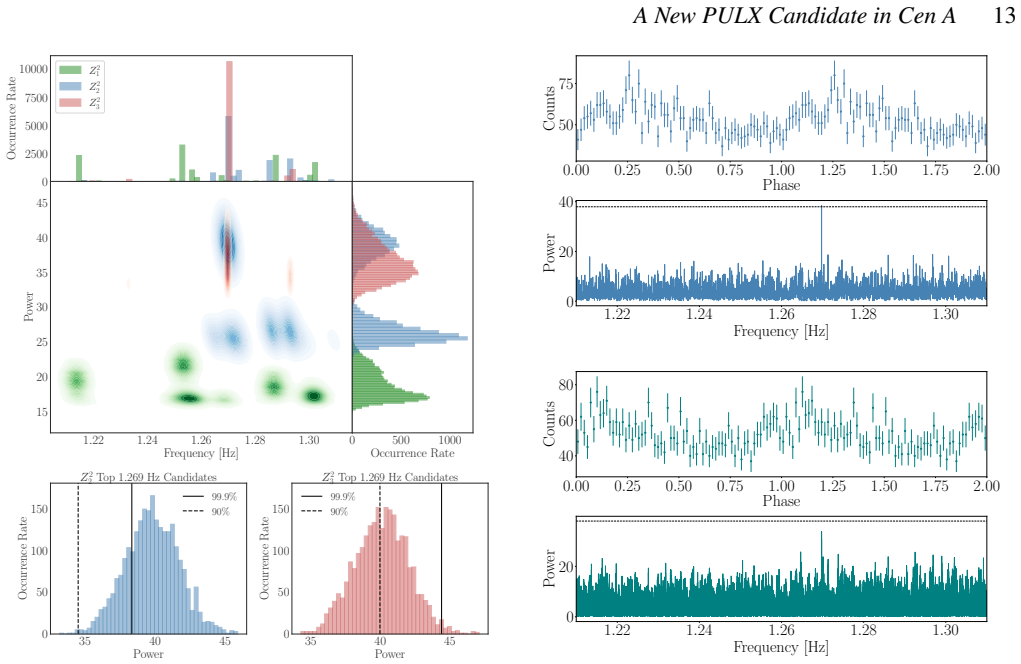
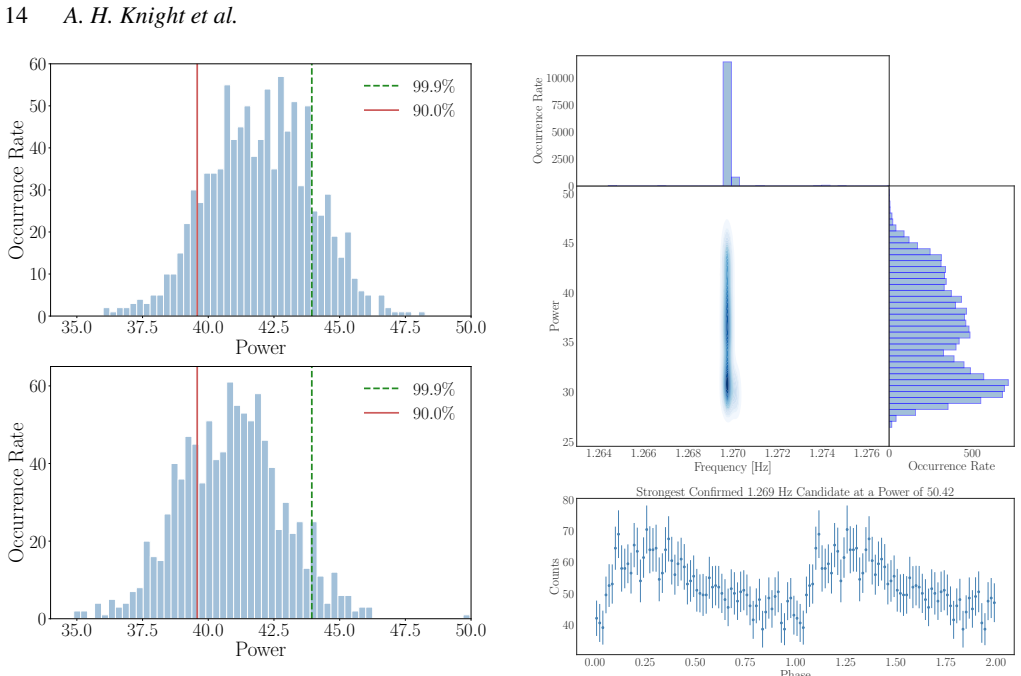
The source 4XMM J132542.2-425943 is a transient that was detectable as a bright X-ray point source for about eight months in 2014, with flux exceeding 10^{-12} erg cm^{-2} s^{-1} at peak. In XMM-Newton observation 0724060801, coherent sinusoidal pulsations at 1.27 Hz are detected at marginal significance, accompanied by a pulsed fraction of 15-17 percent and a frequency derivative of about 4 times 10^{-9} Hz s^{-1}. Repeated reductions of this same observation produce pulsation significances that vary significantly because of the randomisation step in XMM-SAS. This variability can generate widespread false positives and false negatives, which in PULX searches may cause viable candidates to被丢
What carries the argument
The intrinsic randomisation step in XMM-Newton's Science Analysis Software (XMM-SAS) during data reduction, which causes the apparent strength of pulsations to fluctuate between consecutive processing iterations of the same raw data.
If this is right
- Multiple data reductions must be performed on the same observation to determine whether a marginal pulsation signal is robust or an artifact of randomisation.
- Current searches for PULXs based on single reductions may have misclassified some sources, leading to an incomplete or contaminated sample.
- The long-term light curve and outburst behavior of this source resemble known pulsating transients, supporting its classification as a PULX candidate despite the soft spectrum.
- Re-analysis of archival XMM-Newton data for other potential PULX candidates should include checks for randomisation-induced variability in pulsation signals.
Where Pith is reading between the lines
- Similar randomisation procedures in other astronomical data pipelines could affect the reliability of timing analyses beyond X-ray pulsations.
- Developing a version of the reduction software that allows fixing the random seed would enable reproducible results and clearer assessment of signal significance.
- Confirming this candidate with independent observations from other telescopes could bypass the software issue and solidify its status as a PULX.
- Broader implications include the need for statistical methods that incorporate pipeline uncertainties when claiming detections of weak periodic signals.
Load-bearing premise
The observed variation in pulsation significance is caused solely by the randomisation step in XMM-SAS and not by any other unexamined elements of the data processing or analysis.
What would settle it
Re-running the data reduction pipeline multiple times with the randomisation disabled or using a fixed seed and finding that the pulsation significance remains constant would falsify the claim that randomisation is the source of the variation.
Figures



read the original abstract
We report the discovery of a new candidate pulsating ultraluminous X-ray source (PULX) in NGC 5128 (Centaurus A). The candidate, 4XMM J132542.2-425943, is a transient source, identifiable as a clear X-ray point source for $\sim 8$ months in 2014, during its only major recorded outburst. The source flux exceeded $10^{-12}$ erg cm$^{-2}$ s$^{-1}$ at the peak of the outburst. The long-term light curve of 4XMM J132542.2-425943 shows two further, less luminous detections in 2017 and 2024, but was otherwise in quiescence. This behaviour is similar to the class of pulsating transients with outbursts that reach the ultraluminous regime, which includes the well-studied Galactic PULX, Swift J0243.6+6124. However, 4XMM J132542.2-425943 displays a soft X-ray spectrum, making this source distinct from the existing population of PULXs, which typically show hard spectra below $10$ keV. We searched the 2014 XMM-Newton observations for X-ray pulsations, revealing coherent, sinusoidal X-ray pulsations at a frequency of $1.27$ Hz in one XMM-Newton observation (ObsID 0724060801), at a marginal significance. For this signal we measure a pulsed fraction, PF$\approx~15 - 17~\%$ and $\dot{f}~\sim~4~\times~10^{-9}$ Hz s$^{-1}$. However, we find that the intrinsic randomisation employed by XMM-Newton's Science Analysis Software, XMM-SAS, during the data reduction procedure introduces considerable uncertainty in the strength of our marginal pulsations, which varies significantly between consecutive data reduction iterations. We explore the impact of this randomisation and demonstrate that it can generate widespread false positives and false negatives, which, in the context of PULX searches, may cause viable candidates to be unnecessarily discarded or vice versa.
Editorial analysis
A structured set of objections, weighed in public.
Referee Report
Summary. The manuscript reports the discovery of a transient candidate pulsating ultraluminous X-ray source (PULX), 4XMM J132542.2-425943, in Centaurus A (NGC 5128). The source was detected in a 2014 outburst reaching fluxes above 10^{-12} erg cm^{-2} s^{-1} and shows two fainter detections in 2017 and 2024. In XMM-Newton ObsID 0724060801 the authors identify marginal coherent pulsations at 1.27 Hz with pulsed fraction ~15-17% and frequency derivative ~4e-9 Hz/s. The central result is that repeated applications of the XMM-SAS pipeline produce substantially different pulsation significances for this signal, which the authors attribute to intrinsic randomisation steps in the software and argue can generate false positives or negatives in PULX searches.
Significance. If the reported variation is shown to arise primarily from the documented XMM-SAS randomisation rather than other pipeline choices, the work would usefully caution the community against over-interpreting marginal pulsation signals in archival XMM-Newton data. The empirical demonstration on a single observation is a concrete starting point, but the absence of a quantitative error budget or controlled simulations limits the immediate impact on search strategies for the PULX population.
major comments (1)
- [Analysis of ObsID 0724060801] The central claim that the observed changes in 1.27 Hz significance are caused by XMM-SAS randomisation requires explicit isolation from other reduction steps. The manuscript does not state whether background-region selection, GTI filtering thresholds, or barycentric-correction parameters were held fixed across the repeated reductions of ObsID 0724060801; without such controls the attribution remains unproven and the warning about false positives/negatives cannot be tied specifically to randomisation.
minor comments (2)
- [Abstract] The abstract and text would benefit from a brief statement of the energy band used for the quoted flux limit and pulsed-fraction measurement.
- Notation for the frequency derivative (f-dot) should be defined on first use and kept consistent throughout.
Simulated Author's Rebuttal
We thank the referee for their careful reading of the manuscript and for the constructive comment, which helps strengthen the presentation of our results. We address the point below and have revised the manuscript to provide the requested clarification.
read point-by-point responses
-
Referee: [Analysis of ObsID 0724060801] The central claim that the observed changes in 1.27 Hz significance are caused by XMM-SAS randomisation requires explicit isolation from other reduction steps. The manuscript does not state whether background-region selection, GTI filtering thresholds, or barycentric-correction parameters were held fixed across the repeated reductions of ObsID 0724060801; without such controls the attribution remains unproven and the warning about false positives/negatives cannot be tied specifically to randomisation.
Authors: We agree that an explicit statement of the controls is necessary to isolate the effect of randomisation. In the repeated reductions of ObsID 0724060801, the background-region selection, GTI filtering thresholds, and barycentric-correction parameters were held fixed; the only source of variation between iterations was the intrinsic randomisation performed by XMM-SAS during event-list processing and source extraction. We have revised the manuscript to state these controls explicitly in the relevant section, thereby tying the observed changes in pulsation significance directly to the randomisation steps and supporting the broader warning about false positives and negatives. revision: yes
Circularity Check
No significant circularity; empirical re-processing of public data stands independently
full rationale
The paper's central claim rests on repeated executions of the public XMM-Newton pipeline on ObsID 0724060801 event lists, directly measuring variation in the 1.27 Hz pulsation significance across runs. This is an observational demonstration rather than a derivation that reduces to fitted parameters, self-citations, or ansatzes. No equations or steps equate the reported uncertainty to the input data by construction; the randomisation effect is shown by explicit iteration, and the attribution to XMM-SAS is presented as an empirical finding without load-bearing self-referential loops. The analysis is therefore self-contained against external benchmarks.
Axiom & Free-Parameter Ledger
axioms (1)
- domain assumption XMM-Newton event lists can be reduced with the standard SAS pipeline to produce timing products suitable for pulsation searches
Reference graph
Works this paper leans on
-
[1]
Bachetti M., 2018, HENDRICS: High ENergy Data Reduction Interface from the Command Shell , Astrophysics Source Code Library, record ascl:1805.019
work page 2018
-
[24]
G., Egret D., eds, Astronomical Society of the Pacific Conference Series Vol
Gabriel C., et al., 2004, in Ochsenbein F., Allen M. G., Egret D., eds, Astronomical Society of the Pacific Conference Series Vol. 314, Astronomical Data Analysis Software and Systems (ADASS) XIII. p. 759
work page 2004
-
[63]
Shakura N. I., Sunyaev R. A., 1973, , https://ui.adsabs.harvard.edu/abs/1973A&A....24..337S 24, 337
work page 1973
-
[80]
ESA, https://xmm-tools.cosmos.esa.int/external/xmm_user_support/documentation/sas_usg/USG/
XMM-Newton-SOC 2025, Users Guide to the XMM-Newton Science Analysis System, Issue 19.0. ESA, https://xmm-tools.cosmos.esa.int/external/xmm_user_support/documentation/sas_usg/USG/
work page 2025
-
[83]
The Nature of Accreting Black Holes in Nearby Galaxy Nuclei
The Nature of Accreting Black Holes in Nearby Galaxy Nuclei. , keywords =. doi:10.1086/307356 , archivePrefix =. astro-ph/9901023 , primaryClass =
work page internal anchor Pith review Pith/arXiv arXiv doi:10.1086/307356
-
[84]
An Ultraluminous X-ray Source Powered by An Accreting Neutron Star
An ultraluminous X-ray source powered by an accreting neutron star. , keywords =. doi:10.1038/nature13791 , archivePrefix =. 1410.3590 , primaryClass =
work page internal anchor Pith review Pith/arXiv arXiv doi:10.1038/nature13791
-
[85]
Observations of the X-ray sources in the nearby SC galaxy M 33. , keywords =. doi:10.1086/183553 , adsurl =
-
[86]
The Nature of Ultra-Luminous Compact X-Ray Sources in Nearby Spiral Galaxies
The Nature of Ultraluminous Compact X-Ray Sources in Nearby Spiral Galaxies. , keywords =. doi:10.1086/308868 , archivePrefix =. astro-ph/0001009 , primaryClass =
work page internal anchor Pith review Pith/arXiv arXiv doi:10.1086/308868
-
[87]
Ultraluminous X-Ray Sources. , keywords =. doi:10.1146/annurev-astro-091916-055259 , archivePrefix =. 1703.10728 , primaryClass =
work page internal anchor Pith review Pith/arXiv arXiv doi:10.1146/annurev-astro-091916-055259
-
[88]
An accreting pulsar with extreme properties drives an ultraluminous x-ray source in NGC 5907
An accreting pulsar with extreme properties drives an ultraluminous x-ray source in NGC 5907. Science , keywords =. doi:10.1126/science.aai8635 , archivePrefix =. 1609.07375 , primaryClass =
work page internal anchor Pith review Pith/arXiv arXiv doi:10.1126/science.aai8635
-
[89]
Discovery of coherent pulsations from the Ultraluminous X-ray Source NGC 7793 P13
Discovery of Coherent Pulsations from the Ultraluminous X-Ray Source NGC 7793 P13. , keywords =. doi:10.3847/2041-8205/831/2/L14 , archivePrefix =. 1609.07129 , primaryClass =
work page internal anchor Pith review Pith/arXiv arXiv doi:10.3847/2041-8205/831/2/l14 2041
-
[90]
F., Capozziello, S., & Dainotti, M
The ultraluminous state. , keywords =. doi:10.1111/j.1365-2966.2009.15123.x , archivePrefix =. 0905.4076 , primaryClass =
-
[91]
The ultraluminous state revisited: fractional variability and spectral shape as diagnostics of super-Eddington accretion. , keywords =. doi:10.1093/mnras/stt1419 , archivePrefix =. 1307.8044 , primaryClass =
work page internal anchor Pith review Pith/arXiv arXiv doi:10.1093/mnras/stt1419
-
[92]
Optical Counterparts of Ultraluminous X-Ray Sources
Optical Counterparts of Ultraluminous X-Ray Sources. arXiv e-prints , keywords =. doi:10.48550/arXiv.astro-ph/0202488 , archivePrefix =. astro-ph/0202488 , primaryClass =
work page internal anchor Pith review Pith/arXiv arXiv doi:10.48550/arxiv.astro-ph/0202488
-
[93]
Resolved atomic lines reveal outflows in two ultraluminous X-ray sources
Resolved atomic lines reveal outflows in two ultraluminous X-ray sources. , keywords =. doi:10.1038/nature17417 , archivePrefix =. 1604.08593 , primaryClass =
work page internal anchor Pith review Pith/arXiv arXiv doi:10.1038/nature17417
-
[94]
A multimission catalogue of ultraluminous X-ray source candidates. , keywords =. doi:10.1093/mnras/stab3001 , archivePrefix =. 2110.07625 , primaryClass =
-
[95]
Discovery of pulsations from NGC 300 ULX1 and its fast period evolution
Discovery of pulsations from NGC 300 ULX1 and its fast period evolution. , keywords =. doi:10.1093/mnrasl/sly030 , archivePrefix =. 1802.10341 , primaryClass =
work page internal anchor Pith review Pith/arXiv arXiv doi:10.1093/mnrasl/sly030
-
[96]
The discovery of weak coherent pulsations in the ultraluminous X-ray source NGC 1313 X-2
The discovery of weak coherent pulsations in the ultraluminous X-ray source NGC 1313 X-2. , keywords =. doi:10.1093/mnrasl/slz086 , archivePrefix =. 1906.00640 , primaryClass =
work page internal anchor Pith review Pith/arXiv arXiv doi:10.1093/mnrasl/slz086 1906
-
[97]
NICER and Fermi GBM Observations of the First Galactic Ultraluminous X-ray Pulsar Swift J0243.6+6124
NICER and Fermi GBM Observations of the First Galactic Ultraluminous X-Ray Pulsar Swift J0243.6+6124. , keywords =. doi:10.3847/1538-4357/aace60 , archivePrefix =. 1806.10094 , primaryClass =
work page internal anchor Pith review Pith/arXiv arXiv doi:10.3847/1538-4357/aace60
-
[98]
Discovery of a 2.8 s Pulsar in a 2 Day Orbit High-mass X-Ray Binary Powering the Ultraluminous X-Ray Source ULX-7 in M51. , keywords =. doi:10.3847/1538-4357/ab8a44 , archivePrefix =. 1906.04791 , primaryClass =
-
[99]
The most extreme ultraluminous X-ray sources: evidence for intermediate-mass black holes?. , keywords =. doi:10.1111/j.1365-2966.2012.20944.x , archivePrefix =. 1203.4100 , primaryClass =
-
[100]
F., Capozziello, S., & Dainotti, M
Low-metallicity natal environments and black hole masses in ultraluminous X-ray sources. , keywords =. doi:10.1111/j.1365-2966.2009.15509.x , archivePrefix =. 0909.1017 , primaryClass =
-
[101]
Ram Pressure Stripping of Disc Galaxies: The Role of the Inclination Angle , shorttitle =
XMM-Newton observations of the brightest ultraluminous X-ray sources. , keywords =. doi:10.1111/j.1365-2966.2006.10112.x , archivePrefix =. astro-ph/0601651 , primaryClass =
-
[102]
NuSTAR J095551+6940.8: a highly magnetised neutron star with super-Eddington mass accretion
NuSTAR J095551+6940.8: a highly magnetized neutron star with super-Eddington mass accretion. , keywords =. doi:10.1093/mnras/stv170 , archivePrefix =. 1412.1823 , primaryClass =
work page internal anchor Pith review Pith/arXiv arXiv doi:10.1093/mnras/stv170
-
[103]
Pulsator-like spectra from Ultraluminous X-ray sources and the search for more ultraluminous pulsars
Pulsator-like Spectra from Ultraluminous X-Ray Sources and the Search for More Ultraluminous Pulsars. , keywords =. doi:10.3847/1538-4357/836/1/113 , archivePrefix =. 1701.03595 , primaryClass =
work page internal anchor Pith review Pith/arXiv arXiv doi:10.3847/1538-4357/836/1/113
-
[104]
Predicting ultraluminous X-ray source demographics from geometrical beaming. , keywords =. doi:10.1093/mnrasl/slx079 , adsurl =
-
[105]
ULX spectra revisited: Accreting, highly magnetized neutron stars as the engines of ultraluminous X-ray sources. , keywords =. doi:10.1051/0004-6361/201730922 , archivePrefix =. 1710.04953 , primaryClass =
work page internal anchor Pith review Pith/arXiv arXiv doi:10.1051/0004-6361/201730922
-
[106]
Evidence for Pulsar-like Emission Components in the Broadband ULX Sample
Evidence for Pulsar-like Emission Components in the Broadband ULX Sample. , keywords =. doi:10.3847/1538-4357/aab610 , archivePrefix =. 1803.04424 , primaryClass =
work page internal anchor Pith review Pith/arXiv arXiv doi:10.3847/1538-4357/aab610
-
[107]
H I in the galaxy. , keywords =. doi:10.1146/annurev.aa.28.090190.001243 , adsurl =
-
[108]
Chandra and XMM-Newton discovery of the transient X-ray pulsar in the nearby spiral galaxy NGC2403
Chandra and XMM-Newton Discovery of Transient X-Ray Pulsar in the Nearby Spiral Galaxy NGC 2403. , keywords =. doi:10.1086/518500 , archivePrefix =. astro-ph/0701070 , primaryClass =
work page internal anchor Pith review Pith/arXiv arXiv doi:10.1086/518500
-
[109]
Understanding the spectral and timing behaviour of a newly discovered transient X-ray pulsar Swift J0243.6+6124. , keywords =. doi:10.1093/mnras/stx3082 , archivePrefix =. 1711.09813 , primaryClass =
work page internal anchor Pith review Pith/arXiv arXiv doi:10.1093/mnras/stx3082
-
[110]
Study of recent outburst in the Be/X-ray binary RX J0209.6-7427 with AstroSat: a new ultraluminous X-ray pulsar in the Magellanic Bridge?. , keywords =. doi:10.1093/mnras/staa1041 , archivePrefix =. 2004.04930 , primaryClass =
-
[111]
NGC 2403 XMM4: evidence for a super-Eddington neutron star with a possible transient pulsation. , keywords =. doi:10.1093/mnras/stae023 , archivePrefix =. 2401.02177 , primaryClass =
-
[112]
NGC 300 ULX1: A test case for accretion torque theory
NGC 300 ULX1: A test case for accretion torque theory. , keywords =. doi:10.1051/0004-6361/201833442 , archivePrefix =. 1811.11907 , primaryClass =
work page internal anchor Pith review Pith/arXiv arXiv doi:10.1051/0004-6361/201833442
-
[113]
A ~60-day super-orbital period originating from the ultraluminous X-ray pulsar in M82
A 60 day Super-orbital Period Originating from the Ultraluminous X-Ray Pulsar in M82. , keywords =. doi:10.3847/1538-4357/ab0215 , archivePrefix =. 1901.10491 , primaryClass =
work page internal anchor Pith review Pith/arXiv arXiv doi:10.3847/1538-4357/ab0215 1901
-
[114]
Magnetic field strength of a neutron-star-powered ultraluminous X-ray source
Magnetic field strength of a neutron-star-powered ultraluminous X-ray source. Nature Astronomy , keywords =. doi:10.1038/s41550-018-0391-6 , archivePrefix =. 1803.02376 , primaryClass =
work page internal anchor Pith review Pith/arXiv arXiv doi:10.1038/s41550-018-0391-6
-
[115]
Searching for propeller-phase ULXs in the XMM-Newton Serendipitous Source Catalogue
Searching for propeller-phase ULXs in the XMM-Newton Serendipitous Source Catalogue. , keywords =. doi:10.1093/mnras/sty501 , archivePrefix =. 1802.07753 , primaryClass =
work page internal anchor Pith review Pith/arXiv arXiv doi:10.1093/mnras/sty501
-
[116]
Digging a little deeper: characterizing three new extreme ULX candidates. , keywords =. doi:10.1093/mnras/stad2367 , archivePrefix =. 2308.01034 , primaryClass =
-
[117]
HENDRICS: High ENergy Data Reduction Interface from the Command Shell
-
[118]
Bachetti, Matteo and Huppenkothen, Daniela and Stevens, Abigail and Swinbank, John and Mastroserio, Guglielmo and Lucchini, Matteo and Lai, Eleonora Veronica and Buchner, Johannes and Desai, Amogh and Joshi, Gaurav and Pisanu, Francesco and Pisupati, Sri Guru Datta and Sharma, Swapnil and Tripathi, Mihir and Vats, Dhruv , year =. Stingray 2:. Journal of O...
-
[119]
Stingray: A Modern Python Library for Spectral Timing. apj , keywords =. doi:10.3847/1538-4357/ab258d , archivePrefix =. 1901.07681 , primaryClass =
-
[120]
A new candidate pulsating ULX in NGC 7793. , keywords =. doi:10.1093/mnras/stab814 , archivePrefix =. 2103.11650 , primaryClass =
-
[121]
CIAO: Chandra's data analysis system. Observatory Operations: Strategies, Processes, and Systems , year = 2006, editor =. doi:10.1117/12.671760 , adsurl =
-
[122]
A New Search Technique for Short Orbital Period Binary Pulsars
A New Search Technique for Short Orbital Period Binary Pulsars. , keywords =. doi:10.1086/374806 , archivePrefix =. astro-ph/0210010 , primaryClass =
work page internal anchor Pith review Pith/arXiv arXiv doi:10.1086/374806
-
[123]
Another interpretation of the power-law-type spectrum of an ultraluminous compact X-ray source in IC 342. , keywords =. doi:10.1046/j.1365-8711.2002.06043.x , archivePrefix =. astro-ph/0209113 , primaryClass =
-
[124]
2SXPS: An Improved and Expanded Swift X-Ray Telescope Point-source Catalog. , keywords =. doi:10.3847/1538-4365/ab7db9 , archivePrefix =. 1911.11710 , primaryClass =
-
[125]
Michael L. Waskom , title =. 2021 , publisher =. doi:10.21105/joss.03021 , url =
-
[126]
XMM-Newton EPIC observations of the ultraluminous X-ray source NGC 5204 X-1. , keywords =. doi:10.1111/j.1365-2966.2005.08758.x , archivePrefix =. astro-ph/0412521 , primaryClass =
-
[127]
XMM-Newton Observations of Ultraluminous X-Ray Sources in Nearby Galaxies
XMM-Newton Observations of Ultraluminous X-Ray Sources in Nearby Galaxies. , keywords =. doi:10.1086/491597 , archivePrefix =. astro-ph/0507562 , primaryClass =
work page internal anchor Pith review Pith/arXiv arXiv doi:10.1086/491597
-
[128]
Fast Search Techniques for High Energy Pulsars
Fast Search Techniques for High Energy Pulsars. Neutron Stars in Supernova Remnants , year = 2002, editor =. doi:10.48550/arXiv.astro-ph/0112006 , archivePrefix =. astro-ph/0112006 , primaryClass =
work page internal anchor Pith review Pith/arXiv arXiv doi:10.48550/arxiv.astro-ph/0112006 2002
-
[129]
Fourier Techniques for Very Long Astrophysical Time Series Analysis
Fourier Techniques for Very Long Astrophysical Time-Series Analysis. , keywords =. doi:10.1086/342285 , archivePrefix =. astro-ph/0204349 , primaryClass =
work page internal anchor Pith review Pith/arXiv arXiv doi:10.1086/342285
-
[130]
Timing Neutron Stars , year = 1989, editor =
Fourier techniques in X-ray timing. Timing Neutron Stars , year = 1989, editor =. doi:10.1007/978-94-009-2273-0_3 , adsurl =
-
[131]
Long-term X-ray spectral evolution of ultraluminous X-ray sources: implications on the accretion flow geometry and the nature of the accretor. , keywords =. doi:10.1051/0004-6361/202039572 , archivePrefix =. 2102.11159 , primaryClass =
-
[132]
Propeller states in locally supercritical ULXs. , keywords =. doi:10.1093/mnras/stac3380 , archivePrefix =. 2211.13758 , primaryClass =
-
[133]
Decomposing the Spectrum of Ultraluminous X-Ray Pulsar NGC 300 ULX-1. , keywords =. doi:10.3847/1538-4357/acf0bb , archivePrefix =. 2309.11070 , primaryClass =
-
[134]
The Distance to NGC 5128 (Centaurus A)
The Distance to NGC 5128 (Centaurus A). , keywords =. doi:10.1071/AS09061 , archivePrefix =. 0911.3180 , primaryClass =
work page internal anchor Pith review Pith/arXiv arXiv doi:10.1071/as09061
-
[135]
Flares, wind and nebulae: the 2015 December mini-outburst of V404 Cygni
Flares, wind and nebulae: the 2015 December mini-outburst of V404 Cygni. , keywords =. doi:10.1093/mnrasl/slw222 , archivePrefix =. 1610.08517 , primaryClass =
work page internal anchor Pith review Pith/arXiv arXiv doi:10.1093/mnrasl/slw222 2015
-
[136]
Multiwavelength observations of MAXI J1820+070 during its outburst decay and subsequent mini-outburst. , keywords =. doi:10.1093/mnras/stac1574 , archivePrefix =. 2206.02461 , primaryClass =
-
[137]
Ultraluminous X-ray sources. , keywords =. doi:10.1016/j.newar.2022.101672 , archivePrefix =. 2302.10605 , primaryClass =
-
[138]
Evidence for an Intermediate Mass Black Hole in NGC 5408 X-1
Evidence for an Intermediate-mass Black Hole in NGC 5408 X-1. , keywords =. doi:10.1088/0004-637X/703/2/1386 , archivePrefix =. 0911.1076 , primaryClass =
work page internal anchor Pith review Pith/arXiv arXiv doi:10.1088/0004-637x/703/2/1386
-
[139]
Astronomical Data Analysis Software and Systems (ADASS) XIII , year = 2004, editor =
The XMM-Newton SAS - Distributed Development and Maintenance of a Large Science Analysis System: A Critical Analysis. Astronomical Data Analysis Software and Systems (ADASS) XIII , year = 2004, editor =
work page 2004
- [140]
-
[141]
Optically thick envelopes around ULXs powered by accreating neutron stars
Optically thick envelopes around ULXs powered by accreating neutron stars. , keywords =. doi:10.1093/mnras/stx141 , archivePrefix =. 1612.00964 , primaryClass =
work page internal anchor Pith review Pith/arXiv arXiv doi:10.1093/mnras/stx141
-
[142]
Pulsating ultraluminous X-ray sources: Modeling the thermal emission and polarization properties. , keywords =. doi:10.1051/0004-6361/202449834 , archivePrefix =. 2411.13659 , primaryClass =
-
[143]
On the magnetic field in M51 ULX-8
On the magnetic field in M51 ULX-8. , keywords =. doi:10.1093/mnras/stz436 , archivePrefix =. 1902.04058 , primaryClass =
work page internal anchor Pith review Pith/arXiv arXiv doi:10.1093/mnras/stz436 1902
-
[144]
An ultraluminous nascent millisecond pulsar
An ultraluminous nascent millisecond pulsar. , keywords =. doi:10.1093/mnrasl/slu200 , archivePrefix =. 1411.1005 , primaryClass =
work page internal anchor Pith review Pith/arXiv arXiv doi:10.1093/mnrasl/slu200
-
[145]
Masses, beaming and Eddington ratios in ultraluminous X-ray sources. , keywords =. doi:10.1111/j.1745-3933.2008.00594.x , archivePrefix =. 0811.1473 , primaryClass =
-
[146]
Evidence for a Variable Ultrafast Outflow in the Newly Discovered Ultraluminous Pulsar NGC 300 ULX-1
Evidence for a variable Ultrafast Outflow in the newly discovered Ultraluminous Pulsar NGC 300 ULX-1. , keywords =. doi:10.1093/mnras/sty1626 , archivePrefix =. 1803.02367 , primaryClass =
work page internal anchor Pith review Pith/arXiv arXiv doi:10.1093/mnras/sty1626
-
[147]
Timing properties of ULX pulsars: optically thick envelopes and outflows
Timing properties of ULX pulsars: optically thick envelopes and outflows. , keywords =. doi:10.1093/mnras/sty3525 , archivePrefix =. 1811.02049 , primaryClass =
work page internal anchor Pith review Pith/arXiv arXiv doi:10.1093/mnras/sty3525
-
[148]
Populations of neutron star ultraluminous X-ray sources: Mind your bs and Bs. , keywords =. doi:10.1051/0004-6361/202453274 , archivePrefix =. 2501.09526 , primaryClass =
-
[149]
Quasi-isotropic UV emission in the ULX NGC 1313 X-1. , keywords =. doi:10.1093/mnras/stae1329 , archivePrefix =. 2405.14512 , primaryClass =
-
[150]
Probing the nature of the low state in the extreme ultraluminous X-ray pulsar NGC 5907 ULX1. , keywords =. doi:10.1051/0004-6361/202245048 , archivePrefix =. 2302.03425 , primaryClass =
-
[151]
Black holes in binary systems. Observational appearance. , year = 1973, month = jan, volume =
work page 1973
-
[152]
Supercritically accreting stellar mass black holes as ultraluminous X-ray sources. , keywords =. doi:10.1111/j.1365-2966.2007.11668.x , archivePrefix =. astro-ph/0609274 , primaryClass =
-
[153]
The hunt for pulsating ultraluminous X-ray sources. , keywords =. doi:10.1093/mnras/stz3036 , archivePrefix =. 1910.11857 , primaryClass =
-
[154]
The impact of precession on the observed population of ULXs. , keywords =. doi:10.1093/mnras/stab3049 , archivePrefix =. 2110.11318 , primaryClass =
-
[155]
A new pulsating neutron star in the ultraluminous X-ray source NGC 4559 X7?. , keywords =. doi:10.1051/0004-6361/202453240 , archivePrefix =. 2502.10246 , primaryClass =
-
[156]
Statistical study of a large and cleaned sample of ultraluminous and hyperluminous X-ray sources. , keywords =. doi:10.1051/0004-6361/202244952 , archivePrefix =. 2304.11216 , primaryClass =
-
[157]
Diagnosing the accretion flow in ultraluminous X-ray sources using soft X-ray atomic features
Diagnosing the accretion flow in ultraluminous X-ray sources using soft X-ray atomic features. , keywords =. doi:10.1093/mnras/stv2214 , archivePrefix =. 1509.06760 , primaryClass =
work page internal anchor Pith review Pith/arXiv arXiv doi:10.1093/mnras/stv2214
-
[158]
All at Once: Transient Pulsations, Spin-down, and a Glitch from the Pulsating Ultraluminous X-Ray Source M82 X-2. , keywords =. doi:10.3847/1538-4357/ab6d00 , archivePrefix =. 1905.06423 , primaryClass =
discussion (0)
Sign in with ORCID, Apple, or X to comment. Anyone can read and Pith papers without signing in.