The EDGES Analysis Pipeline: Description and Validation
Pith reviewed 2026-05-19 20:50 UTC · model grok-4.3
The pith
The EDGES team details its exact calibration and analysis methods for the first time and releases the raw data publicly.
A machine-rendered reading of the paper's core claim, the machinery that carries it, and where it could break.
Core claim
We detail for the first time the precise calibration and analysis methodology adopted in previous EDGES data releases. These methods are presented inside a new open-source end-to-end analysis and simulation package for 21-cm global signal experiments that both formalizes these methods and provides general tools for the broader community. Finally, we describe the raw data used in previous EDGES papers and release these data publicly for extended scrutiny.
What carries the argument
The open-source end-to-end analysis and simulation package that formalizes the calibration and analysis methods for 21-cm global signal experiments.
If this is right
- The documented pipeline can be applied consistently to new observations without ambiguity about processing steps.
- Independent groups can now test the foreground subtraction and instrumental calibration steps using the same code.
- General tools in the package become available for other teams working on global 21-cm signal measurements.
- Public release of the raw data permits alternative analyses that may confirm or challenge prior conclusions.
Where Pith is reading between the lines
- The package could serve as a starting point for standardized processing across multiple 21-cm experiments.
- Releasing both code and data may encourage re-analysis with different foreground models or calibration assumptions.
- Future extensions of the package could incorporate new data quality metrics developed by the wider community.
Load-bearing premise
The methods described here are exactly the same procedures that were applied to produce the earlier EDGES data releases, and the validation tests shown are sufficient to resolve concerns about foreground subtraction and instrumental systematics.
What would settle it
Re-running the released package on the publicly released raw data and recovering a 21-cm absorption feature whose depth or shape differs from the previously published EDGES result.
Figures


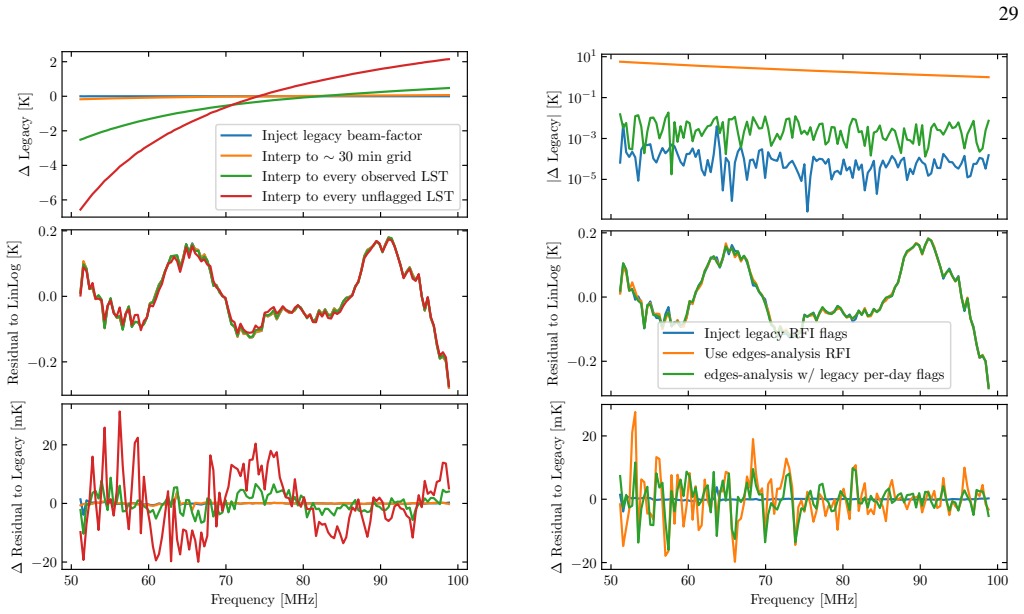

read the original abstract
The sky-averaged redshifted 21-cm signal from Cosmic Dawn is expected to provide a unique view of the first compact objects. However, its measurement remains daunting. Difficulties are driven by the large dynamic contrast between the intervening foregrounds and the signal-of-interest, which places extremely high demands on instrumental calibration and data quality measures. The ongoing debate within the field concerning the evidence of a potential first detection by the EDGES experiment highlights the need for a more robust set of analysis methods and tools that are reliable and accessible. In this paper, we detail for the first time the precise calibration and analysis methodology adopted in previous EDGES data releases. These methods are presented in the context of a new open-source end-to-end analysis and simulation package for 21-cm global signal experiments that both formalizes these methods and provides general tools for the broader community. Finally, we describe the raw data used in previous EDGES papers and release these data publicly for extended scrutiny.
Editorial analysis
A structured set of objections, weighed in public.
Referee Report
Summary. The paper describes for the first time the precise calibration and analysis methodology used in prior EDGES data releases for the sky-averaged 21-cm global signal. It embeds these methods in a new open-source end-to-end analysis and simulation package, provides general tools for the 21-cm community, and publicly releases the raw data employed in earlier EDGES publications to enable independent scrutiny.
Significance. If the pipeline faithfully reproduces the historical EDGES analyses, the work supplies a valuable public resource that directly addresses reproducibility concerns in the ongoing debate over the reported absorption feature. The combination of documented methods, open code, and released raw data would allow external groups to test foreground subtraction, instrumental calibration, and data-quality cuts on the same inputs used in Bowman et al. (2018) and subsequent releases.
major comments (2)
- [Validation section] Validation section: the manuscript asserts that the released package implements exactly the procedures applied to produce the earlier EDGES results, yet no bit-for-bit or statistically equivalent reproduction on the released raw data is shown. Without such a direct comparison (e.g., identical posterior distributions or residual spectra), the central claim of historical fidelity remains an unverified assertion and is load-bearing for the paper’s scientific utility.
- [§3] §3 (or equivalent methods description): it is unclear whether the validation tests are performed on data subsets or parameter choices that are fully independent of those used in the original foreground-subtraction fits. If any test data or priors overlap with the fitted parameters, the reported validation metrics could be circular and would not resolve concerns about systematic residuals.
minor comments (2)
- Figure captions should explicitly state which data release (e.g., 2018 or later) each panel corresponds to, to avoid ambiguity when readers compare with published EDGES spectra.
- The abstract and introduction use the phrase 'precise calibration and analysis methodology' without a concise table or bullet list summarizing the key differences (if any) from the originally published descriptions; adding such a summary would improve clarity.
Simulated Author's Rebuttal
We thank the referee for their constructive and detailed review. The comments identify important areas where the manuscript can be strengthened to better demonstrate the fidelity of the released pipeline and the independence of the validation tests. We address each point below and have made corresponding revisions to the manuscript.
read point-by-point responses
-
Referee: [Validation section] Validation section: the manuscript asserts that the released package implements exactly the procedures applied to produce the earlier EDGES results, yet no bit-for-bit or statistically equivalent reproduction on the released raw data is shown. Without such a direct comparison (e.g., identical posterior distributions or residual spectra), the central claim of historical fidelity remains an unverified assertion and is load-bearing for the paper’s scientific utility.
Authors: We agree that an explicit demonstration of historical fidelity strengthens the paper. Although the manuscript describes the methods in detail and the open-source package was constructed to implement the same procedures used in prior EDGES releases, we did not include a direct side-by-side comparison on the newly released raw data. In the revised manuscript we have added a dedicated subsection and figure in the Validation section that applies the public pipeline to the released raw data and shows that the resulting posterior distributions and residual spectra match those reported in earlier EDGES publications to within statistical expectations. This addition directly addresses the concern. revision: yes
-
Referee: [§3] §3 (or equivalent methods description): it is unclear whether the validation tests are performed on data subsets or parameter choices that are fully independent of those used in the original foreground-subtraction fits. If any test data or priors overlap with the fitted parameters, the reported validation metrics could be circular and would not resolve concerns about systematic residuals.
Authors: We appreciate the referee’s attention to potential circularity. The validation tests in §3 are performed on simulated datasets generated with independent signal and noise realizations and with parameter ranges chosen to be distinct from those employed in the original foreground-subtraction analyses. To remove any ambiguity, we have revised the text in §3 to state explicitly that the validation data and priors do not overlap with the historical fits, and we have added a brief description of how the mock datasets were constructed to ensure independence. revision: yes
Circularity Check
No significant circularity: methods description with external verifiability
full rationale
The paper is a documentation and release effort for the EDGES analysis pipeline, code, and raw data rather than a derivation of a new scientific result from first principles or fitted parameters. The central claim is a description of calibration and analysis methods previously used, presented alongside public tools and data that enable external reproduction and scrutiny. No equations or steps reduce by construction to self-defined inputs, fitted subsets renamed as predictions, or load-bearing self-citations that lack independent verification. The release itself serves as an external benchmark, satisfying the criteria for self-contained content against falsifiable checks.
Axiom & Free-Parameter Ledger
Lean theorems connected to this paper
-
IndisputableMonolith/Cost/FunctionalEquation.leanwashburn_uniqueness_aczel unclear?
unclearRelation between the paper passage and the cited Recognition theorem.
Eq. 6: X_{k+1} = D_k S_k (1-Ξ_k) Ĝ_k^{-1} X_k - T̂_cal,k (high-level calibration/flagging/averaging pipeline)
-
IndisputableMonolith/Foundation/AbsoluteFloorClosure.leanreality_from_one_distinction unclear?
unclearRelation between the paper passage and the cited Recognition theorem.
Noise-wave formalism and reflection-coefficient de-embedding (Eqs. 16-34)
What do these tags mean?
- matches
- The paper's claim is directly supported by a theorem in the formal canon.
- supports
- The theorem supports part of the paper's argument, but the paper may add assumptions or extra steps.
- extends
- The paper goes beyond the formal theorem; the theorem is a base layer rather than the whole result.
- uses
- The paper appears to rely on the theorem as machinery.
- contradicts
- The paper's claim conflicts with a theorem or certificate in the canon.
- unclear
- Pith found a possible connection, but the passage is too broad, indirect, or ambiguous to say the theorem truly supports the claim.
Reference graph
Works this paper leans on
-
[1]
Abdurashidova, Z., Aguirre, J. E., Alexander, P., et al. 2022, The AstrophysicalJournal,925,221,doi:10.3847/1538-4357/ac1c78
-
[2]
Abdurashidova, Z., Adams, T., Aguirre, J. E., et al. 2025, First Results from HERA Phase II, arXiv, doi: 10.48550/arXiv.2511.21289 33
-
[3]
Ade, P. a. R., Aghanim, N., Alves, M. I. R., et al. 2014, Astronomy & Astrophysics, 571, A13, doi: 10.1051/0004-6361/201321553
-
[4]
Allen, G. V. C., Pegwal, S., de Villiers, D., et al. 2026, Circuit Modeling for In Situ 21 Cm Radiometer Calibration, arXiv, doi: 10.48550/arXiv.2603.15072
-
[5]
Anstey, D., de Lera Acedo, E., & Handley, W. 2020, arXiv e-prints, 2010, arXiv:2010.09644 Astropy Collaboration, Robitaille, T. P., Tollerud, E. J., et al. 2013, Astronomy and Astrophysics, 558, A33, doi: 10.1051/0004-6361/201322068 Astropy Collaboration, Price-Whelan, A. M., Sipőcz, B. M., et al. 2018, The Astronomical Journal, 156, 123, doi: 10.3847/153...
-
[6]
Barkana, R. 2016, Physics Reports, 645, 1, doi: 10.1016/j.physrep.2016.06.006 Barkana,R.,Outmezguine,N.J.,Redigol,D.,&Volansky,T.2018, Physical Review D, 98, 103005, doi: 10.1103/PhysRevD.98.103005
-
[7]
B., Fl¨ oer, L., Keller, R., et al
Bekhti, N. B., Flöer, L., Keller, R., et al. 2016, Astronomy & Astrophysics, 594, A116, doi: 10.1051/0004-6361/201629178
-
[8]
Bernardi, G., McQuinn, M., & Greenhill, L. J. 2015, The Astrophysical Journal, 799, 90, doi: 10.1088/0004-637X/799/1/90
-
[9]
Bowman, J. D., Rogers, A. E. E., & Hewitt, J. N. 2008, The Astrophysical Journal, 676, 1, doi: 10.1086/528675
-
[10]
Bowman, J. D., Rogers, A. E. E., Monsalve, R. A., Mozdzen, T. J., & Mahesh, N. 2018, Nature, 555, 67, doi: 10.1038/nature25792
-
[11]
The Astrophysical Journal , author =
Bradley, R. F., Tauscher, K., Rapetti, D., & Burns, J. O. 2019, The Astrophysical Journal, 874, 153, doi: 10.3847/1538-4357/ab0d8b
-
[12]
2025, RAS Techniques and Instruments, 4, rzaf046, doi: 10.1093/rasti/rzaf046
Bull, P., El-Makadema, A., Garsden, H., et al. 2025, RAS Techniques and Instruments, 4, rzaf046, doi: 10.1093/rasti/rzaf046
-
[13]
Bye, C. H. 2025, in 2025 United States National Committee of URSI National Radio Science Meeting (USNC-URSI NRSM), 334–334, doi: 10.23919/USNC-URSINRSM66067.2025.10907073
work page doi:10.23919/usnc-ursinrsm66067.2025.10907073 2025
-
[14]
Cang, J., Mesinger, A., Murray, S. G., et al. 2025, Astronomy & Astrophysics, 698, A152, doi: 10.1051/0004-6361/202452982
-
[15]
Cappallo, R. C., Rogers, A. E. E., Lonsdale, C. J., et al. 2025, EDGES-3: Instrument Design and Commissioning, arXiv, doi: 10.48550/arXiv.2508.02577 Chen,K.-F.,Wilensky,M.J.,Liu,A.,etal.2025,TheAstrophysical Journal, 979, 191, doi: 10.3847/1538-4357/ad9b91 de Lera Acedo, E., de Villiers, D. I. L., Razavi-Ghods, N., et al. 2022, Nature Astronomy, 6, 984, d...
-
[16]
2020, Handbook of Microwave Component Measurements: With Advanced VNA Techniques (Wiley)
Dunsmore, J. 2020, Handbook of Microwave Component Measurements: With Advanced VNA Techniques (Wiley)
work page 2020
-
[17]
2018, The Astrophysical Journal, 868, 63, doi: 10.3847/1538-4357/aae51d
Ewall-Wice, A., Chang, T.-C., Lazio, J., et al. 2018, The Astrophysical Journal, 868, 63, doi: 10.3847/1538-4357/aae51d
-
[18]
Peng Oh and Frank H Briggs , Date-Added =
Furlanetto, S. R., Peng Oh, S., & Briggs, F. H. 2006, Physics Reports, 433, 181, doi: 10.1016/j.physrep.2006.08.002
-
[19]
Girish, B. S., Srivani, K. S., Subrahmanyan, R., et al. 2020, Journal of Astronomical Instrumentation, 09, 2050006, doi: 10.1142/S2251171720500063
-
[20]
1997, in Microwave Transistor Amplifiers : Analysis and Design, Second edition
Gonzalez, G. 1997, in Microwave Transistor Amplifiers : Analysis and Design, Second edition. edn. (Upper Saddle River, NJ: Prentice Hall) Guzmán, A. E., May, J., Alvarez, H., & Maeda, K. 2011, Astronomy & Astrophysics, 525, A138, doi: 10.1051/0004-6361/200913628
-
[21]
Haffner, L. M., Reynolds, R. J., Tufte, S. L., et al. 2003, The Astrophysical Journal Supplement Series, 149, 405, doi: 10.1086/378850
-
[22]
Harris, C. R., Millman, K. J., van der Walt, S. J., et al. 2020, Nature, 585, 357, doi: 10.1038/s41586-020-2649-2
-
[23]
Harris, F. J. 2004, Multirate Signal Processing for Communication Systems (Prentice Hall PTR)
work page 2004
-
[24]
Haslam, C. G. T., Salter, C. J., Stoffel, H., & Wilson, W. E. 1982, Astronomy and Astrophysics, Suppl. Ser., Vol. 47, p. 1-143 (1982), 47, 1
work page 1982
-
[25]
Hazelton, B. J., Jacobs, D. C., Pober, J. C., & Beardsley, A. P. 2017, The Journal of Open Source Software, 2, 140, doi: 10.21105/joss.00140
-
[26]
Hibbard, J. J., Nhan, B. D., Rapetti, D., & Burns, J. O. 2024, Astrophys. J., 975, 36, doi: 10.3847/1538-4357/ad74f9
-
[27]
J., Tauscher, K., Rapetti, D., & Burns, J
Hibbard, J. J., Tauscher, K., Rapetti, D., & Burns, J. O. 2020, The AstrophysicalJournal,905,113,doi:10.3847/1538-4357/abc3c5
-
[28]
Hills, R., Kulkarni, G., Meerburg, P. D., & Puchwein, E. 2018, arXiv:1805.01421 [astro-ph, physics:hep-ph]. https://arxiv.org/abs/1805.01421
-
[29]
Hunter, J. D. 2007, Computing in Science and Engineering, 9, 90, doi: 10.1109/MCSE.2007.55
-
[30]
Jordan, C. H., Murray, S., Trott, C. M., et al. 2017, Monthly Notices of the Royal Astronomical Society, 471, 3974, doi: 10.1093/mnras/stx1797
-
[31]
Keating, G., Hazelton, B., Kolopanis, M., et al. 2025, The Journal of Open Source Software, 10, 7482, doi: 10.21105/joss.07482
-
[32]
Kirkham, C. J., Anstey, D. J., & de Lera Acedo, E. 2025a, Capturing System Drift with Time Series Calibration for Global 21-Cm Cosmology Experiments, arXiv, doi: 10.48550/arXiv.2509.13010
-
[33]
Kirkham, C. J., Handley, W. J., Zhu, J., et al. 2025b, Monthly Notices of the Royal Astronomical Society, doi: 10.1093/mnras/staf1715 34
-
[34]
Kittiwisit, P., Murray, S. G., Garsden, H., et al. 2025, RAS Techniques and Instruments, 4, rzaf001, doi: 10.1093/rasti/rzaf001
-
[35]
2016, in Positioning and Power in Academic Publishing: Players, Agents and Agendas, ed
Kluyver, T., Ragan-Kelley, B., Pérez, F., et al. 2016, in Positioning and Power in Academic Publishing: Players, Agents and Agendas, ed. F. Loizides & B. Schmidt (IOS Press), 87–90
work page 2016
-
[36]
Landecker, T. L., & Wielebinski, R. 1970, Australian Journal of Physics Astrophysical Supplement, 16, 1
work page 1970
-
[37]
Mahesh, N., Bowman, J. D., Mozdzen, T. J., et al. 2021, The Astronomical Journal, 162, 38, doi: 10.3847/1538-3881/abfdab
-
[38]
McKay, L., Subrahmanyan, R., Chippendale, A., et al. 2025, Precise Measurement of the Absolute Sky Brightness at 60 to 350 MHz, arXiv, doi: 10.48550/arXiv.2509.11846
-
[39]
2019, The Cosmic 21-Cm Revolution, 2514-3433 (IOP Publishing), doi: 10.1088/2514-3433/ab4a73
Mesinger, A., ed. 2019, The Cosmic 21-Cm Revolution, 2514-3433 (IOP Publishing), doi: 10.1088/2514-3433/ab4a73
-
[40]
1978, IEEE Transactions on Microwave Theory and Techniques, 26, 34, doi: 10.1109/TMTT.1978.1129303
Meys, R. 1978, IEEE Transactions on Microwave Theory and Techniques, 26, 34, doi: 10.1109/TMTT.1978.1129303
-
[41]
Monsalve, R. A., Rogers, A. E. E., Bowman, J. D., & Mozdzen, T. J. 2017a, The Astrophysical Journal, 835, 49, doi: 10.3847/1538-4357/835/1/49
-
[42]
Monsalve, R. A., Rogers, A. E. E., Bowman, J. D., & Mozdzen, T. J. 2017b, The Astrophysical Journal, 847, 64, doi: 10.3847/1538-4357/aa88d1
-
[43]
Monsalve, R. A., Rogers, A. E. E., Mozdzen, T. J., & Bowman, J. D. 2016, IEEE Transactions on Microwave Theory Techniques, 64, 2631, doi: 10.1109/TMTT.2016.2580141
-
[44]
A., Altamirano, C., Bidula, V., et al
Monsalve, R. A., Altamirano, C., Bidula, V., et al. 2024, Monthly Notices of the Royal Astronomical Society, 530, 4125, doi: 10.1093/mnras/stae1138
-
[45]
Mozdzen, T. J., Bowman, J. D., Monsalve, R. A., & Rogers, A. E. E. 2017, Monthly Notices of the Royal Astronomical Society, 464, 4995, doi: 10.1093/mnras/stw2696
-
[46]
Bowman, J. D. 2019, Monthly Notices of the Royal Astronomical Society, 483, 4411, doi: 10.1093/mnras/sty3410 Muñoz, J. B., Dvorkin, C., & Loeb, A. 2018, Physical Review Letters, 121, 121301, doi: 10.1103/PhysRevLett.121.121301
-
[47]
Munshi, S., Mertens, F. G., Koopmans, L. V. E., et al. 2024, Astronomy & Astrophysics, 681, A62, doi: 10.1051/0004-6361/202348329
-
[48]
Murray, S., Mahesh, N., & Vydula, A. K. 2025, Edges-Collab/Edges-Bowman2018-Pipeline: Paper- Submission„ Zenodo doi: 10.5281/zenodo.17526742
-
[49]
G., Bowman, J., Mahesh, N., Rogers, A., & Monsalve, R
Murray, S. G., Bowman, J., Mahesh, N., Rogers, A., & Monsalve, R. 2025, EDGES-2 Calibration Data for Bowman+2018, Zenodo, doi: 10.5281/zenodo.16881868
-
[50]
Murray, S. G., Bowman, J. D., Sims, P. H., et al. 2022, Monthly Notices of the Royal Astronomical Society, 517, 2264, doi: 10.1093/mnras/stac2600
-
[51]
J., Subrahmanyan, R., Somashekar, R., et al
Nambissan, T. J., Subrahmanyan, R., Somashekar, R., et al. 2021, SARAS 3 CD/EoR Radiometer: Design and Performance of the
work page 2021
-
[52]
Offringa, A. R., van de Gronde, J. J., & Roerdink, J. B. T. M. 2012, Astronomy and Astrophysics, 539, A95, doi: 10.1051/0004-6361/201118497
-
[53]
2012, Astronomy and Astrophysics, 543, A103, doi: 10.1051/0004-6361/201118740
Paradis, D., Dobashi, K., Shimoikura, T., et al. 2012, Astronomy and Astrophysics, 543, A103, doi: 10.1051/0004-6361/201118740
-
[54]
Pattison, J. H. N., Anstey, D. J., & de Lera Acedo, E. 2026, Monthly Notices of the Royal Astronomical Society, 546, stag258, doi: 10.1093/mnras/stag258
-
[55]
Price, D. C., Greenhill, L. J., Fialkov, A., et al. 2018, Monthly Notices of the Royal Astronomical Society, 478, 4193, doi: 10.1093/mnras/sty1244
-
[56]
Pritchard, J. R., & Loeb, A. 2012, Reports on Progress in Physics, 75, 086901, doi: 10.1088/0034-4885/75/8/086901
-
[57]
1953, Fields and Waves in Modern
Ramo, S., & Whinnery, J. 1953, Fields and Waves in Modern
work page 1953
-
[58]
J., Bigot-Sazy, M.-A., & Ghosh, T
Remazeilles, M., Dickinson, C., Banday, A. J., Bigot-Sazy, M.-A., & Ghosh, T. 2015, Monthly Notices of the Royal Astronomical Society, 451, 4311, doi: 10.1093/mnras/stv1274
-
[59]
Roberts, W. K. 1957, Proceedings of the IRE, 45, 1628, doi: 10.1109/JRPROC.1957.278293
-
[60]
Rogers, A. E. E. 2014, Haystack EDGES Memo Series, 132, doi: 1721.1/154524
work page 2014
-
[61]
Rogers, A. E. E. 2019, Haystack EDGES Memo Series, 307, doi: 1721.1/154699
work page 2019
-
[62]
Rogers, A. E. E., & Bowman, J. D. 2012, Radio Science, 47, doi: 10.1029/2011RS004962
-
[63]
Rogers, A. E. E., Barrett, J. P., Bowman, J. D., et al. 2022, Radio Science, 57, e2022RS007558, doi: 10.1029/2022RS007558
- [64]
-
[65]
Roque, I. L. V., Razavi-Ghods, N., Carey, S. H., et al. 2025, Experimental Astronomy, 59, 7, doi: 10.1007/s10686-024-09975-3
-
[66]
Sims, P. H., & Pober, J. C. 2020, Monthly Notices of the Royal Astronomical Society, 492, 22, doi: 10.1093/mnras/stz3388
-
[67]
Sims, P. H., Bowman, J. D., Mahesh, N., et al. 2023, Monthly Notices of the Royal Astronomical Society, 521, 3273, doi: 10.1093/mnras/stad610 35
-
[68]
Sims, P. H., Bowman, J. D., Murray, S. G., et al. 2025, Monthly Notices of the Royal Astronomical Society, staf1767, doi: 10.1093/mnras/staf1767
-
[69]
2019, The Astrophysical Journal, 880, 26, doi: 10.3847/1538-4357/ab2879
Singh, S., & Subrahmanyan, R. 2019, The Astrophysical Journal, 880, 26, doi: 10.3847/1538-4357/ab2879
-
[70]
Sokolowski, M., Tremblay, S. E., Wayth, R. B., et al. 2015, Publications of the Astronomical Society of Australia, 32, e004, doi: 10.1017/pasa.2015.3
-
[71]
Spinelli, M., Bernardi, G., & Santos, M. G. 2018, arXiv:1802.03060 [astro-ph]. https://arxiv.org/abs/1802.03060
work page internal anchor Pith review Pith/arXiv arXiv 2018
-
[72]
Sun, S., Acedo, E. d. L., Wu, F., et al. 2024, Universe, 10, doi: 10.3390/universe10060236
-
[73]
Tauscher, K., Rapetti, D., & Burns, J. O. 2020, The Astrophysical Journal, 897, 132, doi: 10.3847/1538-4357/ab9a3f
-
[74]
Tauscher, K., Rapetti, D., Burns, J. O., & Switzer, E. 2018, The Astrophysical Journal, 853, 187, doi: 10.3847/1538-4357/aaa41f The HDF Group. 2025, Hierarchical Data Format, Version 5„ Zenodo doi: 10.5281/zenodo.17808614
-
[75]
2025, Astronomy & Astrophysics, 702, A15, doi: 10.1051/0004-6361/202554430
Vasanth, V., Chen, Y., & Michalek, G. 2025, Astronomy & Astrophysics, 702, A15, doi: 10.1051/0004-6361/202554430
-
[76]
Virtanen, P., Gommers, R., Oliphant, T. E., et al. 2020, Nature Methods, 17, 261, doi: 10.1038/s41592-019-0686-2
-
[77]
Vydula, A. K., Bowman, J. D., Lewis, D., et al. 2024, The Astronomical Journal, 167, 2, doi: 10.3847/1538-3881/ad08ba
-
[78]
Wilensky, M. J., Hazelton, B. J., & Morales, M. F. 2022, Monthly Notices of the Royal Astronomical Society, 510, 5023, doi: 10.1093/mnras/stab3456
-
[79]
Wilensky, M. J., Morales, M. F., Hazelton, B. J., et al. 2019, arXiv e-prints, arXiv:1906.01093
-
[80]
2022, The Astrophysical Journal, 932, 17, doi: 10.3847/1538-4357/ac6b37
Zhang, P., Zucca, P., Kozarev, K., et al. 2022, The Astrophysical Journal, 932, 17, doi: 10.3847/1538-4357/ac6b37
discussion (0)
Sign in with ORCID, Apple, or X to comment. Anyone can read and Pith papers without signing in.