"I'm Not Mad, Just Focused'': Understanding Human Emotions in Human-Robot Collaboration
Pith reviewed 2026-05-19 21:29 UTC · model grok-4.3
The pith
A vision-language model for emotion recognition aligns better with human judgments than convolutional networks and produces preferred robot adaptations in collaboration tasks.
A machine-rendered reading of the paper's core claim, the machinery that carries it, and where it could break.
Core claim
The paper claims that its VLM-based emotion recognition system achieves higher semantic similarity and positive sentiment alignment with human annotations on an HRC dataset compared to a baseline CNN system, and that participants in a collaborative delivery task with a service robot preferred the emotion-adaptive robot behavior enabled by the VLM-ER inferences.
What carries the argument
The VLM-ER system that combines vision and language inputs for contextual inference of human emotional states during collaboration.
If this is right
- The VLM-ER system produces emotion interpretations that align more closely with human semantic and sentiment judgments than CNN baselines.
- Users favor robots whose actions adapt to emotional states detected by the VLM-ER system in collaborative delivery tasks.
- Contextual multimodal inputs can reduce dependence on acted datasets and single-modality signals like facial expressions alone.
Where Pith is reading between the lines
- Robots in service or manufacturing settings could respond to subtle cues like focused concentration rather than mistaking them for negative states.
- The approach may support longer-term trust in repeated human-robot interactions by incorporating emotional context over time.
- Combining this inference with robot planning modules could enable proactive task adjustments based on detected user states.
Load-bearing premise
That modulating a robot's behavior according to emotional states inferred by the VLM will improve collaboration quality and user preference without introducing new errors or biases in real settings.
What would settle it
A follow-up user study in the same delivery task where participants show no preference or performance difference between VLM-adaptive robot behavior and a non-adaptive baseline.
Figures
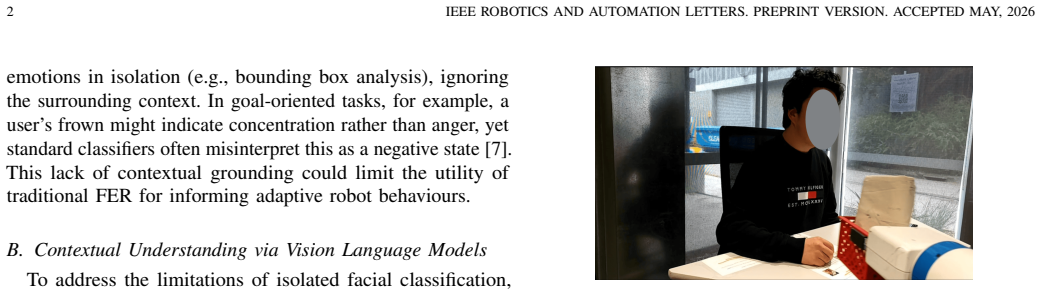


read the original abstract
Human-robot collaboration (HRC) can benefit from robots' abilities to interpret human emotional states. However, current emotion recognition (ER) models in HRC often fall short, particularly due to their reliance on acted datasets and single-modality inputs like facial expressions. We propose a novel vision language model (VLM)-based ER system that leverages contextual understanding to improve emotion interpretation in HRC. We first evaluate the VLM-ER system by assessing its semantic and sentiment similarity with human annotations on an existing HRC dataset. Then, in a user study with a service robot in a collaborative delivery task, we evaluate the effects of modulating the robot's behaviour based on the user's emotional state inferred by the VLM-ER system. The results show that the proposed VLM-ER system achieves higher semantic similarity and positive sentiment alignment with human annotations compared to a baseline convolutional neural network-based system. Further, participants in the user study preferred emotion-adaptive robot behaviour facilitated by the VLM-ER system.
Editorial analysis
A structured set of objections, weighed in public.
Referee Report
Summary. The manuscript proposes a vision-language model (VLM)-based emotion recognition (ER) system for human-robot collaboration that leverages contextual cues to interpret human emotions more effectively than single-modality CNN approaches. It evaluates semantic and sentiment similarity to human annotations on an existing HRC dataset and reports results from a user study in which a service robot modulates its behavior according to VLM-inferred emotional states during a collaborative delivery task, with participants preferring the adaptive condition.
Significance. If the central claims hold after addressing design details, the work could meaningfully advance emotion-aware HRC by demonstrating that VLMs can provide contextually richer emotion signals than traditional models. The dual evaluation strategy (dataset similarity plus user preference) directly targets the motivating claim and supplies falsifiable evidence; the absence of free parameters or circular fitting in the reported comparisons is a strength.
major comments (2)
- [User study] User study section: the reported preference for VLM-ER-facilitated adaptive behavior rests on a single-task design that does not isolate the contribution of emotion inference accuracy. No details are given on participant blinding to the robot's emotional awareness, counterbalancing of task difficulty or robot personality, or objective secondary measures (completion time, error rates, or physiological signals) that would rule out novelty or demand-characteristic confounds.
- [Evaluation] Evaluation section: the claim of higher semantic similarity and positive sentiment alignment is presented without reported sample sizes, exact metric definitions, error bars, or statistical tests, making it impossible to assess whether the improvement over the CNN baseline is reliable or practically meaningful.
minor comments (2)
- [Title] The title is colloquial; a more descriptive subtitle would help readers locate the technical contribution.
- [Methods] Clarify the precise VLM architecture, prompting strategy, and any fine-tuning steps used in the VLM-ER pipeline.
Simulated Author's Rebuttal
We thank the referee for the detailed and constructive comments. We address each major point below, indicating where revisions will be made to improve clarity and rigor while preserving the core contributions of the work.
read point-by-point responses
-
Referee: [User study] User study section: the reported preference for VLM-ER-facilitated adaptive behavior rests on a single-task design that does not isolate the contribution of emotion inference accuracy. No details are given on participant blinding to the robot's emotional awareness, counterbalancing of task difficulty or robot personality, or objective secondary measures (completion time, error rates, or physiological signals) that would rule out novelty or demand-characteristic confounds.
Authors: We agree that the single-task design limits the ability to isolate the precise contribution of emotion inference accuracy and that additional controls would strengthen causal claims. The study was intentionally scoped to a realistic collaborative delivery task to evaluate end-to-end user preference for adaptive behavior. In the revision we will expand the user study section with further procedural details, including how conditions were presented and any counterbalancing of task elements. We will add an explicit limitations paragraph acknowledging the lack of participant blinding, absence of objective secondary measures, and potential novelty or demand effects. These points will be framed as important directions for follow-up studies rather than claims the current data fully resolve. revision: partial
-
Referee: [Evaluation] Evaluation section: the claim of higher semantic similarity and positive sentiment alignment is presented without reported sample sizes, exact metric definitions, error bars, or statistical tests, making it impossible to assess whether the improvement over the CNN baseline is reliable or practically meaningful.
Authors: We accept that the evaluation reporting was incomplete. The comparisons were performed on the full set of human annotations from the existing HRC dataset. In the revised manuscript we will state the exact sample size, provide precise definitions of the semantic similarity (cosine similarity between VLM embeddings and human annotations) and sentiment alignment metrics, include error bars or standard deviations, and report statistical tests (e.g., paired t-tests or Wilcoxon tests) with p-values to establish whether the observed improvements over the CNN baseline are reliable. revision: yes
Circularity Check
No circularity: empirical comparisons to external baselines and annotations
full rationale
The paper describes an empirical VLM-based emotion recognition system evaluated via semantic/sentiment similarity metrics against human annotations on an existing HRC dataset and against a separate CNN baseline, followed by a user study measuring participant preference for emotion-adaptive robot behavior. No equations, parameter fitting, or derivation steps are present that could reduce outputs to inputs by construction. All load-bearing claims rest on independent external references (human labels, baseline model, participant responses) rather than self-referential fitting or self-citation chains, rendering the evaluation self-contained.
Axiom & Free-Parameter Ledger
axioms (2)
- domain assumption Vision-language models can produce emotion interpretations that align with human semantic and sentiment judgments when given contextual image and task information.
- domain assumption Participants' stated preference for emotion-adaptive robot behavior reflects genuine improvement in collaboration experience.
Lean theorems connected to this paper
-
IndisputableMonolith/Foundation/RealityFromDistinction.leanreality_from_one_distinction unclear?
unclearRelation between the paper passage and the cited Recognition theorem.
We propose a novel vision language model (VLM)-based ER system that leverages contextual understanding to improve emotion interpretation in HRC.
-
IndisputableMonolith/Foundation/Cost/FunctionalEquation.leanwashburn_uniqueness_aczel unclear?
unclearRelation between the paper passage and the cited Recognition theorem.
A binomial test revealed that a significant majority of participants preferred the EA condition over the control condition
What do these tags mean?
- matches
- The paper's claim is directly supported by a theorem in the formal canon.
- supports
- The theorem supports part of the paper's argument, but the paper may add assumptions or extra steps.
- extends
- The paper goes beyond the formal theorem; the theorem is a base layer rather than the whole result.
- uses
- The paper appears to rely on the theorem as machinery.
- contradicts
- The paper's claim conflicts with a theorem or certificate in the canon.
- unclear
- Pith found a possible connection, but the passage is too broad, indirect, or ambiguous to say the theorem truly supports the claim.
Reference graph
Works this paper leans on
-
[1]
Li Liu, Fu Guo, Zishuai Zou, and Vincent G Duffy. Application, development and future opportunities of collaborative robots (cobots) in manufacturing: A literature review.International Journal of Human– Computer Interaction, 40(4):915–932, 2024
work page 2024
-
[2]
Aitor Toichoa Eyam, Wael M. Mohammed, and Jose L. Martinez Lastra. Emotion-driven analysis and control of human-robot interactions in collaborative applications.Sensors, 21(14), 2021
work page 2021
-
[3]
A review of the emotion recognition model of robots.Applied Intelligence, 55(6):1–33, 2025
Mingyi Zhao, Linrui Gong, and Abdul Sattar Din. A review of the emotion recognition model of robots.Applied Intelligence, 55(6):1–33, 2025
work page 2025
-
[4]
Shan Jia, Shuo Wang, Chuanbo Hu, Paula J Webster, and Xin Li. Detection of genuine and posed facial expressions of emotion: databases and methods.Frontiers in psychology, 11:580287, 2021
work page 2021
-
[5]
Niyati Rawal and Ruth Maria Stock-Homburg. Facial emotion expressions in human–robot interaction: A survey.International Journal of Social Robotics, 14(7):1583–1604, 2022
work page 2022
-
[6]
Hillel Aviezer, Yaacov Trope, and Alexander Todorov. Body cues, not facial expressions, discriminate between intense positive and negative emotions.Science, 338(6111):1225–1229, 2012
work page 2012
-
[7]
Fabian Benitez-Quiroz, Ramprakash Srinivasan, Qianli Feng, Yan Wang, and Aleix M
C. Fabian Benitez-Quiroz, Ramprakash Srinivasan, Qianli Feng, Yan Wang, and Aleix M. Martinez. Emotionet challenge: Recognition of facial expressions of emotion in the wild, 2017
work page 2017
-
[8]
Alexandra Weidemann and Nele Rußwinkel. The role of frustration in human–robot interaction–what is needed for a successful collaboration? Frontiers in psychology, 12:640186, 2021
work page 2021
-
[9]
Sergio Garcia, Francisco Gomez-Donoso, and Miguel Cazorla. Enhancing human–robot interaction: Development of multimodal robotic assistant for user emotion recognition.Applied Sciences, 14(24):11914, 2024
work page 2024
-
[10]
Matteo Spezialetti, Giuseppe Placidi, and Silvia Rossi. Emotion recognition for human-robot interaction: Recent advances and future perspectives.Frontiers in Robotics and AI, 7:532279, 2020
work page 2020
-
[11]
Najmeh Samadiani, Guangyan Huang, Borui Cai, Wei Luo, Chi-Hung Chi, Yong Xiang, and Jing He. A review on automatic facial expression recognition systems assisted by multimodal sensor data.Sensors, 19(8), 2019
work page 2019
-
[12]
Daniel Octavian Melinte and Luige Vladareanu. Facial expressions recognition for human–robot interaction using deep convolutional neural networks with rectified adam optimizer.Sensors, 20(8):2393, 2020
work page 2020
-
[13]
Ramachandran Venkatesan, Sundarsingh Shirly, Mariappan Selvarathi, and Theena Jemima Jebaseeli. Human emotion detection using deepface and artificial intelligence.Engineering Proceedings, 59(1):37, 2023
work page 2023
-
[14]
Eva G Krumhuber, Dennis K ¨uster, Shushi Namba, Datin Shah, and Manuel G Calvo. Emotion recognition from posed and spontaneous dynamic expressions: Human observers versus machine analysis.Emotion, 21(2):447, 2021
work page 2021
-
[15]
Hyoung-Rock Kim and Dong-Soo Kwon. Computational model of emotion generation for human–robot interaction based on the cognitive appraisal theory.Journal of Intelligent & Robotic Systems, 60:263–283, 2010
work page 2010
-
[16]
Alexandros Xenos, Niki Maria Foteinopoulou, Ioanna Ntinou, Ioannis Patras, and Georgios Tzimiropoulos. Vllms provide better context for emotion understanding through common sense reasoning.arXiv preprint arXiv:2404.07078, 2024
-
[17]
When robots get chatty: Grounding multimodal human-robot conversation and collaboration
Philipp Allgeuer, Hassan Ali, and Stefan Wermter. When robots get chatty: Grounding multimodal human-robot conversation and collaboration. In International Conference on Artificial Neural Networks, pages 306–321. Springer, 2024
work page 2024
-
[18]
Leimin Tian, Kerry He, Shiyu Xu, Akansel Cosgun, and Dana Kulic. Crafting with a robot assistant: use social cues to inform adaptive handovers in human-robot collaboration. InProceedings of the 2023 ACM/IEEE International Conference on Human-Robot Interaction, pages 252–260, 2023
work page 2023
-
[19]
Collaborative object handover in a robot crafting assistant
Leimin Tian, Shiyu Xu, Kerry He, Rachel Love, Akansel Cosgun, and Dana Kulic. Collaborative object handover in a robot crafting assistant. arXiv preprint arXiv:2502.19991, 2025
-
[20]
Katie Hoemann, Evan Warfel, Caitlin Mills, Laura Allen, Peter Kuppens, and Jolie B Wormwood. Using freely generated labels instead of rating scales to assess emotion in everyday life.Assessment, 32(6):859–877, 2025
work page 2025
-
[21]
Deepface: Closing the gap to human-level performance in face verification
Yaniv Taigman, Ming Yang, Marc’Aurelio Ranzato, and Lior Wolf. Deepface: Closing the gap to human-level performance in face verification. In2014 IEEE Conference on Computer Vision and Pattern Recognition, pages 1701–1708, 2014
work page 2014
-
[22]
Yolov9: Learn- ing what you want to learn using programmable gradient information, 2024
Chien-Yao Wang, I-Hau Yeh, and Hong-Yuan Mark Liao. Yolov9: Learn- ing what you want to learn using programmable gradient information, 2024
work page 2024
-
[23]
Nidhal Jegham, Chan Young Koh, Marwan Abdelatti, and Abdeltawab Hendawi. Yolo evolution: A comprehensive benchmark and architectural review of yolov12, yolo11, and their previous versions.arXiv preprint arXiv:2411.00201, 2024
-
[24]
Yuntao Shou, Tao Meng, Wei Ai, and Keqin Li. Multimodal large language models meet multimodal emotion recognition and reasoning: A survey.arXiv preprint arXiv:2509.24322, 2025
-
[25]
C-pack: Packaged resources to advance general chinese embedding, 2023
Shitao Xiao, Zheng Liu, Peitian Zhang, and Niklas Muennighoff. C-pack: Packaged resources to advance general chinese embedding, 2023
work page 2023
-
[26]
C. Hutto and Eric Gilbert. Vader: A parsimonious rule-based model for sentiment analysis of social media text.Proceedings of the International AAAI Conference on Web and Social Media, 8(1):216–225, May 2014
work page 2014
-
[27]
Christoph Bartneck, Dana Kuli ´c, Elizabeth Croft, and Susana Zoghbi. Measurement instruments for the anthropomorphism, animacy, likeability, perceived intelligence, and perceived safety of robots.International journal of social robotics, 1:71–81, 2009
work page 2009
-
[28]
Object handovers: a review for robotics
Valerio Ortenzi, Akansel Cosgun, Tommaso Pardi, Wesley P Chan, Elizabeth Croft, and Dana Kuli ´c. Object handovers: a review for robotics. IEEE Transactions on Robotics, 37(6):1855–1873, 2021
work page 2021
discussion (0)
Sign in with ORCID, Apple, or X to comment. Anyone can read and Pith papers without signing in.