An Analysis on the Parton Distribution Functions of Heavy Mesons
Pith reviewed 2026-05-20 13:06 UTC · model grok-4.3
The pith
Heavy constituents carry larger momentum fractions than light ones inside heavy mesons.
A machine-rendered reading of the paper's core claim, the machinery that carries it, and where it could break.
Core claim
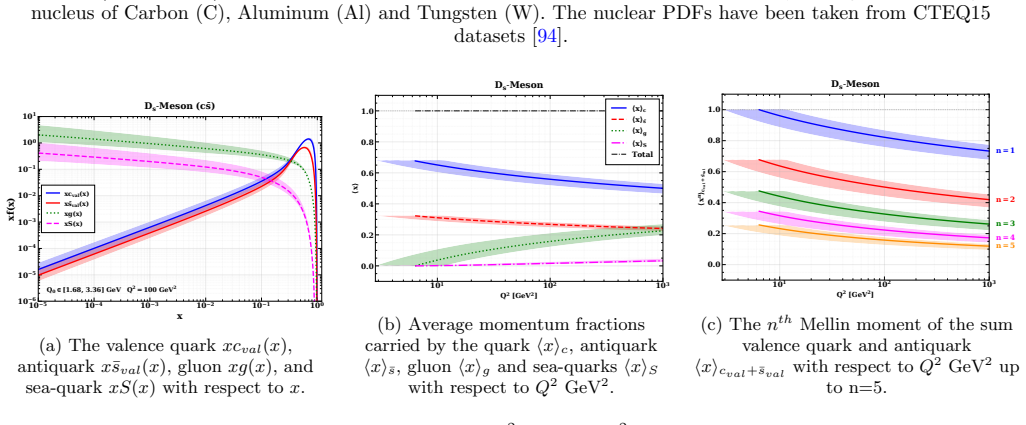
Within the light-cone quark model, the initial-scale PDFs of heavy pseudoscalar mesons are constructed from quark-quark correlation functions, then evolved via NLO DGLAP equations; the resulting momentum fractions demonstrate that the heavy quark and antiquark carry larger shares of the total momentum than the lighter constituents both before and after evolution.
What carries the argument
Light-cone quark model PDFs derived from quark-quark correlation functions, evolved with NLO DGLAP equations to extract constituent momentum fractions.
If this is right
- Heavy mesons exhibit a partonic structure in which valence heavy quarks dominate the longitudinal momentum.
- Kaon structure functions can be predicted at the energy scales of the upcoming Electron-Ion Collider.
- Drell-Yan cross sections for both isospin states of the kaon can be computed for nuclear targets such as carbon, tungsten, and aluminum.
Where Pith is reading between the lines
- The same dominance pattern may appear in other heavy-hadron systems once similar model calculations are performed.
- Higher-order evolution or lattice comparisons could provide independent checks on the momentum-fraction ordering.
Load-bearing premise
The initial-scale quark and antiquark PDFs obtained by evaluating the quark-quark correlation functions for individual mesons accurately represent the mesons' partonic structure at the model scale.
What would settle it
An experimental measurement of momentum fractions in a heavy meson at high scales showing the lighter constituent carrying a larger fraction than the heavy one would contradict the dominance result.
Figures






read the original abstract
In this work, we investigate the constituent parton distribution functions (PDFs) of the kaon and heavy pseudoscalar mesons within the light-cone quark model. Starting from the initial scale quark and antiquark PDFs, obtained by evaluating the quark-quark correlation functions for individual mesons, we perform quantum chromodynamics (QCD) evolution to determine the partonic structure at higher energy scales. The QCD evolution has been carried out through the next-to-leading order (NLO) Dokshitzer-Gribov-Lipatov-Altarelli-Parisi (DGLAP) equations. We further compute the average longitudinal momentum fractions carried by the individual constituents both at the model scale and evolved scale. In addition, the NLO structure functions for the kaon are predicted at higher energy scales relevant for the upcoming Electron-Ion Collider (EIC). For the COMPASS++/AMBER experiment, we further present detailed predictions for the NLO Drell-Yan cross sections corresponding to both isospin states of the kaon, employing Carbon, Tungsten, and Aluminum as nuclear targets. We demonstrate the dominance of the heavy constituents over the lighter constituents within their heavy mesons in terms of their possessed momentum fractions.
Editorial analysis
A structured set of objections, weighed in public.
Referee Report
Summary. The manuscript investigates the parton distribution functions of the kaon and heavy pseudoscalar mesons in the light-cone quark model. Initial-scale valence PDFs are obtained by evaluating quark-quark correlation functions, followed by NLO DGLAP evolution to higher scales. Average longitudinal momentum fractions <x> are computed at both the model scale and after evolution; NLO structure functions for the kaon are predicted at EIC-relevant scales, and NLO Drell-Yan cross sections are given for kaon isospin states on Carbon, Tungsten, and Aluminum targets. The central claim is that heavy constituents dominate the momentum fractions in heavy mesons.
Significance. If the light-cone model inputs are reliable, the work supplies concrete predictions for upcoming EIC structure-function measurements and COMPASS++/AMBER Drell-Yan data, together with a quantitative statement of heavy-quark momentum dominance that could be tested. The approach of fixing model-scale PDFs and evolving them perturbatively is standard, but the absence of any reported validation, error propagation, or comparison to existing calculations or data limits the immediate utility of the results.
major comments (2)
- [Abstract / initial-scale PDF construction] The central claim of heavy-constituent dominance rests on the average momentum fractions <x> evaluated directly from the quark-quark correlation functions that define the initial-scale PDFs (Abstract and workflow description). No validation against experimental constraints, lattice results, or alternative heavy-meson models is presented, so it is impossible to determine whether the reported dominance reflects the meson structure or the specific light-cone ansatz chosen for the heavy-light mass asymmetry.
- [Momentum-fraction and evolution sections] The manuscript supplies no error estimates, scale-variation bands, or sensitivity tests on the model-scale input. Because evolution preserves the ordering only when the initial asymmetry is sufficiently large, the lack of uncertainty quantification on the initial <x> values makes the post-evolution dominance statement difficult to assess quantitatively.
minor comments (2)
- Notation for the initial scale and the precise definition of the model wave function should be stated explicitly in the main text rather than left implicit in the abstract description.
- Figure captions and table headings should include the numerical values of the model scale and the evolution scale used for each result.
Simulated Author's Rebuttal
We thank the referee for the careful reading of our manuscript and the constructive comments. We address each major comment point by point below and indicate the revisions we will make to strengthen the presentation and quantitative support for our results.
read point-by-point responses
-
Referee: [Abstract / initial-scale PDF construction] The central claim of heavy-constituent dominance rests on the average momentum fractions <x> evaluated directly from the quark-quark correlation functions that define the initial-scale PDFs (Abstract and workflow description). No validation against experimental constraints, lattice results, or alternative heavy-meson models is presented, so it is impossible to determine whether the reported dominance reflects the meson structure or the specific light-cone ansatz chosen for the heavy-light mass asymmetry.
Authors: We acknowledge that the manuscript does not contain explicit side-by-side comparisons with lattice QCD or other non-perturbative calculations for heavy-meson PDFs. The light-cone quark model parameters are fixed by reproducing the known decay constants and masses of the mesons, which constitute indirect experimental constraints. In the revised version we will add a dedicated paragraph in Section II that recalls prior validations of the same light-cone ansatz for the kaon against available data and that briefly contrasts our <x> values with expectations from heavy-quark effective theory and selected Dyson-Schwinger studies. This addition clarifies that the reported dominance follows from the large mass asymmetry built into the model wave function rather than from an arbitrary choice of functional form. revision: partial
-
Referee: [Momentum-fraction and evolution sections] The manuscript supplies no error estimates, scale-variation bands, or sensitivity tests on the model-scale input. Because evolution preserves the ordering only when the initial asymmetry is sufficiently large, the lack of uncertainty quantification on the initial <x> values makes the post-evolution dominance statement difficult to assess quantitatively.
Authors: We agree that the absence of uncertainty quantification limits the ability to judge how robust the dominance conclusion remains under reasonable variations of the model input. In the revised manuscript we will include a new sensitivity study: the constituent quark masses and the transverse-momentum scale parameter of the light-cone wave function are varied within intervals consistent with meson spectroscopy. The resulting spread in the initial-scale <x> values is propagated through the NLO DGLAP evolution and displayed as shaded bands on the relevant figures for both the momentum fractions and the predicted observables. We also add a short paragraph demonstrating that the ordering of <x> is preserved for all variations explored, thereby addressing the referee’s concern about the stability of the post-evolution statement. revision: yes
Circularity Check
No significant circularity; model inputs yield direct momentum-fraction results
full rationale
The paper defines initial-scale valence PDFs by direct evaluation of quark-quark correlation functions inside the light-cone quark model for each meson, then computes average momentum fractions <x> as the first moment of those same PDFs at both the model scale and after NLO DGLAP evolution. This is a straightforward model calculation rather than a prediction that reduces to its inputs by construction. No load-bearing self-citation, fitted parameter renamed as prediction, or ansatz smuggled via prior work is present in the provided text; the dominance statement follows immediately from integrating the model-defined distributions. The derivation chain remains self-contained against external benchmarks.
Axiom & Free-Parameter Ledger
free parameters (1)
- model-scale initial PDFs
axioms (2)
- domain assumption Light-cone quark model wave functions correctly encode the meson structure at the initial scale
- standard math NLO DGLAP evolution accurately describes the scale dependence of meson PDFs
Lean theorems connected to this paper
-
IndisputableMonolith/Cost/FunctionalEquation.leanwashburn_uniqueness_aczel unclear?
unclearRelation between the paper passage and the cited Recognition theorem.
We demonstrate the dominance of the heavy constituents over the lighter constituents within their heavy mesons in terms of their possessed momentum fractions.
-
IndisputableMonolith/Foundation/AlphaCoordinateFixation.leanalpha_pin_under_high_calibration unclear?
unclearRelation between the paper passage and the cited Recognition theorem.
The radial wave function of the mesons is expressed as ϕ(x,k²_⊥)=A_h exp[−(k²_⊥+m²_q)/x + (k²_⊥+m²_¯q)/(1−x) / (8β²_h) + …]
What do these tags mean?
- matches
- The paper's claim is directly supported by a theorem in the formal canon.
- supports
- The theorem supports part of the paper's argument, but the paper may add assumptions or extra steps.
- extends
- The paper goes beyond the formal theorem; the theorem is a base layer rather than the whole result.
- uses
- The paper appears to rely on the theorem as machinery.
- contradicts
- The paper's claim conflicts with a theorem or certificate in the canon.
- unclear
- Pith found a possible connection, but the passage is too broad, indirect, or ambiguous to say the theorem truly supports the claim.
Reference graph
Works this paper leans on
-
[1]
Now using the meson Fock-state of Eq
and determines the path of the quark field operators, which has been taken as unity here. Now using the meson Fock-state of Eq. (15) and quark field operators from Ref. [90], the overlap form of the unpolarized quark PDFf(x) is found to be, fq(x) = Z d2k⊥ 16π3 |ϕ(x,k 2 ⊥)|2 × h |S(x,k ⊥,↑,↑)| 2 +|S(x,k ⊥,↓,↓)| 2 +|S(x,k ⊥,↓,↑)| 2 +|S(x,k ⊥,↑,↓)| 2 i . (17...
-
[2]
= 1, Z 1 0 dx f¯q(x, Q2
-
[3]
= 1, Z 1 0 dx x fq(x, Q2
-
[4]
+ ¯f¯q(x, Q2 0) = 1. (19) As, we have not consider the gluon and sea-quark contri- butions in this work at the initial scale, so both of them 7 0.0 0.2 0.4 0.6 0.8 1.0 x 0.0 0.2 0.4 0.6 0.8xf(x) JAM uK JAM sK This work uK This work sK Q2 = 4 GeV2 FIG. 4: (Color online) The evolved quark and antiquark PDFs of kaon have been compared with recent JAM results...
-
[5]
= 0, Z 1 0 dx S(x, Q2
-
[6]
(20) Here,gandSrepresent the gluon and sea-quark con- tributions, respectively
= 0. (20) Here,gandSrepresent the gluon and sea-quark con- tributions, respectively. It is important to note thatQ 0 corresponds to the lower limit of the initial scale range considered in this work. The dynamical gluon contribu- tions arising from higher Fock states for the pion and kaon are currently under investigation, and the corre- sponding results ...
work page 2016
-
[7]
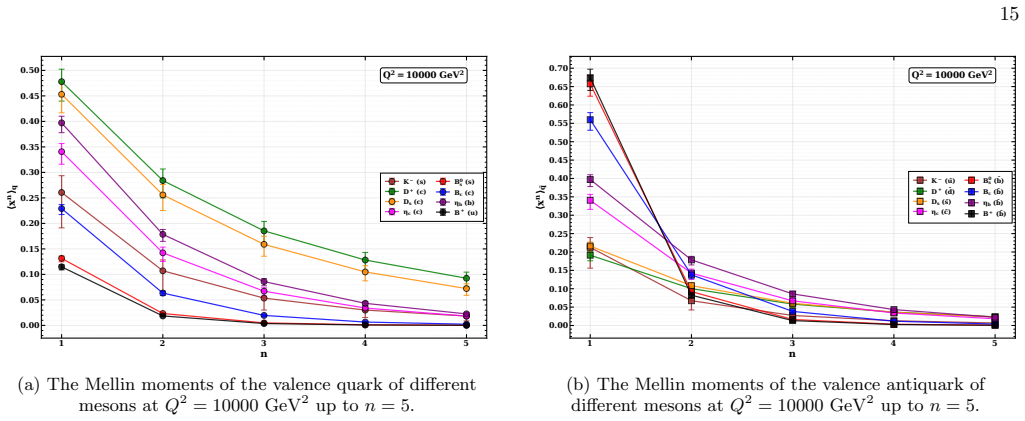
The momentum fraction carried by the total valence quark and antiquark of the heavy mesons is found to be higher compared to the light mesons. The valence quark and antiquark PDFs of bottomonia and B-mesons are found to carry almost 75%−83% of the total longitudi- nal momentum of the mesons, which one can expect from heavy quark systems. At the same time,...
-
[8]
In Fig. 22, we have plotted the top sea-quark distri- butions from different mesonic systems by taking the en- ergy scaleQ 2(105)> m 2 t (GeV2). At such scales, the top sea-quark distributions are generated perturbatively via gluon splittingg→t ¯t. The observed enhancement of the top sea-quark distribution for the kaon reflects its com- paratively larger ...
- [10]
- [11]
-
[12]
S. P. Klevansky, Rev. Mod. Phys.64, 649 (1992)
work page 1992
- [13]
-
[14]
S. J. Brodsky and G. F. de Teramond, Phys. Rev. Lett. 96, 201601 (2006), hep-ph/0602252
work page internal anchor Pith review Pith/arXiv arXiv 2006
-
[15]
C. D. Roberts and S. M. Schmidt, Prog. Part. Nucl. Phys.45, S1 (2000)
work page 2000
-
[16]
X. Ji, G. A. Miller, and C. Yang (2026), 2605.00339
work page internal anchor Pith review Pith/arXiv arXiv 2026
-
[17]
Generalized parton correlation functions for a spin-1/2 hadron
S. Meissner, A. Metz, and M. Schlegel, JHEP08, 056 18 (2009), 0906.5323
work page internal anchor Pith review Pith/arXiv arXiv 2009
-
[18]
Parameterization of the quark-quark correlator of a spin-1/2 hadron
K. Goeke, A. Metz, and M. Schlegel, Phys. Lett. B618, 90 (2005), hep-ph/0504130
work page internal anchor Pith review Pith/arXiv arXiv 2005
- [19]
-
[20]
Generalized Parton Distributions
M. Diehl, Phys. Rept.388, 41 (2003), hep-ph/0307382
work page internal anchor Pith review Pith/arXiv arXiv 2003
- [21]
- [22]
-
[23]
W. Broniowski, V. Shastry, and E. Ruiz Arriola, Phys. Lett. B840, 137872 (2023), 2211.11067
-
[24]
Nucleon Form Factors from Generalized Parton Distributions
M. Guidal, M. V. Polyakov, A. V. Radyushkin, and M. Vanderhaeghen, Phys. Rev. D72, 054013 (2005), hep-ph/0410251
work page internal anchor Pith review Pith/arXiv arXiv 2005
-
[25]
Extraction of Pion Unpolarized Quark Generalized Parton Distribution from Charge Form Factors
S. Puhan, S. Sharma, N. Kumar, and H. Dahiya (2026), 2604.11116
work page internal anchor Pith review Pith/arXiv arXiv 2026
-
[26]
M. Diehl, Eur. Phys. J. A52, 149 (2016), 1512.01328
work page internal anchor Pith review Pith/arXiv arXiv 2016
-
[27]
Transverse momentum dependent (TMD) parton distribution functions: status and prospects
R. Angeles-Martinez et al., Acta Phys. Polon. B46, 2501 (2015), 1507.05267
work page internal anchor Pith review Pith/arXiv arXiv 2015
-
[28]
Transverse momentum dependent parton distributions in a light-cone quark model
B. Pasquini, S. Cazzaniga, and S. Boffi, Phys. Rev. D 78, 034025 (2008), 0806.2298
work page internal anchor Pith review Pith/arXiv arXiv 2008
- [29]
- [30]
- [31]
-
[32]
J. C. Collins and D. E. Soper, Nucl. Phys. B194, 445 (1982)
work page 1982
-
[33]
A. D. Martin, R. G. Roberts, W. J. Stirling, and R. S. Thorne, Eur. Phys. J. C4, 463 (1998), hep-ph/9803445
work page internal anchor Pith review Pith/arXiv arXiv 1998
- [34]
- [35]
-
[36]
Nucleon electromagnetic form factors
J. Arrington, C. D. Roberts, and J. M. Zanotti, J. Phys. G34, S23 (2007), nucl-th/0611050
work page internal anchor Pith review Pith/arXiv arXiv 2007
-
[37]
P. C. e. a. Barry, Phys. Rev. Lett.121, 152001 (2018)
work page 2018
-
[38]
E. D. Bloom et al., Phys. Rev. Lett.23, 930 (1969)
work page 1969
- [39]
-
[40]
F. D. Aaron et al. (H1), Eur. Phys. J. C68, 381 (2010), 1001.0532
work page internal anchor Pith review Pith/arXiv arXiv 2010
-
[41]
Leading neutron production in $e^+p$ collisions at HERA
S. Chekanov et al. (ZEUS), Nucl. Phys. B637, 3 (2002), hep-ex/0205076
work page internal anchor Pith review Pith/arXiv arXiv 2002
- [42]
-
[43]
W.-C. Chang, J.-C. Peng, S. Platchkov, and T. Sawada, Phys. Rev. D107, 056008 (2023), 2209.04072
-
[44]
S. D. Drell and T.-M. Yan, Phys. Rev. Lett.25, 316 (1970), [Erratum: Phys.Rev.Lett. 25, 902 (1970)]
work page 1970
-
[45]
C. Lorc´ e, A. Metz, B. Pasquini, and P. Schweitzer (2025), 2507.12664
- [46]
-
[47]
H. G. P, S. Puhan, A. K. P, R. Pandey, H. Dahiya, A. Kumar, and S. Dutt (2026), 2604.05762
work page internal anchor Pith review Pith/arXiv arXiv 2026
- [48]
-
[49]
Pion light-front wave function, parton distribution and the electromagnetic form factor
T. Gutsche, V. E. Lyubovitskij, I. Schmidt, and A. Vega, J. Phys. G42, 095005 (2015), 1410.6424
work page internal anchor Pith review Pith/arXiv arXiv 2015
- [50]
-
[51]
J. S. Conway et al. (E615), Phys. Rev. D39, 92 (1989)
work page 1989
-
[52]
C. Bourrely, W.-C. Chang, and J.-C. Peng, Phys. Rev. D105, 076018 (2022), 2202.12547
- [53]
-
[54]
W.-C. Chang, J.-C. Peng, S. Platchkov, and T. Sawada, Phys. Rev. D102, 054024 (2020), 2006.06947
-
[55]
I. Novikov et al., Phys. Rev. D102, 014040 (2020), 2002.02902
-
[56]
Pionic Parton Distributions Revisited
M. Gluck, E. Reya, and I. Schienbein, Eur. Phys. J. C 10, 313 (1999), hep-ph/9903288
work page internal anchor Pith review Pith/arXiv arXiv 1999
-
[57]
J. Miller, J. Torsiello, I. Anderson, K. Cichy, M. Con- stantinou, J. Delmar, and S. Lampreich (2025), 2512.06121
work page internal anchor Pith review Pith/arXiv arXiv 2025
-
[58]
Quark and gluon momentum fractions in the pion and in the kaon,
C. Alexandrou et al. (Extended Twisted Mass), Phys. Rev. Lett.134, 131902 (2025), 2405.08529
- [59]
-
[60]
G. F. de Teramond and S. J. Brodsky, Phys. Rev. Lett. 102, 081601 (2009), 0809.4899
work page internal anchor Pith review Pith/arXiv arXiv 2009
- [61]
-
[62]
S.-i. Nam, Phys. Rev. D86, 074005 (2012), 1205.4156
work page internal anchor Pith review Pith/arXiv arXiv 2012
- [63]
-
[64]
W.-C. Chang, J.-C. Peng, S. Platchkov, and T. Sawada, Phys. Lett. B855, 138820 (2024), 2402.02860
-
[65]
C. Bourrely, F. Buccella, W.-C. Chang, and J.-C. Peng, Phys. Lett. B848, 138395 (2024), 2305.18117
-
[66]
J. Badier et al. (Saclay-CERN-College de France-Ecole Poly-Orsay), Phys. Lett. B93, 354 (1980)
work page 1980
-
[67]
M. J. Corden et al., Phys. Lett. B96, 411 (1980)
work page 1980
-
[68]
Letter of Intent: A New QCD facility at the M2 beam line of the CERN SPS (COMPASS++/AMBER)
B. Adams et al. (2018), 1808.00848
work page internal anchor Pith review Pith/arXiv arXiv 2018
- [69]
- [70]
- [71]
- [72]
- [73]
- [74]
- [75]
- [76]
- [77]
-
[78]
A. Karlberg, P. Nason, G. Salam, G. Zanderighi, and F. Dreyer, Eur. Phys. J. C86, 157 (2026), 2510.09310
-
[79]
LHAPDF6: parton density access in the LHC precision era
A. Buckley, J. Ferrando, S. Lloyd, K. Nordstr¨ om, B. Page, M. R¨ ufenacht, M. Sch¨ onherr, and G. Watt, Eur. Phys. J. C75, 132 (2015), 1412.7420
work page internal anchor Pith review Pith/arXiv arXiv 2015
-
[80]
M. B. Hecht, C. D. Roberts, and S. M. Schmidt, Phys. Rev. C63, 025213 (2001), nucl-th/0008049
work page internal anchor Pith review Pith/arXiv arXiv 2001
-
[81]
G. P. Lepage and S. J. Brodsky, Phys. Rev. D22, 2157 (1980). 19
work page 1980
discussion (0)
Sign in with ORCID, Apple, or X to comment. Anyone can read and Pith papers without signing in.