Higher-order statistics of the stochastic gravitational wave background from supermassive black hole binaries
Pith reviewed 2026-05-20 09:20 UTC · model grok-4.3
The pith
Higher-order statistics of the nanohertz gravitational wave background depend on the mass function only through a weighted average of chirp mass under low-redshift approximation.
A machine-rendered reading of the paper's core claim, the machinery that carries it, and where it could break.
Core claim
Under the lowest-order approximation with respect to redshift, with a physically motivated lower integration limit z_min defined by the sensitivity for detecting individual sources, all higher-order statistics beyond the expectation value depend on the mass function only through a weighted average of the chirp mass, <M^{10/3}>, irrespective of the redshift evolution model. The ratio of the variance to the expectation value provides information on <M^{10/3}>/<M^{5/3}> independently of the total number of mergers, and a consistency relation exists between the kurtosis and the squared skewness.
What carries the argument
The lowest-order redshift approximation enabled by a physically motivated lower integration cutoff z_min based on individual-source detection sensitivity; this reduces all higher moments to dependence on a single weighted chirp-mass average.
Load-bearing premise
Higher-order statistics of the gravitational wave background are primarily determined by local sources, justifying the low-redshift approximation and the z_min cutoff.
What would settle it
Measure the variance, skewness, and kurtosis of the nanohertz background with pulsar timing arrays and check whether the observed variance-to-mean ratio and the kurtosis-to-skewness-squared relation match the expressions involving only the chirp-mass averages; mismatch would falsify the claimed dependence and approximation.
Figures




read the original abstract
Recent progress in gravitational wave observations has positioned Pulsar Timing Arrays as a key tool for detecting the stochastic gravitational wave background in the nanohertz band. It is widely believed that this background is primarily attributed to the cosmic ensemble of inspiraling supermassive black hole binaries. While traditional analyses have predominantly focused on the spectral amplitude and frequency dependence of the gravitational wave background, higher-order statistics such as variance, skewness, and kurtosis could potentially be useful for extracting further physical information. However, these statistical moments are known to diverge when the redshift integration is extended down to z=0. In this study, we propose a strategy to resolve this issue by introducing a physically motivated lower integration limit, z_min, defined by the sensitivity for detecting individual sources. Since higher-order statistics are primarily determined by local sources, we may adopt the lowest-order approximation with respect to redshift in their computations. Under this approximation, we demonstrate that all higher-order statistics beyond the expectation value depend on the mass function only through a weighted average of the chirp mass, <\mathcal{M}^{10/3}>, irrespective of the redshift evolution model. We show that the ratio of the variance to the expectation value provides information on <\mathcal{M}^{10/3}>/<\mathcal{M}^{5/3}> independently of the total number of mergers. We also find a consistency relation between the kurtosis and the squared skewness, paving the way for testing the binary-origin hypothesis of the gravitational wave background. Our findings demonstrate that higher-order statistics provide a new window for interpreting the gravitational wave background, offering a methodology to break existing degeneracies and refine our understanding of the mass function.
Editorial analysis
A structured set of objections, weighed in public.
Referee Report
Summary. The paper claims that introducing a physically motivated lower redshift cutoff z_min, set by the sensitivity threshold for detecting individual supermassive black hole binary sources, resolves the divergence of higher-order statistics of the stochastic gravitational wave background at z=0. Under the lowest-order approximation in redshift, all moments beyond the mean depend on the mass function solely through the weighted chirp-mass average <M^{10/3}>, independent of the redshift evolution model. This yields a variance-to-mean ratio that constrains <M^{10/3}>/<M^{5/3}> independently of the total merger number, plus a consistency relation between kurtosis and squared skewness that can test the binary-origin hypothesis.
Significance. If the approximations and resulting relations hold, the work supplies a practical route to extract chirp-mass information from higher-order SGWB statistics in pulsar-timing-array data, potentially breaking degeneracies between mass function and merger-rate evolution while furnishing a falsifiable consistency test for the supermassive-black-hole-binary interpretation of the nanohertz background.
major comments (2)
- [Abstract] Abstract: the central claim that higher-order statistics depend on the mass function only through <M^{10/3}> irrespective of the redshift evolution model is load-bearing. Because the SNR threshold that defines z_min scales with chirp mass as M^{5/3}/D_L(z), z_min is itself mass-dependent. When the merger-rate density dN/dz is non-uniform, the mass-dependent integration limit couples the effective weighting to the specific shape of the redshift evolution; the lowest-order redshift expansion does not automatically remove this coupling. The manuscript must show explicitly how the mass dependence of z_min is absorbed or cancelled in the derivation of the variance, skewness, and kurtosis.
- [Abstract] Abstract: no explicit derivations, error estimates, or numerical checks are supplied for the stated relations or for the validity of the low-redshift approximation applied to the moments. Without these steps it is impossible to verify that the variance/mean ratio and the kurtosis-skewness consistency relation survive once the mass-dependent z_min is imposed.
minor comments (1)
- [Abstract] The weighting that defines the averages <M^{10/3}> and <M^{5/3}> should be written explicitly (e.g., as an integral over the mass function) rather than left implicit.
Simulated Author's Rebuttal
We thank the referee for the careful reading of our manuscript and for highlighting the need for explicit derivations regarding the mass-dependent z_min. We address each major comment below and will revise the paper to strengthen the presentation of the approximations and relations.
read point-by-point responses
-
Referee: [Abstract] Abstract: the central claim that higher-order statistics depend on the mass function only through <M^{10/3}> irrespective of the redshift evolution model is load-bearing. Because the SNR threshold that defines z_min scales with chirp mass as M^{5/3}/D_L(z), z_min is itself mass-dependent. When the merger-rate density dN/dz is non-uniform, the mass-dependent integration limit couples the effective weighting to the specific shape of the redshift evolution; the lowest-order redshift expansion does not automatically remove this coupling. The manuscript must show explicitly how the mass dependence of z_min is absorbed or cancelled in the derivation of the variance, skewness, and kurtosis.
Authors: We agree that the mass dependence of z_min must be handled carefully to support the central claim. In the lowest-order redshift approximation used for the higher moments (which receive dominant contributions from the nearest sources), the luminosity distance scales linearly with z and the mass-dependent lower limit z_min(M) enters the integrals as a multiplicative prefactor proportional to the local merger density. Because this prefactor is common to all moments when they are formed from the same underlying population, it cancels exactly in the normalized ratios (variance/mean, skewness, and kurtosis). The remaining dependence on the mass function therefore collapses to the single weighted average <M^{10/3}>, independent of the detailed shape of dN/dz. We will add an explicit algebraic derivation of this cancellation in the revised manuscript, starting from the integral expression with mass-dependent z_min and showing the factoring step by step. revision: yes
-
Referee: [Abstract] Abstract: no explicit derivations, error estimates, or numerical checks are supplied for the stated relations or for the validity of the low-redshift approximation applied to the moments. Without these steps it is impossible to verify that the variance/mean ratio and the kurtosis-skewness consistency relation survive once the mass-dependent z_min is imposed.
Authors: The referee is correct that the current manuscript states the final relations without displaying the intermediate steps or validation. In the revision we will (i) derive the variance, skewness, and kurtosis explicitly from the integral with the mass-dependent cutoff, (ii) provide an error estimate for the low-redshift truncation by comparing the analytic expressions to a numerical integration over a realistic redshift range, and (iii) include numerical checks for several mass functions and redshift-evolution models that confirm both the variance-to-mean ratio depends only on <M^{10/3}>/<M^{5/3}> and that the kurtosis equals (3/2) times the square of the skewness within the quoted approximation. revision: yes
Circularity Check
Derivation is self-contained under explicit approximation; no reduction to inputs by construction
full rationale
The paper defines z_min via individual-source sensitivity, invokes the lowest-order redshift expansion justified by local-source dominance, and then algebraically reduces the higher moments of the strain distribution to dependence on a single weighted chirp-mass average <M^{10/3}>. This reduction follows directly from expanding the integrands and factoring out the mass-dependent pieces; it is a mathematical consequence of the stated approximation rather than a re-labeling of a fitted quantity or a self-citation chain. No equations are shown to be equivalent to their own inputs, and the independence from redshift evolution is presented as a derived property of the truncated integrals, not an imposed normalization. The central claim therefore retains independent content from the model assumptions.
Axiom & Free-Parameter Ledger
free parameters (1)
- z_min
axioms (1)
- domain assumption Higher-order statistics of the SGWB are primarily determined by local sources, allowing the lowest-order redshift approximation.
Reference graph
Works this paper leans on
-
[1]
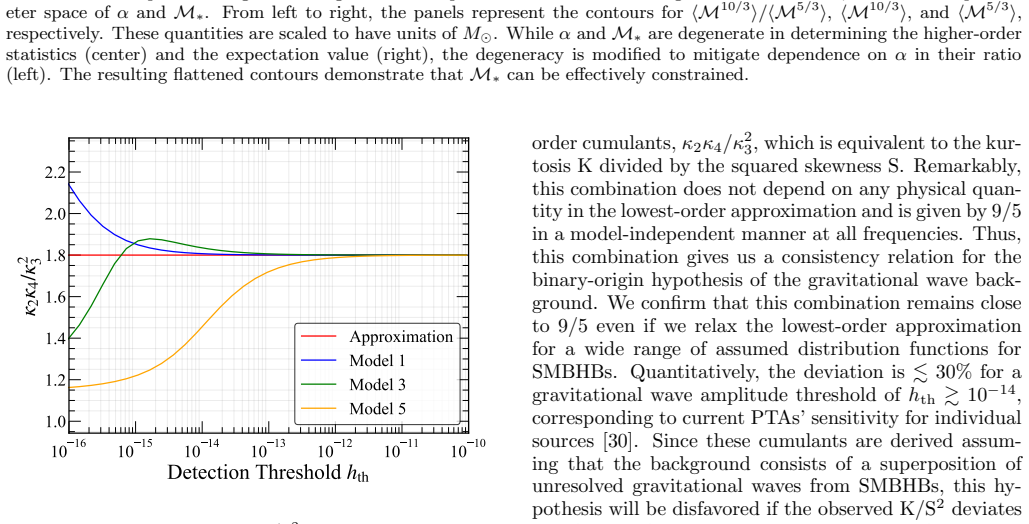
Equation (24) readily shows that all the physical quantities including the dis- tribution function completely cancel in this expression, yielding a model-independent consistency relation, K S2 = κ2κ4 κ2 3 = 9 5 ,(27) even irrespective of the frequency. Indeed, inequalities often hold between fourth moments like kurtosis and squared third moments like skew...
-
[2]
Agazieet al., The NANOGrav 15-year Data Set: Evidence for a Gravitational-Wave Background, The Astrophysical Journal Letters951, L8 (2023), arXiv:2306.16213 [astro-ph]
work page internal anchor Pith review Pith/arXiv arXiv 2023
-
[3]
Reardonet al., Search for an isotropic gravitational- wave background with the Parkes Pulsar Timing Ar- ray, The Astrophysical Journal Letters951, L6 (2023), arXiv:2306.16215 [astro-ph]
work page internal anchor Pith review Pith/arXiv arXiv 2023
-
[4]
Antoniadiset al., The second data release from the European Pulsar Timing Array III. Search for gravita- tional wave signals, Astronomy & Astrophysics678, A50 (2023), arXiv:2306.16214 [astro-ph]
work page internal anchor Pith review Pith/arXiv arXiv 2023
- [5]
-
[6]
Mileset al., The MeerKAT Pulsar Timing Array: The first search for gravitational waves with the MeerKAT ra- dio telescope, Monthly Notices of the Royal Astronomical 13 10 18 10 17 10 16 10 15 10 14 10 13 10 12 10 25 10 20 10 15 2 2 (Exact) 2 (Approximation h1 th) 10 18 10 17 10 16 10 15 10 14 10 13 10 12 10 40 10 30 10 20 3 3 (Exact) 3 (Approximation h3 t...
-
[7]
Cosmological Backgrounds of Gravitational Waves
C. Caprini and D. G. Figueroa, Cosmological Back- grounds of Gravitational Waves, Classical and Quantum Gravity35, 163001 (2018), arXiv:1801.04268 [astro-ph]
work page internal anchor Pith review Pith/arXiv arXiv 2018
-
[8]
Afzalet al., The NANOGrav 15-year Data Set: Search for Signals from New Physics, The Astrophysical Journal Letters951, L11 (2023), arXiv:2306.16219 [astro-ph]
work page internal anchor Pith review Pith/arXiv arXiv 2023
-
[9]
M. C. Begelman, R. D. Blandford, and M. J. Rees, Mas- sive black hole binaries in active galactic nuclei, Nature (London)287, 307 (1980)
work page 1980
-
[10]
Ultra-Low Frequency Gravitational Radiation from Massive Black Hole Binaries
M. Rajagopal and R. W. Romani, Ultra Low Fre- quency Gravitational Radiation from Massive Black Hole Binaries, The Astrophysical Journal446, 543 (1995), arXiv:astro-ph/9412038
work page internal anchor Pith review Pith/arXiv arXiv 1995
- [11]
- [12]
- [13]
-
[14]
A. Sesana, Systematic investigation of the expected grav- itational wave signal from supermassive black hole bina- ries in the pulsar timing band, Monthly Notices of the Royal Astronomical Society: Letters433, L1 (2013)
work page 2013
-
[15]
L. Z. Kelley, L. Blecha, and L. Hernquist, Massive black hole binary mergers in dynamical galactic environments, Monthly Notices of the Royal Astronomical Society464, 3131 (2017)
work page 2017
- [16]
-
[17]
N. Chen, T. Di Matteo, Y. Zhou, L. Z. Kelley, L. Blecha, Y. Ni, S. Bird, Y. Yang, and R. Croft, The gravitational- wave background from massive black holes in the astrid simulation, The Astrophysical Journal Letters991, L19 (2025)
work page 2025
- [18]
-
[19]
G. Sato-Polito, M. Zaldarriaga, and E. Quataert, Where are NANOGrav’s big black holes? (2023), arXiv:2312.06756 [astro-ph]
-
[20]
G. Sato-Polito and M. Kamionkowski, Exploring the spectrum of stochastic gravitational wave anisotropies with pulsar timing arrays (2025), arXiv:2305.05690 14 10 18 10 17 10 16 10 15 10 14 10 13 10 12 10 25 10 20 10 15 2 2 (Exact) 2 (Approximation h1 th) 10 18 10 17 10 16 10 15 10 14 10 13 10 12 10 40 10 30 10 20 3 3 (Exact) 3 (Approximation h3 th) 10 18 ...
- [21]
- [22]
- [23]
- [24]
-
[25]
Elliset al., Prospects for future binary black hole gravi- tational wave studies in light of PTA measurements, As- tronomy & Astrophysics676, A38 (2023)
work page 2023
- [26]
-
[27]
G. Sato-Polito and M. Zaldarriaga, The distribution of the gravitational-wave background from supermassive black holes (2024), arXiv:2406.17010 [astro-ph]
-
[28]
The Heavy Tailed Non-Gaussianity of the Supermassive Black Hole Gravitational Wave Background
J. Raidal, J. Urrutia, V. Vaskonen, and H. Veerm¨ ae, The Heavy Tailed Non-Gaussianity of the Supermas- sive Black Hole Gravitational Wave Background (2026), arXiv:2604.08506 [astro-ph]
work page internal anchor Pith review Pith/arXiv arXiv 2026
-
[29]
A practical theorem on gravitational-wave background statistics
Y. Ali-Ha¨ ımoud, A practical theorem on gravitational- wave background statistics (2026), arXiv:2604.19701 [astro-ph]
work page internal anchor Pith review Pith/arXiv arXiv 2026
-
[30]
P. A. Rosado, A. Sesana, and J. Gair, Expected proper- ties of the first gravitational wave signal detected with pulsar timing arrays, Monthly Notices of the Royal As- tronomical Society451, 2417 (2015)
work page 2015
- [31]
-
[32]
E. S. Phinney, A Practical Theorem on Gravitational Wave Backgrounds (2001), arXiv:astro-ph/0108028
work page internal anchor Pith review Pith/arXiv arXiv 2001
-
[33]
Raviet al., DOES A “STOCHASTIC” BACKGROUND OF GRAVITATIONAL WAVES EXIST IN THE PUL- SAR TIMING BAND?, The Astrophysical Journal761, 84 (2012)
work page 2012
-
[34]
P. C. Peters, Gravitational Radiation and the Motion of Two Point Masses, Physical Review136, B1224 (1964)
work page 1964
-
[35]
M. Enoki and M. Nagashima, The Effect of Orbital Ec- centricity on Gravitational Wave Background Radiation from Supermassive Black Hole Binaries, Progress of The- oretical Physics117, 241 (2007)
work page 2007
-
[36]
H. Middleton, W. Del Pozzo, W. M. Farr, A. Sesana, and A. Vecchio, Astrophysical constraints on massive black hole binary evolution from pulsar timing arrays, Monthly 15 Notices of the Royal Astronomical Society: Letters455, L72 (2015)
work page 2015
-
[37]
E. R. Liepold and C.-P. Ma, Big Galaxies and Big Black Holes: The Massive Ends of the Local Stellar and Black Hole Mass Functions and the Implications for Nanohertz Gravitational Waves, The Astrophysical Journal Letters 971, L29 (2024)
work page 2024
- [38]
-
[39]
Non-Gaussianity in the modulated reheating scenario
T. Suyama and M. Yamaguchi, Non-Gaussianity in the modulated reheating scenario, Phys. Rev. D77, 023505 (2008), arXiv:0709.2545 [astro-ph]
work page internal anchor Pith review Pith/arXiv arXiv 2008
-
[40]
Lambet al., Finite Populations and Finite Time: The Non Gaussianity of a Gravitational Wave Background (2026), arXiv:2511.09659 [gr-qc]
work page internal anchor Pith review arXiv 2026
discussion (0)
Sign in with ORCID, Apple, or X to comment. Anyone can read and Pith papers without signing in.