Prompt2Fingerprint: Plug-and-Play LLM Fingerprinting via Text-to-Weight Generation
Pith reviewed 2026-05-20 09:31 UTC · model grok-4.3
The pith
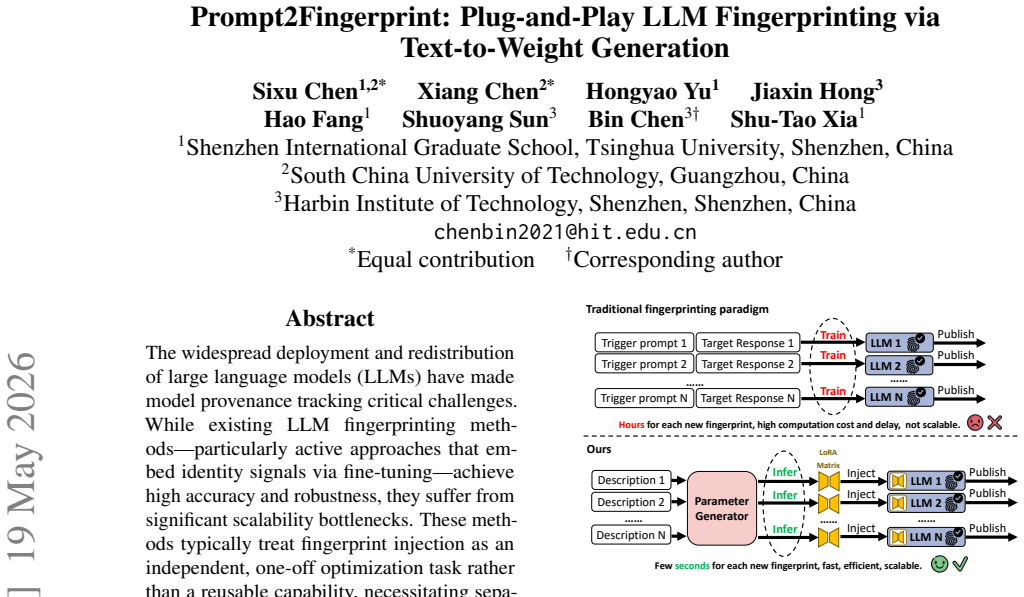
A trained generator network turns any text description into a ready-to-use low-rank fingerprint for an LLM in one forward pass.
A machine-rendered reading of the paper's core claim, the machinery that carries it, and where it could break.
Core claim
Prompt2Fingerprint reformulates LLM fingerprinting as a conditional parameter generation task. A specialized generator network accepts textual descriptions of identities and produces low-rank parameter increments that are added to the base model in a single forward pass. This produces fingerprints that remain detectable with high accuracy, do not degrade task performance, and resist removal attempts, all without any further optimization on the target model.
What carries the argument
The generator network that maps an arbitrary textual identity description to a set of low-rank parameter increments for direct addition to the base LLM weights.
If this is right
- New identities can receive fingerprints in seconds rather than hours of dedicated training.
- The same generator works across multiple base models without repeating the optimization step.
- Computational cost for ownership management scales with the number of identities rather than with the cost of repeated fine-tuning runs.
- Fingerprint injection becomes a plug-and-play operation that leaves the original model weights otherwise untouched.
Where Pith is reading between the lines
- The approach could be tested on parameter-efficient fine-tuning families beyond low-rank updates to see whether the generator idea generalizes.
- Real-time deployment pipelines might adopt the generator to attach fresh ownership signals at the moment a model is served or shared.
- The method raises the question of whether similar text-conditioned generators could be trained for other lightweight model modifications such as safety alignments or domain adaptations.
Load-bearing premise
One fixed generator network can produce effective, harmless, and robust fingerprints for any new textual identity and any new base model without per-identity retraining or optimization.
What would settle it
Train the generator on a collection of base models and identity texts, then apply the resulting fingerprints to an unseen base model with a completely new identity text and measure whether detection accuracy drops below usable levels or the update harms downstream performance.
Figures


read the original abstract
The widespread deployment and redistribution of large language models (LLMs) have made model provenance tracking a critical challenge. While existing LLM fingerprinting methods, particularly active approaches that embed identity signals via fine-tuning, achieve high accuracy and robustness, they suffer from significant scalability bottlenecks. These methods typically treat fingerprint injection as an independent, one-off optimization task rather than a reusable capability, necessitating separate, resource-intensive training for every new identity. This incurs prohibitive computational costs and deployment delays. To address this, we propose Prompt2Fingerprint (P2F), the first framework that reformulates fingerprinting as a conditional parameter generation task. By leveraging a specialized generator, P2F maps textual descriptions directly to low-rank parameter increments in a single forward pass, enabling plug-and-play LLM fingerprint injection without further model retraining. Our experiments demonstrate that P2F maintains high fingerprint accuracy, harmlessness, and robustness while significantly reducing computational overhead, offering a scalable and instant solution for LLM ownership management.
Editorial analysis
A structured set of objections, weighed in public.
Referee Report
Summary. The manuscript proposes Prompt2Fingerprint (P2F), a framework that reformulates LLM fingerprinting as a conditional parameter generation task. A generator network is trained to map textual identity descriptions directly to low-rank parameter increments (deltas) in a single forward pass, enabling plug-and-play injection into base LLMs without per-identity fine-tuning or retraining. The abstract claims that experiments show the resulting fingerprints achieve high accuracy, harmlessness to model utility, and robustness while reducing computational overhead compared to prior active methods.
Significance. If the generalization claims hold, P2F could substantially improve the scalability of active LLM provenance tracking by eliminating the need for separate optimization per identity, which is a practical bottleneck in current methods. This would be a meaningful contribution to model ownership management in cs.CR.
major comments (2)
- [§4 and §3.2] §4 (Experiments) and §3.2 (Generator Architecture): The central plug-and-play claim requires that a single generator, trained once, produces effective low-rank deltas for arbitrary unseen base models and textual identities. However, low-rank updates are tied to the specific weight dimensions and residual streams of the training-time base model; if training was limited to one family (e.g., Llama-7B/13B), the deltas will be dimensionally or semantically mismatched for other architectures or scales, breaking detectability or harmlessness. Cross-model transfer results or explicit scope limitations are needed.
- [Abstract and §4.1] Abstract and §4.1 (Evaluation Metrics): The abstract asserts 'high fingerprint accuracy, harmlessness, and robustness' without reporting quantitative values, baselines, or measurement protocols (e.g., exact accuracy percentages, perplexity deltas on standard benchmarks, or attack success rates). These details are load-bearing for verifying the claims against prior active fingerprinting methods.
minor comments (2)
- [§3.1] Clarify in §3.1 how the textual prompt is encoded and conditioned on the generator (e.g., exact embedding method and any prompt engineering details).
- [Discussion or Limitations] Add a limitations paragraph discussing potential failure modes when identities are out-of-distribution relative to the generator's training prompts.
Simulated Author's Rebuttal
We are grateful to the referee for providing thoughtful and detailed comments that help improve the clarity and rigor of our work on Prompt2Fingerprint. We address the major comments below and have updated the manuscript to incorporate clarifications on the scope of our method and to include more specific quantitative information in the abstract.
read point-by-point responses
-
Referee: [§4 and §3.2] §4 (Experiments) and §3.2 (Generator Architecture): The central plug-and-play claim requires that a single generator, trained once, produces effective low-rank deltas for arbitrary unseen base models and textual identities. However, low-rank updates are tied to the specific weight dimensions and residual streams of the training-time base model; if training was limited to one family (e.g., Llama-7B/13B), the deltas will be dimensionally or semantically mismatched for other architectures or scales, breaking detectability or harmlessness. Cross-model transfer results or explicit scope limitations are needed.
Authors: We thank the referee for highlighting this important consideration regarding dimensional compatibility. Our generator is trained and evaluated on models within the same architectural family (Llama variants) to maintain alignment in weight dimensions and residual streams. The plug-and-play property refers to generating deltas for new textual identities in a single forward pass without per-identity optimization, rather than claiming universal applicability to arbitrary architectures. We have revised the manuscript to add explicit scope limitations in §3.2 and included additional results demonstrating transfer across scales within the Llama family. Full cross-architecture generalization would require model-specific adaptations, which we note as a direction for future work. revision: partial
-
Referee: [Abstract and §4.1] Abstract and §4.1 (Evaluation Metrics): The abstract asserts 'high fingerprint accuracy, harmlessness, and robustness' without reporting quantitative values, baselines, or measurement protocols (e.g., exact accuracy percentages, perplexity deltas on standard benchmarks, or attack success rates). These details are load-bearing for verifying the claims against prior active fingerprinting methods.
Authors: We agree that the abstract should include concrete quantitative results to allow direct verification of the claims. In the revised manuscript, we have updated the abstract to report key metrics from our experiments, including fingerprint detection accuracy, perplexity deltas on standard benchmarks such as WikiText, and attack success rates under robustness evaluations. Section 4.1 has been expanded to detail the measurement protocols and baselines used for comparison against prior active fingerprinting approaches. revision: yes
Circularity Check
No circularity: new generator framework presented without self-referential reductions
full rationale
The paper introduces P2F as a reformulation of fingerprinting into a conditional generation task using a specialized generator network that maps text to low-rank deltas in one forward pass. No equations, derivations, or fitted-parameter predictions are shown in the abstract or description that reduce any claimed output to inputs by construction. The 'first framework' claim is stated directly without load-bearing self-citations or uniqueness theorems imported from prior author work. The central premise of plug-and-play injection for arbitrary identities remains an empirical claim rather than a definitional or fitted tautology, making the derivation chain self-contained against external benchmarks.
Axiom & Free-Parameter Ledger
Reference graph
Works this paper leans on
-
[1]
Text-to-lora: Instant transformer adaption.arXiv preprint arXiv:2506.06105. DeepSeek-AI, Aixin Liu, Bei Feng, Bing Xue, Bingx- uan Wang, Bochao Wu, Chengda Lu, Chenggang Zhao, Chengqi Deng, Chenyu Zhang, Chong Ruan, Damai Dai, Daya Guo, Dejian Yang, Deli Chen, Dongjie Ji, Erhang Li, Fangyun Lin, Fucong Dai, and 181 others
-
[2]
Deepseek-v3 technical report. Preprint, arXiv:2412.19437. Hao Fang, Jiawei Kong, Wenbo Yu, Bin Chen, Jiawei Li, Hao Wu, Shu-Tao Xia, and Ke Xu. 2025a. One perturbation is enough: On generating universal ad- versarial perturbations against vision-language pre- training models. InProceedings of the IEEE/CVF International Conference on Computer Vision, pages...
work page internal anchor Pith review Pith/arXiv arXiv
-
[3]
A survey of quantization methods for efficient neural network inference.Preprint, arXiv:2103.13630. Chenxi Gu, Chengsong Huang, Xiaoqing Zheng, Kai- Wei Chang, and Cho-Jui Hsieh
-
[4]
Watermark- ing Pre-trained Language Models with Backdooring. arXiv preprint. ArXiv:2210.07543 [cs]. Martin Gubri, Dennis Ulmer, Hwaran Lee, Sangdoo Yun, and Seong Joon Oh
-
[5]
TRAP: Targeted ran- dom adversarial prompt honeypot for black-box iden- tification. InFindings of the Association for Compu- tational Linguistics: ACL 2024, pages 11496–11517, Bangkok, Thailand. Association for Computational Linguistics. Edward J Hu, Yelong Shen, Phillip Wallis, Zeyuan Allen-Zhu, Yuanzhi Li, Shean Wang, Liang Wang, Weizhu Chen, and 1 others
work page 2024
-
[6]
Mistral 7b.Preprint, arXiv:2310.06825. Heng Jin, Chaoyu Zhang, Shanghao Shi, Wenjing Lou, and Y . Thomas Hou. 2024a. ProFLingo: A Fingerprinting-based Intellectual Property Protection Scheme for Large Language Models. Xiaolong Jin, Kai Wang, Dongwen Tang, Wangbo Zhao, Yukun Zhou, Junshu Tang, and Yang You. 2024b. Conditional LoRA Parameter Generation.arXi...
work page internal anchor Pith review Pith/arXiv arXiv
-
[7]
ORAL: Prompting Your Large-Scale LoRAs via Conditional Recurrent Diffusion.arXiv preprint. ArXiv:2503.24354 [cs]. Daniel Khashabi, Snigdha Chaturvedi, Michael Roth, Shyam Upadhyay, and Dan Roth
-
[8]
Looking beyond the surface: A challenge set for reading com- prehension over multiple sentences. InProceedings of the 2018 Conference of the North American Chap- ter of the Association for Computational Linguistics: Human Language Technologies, Volume 1 (Long Pa- pers), pages 252–262, New Orleans, Louisiana. As- sociation for Computational Linguistics. Ji...
work page 2018
-
[9]
Revisiting backdoor attacks on llms: A stealthy and practical poisoning framework via harmless inputs. arXiv preprint arXiv:2505.17601. Shuai Li, Kejiang Chen, Jun Jiang, Jie Zhang, Qiyi Yao, Kai Zeng, Weiming Zhang, and Nenghai Yu
-
[10]
Drag- and-drop llms: Zero-shot prompt-to-weights
Drag-and-Drop LLMs: Zero-Shot Prompt-to-Weights.arXiv preprint. ArXiv:2506.16406 [cs]. Chin-Yew Lin
-
[11]
Can a suit of armor conduct elec- tricity? a new dataset for open book question an- swering. InProceedings of the 2018 Conference on Empirical Methods in Natural Language Processing, pages 2381–2391, Brussels, Belgium. Association for Computational Linguistics. OpenAI
work page 2018
-
[12]
Hey, That’s My Model! Introducing Chain & Hash, An LLM Fingerprinting Technique.arXiv preprint. ArXiv:2407.10887 [cs]. Rohan Taori, Ishaan Gulrajani, Tianyi Zhang, Yann Dubois, Xuechen Li, Carlos Guestrin, Percy Liang, and Tatsunori B. Hashimoto
-
[13]
Llama 2: Open Foundation and Fine-Tuned Chat Models
Llama 2: Open foundation and fine-tuned chat models.Preprint, arXiv:2307.09288. Ashish Vaswani, Noam Shazeer, Niki Parmar, Jakob Uszkoreit, Llion Jones, Aidan N Gomez, Łukasz Kaiser, and Illia Polosukhin
work page internal anchor Pith review Pith/arXiv arXiv
-
[14]
Recurrent diffusion for large-scale parameter generation.arXiv preprint arXiv:2501.11587,
Recurrent Diffusion for Large-Scale Parameter Gen- eration.arXiv preprint. ArXiv:2501.11587 [cs]. Zixun Xiong, Gaoyi Wu, Qingyang Yu, Mingyu Derek Ma, Lingfeng Yao, Miao Pan, Xiaojiang Du, and Hao Wang
-
[15]
iSeal: Encrypted Fingerprinting for Reliable LLM Ownership Verification.arXiv preprint. ArXiv:2511.08905 [cs]. Can Xu, Qingfeng Sun, Kai Zheng, Xiubo Geng, Pu Zhao, Jiazhan Feng, Chongyang Tao, Qingwei Lin, and Daxin Jiang. 2024a. WizardLM: Empow- ering large pre-trained language models to follow complex instructions. InThe Twelfth International Conferenc...
-
[16]
REEF: Representation Encoding Fingerprints for Large Lan- guage Models.International Conference on Learn- ing Representations, 2025:48092–48117. A Implementation Details Table 5 summarizes the model configurations and hyper-parameters used in our experiments. All experiments are conducted on a single NVIDIA RTX A6000 GPU (48GB). The training duration for ...
work page 2025
-
[17]
We use the validation split ( N= 4,848 ) as the test set following standard prac- tice
• MultiRC(Khashabi et al., 2018): A read- ing comprehension dataset over multiple sen- tences. We use the validation split ( N= 4,848 ) as the test set following standard prac- tice. The primary metric isAccuracy(acc). • LogiQA(Liu et al., 2020): A logical compre- hension dataset derived from publically avail- able questions of the National Civil Servants...
work page 2018
-
[18]
(for In- struct models), as Instruct models are already opti- mized for instruction-based tasks (Russinovich and Salem, 2025). After 3 epochs of fine-tuning with a learning rate = 2×10 −5 (Xiong et al., 2025), we re-evaluate the FSR at a temperature of 0.7 during LLM inference. A fingerprinted model is counted as a "Successful Retention" if it still meets...
work page 2025
-
[19]
mBERT features a multilingual vocabulary and is pre-trained using a masked language modeling objective, enabling it to generate more discrimina- tive representations for multilingual tokens. This is particularly important for encoding fingerprint descriptions that contain triggers in languages such as Chinese or Japanese. In contrast, the training corpus ...
work page 2024
discussion (0)
Sign in with ORCID, Apple, or X to comment. Anyone can read and Pith papers without signing in.