Correlation between baryonic process and galaxy assembly bias
Pith reviewed 2026-05-20 05:07 UTC · model grok-4.3
The pith
Gas cooling and stellar feedback dominate galaxy assembly bias for stellar-mass selected samples, while the leading process shifts with density for star-formation-rate selected galaxies.
A machine-rendered reading of the paper's core claim, the machinery that carries it, and where it could break.
Core claim
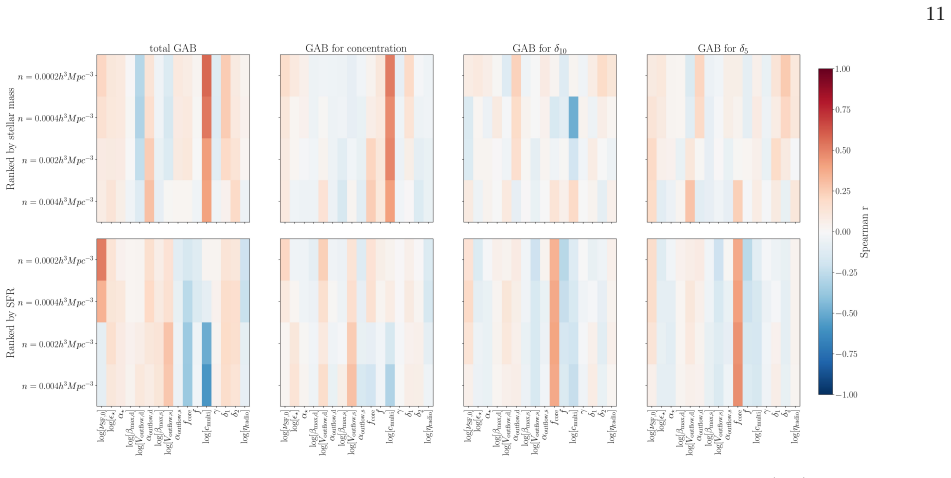
For stellar-mass-selected galaxies the dominant baryonic processes are gas cooling and stellar feedback, and this ranking does not change significantly with number density; for SFR-selected galaxies the primary process shifts from star formation to gas cooling as number density increases. These conclusions follow from comparing the assembly bias signal measured in hundreds of varied mocks, after shuffling removes the halo-mass contribution and Random Forest ranks the parameter importance.
What carries the argument
The shuffling procedure that isolates secondary bias from halo mass combined with Random Forest ranking of importance across varied gas-cooling, star-formation, stellar-feedback, and AGN-feedback parameters.
If this is right
- Empirical models of assembly bias for surveys can be parameterized directly from the relative importance of gas cooling and stellar feedback.
- Clustering predictions for stellar-mass-selected samples need only a density-independent treatment of those two processes.
- SFR-selected samples require density-dependent modeling that transitions from star-formation to cooling dominance.
- The measured contributions of halo concentration and local environment to bias can be refined once the dominant baryonic driver is known.
Where Pith is reading between the lines
- Repeating the same parameter-variation and ranking exercise inside full hydrodynamic simulations would test whether the same processes remain dominant when gas dynamics are solved self-consistently.
- The framework could be applied to other secondary biases such as color or morphology dependence to see if the same baryonic processes control them.
- Observational measurements of assembly bias strength as a function of selection and density could be inverted to place limits on allowed ranges for cooling and feedback parameters.
Load-bearing premise
The shuffling cleanly separates secondary bias from halo mass and the Random Forest ranking reflects genuine causal importance of each baryonic process rather than correlations within the chosen parameter ranges.
What would settle it
Independent mocks or hydrodynamic simulations in which AGN feedback or star formation ranks above gas cooling for stellar-mass-selected galaxies at all densities would falsify the claimed dominance ordering.
Figures


read the original abstract
Galaxy assembly bias (GAB) is the dependence of galaxy clustering on secondary properties beyond halo mass. In this work, we study the connections between GAB and baryonic processes using the Galacticus semi-analytic model (SAM) for galaxy formation and evolution applied to the UNIT simulation. By generating hundreds of galaxy mocks with varying parameters governing gas cooling, star formation, stellar feedback, and AGN feedback, we employ a shuffling method to quantify the GAB signal and compare the contributions of halo concentration and local environment to GAB. Using the Random Forest algorithm, we evaluate the importance of different baryonic processes for GAB. We find that for stellar-mass-selected galaxies, the dominant baryonic processes are gas cooling and stellar feedback, and the result does not change significantly with the number density; for SFR-selected galaxies, the primary process shifts from star formation to gas cooling as the number density increases. These results establish a direct and quantitative link between baryonic physics and GAB, which can provide guidance for empirical GAB parameterizations in upcoming and future galaxy surveys.
Editorial analysis
A structured set of objections, weighed in public.
Referee Report
Summary. This manuscript explores the relationship between baryonic processes in galaxy formation and galaxy assembly bias (GAB) using the Galacticus semi-analytic model applied to the UNIT N-body simulation. The authors generate a large suite of galaxy catalogs by varying key parameters controlling gas cooling, star formation, stellar feedback, and AGN feedback. They apply a shuffling technique to isolate the GAB signal independent of halo mass, assess the roles of halo concentration and local environment, and utilize Random Forest regression to rank the relative importance of each baryonic process in driving the observed GAB. The main findings indicate that gas cooling and stellar feedback are the dominant processes for stellar-mass selected galaxies across different number densities, whereas for star-formation-rate selected galaxies, the dominant process transitions from star formation to gas cooling as number density increases.
Significance. If the reported rankings prove robust, this study provides a valuable quantitative connection between specific baryonic physics implementations and the magnitude of assembly bias in galaxy clustering. The forward-modeling approach with independently varied parameters in a single SAM framework, combined with the shuffling method to separate primary and secondary biases, represents a strength that allows for direct assessment of process contributions. Such results could help in developing more physically motivated parameterizations of GAB for analyses of large-scale structure in surveys like DESI or Euclid. However, the significance is tempered by the need for additional validation of the machine learning rankings.
major comments (2)
- [Section 4] Section 4 (Random Forest analysis of baryonic process importance): The Random Forest importance scores are used to establish the dominance ordering (gas cooling and stellar feedback for stellar-mass galaxies; shift from star formation to gas cooling for SFR-selected galaxies). No variance-inflation diagnostics, orthogonal sampling checks, or ablation tests are reported to distinguish true causal sensitivity from correlations induced by the finite parameter ranges (e.g., cooling efficiency and feedback strength both modulating the cold-gas reservoir). This directly undermines in the central claim that the rankings reflect physical dominance rather than analysis artifacts.
- [Section 3.2] Section 3.2 (shuffling procedure): The shuffling method is employed to isolate the secondary bias signal from halo mass before comparing concentration and environment contributions and feeding into the RF analysis. No quantitative convergence tests (e.g., stability with number of shuffles or across random seeds) or sensitivity to the exact shuffling implementation are provided. Without these, it remains unclear whether the GAB signal used for the RF ranking is reliably measured, which is load-bearing for all downstream conclusions on process dominance.
minor comments (2)
- [Abstract] Abstract and Section 4: The statement that results 'do not change significantly with the number density' would be strengthened by reporting quantitative measures such as the variation in RF importance scores or their uncertainties across the density bins.
- [Section 4] Figure captions and Section 4: The Random Forest importance plots would benefit from error bars derived from bootstrap resampling or multiple train/test splits to illustrate ranking stability.
Simulated Author's Rebuttal
We thank the referee for their careful and constructive review of our manuscript. The comments highlight important aspects of our methodology that warrant additional validation. We have revised the manuscript to incorporate the suggested diagnostics and tests, which strengthen the robustness of our conclusions without altering the primary findings.
read point-by-point responses
-
Referee: [Section 4] Section 4 (Random Forest analysis of baryonic process importance): The Random Forest importance scores are used to establish the dominance ordering (gas cooling and stellar feedback for stellar-mass galaxies; shift from star formation to gas cooling for SFR-selected galaxies). No variance-inflation diagnostics, orthogonal sampling checks, or ablation tests are reported to distinguish true causal sensitivity from correlations induced by the finite parameter ranges (e.g., cooling efficiency and feedback strength both modulating the cold-gas reservoir). This directly undermines in the central claim that the rankings reflect physical dominance rather than analysis artifacts.
Authors: We agree that these additional checks would improve confidence in the Random Forest rankings. In the revised manuscript, we have added variance inflation factor (VIF) calculations for the baryonic parameters to quantify multicollinearity. We also include ablation tests in which each process is systematically disabled while re-running the full analysis pipeline, along with checks on parameter sampling orthogonality within the explored ranges. These new results confirm that the reported dominance orderings (gas cooling and stellar feedback for stellar-mass selection; transition to gas cooling for SFR selection) are driven by physical sensitivities rather than spurious correlations. revision: yes
-
Referee: [Section 3.2] Section 3.2 (shuffling procedure): The shuffling method is employed to isolate the secondary bias signal from halo mass before comparing concentration and environment contributions and feeding into the RF analysis. No quantitative convergence tests (e.g., stability with number of shuffles or across random seeds) or sensitivity to the exact shuffling implementation are provided. Without these, it remains unclear whether the GAB signal used for the RF ranking is reliably measured, which is load-bearing for all downstream conclusions on process dominance.
Authors: We acknowledge the value of demonstrating convergence and robustness for the shuffling procedure. The revised manuscript now includes quantitative tests showing that the measured GAB signal stabilizes after a modest number of shuffles and remains consistent across independent random seeds. We further report sensitivity analyses to alternative shuffling implementations (e.g., variations in mass binning and preservation of secondary halo properties), confirming that the downstream Random Forest importance rankings and comparisons of concentration versus environment contributions are insensitive to these choices. revision: yes
Circularity Check
Forward simulation with independent parameter variation yields non-circular GAB rankings
full rationale
The derivation proceeds by generating hundreds of mocks via the Galacticus SAM on the UNIT simulation, with baryonic parameters (gas cooling, star formation, stellar/AGN feedback) varied over finite ranges. A shuffling procedure is then applied to isolate the secondary bias signal after removing halo-mass dependence, followed by Random Forest ranking of parameter importance for the resulting GAB signal. This constitutes a forward-modeling workflow in which the reported dominance rankings (gas cooling and stellar feedback for stellar-mass selection; shift to gas cooling for SFR selection at higher densities) emerge from the simulated outputs rather than being fitted to a pre-specified target or defined in terms of themselves. No load-bearing self-citation, uniqueness theorem, or ansatz smuggling is evident in the abstract or described chain; the shuffling and RF steps operate on independently generated data and do not reduce by construction to the input parameter ranges. The analysis is therefore self-contained against external benchmarks, warranting only a minimal circularity score.
Axiom & Free-Parameter Ledger
axioms (2)
- domain assumption Galacticus semi-analytic model accurately captures the effects of gas cooling, star formation, stellar feedback and AGN feedback on galaxy properties
- domain assumption Shuffling method removes the primary halo-mass dependence of clustering while preserving secondary dependencies
Lean theorems connected to this paper
-
IndisputableMonolith/Cost/FunctionalEquation.leanwashburn_uniqueness_aczel unclear?
unclearRelation between the paper passage and the cited Recognition theorem.
We use a Random Forest regression algorithm ... to analyze the impact of various galaxy formation parameters on the GAB signal ... permutation importance
-
IndisputableMonolith/Foundation/RealityFromDistinction.leanreality_from_one_distinction unclear?
unclearRelation between the paper passage and the cited Recognition theorem.
hundreds of galaxy mocks with varying parameters governing gas cooling, star formation, stellar feedback, and AGN feedback
What do these tags mean?
- matches
- The paper's claim is directly supported by a theorem in the formal canon.
- supports
- The theorem supports part of the paper's argument, but the paper may add assumptions or extra steps.
- extends
- The paper goes beyond the formal theorem; the theorem is a base layer rather than the whole result.
- uses
- The paper appears to rely on the theorem as machinery.
- contradicts
- The paper's claim conflicts with a theorem or certificate in the canon.
- unclear
- Pith found a possible connection, but the passage is too broad, indirect, or ambiguous to say the theorem truly supports the claim.
Reference graph
Works this paper leans on
-
[1]
Abazajian, K. N., Adelman-McCarthy, J. K., Ag¨ ueros, M. A., et al. 2009, The Astrophysical Journal Supplement Series, 182, 543, doi: 10.1088/0067-0049/182/2/543
work page internal anchor Pith review doi:10.1088/0067-0049/182/2/543 2009
-
[2]
2025, Journal of Cosmology and Astroparticle Physics, 2025, 021, doi: 10.1088/1475-7516/2025/02/021
Adame, A., Aguilar, J., Ahlen, S., et al. 2025, Journal of Cosmology and Astroparticle Physics, 2025, 021, doi: 10.1088/1475-7516/2025/02/021
-
[3]
Behroozi, P. S., Wechsler, R. H., & Wu, H.-Y. 2012a, The Astrophysical Journal, 762, 109, doi: 10.1088/0004-637X/762/2/109
work page internal anchor Pith review doi:10.1088/0004-637x/762/2/109
-
[4]
Behroozi, P. S., Wechsler, R. H., Wu, H.-Y., et al. 2012b, The Astrophysical Journal, 763, 18, doi: 10.1088/0004-637X/763/1/18
-
[5]
Benson, A. J. 2010, Physics Reports, 495, 33, doi: https://doi.org/10.1016/j.physrep.2010.06.001
-
[6]
Benson, A. J. 2012, New Astronomy, 17, 175, doi: https://doi.org/10.1016/j.newast.2011.07.004
-
[7]
Lacey, C. G. 2000, Monthly Notices of the Royal Astronomical Society, 311, 793, doi: 10.1046/j.1365-8711.2000.03101.x
-
[8]
Berlind, A. A., & Weinberg, D. H. 2002, The Astrophysical Journal, 575, 587, doi: 10.1086/341469
-
[9]
Berti, A. M., Coil, A. L., Behroozi, P. S., et al. 2017, The Astrophysical Journal, 834, 87, doi: 10.3847/1538-4357/834/1/87
-
[10]
Blanton, M. R., & Berlind, A. A. 2007, The Astrophysical Journal, 664, 791, doi: 10.1086/512478
-
[11]
R., Cole , S., Efstathiou , G., & Kaiser , N
Bond, J. R., Cole, S., Efstathiou, G., & Kaiser, N. 1991, ApJ, 379, 440, doi: 10.1086/170520
-
[12]
Breiman, L. 2001, 45, 5, doi: 10.1023/A:1010933404324
-
[13]
Chaves-Montero, J., Angulo, R. E., Schaye, J., et al. 2016, Monthly Notices of the Royal Astronomical Society, 460, 3100, doi: 10.1093/mnras/stw1225
-
[14]
2019, Monthly Notices of the Royal Astronomical Society, 487, 48, doi: 10.1093/mnras/stz1233
Chuang, C.-H., Yepes, G., Kitaura, F.-S., et al. 2019, Monthly Notices of the Royal Astronomical Society, 487, 48, doi: 10.1093/mnras/stz1233
-
[15]
Cole, S., Lacey, C. G., Baugh, C. M., & Frenk, C. S. 2000, Monthly Notices of the Royal Astronomical Society, 319, 168, doi: 10.1046/j.1365-8711.2000.03879.x
-
[16]
Cole, S., Percival, W. J., Peacock, J. A., et al. 2005, Monthly Notices of the Royal Astronomical Society, 362, 505, doi: 10.1111/j.1365-2966.2005.09318.x
-
[17]
The DESI Experiment Part I: Science,Targeting, and Survey Design
Collaboration, D., Aghamousa, A., Aguilar, J., et al. 2016, The DESI Experiment Part I: Science,Targeting, and Survey Design, https://arxiv.org/abs/1611.00036
work page internal anchor Pith review Pith/arXiv arXiv 2016
-
[18]
Colless, M., Dalton, G., Maddox, S., et al. 2001, Monthly Notices of the Royal Astronomical Society, 328, 1039, doi: 10.1046/j.1365-8711.2001.04902.x
-
[19]
Contreras, S., Angulo, R. E., & Zennaro, M. 2021, Monthly Notices of the Royal Astronomical Society, 504, 5205, doi: 10.1093/mnras/stab1170
-
[20]
2019, Monthly Notices of the Royal Astronomical Society, 484, 1133, doi: 10.1093/mnras/stz018
Contreras, S., Zehavi, I., Padilla, N., et al. 2019, Monthly Notices of the Royal Astronomical Society, 484, 1133, doi: 10.1093/mnras/stz018
-
[21]
Cooper, M. C., Gallazzi, A., Newman, J. A., & Yan, R. 2010, Monthly Notices of the Royal Astronomical Society, 402, 1942, doi: 10.1111/j.1365-2966.2009.16020.x
-
[22]
2002, Physics Reports, 372, 1, doi: https://doi.org/10.1016/S0370-1573(02)00276-4
Cooray, A., & Sheth, R. 2002, Physics Reports, 372, 1, doi: https://doi.org/10.1016/S0370-1573(02)00276-4
-
[23]
Croton, D. J., Gao, L., & White, S. D. M. 2007, Monthly Notices of the Royal Astronomical Society, 374, 1303, doi: 10.1111/j.1365-2966.2006.11230.x
-
[24]
The Baryon Oscillation Spectroscopic Survey of SDSS-III
Dawson, K. S., Schlegel, D. J., Ahn, C. P., et al. 2012, The Astronomical Journal, 145, 10, doi: 10.1088/0004-6256/145/1/10
work page internal anchor Pith review doi:10.1088/0004-6256/145/1/10 2012
-
[25]
Dawson, K. S., Kneib, J.-P., Percival, W. J., et al. 2016, The Astronomical Journal, 151, 44, doi: 10.3847/0004-6256/151/2/44
-
[26]
Drinkwater, M. J., Jurek, R. J., Blake, C., et al. 2010, Monthly Notices of the Royal Astronomical Society, 401, 1429, doi: 10.1111/j.1365-2966.2009.15754.x Euclid Collaboration, Scaramella, R., Amiaux, J., et al. 2022, A&A, 662, A112, doi: 10.1051/0004-6361/202141938
-
[27]
Gao, L., Springel, V., & White, S. D. M. 2005, Monthly Notices of the Royal Astronomical Society: Letters, 363, L66, doi: 10.1111/j.1745-3933.2005.00084.x
-
[28]
Gao, L., & White, S. D. M. 2007, Monthly Notices of the Royal Astronomical Society: Letters, 377, L5, doi: 10.1111/j.1745-3933.2007.00292.x 13
-
[29]
Guo, Q., White, S., Angulo, R. E., et al. 2012, Monthly Notices of the Royal Astronomical Society, 428, 1351, doi: 10.1093/mnras/sts115
-
[30]
Spergel, D. N. 2020, Monthly Notices of the Royal Astronomical Society, 493, 5506, doi: 10.1093/mnras/staa623
-
[31]
Hearin, A. P., Behroozi, P. S., & van den Bosch, F. C. 2016a, Monthly Notices of the Royal Astronomical Society, 461, 2135, doi: 10.1093/mnras/stw1462
-
[32]
Hearin, A. P., Watson, D. F., & Bosch, F. C. v. d. 2015, Monthly Notices of the Royal Astronomical Society, 452, 1958, doi: 10.1093/mnras/stv1358
-
[33]
2016b, Monthly Notices of the Royal Astronomical Society, 460, 2552, doi: 10.1093/mnras/stw840
Campbell, D., & Tollerud, E. 2016b, Monthly Notices of the Royal Astronomical Society, 460, 2552, doi: 10.1093/mnras/stw840
-
[34]
Jing, Y. P., Mo, H. J., & B¨ orner, G. 1998, The Astrophysical Journal, 494, 1, doi: 10.1086/305209
-
[35]
2013, Monthly Notices of the Royal Astronomical Society, 430, 1447, doi: 10.1093/mnras/stt007
Kauffmann, G., Li, C., Zhang, W., & Weinmann, S. 2013, Monthly Notices of the Royal Astronomical Society, 430, 1447, doi: 10.1093/mnras/stt007
-
[36]
Kravtsov, A. V., Berlind, A. A., Wechsler, R. H., et al. 2004, The Astrophysical Journal, 609, 35, doi: 10.1086/420959
-
[37]
2025, A&A, 703, A247, doi: 10.1051/0004-6361/202555329
Lacerna, Ivan, Padilla, Nelson, & Palma, Daniela. 2025, A&A, 703, A247, doi: 10.1051/0004-6361/202555329
-
[38]
Euclid Definition Study Report
Laureijs, R., Amiaux, J., Arduini, S., et al. 2011, Euclid Definition Study Report, https://arxiv.org/abs/1110.3193
work page internal anchor Pith review Pith/arXiv arXiv 2011
-
[39]
Lehmann, B. V., Mao, Y.-Y., Becker, M. R., Skillman, S. W., & Wechsler, R. H. 2016, The Astrophysical Journal, 834, 37, doi: 10.3847/1538-4357/834/1/37
-
[40]
Li, Y., Mo, H. J., & Gao, L. 2008, Monthly Notices of the Royal Astronomical Society, 389, 1419, doi: 10.1111/j.1365-2966.2008.13667.x
-
[41]
Lin, S., Tinker, J. L., Blanton, M. R., et al. 2022, Monthly Notices of the Royal Astronomical Society, 519, 4253, doi: 10.1093/mnras/stac2793
-
[42]
2016, The Astrophysical Journal, 819, 119, doi: 10.3847/0004-637X/819/2/119
Lin, Y.-T., Mandelbaum, R., Huang, Y.-H., et al. 2016, The Astrophysical Journal, 819, 119, doi: 10.3847/0004-637X/819/2/119
-
[43]
Understanding Random Forests: From Theory to Practice
Louppe, G. 2015, https://arxiv.org/abs/1407.7502
work page internal anchor Pith review Pith/arXiv arXiv 2015
-
[44]
Lundberg, S. M., & Lee, S.-I. 2017, in 31st Conference on Neural Information Processing Systems (NIPS 2017), Long Beach, CA, USA (Curran Associates, Inc.). http://papers.nips.cc/paper/7062-a-unified-approach-to- interpreting-model-predictions.pdf
work page 2017
-
[45]
Mao, Y.-Y., Zentner, A. R., & Wechsler, R. H. 2017, Monthly Notices of the Royal Astronomical Society, 474, 5143, doi: 10.1093/mnras/stx3111
-
[46]
McEwen, J. E., & Weinberg, D. H. 2018, Monthly Notices of the Royal Astronomical Society, 477, 4348, doi: 10.1093/mnras/sty882
-
[47]
2019, Monthly Notices of the Royal Astronomical Society, 486, 5737, doi: 10.1093/mnras/stz1204
Merson, A., Smith, A., Benson, A., Wang, Y., & Baugh, C. 2019, Monthly Notices of the Royal Astronomical Society, 486, 5737, doi: 10.1093/mnras/stz1204
-
[48]
Miyatake, H., More, S., Takada, M., et al. 2016, Phys. Rev. Lett., 116, 041301, doi: 10.1103/PhysRevLett.116.041301
-
[49]
Morris, M. D. 1991, Technometrics, 33, 161, doi: 10.1080/00401706.1991.10484804
-
[50]
Navarro, J. F., Frenk, C. S., & White, S. D. M. 1996, ApJ, 462, 563, doi: 10.1086/177173
-
[51]
Obuljen, A., Percival, W. J., & Dalal, N. 2020, Journal of Cosmology and Astroparticle Physics, 2020, 058, doi: 10.1088/1475-7516/2020/10/058 Ole´ skiewicz, P., & Baugh, C. M. 2019, Monthly Notices of the Royal Astronomical Society, 493, 1827, doi: 10.1093/mnras/stz3560
-
[52]
2019, Monthly Notices of the Royal Astronomical Society, 486, 582, doi: 10.1093/mnras/stz824
Norberg, P. 2019, Monthly Notices of the Royal Astronomical Society, 486, 582, doi: 10.1093/mnras/stz824
-
[53]
Pakmor, R., Springel, V., Coles, J. P., et al. 2023, Monthly Notices of the Royal Astronomical Society, 524, 2539, doi: 10.1093/mnras/stac3620
-
[54]
Paranjape, A., Kovaˇ c, K., Hartley, W. G., & Pahwa, I. 2015, Monthly Notices of the Royal Astronomical Society, 454, 3030, doi: 10.1093/mnras/stv2137
-
[55]
Paviot, R., Rocher, A., Codis, S., et al. 2024, Impact of assembly bias on clustering plus weak lensing cosmological analysis, doi: https://doi.org/10.1051/0004-6361/202449574
-
[56]
Peacock, J. A., & Smith, R. E. 2000, Monthly Notices of the Royal Astronomical Society, 318, 1144, doi: 10.1046/j.1365-8711.2000.03779.x
-
[57]
Simulating Galaxy Formation with the IllustrisTNG Model
Pillepich, A., Springel, V., Nelson, D., et al. 2017, Monthly Notices of the Royal Astronomical Society, 473, 4077, doi: 10.1093/mnras/stx2656 Planck Collaboration, Ade, P. A. R., Aghanim, N., et al. 2016, A&A, 594, A13, doi: 10.1051/0004-6361/201525830
work page internal anchor Pith review doi:10.1093/mnras/stx2656 2017
-
[58]
Press, W. H., & Schechter, P. 1974, ApJ, 187, 425, doi: 10.1086/152650
-
[59]
Salcedo, A. N., Zu, Y., Zhang, Y., et al. 2022, Science China Physics, Mechanics & Astronomy, 65, 109811, doi: 10.1007/s11433-022-1955-7
-
[60]
Seljak, U. 2000, Monthly Notices of the Royal Astronomical Society, 318, 203, doi: 10.1046/j.1365-8711.2000.03715.x 14
-
[61]
Shao, Z., Zu, Y., Salcedo, A. N., et al. 2025, arXiv e-prints, arXiv:2510.20896, doi: 10.48550/arXiv.2510.20896
-
[62]
Wide-Field InfrarRed Survey Telescope-Astrophysics Focused Telescope Assets WFIRST-AFTA 2015 Report
Spergel, D., Gehrels, N., Baltay, C., et al. 2015, Wide-Field InfrarRed Survey Telescope-Astrophysics Focused Telescope Assets WFIRST-AFTA 2015 Report, https://arxiv.org/abs/1503.03757
work page internal anchor Pith review Pith/arXiv arXiv 2015
-
[63]
Primack, J. R. 2004, The Astrophysical Journal, 614, 533, doi: 10.1086/423784
-
[64]
2018, Monthly Notices of the Royal Astronomical Society, 477, 935, doi: 10.1093/mnras/sty666
Conroy, C. 2018, Monthly Notices of the Royal Astronomical Society, 477, 935, doi: 10.1093/mnras/sty666
-
[65]
Vale, A., & Ostriker, J. P. 2004, Monthly Notices of the Royal Astronomical Society, 353, 189, doi: 10.1111/j.1365-2966.2004.08059.x van Daalen, M. P., Schaye, J., McCarthy, I. G., Booth, C. M., & Vecchia, C. D. 2014, Monthly Notices of the Royal Astronomical Society, 440, 2997, doi: 10.1093/mnras/stu482
-
[66]
Monthly Notices of the Royal Astronomical Society , author =
Vogelsberger, M., Genel, S., Springel, V., et al. 2014, Monthly Notices of the Royal Astronomical Society, 444, 1518, doi: 10.1093/mnras/stu1536
-
[67]
2019, Monthly Notices of the Royal Astronomical Society, 488, 470, doi: 10.1093/mnras/stz1351
Walsh, K., & Tinker, J. 2019, Monthly Notices of the Royal Astronomical Society, 488, 470, doi: 10.1093/mnras/stz1351
-
[68]
Wang, L., Weinmann, S. M., De Lucia, G., & Yang, X. 2013, Monthly Notices of the Royal Astronomical Society, 433, 515, doi: 10.1093/mnras/stt743
-
[69]
Wang, Y., Zhai, Z., Yang, X., & Tinker, J. L. 2025, The Astrophysical Journal, 994, 51, doi: 10.3847/1538-4357/ae0c10
-
[70]
2022, ApJ, 928, 1, doi: 10.3847/1538-4357/ac4973
Wang, Y., Zhai, Z., Alavi, A., et al. 2022, ApJ, 928, 1, doi: 10.3847/1538-4357/ac4973
-
[71]
Wechsler, R. H., & Tinker, J. L. 2018, Annual Review of Astronomy and Astrophysics, 56, 435, doi: https: //doi.org/10.1146/annurev-astro-081817-051756
work page internal anchor Pith review doi:10.1146/annurev-astro-081817-051756 2018
-
[72]
Wechsler, R. H., Zentner, A. R., Bullock, J. S., Kravtsov, A. V., & Allgood, B. 2006, The Astrophysical Journal, 652, 71, doi: 10.1086/507120
-
[73]
Weinmann, S. M., van den Bosch, F. C., Yang, X., & Mo, H. J. 2006, Monthly Notices of the Royal Astronomical Society, 366, 2, doi: 10.1111/j.1365-2966.2005.09865.x
-
[74]
2001, The Astrophysical Journal, 550, L129, doi: 10.1086/319644
White, M., Hernquist, L., & Springel, V. 2001, The Astrophysical Journal, 550, L129, doi: 10.1086/319644
-
[75]
2011, The Astrophysical Journal, 728, 126, doi: 10.1088/0004-637X/728/2/126
White, M., Blanton, M., Bolton, A., et al. 2011, The Astrophysical Journal, 728, 126, doi: 10.1088/0004-637X/728/2/126
-
[76]
White, S. D. M., & Frenk, C. S. 1991, ApJ, 379, 52, doi: 10.1086/170483
-
[77]
Wibking, B. D., Salcedo, A. N., Weinberg, D. H., et al. 2018, Monthly Notices of the Royal Astronomical Society, 484, 989, doi: 10.1093/mnras/sty2258
-
[78]
2021b, Monthly Notices of the Royal Astronomical Society, 507, 4879, doi: 10.1093/mnras/stab2464
Xu, X., Kumar, S., Zehavi, I., & Contreras, S. 2021b, Monthly Notices of the Royal Astronomical Society, 507, 4879, doi: 10.1093/mnras/stab2464
-
[79]
2021a, Monthly Notices of the Royal Astronomical Society, 502, 3242, doi: 10.1093/mnras/stab100
Xu, X., Zehavi, I., & Contreras, S. 2021a, Monthly Notices of the Royal Astronomical Society, 502, 3242, doi: 10.1093/mnras/stab100
-
[80]
Yang, H.-G., Pellejero-Ib´ a˜ nez, M., Peacock, J. A., & Dav´ e, R. 2026, Monthly Notices of the Royal Astronomical Society, 547, stag314, doi: 10.1093/mnras/stag314
discussion (0)
Sign in with ORCID, Apple, or X to comment. Anyone can read and Pith papers without signing in.