LEAP: A closed-loop framework for perovskite precursor additive discovery
Pith reviewed 2026-05-21 08:46 UTC · model grok-4.3
The pith
A domain-specialized LLM paired with Bayesian optimization prioritizes perovskite additives and lifts device efficiencies above 20 percent.
A machine-rendered reading of the paper's core claim, the machinery that carries it, and where it could break.
Core claim
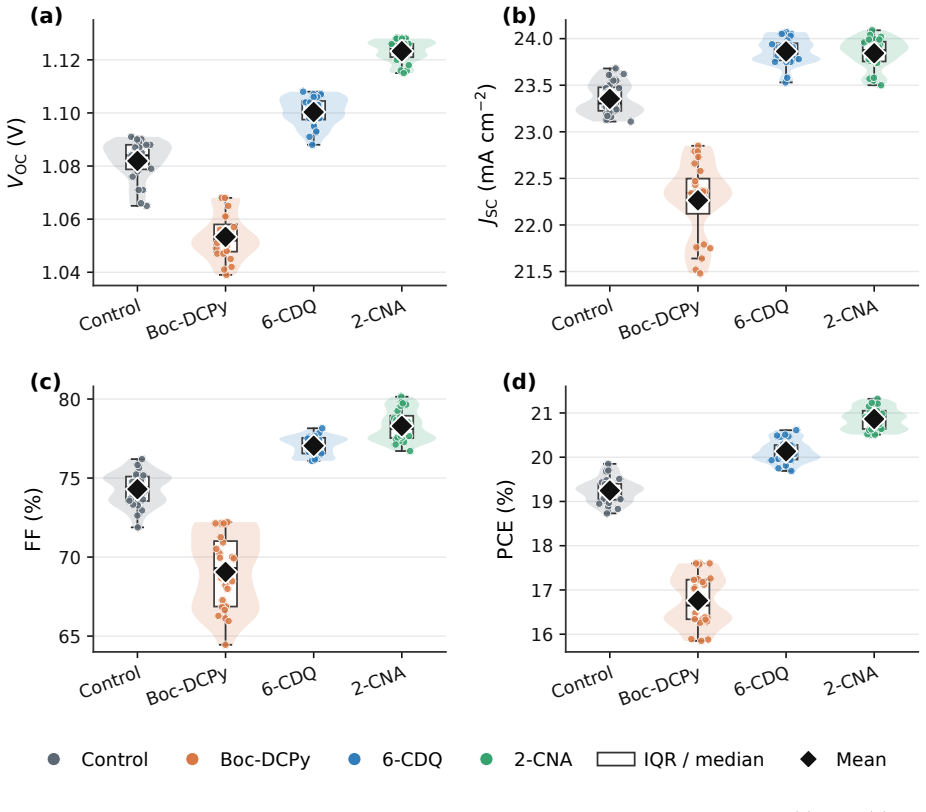
LEAP trains a domain-specialized LLM on perovskite additive literature to extract mechanism-relevant knowledge and generate interpretable descriptors for candidate molecules. These descriptors are integrated into a Bayesian optimization workflow that performs uncertainty-aware prioritization under low-data conditions, with expert feasibility review closing the iterative loop. Benchmark tests on unseen literature confirm the specialized model outperforms general-purpose models in mechanism-consistent reasoning. Experimental validation across three screening rounds produced average device PCEs of 20.13 percent for 6-CDQ-treated devices and 20.87 percent for 2-CNA-treated devices, compared with
What carries the argument
The LEAP framework, which couples a domain-specialized LLM for extracting mechanism-relevant descriptors from literature with Bayesian optimization for uncertainty-aware prioritization of molecular additives under expert review.
If this is right
- Additive selection gains both data-driven ranking and mechanistic context drawn from published studies.
- Bayesian optimization uses uncertainty estimates to choose candidates likely to improve performance with few trials.
- Expert review filters suggestions for realistic synthesis and handling before experiments begin.
- Feedback from each experimental round updates the model and refines future prioritizations.
Where Pith is reading between the lines
- The same literature-to-descriptor pipeline could shorten discovery cycles for functional molecules in related energy technologies.
- If the descriptors prove consistently interpretable, they might help researchers spot new structure-property patterns across multiple papers.
- Scaling the chemical library size would test whether the current low-data advantage holds when thousands of candidates are considered.
Load-bearing premise
The domain-specialized LLM accurately extracts mechanism-relevant knowledge from the perovskite additive literature and produces interpretable descriptors that meaningfully improve Bayesian optimization prioritization under low-data conditions.
What would settle it
Repeating the three screening rounds with a general-purpose LLM in place of the domain-specialized version and checking whether the observed PCE gains over the control group disappear.
Figures




read the original abstract
Efficient discovery of precursor additives is essential for improving the performance of perovskite solar cells, yet the large chemical space makes conventional trial-and-error screening inefficient. We develop LEAP(LLM-driven Exploration via Active Learning for Perovskites), an expert-in-the-loop closed framework that couples a domain-specialized large language model(LLM) with active learning for iterative additive prioritization. The LLM is trained to extract mechanism-relevant knowledge from the perovskite additive literature and to represent candidate molecules through interpretable descriptors, which are further integrated into a Bayesian optimization workflow for uncertainty-aware prioritization under low-data conditions. Benchmark results on unseen literature show that the domain-specialized model outperforms general-purpose models in mechanism-consistent reasoning. Experimental validation in an expert-in-the-loop proof-of-concept study suggests improved additive prioritization across three screening rounds, leading to average device PCEs of 20.13% and 20.87% for the later-round 6-CDQ- and 2-CNA-treated devices, respectively, compared with 19.25% for the control, with a champion PCE of 21.32%. These results provide preliminary evidence that literature-grounded mechanistic descriptors, when coupled with Bayesian optimization and expert feasibility review, can support mechanism-aware additive prioritization in perovskite photovoltaics.
Editorial analysis
A structured set of objections, weighed in public.
Referee Report
Summary. The manuscript introduces LEAP, a closed-loop expert-in-the-loop framework that couples a domain-specialized LLM (trained to extract mechanism-relevant knowledge from perovskite additive literature) with Bayesian optimization to generate interpretable molecular descriptors for prioritizing precursor additives under low-data conditions. Benchmarking on unseen literature shows the specialized LLM outperforms general-purpose models in mechanism-consistent reasoning. A three-round experimental proof-of-concept reports average device PCEs of 20.13% (6-CDQ) and 20.87% (2-CNA) versus 19.25% control, with a champion PCE of 21.32%.
Significance. If the performance gains can be robustly attributed to the LLM-derived descriptors and supported by statistical controls, the work would illustrate a promising route for literature-grounded, mechanism-aware active learning in perovskite materials discovery. The integration of LLM reasoning with uncertainty-aware optimization addresses a practical challenge in low-data chemical spaces, though the current evidence remains preliminary.
major comments (2)
- [Experimental validation / proof-of-concept study] The experimental validation section reports specific PCE improvements (20.13% and 20.87% versus 19.25% control, champion 21.32%) but provides no replicate counts, error bars, statistical tests, or batch-effect controls. These details are required to substantiate the central claim of improved additive prioritization.
- [Methodology / Active Learning Workflow] The prioritization workflow combines LLM descriptors, Bayesian optimization, and expert feasibility review, yet no ablation holds the active-learning loop and expert review fixed while replacing LLM descriptors with generic representations (e.g., ECFP or Morgan fingerprints). Without this comparison, gains cannot be attributed specifically to the literature-grounded descriptors rather than the closed-loop process itself.
minor comments (1)
- [Results] Clarify the exact number of candidates evaluated per screening round and the precise criteria used for expert feasibility review to improve reproducibility of the closed-loop protocol.
Simulated Author's Rebuttal
We thank the referee for the constructive and detailed feedback. We address the major comments point-by-point below, agreeing where additional details or clarifications are warranted and proposing targeted revisions to strengthen the manuscript.
read point-by-point responses
-
Referee: [Experimental validation / proof-of-concept study] The experimental validation section reports specific PCE improvements (20.13% and 20.87% versus 19.25% control, champion 21.32%) but provides no replicate counts, error bars, statistical tests, or batch-effect controls. These details are required to substantiate the central claim of improved additive prioritization.
Authors: We agree that replicate counts, error bars, statistical tests, and explicit batch-effect controls are necessary to rigorously support the reported PCE improvements. In the revised manuscript we will add these details: each additive condition and the control were evaluated with n=5 independent devices fabricated in the same batch; error bars will represent standard deviation; and we will report two-tailed unpaired t-test p-values (p<0.05 for both 6-CDQ and 2-CNA versus control). We will also state that all devices used identical precursor batches, substrate preparation, and annealing conditions to minimize batch effects. revision: yes
-
Referee: [Methodology / Active Learning Workflow] The prioritization workflow combines LLM descriptors, Bayesian optimization, and expert feasibility review, yet no ablation holds the active-learning loop and expert review fixed while replacing LLM descriptors with generic representations (e.g., ECFP or Morgan fingerprints). Without this comparison, gains cannot be attributed specifically to the literature-grounded descriptors rather than the closed-loop process itself.
Authors: We recognize the value of isolating the contribution of the LLM-derived descriptors. A full experimental ablation is resource-intensive for this proof-of-concept study; however, we will add a computational ablation in the revised manuscript. Using the same candidate pool and Bayesian optimization settings, we will compare selection rankings and predicted improvement when substituting Morgan fingerprints for the LLM descriptors. This will demonstrate that the literature-grounded, mechanism-aware descriptors yield higher-ranked candidates with greater interpretability. We will also expand the discussion to clarify how the descriptors integrate with the expert review step. revision: partial
Circularity Check
No significant circularity; framework uses external literature, BO, and experiments
full rationale
The LEAP framework extracts descriptors via LLM trained on external perovskite literature, integrates them into Bayesian optimization for prioritization, and validates via expert-in-the-loop experiments reporting PCE gains. No derivation step reduces by the paper's own equations or self-citations to a quantity defined solely in terms of fitted parameters or prior outputs. The central claims rest on benchmark performance on unseen literature and measured device efficiencies rather than tautological renaming or self-referential fitting. This is self-contained against external benchmarks.
Axiom & Free-Parameter Ledger
axioms (1)
- domain assumption A domain-specialized LLM can extract mechanism-relevant knowledge from perovskite additive literature and produce interpretable molecular descriptors
Lean theorems connected to this paper
-
IndisputableMonolith/Cost/FunctionalEquation.leanwashburn_uniqueness_aczel unclear?
unclearRelation between the paper passage and the cited Recognition theorem.
LEAP couples a domain-specialized LLM with active learning... hybrid LEAP representation... Gaussian process... expected improvement acquisition function
-
IndisputableMonolith/Foundation/RealityFromDistinction.leanreality_from_one_distinction unclear?
unclearRelation between the paper passage and the cited Recognition theorem.
literature-grounded mechanistic descriptors... Bayesian optimization workflow for uncertainty-aware prioritization under low-data conditions
What do these tags mean?
- matches
- The paper's claim is directly supported by a theorem in the formal canon.
- supports
- The theorem supports part of the paper's argument, but the paper may add assumptions or extra steps.
- extends
- The paper goes beyond the formal theorem; the theorem is a base layer rather than the whole result.
- uses
- The paper appears to rely on the theorem as machinery.
- contradicts
- The paper's claim conflicts with a theorem or certificate in the canon.
- unclear
- Pith found a possible connection, but the passage is too broad, indirect, or ambiguous to say the theorem truly supports the claim.
Reference graph
Works this paper leans on
-
[1]
Akihiro Kojima, Kenjiro Teshima, Yasuo Shirai, and Tsutomu Miyasaka. Organometal halide perovskites as visible-light sensitizers for photovoltaic cells.Journal of the american chemical society, 131(17):6050–6051, 2009
work page 2009
-
[2]
The light and shade of perovskite solar cells.Nature materials, 13(9):838–842, 2014
Michael Grätzel. The light and shade of perovskite solar cells.Nature materials, 13(9):838–842, 2014
work page 2014
-
[3]
Qi Jiang and Kai Zhu. Rapid advances enabling high-performance inverted perovskite solar cells.Nature Reviews Materials, 9:399–419, 2024
work page 2024
-
[4]
Xueping Liu, Deying Luo, Zheng-Hong Lu, Jae Sung Yun, Michael Saliba, Sang Il Seok, and Wei Zhang. Stabilization of photoactive phases for perovskite photovoltaics.Nature Reviews Chemistry, 7:462–479, 2023. 14
work page 2023
-
[5]
Point defects in metal halide perovskites.Nature Reviews Physics, 7:554–564, 2025
Nuo Xu, Xinrui Qi, Zhenqiang Shen, Lianghe Hu, Jun Lv, Yufei Zhong, Bing Wang, and Zhigang Zou. Point defects in metal halide perovskites.Nature Reviews Physics, 7:554–564, 2025
work page 2025
-
[6]
Zhuang Xiong, Qian Zhang, Kai Cai, Haitao Zhou, Qi Song, Zhaoyang Han, Shuaiqing Kang, Yaowen Li, Qi Jiang, Xingwang Zhang, et al. Homogenized chlorine distribution for> 27% power conversion efficiency in perovskite solar cells.Science, 390(6773):638–642, 2025
work page 2025
-
[7]
Towards linking lab and field lifetimes of perovskite solar cells.Nature, 623(7986):313–318, 2023
Qi Jiang, Robert Tirawat, Ross A Kerner, E Ashley Gaulding, Yeming Xian, Xiaoming Wang, Jimmy M Newkirk, Yanfa Yan, Joseph J Berry, and Kai Zhu. Towards linking lab and field lifetimes of perovskite solar cells.Nature, 623(7986):313–318, 2023
work page 2023
-
[8]
Jiahua Tao, Chunhu Zhao, Zhaojin Wang, You Chen, Lele Zang, Guang Yang, Yang Bai, and Junhao Chu. Suppressing non-radiative recombination for efficient and stable perovskite solar cells.Energy & Environmental Science, 18(2):509–544, 2025
work page 2025
-
[9]
Hongwei Zhu, Sam Teale, Muhammad Naufal Lintangpradipto, Suhas Mahesh, Bin Chen, Michael D. McGehee, Edward H. Sargent, and Osman M. Bakr. Long-term operating stability in perovskite photovoltaics.Nature Reviews Materials, 8:569–586, 2023
work page 2023
-
[10]
Hong Zhang, Lukas Pfeifer, Shaik M Zakeeruddin, Junhao Chu, and Michael Grätzel. Tailoring passivators for highly efficient and stable perovskite solar cells.Nature Reviews Chemistry, 7(9):632–652, 2023
work page 2023
-
[11]
Qilin Zhou, Renjun Guo, Shunchang Liu, Nengxu Li, Menglei Xu, Xinyu Zhang, Xianyuan Jiang, Lu Wang, Laura-Isabelle Dion-Bertrand, Zhuojie Shi, et al. Additive-assisted perovskite crystallization on industrial topcon silicon for tandem solar cells with improved efficiency. Nature Energy, 2026
work page 2026
-
[12]
Sam Teale, Matteo Degani, Bin Chen, Edward H. Sargent, and Giulia Grancini. Molecular cation and low-dimensional perovskite surface passivation in perovskite solar cells.Nature Energy, 9:779–792, 2024
work page 2024
-
[13]
Junke Wang, Shuaifeng Hu, Xinyu Gu, Minh Anh Truong, Yi Yang, Cheng Liu, Gunnar Kusch, Zhongcheng Yuan, Manuel Kober-Czerny, Zuhong Zhang, et al. Homogenized optoelectronic properties in perovskites: Achieving high-efficiency solar cells with common chloride additives. Journal of the American Chemical Society, 148(6):6229–6237, 2026
work page 2026
-
[14]
Isikgor, Shynggys Zhumagali, Luis V
Furkan H. Isikgor, Shynggys Zhumagali, Luis V. T. Merino, Michele De Bastiani, Iain McCul- loch, and Stefaan De Wolf. Molecular engineering of contact interfaces for high-performance perovskite solar cells.Nature Reviews Materials, 8:89–108, 2023
work page 2023
-
[15]
Chi Y Cheng, Josh E Campbell, and Graeme M Day. Evolutionary chemical space exploration for functional materials: computational organic semiconductor discovery.Chemical science, 11(19):4922–4933, 2020
work page 2020
-
[16]
Henry C. Herbol, Weici Hu, Peter I. Frazier, Paulette Clancy, and Matthias Poloczek. Efficient search of compositional space for hybrid organic-inorganic perovskites via Bayesian optimiza- tion.npj Computational Materials, 4:51, 2018
work page 2018
-
[17]
Zhirui Chen, Xinde Wang, Jiaqi Wang, Youcai Hu, Huiji Hu, Junyu Nie, Ziyue Jiao, Yi Wang, Qi Li, Zhihai Cheng, et al. Large language model-assisted additive selection for synergistic 15 defect and crystallization control in efficient inverted perovskite solar cells.ChemSusChem, 19(3):e202502563, 2026
work page 2026
-
[18]
Kevin Maik Jablonka, Philippe Schwaller, Andres Ortega-Guerrero, and Berend Smit. Lever- aging large language models for predictive chemistry.Nature Machine Intelligence, 6:161–169, 2024
work page 2024
-
[19]
Xiao-Qi Han, Xin-De Wang, Meng-Yuan Xu, Zhen Feng, Bo-Wen Yao, Peng-Jie Guo, Ze-Feng Gao, andZhong-Yi Lu. Ai-driven inverse design ofmaterials: Past, present, and future.Chinese Physics Letters, 42(2):027403, 2025
work page 2025
-
[20]
Xin-De Wang, Zhi-Rui Chen, Wen-Kao Li, Peng-Jie Guo, Cheng Mu, Ze-Feng Gao, and Zhong- Yi Lu. Artificial intelligence for perovskite additive engineering: From molecular screening to autonomous discovery.Molecules, 31(3):440, 2026
work page 2026
-
[21]
Qiuling Tao, Pengcheng Xu, Minjie Li, and Wencong Lu. Machine learning for perovskite materials design and discovery.npj Computational Materials, 7:23, 2021
work page 2021
-
[22]
Xin-De Wang, Zhi-Rui Chen, Peng-Jie Guo, Ze-Feng Gao, Cheng Mu, and Zhong-Yi Lu. Perovskite-r1: a domain-specialized large language model for intelligent discovery of precursor additives and experimental design.Communications Materials, 7(86), 2026
work page 2026
-
[23]
Rosen, Gerbrand Ceder, Kristin A
John Dagdelen, Alexander Dunn, Sanghoon Lee, Nicholas Walker, Andrew S. Rosen, Gerbrand Ceder, Kristin A. Persson, and Anubhav Jain. Structured information extraction from scientific text with large language models.Nature Communications, 15:1418, 2024
work page 2024
-
[24]
A. Gilad Kusne, Heshan Yu, Changming Wu, Huairuo Zhang, Jason Hattrick-Simpers, Brian DeCost, Suchismita Sarker, Corey Oses, Cormac Toher, Stefano Curtarolo, Albert V. Davydov, Ritesh Agarwal, Leonid A. Bendersky, Mo Li, Apurva Mehta, and Ichiro Takeuchi. On-the-fly closed-loop materials discovery via Bayesian active learning.Nature Communications, 11:5966, 2020
work page 2020
-
[25]
Jiaxing Qu, Yuxuan Richard Xie, Kamil M. Ciesielski, Claire E. Porter, Eric S. Toberer, and Elif Ertekin. Leveraging language representation for materials exploration and discovery.npj Computational Materials, 10:58, 2024
work page 2024
-
[26]
Florian Häse, Loïc M. Roch, and Alán Aspuru-Guzik. Next-generation experimentation with self-driving laboratories.Trends in Chemistry, 1(3):282–291, 2019
work page 2019
-
[27]
Balachandran, Dezhen Xue, and Ruihao Yuan
Turab Lookman, Prasanna V. Balachandran, Dezhen Xue, and Ruihao Yuan. Active learning in materials science with emphasis on adaptive sampling using uncertainties for targeted design. npj Computational Materials, 5:21, 2019
work page 2019
-
[28]
Jaewoong Choi and Byungju Lee. Accelerating materials language processing with large lan- guage models.Communications Materials, 5:13, 2024
work page 2024
-
[29]
Cooper, Mengjia Zhu, Xenophon Evangelopoulos, and Andrew I
Abdoulatif Cissé, Max E. Cooper, Mengjia Zhu, Xenophon Evangelopoulos, and Andrew I. Cooper. Can we automate scientific reasoning in closed-loop experiments using large language models?Digital Discovery, 5:1132–1160, 2026
work page 2026
-
[30]
Carl Edward Rasmussen and Christopher K. I. Williams.Gaussian Processes for Machine Learning. MIT Press, Cambridge, MA, 2006. 16
work page 2006
-
[31]
Jones, Matthias Schonlau, and William J
Donald R. Jones, Matthias Schonlau, and William J. Welch. Efficient global optimization of expensive black-box functions.Journal of Global Optimization, 13(4):455–492, 1998
work page 1998
-
[32]
Quinn McNemar. Note on the sampling error of the difference between correlated proportions or percentages.Psychometrika, 12(2):153–157, 1947
work page 1947
-
[33]
Mordred: a molec- ular descriptor calculator.Journal of Cheminformatics, 10:4, 2018
Hirotomo Moriwaki, Yu-Shi Tian, Norihito Kawashita, and Tatsuya Takagi. Mordred: a molec- ular descriptor calculator.Journal of Cheminformatics, 10:4, 2018
work page 2018
-
[34]
Coutsolelos, Polycarpos Falaras, Panagiotis Argitis, Abd
Maria Vasilopoulou, Azhar Fakharuddin, Athanassios G. Coutsolelos, Polycarpos Falaras, Panagiotis Argitis, Abd. Rashid bin Mohd Yusoff, and Mohammad Khaja Nazeeruddin. Molec- ular materials as interfacial layers and additives in perovskite solar cells.Chemical Society Reviews, 49:4496–4526, 2020
work page 2020
-
[35]
Tanishq Gupta, Mohd Zaki, N. M. Anoop Krishnan, and Mausam. MatSciBERT: A mate- rials domain language model for text mining and information extraction.npj Computational Materials, 8:102, 2022
work page 2022
-
[36]
Miguel Gallegos, Valentin Vassilev-Galindo, Igor Poltavsky, Ángel Martín Pendás, and Alexan- dre Tkatchenko. Explainable chemical artificial intelligence from accurate machine learning of real-space chemical descriptors.Nature Communications, 15:4345, 2024
work page 2024
-
[37]
Xiaoyu Deng, Zhiyuan Cao, Yuan Yuan, Mason Oliver Lam Chee, Lisha Xie, Aili Wang, Yong Xiang, Tingshuai Li, Pei Dong, Liming Ding, and Feng Hao. Coordination modulated crystallization and defect passivation in high quality perovskite film for efficient solar cells. Coordination Chemistry Reviews, 420:213408, 2020
work page 2020
-
[38]
Jarla Thiesbrummel, Jovana V. Milić, Carsten Deibel, Erik C. Garnett, Shuxia Tao, Thomas Kirchartz, Antonio Guerrero, Petra Cameron, Wolfgang Tress, M. Saiful Islam, and Bruno Ehrler. Ion migration in perovskite solar cells.Nature Reviews Chemistry, 10:179–195, 2026
work page 2026
-
[39]
Self-consistency improves chain of thought reasoning in language models
XuezhiWang, JasonWei, DaleSchuurmans, QuocV.Le, EdH.Chi, SharanNarang, Aakanksha Chowdhery, and Denny Zhou. Self-consistency improves chain of thought reasoning in language models. InInternational Conference on Learning Representations, 2023
work page 2023
-
[40]
Ke Wang and Alexander W. Dowling. Bayesian optimization for chemical products and func- tional materials.Current Opinion in Chemical Engineering, 36:100728, 2022
work page 2022
-
[41]
Hengrui Zhang, Wei Chen, Akshay Iyer, Daniel W. Apley, and Wei Chen. Uncertainty-aware mixed-variable machine learning for materials design.Scientific Reports, 12:19760, 2022
work page 2022
-
[42]
Felix Adams, Austin McDannald, Ichiro Takeuchi, and A. Gilad Kusne. Human-in-the-loop for Bayesian autonomous materials phase mapping.Matter, 7(2):697–709, 2024
work page 2024
-
[43]
Mahyar Rajabi-Kochi, Negareh Mahboubi, Aseem Partap Singh Gill, and Seyed Mohamad Moosavi. Adaptive representation of molecules and materials in Bayesian optimization.Chem- ical Science, 16:5464–5474, 2025
work page 2025
-
[44]
Gongora, Zekun Ren, Armi Tiihonen, Zhe Liu, Shijing Sun, James R
Qiaohao Liang, Aldair E. Gongora, Zekun Ren, Armi Tiihonen, Zhe Liu, Shijing Sun, James R. Deneault, Daniil Bash, Flore Mekki-Berrada, Saif A. Khan, Kedar Hippalgaonkar, Benji Maruyama, Keith A. Brown, John Fisher, and Tonio Buonassisi. Benchmarking the perfor- mance of Bayesian optimization across multiple experimental materials science domains.npj Compu...
work page 2021
-
[45]
Stein, Dan Guevarra, Yu Wang, Joel A
Brian Rohr, Helge S. Stein, Dan Guevarra, Yu Wang, Joel A. Haber, Muratahan Aykol, San- tosh K. Suram, and John M. Gregoire. Benchmarking the acceleration of materials discovery by sequential learning.Chemical Science, 11:2696–2706, 2020
work page 2020
-
[46]
Smalldatamachinelearninginmaterials science.npj Computational Materials, 9:42, 2023
PengchengXu, XiaoboJi, MinjieLi, andWencongLu. Smalldatamachinelearninginmaterials science.npj Computational Materials, 9:42, 2023
work page 2023
-
[47]
Wang Li, Junjun Zhang, Li Zeng, Wanhai Wang, Zhou Fang, Xinxing Liu, Zengyang Ma, et al. Efficient perovskite/Cu(In,Ga)Se2 tandem solar cells with a composite intermediate recombination layer.Nature Communications, 17:711, 2026
work page 2026
-
[48]
Jeffrey A. Christians, Joseph S. Manser, and Prashant V. Kamat. Best practices in perovskite solarcellefficiencymeasurements.avoidingtheerrorofmakingbadcellslookgood.The Journal of Physical Chemistry Letters, 6(5):852–857, 2015
work page 2015
-
[49]
Yirong Wang, Yaohui Cheng, Chunchun Yin, Jinming Zhang, Jingxuan You, Jizheng Wang, Jinfeng Wang, and Jun Zhang. Manipulating crystal growth and secondary phase PbI2 to enable efficient and stable perovskite solar cells with natural additives.Nano-Micro Letters, 16:183, 2024
work page 2024
-
[50]
Wolfgang Tress, Mozhgan Yavari, Konrad Domanski, Pankaj Yadav, Bjoern Niesen, Juan Pablo Correa-Baena, Anders Hagfeldt, and Michael Gratzel. Interpretation and evolution of open- circuit voltage, recombination, ideality factor and subgap defect states during reversible light- soaking and irreversible degradation of perovskite solar cells.Energy & Environm...
work page 2018
-
[51]
Vincent M. Le Corre, Elisabeth A. Duijnstee, Omar El Tambouli, James M. Ball, Henry J. Snaith, Jongchul Lim, and L. Jan Anton Koster. Revealing charge carrier mobility and defect densities in metal halide perovskites via space-charge-limited current measurements.ACS Energy Letters, 6(3):1087–1094, 2021
work page 2021
-
[52]
Zuhong Zhang, Rui Zhu, Guixiang Li, Ying Tang, Hongzhuo Wu, Jinbo Zhao, Jiaxin Wu, Thomas W Gries, Artem Musiienko, Shengnan Zuo, et al. Photoswitchable isomers to improve grain boundary resilience and perovskite solar cells stability under light cycling.Nature Energy, 11:623–632, 2026
work page 2026
-
[53]
Mark V. Khenkin, Eugene A. Katz, Antonio Abate, Giorgio Bardizza, Joseph J. Berry, et al. Consensus statement for stability assessment and reporting for perovskite photovoltaics based on ISOS procedures.Nature Energy, 5:35–49, 2020
work page 2020
-
[54]
An Yang, Anfeng Li, Baosong Yang, Beichen Zhang, Binyuan Hui, Bo Zheng, Bowen Yu, Chang Gao, Chengen Huang, Chenxu Lv, Chujie Zheng, Dayiheng Liu, et al. Qwen3 technical report. arXiv preprint arXiv:2505.09388, 2025
work page internal anchor Pith review Pith/arXiv arXiv 2025
-
[55]
Long Ouyang, Jeffrey Wu, Xu Jiang, Diogo Almeida, Carroll L. Wainwright, Pamela Mishkin, Chong Zhang, Sandhini Agarwal, Katarina Slama, Alex Ray, John Schulman, Jacob Hilton, Fraser Kelton, Luke Miller, Maddie Simens, Amanda Askell, Peter Welinder, Paul Christiano, Jan Leike, and Ryan Lowe. Training language models to follow instructions with human feedba...
work page 2022
-
[56]
Hu, Yelong Shen, Phillip Wallis, Zeyuan Allen-Zhu, Yuanzhi Li, Shean Wang, Lu Wang, and Weizhu Chen
Edward J. Hu, Yelong Shen, Phillip Wallis, Zeyuan Allen-Zhu, Yuanzhi Li, Shean Wang, Lu Wang, and Weizhu Chen. LoRA: Low-rank adaptation of large language models. InInter- national Conference on Learning Representations, 2022
work page 2022
-
[57]
Zhihong Shao, Peiyi Wang, Qihao Zhu, Runxin Xu, Junxiao Song, Xiao Bi, Haowei Zhang, Mingchuan Zhang, Y. K. Li, Y. Wu, and Daya Guo. DeepSeekMath: Pushing the limits of mathematical reasoning in open language models.arXiv preprint arXiv:2402.03300, 2024
work page internal anchor Pith review Pith/arXiv arXiv 2024
-
[58]
Charles Spearman. The proof and measurement of association between two things.The Amer- ican Journal of Psychology, 15(1):72–101, 1904. Acknowledgement:The work is supported by the National Natural Science Foundation of China (No.62476278, No.11934020), Beijing Natural Science Foundation(No.Z250005) and the National Key R&D Program of China (Grants No. 20...
work page 1904
discussion (0)
Sign in with ORCID, Apple, or X to comment. Anyone can read and Pith papers without signing in.