Entangling Power: A Probe of Symmetry and Integrability in Quantum Many-Body Systems
Pith reviewed 2026-05-21 05:26 UTC · model grok-4.3
The pith
In the thermodynamic limit the entangling power of the two-magnon S-matrix vanishes at the SU(2) points but reaches a maximum at the free-fermion point.
A machine-rendered reading of the paper's core claim, the machinery that carries it, and where it could break.
Core claim
The two-magnon S-matrix in the thermodynamic limit decomposes into the quantum logic gates Identity, SWAP, and sigma_z tensor sigma_z. At the SU(2) points the S-matrix reduces to the Identity gate, causing the entangling power to vanish for every scattering energy. At the free-fermion point the entangling power instead attains its highest value. This stands in contrast to the dips observed in finite-size chains and positions the entangling power as an operator-level probe of symmetry and integrability.
What carries the argument
The decomposition of the two-magnon S-matrix into the gates Identity, SWAP, and sigma_z tensor sigma_z, which is used to calculate the entangling power directly from the scattering data.
If this is right
- Entangling power decreases monotonically with increasing symmetry in two-site models, reaching minimum at the SU(2) XXX point.
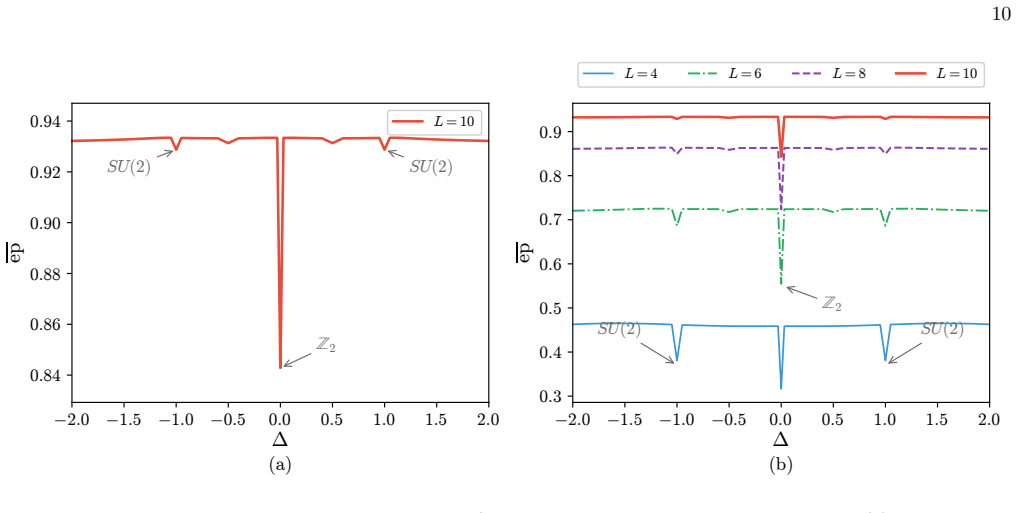
- Finite-size XXZ chains display sharp dips in entangling power at the SU(2) points where Delta equals plus or minus one and at the free-fermion point where Delta equals zero.
- The dip at the free-fermion point decays more slowly with increasing system size compared to the SU(2) dips.
- In the thermodynamic limit the entangling power vanishes at SU(2) points for all energies while maximizing at the free-fermion point.
- The entangling power provides an operator diagnostic for symmetry and aspects of integrability in quantum simulations of spin-chain dynamics.
Where Pith is reading between the lines
- The reversal between finite and infinite system behavior implies that symmetry constraints on entanglement generation become absolute only in the thermodynamic limit.
- This method could help experimentalists identify integrable or symmetric regimes in quantum simulators by measuring entanglement generation rates.
- The connection to high-energy scattering suggests similar diagnostics might apply to particle physics models with enhanced symmetries.
- Further work might test whether entangling power can distinguish different types of integrability beyond the points studied here.
Load-bearing premise
The two-magnon S-matrix can be fully decomposed into the gates Identity, SWAP, and sigma_z tensor sigma_z in a way that completely determines the entangling power without missing dynamical or truncation effects.
What would settle it
An experimental or numerical observation of non-vanishing entangling power for two-magnon scattering at the SU(2) points in a large but finite system approaching the thermodynamic limit would contradict the vanishing result.
Figures





read the original abstract
The entangling power of a unitary operator quantifies its ability to generate entanglement from product states and provides a natural probe of quantum many-body dynamics. Entanglement extremization at points of enhanced symmetry has previously been observed in high-energy scattering. In this work we compute the time-averaged entangling power of anisotropic Heisenberg spin chains across two-site models and finite-size systems, as well as the entangling power of the two-magnon $S$-matrix in the thermodynamic limit. For two-site models we establish a monotonic hierarchy: the entangling power decreases as the symmetry group grows, reaching its minimum at the $SU(2)$ XXX point. Finite-size XXZ chains exhibit sharp dips at the $SU(2)$ points $\Delta=\pm 1$ and the free-fermion point $\Delta=0$, with the free-fermion dip decaying much more slowly with system size. In the thermodynamic limit, we decompose the two-magnon $S$-matrix into quantum logic gates -- Identity, SWAP, and $\sigma_z\otimes\sigma_z$ -- and show that the entangling power vanishes for all scattering energies at the $SU(2)$ points, where the $S$-matrix reduces to the Identity gate, while the free-fermion point achieves the maximum -- the opposite of the finite-size many-body behavior. The entangling power can serve as an {\em operator} diagnostic for symmetry and selected aspects of integrability in quantum simulations of spin-chain dynamics.
Editorial analysis
A structured set of objections, weighed in public.
Referee Report
Summary. The manuscript claims to compute the entangling power of unitary operators as a probe of symmetry and integrability in quantum many-body systems, focusing on anisotropic Heisenberg (XXZ) spin chains. In two-site models, it establishes a monotonic hierarchy where entangling power decreases as the symmetry group enlarges, reaching a minimum at the SU(2) XXX point. For finite-size XXZ chains, sharp dips occur at the SU(2) points Δ=±1 and the free-fermion point Δ=0, with the free-fermion dip decaying more slowly with system size. In the thermodynamic limit, the two-magnon S-matrix is decomposed into quantum logic gates (Identity, SWAP, σz⊗σz), showing that entangling power vanishes for all scattering energies at SU(2) points where the S-matrix reduces to the Identity gate, while the free-fermion point achieves the maximum, contrasting with finite-size behavior. The entangling power is suggested as an operator diagnostic for symmetry and integrability in quantum simulations.
Significance. If the central results hold, particularly the thermodynamic-limit decomposition, this work offers a novel operator-based diagnostic for symmetry and integrability in quantum many-body systems, with potential utility in quantum simulations of spin chains. The explicit decomposition of the two-magnon S-matrix into standard quantum gates (Identity, SWAP, σz⊗σz) is a technical strength that could bridge many-body physics and quantum information. The observed reversal between finite-size dips and thermodynamic-limit behavior is noteworthy and may motivate further entanglement studies in integrable models.
major comments (1)
- [Thermodynamic limit analysis] Thermodynamic-limit paragraph: The claim that entangling power vanishes for all scattering energies at the SU(2) points rests on the two-magnon S-matrix reducing precisely to the Identity gate. The Bethe-ansatz scattering phase at Δ=±1 takes the form of a rational function of rapidity u (e.g., (u−i)/(u+i)); explicit matrix elements or projections onto the two-particle subspace must be provided to confirm that any rapidity-dependent phase is global and that no residual components project onto the SWAP or σz⊗σz sectors, which would produce non-zero entangling power.
minor comments (1)
- [Abstract] Abstract: The distinction between the 'time-averaged entangling power' computed for finite-size chains and the entangling power of the S-matrix in the thermodynamic limit should be clarified, including whether the same definition and averaging procedure apply in both regimes.
Simulated Author's Rebuttal
We thank the referee for their careful reading of the manuscript and for the constructive comment on the thermodynamic-limit analysis. We address the point below and have revised the manuscript to incorporate additional explicit derivations as suggested.
read point-by-point responses
-
Referee: [Thermodynamic limit analysis] Thermodynamic-limit paragraph: The claim that entangling power vanishes for all scattering energies at the SU(2) points rests on the two-magnon S-matrix reducing precisely to the Identity gate. The Bethe-ansatz scattering phase at Δ=±1 takes the form of a rational function of rapidity u (e.g., (u−i)/(u+i)); explicit matrix elements or projections onto the two-particle subspace must be provided to confirm that any rapidity-dependent phase is global and that no residual components project onto the SWAP or σz⊗σz sectors, which would produce non-zero entangling power.
Authors: We agree that an explicit verification strengthens the presentation. In the revised manuscript we have added a detailed derivation of the two-magnon S-matrix at the SU(2) points Δ=±1. Starting from the known Bethe-ansatz phase shift φ(u)=(u−i)/(u+i), we project the operator onto the two-particle subspace in the basis of symmetric and antisymmetric spin states. The calculation shows that the rapidity-dependent phase factor is identical for all spin configurations and factors out as a global U(1) phase; the coefficients of the SWAP and σz⊗σz components are identically zero for every u. Consequently the S-matrix reduces to the identity (up to the global phase) and the entangling power vanishes for all scattering energies. The new derivation appears in the main text immediately following the gate decomposition and is supported by an appendix containing the full matrix elements. revision: yes
Circularity Check
No circularity: direct evaluation of entangling power from standard S-matrix decomposition
full rationale
The paper computes the time-averaged entangling power and the thermodynamic-limit two-magnon S-matrix entangling power by explicit decomposition into Identity, SWAP, and σz⊗σz gates, then evaluates the resulting expression at the SU(2) points (Δ=±1) and free-fermion point (Δ=0). These steps rest on the known Bethe-ansatz form of the XXZ scattering phase and the definition of entangling power; no equation in the supplied text reduces the output to a fitted parameter, a self-referential definition, or a load-bearing self-citation. The vanishing at SU(2) follows from the S-matrix reducing to the Identity (up to phase) in that limit, which is an external input rather than a construction internal to the paper. The derivation is therefore self-contained against external benchmarks.
Axiom & Free-Parameter Ledger
axioms (1)
- domain assumption Time-averaged entangling power is a faithful probe of the underlying unitary dynamics in spin chains.
Lean theorems connected to this paper
-
IndisputableMonolith/Foundation/RealityFromDistinction.leanreality_from_one_distinction unclear?
unclearRelation between the paper passage and the cited Recognition theorem.
In the thermodynamic limit, we decompose the two-magnon S-matrix into quantum logic gates—Identity, SWAP, and σz⊗σz—and show that the entangling power vanishes for all scattering energies at the SU(2) points, where the S-matrix reduces to the Identity gate
What do these tags mean?
- matches
- The paper's claim is directly supported by a theorem in the formal canon.
- supports
- The theorem supports part of the paper's argument, but the paper may add assumptions or extra steps.
- extends
- The paper goes beyond the formal theorem; the theorem is a base layer rather than the whole result.
- uses
- The paper appears to rely on the theorem as machinery.
- contradicts
- The paper's claim conflicts with a theorem or certificate in the canon.
- unclear
- Pith found a possible connection, but the passage is too broad, indirect, or ambiguous to say the theorem truly supports the claim.
Reference graph
Works this paper leans on
-
[1]
meansd= 3 L grows faster than 2L, and the symmetry constraints become subdominant more rapidly. V. ENT ANGLING POWER AND INTEGRABILITY The XXZ chain is Bethe-ansatz integrable for all val- ues of ∆, so the symmetry dips documented in Sec. IV are features that appearwithinan integrable family. A natural question is whether the entangling power can also det...
-
[2]
Let{|a⟩}and{|b⟩}be orthonormal bases forH A and HB, respectively
Matrix element of the swap operator We now evaluate⟨kl|T 13|mn⟩in the product basis. Let{|a⟩}and{|b⟩}be orthonormal bases forH A and HB, respectively. Each eigenvector decomposes as|n⟩=P a,b(Cn)ab |a⟩ ⊗ |b⟩, whereC n is ad A ×d B matrix. In the doubled space the basis is|a 1, b1, a2, b2⟩, with posi- tions 1 and 2 labelling theA-factor and theB-factor of e...
-
[3]
Time average and eigenvalue grouping The infinite-time average of Eq. (A2) retains only those quartets (k, l, m, n) satisfyingE k +E l =E m +E n, or equivalentlyE k −E m =E n −E l ≡ω: I(2) 0 = X ω X (k,m):E k−Em=ω (n,l):E n−El=ω × TrA(CmC † k ·C nC † l ) 2 .(A5) 20 For each value ofω, define a groupg ω consisting of all pairs of eigenstates (p, q) withE p...
-
[4]
Relation betweenI 1 andI 0 The formula forα= 1 reads I1(U) = Tr(T 24) + Tr (U †)⊗2 T24 U ⊗2 T13 .(A8) UnlikeI 0, the two swap operators flankingU ⊗2 are dif- ferent (T24 andT 13), so the| · | 2 factorization of Eq. (A2) does not apply directly. Instead, we relateI 1(U) toI 0 evaluated on a modified unitary. LetSdenote the SWAP gate onH A⊗HB, i.e.S|a, b⟩= ...
-
[5]
Assembling the time-averaged entangling power Combining the results above with Eq. (2), the time- averaged entanglement power is ep = 1−C dA CdB h Tr(T13) + I(2) 0 + Tr(T24) + I(2) 1 i ,(A13) where I(2) 0 and I(2) 1 are given by Eqs. (A7) and (A12), and the constant terms are Tr(T 13) =d A d2 B and Tr(T24) = d2 A dB. This completes the derivation of the a...
-
[6]
Discrete symmetry The general XYZ Hamiltonian (6) does not commute withS tot z fora x ̸=a y, but it commutes with the parity operatorsR α ≡e iπSα,1 ⊗e iπSα,2 forα=x, y, z. Aπ- rotation about theα-axis preservesS α and flips the other two components, e−iπSα Sβ eiπSα = ( +Sβ β=α , −Sβ β̸=α , (B1) so each bilinear termS (1) β S(2) β picks up two sign flips t...
-
[7]
The operatorR x acts as|m 1, m2⟩ → | −m 1,−m 2⟩and commutes with Rz
Sector decomposition For spin-1,R z has eigenvalue (−1)m1+m2 on|m 1, m2⟩, splitting the nine product states into a 5-dimensional even and a 4-dimensional odd sector. The operatorR x acts as|m 1, m2⟩ → | −m 1,−m 2⟩and commutes with Rz. Forming symmetric and antisymmetric combina- tions underR x within eachR z sector yields four blocks. WritingS x andS y in...
-
[8]
For a 5-fold degenerate eigenvalueλ 0 to exist, it must appear in all four sec- tors
Uniqueness of the{1,3,5}pattern The full spectrum consists of the three roots ofp(λ) together with±a x,±a y,±a z. For a 5-fold degenerate eigenvalueλ 0 to exist, it must appear in all four sec- tors. From the two-dimensional sectors,λ 0 ∈ {±a x} ∩ {±ay} ∩ {±a z}, which requires|a x|=|a y|=|a z|. The identityp(a x) =−a x(ay −a z)2 showsa x is a root of pif...
-
[9]
Spectrum and eigenstates Settinga x =a y = 1 anda z = ∆ in the sector Hamilto- nians of Appendix B, the (+,−) block (B3) gives eigen- values±∆, the (−,+) and (−,−) blocks (B4)–(B5) each give±1 (sincea x =a y = 1), and the 3×3 (+,+) block (B2) reduces to H(+,+) = 0 0 √ 2 0 ∆ 0√ 2 0−∆ ,(C2) whose characteristic polynomial isλ 3 −(∆ 2 + 8)λ/4 = 0, ...
-
[10]
For the rational states, these prod- ucts are inQ( √
Algebraic structure of the traces Each trace Tr A(M † i Mj) involves bilinear products of C-matrix entries. For the rational states, these prod- ucts are inQ( √
-
[11]
and are ∆-independent. For the E± states, the individual entriesα ± = √ 2/N± and β±/ √ 2 =E ±/( √ 2N ±) involve irrational normalization factors, but in the traces the square roots cancel and the bilinear products lie in the quadratic extensionQ(∆, ς) subject toς 2 = ∆2 + 8. For example, α2 ± = 4 ς(ς∓∆) , α + α− = √ 2 ς .(C5) The computation then proceeds...
-
[12]
The parity factor The instantaneous entangling power involves the sum I0(t)+I 1(t), each containing alld 4 quadruples (k, l, k′, l′) weighted by the phasee −iΩt with Ω = (Ek −E l)−(E k′ − El′). Since every eigenstate has definite site-exchange parity,C T n =ϵ n Cn withϵ n =±1, the ˆM-matrix (defined as ˆMkl =C T k Cl) is related toM kl =C kC T l by ˆMkl =...
-
[13]
The instantaneous entangling power Since all coefficient matrices are real, every trace is real andI 0(t) +I1(t) is a real trigonometric polynomial. The contributions at +Ω and−Ω combine into cosines, giving ep(t) = 5 8 − 1 144 A0 + 24X j=1 Aj cos(Ωj t) ,(C9) with 5/8 = 1−2d 3/[d2(d+ 1) 2] ford= 3. The DC component is A0 = 46∆4 + 684∆2 + 2636 (∆2 + 8)2 ,(...
-
[14]
Equiva- lently, this corresponds to restricting the sum in Eq
Time averaging and ep Time averaging ep(t) kills all oscillating terms, leaving only the DC component: ep = 5/8− A 0/144. Equiva- lently, this corresponds to restricting the sum in Eq. (C7) to same-ω-group contributions (Ω = 0), for which the parity factor is uniformly 2. This gives I0 + I1 = 2I0, i.e., I0 = I1 (or equivalently, I(2) 0 = I(2) 1 , see Appe...
-
[15]
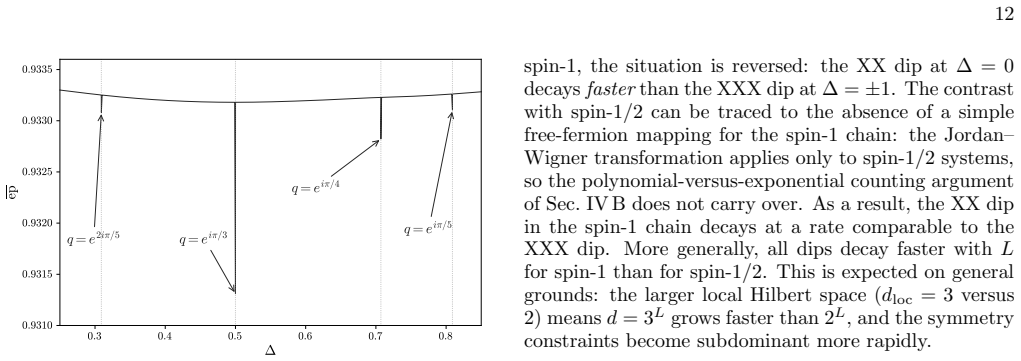
V alidity and degenerate points Both Eq. (C9) and Eq. (18) were derived under the assumption that the 27ω-groups are all distinct. At spe- cial values of ∆ where eigenvalue differences coincide— namely ∆ = 0,±1, and±2—some groups merge and the cross-terms between formerly separate groups contribute additional positive terms to I(2) 0 . Since ep decreases ...
-
[16]
We parametrize ∆ = cosγwith 24 γ∈[0, π]
Setup and the ferromagnetic vacuum We consider the spin-1/2 XXZ Hamiltonian on a peri- odic chain ofLsites: HXXZ = LX j=1 Sx j Sx j+1 +S y j Sy j+1 + ∆S z j Sz j+1 ,(D1) with periodic boundary conditions ⃗SL+1 ≡ ⃗S1 and anisotropy parameter ∆. We parametrize ∆ = cosγwith 24 γ∈[0, π]. The Hamiltonian conserves the total spin projection Sz tot = P j Sz j , ...
-
[17]
One-magnon sector A single spin flip at sitencreates the state|n⟩ ≡ S− n |Ω⟩. Acting with the Hamiltonian on the ansatz |ψ⟩= PL n=1 ϕ(n)|n⟩yields the eigenvalue equation 1 2[ϕ(n+ 1) +ϕ(n−1)] + 1 4(L−2)∆ϕ(n) − 1 2∆ϕ(n) =E ϕ(n).(D2) Substituting the plane-wave ansatzϕ(n) =e ipn immedi- ately gives the magnon dispersion relation ϵ(p)≡E−E 0 = ∆−cosp ,(D3) whe...
-
[18]
Two-magnon sector and the Bethe wavefunction Two magnons at positionsn 1 < n 2 define the state |n1, n2⟩=S − n1 S− n2 |Ω⟩. In the regionn 2 −n 1 ≥2, where the two flipped spins do not occupy adjacent sites, each magnon propagates independently and the eigenvalue equation reduces to two copies of the one-magnon prob- lem. The Bethe ansatz wavefunction in t...
-
[19]
Spectral parameter, rapidity , and theR-matrix The scattering phase (D6) can be greatly simplified by trading the quasi-momentap j for the trigonometric spectral parameteru j, defined by [75, 77] eipj = sin(uj +γ/2) sin(uj −γ/2) .(D8) Substituting into the scattering amplitude (D6) yields, after straightforward algebra, B A = sin(u12 −γ) sin(u12 +γ) ,(D9)...
-
[20]
Y ang–Baxter equation The integrability of the XXZ chain is ultimately guar- anteed by the Yang–Baxter equation [65, 67, 68]: R12(u12)R 13(u13)R 23(u23) =R 23(u23)R 13(u13)R 12(u12),(D11) whereu ij ≡u i −u j andR jk acts on spacesjandk. Equation (D11) is a matrix equation in (C2)⊗3 and states that the order of pairwise scatterings in a three-body collisio...
-
[21]
F romR-matrix to physicalS-matrix TheR-matrix (D10) is not unitary for real spectral pa- rameteru, as the vertex weights are in general complex. To obtain the physical unitaryS-matrix appropriate for real-time scattering, we analytically continueu→iθ, whereθis the rapidity difference of the two magnons. This yields the vertex weights a= sin(iθ+γ) =isinhθc...
-
[22]
(41) for anyU(1)-conserving two-qubit unitary with eigenvalue phase differencesδ t+ andδ s+
Entangling power of theS-matrix We derive the entangling power formula Eq. (41) for anyU(1)-conserving two-qubit unitary with eigenvalue phase differencesδ t+ andδ s+. Ford A =d B = 2 the identity 1−Tr(ρ 2 A) = 2 detρ A simplifies the entangling power to ep(U) = 4 Z dµ(ψ) dµ(ϕ) detρ A ,(D13) where dµ(ψ) and dµ(ϕ) denote independent Haar mea- sures onC 2. ...
-
[23]
S. R. Beane, D. B. Kaplan, N. Klco, and M. J. Savage, Phys. Rev. Lett.122, 102001 (2019), arXiv:1812.03138 [hep-ph]
work page internal anchor Pith review Pith/arXiv arXiv 2019
- [24]
- [25]
- [26]
- [27]
- [28]
- [29]
- [30]
-
[31]
C. Li, T. Ma, J. Shu, and M. Zhu, (2026), arXiv:2605.17434 [hep-ph]
work page internal anchor Pith review Pith/arXiv arXiv 2026
-
[32]
McGinnis, (2025), arXiv:2504.21079 [hep-th]
N. McGinnis, (2025), arXiv:2504.21079 [hep-th]
-
[33]
McGinnis, (2025), arXiv:2511.10559 [hep-th]
N. McGinnis, (2025), arXiv:2511.10559 [hep-th]
-
[34]
J. Thaler and S. Trifinopoulos, Phys. Rev. D111, 056021 (2025), arXiv:2410.23343 [hep-ph]
- [35]
- [36]
-
[37]
Entanglement Entropy and Quantum Field Theory
P. Calabrese and J. L. Cardy, J. Stat. Mech.0406, P06002 (2004), arXiv:hep-th/0405152
work page internal anchor Pith review Pith/arXiv arXiv 2004
-
[38]
Entanglement entropy and conformal field theory
P. Calabrese and J. Cardy, J. Phys. A42, 504005 (2009), arXiv:0905.4013 [cond-mat.stat-mech]
work page internal anchor Pith review Pith/arXiv arXiv 2009
-
[39]
Entanglement in quantum critical phenomena
G. Vidal, J. I. Latorre, E. Rico, and A. Kitaev, Phys. Rev. Lett.90, 227902 (2003), arXiv:quant-ph/0211074
work page internal anchor Pith review Pith/arXiv arXiv 2003
-
[40]
J. I. Latorre, E. Rico, and G. Vidal, Quant. Inf. Comput. 4, 48 (2004), arXiv:quant-ph/0304098
work page internal anchor Pith review Pith/arXiv arXiv 2004
- [41]
-
[42]
T. J. Osborne and M. A. Nielsen, Phys. Rev. A66, 032110 (2002)
work page 2002
-
[43]
Entanglement in Many-Body Systems
L. Amico, R. Fazio, A. Osterloh, and V. Vedral, Rev. Mod. Phys.80, 517 (2008), arXiv:quant-ph/0703044
work page internal anchor Pith review Pith/arXiv arXiv 2008
-
[44]
Area laws for the entanglement entropy - a review
J. Eisert, M. Cramer, and M. B. Plenio, Rev. Mod. Phys. 82, 277 (2010), arXiv:0808.3773 [quant-ph]
work page internal anchor Pith review Pith/arXiv arXiv 2010
-
[45]
Symmetry-resolved entanglement in many-body systems
M. Goldstein and E. Sela, Phys. Rev. Lett.120, 200602 (2018), arXiv:1711.09418 [cond-mat.stat-mech]
work page internal anchor Pith review Pith/arXiv arXiv 2018
-
[46]
J. C. Xavier and F. C. Alcaraz, Phys. Rev. B98, 041106 (2018), arXiv:1804.06357 [cond-mat.stat-mech]
work page internal anchor Pith review Pith/arXiv arXiv 2018
-
[47]
S. Murciano, G. Di Giulio, and P. Calabrese, SciPost Phys.8, 046 (2020), arXiv:1911.09588 [cond-mat.stat- mech]
- [48]
- [49]
-
[50]
P. Zanardi, Phys. Rev. A63, 040304 (2001), arXiv:quant- ph/0010074
-
[51]
Entangling power of time-evolution operators in integrable and nonintegrable many-body systems
R. Pal and A. Lakshminarayan, Phys. Rev. B98, 174304 (2018), arXiv:1805.11632 [quant-ph]
work page internal anchor Pith review Pith/arXiv arXiv 2018
- [52]
-
[53]
M. A. Nielsen and I. L. Chuang,Quantum Computation and Quantum Information(Cambridge University Press, 2012)
work page 2012
-
[54]
G. Styliaris, N. Anand, and P. Zanardi, Phys. Rev. Lett. 126, 030601 (2021), arXiv:2007.08570 [quant-ph]
- [55]
-
[56]
Entanglement of a Pair of Quantum Bits
S. Hill and W. K. Wootters, Phys. Rev. Lett.78, 5022 (1997), arXiv:quant-ph/9703041
work page internal anchor Pith review Pith/arXiv arXiv 1997
-
[57]
W. K. Wootters, Phys. Rev. Lett.80, 2245 (1998), arXiv:quant-ph/9709029
work page internal anchor Pith review Pith/arXiv arXiv 1998
- [58]
- [59]
-
[60]
E. Lieb, T. Schultz, and D. Mattis, Ann. Phys.16, 407 (1961)
work page 1961
-
[61]
E. Lieb, T. Schultz, and D. Mattis, Annals Phys.16, 407 (1961)
work page 1961
- [62]
-
[63]
V. G. Drinfel’d, Sov. Math. Dokl.32, 254 (1985)
work page 1985
- [64]
-
[65]
V. Chari and A. Pressley,A Guide to Quantum Groups (Cambridge University Press, 1994)
work page 1994
-
[66]
J. Lamers, PoSModave2014, 001 (2014), arXiv:1501.06805 [math-ph]
work page internal anchor Pith review Pith/arXiv arXiv 2014
- [67]
-
[68]
F. C. Alcaraz, M. N. Barber, and M. T. Batchelor, Ann. Phys.182, 280 (1988)
work page 1988
-
[69]
The sl_2 loop algebra symmetry of the six-vertex model at roots of unity
T. Deguchi, K. Fabricius, and B. M. McCoy, J. Stat. Phys.102, 701 (2001), arXiv:cond-mat/9912141
work page internal anchor Pith review Pith/arXiv arXiv 2001
-
[70]
F. D. M. Haldane, Phys. Rev. Lett.50, 1153 (1983)
work page 1983
-
[71]
I. Affleck, T. Kennedy, E. H. Lieb, and H. Tasaki, Phys. Rev. Lett.59, 799 (1987)
work page 1987
-
[72]
I. Affleck, T. Kennedy, E. H. Lieb, and H. Tasaki, Com- mun. Math. Phys.115, 477 (1988)
work page 1988
-
[73]
G. V. Uimin, JETP Lett.12, 225 (1970)
work page 1970
-
[74]
C. K. Lai, J. Math. Phys.15, 1675 (1974)
work page 1974
- [75]
-
[76]
L. A. Takhtajan, Phys. Lett. A87, 479 (1982)
work page 1982
-
[77]
H. M. Babujian, Phys. Lett. A90, 479 (1982)
work page 1982
-
[78]
H. N. V. Temperley and E. H. Lieb, Proc. Roy. Soc. Lond. A322, 251 (1971)
work page 1971
-
[79]
M. N. Barber and M. T. Batchelor, Phys. Rev. B40, 4621 (1989)
work page 1989
- [80]
discussion (0)
Sign in with ORCID, Apple, or X to comment. Anyone can read and Pith papers without signing in.