Magnetic field dynamics in isolated neutron stars with an external dipole field
Pith reviewed 2026-05-25 05:28 UTC · model grok-4.3
The pith
Neutron star magnetic fields relax to a stable mixed poloidal-toroidal geometry with the toroidal component holding at most 10 percent of the total magnetic energy.
A machine-rendered reading of the paper's core claim, the machinery that carries it, and where it could break.
Core claim
The simulations reveal that the internal magnetic field relaxes toward a dynamically stable mixed poloidal-toroidal geometry, in which the toroidal component contributes to ≲10% of the total magnetic energy both in the exterior and in the interior. This configuration emerges within one Alfvén time following the saturation of the Tayler instabilities and is also aided by gravitational-wave emission.
What carries the argument
Long-term numerical-relativity simulations that evolve an initial external dipole field together with mixed poloidal-toroidal internal fields whose toroidal energy fraction ranges up to 80 percent.
If this is right
- Long-lived neutron star magnetic fields are strongly constrained toward these stable mixed configurations.
- Pulsar emission models must accommodate predominantly poloidal external fields with only a small toroidal contribution.
- Magnetar evolution is limited by the low toroidal energy available for outbursts.
- Gravitational-wave signals from magnetized neutron star remnants carry signatures of this rapid relaxation process.
Where Pith is reading between the lines
- The same relaxation mechanism could operate in other compact objects where Alfvén times are short compared with evolutionary timescales.
- Future gravitational-wave detections from neutron star mergers might show reduced magnetic energy in the toroidal component as a testable signature.
- The 10 percent toroidal limit may explain why some observed pulsar fields appear stable over millions of years without requiring ongoing dynamo action.
Load-bearing premise
The numerical-relativity simulations accurately capture the long-term dynamical evolution, including the saturation of Tayler instabilities and the contribution of gravitational-wave emission, without being dominated by numerical artifacts or missing physics over the relevant timescales.
What would settle it
A simulation or observation in which a neutron star magnetic field maintains a toroidal energy fraction above 10 percent of the total after one Alfvén time without decaying would falsify the claimed relaxation.
Figures




read the original abstract
Neutron stars can harbor extremely strong magnetic fields, yet the structure and stability of their magnetic field configuration remain poorly understood. Observations of pulsars indicate that the large-scale external field is predominantly dipolar far from the star, while the internal magnetic configurations are largely unconstrained. We investigate the dynamical stability of magnetized neutron stars through long-term numerical-relativity simulations. We explore a range of models with an initial external dipole field and mixed poloidal-toroidal internal field where the energy of the toroidal component varies up to $80\%$ of the magnetic energy. We find that the internal magnetic field relaxes toward a dynamically stable mixed poloidal-toroidal geometry, in which the toroidal component contributes to $\lesssim10\%$ of the total magnetic energy both in the exterior and in the interior. This configuration emerges within one Alfv\'en time following the saturation of the Tayler instabilities and also aided by gravitational-wave emission. These results suggest that long-lived neutron star magnetic fields are strongly constrained toward stable mixed configurations, with important implications for pulsar emission models, magnetar evolution, and the interpretation of gravitational-wave signals from magnetized remnants.
Editorial analysis
A structured set of objections, weighed in public.
Referee Report
Summary. The paper reports results from long-term numerical-relativity simulations of isolated neutron stars initialized with an external dipole field and internal mixed poloidal-toroidal magnetic fields (toroidal energy fraction up to 80%). The central claim is that the internal field relaxes to a dynamically stable mixed poloidal-toroidal geometry in which the toroidal component contributes ≲10% of the total magnetic energy both inside and outside the star; this configuration is reached within one Alfvén time after saturation of the Tayler instability and is aided by gravitational-wave emission.
Significance. If the numerical results hold, the finding would constrain the long-term stable magnetic configurations of neutron stars to mixed geometries with limited toroidal content, carrying implications for pulsar emission models, magnetar spin-down and outburst evolution, and the interpretation of gravitational-wave signals from magnetized merger remnants. The use of full numerical relativity to capture the coupled MHD, spacetime, and GW dynamics is a methodological strength.
major comments (2)
- [Abstract] Abstract and results presentation: the headline claim that the toroidal energy fraction relaxes to ≲10% within one Alfvén time after Tayler saturation rests on the assumption that the simulations accurately capture instability growth, nonlinear saturation, and energy redistribution. No information is supplied on grid resolution, AMR hierarchy, artificial dissipation coefficients, or convergence tests for the late-time toroidal fraction, making it impossible to assess whether the reported 10% limit is physical or set by numerical resistivity.
- [Results (implied)] The weakest assumption identified in the stress-test note is load-bearing: without demonstrated convergence of the toroidal energy fraction under increased resolution or varied dissipation parameters, the reported attractor configuration cannot be distinguished from an artifact of under-resolved dissipation on Alfvén timescales.
Simulated Author's Rebuttal
We thank the referee for their thoughtful review and for highlighting the methodological strengths of our numerical-relativity approach. We address the concerns about numerical details and convergence below. We will revise the manuscript to supply the requested information and tests.
read point-by-point responses
-
Referee: [Abstract] Abstract and results presentation: the headline claim that the toroidal energy fraction relaxes to ≲10% within one Alfvén time after Tayler saturation rests on the assumption that the simulations accurately capture instability growth, nonlinear saturation, and energy redistribution. No information is supplied on grid resolution, AMR hierarchy, artificial dissipation coefficients, or convergence tests for the late-time toroidal fraction, making it impossible to assess whether the reported 10% limit is physical or set by numerical resistivity.
Authors: We agree that these numerical parameters are necessary to evaluate the robustness of the reported attractor. In the revised manuscript we will add a dedicated methods subsection (and, if appropriate, an appendix) that specifies the grid resolution, AMR hierarchy, artificial dissipation coefficients, and any convergence tests performed on the late-time toroidal energy fraction. This addition will allow readers to assess whether the ≲10% limit is physical. revision: yes
-
Referee: [Results (implied)] The weakest assumption identified in the stress-test note is load-bearing: without demonstrated convergence of the toroidal energy fraction under increased resolution or varied dissipation parameters, the reported attractor configuration cannot be distinguished from an artifact of under-resolved dissipation on Alfvén timescales.
Authors: We acknowledge that explicit convergence demonstrations are required to rule out numerical artifacts. While the models presented already exhibit consistent relaxation behavior, we will carry out and report additional higher-resolution runs and variations in dissipation parameters in the revised manuscript to confirm that the toroidal fraction limit is insensitive to these choices. revision: yes
Circularity Check
No significant circularity; results are direct simulation outputs
full rationale
The paper reports outcomes from numerical-relativity simulations of magnetic field evolution in neutron stars. The central claim—that the internal field relaxes to a mixed poloidal-toroidal state with toroidal energy fraction ≲10% within one Alfvén time after Tayler saturation—is presented as an emergent result of the simulations, not as a quantity defined by construction from fitted parameters, self-citations, or ansatzes. No self-definitional steps, fitted inputs renamed as predictions, or load-bearing self-citation chains appear in the abstract or described derivation. The work is self-contained against external benchmarks of simulation outputs.
Axiom & Free-Parameter Ledger
axioms (1)
- standard math The evolution of magnetized neutron stars is governed by the coupled equations of general relativity and ideal magnetohydrodynamics.
Reference graph
Works this paper leans on
-
[1]
varicose
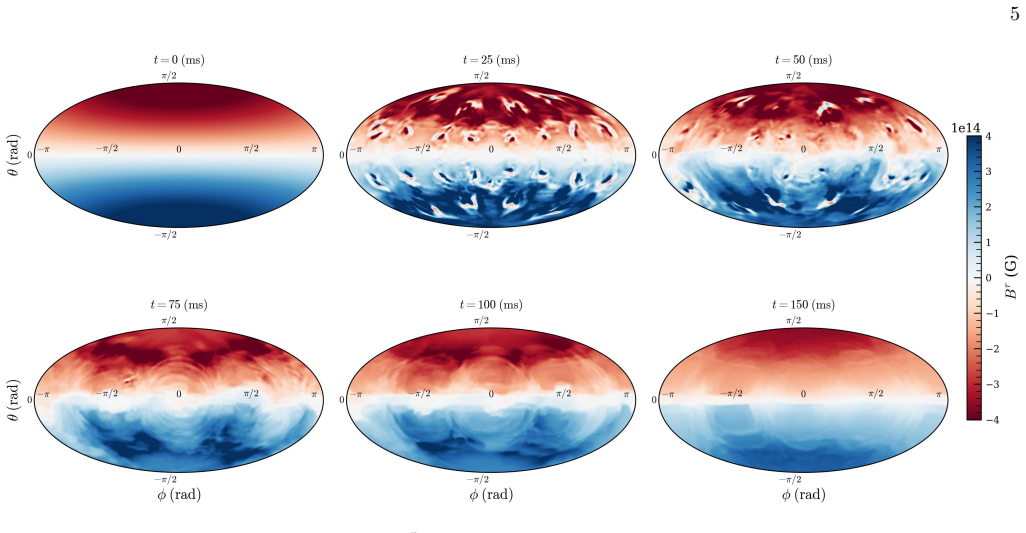
with a Courant-Friedrichs-Lewy factor of0.5. Af- ter each timestep, primitive variables are recovered from the conserved variables via a nonlinear inversion proce- dure [69]. Details of the primitive solver are provided in Appendix A of Cooket al.[61]. III. RESULTS A. Magnetic field evolution We begin by discussing the qualitative evolution of the magneti...
-
[2]
D. R. Lorimer and M. Kramer,Handbook of Pulsar As- tronomy, Vol. 4 (2004)
2004
-
[3]
C. T. Y. Chung and A. Melatos, mnras411, 2471 (2011), arXiv:1010.2816 [astro-ph.SR]
work page internal anchor Pith review Pith/arXiv arXiv 2011
-
[4]
C. T. Y. Chung and A. Melatos, mnras415, 1703 (2011), arXiv:1104.1016 [astro-ph.SR]
work page internal anchor Pith review Pith/arXiv arXiv 2011
- [5]
-
[6]
K. C. Gendreau, Z. Arzoumanian, and T. Okajima, in Space Telescopes and Instrumentation 2012, Society of Photo-Optical Instrumentation Engineers (SPIE) Con- ference Series, Vol. 8443, edited by T. Takahashi, S. S. Murray, and J.-W. A. den Herder (2012) p. 844313
2012
-
[7]
A. V. Bilous, A. L. Watts, A. K. Harding, T. E. Riley, Z. Arzoumanian, S. Bogdanov, K. C. Gendreau, P. S. Ray, S. Guillot, W. C. G. Ho, and D. Chakrabarty, The Astrophysical Journal Letters887, L23 (2019)
2019
- [8]
- [9]
-
[10]
D. Choudhury, T. Salmi, S. Vinciguerra, T. E. Riley, Y. Kini, A. L. Watts, B. Dorsman, S. Bogdanov, S. Guil- lot, P. S. Ray, D. J. Reardon, R. A. Remillard, A. V. Bilous, D. Huppenkothen, J. M. Lattimer, N. Ruther- ford, Z. Arzoumanian, K. C. Gendreau, S. M. Morsink, and W. C. G. Ho, Astrophys. J. Lett.971, L20 (2024), arXiv:2407.06789 [astro-ph.HE]
-
[11]
T. Salmi, J. S. Deneva, P. S. Ray, A. L. Watts, D. Choud- hury, Y. Kini, S. Vinciguerra, H. T. Cromartie, M. T. Wolff, Z. Arzoumanian, S. Bogdanov, K. Gendreau, S. Guillot, W. C. G. Ho, S. M. Morsink, I. Cognard, L. Guillemot, G. Theureau, and M. Kerr, Astrophys. J. 976, 58 (2024), arXiv:2409.14923 [astro-ph.HE]
-
[12]
Goldreich and W
P. Goldreich and W. H. Julian, Astrophys. J.157, 869 (1969)
1969
-
[13]
Thompson and R
C. Thompson and R. C. Duncan, Mon. Not. Roy. Astron. Soc.275, 255 (1995)
1995
-
[14]
Gravitational waves from pulsars: emission by the magnetic field induced distortion
S. Bonazzola and E. Gourgoulhon, Astron. Astrophys. 312, 675 (1996), arXiv:astro-ph/9602107
work page internal anchor Pith review Pith/arXiv arXiv 1996
-
[15]
R. J. Tayler, Proceedings of the Physical Society B70, 31 (1957)
1957
-
[16]
R. J. Tayler, Mon. Not. R. Astron. Soc.161, 365 (1973)
1973
-
[17]
G. A. E. Wright, Mon. Not. R. Astron. Soc.162, 339 (1973)
1973
-
[18]
Markey and R
P. Markey and R. J. Tayler, Mon. Not. R. Astron. Soc. 163, 77 (1973)
1973
-
[19]
Markey and R
P. Markey and R. J. Tayler, Mon. Not. R. Astron. Soc. 168, 505 (1974)
1974
-
[20]
Flowers and M
E. Flowers and M. A. Ruderman, Astrophys. J.215, 302 (1977)
1977
-
[21]
Ciolfi, V
R. Ciolfi, V. Ferrari, and L. Gualtieri, Monthly Notices of the Royal Astronomical Society406, 2540–2548 (2010)
2010
-
[22]
Mastrano, A
A. Mastrano, A. Melatos, A. Reisenegger, and T. Akgün, Monthly Notices of the Royal Astronomical Society417, 2288 (2011)
2011
-
[23]
Twisted-torus configurations with large toroidal magnetic fields in relativistic stars
R. Ciolfi and L. Rezzolla, Mon. Not. Roy. Astron. Soc. 435, L43 (2013), arXiv:1306.2803 [astro-ph.SR]
work page internal anchor Pith review Pith/arXiv arXiv 2013
-
[24]
P. D. Lasky and A. Melatos, Phys. Rev. D88, 103005 (2013)
2013
-
[25]
Mastrano, A
A. Mastrano, A. G. Suvorov, and A. Melatos, Monthly Notices of the Royal Astronomical Society447, 3475–3485 (2015)
2015
-
[26]
Castillo, A
F. Castillo, A. Reisenegger, and J. A. Valdivia, Monthly Notices of the Royal Astronomical Society471, 507–522 (2017)
2017
-
[27]
Stable magnetic fields in stellar interiors
J. Braithwaite and A. Nordlund, Astron. Astrophys.450, 1077 (2006), arXiv:astro-ph/0510316
work page internal anchor Pith review Pith/arXiv arXiv 2006
-
[28]
Axisymmetric magnetic fields in stars: relative strengths of poloidal and toroidal components
J. Braithwaite, Mon. Not. R. Astron. Soc.397, 763 (2009), arXiv:0810.1049 [astro-ph]
work page internal anchor Pith review Pith/arXiv arXiv 2009
-
[29]
Evolution of the magnetic field in magnetars
J. Braithwaite and H. C. Spruit, Astron. Astrophys.450, 1097 (2006), arXiv:astro-ph/0510287
work page internal anchor Pith review Pith/arXiv arXiv 2006
-
[30]
The stability of poloidal magnetic fields in rotating stars
J. Braithwaite, Astron. Astrophys.469, 275 (2007), arXiv:0705.0185 [astro-ph]
work page internal anchor Pith review Pith/arXiv arXiv 2007
-
[31]
Armaza, A
C. Armaza, A. Reisenegger, and J. A. Valdivia, The As- trophysical Journal802, 121 (2015)
2015
-
[32]
On non-axisymmetric magnetic equilibria in stars
J. Braithwaite, Monthly Notices of the Royal Astronom- ical Society386, 1947 (2008), arXiv:0803.1661
work page internal anchor Pith review Pith/arXiv arXiv 1947
-
[33]
Chandrasekhar and E
S. Chandrasekhar and E. Fermi, Astrophys. J.118, 116 (1953)
1953
-
[34]
Modelling magnetically deformed neutron stars
B. Haskell, L. Samuelsson, K. Glampedakis, and N. An- dersson, Mon. Not. Roy. Astron. Soc.385, 531 (2008), arXiv:0705.1780 [astro-ph]
work page internal anchor Pith review Pith/arXiv arXiv 2008
-
[35]
M. E. Gusakov, E. M. Kantor, and D. D. Ofengeim, Phys. Rev. D96, 103012 (2017), arXiv:1705.00508 [astro- ph.HE]
work page internal anchor Pith review Pith/arXiv arXiv 2017
-
[36]
D. D. Ofengeim and M. E. Gusakov, Phys. Rev. D98, 043007 (2018), arXiv:1805.03956 [astro-ph.HE]
work page internal anchor Pith review Pith/arXiv arXiv 2018
-
[37]
Ciolfi, V
R. Ciolfi, V. Ferrari, L. Gualtieri, and J. A. Pons, Monthly Notices of the Royal Astronomical Society397, 913 (2009), https://academic.oup.com/mnras/article- 12 pdf/397/2/913/2939394/mnras0397-0913.pdf
2009
-
[38]
Instability-driven evolution of poloidal magnetic fields in relativistic stars
R. Ciolfi, S. K. Lander, G. M. Manca, and L. Rezzolla, Astrophys.J.736, L6 (2011), arXiv:1105.3971 [gr-qc]
work page internal anchor Pith review Pith/arXiv arXiv 2011
-
[39]
S. K. Lander and D. I. Jones, Mon. Not. Roy. Astron. Soc.395, 2162 (2009), arXiv:0903.0827 [astro-ph.SR]
work page internal anchor Pith review Pith/arXiv arXiv 2009
-
[40]
S. K. Lander and D. I. Jones, Mon. Not. R. Astron. Soc. 412, 1730 (2011), arXiv:1010.0614 [astro-ph.SR]
work page internal anchor Pith review Pith/arXiv arXiv 2011
- [41]
-
[42]
Herbrik and K
M. Herbrik and K. D. Kokkotas, Monthly Notices of the Royal Astronomical Society466, 1330–1347 (2016)
2016
-
[43]
S. G. Frederick, K. L. Thompson, and M. P. Kuchera, Monthly Notices of the Royal Astronomical Society503, 2764 (2021)
2021
-
[44]
Kiuchi, M
K. Kiuchi, M. Shibata, and S. Yoshida, Phys. Rev. D78, 024029 (2008)
2008
-
[45]
P. D. Lasky, B. Zink, K. D. Kokkotas, and K. Glampedakis, Astrophys. J. Lett.735, L20 (2011), arXiv:1105.1895 [astro-ph.SR]
work page internal anchor Pith review Pith/arXiv arXiv 2011
-
[46]
P. D. Lasky, B. Zink, and K. D. Kokkotas, (2012), arXiv:1203.3590 [astro-ph.SR]
work page internal anchor Pith review Pith/arXiv arXiv 2012
-
[47]
Poloidal-Field Instability in Magnetized Relativistic Stars
R. Ciolfi and L. Rezzolla, Astrophys. J.760, 1 (2012), arXiv:1206.6604 [astro-ph.SR]
work page internal anchor Pith review Pith/arXiv arXiv 2012
-
[48]
A. G. Pili, N. Bucciantini, and L. Del Zanna, Mon. Not.Roy.Astron.Soc.439,3541(2014),arXiv:1401.4308 [astro-ph.HE]
work page internal anchor Pith review Pith/arXiv arXiv 2014
-
[49]
A. G. Pili, N. Bucciantini, and L. Del Zanna, Mon. Not. Roy. Astron. Soc.470, 2469 (2017), arXiv:1705.03795 [astro-ph.HE]
work page internal anchor Pith review Pith/arXiv arXiv 2017
-
[50]
A. Tsokaros, M. Ruiz, S. L. Shapiro, and K. Ury¯ u, Phys. Rev. Lett.128, 061101 (2022), arXiv:2111.00013 [gr-qc]
- [51]
-
[52]
P. C.-K. Cheong, A. Tsokaros, M. Ruiz, F. Venturi, J. C. L. Chan, A. K. L. Yip, and K. Uryu, (2024), arXiv:2409.10508 [astro-ph.HE]
work page internal anchor Pith review Pith/arXiv arXiv 2024
- [53]
- [54]
-
[55]
A five-wave HLL Riemann solver for relativistic MHD
A. Mignone, M. Ugliano, and G. Bodo, Mon. Not. Roy. Astron. Soc.393, 1141 (2009), arXiv:0811.1483 [astro- ph]
work page internal anchor Pith review Pith/arXiv arXiv 2009
- [56]
- [57]
- [58]
-
[59]
S. Bernuzzi and D. Hilditch, Phys. Rev.D81, 084003 (2010), arXiv:0912.2920 [gr-qc]
work page internal anchor Pith review Pith/arXiv arXiv 2010
-
[60]
Compact binary evolutions with the Z4c formulation
D. Hilditch, S. Bernuzzi, M. Thierfelder, Z. Cao, W. Tichy, and B. Bruegmann, Phys. Rev.D88, 084057 (2013), arXiv:1212.2901 [gr-qc]
work page internal anchor Pith review Pith/arXiv arXiv 2013
-
[61]
H. Dimmelmeier, N. Stergioulas, and J. A. Font, Mon. Not. Roy. Astron. Soc.368, 1609 (2006), arXiv:astro- ph/0511394
- [62]
-
[63]
Colella and M
P. Colella and M. D. Sekora, Journal of Computational Physics227, 7069 (2008)
2008
-
[64]
Harten, J
A. Harten, J. Comput. Phys.135, 260 (1983)
1983
-
[65]
Einfeldt, SIAM J
B. Einfeldt, SIAM J. Numer. Anal.25, 294 (1988)
1988
-
[66]
M.N.LemasterandJ.M.Stone,TheAstrophysicalJour- nal691, 1092–1108 (2009)
2009
-
[67]
C. R. Evans and J. F. Hawley, Astrophys. J.332, 659 (1988)
1988
-
[68]
T. A. Gardiner and J. M. Stone, J. Comput. Phys.227, 4123 (2008), arXiv:0712.2634 [astro-ph]
work page internal anchor Pith review Pith/arXiv arXiv 2008
-
[69]
Gottlieb and C.-W
S. Gottlieb and C.-W. Ketcheson, David I.and Shu, Jour- nal of Scientific Computing38, 251 (2009)
2009
-
[70]
W. Kastaun, J. V. Kalinani, and R. Ciolfi, Phys. Rev. D 103, 023018 (2021), arXiv:2005.01821 [gr-qc]
-
[71]
Piñas, A
F. Piñas, A. Yip, P. C.-K. Cheong, and M. Ruiz, The Astrophysical Journal1001, 49 (2026)
2026
-
[72]
J. Fontbuté, S. Bernuzzi, S. Albanesi, D. Radice, A. Rashti, W. Cook, B. Daszuta, and A. Nagar, Phys. Rev. D113, 064036 (2026), arXiv:2508.03799 [gr-qc]
-
[73]
L. Baiotti, S. Bernuzzi, G. Corvino, R. De Pietri, and A. Nagar, Phys. Rev.D79, 024002 (2009), arXiv:0808.4002 [gr-qc]
work page internal anchor Pith review Pith/arXiv arXiv 2009
-
[74]
C. D. Ott, Class.Quant.Grav.26, 063001 (2009), arXiv:0809.0695 [astro-ph]
work page internal anchor Pith review Pith/arXiv arXiv 2009
-
[75]
C. Afle, S. K. Kundu, J. Cammerino, E. R. Coughlin, D. A. Brown, D. Vartanyan, and A. Burrows, Physical Review D107, 10.1103/physrevd.107.123005 (2023)
-
[76]
P. D. Lasky, Publications of the Astronomical Society of Australia32, 10.1017/pasa.2015.35 (2015)
-
[77]
Jülich Supercomputing Centre, Journal of large-scale re- search facilities7, 10.17815/jlsrf-7-183 (2021)
discussion (0)
Sign in with ORCID, Apple, or X to comment. Anyone can read and Pith papers without signing in.