The AGORA High-resolution Galaxy Simulations Comparison Project. XI: Solving the Non-Spherical Morphology and Evolution of Dark Matter Halos with Haskap Pie
Pith reviewed 2026-06-30 15:22 UTC · model grok-4.3
The pith
A bound-particle method treats dark matter halos as non-spherical and tracks their merger-driven shape changes across simulation codes.
A machine-rendered reading of the paper's core claim, the machinery that carries it, and where it could break.
Core claim
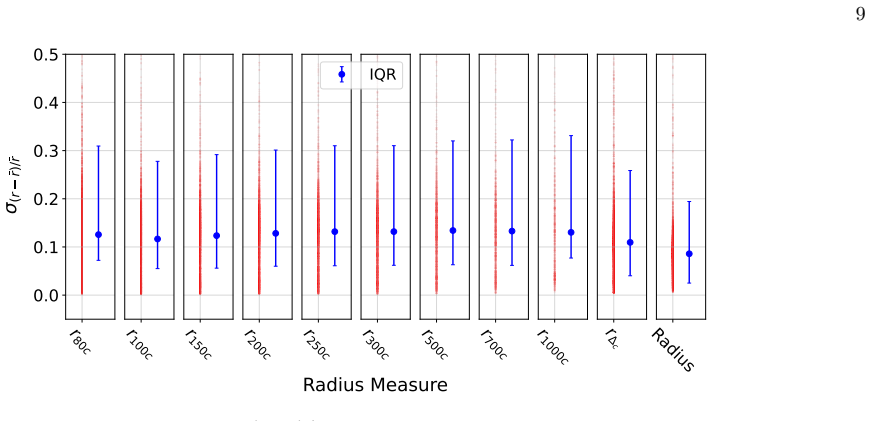
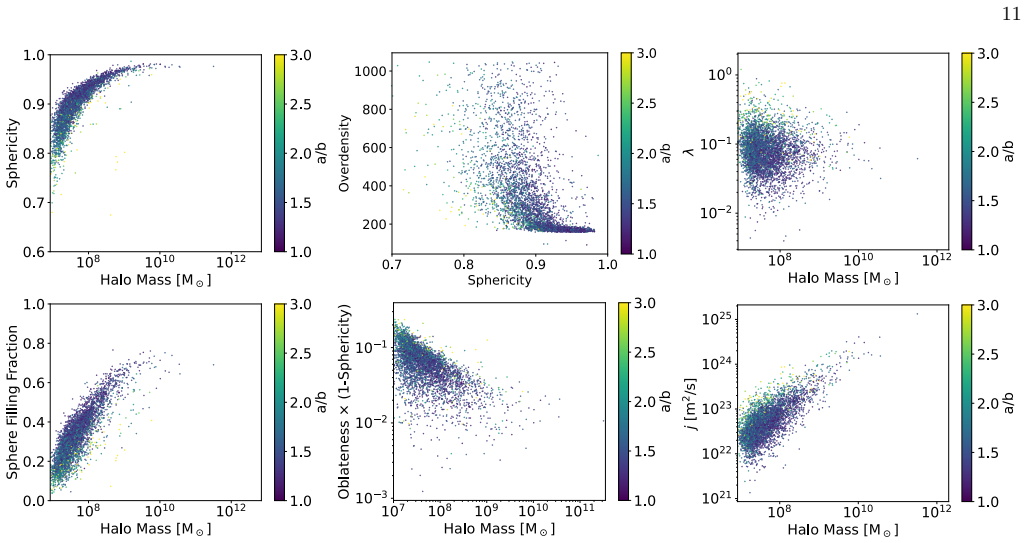
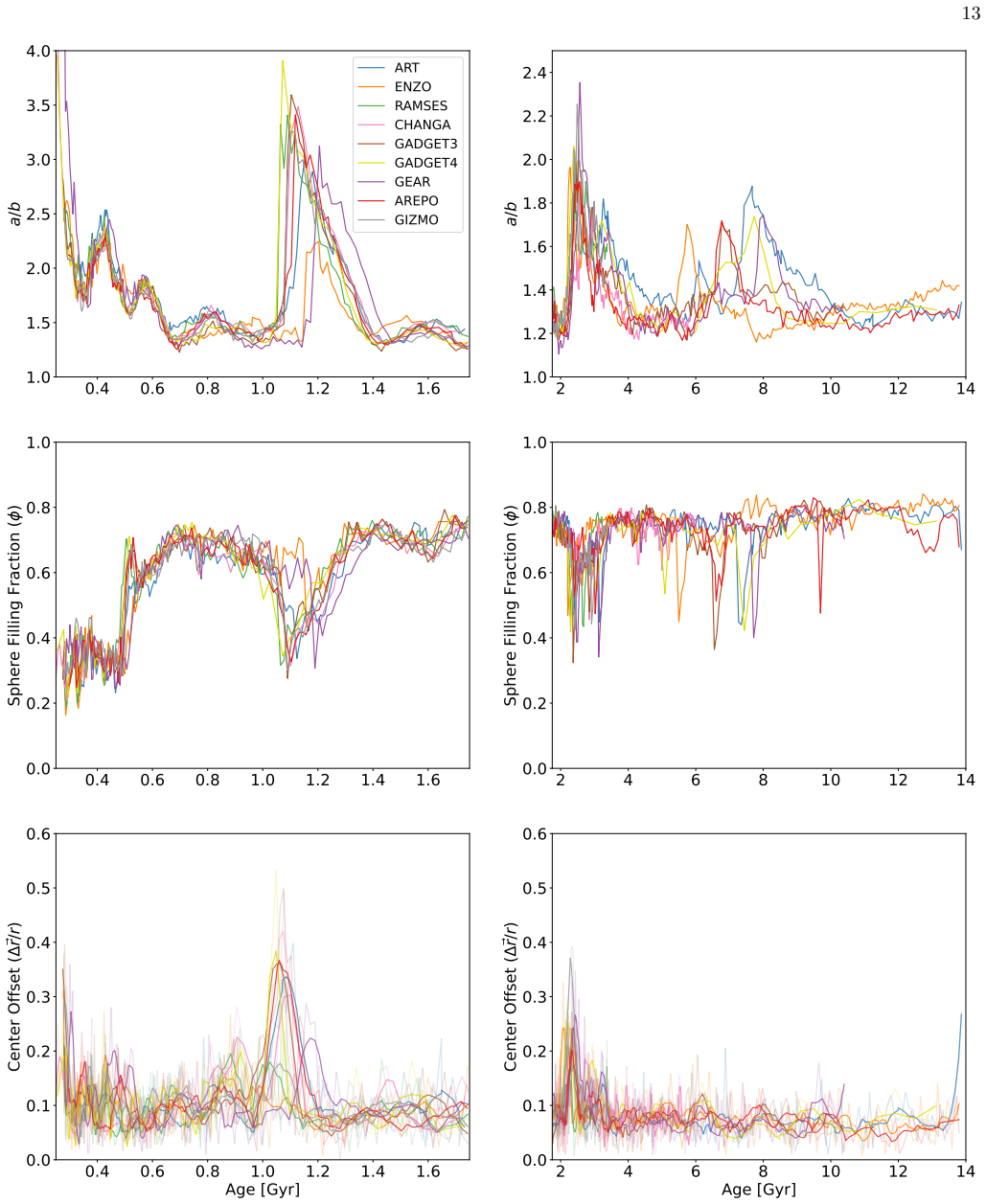
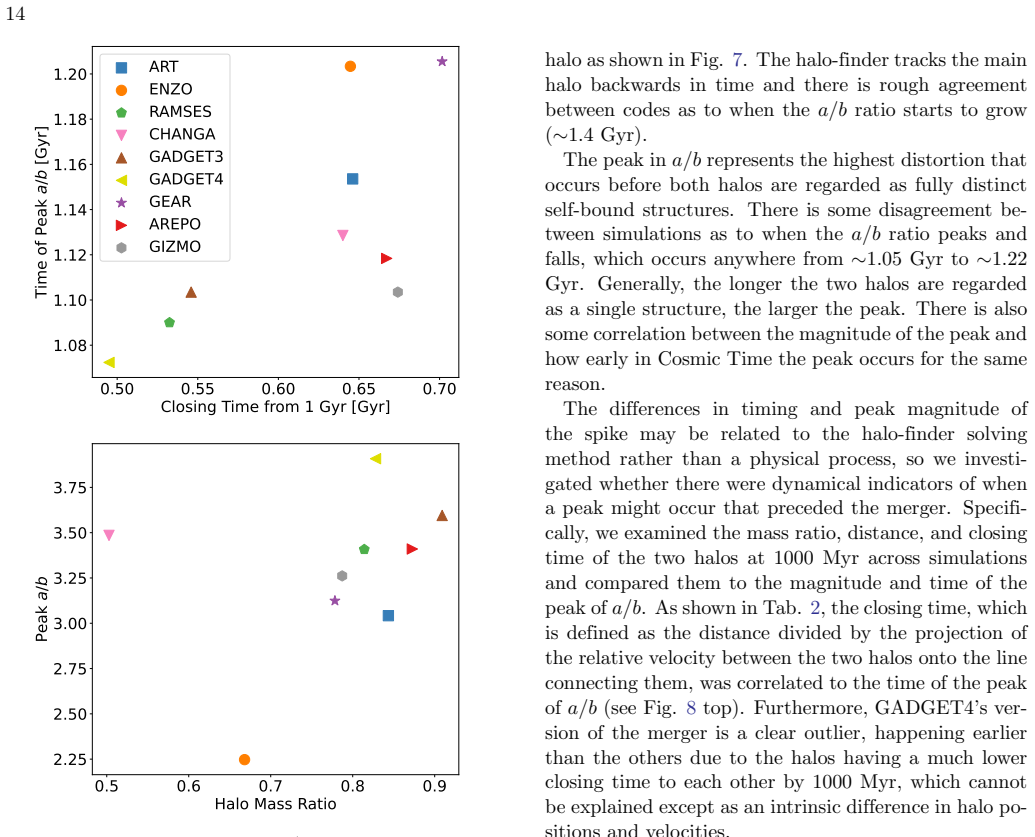
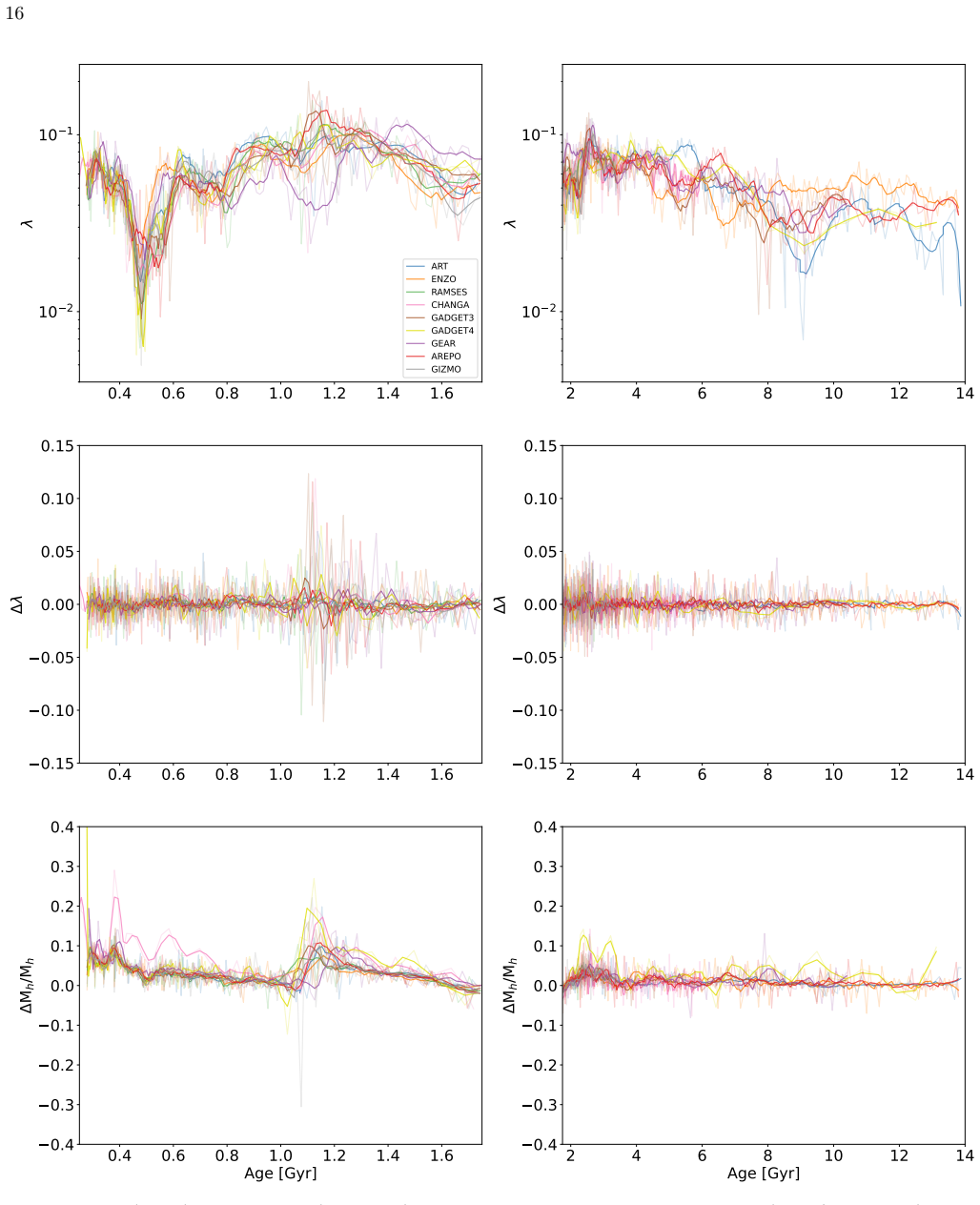
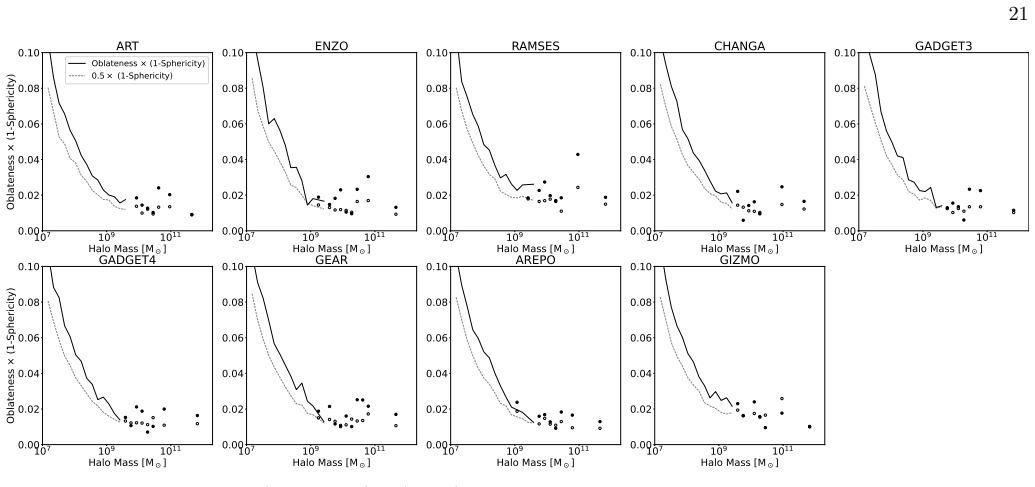
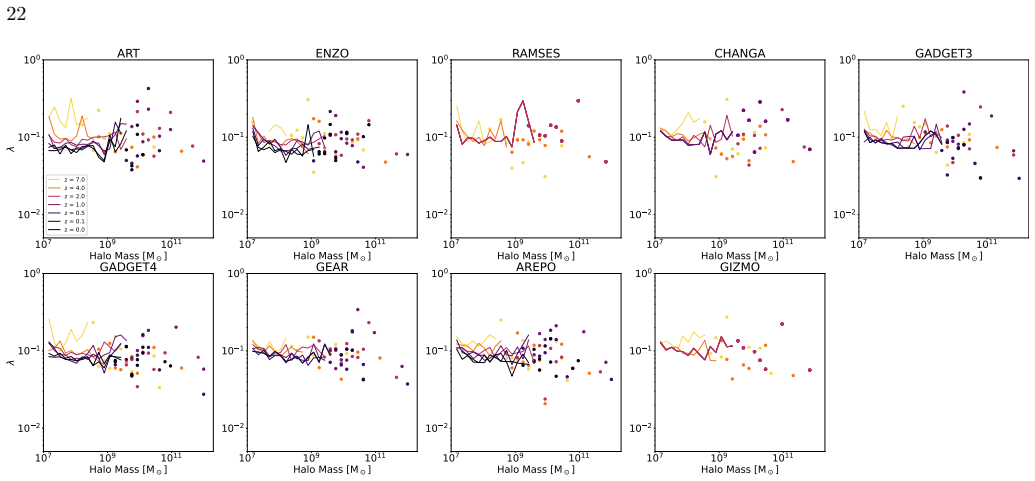
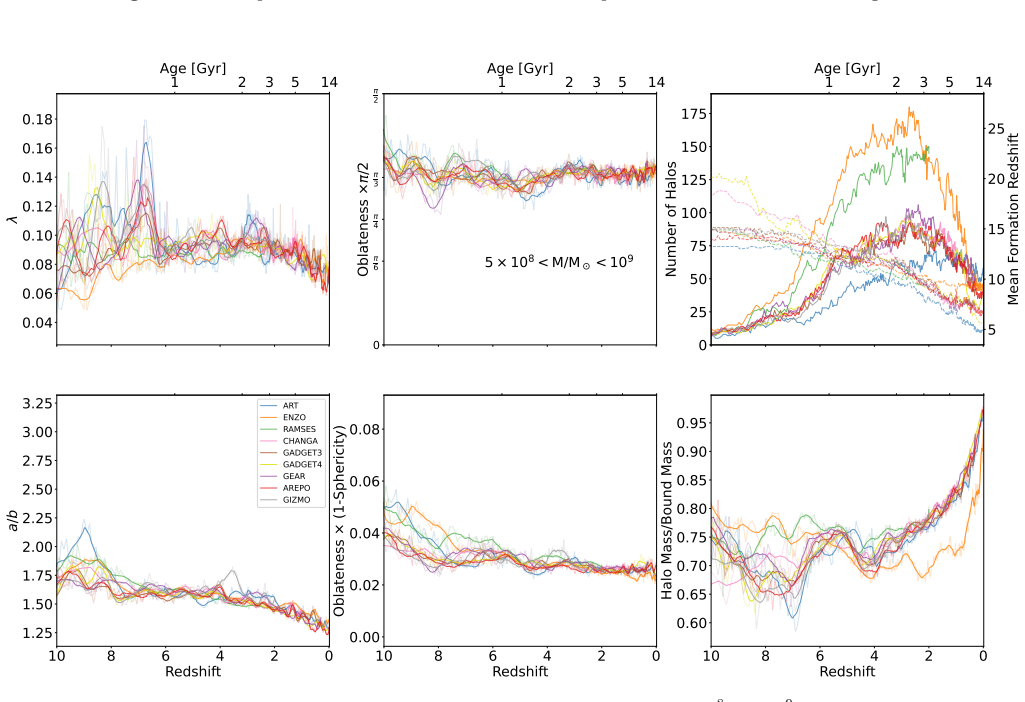
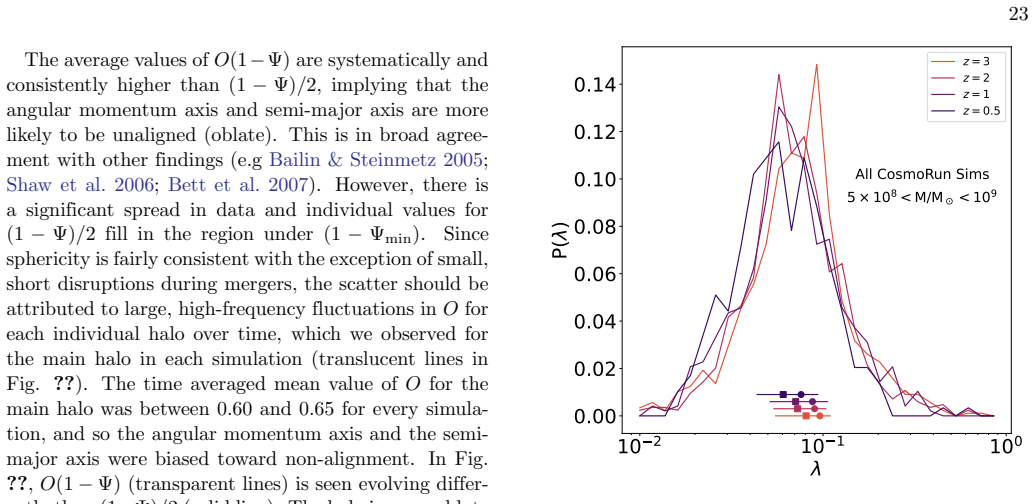
We introduce a halo solving and tracking procedure that intrinsically treats dark matter halos as non-spherical objects by leveraging the bound particle searching techniques used in Haskap Pie. Several morphological and shape measures prove very responsive to high mass ratio mergers. The greatest differences between simulation codes arise from timing discrepancies and the dynamical state of the halos prior to mergers. Most other quantities remain similar across codes, including secular and redshift-dependent trends in dynamical quantities that depart from the Virial Theorem. Halo spin and the semi-major to semi-minor axis ratio peak between 4 > z > 2 before declining at low redshift, while h
What carries the argument
Haskap Pie bound-particle searching procedure for identifying and tracking non-spherical halo boundaries and dynamical states
If this is right
- Morphological and shape measures change markedly during high mass ratio mergers.
- Halo spin and the semi-major to semi-minor axis ratio reach a maximum between redshift 4 and 2 then decline toward z=0.
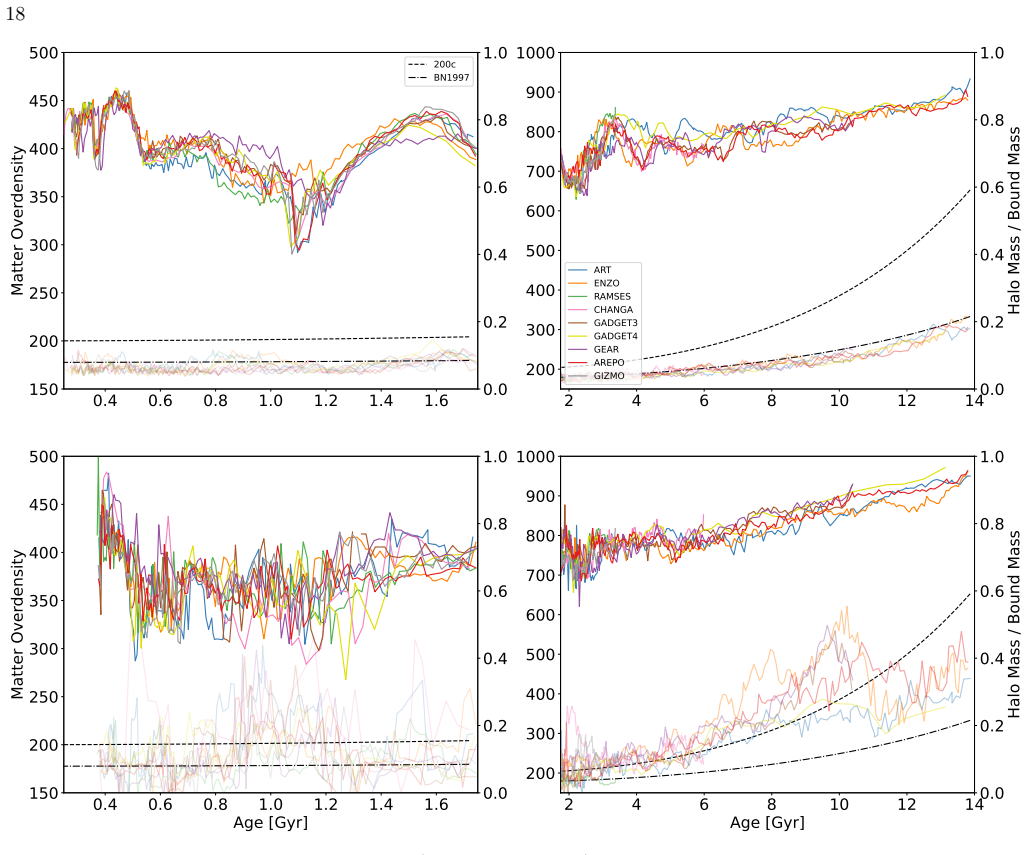
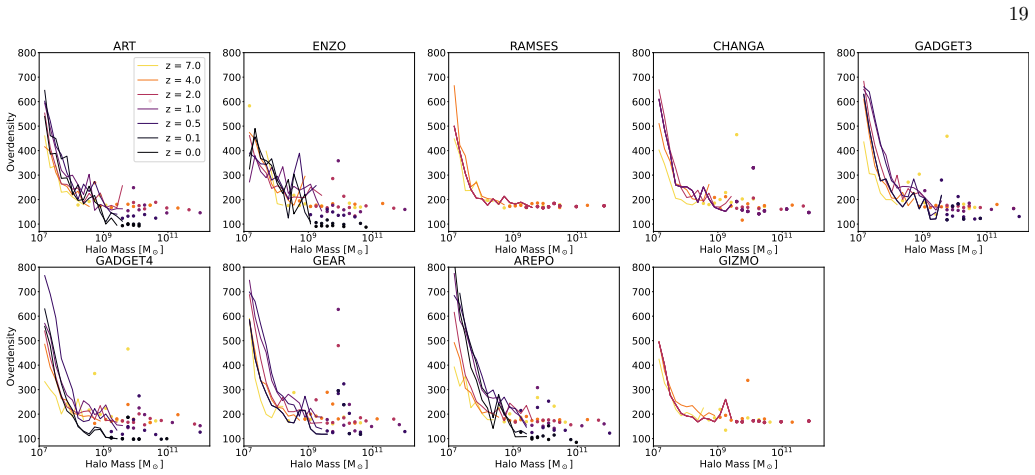
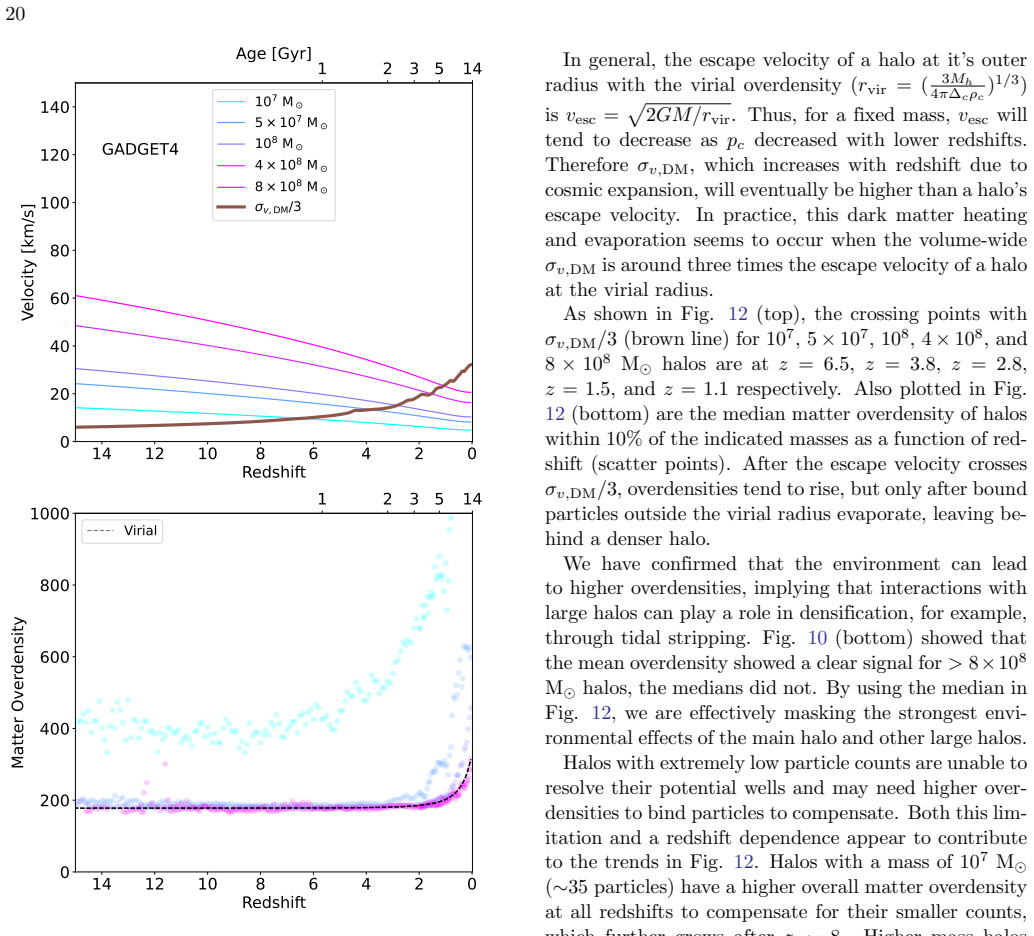
- Halo overdensity depends on both halo mass and redshift, with low-mass halos diverging at low redshift.
- Most dynamical quantities evolve similarly across different simulation codes once merger timing is accounted for.
- Trends in overdensity and halo mass depart from expectations under the Virial Theorem.
Where Pith is reading between the lines
- Adopting the non-spherical tracking method on larger simulation volumes could revise inferred merger rates for low-mass galaxies at late times.
- The reported spin peak at 4 > z > 2 offers a concrete prediction that weak-lensing surveys could test by stacking halo shapes at those redshifts.
- If the method is extended to baryonic particles, it might reveal how gas inflows during mergers alter the non-spherical dark-matter response.
- Code-to-code differences in merger timing highlight the need for synchronized initial conditions when comparing morphology statistics.
Load-bearing premise
The bound particle searching techniques used in Haskap Pie accurately capture non-spherical halo boundaries and dynamical states across multiple simulation codes without introducing code-specific biases in morphology measures.
What would settle it
Demonstrating that the same merger responses and redshift trends in axis ratio and spin appear when the identical simulation outputs are analyzed with conventional spherical-overdensity halo finders would falsify the claim that non-spherical treatment is required.
Figures
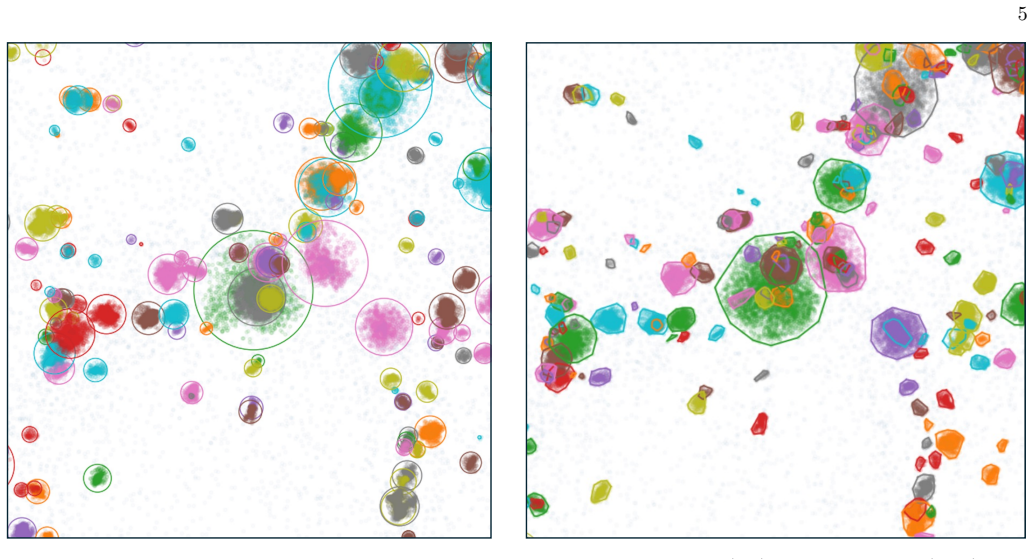
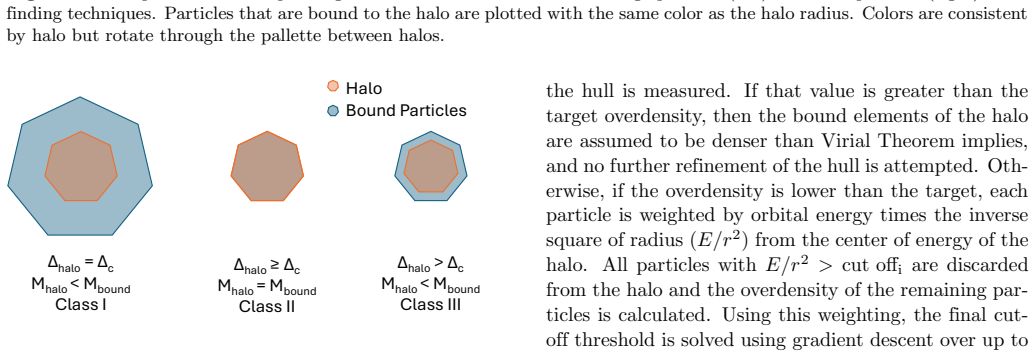
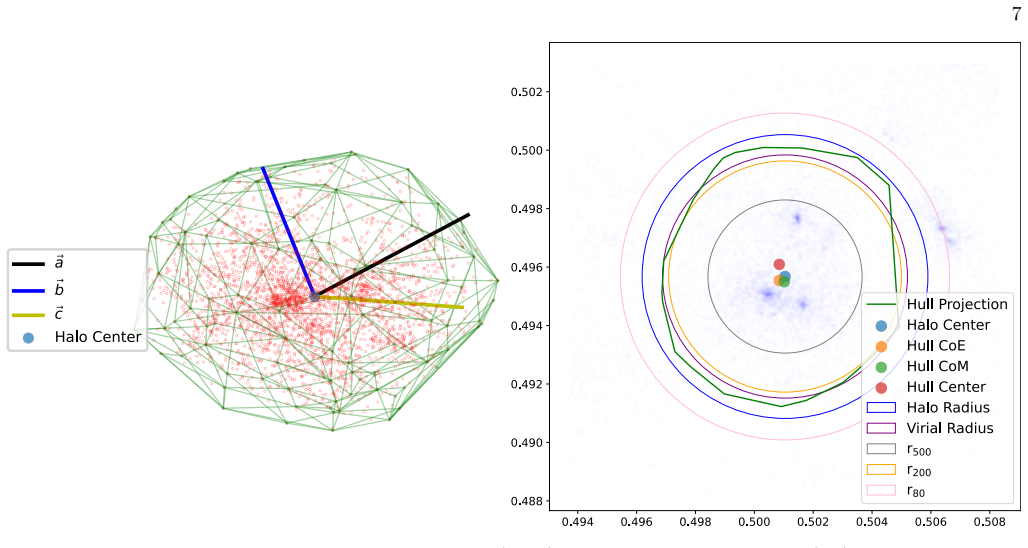
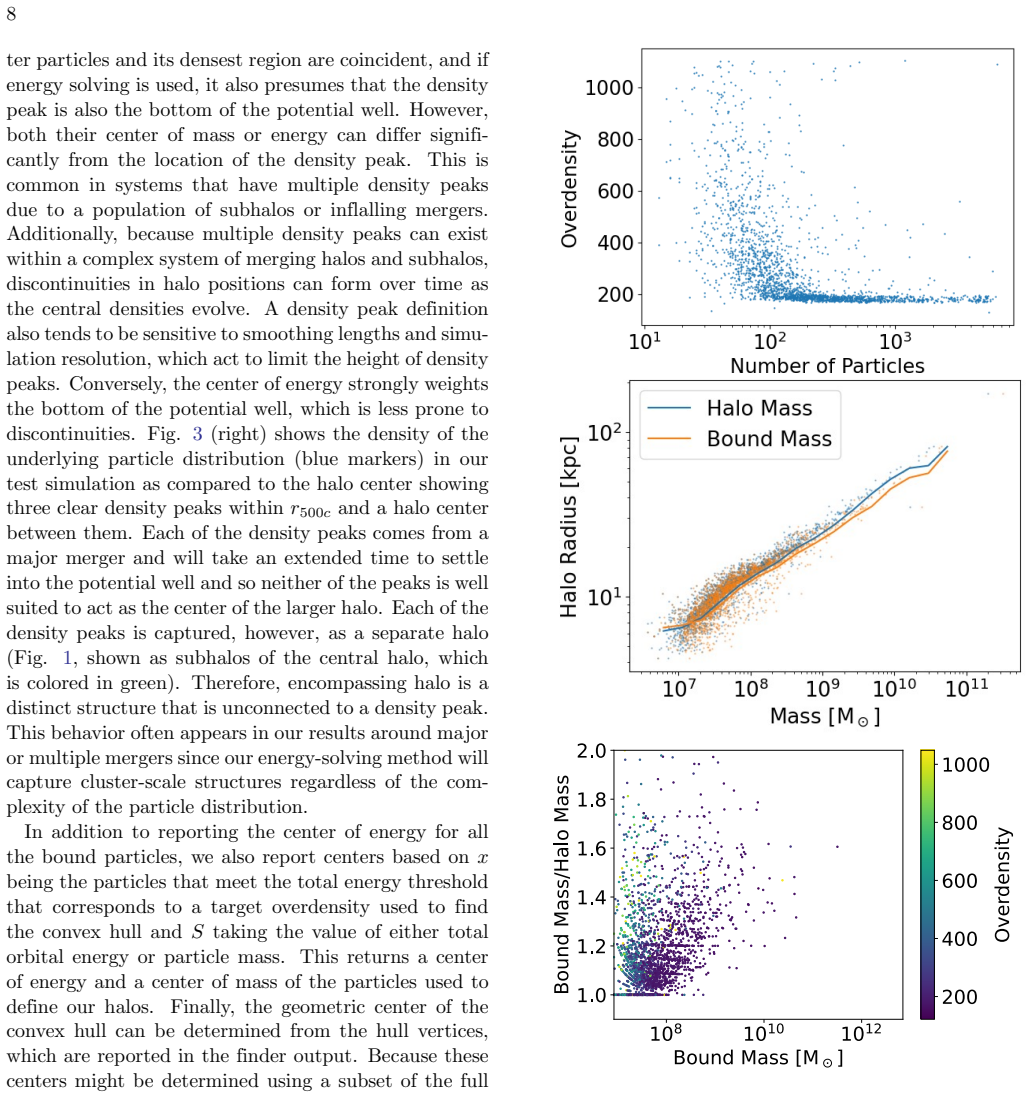
read the original abstract
We introduce a halo solving and tracking procedure that intrinsically treats dark matter halos as non-spherical objects by leveraging the bound particle searching techniques used in Haskap Pie. The AGORA Collaboration's hydrodynamic simulation CosmoRun}project provides a useful laboratory to explore trends in dark matter halo morphology that are revealed by our new procedure in the context of any dispersions or similarities between the codes. We find that several morphological and shape measures were very responsive to high mass ratio mergers. The greatest difference in these measures between the simulation codes were related to timing discrepancies and the dynamical state of the halos prior to the mergers. Most other quantities were similar across codes, including several secular and redshift-dependent trends in various dynamical quantities that showed a departure from Virial Theorem (e.g., overdensity and halo mass). We find that halo spin and the ratio between the semi-major and the semi-minor axis peaked at 4>z>2 before declining at low redshift. Also, halo overdensity is both mass-dependent and redshift-dependent, diverging for low mass halos at low redshift. Our method contributes a new perspective on these trends that have not been fully replicated in other works due to our emphasis on fundamentally non-spherical halos and measures of morphology that correspondingly do not assume spherical symmetry.
Editorial analysis
A structured set of objections, weighed in public.
Referee Report
Summary. The manuscript introduces Haskap Pie, a halo solving and tracking procedure that treats dark matter halos as intrinsically non-spherical objects via bound-particle searching techniques. Applied to the AGORA CosmoRun suite of hydrodynamic simulations, the work reports that several morphological and shape measures respond strongly to high mass-ratio mergers, with the largest inter-code differences arising from merger timing and pre-merger dynamical state. Secular trends include halo spin and the semi-major to semi-minor axis ratio peaking between 4 > z > 2 before declining at low redshift, while halo overdensity is both mass- and redshift-dependent, diverging for low-mass halos at low z. The authors argue that their non-spherical measures provide a new perspective not fully replicated in prior work that assumes spherical symmetry.
Significance. If the Haskap Pie finder is demonstrated to be free of code-specific biases, the results would offer a useful addition to the AGORA code-comparison literature by quantifying how merger history and dynamical state drive non-spherical halo morphology. The explicit focus on departures from the virial theorem in overdensity and mass evolution, together with the spin and axis-ratio trends, could inform interpretations of halo assembly in both simulations and observations.
major comments (1)
- [Abstract] Abstract: The claim that 'the greatest difference in these measures between the simulation codes were related to timing discrepancies' presupposes that Haskap Pie’s bound-particle search returns statistically equivalent boundary and shape statistics when applied to snapshots from ART, ENZO, GADGET, etc., at matched resolution. No cross-code validation test of the iterative unbinding or potential estimation step is described, leaving open the possibility that reported morphology trends partly reflect code-specific differences in density estimation or softening rather than physical differences.
minor comments (1)
- [Abstract] Abstract: 'CosmoRun}project' contains an apparent typesetting artifact and should read 'CosmoRun project'.
Simulated Author's Rebuttal
We thank the referee for their constructive and detailed review of our manuscript. The single major comment raises a valid methodological concern about cross-code consistency of the halo finder, which we address below. We will incorporate revisions to strengthen the paper.
read point-by-point responses
-
Referee: [Abstract] Abstract: The claim that 'the greatest difference in these measures between the simulation codes were related to timing discrepancies' presupposes that Haskap Pie’s bound-particle search returns statistically equivalent boundary and shape statistics when applied to snapshots from ART, ENZO, GADGET, etc., at matched resolution. No cross-code validation test of the iterative unbinding or potential estimation step is described, leaving open the possibility that reported morphology trends partly reflect code-specific differences in density estimation or softening rather than physical differences.
Authors: We thank the referee for highlighting this important point regarding potential finder-induced biases. The AGORA CosmoRun suite was explicitly constructed with identical initial conditions, particle masses, and force resolutions across codes (ART, ENZO, GADGET, etc.) to enable direct inter-code comparisons of the resulting halo properties. Haskap Pie applies an identical bound-particle search, iterative unbinding, and potential estimation procedure to every snapshot. While the original manuscript did not include a dedicated cross-code validation test of these steps, the reported similarity across codes in most morphological measures (apart from merger timing) provides supporting evidence that the finder behaves consistently. To directly resolve the concern, we will add a new validation subsection to the Methods section. This will apply Haskap Pie to a set of temporally matched snapshots from two representative codes and demonstrate that the resulting boundary definitions, axis ratios, and spin parameters agree statistically within the level of numerical differences inherent to the codes. We will also revise the abstract to note that the timing-related differences are identified after uniform application of the finder. These changes will appear in the revised manuscript. revision: yes
Circularity Check
No circularity: results are direct simulation outputs, not fitted or self-defined quantities
full rationale
The paper introduces a halo tracking procedure based on Haskap Pie's bound-particle search and applies it to AGORA CosmoRun outputs across codes. All reported trends (merger responsiveness, spin evolution, overdensity mass/redshift dependence) are presented as direct measurements from the simulations. No equations, fitted parameters, or predictions are shown that reduce to the inputs by construction. No self-citation chains or uniqueness theorems are invoked to justify the central claims. The derivation chain is self-contained against external simulation benchmarks.
Axiom & Free-Parameter Ledger
axioms (1)
- domain assumption Departure from Virial Theorem expectations is a meaningful diagnostic for halo dynamical state
Reference graph
Works this paper leans on
-
[1]
Allgood, B., Flores, R. A., Primack, J. R., et al. 2006, MNRAS, 367, 1781, doi: 10.1111/j.1365-2966.2006.10094.x
-
[2]
Anderhalden, D., & Diemand, J. 2013, JCAP, 2013, 009, doi: 10.1088/1475-7516/2013/04/009 A vila-Reese, V., Colín, P., Gottl¨ ober, S., Firmani, C., &
-
[3]
2005, ApJ, 634, 51, doi: 10.1086/491726
Maulbetsch, C. 2005, ApJ, 634, 51, doi: 10.1086/491726
-
[4]
2005, ApJ, 627, 647, doi: 10.1086/430397
Bailin, J., & Steinmetz, M. 2005, ApJ, 627, 647, doi: 10.1086/430397
-
[5]
1987, ApJ, 319, 575, doi: 10.1086/165480
Barnes, J., & Efstathiou, G. 1987, ApJ, 319, 575, doi: 10.1086/165480
-
[6]
Barrow, K. S. S., Nguyễn, T. H., & Skrabacz, E. 2026, ApJ, 999, 72, doi: 10.3847/1538-4357/ae2eb4
-
[7]
The Rockstar Phase-Space Temporal Halo Finder and the Velocity Offsets of Cluster Cores
Behroozi, P. S., Wechsler, R. H., & Wu, H.-Y. 2012, The Astrophysical Journal, 762, 109, doi: 10.1088/0004-637X/762/2/109
work page internal anchor Pith review doi:10.1088/0004-637x/762/2/109 2012
-
[8]
Bett, P., Eke, V., Frenk, C. S., et al. 2007, MNRAS, 376, 215, doi: 10.1111/j.1365-2966.2007.11432.x
-
[9]
2015, MNRAS, 449, 3171, doi: 10.1093/mnras/stv417
Bonamigo, M., Despali, G., Limousin, M., et al. 2015, MNRAS, 449, 3171, doi: 10.1093/mnras/stv417
-
[10]
Statistical Properties of X-ray Clusters: Analytic and Numerical Comparisons
Bryan, G. L., & Norman, M. L. 1998, ApJ, 495, 80, doi: 10.1086/305262
work page internal anchor Pith review doi:10.1086/305262 1998
-
[11]
Bryan, G. L., Norman, M. L., O’Shea, B. W., et al. 2014, ApJS, 211, 19, doi: 10.1088/0067-0049/211/2/19
-
[12]
Bullock, J. S. 2002, in The Shapes of Galaxies and their Dark Halos, ed. P. Natarajan, 109–113, doi: 10.1142/9789812778017_0018
-
[13]
Bullock, J. S., Dekel, A., Kolatt, T. S., et al. 2001, ApJ, 555, 240, doi: 10.1086/321477
-
[14]
Davis, M., Efstathiou, G., Frenk, C. S., & White, S. D. M. 1985, ApJ, 292, 371, doi: 10.1086/163168
-
[15]
2006, ApJ, 649, 1, doi: 10.1086/506377
Diemand, J., Kuhlen, M., & Madau, P. 2006, ApJ, 649, 1, doi: 10.1086/506377
-
[16]
2005, Nature, 433, 389, doi: 10.1038/nature03270
Diemand, J., Moore, B., & Stadel, J. 2005, Nature, 433, 389, doi: 10.1038/nature03270
-
[17]
2024, MNRAS, 533, 3811, doi: 10.1093/mnras/stae2007
Diemer, B., Behroozi, P., & Mansfield, P. 2024, MNRAS, 533, 3811, doi: 10.1093/mnras/stae2007
-
[18]
Dillamore, A. M., & Sanders, J. L. 2026, MNRAS, doi: 10.1093/mnras/stag226
-
[19]
Dolag, K., Borgani, S., Murante, G., & Springel, V. 2009, MNRAS, 399, 497, doi: 10.1111/j.1365-2966.2009.15034.x
-
[20]
1983, IEEE Transactions on Information Theory, 29, 551, doi: 10.1109/TIT.1983.1056714
Edelsbrunner, H., Kirkpatrick, D., & Seidel, R. 1983, IEEE Transactions on Information Theory, 29, 551, doi: 10.1109/TIT.1983.1056714
-
[21]
1965, Trudy Astrofizicheskogo Instituta Alma-Ata, 5, 87
Einasto, J. 1965, Trudy Astrofizicheskogo Instituta Alma-Ata, 5, 87
1965
-
[22]
Eisenstein, D. J., & Hut, P. 1998, ApJ, 498, 137, doi: 10.1086/305535
-
[23]
Eke, V. R., Cole, S., & Frenk, C. S. 1996, MNRAS, 282, 263, doi: 10.1093/mnras/282.1.263
-
[24]
Elahi, P. J., Ca˜ nas, R., Poulton, R. J. J., et al. 2019, PASA, 36, e021, doi: 10.1017/pasa.2019.12
-
[25]
Frenk, C. S., White, S. D. M., Davis, M., & Efstathiou, G. 1988, ApJ, 327, 507, doi: 10.1086/166213 Górski, K. M., Hivon, E., Banday, A. J., et al. 2005, ApJ, 622, 759, doi: 10.1086/427976
-
[26]
, year = 1972, month = Aug, volume =
Gunn, J. E., & Gott, III, J. R. 1972, ApJ, 176, 1, doi: 10.1086/151605
-
[27]
2022, MNRAS, 509, 501, doi: 10.1093/mnras/stab2980
Maksimova, N. 2022, MNRAS, 509, 501, doi: 10.1093/mnras/stab2980
-
[28]
Han, J. J., Conroy, C., Johnson, B. D., et al. 2026, AJ, 164, 249, doi: 10.3847/1538-3881/ac97e9
-
[29]
Hopkins, P. F. 2015, Monthly Notices of the Royal Astronomical Society, 450, 53, doi: 10.1093/mnras/stv195
-
[30]
Jetley, P., Gioachin, F., Mendes, C., Kale, L. V., & Quinn, T. 2008, in 2008 IEEE International Symposium on Parallel and Distributed Processing (Miami, FL, USA: IEEE), 1–12, doi: 10.1109/IPDPS.2008.4536319 28
-
[31]
Quinn, T. R. 2010, in Proceedings of the 2010 ACM/IEEE International Conference for High Performance Computing, Networking, Storage and
2010
-
[32]
Analysis, SC ’10 (USA: IEEE Computer Society), 1–11, doi: 10.1109/SC.2010.49
-
[33]
2024, ApJ, 964, 123, doi: 10.3847/1538-4357/ad245b
Jung, M., Roca-Fàbrega, S., Kim, J.-H., et al. 2024, ApJ, 964, 123, doi: 10.3847/1538-4357/ad245b
-
[34]
Jung, M., Kim, J.-H., Nguyễn, T. H., et al. 2025, ApJ, 994, 245, doi: 10.3847/1538-4357/ae112d
-
[35]
2014, ApJS, 210, 14, doi: 10.1088/0067-0049/210/1/14
Kim, J.-h., Abel, T., Agertz, O., et al. 2014, ApJS, 210, 14, doi: 10.1088/0067-0049/210/1/14
-
[36]
Knollmann, S. R., & Knebe, A. 2009, ApJS, 182, 608, doi: 10.1088/0067-0049/182/2/608
-
[37]
Kong, H., Boylan-Kolchin, M., & Bullock, J. S. 2025, arXiv e-prints, arXiv:2503.10766, doi: 10.48550/arXiv.2503.10766
-
[38]
Kravtsov, A. V., Klypin, A. A., & Khokhlov, A. M. 1997, The Astrophysical Journal Supplement Series, 111, 73, doi: 10.1086/313015
-
[39]
1994, MNRAS, 271, 676, doi: 10.1093/mnras/271.3.676
Lacey, C., & Cole, S. 1994, MNRAS, 271, 676, doi: 10.1093/mnras/271.3.676
-
[40]
Lahav, O., Lilje, P. B., Primack, J. R., & Rees, M. J. 1991, MNRAS, 251, 128, doi: 10.1093/mnras/251.1.128
-
[41]
Lin, C. C., Mestel, L., & Shu, F. H. 1965, ApJ, 142, 1431, doi: 10.1086/148428
-
[42]
Bouchet, F. R. 2009, MNRAS, 396, 1329, doi: 10.1111/j.1365-2966.2009.14825.x
-
[43]
2024, ApJ, 970, 178, doi: 10.3847/1538-4357/ad4e33
Mansfield, P., Darragh-Ford, E., Wang, Y., et al. 2024, ApJ, 970, 178, doi: 10.3847/1538-4357/ad4e33
-
[44]
Menon, H., Wesolowski, L., Zheng, G., et al. 2015, Computational Astrophysics and Cosmology, 2, 1, doi: 10.1186/s40668-015-0007-9 Mu˜ noz-Cuartas, J. C., Macciò, A. V., Gottl¨ ober, S., &
-
[45]
Dutton, A. A. 2011, MNRAS, 411, 584, doi: 10.1111/j.1365-2966.2010.17704.x
-
[46]
Navarro, J. F., Frenk, C. S., & White, S. D. M. 1996, ApJ, 462, 563, doi: 10.1086/177173 Nguyễn, T. H., Barrow, K. S. S., Byrom, S., & Satish, V. 2026, MNRAS, 545, staf2045, doi: 10.1093/mnras/staf2045
-
[47]
Peebles, P. J. E. 1980, The large-scale structure of the universe
1980
-
[48]
2010, A&A, 519, A94, doi: 10.1051/0004-6361/201014214
Planelles, S., & Quilis, V. 2010, A&A, 519, A94, doi: 10.1051/0004-6361/201014214
-
[49]
Revaz, Y., & Jablonka, P. 2012, Astronomy & Astrophysics, 538, A82, doi: 10.1051/0004-6361/201117402 Roca-Fàbrega, S., Kim, J.-H., Hausammann, L., et al. 2021, ApJ, 917, 64, doi: 10.3847/1538-4357/ac088a Roca-Fàbrega, S., Kim, J.-H., Primack, J. R., et al. 2024a, ApJ, 968, 125, doi: 10.3847/1538-4357/ad43de Roca-Fàbrega, S., Kim, J.-h., Primack, J. R., et...
-
[50]
Santos-Olmsted, L., Barrow, K. S. S., & Hartwig, T. 2024, ApJ, 969, 144, doi: 10.3847/1538-4357/ad46fd
-
[51]
Shaw, L. D., Weller, J., Ostriker, J. P., & Bode, P. 2006, ApJ, 646, 815, doi: 10.1086/505016
-
[52]
Skory, S., Turk, M. J., Norman, M. L., & Coil, A. L. 2010, ApJS, 191, 43, doi: 10.1088/0067-0049/191/1/43
-
[53]
Springel, V. 2005, Monthly Notices of the Royal Astronomical Society, 364, 1105, doi: 10.1111/j.1365-2966.2005.09655.x —. 2010, Monthly Notices of the Royal Astronomical Society, 401, 791, doi: 10.1111/j.1365-2966.2009.15715.x
-
[54]
Springel, V., Pakmor, R., Zier, O., & Reinecke, M. 2021, Monthly Notices of the Royal Astronomical Society, 506, 2871, doi: 10.1093/mnras/stab1855
-
[55]
Springel, V., White, S. D. M., & Hernquist, L. 2004, in IAU
2004
-
[56]
Springel, V., White, S. D. M., Tormen, G., & Kauffmann, G. 2001, MNRAS, 328, 726, doi: 10.1046/j.1365-8711.2001.04912.x
-
[57]
Strawn, C., Roca-Fàbrega, S., Primack, J. R., et al. 2024, ApJ, 962, 29, doi: 10.3847/1538-4357/ad12cb
-
[58]
A new high resolution code called RAMSES
Teyssier, R. 2002, Astronomy & Astrophysics, 385, 337, doi: 10.1051/0004-6361:20011817
-
[59]
2016, MNRAS, 458, 4477, doi: 10.1093/mnras/stw606 Vallés-Pérez, D., Planelles, S., & Quilis, V
Tomassetti, M., Dekel, A., Mandelker, N., et al. 2016, MNRAS, 458, 4477, doi: 10.1093/mnras/stw606 Vallés-Pérez, D., Planelles, S., & Quilis, V. 2022, A&A, 664, A42, doi: 10.1051/0004-6361/202243712
-
[60]
2017, MNRAS, 467, 3226, doi: 10.1093/mnras/stx282
Vega-Ferrero, J., Yepes, G., & Gottl¨ ober, S. 2017, MNRAS, 467, 3226, doi: 10.1093/mnras/stx282
-
[61]
Wang, J., Bose, S., Frenk, C. S., et al. 2020, Nature, 585, 39, doi: 10.1038/s41586-020-2642-9
-
[62]
2020, The Astrophysical Journal Supplement Series, 248, 32, doi: 10.3847/1538-4365/ab908c
Weinberger, R., Springel, V., & Pakmor, R. 2020, The Astrophysical Journal Supplement Series, 248, 32, doi: 10.3847/1538-4365/ab908c
-
[63]
2025, A&A, 703, A43, doi: 10.1051/0004-6361/202556036
Zhu, L., Xue, X.-X., Mao, S., Yang, C., & Zhang, L. 2025, A&A, 703, A43, doi: 10.1051/0004-6361/202556036
-
[64]
2017, MNRAS, 466, 1625, doi: 10.1093/mnras/stw2945
Zjupa, J., & Springel, V. 2017, MNRAS, 466, 1625, doi: 10.1093/mnras/stw2945
discussion (0)
Sign in with ORCID, Apple, or X to comment. Anyone can read and Pith papers without signing in.