Inferring Neutron-Star Properties from Post-merger Gravitational-wave Spectra with Neural Networks
Pith reviewed 2026-06-30 14:50 UTC · model grok-4.3
The pith
Neural networks learn to map post-merger gravitational-wave spectra to neutron-star mass, tidal deformability, and mass-radius slope.
A machine-rendered reading of the paper's core claim, the machinery that carries it, and where it could break.
Core claim
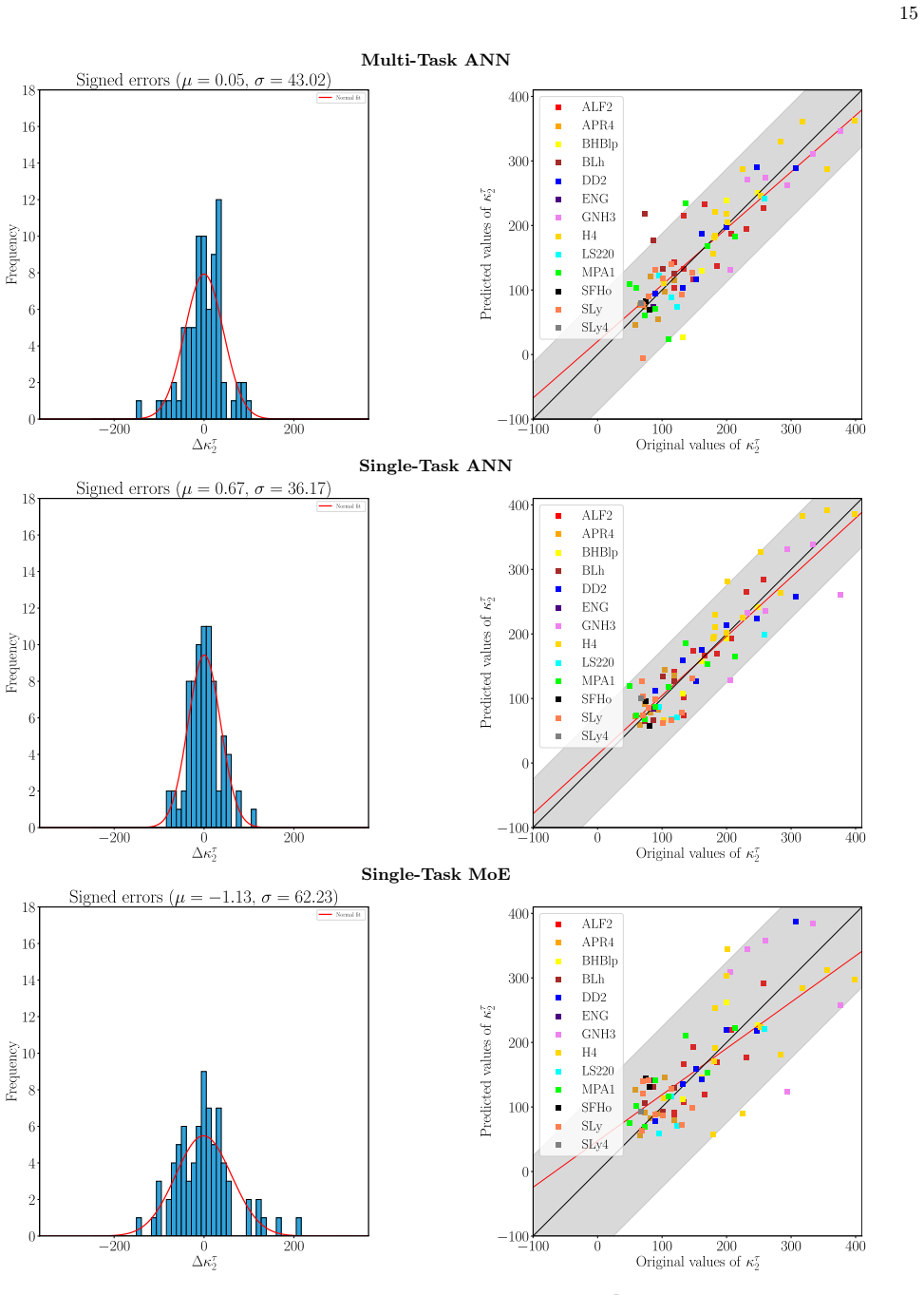
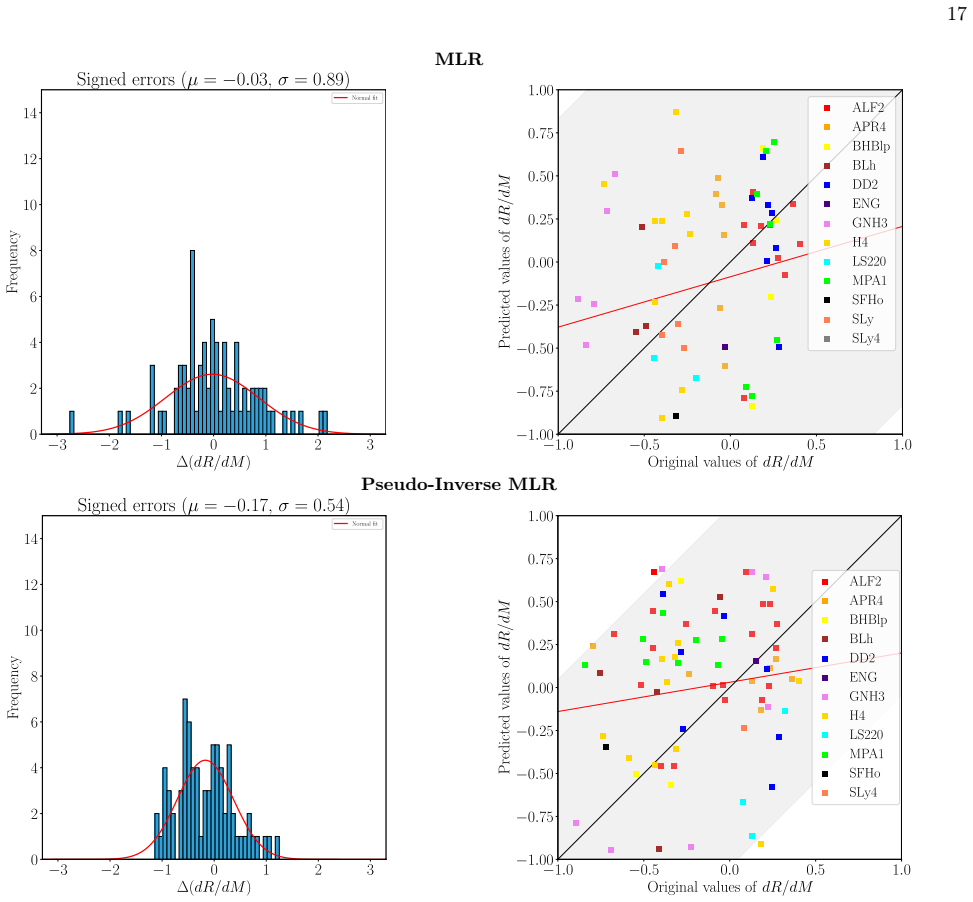
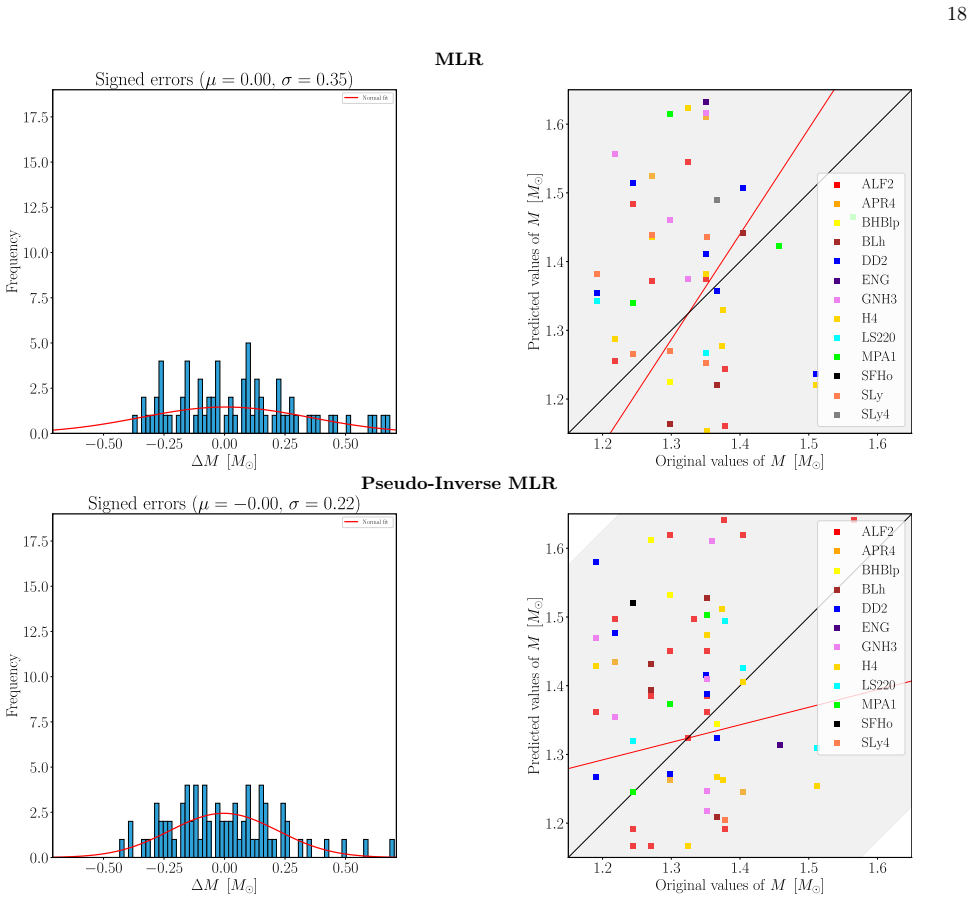
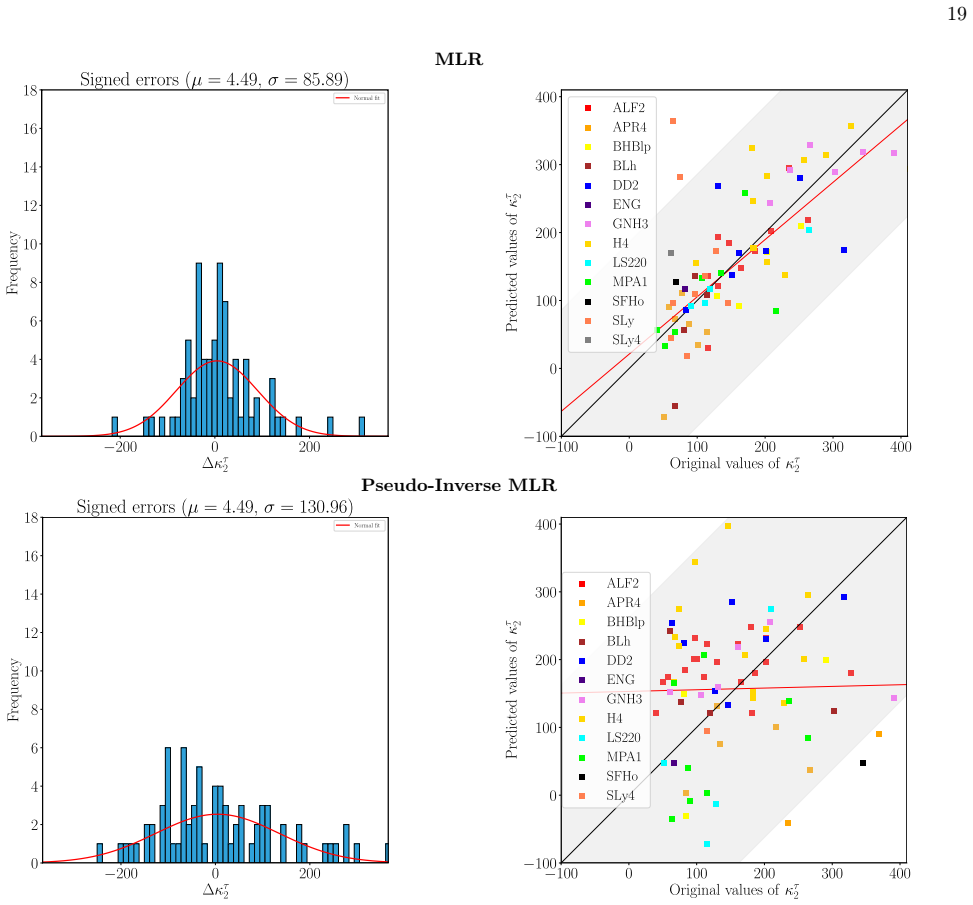
Neural-network regression models trained on post-merger spectra outperform linear baselines in predicting stellar mass, tidal deformability, and mass-radius slope, with the best ensemble model reproducing the empirical relation between dominant post-merger frequency and tidal deformability while recovering equation-of-state-dependent trends in mass-tidal deformability.
What carries the argument
Inverse surrogate neural networks trained with a two-stage residual-weighted procedure, dropout, Gaussian-noise injection, and early stopping that map frequency-domain post-merger spectra directly to mass, tidal deformability, and mass-radius slope.
If this is right
- Nonlinear neural networks capture the inverse spectral mapping more effectively than algebraic inversion.
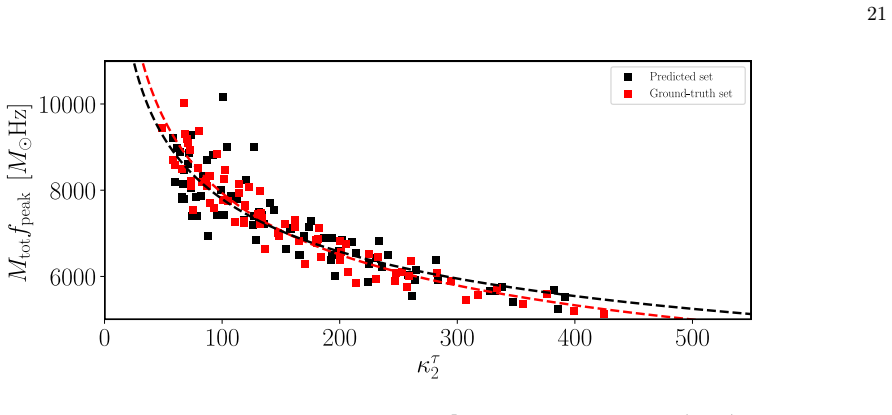
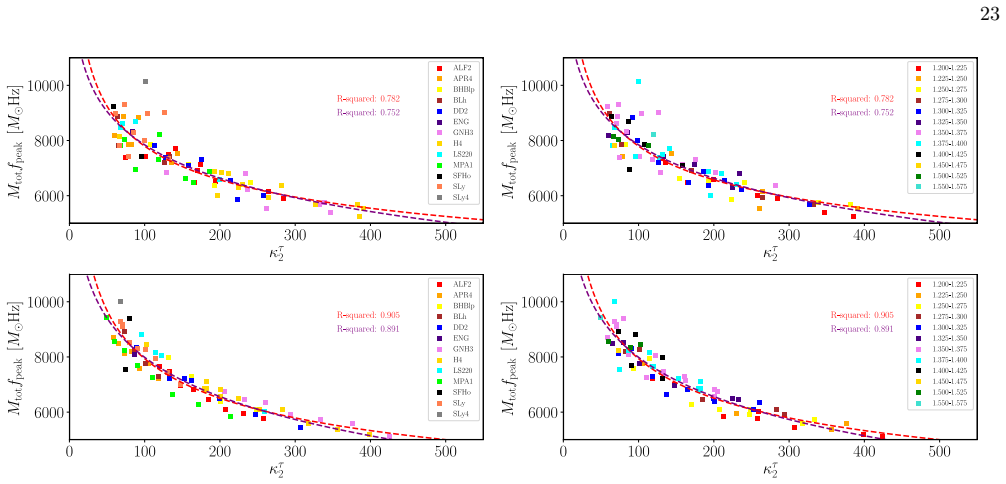
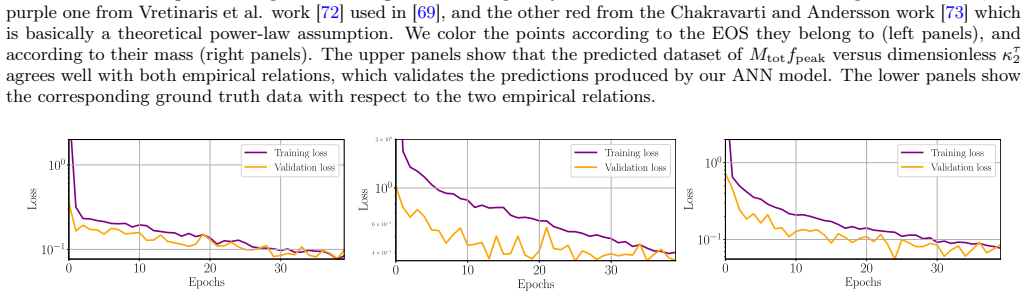
- An ensemble of single-task networks achieves the highest accuracy for the three target properties.
- The models recover equation-of-state-dependent mass-tidal-deformability trends without being explicitly trained on them.
- Post-merger signals become a viable channel for extracting neutron-star information with future third-generation detectors.
Where Pith is reading between the lines
- Training the same architecture on spectra that include realistic noise and mass asymmetry would directly test whether the learned mapping survives the conditions of actual observations.
- The mixture-of-experts architecture already identifies which frequency bands carry the strongest information about each property; this could guide targeted feature selection in future analyses.
- Combining the post-merger surrogate with existing pre-merger tidal constraints could tighten equation-of-state bounds without requiring a single joint waveform model.
Load-bearing premise
The inverse mapping learned from idealized equal-mass noise-free spectra will still be informative once real detector noise, unequal masses, and waveform modeling errors are present.
What would settle it
Running the trained networks on a fresh set of numerical-relativity spectra that include simulated detector noise and unequal masses and finding that root-mean-square errors rise well above the levels reported for the noise-free equal-mass case.
Figures
read the original abstract
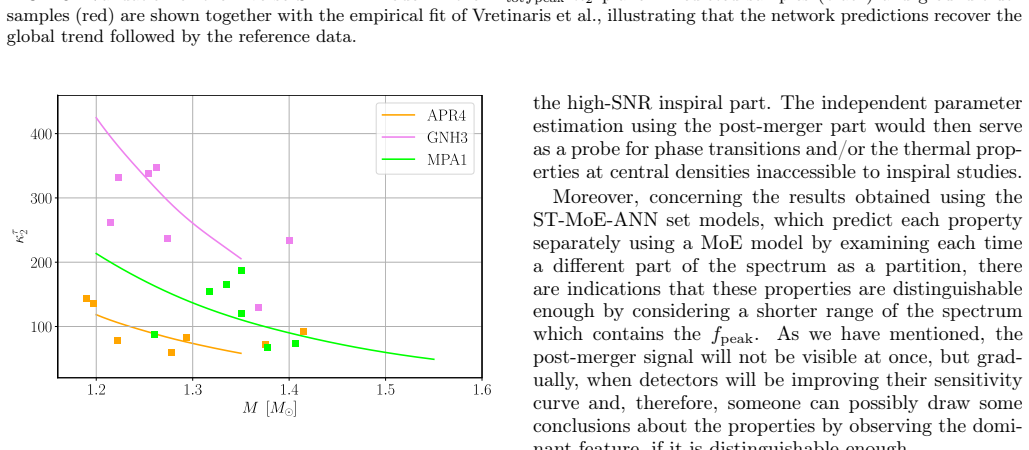
We present a proof-of-concept study of the inverse problem of inferring neutron-star properties directly from the post-merger gravitational-wave spectrum of equal-mass binary neutron-star mergers. Using noise-free spectra from numerical-relativity catalogs, we train and compare three artificial-neural-network regression models and two multivariate linear-regression baselines to predict the stellar mass, $M$, the quadrupolar tidal deformability, $\kappa_2^\tau$, and the slope of the mass--radius relation, $dR/dM$. Since the inverse mapping is nonlinear and cannot be obtained by analytically inverting the direct neural-network model, we construct inverse surrogates and train the networks with a two-stage procedure in which residuals from an initial pass define sample weights for a second pass, together with regularization via dropout, Gaussian-noise injection, and early stopping. We find that neural networks consistently outperform linear baselines, showing that nonlinear surrogates capture the inverse relation between post-merger spectra and source properties more effectively than algebraic inversion. The best performance is achieved by an ensemble of single-task networks, while a multi-task model gives comparable accuracy for predicting the mass--radius slope, and a mixture-of-experts architecture provides insight into spectral-region importance. We further show that the best model reproduces empirical relations between the dominant post-merger frequency and tidal deformability, and recovers equation-of-state-dependent mass--tidal-deformability trends, indicating physical consistency beyond pointwise accuracy. Although restricted to idealized noise-free spectra, the results show that neural-network surrogates provide a promising route for extracting neutron-star information from post-merger signals with future third-generation detectors.
Editorial analysis
A structured set of objections, weighed in public.
Referee Report
Summary. The paper presents a proof-of-concept study using neural-network regression models to infer neutron-star properties (stellar mass M, quadrupolar tidal deformability κ₂^τ, and mass-radius slope dR/dM) directly from noise-free post-merger gravitational-wave spectra of equal-mass binary neutron-star mergers drawn from numerical-relativity catalogs. Three ANN architectures (single-task ensemble, multi-task, mixture-of-experts) are compared against two multivariate linear-regression baselines. A two-stage training procedure is employed in which residuals from an initial pass are used to define sample weights for a second pass, combined with dropout, Gaussian-noise injection, and early stopping. The networks are shown to outperform the linear baselines on the test spectra, to reproduce empirical f_peak–κ₂^τ relations, and to recover equation-of-state-dependent M–κ₂^τ trends, indicating physical consistency within the idealized setting. The work is explicitly restricted to noise-free, equal-mass spectra and does not claim applicability to detector noise or unequal-mass systems.
Significance. If the reported performance holds, the manuscript demonstrates that nonlinear neural-network surrogates can capture the inverse mapping from post-merger spectra to source properties more effectively than linear algebraic inversion in a controlled, noise-free environment. Strengths include the use of numerical-relativity catalogs, explicit checks against known empirical relations, and the demonstration that the best model recovers EoS-dependent trends without being forced to do so by construction. The work provides a clear baseline for future studies that incorporate realistic noise and waveform systematics, and the scoping to idealized data is stated transparently.
major comments (2)
- [Methods (two-stage procedure)] The two-stage weighting procedure (residuals from first pass define weights for second pass) is presented as improving performance, but no ablation study isolating its contribution versus the regularization terms (dropout, Gaussian noise, early stopping) is reported; without this, it remains unclear whether the outperformance over linear baselines is driven primarily by the weighting or by the network capacity itself.
- [Results (performance and relation checks)] All performance metrics and relation-recovery checks are obtained from train/test splits within the same numerical-relativity catalog; while the networks are not constructed to enforce the empirical relations, the absence of an external validation set (different codes, resolutions, or EoS families) leaves open the possibility that the reported accuracy partly reflects catalog-specific correlations rather than a general inverse mapping.
minor comments (2)
- [Abstract and throughout] Notation for the tidal deformability is written as κ₂^τ in the abstract and text; consistent use of subscript/superscript formatting (e.g., κ_2^τ) would improve readability.
- [Results (mixture-of-experts)] The mixture-of-experts architecture is said to provide insight into spectral-region importance, but the corresponding figure or table does not quantify the expert gating weights or their correlation with frequency bands; adding this would strengthen the interpretability claim.
Simulated Author's Rebuttal
We thank the referee for the careful reading, positive assessment of the work as a proof-of-concept, and recommendation for minor revision. We respond to each major comment below.
read point-by-point responses
-
Referee: [Methods (two-stage procedure)] The two-stage weighting procedure (residuals from first pass define weights for second pass) is presented as improving performance, but no ablation study isolating its contribution versus the regularization terms (dropout, Gaussian noise, early stopping) is reported; without this, it remains unclear whether the outperformance over linear baselines is driven primarily by the weighting or by the network capacity itself.
Authors: We agree that an explicit ablation isolating the two-stage weighting would strengthen the presentation. In the revised manuscript we will add a controlled comparison of the full training procedure against an otherwise identical setup that omits the residual-based sample weighting (while retaining dropout, noise injection, and early stopping). This will clarify the incremental contribution of the weighting step. revision: yes
-
Referee: [Results (performance and relation checks)] All performance metrics and relation-recovery checks are obtained from train/test splits within the same numerical-relativity catalog; while the networks are not constructed to enforce the empirical relations, the absence of an external validation set (different codes, resolutions, or EoS families) leaves open the possibility that the reported accuracy partly reflects catalog-specific correlations rather than a general inverse mapping.
Authors: We acknowledge the limitation. The study is deliberately scoped to noise-free, equal-mass spectra from a single set of available NR catalogs, as stated in the abstract and introduction. We will expand the discussion to note that catalog-specific correlations cannot be ruled out by internal splits alone. At the same time, the unsupervised recovery of EoS-dependent M–κ₂^τ trends (without any explicit enforcement) already provides evidence that the networks are not merely memorizing catalog artifacts. A full external validation on independent simulations would require new high-resolution runs from other groups and is outside the present scope. revision: partial
Circularity Check
No significant circularity identified
full rationale
The paper is an empirical ML study training neural-network regressors on a fixed numerical-relativity catalog of noise-free equal-mass post-merger spectra to predict M, κ₂^τ and dR/dM. Performance is measured by direct comparison to linear baselines on the same catalog (standard train/test split practice), and the reproduction of f_peak–κ₂^τ and EoS-dependent M–κ₂^τ trends is a post-hoc consistency check against patterns already present in the training data rather than a derivation that forces those patterns by construction. No equations, self-citations, or uniqueness claims reduce the reported results to the inputs; the central claim (nonlinear surrogates outperform linear ones on this task) remains independently falsifiable against the catalog and the linear controls.
Axiom & Free-Parameter Ledger
free parameters (2)
- network weights and biases
- dropout rate, Gaussian noise variance, early-stopping patience
axioms (2)
- domain assumption The post-merger spectrum is a deterministic function of the source properties for a given equation of state.
- domain assumption The training and test splits are drawn from the same distribution of equal-mass mergers.
Reference graph
Works this paper leans on
-
[1]
This objective function corresponds to calculating the vertically projected distances of theRn points from a hyperplane, wheren is the dimensionality of the problem at hand
Direct multivariate linear regression Direct multivariate linear regression actually emanates from Ordinary Least-Squares (OLS) theory, reduced to multiple dimensions, and can be safely regarded as an op- timization problem, where one attempts to minimize an objective function. This objective function corresponds to calculating the vertically projected di...
-
[2]
Pseudo-inverse multivariate linear regression (PI-MLR) The main equation in inverse linear regression is basi- cally characterized by the same equation (as a specifica- tion) of direct linear regression, see Eq. 1. One can easily derive the specification of the inverse model equation us- ing this equation of the direct model; however, we have to emphasize...
-
[3]
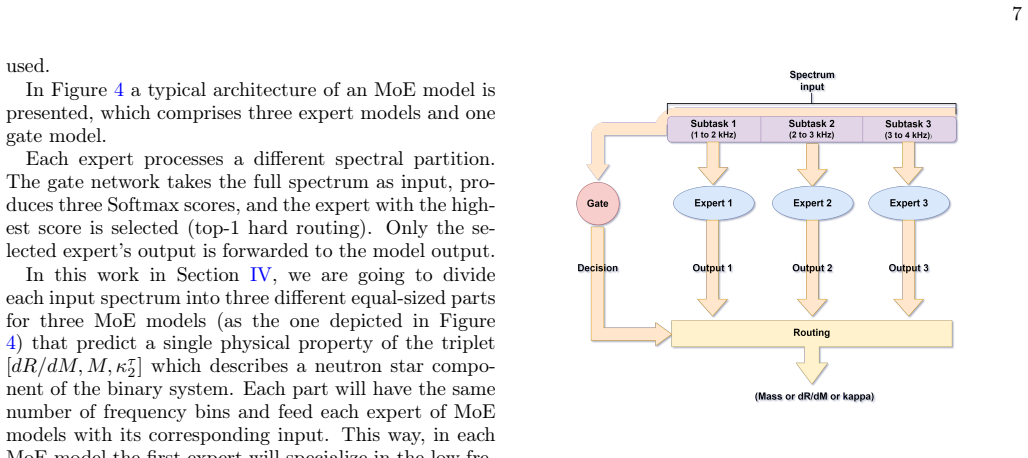
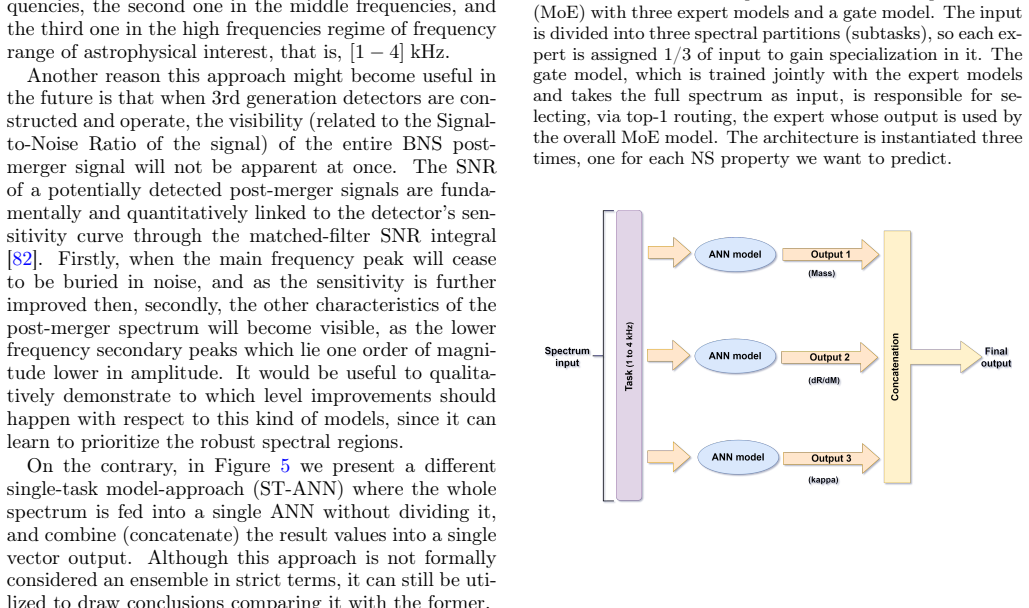
Each part will have the same number of frequency bins and feed each expert of MoE models with its corresponding input
that predict a single physical property of the triplet [dR/dM, M, κτ 2] which describes a neutron star compo- nent of the binary system. Each part will have the same number of frequency bins and feed each expert of MoE models with its corresponding input. This way, in each MoE model the first expert will specialize in the low fre- quencies, the second one...
-
[4]
The results for our case are depicted in Table VI
for a specific model is in- dicated by a calculation of the predicted valuesypredicted against its original true valuesyoriginal, using the follow- ing formula: RMSE(y) = vuuut NX i=1 (y(i) predicted − y(i) original)2 N , (9) where the summation index i traverses all the observa- tions and, consequently,N = 77 in our case, as we will describe in Subsectio...
-
[5]
This type of set-up is typical of addressing the problem of prediction using neural networks when data can be represented in tabular form
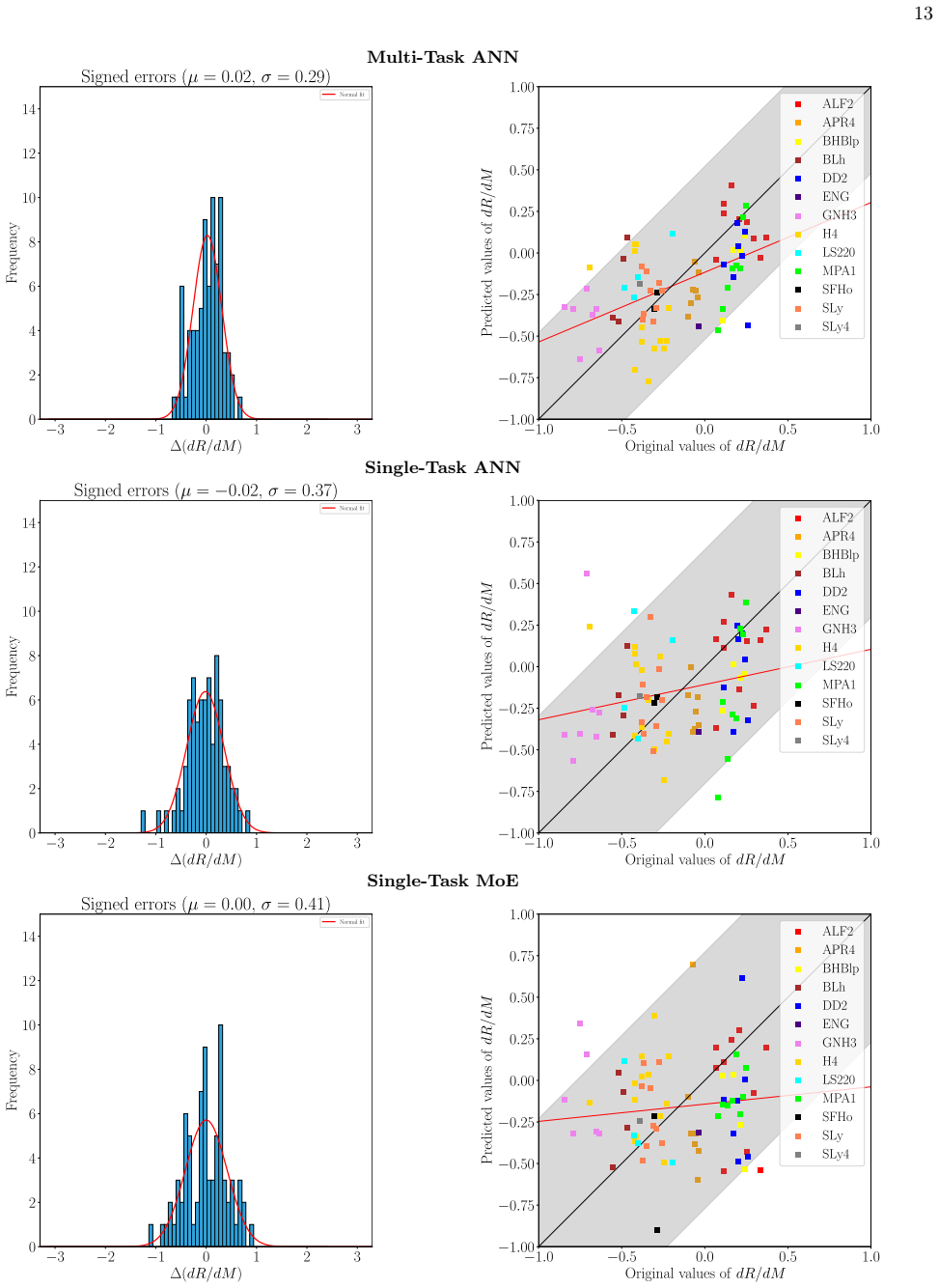
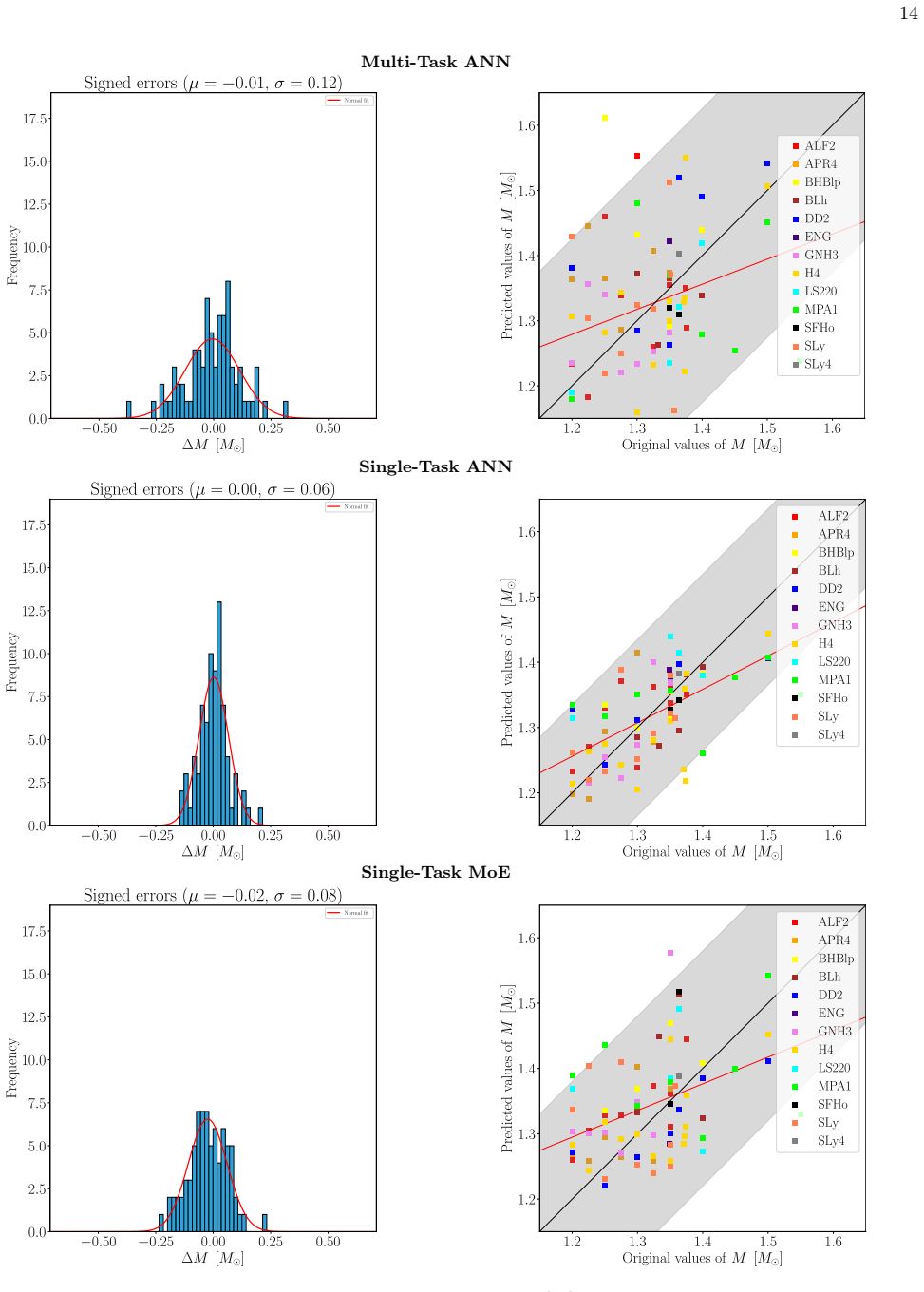
Multi-task ANN model The first deep learning model is an implemented ANN used for solving the problem of predicting multiple val- ues using a regression-like scheme with 3 hidden layers. This type of set-up is typical of addressing the problem of prediction using neural networks when data can be represented in tabular form. We feed it with 77 original spe...
-
[6]
So, we constructed three ANNs that can be used as an ensemble, similar to the one described in Table III, except for the fact that the last output layer has (None,
Single-task ANN models In order to be able to assess the prediction capacity of theprevious MT-ANN network, webrokedowntheprob- lem of predicting the output into three separate neural networks, where each one predicts a single component of the regressand vector while having the same regressors as input. So, we constructed three ANNs that can be used as an...
-
[7]
We used the same enhancements as in theMT-ANN case, but we were slightly differentiated in input/output scaling of each network
shape, that is predicting a single value; either BNS component mass M, or inverse gradient of NS radius vs its mass dR/dM or, lastly, tidal deformabilityκτ 2. We used the same enhancements as in theMT-ANN case, but we were slightly differentiated in input/output scaling of each network. To be more precise, the ANNs predicting mass M and tidal deformabilit...
-
[8]
Single-task Mixture of Experts (MoE) models The third deep learning model we employed for pre- dicting the specified neutron star properties is an en- semble of mixture-of-experts (MoE) models, one for each property out of three, and is depicted in Figure 4, while we form each spectral partition so as to almost equally comprise the 1/3 of the input spectr...
-
[9]
Pseudo-Inverse Multivariate Regression model (PI-MLR) The first algebraic model we implemented takes ad- vantage of Eq. 6a, as described in IIB, whereB is the coefficients matrix of the direct model of our previous work, used to formulate the respective coefficients ma- trix Γ of our inverse MLR model. All we have to do in order to calculate a triplet of ...
-
[10]
peak”) or one of the two regions that do not (“non- peak
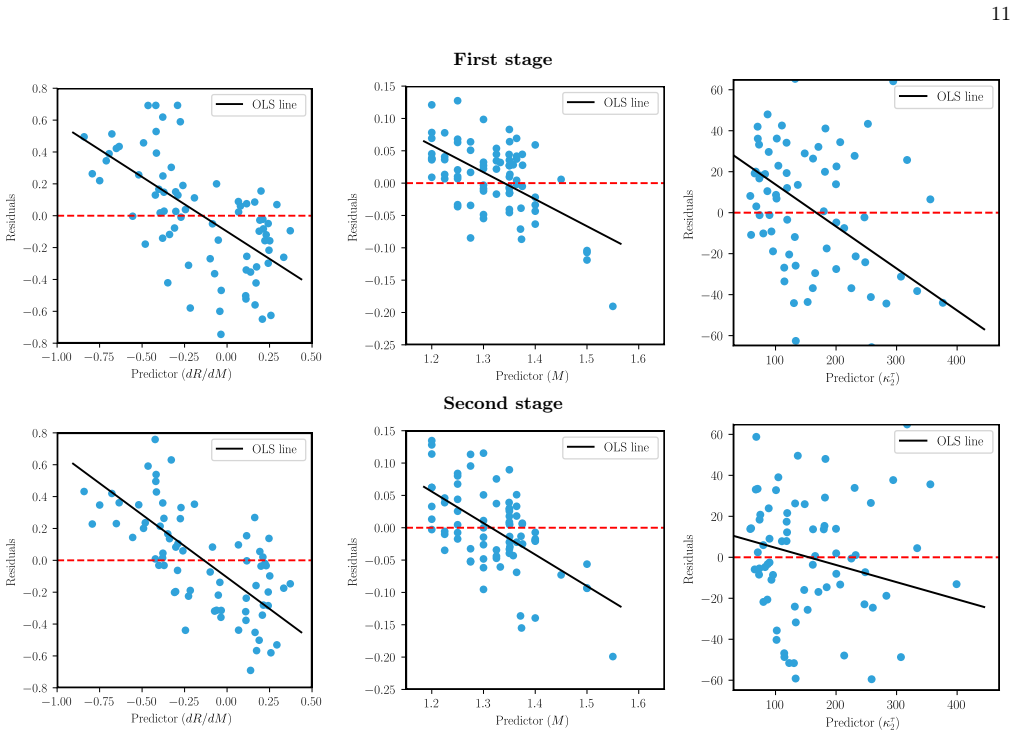
Multivariate Regression model (MLR) Apart from the PI-MLR model which takes advantage of the pseudo-inverse approach, we can use the well- known Ordinary Least Squares (OLS) methodology to fit the inverse linear model of Eq. 3, thereby estimating the prediction matrixΓ. That is, to deal with the inverse problem as a direct one to mainly make comparisons w...
-
[11]
Its determination coefficientR2 is equal to 0.782 for our predicted dataset compared to 0.905 for the ground truth dataset, slightly better than the 41st relation of [72]
empirical fit, the fit introduced by Chakravarti and Andersson [73]. Its determination coefficientR2 is equal to 0.782 for our predicted dataset compared to 0.905 for the ground truth dataset, slightly better than the 41st relation of [72]. In Figure 16, we show theaverage loss curves among 77 trained models following a LOO-CV evaluation pro- cess. We can...
-
[12]
Haensel, A
P. Haensel, A. Y. Potekhin, and D. G. Yakovlev,Neu- tron Stars 1: Equation of State and Structure, Astro- physics and Space Science Library, Vol. 326 (Springer, New York, 2007)
2007
-
[13]
A. Abac, R. Abramo, S. Albanesi, A. Albertini, A. Agapito, M. Agathos, C. Albertus, N. Andersson, et al., The science of the einstein telescope (2025), arXiv:2503.12263 [gr-qc]
work page internal anchor Pith review Pith/arXiv arXiv 2025
-
[14]
A.Bauswein, N.Stergioulas,andH.-T.Janka,European Physical Journal A52, 56 (2016)
2016
-
[15]
Dietrich, T
T. Dietrich, T. Hinderer, and A. Samajdar, Gen. Rela- tivity Gravit.53, 27 (2021)
2021
-
[16]
B. P. Abbottet al., Phys. Rev. X9, 011001 (2019)
2019
-
[17]
121,161101(2018)
B.P.Abbott et al.,Phys.Rev.Lett. 121,161101(2018)
2018
-
[18]
Iacovelli, M
F. Iacovelli, M. Mancarella, C. Mondal, A. Puecher, T. Dietrich, F. Gulminelli, M. Maggiore, and M. Oertel, Phys. Rev. D108, 122006 (2023)
2023
-
[19]
J.L.FriedmanandN.Stergioulas,InternationalJournal of Modern Physics D29, 2041015 (2020)
2020
-
[20]
Baiotti and L
L. Baiotti and L. Rezzolla, Reports on Progress in Physics 80, 096901 (2017), publisher: IOP Publishing
2017
-
[21]
Baiotti, Progress in Particle and Nuclear Physics 109, 103714 (2019), _eprint: 1907.08534
L. Baiotti, Progress in Particle and Nuclear Physics 109, 103714 (2019), _eprint: 1907.08534
-
[22]
Hild S., et al., Classical and Quantum Gravity 28, 094013 (2011)
2011
-
[23]
S. Ascenzi, V. Graber, and N. Rea, Astroparticle Physics 158, 102935 (2024), _eprint: 2401.14930
-
[24]
A. Bauswein, S. Blacker, V. Vijayan, N. Stergioulas, K. Chatziioannou, J. A. Clark, N.-U. F. Bastian, D. B. Blaschke, M. Cierniak, and T. Fischer, Physi- calReview Letters125, 10.1103/physrevlett.125.141103 (2020), publisher: American Physical Society (APS)
-
[26]
B. P. Abbott and others, Phys. Rev. Lett.116, 061102 (2016), _eprint: 1602.03837
work page internal anchor Pith review Pith/arXiv arXiv 2016
-
[27]
L"uck, J
H. L"uck, J. Smith, and M. Punturo, inHandbook of Gravitational Wave Astronomy(Springer, 2022) pp. 1– 18
2022
-
[28]
L. S. Collaboration and J. Harms, Class. Quantum Gravity 34, 044001 (2017)
2017
-
[29]
Cosmic Explorer: The U.S. Contribution to Gravitational-Wave Astronomy beyond LIGO
D. Reitze, R. X. Adhikari, S. Ballmer, B. Barish, L. Barsotti, G. Billingsley, D. A. Brown, Y. Chen, D. Coyne, R. Eisenstein,et al., arXiv preprint (2019), arXiv:1907.04833
work page internal anchor Pith review Pith/arXiv arXiv 2019
-
[30]
Zhang, H
T. Zhang, H. Yang, D. Martynov, P. Schmidt, and H. Miao, A Gravitational Wave Detector for Post MergerNeutronStars: BeyondtheQuantumLossLimit of Michelson Fabry Perot Interferometer (2022)
2022
-
[31]
Evans M., et al., A Horizon Study for Cosmic Explorer: Science, Observatories, and Community (2021)
2021
-
[32]
S. Borhanian and B. S. Sathyaprakash, \prd 110, 083040 (2024), _eprint: 2202.11048
-
[33]
Ackley K., et al., Publications of the Astronomical Soci- ety of Australia37, 10.1017/pasa.2020.39 (2020), pub- lisher: Cambridge University Press (CUP)
-
[34]
Branchesi M., et al., Journal of Cosmology and As- troparticle Physics2023 (07), 068, publisher: IOP Pub- lishing
-
[35]
Takami, L
K. Takami, L. Rezzolla, and L. Baiotti, Phys. Rev. Lett. 113, 091104 (2014), publisher: American Physical So- ciety. 23 FIG. 15. In these figures we depict the fitting of two conceptually different universal neutron star empirical relations, the purple one from Vretinaris et al. work [72] used in [69], and the other red from the Chakravarti and Andersson ...
2014
-
[36]
Bernuzzi, F
S. Bernuzzi, F. Magistrelli, M. Jacobi, D. Lo- goteta, A. Perego, and D. Radice, Monthly No- tices of the Royal Astronomical Society 542, 256 (2025), https://academic.oup.com/mnras/article- pdf/542/1/256/63841147/staf1147.pdf
2025
-
[38]
M. Breschi, S. Bernuzzi, D. Godzieba, A. Perego, and D. Radice, Physical Review Letters128, 10.1103/phys- revlett.128.161102 (2022), publisher: American Physi- cal Society (APS)
-
[39]
P. J. Easter, S. Ghonge, P. D. Lasky, A. R. Casey, J. A. Clark, F. Hernandez Vivanco, and K. Chatziioannou, Phys. Rev. D102, 043011 (2020)
2020
-
[40]
Wijngaarden, T
M. Wijngaarden, T. Hinderer, A. Schwenk,et al., Phys. Rev. D105, 044015 (2022)
2022
-
[41]
J. A. Clark, A. Bauswein, N. Stergioulas, and D. Shoe- maker, Classical and Quantum Gravity 33, 085003 (2016), publisher: IOP Publishing
2016
-
[42]
F. Iacovelli, M. Mancarella, C. Mondal, A. Puecher, T. Dietrich, F. Gulminelli, M. Maggiore, and M. Oertel, Physical Review D 108, 10.1103/physrevd.108.122006 (2023), publisher: American Physical Society (APS)
-
[43]
S. Vretinaris, G. Vretinaris, C. Mermigkas, M. Kara- manis, and N. Stergioulas, Robust and fast parameter estimation for gravitational waves from binary neutron star merger remnants (2025), arXiv:2501.11518 [gr-qc]
-
[44]
Banagiri, M
S. Banagiri, M. W. Coughlin, J. Clark, P. D. Lasky, M. A. Bizouard, C. Talbot, E. Thrane, and V. Mandic, MonthlyNoticesoftheRoyalAstronomicalSociety 492, 4945–4951 (2020)
2020
-
[45]
T. Jain and M. Agathos, arXiv e-prints , arXiv:2404.12126 (2024), _eprint: 2404.12126
-
[46]
A. W. Criswell, J. Miller, N. Woldemariam, T. Soul- tanis, A. Bauswein, K. Chatziioannou, M. W. Cough- lin, G. Jones, and V. Mandic, Physical Review D107, 10.1103/physrevd.107.043021 (2023), publisher: Amer- ican Physical Society (APS)
-
[47]
G. Huez, S. Bernuzzi, M. Breschi, and R. Gamba, Phys- ical Review D113, 10.1103/2jxk-1bf1 (2026)
- [48]
-
[49]
F. H. Panther and P. D. Lasky, Careless whispers: A population of sub-threshold post-merger gravitational waves constrains the hot nuclear equation of state (2025), arXiv:2512.08497 [gr-qc]
work page internal anchor Pith review Pith/arXiv arXiv 2025
-
[50]
Christensen and R
N. Christensen and R. Meyer, Rev. Mod. Phys. 94, 025001 (2022)
2022
- [51]
-
[52]
Baiotti, Arabian Journal of Mathematics 11, 105 (2022)
L. Baiotti, Arabian Journal of Mathematics 11, 105 (2022)
2022
-
[53]
M. Wijngaarden, K. Chatziioannou, A. Bauswein, J. A. Clark, and N. J. Cornish, \prd 105, 104019 (2022), _eprint: 2202.09382
-
[54]
A. Puecher, T. Dietrich, K. W. Tsang, C. Kalaghatgi, S. Roy, Y. Setyawati, and C. Van Den Broeck, \prd107, 124009 (2023), _eprint: 2210.09259
-
[55]
M. C. Miller and N. Yunes, Nature568, 469 (2019)
2019
-
[56]
Arimoto and others, Progress of Theoretical and Ex- perimental Physics2023, 10A103 (2021)
M. Arimoto and others, Progress of Theoretical and Ex- perimental Physics2023, 10A103 (2021)
2021
-
[57]
D. M. Eardley, D. L. Lee, and A. P. Lightman, Phys. Rev. D8, 3308 (1973)
1973
-
[58]
Abbottet al., Phys
R. Abbottet al., Phys. Rev. D103, 122002 (2021)
2021
-
[59]
C. M. Will, Living Rev. Relativity17, 1 (2014)
2014
-
[60]
B. S. Sathyaprakash and B. F. Schutz, Living Rev. Rel- ativity 12, 2 (2009)
2009
-
[61]
Maggiore, Phys
M. Maggiore, Phys. Rep.331, 283 (2000)
2000
-
[62]
R. Huxford, R. Kashyap, S. Borhanian, A. Dhani, I. Gupta, and B. S. Sathyaprakash, \prd109, 103035 (2024), _eprint: 2307.05376
-
[63]
P. J. Easter, S. Ghonge, P. D. Lasky, A. R. Casey, J. A. Clark, F. Hernandez Vivanco, and K. Chatziioannou, Phys. Rev. D102, 043011 (2020), publisher: American Physical Society
2020
- [64]
-
[65]
M. Breschi, S. Bernuzzi, F. Zappa, M. Agathos, A. Perego, D. Radice, and A. Nagar, \prd100, 104029 (2019), _eprint: 1908.11418
-
[66]
M. Breschi, S. Bernuzzi, K. Chakravarti, A. Camilletti, A. Prakash, and A. Perego, Physical Review D 109, 10.1103/physrevd.109.064009 (2024), publisher: Amer- ican Physical Society (APS)
-
[67]
A. Tsokaros, J. Bamber, M. Ruiz, and S. L. Shapiro, arXiv e-prints , arXiv:2411.00939 (2024), _eprint: 2411.00939
-
[68]
T. Soultanis, A. Bauswein, and N. Stergioulas, Physical Review D105, 10.1103/physrevd.105.043020 (2022)
- [69]
-
[70]
H. Kochankovski, A. Ramos, L. Tolos, S. Blacker, and A. Bauswein, Hyperons in neutron star mergers (2024), arXiv:2411.14978 [hep-ph]
-
[71]
Blacker, H
S. Blacker, H. Kochankovski, A. Bauswein, A. Ramos, and L. Tolos, Phys. Rev. D109, 043015 (2024)
2024
-
[72]
Convective Excitation of Inertial Modes in Binary Neutron Star Mergers
R. De Pietri, A. Feo, J. A. Font, F. Löffler, F. Maione, M. Pasquali, and N. Stergioulas, Phys. Rev. Lett.120, 221101 (2018), arXiv:1802.03288 [gr-qc]
work page internal anchor Pith review Pith/arXiv arXiv 2018
-
[73]
R. De Pietri, A. Feo, J. A. Font, F. Löffler, M. Pasquali, and N. Stergioulas, Phys. Rev. D101, 064052 (2020), arXiv:1910.04036 [gr-qc]
-
[74]
A. Sasli, N. Karnesis, and N. Stergioulas, Phys. Rev. D 109, 043045 (2024), arXiv:2311.10626 [gr-qc]
work page internal anchor Pith review Pith/arXiv arXiv 2024
- [75]
-
[76]
A. Puecher and T. Dietrich, Physical Review D110, 10.1103/physrevd.110.123038 (2024), publisher: Amer- ican Physical Society (APS)
-
[77]
T. Whittaker, W. E. East, S. R. Green, L. Lehner, and H. Yang, \prd105, 124021(2022), _eprint: 2201.06461
-
[78]
M. Llorens-Monteagudo, A. Torres-Forné, and J. A. Font, Clawdia: A dictionary learning frame- work for gravitational-wave data analysis (2025), arXiv:2511.16750 [astro-ph.IM]
-
[79]
T. Soultanis, K. Maltsev, A. Bauswein, K. Chatziioan- nou, F. K. Roepke, and N. Stergioulas, Gravitational- wave model for neutron star merger remnants with supervised learning (2024), arXiv:2405.09513 [astro- ph.HE]
-
[80]
Pesios, I
D. Pesios, I. Koutalios, D. Kugiumtzis, and N. Ster- gioulas, Phys. Rev. D110, 063008 (2024)
2024
-
[81]
E. Cuoco, M. Cavaglià, I. S. Heng, D. Keitel, and C. Messenger, Living Reviews in Relativity 28, 10.1007/s41114-024-00055-8 (2025)
-
[83]
Vretinaris, N
S. Vretinaris, N. Stergioulas, and A. Bauswein, Phys. Rev. D101, 084039 (2020)
2020
discussion (0)
Sign in with ORCID, Apple, or X to comment. Anyone can read and Pith papers without signing in.