REVIEW 3 minor 68 references
Observable trace sequences enable algebraic reconstruction of non-Hermitian Floquet monodromy matrices.
Reviewed by Pith at T0; open to challenge. T0 means a machine referee read the full paper against a public rubric. the ladder, T0–T4 →
T0 review · grok-4.3
2026-06-30 13:07 UTC pith:JH3O2UPP
load-bearing objection The paper turns trace reconstruction in non-Hermitian Floquet systems into a standard algebraic problem via Cayley-Hamilton and adds a useful identifiability discussion, but the contribution is mostly framing.
Algebraic Tomography of Non-Hermitian Floquet Systems from Observable Traces
The pith
A machine-rendered reading of the paper's core claim, the machinery that carries it, and where it could break.
Core claim
The central discovery is that the inverse problem for reconstructing the monodromy matrix M from sequences ζ_n^(O) = Tr(O M^n) is finite-dimensional and algebraic because the sequences satisfy the recurrence from the characteristic polynomial of M, allowing recovery of spectral data via resolvent and determinant constructions, with Cayley-Hamilton and Hankel methods providing the reconstruction while accounting for visible and invisible sectors.
What carries the argument
The observable resolvent and spectral determinant, which separate the common spectral skeleton from observable-dependent dressing.
Load-bearing premise
The trace sequences are exactly constrained by the characteristic polynomial of the monodromy matrix M, and the extracted visible representative captures the essential information.
What would settle it
A counterexample where the Hankel matrix rank or the reconstructed characteristic polynomial fails to reproduce the original trace sequence within numerical precision would falsify the algebraic reconstruction claim.
If this is right
- The data determine a visible representative of the monodromy matrix.
- Micromotion enlarges the sampled visible operator space.
- Exact symmetries leave residual invisible sectors.
- Multi-observable extensions connect to realization theory.
- Examples demonstrate leakage-induced visibility expansion and EP-accessible branch geometry.
Where Pith is reading between the lines
- If the algebraic reconstruction holds, it could simplify experimental tomography in driven open quantum systems by reducing data requirements to recurrence relations.
- Connections to Liouville-space methods suggest extensions to higher-dimensional operator spaces for more complete identification.
- Disorder and probe dependence in observable-dimension readouts may allow mapping of system parameters without full state tomography.
Editorial analysis
A structured set of objections, weighed in public.
Referee Report
Summary. The paper formulates Floquet algebraic tomography for finite-dimensional non-Hermitian monodromy matrices M from observable trace sequences ζ_n^(O) = Tr(O M^n). It shows that these sequences obey the linear recurrence from the characteristic polynomial of M (via Cayley-Hamilton), turning the inverse problem into algebraic reconstruction of similarity-invariant spectral data using Hankel matrices and Prony-type methods rather than generic exponential fitting. The framework organizes reconstruction via the observable resolvent, spectral determinant, and Dirichlet spectral data, separating the common spectral skeleton from observable-dependent dressing; it extends to multi-observable and Liouville-space settings, connects to realization theory, and analyzes identifiability limits through visible representatives, micromotion, and invisible sectors induced by symmetries. Two concrete examples (driven transmon qutrit and finite non-Hermitian Floquet SSH chain) illustrate leakage-induced visibility expansion, observable-dependent phase response, EP branch geometry, and disorder/probe-dependent readouts.
Significance. If the algebraic reconstruction is rigorously established, the work provides a parameter-free, finite-dimensional method for spectral tomography in non-Hermitian Floquet systems that directly exploits the Cayley-Hamilton constraint on trace sequences. This is significant for experimental characterization of open quantum systems, where non-unitary evolution precludes standard unitary tomography; the explicit separation of spectral invariants from dressing, the treatment of identifiability limits, and the link to realization theory constitute clear strengths. The examples demonstrate practical applicability to leakage and exceptional-point phenomena.
minor comments (3)
- [Abstract / identifiability section] Abstract and § on identifiability limits: the phrase 'Dirichlet spectral data' is introduced without an explicit definition or reference to its standard meaning in the context of the resolvent; a one-sentence clarification would improve accessibility.
- [Examples] Examples section: while the transmon and SSH demonstrations are mentioned, the manuscript would benefit from a short table or figure explicitly comparing the algebraically recovered characteristic polynomial coefficients against the known values of M in each case.
- [Multi-observable extension] Notation: the symbol ζ_n^(O) is used consistently, but the transition from single-observable to multi-observable and Liouville-space extensions would be clearer with an explicit statement of how the Hankel matrix rank changes with the number of observables.
Simulated Author's Rebuttal
We thank the referee for the positive summary, significance assessment, and recommendation of minor revision. No major comments were provided in the report.
Circularity Check
No significant circularity; derivation rests on standard theorems
full rationale
The paper's central claim—that trace sequences ζ_n^(O) obey a linear recurrence from the characteristic polynomial of M, enabling algebraic reconstruction via Cayley-Hamilton and Hankel methods—is a direct application of the standard Cayley-Hamilton theorem, which holds independently for any finite-dimensional matrix and is not derived from or fitted to the paper's own data or prior self-citations. The framework separates spectral skeleton from observable-dependent terms using established realization theory and addresses identifiability limits without reducing any prediction to a fitted parameter renamed as output. No self-citation chains, ansatzes smuggled via citation, or self-definitional steps are present in the described derivation. This is the normal case of a self-contained application of linear algebra to Floquet traces.
Axiom & Free-Parameter Ledger
axioms (1)
- domain assumption Observable trace sequences ζ_n^(O) = Tr(O M^n) are constrained by the characteristic polynomial of the monodromy matrix M
read the original abstract
We formulate a framework of Floquet algebraic tomography for finite-dimensional non-Hermitian monodromy matrices from observable trace sequences $\zeta_n^{(O)}={\rm Tr}(OM^n)$. Since these sequences are constrained by the characteristic polynomial of $M$, the inverse problem is a finite-dimensional algebraic reconstruction problem rather than a generic exponential fit. We organize the reconstruction through the observable resolvent, spectral determinant, and Dirichlet spectral data, separating the common spectral skeleton from observable-dependent dressing. Cayley--Hamilton and Hankel methods recover the similarity-invariant spectral data, while multi-observable and Liouville-space extensions connect the construction to realization theory and tomography reconstruction. We further clarify the limits of identifiability from restricted observable algebras: the data determine a visible representative, micromotion can enlarge the sampled visible operator space, and exact symmetries impose residual invisible sectors. Two examples, a driven transmon qutrit and a finite non-Hermitian Floquet SSH chain, demonstrate leakage-induced visibility expansion, observable-dependent phase response, EP-accessible branch geometry, and disorder/probe-dependent observable-dimension readouts.
Figures




Reference graph
Works this paper leans on
-
[1]
28 Purpose / figure Parameters Reconstruction check (Fig
WeprovideaminimalGL(3,C)Floquetsettingthatexplicitlyverifiesthealgebraicreconstructionofthecommon spectral skeleton from a single observable channel. 28 Purpose / figure Parameters Reconstruction check (Fig. 1) A= 0.94,B=A/2,E 1 ∈[0.02,2.02](101 points). Near-degeneracy regime (Fig. 2) A∈[0.75,0.95]andE 1 ∈[0.05,0.14](81×81grid),B=A/2. Visibility mismatch...
-
[2]
We examine the distinction between the common spectral skeleton and observable-dependent dressing by study- ing how drive-induced mode mixing changes the visible phase response relative to the global determinant-phase accumulation
-
[3]
We use the micromotion-expanded observable dimensionDobs = rank(K0)to test whether the qubit-population observable remains confined to the invariant qubit sector or expands to the full qutrit operator space through coherent leakage. B. Numerical experiments
-
[4]
Algebraic reconstruction from a single observable WefirstchecktheGL(N,C)structureusingtherecurrencerelationinEq.(24)andthePronyreconstruction, whichis summarized in App. A1. We useOqub in Eq.(134) and numerically reconstruct the common spectral skeleton, namely the characteristic coefficients{ea}3 a=1 and the spectrum{λ j}3 j=1, from the first six points ...
-
[5]
Observable phase visibility and level allocation near DPs We first identify the parameter regime near degeneracy points. Fig. 2 visualizes this near-degeneracy point through the spectral gap and the condition number ofU,δλandκ(U), defined as δλ:= min i<j |λi −λ j|, κ(U) :=∥U∥ 2 · ∥U −1∥2,(136) in theE1-Aplane, where∥U∥ 2 is the matrix-norm ofU= (|u1⟩,|u 2...
-
[6]
HereDobs is not the recurrence order of a single scalar OTS
Tracking the dimensionality of the visible operator space We next use the DTQ3 model to illustrate how the observable dimensionDobs detects the enlargement of the visible operator space caused by coherent leakage. HereDobs is not the recurrence order of a single scalar OTS. Rather, following the definition in Sec. IVC, it is computed as the rank of the sa...
-
[7]
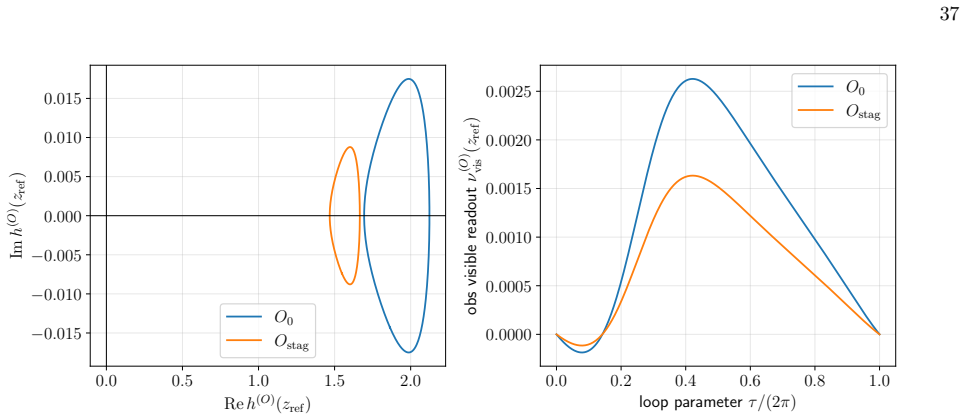
We use an EP-accessible finite-size NHFSSH chain to test how a branch-sensitive spectral skeleton is filtered into observable-dependent visible readouts, from local EP-neighborhood responses to winding-related responses along a twist cycle
-
[8]
We use the sampled observable dimensionDobs = rank(K 0)to quantify the finite-sampling visibility of the operator space under symmetry, disorder, and probe choice, without identifying this sampled rank with a sharp symmetry-wall saturation. B. Numerical experiments
-
[9]
Local EP response and global winding Readout The central utility of the present framework lies in its ability to distinguish between the common spectral skeleton, or shadow-level structure, and the channel-dependent output (the visible level). To demonstrate this, we first establish the local spectral geometry underlying the NHFSSH chain and then examine ...
-
[10]
In this subsection,Dobs is understood in the sampled sense introduced in Sec
Observable-dimension growth under symmetry and disorder We next examine how the observable dimensionDobs depends on the choice of observable and on the disorder profile in the finite NHFSSH chain. In this subsection,Dobs is understood in the sampled sense introduced in Sec. IVC: it is the rank of the sampled micromotion-expanded observable map, as in Eq.(...
-
[11]
We restrict ourselves here to the diagonalizable case with simple spectrum
Prony reconstruction of the spectrum and observable coefficients In this part, we briefly explain how to reconstruct the spectrum{λj}N j=1 and the observable coefficients{c(O) j }N j=1 from the OTS once the rankNand the characteristic coefficients{ea}N a=1 have been identified. We restrict ourselves here to the diagonalizable case with simple spectrum. Th...
-
[12]
determine{e a}N a=1 from the CH recurrence,
-
[13]
This is precisely the classical Prony reconstruction in the present context
solve Eq.(A2) for{λj}N j=1 and then solve Eq.(A3) for{c(O) j }N j=1. This is precisely the classical Prony reconstruction in the present context. The role of the annihilating polynomial is played by the characteristic polynomialP(λ)in Eq.(A1), while the amplitudes are the observable coefficients, {c(O) j }j. The essential difference from a purely phenomen...
-
[14]
Arbitrary-stepsize Cayley–Hamilton interpolation In this appendix, we give the detailed formulas for the arbitrary-stepsize generalization of the CH recurrence used in Sec. IIIA. The ordinary CH recurrence for the OTS (24) consists of the one-step sequence{ζ(O) n+N , ζ(O) n+N−1 ,· · ·, ζ (O) n }. Since onlyNpointsintheOTSareindependent, onemaygeneralizeEq...
-
[15]
Below, we assume the SS and EP cases
Multi-observable realization and similarity In this appendix, we give the detailed derivation of the multi-observable realization and the fact that the realized monodromy matrix is equivalent to the exact monodromy matrix,M, up to similarity transform. Below, we assume the SS and EP cases. We define a vector of the OTS with a fixednmeasured by{Oℓ}L ℓ=1 as...
-
[16]
Proof of Prop. 1 We begin with two lemmas that make explicit the visible/invisible decomposition associated with the observable algebra. Lemma 1(Finite-dimensional visible decomposition).LetO⊂End(H)be a finite-dimensional unital∗-subalgebra. Then, there exists an orthogonal decomposition given by H= JM j=1 (Hj ⊗ Mj)(B2) 47 such that O ∼= JM j=1 End(Hj)⊗I ...
-
[17]
Proof of Prop. 2 We next prove Prop. 2. The key point is that micromotion enlarges the observable algebra, but exact commuting symmetries survive this enlargement. In order to make a proof for the proposition, let us consider the following lemma: Lemma 3(Micromotion preserves commuting symmetries).Let O(t) :=U(t,0) −1O U(t,0).(B22) If an operatorQsatisfie...
-
[18]
J. H. Shirley, “Solution of the Schr"odinger equation with a hamiltonian periodic in time,”Physical Review138no. 4B, (1965) B979–B987. 50
work page 1965
-
[19]
Steady states and quasienergies of a quantum-mechanical system in an oscillating field,
H. Sambe, “Steady states and quasienergies of a quantum-mechanical system in an oscillating field,”Physical Review A7 no. 6, (1973) 2203–2213
work page 1973
-
[20]
Stationary scattering theory for time-dependent hamiltonians,
J. S. Howland, “Stationary scattering theory for time-dependent hamiltonians,”Mathematische Annalen207no. 4, (Dec,
-
[21]
Edge states and topological invariants of non-hermitian systems,
S. Yao and Z. Wang, “Edge states and topological invariants of non-hermitian systems,”Physical Review Letters121 no. 8, (2018) 086803
work page 2018
-
[22]
Topological phases of non-hermitian systems,
Z. Gong, Y. Ashida, K. Kawabata, K. Takasan, S. Higashikawa, and M. Ueda, “Topological phases of non-hermitian systems,”Physical Review X8no. 3, (2018) 031079
work page 2018
-
[23]
Topological origin of non-hermitian skin effects,
N. Okuma, K. Kawabata, K. Shiozaki, and M. Sato, “Topological origin of non-hermitian skin effects,”Physical Review Letters124no. 8, (2020) 086801
work page 2020
-
[24]
Y. Ashida, Z. Gong, and M. Ueda, “Non-hermitian physics,”Advances in Physics69no. 3, (2021) 249–435
work page 2021
-
[25]
Exceptional topology of non-hermitian systems,
E. J. Bergholtz, J. C. Budich, and F. K. Kunst, “Exceptional topology of non-hermitian systems,”Reviews of Modern Physics93no. 1, (2021) 015005
work page 2021
-
[26]
Non-hermitian topology and exceptional-point geometries,
K. Ding, C. Fang, and G. Ma, “Non-hermitian topology and exceptional-point geometries,”Nature Reviews Physics4 (2022) 745–760
work page 2022
-
[27]
X. Zhang and J. Gong, “Non-hermitian floquet topological phases: Exceptional points, coalescent edge modes, and the skin effect,”Physical Review B101no. 4, (2020) 045415
work page 2020
-
[28]
Floquet topological phases of non-hermitian systems,
H. Wu and J.-H. An, “Floquet topological phases of non-hermitian systems,”Physical Review B102no. 4, (2020) 041119(R)
work page 2020
-
[29]
Non-hermitian floquet topological matter—a review,
L. Zhou and D.-J. Zhang, “Non-hermitian floquet topological matter—a review,”Entropy25no. 10, (2023) 1401
work page 2023
-
[30]
Exact-WKB, complete resurgent structure, and mixed anomaly in quantum mechanics onS1,
N. Sueishi, S. Kamata, T. Misumi, and M. Ünsal, “Exact-WKB, complete resurgent structure, and mixed anomaly in quantum mechanics onS1,”Journal of High Energy Physics2021no. 7, (2021) 096
work page 2021
-
[31]
Exact wentzel–kramers–brillouin (wkb) analysis of two-level floquet systems,
T. Fujimori, S. Kamata, T. Misumi, N. Sueishi, and H. Taya, “Exact wentzel–kramers–brillouin (wkb) analysis of two-level floquet systems,”Progress of Theoretical and Experimental Physics2025no. 10, (2025) 103A02
work page 2025
-
[32]
PT-Symmetric Quantum Mechanics,
C. M. Bender, S. Boettcher, and P. N. Meisinger, “PT-Symmetric Quantum Mechanics,”Journal of Mathematical Physics40(1999) 2201–2229
work page 1999
-
[33]
PT Symmetry Breaking and Exceptional Points for a Class of Inhomogeneous Complex Potentials,
P. Dorey, C. Dunning, A. Lishman, and R. Tateo, “PT Symmetry Breaking and Exceptional Points for a Class of Inhomogeneous Complex Potentials,”Journal of Physics A: Mathematical and Theoretical42(2009) 465302
work page 2009
-
[34]
Exact WKB analysis of inverted triple-well: resonance, PT-symmetry breaking, and resurgence
S. Kamata, T. Misumi, C. Pazarbaşı, and H. Taya, “Exact WKB analysis of inverted triple-well: Resonance, PT-symmetry breaking, and resurgence,”arXiv:2604.05878 [hep-th]
work page internal anchor Pith review Pith/arXiv arXiv
-
[35]
R. Prony, “Essai experimental et analytique sur les lois de la dilatabilite de fluides elastiques et sur celles da la force expansion de la vapeur de l’alcool, a differentes temperatures,”Journal de l’Ecole Polytechnique1no. 2, (1795)
-
[36]
Matrix pencil method for estimating parameters of exponentially damped/undamped sinusoids in noise,
Y. Hua and T. K. Sarkar, “Matrix pencil method for estimating parameters of exponentially damped/undamped sinusoids in noise,”IEEE Transactions on Acoustics, Speech, and Signal Processing38no. 5, (1990) 814–824
work page 1990
-
[37]
M. R. Wall and D. Neuhauser, “Extraction, through filter-diagonalization, of general quantum eigenvalues or classical normal mode frequencies from a small number of residues or a short-time segment of a signal. i. theory and application to a quantum-dynamics model,”Journal of Chemical Physics102(1995) 8011–8022
work page 1995
-
[38]
Harmonic inversion of time signals and its applications,
V. A. Mandelshtam and H. S. Taylor, “Harmonic inversion of time signals and its applications,”Journal of Chemical Physics107(1997) 6756–6769
work page 1997
-
[39]
Harmonic inversion as a general method for periodic orbit quantization,
J. Main, V. A. Mandelshtam, G. Wunner, and H. S. Taylor, “Harmonic inversion as a general method for periodic orbit quantization,”Nonlinearity11no. 4, (1998) 1015–1035
work page 1998
-
[40]
Effective construction of linear state-variable models from input/output functions,
B. L. Ho and R. E. Kalman, “Effective construction of linear state-variable models from input/output functions,” Regelungstechnik14(1966) 545–548
work page 1966
-
[41]
T. Kailath,Linear Systems. Prentice-Hall, Englewood Cliffs, NJ, 1980
work page 1980
-
[42]
An eigensystem realization algorithm for modal parameter identification and model reduction,
J.-N. Juang and R. S. Pappa, “An eigensystem realization algorithm for modal parameter identification and model reduction,”Journal of Guidance, Control, and Dynamics8no. 5, (1985) 620–627
work page 1985
-
[43]
Esprit-estimation of signal parameters via rotational invariance techniques,
R. Roy and T. Kailath, “Esprit-estimation of signal parameters via rotational invariance techniques,”IEEE Transactions on Acoustics, Speech, and Signal Processing37no. 7, (1989) 984–995
work page 1989
-
[44]
N4SID: Subspace algorithms for the identification of combined deterministic-stochastic systems,
P. Van Overschee and B. De Moor, “N4SID: Subspace algorithms for the identification of combined deterministic-stochastic systems,”Automatica30no. 1, (1994) 75–93
work page 1994
-
[45]
P. Van Overschee and B. De Moor,Subspace Identification for Linear Systems: Theory—Implementation—Applications. Springer, Boston, 1996
work page 1996
-
[46]
Complete characterization of a quantum process: The two-bit quantum gate,
J. F. Poyatos, J. I. Cirac, and P. Zoller, “Complete characterization of a quantum process: The two-bit quantum gate,” 51 Physical Review Letters78no. 2, (1997) 390–393
work page 1997
-
[47]
Prescription for experimental determination of the dynamics of a quantum black box,
I. L. Chuang and M. A. Nielsen, “Prescription for experimental determination of the dynamics of a quantum black box,” Journal of Modern Optics44no. 11-12, (1997) 2455–2467
work page 1997
-
[48]
Self-consistent quantum process tomography,
S. T. Merkel, J. M. Gambetta, J. A. Smolin, S. Poletto, A. D. Córcoles, B. R. Johnson, C. A. Ryan, and M. Steffen, “Self-consistent quantum process tomography,”Physical Review A87no. 6, (2013) 062119
work page 2013
-
[49]
Robust, self-consistent, closed-form tomography of quantum logic gates on a trapped ion qubit
R. Blume-Kohout, J. K. Gamble, E. Nielsen, J. Mizrahi, J. D. Sterk, and P. Maunz, “Robust, self-consistent, closed-form tomography of quantum logic gates on a trapped ion qubit,”arXiv:1310.4492 [quant-ph]
work page internal anchor Pith review Pith/arXiv arXiv
-
[50]
Spectroscopic signatures of localization with interacting photons in superconducting qubits,
P. Roushan, C. Neill, J. Tangpanitanon, V. M. Bastidas, A. Megrant, R. Barends, Y. Chen, Z. Chen, B. Chiaro, A. Dunsworth, A. Fowler, B. Foxen, M. Giustina, E. Jeffrey, J. Kelly, E. Lucero, J. Mutus, M. Neeley, C. Quintana, D. Sank, A. Vainsencher, J. Wenner, T. White, H. Neven, D. G. Angelakis, and J. M. Martinis, “Spectroscopic signatures of localizatio...
work page 2017
-
[51]
The randomized measurement toolbox,
A. Elben, S. T. Flammia, H.-Y. Huang, R. Kueng, J. Preskill, B. Vermersch, and P. Zoller, “The randomized measurement toolbox,”Nature Rev. Phys.5no. 1, (2023) 9–24
work page 2023
-
[52]
O. Bratteli and D. W. Robinson,Operator Algebras and Quantum Statistical Mechanics 1:C∗- andW ∗-Algebras, Symmetry Groups, Decomposition of States. Springer, Berlin, 2 ed., 1987
work page 1987
-
[53]
R. V. Kadison and J. R. Ringrose,Fundamentals of the Theory of Operator Algebras, Volume I: Elementary Theory, vol. 15 ofGraduate Studies in Mathematics. American Mathematical Society, Providence, RI, 1997
work page 1997
-
[54]
Takesaki,Theory of Operator Algebras I
M. Takesaki,Theory of Operator Algebras I. Springer, Berlin, 2002
work page 2002
-
[55]
Quantum tensor product structures are observable induced,
P. Zanardi, D. A. Lidar, and S. Lloyd, “Quantum tensor product structures are observable induced,”Physical Review Letters92no. 6, (2004) 060402
work page 2004
-
[56]
Constructing qubits in physical systems,
L. Viola, E. Knill, and R. Laflamme, “Constructing qubits in physical systems,”Journal of Physics A: Mathematical and General34no. 35, (2001) 7067–7079
work page 2001
-
[57]
M. S. Rudner, N. H. Lindner, E. Berg, and M. Levin, “Anomalous edge states and the bulk-edge correspondence for periodically driven two-dimensional systems,”Physical Review X3no. 3, (2013) 031005
work page 2013
-
[58]
Topology and broken symmetry in floquet systems,
F. Harper, R. Roy, A. S. Christensen, and R.-J. Slager, “Topology and broken symmetry in floquet systems,”Annual Review of Condensed Matter Physics11(2020) 345–368
work page 2020
-
[59]
Notions of controllability for bilinear multilevel quantum systems,
F. Albertini and D. D’Alessandro, “Notions of controllability for bilinear multilevel quantum systems,”IEEE Transactions on Automatic Control48no. 8, (2003) 1399–1403
work page 2003
-
[60]
Local observability of quantum networks,
D. Burgarth, S. Bose, C. Bruder, and V. Giovannetti, “Local observability of quantum networks,”Physical Review A79 no. 6, (2009) 060305
work page 2009
-
[61]
Charge-insensitive qubit design derived from the Cooper pair box,
J. Koch, T. M. Yu, J. Gambetta, A. A. Houck, D. I. Schuster, J. Majer, A. Blais, M. H. Devoret, S. M. Girvin, and R. J. Schoelkopf, “Charge-insensitive qubit design derived from the Cooper pair box,”Physical Review A76no. 4, (2007) 042319
work page 2007
-
[62]
Simple pulses for elimination of leakage in weakly nonlinear qubits,
F. Motzoi, J. M. Gambetta, P. Rebentrost, and F. K. Wilhelm, “Simple pulses for elimination of leakage in weakly nonlinear qubits,”Physical Review Letters103no. 11, (2009) 110501
work page 2009
-
[63]
W. P. Su, J. R. Schrieffer, and A. J. Heeger, “Solitons in polyacetylene,”Physical Review Letters42no. 25, (1979) 1698–1701
work page 1979
-
[64]
Kato,Perturbation Theory for Linear Operators
T. Kato,Perturbation Theory for Linear Operators. Classics in Mathematics. Springer, Berlin, 1995
work page 1995
-
[65]
T-systems and Y-systems in integrable systems,
A. Kuniba, T. Nakanishi, and J. Suzuki, “T-systems and Y-systems in integrable systems,”Journal of Physics A: Mathematical and Theoretical44no. 10, (2011) 103001
work page 2011
-
[66]
H.-P. Breuer, W. Huber, and F. Petruccione, “Quasistationary distributions of dissipative nonlinear quantum oscillators in strong periodic driving fields,”Physical Review E61no. 5, (2000) 4883–4889
work page 2000
-
[67]
Driven quantum transport on the nanoscale,
S. Kohler, J. Lehmann, and P. Hänggi, “Driven quantum transport on the nanoscale,”Physics Reports406no. 6, (2005) 379–443
work page 2005
-
[68]
J. K. Asbóth, L. Oroszlány, and A. Pályi,A Short Course on Topological Insulators: Band Structure and Edge States in One and Two Dimensions, vol. 919 ofLecture Notes in Physics. Springer, Cham, 2016
work page 2016
discussion (0)
Sign in with ORCID, Apple, or X to comment. Anyone can read and Pith papers without signing in.