Chaotic motion of particles around a Schwarzschild black hole in a swirling electromagnetic background
Pith reviewed 2026-06-29 23:53 UTC · model grok-4.3
The pith
Chaotic particle motion appears around a Schwarzschild black hole even without any swirling in the electromagnetic background.
A machine-rendered reading of the paper's core claim, the machinery that carries it, and where it could break.
Core claim
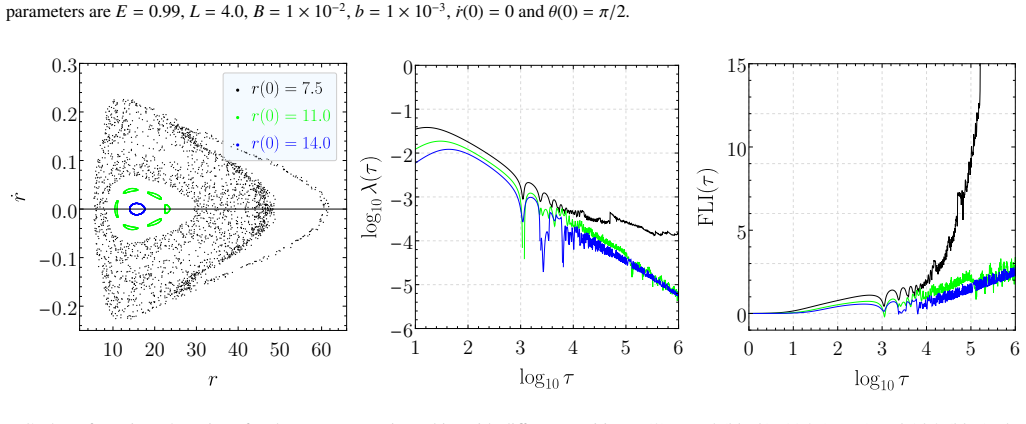
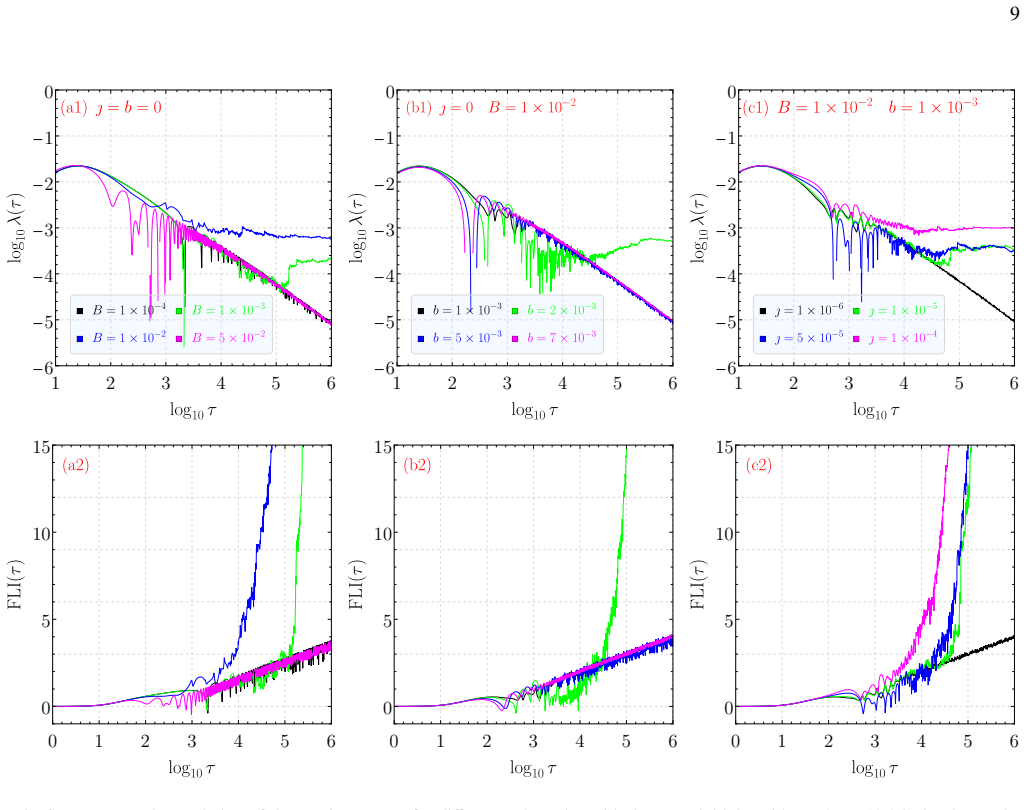
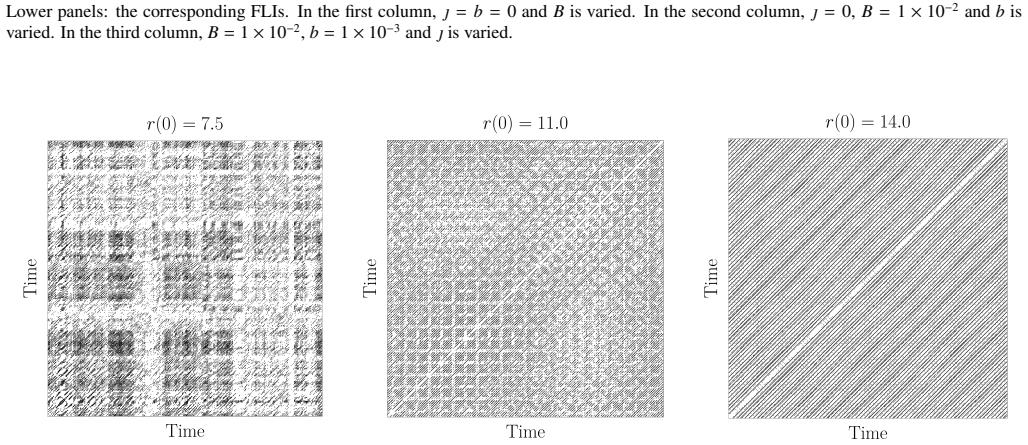
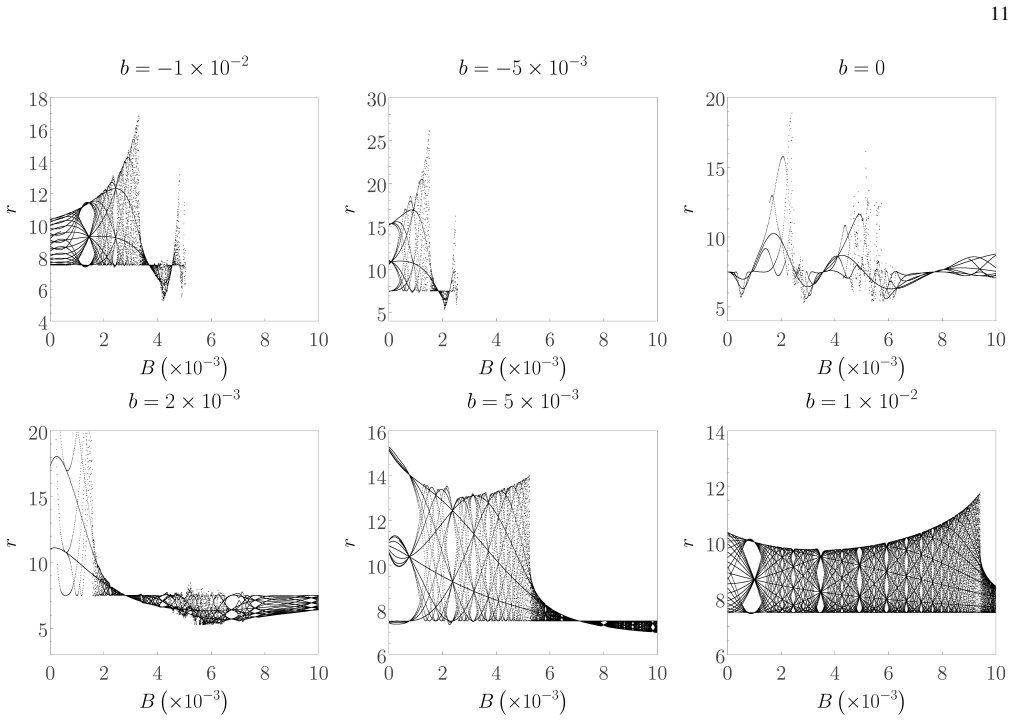
The central claim is that chaotic motion can already appear in the non-swirling Schwarzschild-Bertotti-Robinson black hole. This indicates that the swirling background is not a necessary condition for chaos in this family of spacetimes; it mainly shifts the parameter region where chaos occurs. The effects of the two electromagnetic fields are complicated, and the existence of bound orbits is strongly restricted by their strengths and relative direction. Chaotic motion is associated with the nonlinear interaction between the accessible phase space, the electromagnetic backreaction and the swirling deformation.
What carries the argument
The swirling Bertotti-Robinson-Bonnor-Melvin electromagnetic background, whose non-swirling limit already permits chaotic orbits when combined with the Schwarzschild geometry.
If this is right
- Bound orbits remain possible only within limited ranges of the two electromagnetic field strengths and their relative direction.
- The swirling deformation shifts the location of chaotic regions in parameter space but does not create them.
- Nonlinear coupling between electromagnetic backreaction and accessible phase space is sufficient to produce chaos in this spacetime family.
Where Pith is reading between the lines
- Similar numerical searches could reveal whether chaos appears in other non-swirling charged black-hole backgrounds without any additional deformation.
- The restriction on bound orbits may limit the longevity of equatorial disks or rings in such electromagnetic environments.
- The same diagnostics could be applied to slowly rotating versions of the metric to test whether frame-dragging enlarges or suppresses the chaotic zones.
Load-bearing premise
The chosen numerical indicators correctly identify genuine chaotic behavior rather than numerical artifacts or incomplete sampling of the phase space.
What would settle it
Absence of chaos in the non-swirling metric when the same initial conditions are integrated with higher-precision methods or denser phase-space sampling would falsify the claim.
Figures
read the original abstract
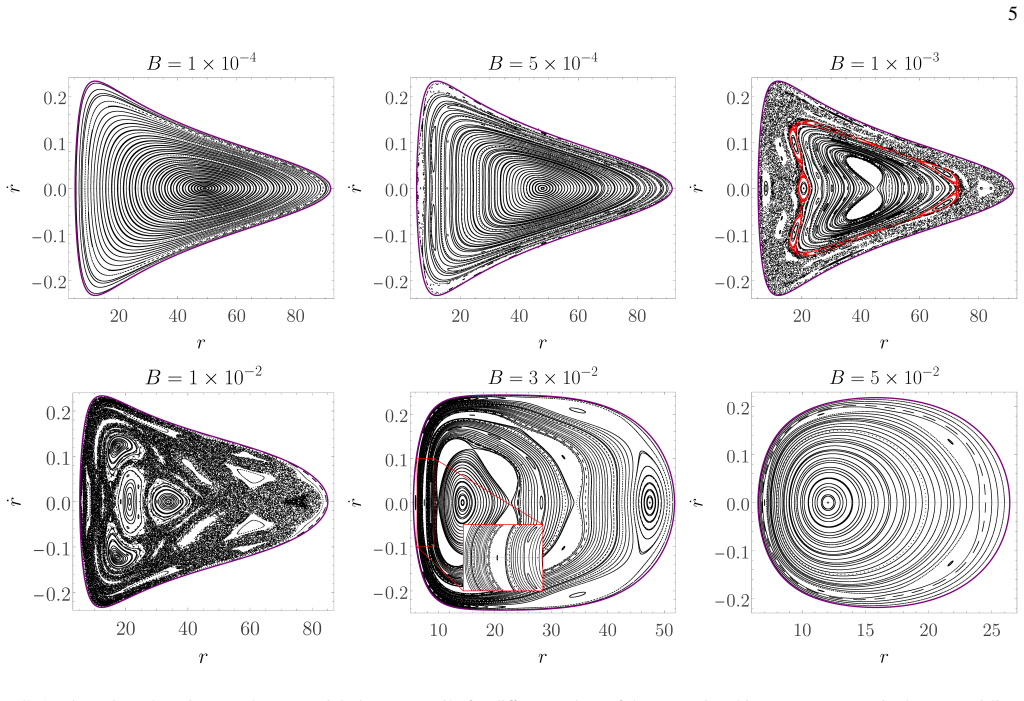
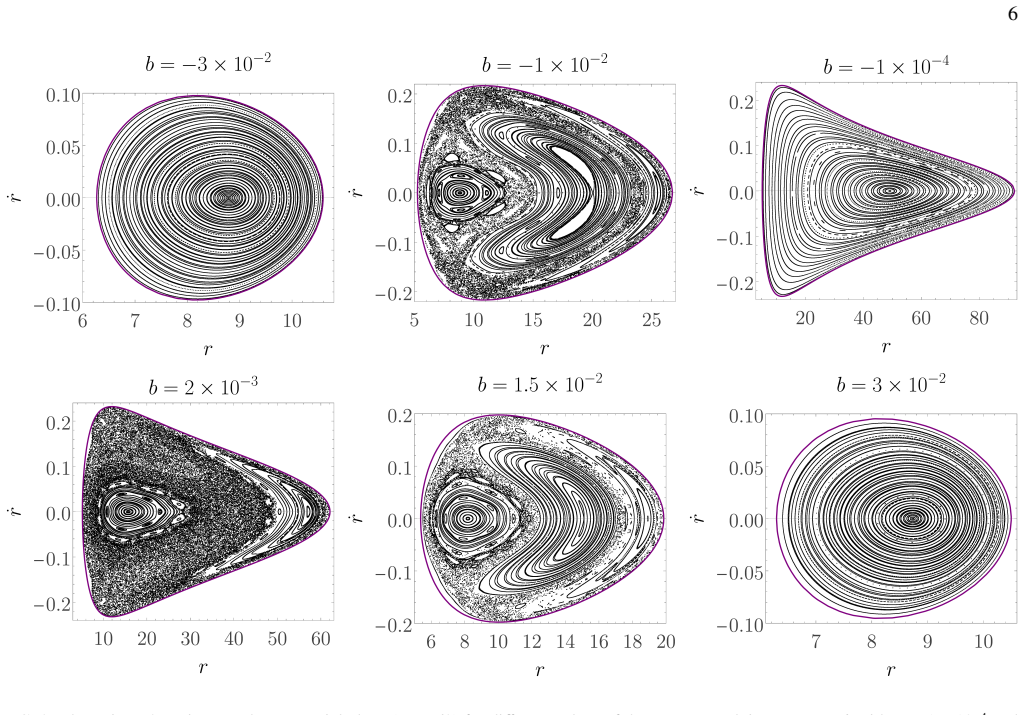
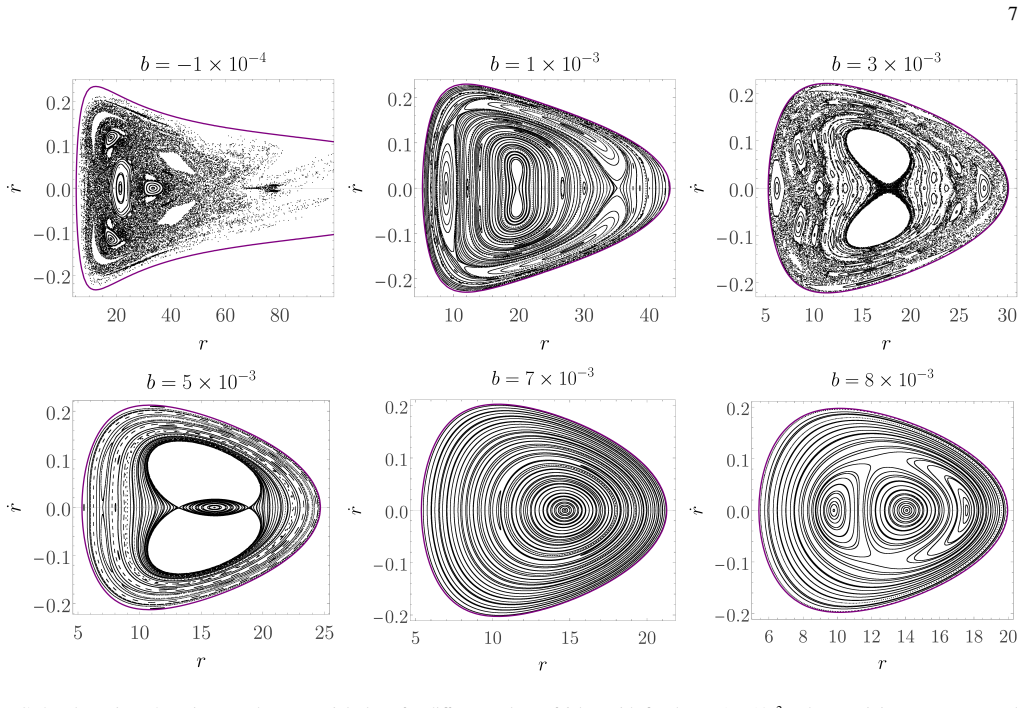
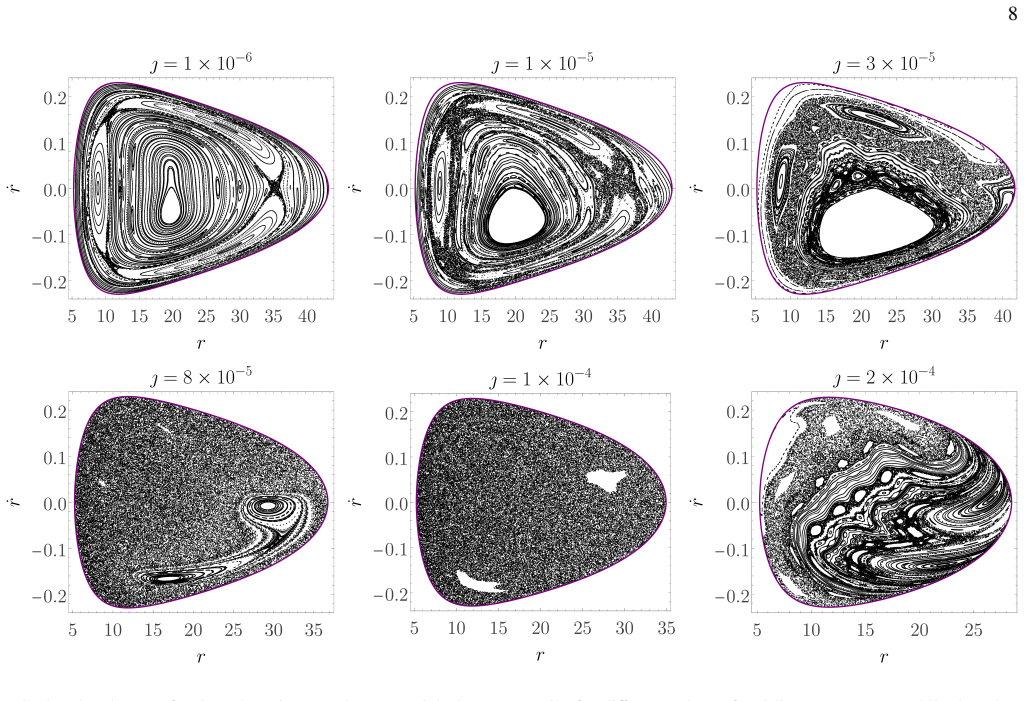
We investigate the particle motion around a Schwarzschild black hole immersed in a swirling Bertotti-Robinson-Bonnor-Melvin background. This spacetime provides a physically well-motivated framework for studying how the two different electromagnetic components and the swirling deformation affect particle dynamics near compact objects. By employing Poincar\'{e} sections, the maximum Lyapunov exponent, the Fast Lyapunov indicator, recurrence analysis and bifurcation diagrams, we show that chaotic motion can already appear in the non-swirling Schwarzschild-Bertotti-Robinson black hole. This indicates that the swirling background is not a necessary condition for chaos in this family of spacetimes, it mainly shifts the parameter region where chaos occurs. We further find that the effects of the two electromagnetic fields are very complicated. In particular, the existence of bound orbits is strongly restricted by the strengths of the two electromagnetic fields and their relative direction. These results provide rich numerical evidence that the chaotic motion of particles is associated with the nonlinear interaction between the accessible phase space, the electromagnetic backreaction and the swirling deformation.
Editorial analysis
A structured set of objections, weighed in public.
Referee Report
Summary. The manuscript examines geodesic motion of test particles in the spacetime of a Schwarzschild black hole embedded in a swirling Bertotti-Robinson-Bonnor-Melvin electromagnetic background. Employing Poincaré sections, maximum Lyapunov exponents, Fast Lyapunov indicators, recurrence plots and bifurcation diagrams, the authors conclude that chaotic orbits already exist in the non-swirling Schwarzschild-Bertotti-Robinson limit; the swirling deformation merely shifts the parameter region of chaos. They further report that the two electromagnetic field strengths and their relative orientation impose strong restrictions on the existence of bound orbits.
Significance. If the numerical diagnostics are free of integration artifacts, the result establishes that electromagnetic nonlinearities alone suffice to produce chaos in this family of exact solutions, without requiring the swirling deformation. The deployment of five complementary indicators on the same phase-space slices constitutes a methodological strength that would, if validated, make the parameter-shift claim falsifiable and reproducible.
major comments (2)
- [Numerical methods] Numerical methods section: no information is supplied on the integrator (e.g., Runge-Kutta order), adaptive step-size tolerance, total integration time, or energy-conservation monitor used to compute the maximum Lyapunov exponent and Fast Lyapunov indicator. In an electromagnetic metric whose effective potential contains two independent field strengths, uncontrolled truncation errors can generate spurious positive Lyapunov exponents; this directly undermines the central claim that chaos is present in the non-swirling case.
- [§4] §4 (results on non-swirling case): the Poincaré sections and recurrence plots for the Schwarzschild-Bertotti-Robinson limit are presented without a control run at vanishing electromagnetic fields or a comparison against an independent covariant Lyapunov formulation. Without such cross-checks the reported onset of chaos cannot be distinguished from numerical artifacts.
minor comments (2)
- [Figures] Figure captions should explicitly state the integration time and sampling density used for each Poincaré section and recurrence plot.
- [Abstract] The abstract states that the swirling background 'mainly shifts the parameter region'; this phrasing should be replaced by a quantitative statement (e.g., 'shifts the critical electromagnetic strength by a factor of …') once the parameter scans are fully documented.
Simulated Author's Rebuttal
We thank the referee for the careful reading and constructive comments on numerical validation. The points raised are important for ensuring the reliability of the chaos diagnostics. We address each major comment below and will revise the manuscript accordingly to strengthen the presentation.
read point-by-point responses
-
Referee: [Numerical methods] Numerical methods section: no information is supplied on the integrator (e.g., Runge-Kutta order), adaptive step-size tolerance, total integration time, or energy-conservation monitor used to compute the maximum Lyapunov exponent and Fast Lyapunov indicator. In an electromagnetic metric whose effective potential contains two independent field strengths, uncontrolled truncation errors can generate spurious positive Lyapunov exponents; this directly undermines the central claim that chaos is present in the non-swirling case.
Authors: We agree that the numerical methods section requires additional detail to allow full reproducibility and to address concerns about possible artifacts. In the revised manuscript we will specify the integrator (fourth-order Runge-Kutta with adaptive step-size control), the adopted tolerances (relative and absolute tolerances of 10^{-12}), the integration durations employed for each diagnostic, and the energy-conservation monitor, which keeps the relative Hamiltonian error below 10^{-10} for all trajectories. These additions will directly support the robustness of the positive Lyapunov exponents reported in the non-swirling Schwarzschild-Bertotti-Robinson limit. revision: yes
-
Referee: [§4] §4 (results on non-swirling case): the Poincaré sections and recurrence plots for the Schwarzschild-Bertotti-Robinson limit are presented without a control run at vanishing electromagnetic fields or a comparison against an independent covariant Lyapunov formulation. Without such cross-checks the reported onset of chaos cannot be distinguished from numerical artifacts.
Authors: We accept that explicit control checks strengthen the claim. In the revision we will add a short discussion (and, if space permits, a supplementary panel) showing that our numerical setup recovers regular motion in the pure Schwarzschild limit (vanishing electromagnetic fields) and that chaos appears only once the field strengths are turned on, thereby demonstrating the transition within the same code. A fully covariant Lyapunov formulation would constitute an independent and valuable cross-check; however, its implementation lies outside the scope of the present work. We will instead emphasize that the consistency of five independent indicators (Poincaré sections, maximum Lyapunov exponent, Fast Lyapunov indicator, recurrence plots and bifurcation diagrams) applied to identical phase-space slices already provides substantial protection against integration artifacts. revision: partial
Circularity Check
No circularity in purely numerical chaos study
full rationale
The paper is a numerical investigation of geodesic motion in a fixed spacetime metric, employing standard indicators (Poincaré sections, Lyapunov exponents, recurrence plots, bifurcation diagrams) to map parameter regions for chaos. No analytic derivation chain exists that reduces a claimed prediction to a fitted input or self-citation by construction. The central observation—that chaos appears without the swirling term—is a direct computational result, not a self-definitional or renamed empirical pattern. No load-bearing self-citations or uniqueness theorems are invoked to force the outcome. The study is therefore self-contained against external benchmarks.
Axiom & Free-Parameter Ledger
axioms (2)
- domain assumption The spacetime is exactly the given swirling Bertotti-Robinson-Bonnor-Melvin metric superimposed on Schwarzschild.
- standard math Standard geodesic equations govern the particle motion in this spacetime.
Reference graph
Works this paper leans on
-
[1]
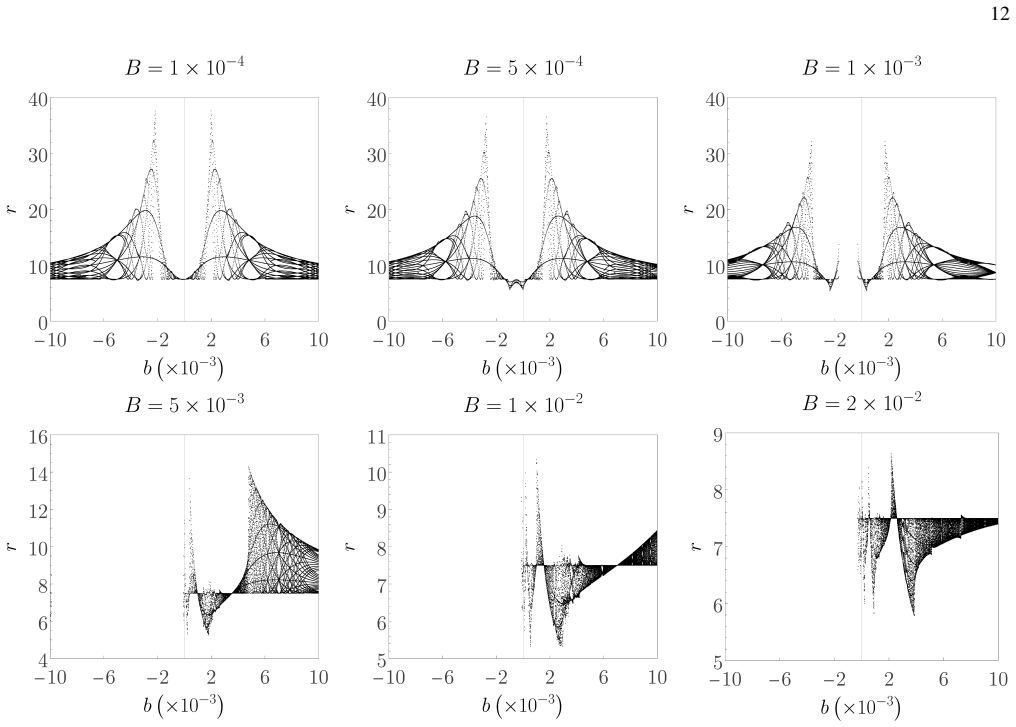
First, we chooseB=1×10 −4, because the spacetime is still close to integrable atb=0 and stable bound orbits exist over a wide interval of both negative and positive values. Fig. 2 shows the corresponding Poincaré sections for several repre- sentativeb, while the remaining parameters are kept the same as before. Starting from a regular configuration at suf...
-
[2]
Chaos in Dynamical Systems,
E. Ott, “Chaos in Dynamical Systems,” Cambridge University Press, 2nd Edition (2002)
2002
-
[3]
Chaotic dynamics of nonlinear systems,
S. N. Rasband, “Chaotic dynamics of nonlinear systems,” Courier Dover Publications (2015)
2015
-
[4]
Global structure of the Kerr family of gravitational fields,
B. Carter, “Global structure of the Kerr family of gravitational fields,” Phys. Rev.174, 1559-1571 (1968)
1968
-
[5]
Chaos around a black hole,
L. Bombelli and E. Calzetta, “Chaos around a black hole,” Class. Quant. Grav.9, 2573-2599 (1992)
1992
-
[6]
Chaos in black holes surrounded by gravitational waves
P. S. Letelier and W. M. Vieira, “Chaos in black holes sur- rounded by gravitational waves,” Class. Quant. Grav.14, 1249- 1257 (1997). [arXiv:gr-qc/9706025 [gr-qc]]
work page internal anchor Pith review Pith/arXiv arXiv 1997
-
[7]
Chaos in black holes sur- rounded by electromagnetic fields,
M. Santoprete and G. Cicogna, “Chaos in black holes sur- rounded by electromagnetic fields,” Gen. Rel. Grav.34, 1107- 1119 (2002). [arXiv:nlin/0110046 [nlin.CD]]
-
[8]
Universality in Chaos of Particle Motion near Black Hole Horizon
K. Hashimoto and N. Tanahashi, “Universality in Chaos of Par- ticle Motion near Black Hole Horizon,” Phys. Rev. D95, no.2, 024007 (2017). [arXiv:1610.06070 [hep-th]]
work page internal anchor Pith review Pith/arXiv arXiv 2017
-
[9]
Presence of horizon makes particle motion chaotic
S. Dalui, B. R. Majhi and P. Mishra, “Presence of horizon makes particle motion chaotic,” Phys. Lett. B788, 486-493 (2019). [arXiv:1803.06527 [gr-qc]]
work page internal anchor Pith review Pith/arXiv arXiv 2019
-
[10]
Chaotic dynamics in extremal black holes: A challenge to the chaos bound,
S. Dalui, C. Singha and K. Bhattacharya, “Chaotic dynamics in extremal black holes: A challenge to the chaos bound,” Phys. Lett. B874, 140256 (2026). [arXiv:2602.04423 [gr-qc]]
-
[11]
Chaotic motion of test particles in the Ernst space-time,
V . Karas and D. V okrouhlický, “Chaotic motion of test particles in the Ernst space-time,” Gen. Relativ. Gravit.24, 729 (1992)
1992
-
[12]
Fractal basins and chaotic trajectories in multi-black hole space-times
C. P. Dettmann, N. E. Frankel and N. J. Cornish, “Fractal basins and chaotic trajectories in multi-black hole space-times,” Phys. Rev. D50, R618-R621 (1994). [arXiv:gr-qc/9402027 [gr-qc]]
work page internal anchor Pith review Pith/arXiv arXiv 1994
-
[13]
Chaos in Static Axisymmetric Spacetimes I : Vacuum Case
Y . Sota, S. Suzuki and K. i. Maeda, “Chaos in static axisym- metric space-times. 1: Vacuum case,” Class. Quant. Grav.13, 1241-1260 (1996). [arXiv:gr-qc/9505036 [gr-qc]]
work page internal anchor Pith review Pith/arXiv arXiv 1996
-
[14]
Chaos around a H\'enon-Heiles-inspired exact perturbation of a black hole
W. M. Vieira and P. S. Letelier, “Chaos around a Henon-Heiles inspired exact perturbation of a black hole,” Phys. Rev. Lett.76, 1409-1412 (1996). [arXiv:gr-qc/9604037 [gr-qc]]
work page internal anchor Pith review Pith/arXiv arXiv 1996
-
[15]
Chaotic scattering around black holes
J. M. Aguirregabiria, “Chaotic scattering around black holes,” Phys. Lett. A224, 234-238 (1997). [arXiv:gr-qc/9604032 [gr- qc]]
work page internal anchor Pith review Pith/arXiv arXiv 1997
-
[16]
Geodesic chaos around quadrupo- lar deformed centers of attraction,
E. Gueron and P. S. Letelier, “Geodesic chaos around quadrupo- lar deformed centers of attraction,” Phys. Rev. E66, 046611 (2002)
2002
-
[17]
Chaotic dynamics around astrophysical objects with non- isotropic stresses,
F. L. Dubeibe, L. A. Pachon and J. D. Sanabria-Gomez, “Chaotic dynamics around astrophysical objects with non- isotropic stresses,” Phys. Rev. D75, 023008 (2007). [arXiv:gr- qc/0701065 [gr-qc]]
-
[18]
Free motion around black holes with discs or rings: between integrability and chaos - I
O. Semerák and P. Suková, “Free motion around black holes with discs or rings: between integrability and chaos - I,” Mon. Not. Roy. Astron. Soc.404, 545-574 (2010). [arXiv:1211.4106 [gr-qc]]
work page internal anchor Pith review Pith/arXiv arXiv 2010
-
[19]
Orbits in a non-Kerr Dynamical System
G. Contopoulos, G. Lukes-Gerakopoulos and T. A. Aposto- latos, “Orbits in a non-Kerr Dynamical System,” Int. J. Bifurc. Chaos21, 2261-2277 (2011). [arXiv:1108.5057 [gr-qc]]
work page internal anchor Pith review Pith/arXiv arXiv 2011
-
[20]
Free motion around black holes with discs or rings: between integrability and chaos - II
O. Semerák and P. Suková, “Free motion around black holes with discs or rings: between integrability and chaos - II,” Mon. Not. Roy. Astron. Soc.425, 2455-2476 (2012). [arXiv:1211.4107 [gr-qc]]
work page internal anchor Pith review Pith/arXiv arXiv 2012
-
[21]
Free motion around black holes with discs or rings: between integrability and chaos - III
P. Suková and O. Semerák, “Free motion around black holes with discs or rings: between integrability and chaos - III,” Mon. Not. Roy. Astron. Soc.436, 978-996 (2013). [arXiv:1308.4306 [gr-qc]]
work page internal anchor Pith review Pith/arXiv arXiv 2013
-
[22]
Non-Linear Effects in Non-Kerr spacetimes
G. Lukes-Gerakopoulos, G. Contopoulos and T. A. Aposto- latos, “Non-Linear Effects in Non-Kerr spacetimes,” Springer Proc. Phys.157, 129-136 (2014). [arXiv:1408.4697 [gr-qc]]
work page internal anchor Pith review Pith/arXiv arXiv 2014
-
[23]
Free motion around black holes with discs or rings: between integrability and chaos -- IV
V . Witzany, O. Semerák and P. Suková, “Free motion around black holes with discs or rings: between integrability and chaos – IV ,” Mon. Not. Roy. Astron. Soc.451, no.2, 1770-1794 (2015). [arXiv:1503.09077 [astro-ph.HE]]
work page internal anchor Pith review Pith/arXiv arXiv 2015
-
[24]
Chaotic motion of particles in the accelerating and rotating black holes spacetime
S. Chen, M. Wang and J. Jing, “Chaotic motion of particles in the accelerating and rotating black holes spacetime,” JHEP09, 082 (2016). [arXiv:1604.02785 [gr-qc]]
work page internal anchor Pith review Pith/arXiv arXiv 2016
-
[25]
Chaotic motion of neutral and charged particles in the magnetized Ernst-Schwarzschild spacetime
D. Li and X. Wu, “Chaotic motion of neutral and charged par- ticles in a magnetized Ernst-Schwarzschild spacetime,” Eur. Phys. J. Plus134, no.3, 96 (2019). [arXiv:1803.02119 [gr-qc]]
work page internal anchor Pith review Pith/arXiv arXiv 2019
-
[26]
Free motion around black holes with discs or rings: between integrability and chaos -- V
L. Polcar, P. Suková and O. Semerák, “Free Motion around Black Holes with Disks or Rings: Between Integrabil- ity and Chaos–V ,” Astrophys. J.877, no.1, 16 (2019). [arXiv:1905.07646 [astro-ph.HE]]
work page internal anchor Pith review Pith/arXiv arXiv 2019
-
[27]
A. Bera, S. Dalui, S. Ghosh and E. C. Vagenas, “Quantum cor- rections enhance chaos: Study of particle motion near a gen- eralized Schwarzschild black hole,” Phys. Lett. B829, 137033 (2022). [arXiv:2109.00330 [gr-qc]]
-
[28]
W. Sun, Y . Wang, F. Liu and X. Wu, “Applying explicit sym- plectic integrator to study chaos of charged particles around magnetized Kerr black hole,” Eur. Phys. J. C81, no.9, 785 (2021). [arXiv:2109.02295 [gr-qc]]
-
[29]
H. Zhang, N. Zhou, W. Liu and X. Wu, “Charged Particle Motions near Non-Schwarzschild Black Holes with External Magnetic Fields in Modified Theories of Gravity,” Universe7, no.12, 488 (2021). [arXiv:2112.05915 [gr-qc]]
-
[30]
A. Deich, A. Cárdenas-Avendaño and N. Yunes, “Chaos in quadratic gravity,” Phys. Rev. D106, no.2, 024040 (2022). [arXiv:2203.00524 [gr-qc]]
-
[31]
Impact of electric charges on chaos in magnetized Reissner–Nordström spacetimes,
D. Yang, W. Liu and X. Wu, “Impact of electric charges on chaos in magnetized Reissner–Nordström spacetimes,” Eur. Phys. J. C83, no.5, 357 (2023). [arXiv:2305.02702 [gr-qc]]
-
[32]
W. Cao, X. Wu and J. Lyu, “Electromagnetic field and chaotic charged-particle motion around hairy black holes in Horndeski gravity,” Eur. Phys. J. C84, no.4, 435 (2024). [arXiv:2404.19225 [gr-qc]]
-
[33]
Chaotic mo- tion of particles in the spacetime of a Kerr black hole immersed in swirling universes,
D. Cao, L. Zhang, S. Chen, Q. Pan and J. Jing, “Chaotic mo- tion of particles in the spacetime of a Kerr black hole immersed in swirling universes,” Eur. Phys. J. C85, no.1, 28 (2025). [arXiv:2410.03214 [gr-qc]]
-
[34]
Chaos dynamics of charged particles near Gibbons-Maeda-Garfinkle-Horowitz- Strominger black holes,
Z. M. Xu, D. Z. Ma and K. Li, “Chaos dynamics of charged particles near Gibbons-Maeda-Garfinkle-Horowitz- Strominger black holes,” Nucl. Phys. B1021, 117199 (2025). [arXiv:2507.18879 [hep-th]]
-
[35]
J. Lu and X. Wu, “Chaos of charged particles near a renor- malized group improved Kerr black hole in an external magnetic field,” Eur. Phys. J. C85, no.10, 1122 (2025). [arXiv:2510.08954 [gr-qc]]
-
[36]
D. Cao, L. Zhang, S. Chen, Q. Pan and J. Jing, “Chaotic mo- tion of particles around a dyonic Kerr–Newman black hole im- mersed in the Melvin-swirling universe,” Eur. Phys. J. C85, no.11, 1250 (2025) [arXiv:2511.08415 [gr-qc]]
-
[37]
Third type of spacetime with the coexistence of integrability and non-integrability,
J. Lu and X. Wu, “Third type of spacetime with the coexistence of integrability and non-integrability,” Eur. Phys. J. C86, no.3, 256 (2026). [arXiv:2603.12674 [gr-qc]]
-
[38]
Chaos in Schwarzschild Spacetime : The Motion of a Spinning Particle
S. Suzuki and K. i. Maeda, “Chaos in Schwarzschild space- time: The motion of a spinning particle,” Phys. Rev. D55, 4848-4859 (1997). [arXiv:gr-qc/9604020 [gr-qc]]
work page internal anchor Pith review Pith/arXiv arXiv 1997
-
[39]
Dynamics of spinning test particles in Kerr spacetime
M. D. Hartl, “Dynamics of spinning test particles in Kerr space- time,” Phys. Rev. D67, 024005 (2003). [arXiv:gr-qc/0210042 16 [gr-qc]]
work page internal anchor Pith review Pith/arXiv arXiv 2003
-
[40]
A Survey of spinning test particle orbits in Kerr space-time,
M. D. Hartl, “A Survey of spinning test particle orbits in Kerr space-time,” Phys. Rev. D67, 104023 (2003). [arXiv:gr- qc/0302103 [gr-qc]]
-
[41]
The Onset of Chaotic Motion of a Spinning Particle around the Schwarzchild Black Hole
J. K. Kao and H. T. Cho, “The Onset of chaotic motion of a spinning particle around the Schwarzchild black hole,” Phys. Lett. A336, 159-166 (2005). [arXiv:gr-qc/0406101 [gr-qc]]
work page internal anchor Pith review Pith/arXiv arXiv 2005
-
[42]
Chaos and dynamics of spinning particles in Kerr spacetime
W. Han, “Chaos and dynamics of spinning particles in Kerr spacetime,” Gen. Rel. Grav.40, 1831-1847 (2008). [arXiv:1006.2229 [gr-qc]]
work page internal anchor Pith review Pith/arXiv arXiv 2008
-
[43]
Chaotic orbits for spinning particles in Schwarzschild spacetime
C. Verhaaren and E. W. Hirschmann, “Chaotic orbits for spin- ning particles in Schwarzschild spacetime,” Phys. Rev. D81, 124034 (2010). [arXiv:0912.0031 [gr-qc]]
work page internal anchor Pith review Pith/arXiv arXiv 2010
-
[44]
The dynamics of a spinning particle in a linear in spin Hamiltonian approximation
G. Lukes-Gerakopoulos, M. Katsanikas, P. A. Patsis and J. Seyrich, “The dynamics of a spinning particle in a linear in spin Hamiltonian approximation,” Phys. Rev. D94, no.2, 024024 (2016). [arXiv:1606.09171 [gr-qc]]
work page internal anchor Pith review Pith/arXiv arXiv 2016
-
[45]
Growth of resonances and chaos for a spinning test particle in the Schwarzschild background,
O. Zelenka, G. Lukes-Gerakopoulos, V . Witzany and O. Kopáˇcek, “Growth of resonances and chaos for a spinning test particle in the Schwarzschild background,” Phys. Rev. D 101, no.2, 024037 (2020). [arXiv:1911.00414 [gr-qc]]
-
[46]
D. D. Yuan, J. G. Jiao, Y . Q. Lei, J. X. Shi, J. Q. Lai, C. Shao and Y . Tian, “Astrophysically Realistic Secondary Spins Trig- ger Chaos in Schwarzschild Spacetime and Discernible Gravi- tational Wave Signatures,” [arXiv:2604.20533 [gr-qc]]
work page internal anchor Pith review Pith/arXiv arXiv
-
[47]
M. Shahzadi, M. Kolos, O. Zelenka and G. Lukes- Gerakopoulos, “Spinning charged test particle dynamics around a Schwarzschild black hole embedded in a homogeneous mag- netic field,” [arXiv:2605.02084 [gr-qc]]
work page internal anchor Pith review Pith/arXiv arXiv
-
[48]
Chaotic Scattering and Capture of Strings by Black Hole
A. V . Frolov and A. L. Larsen, “Chaotic scattering and capture of strings by black hole,” Class. Quant. Grav.16, 3717-3724 (1999). [arXiv:gr-qc/9908039 [gr-qc]]
work page internal anchor Pith review Pith/arXiv arXiv 1999
-
[49]
Chaos in the Gauge/Gravity Correspondence
L. A. Pando Zayas and C. A. Terrero-Escalante, “Chaos in the Gauge/Gravity Correspondence,” JHEP09, 094 (2010). [arXiv:1007.0277 [hep-th]]
work page internal anchor Pith review Pith/arXiv arXiv 2010
-
[50]
Chaos in Geodesic Motion around a Black Ring
T. Igata, H. Ishihara and Y . Takamori, “Chaos in Geodesic Mo- tion around a Black Ring,” Phys. Rev. D83, 047501 (2011). [arXiv:1012.5725 [hep-th]]
work page internal anchor Pith review Pith/arXiv arXiv 2011
-
[51]
Chaos from the ring string in Gauss-Bonnet black hole in $AdS_5$ space
D. Z. Ma, J. P. Wu and J. Zhang, “Chaos from the ring string in a Gauss-Bonnet black hole in AdS5 space,” Phys. Rev. D89, no.8, 086011 (2014). [arXiv:1405.3563 [hep-th]]
work page internal anchor Pith review Pith/arXiv arXiv 2014
-
[52]
Chaotic dynamics of string around charged black brane with hyperscaling violation,
D. Z. Ma, D. Zhang, G. Fu and J. P. Wu, “Chaotic dynamics of string around charged black brane with hyperscaling violation,” JHEP01, 103 (2020). [arXiv:1911.09913 [hep-th]]
-
[53]
Chaotic particle motion around a homogeneous circular ring,
T. Igata, “Chaotic particle motion around a homogeneous circular ring,” Phys. Rev. D102, no.4, 044019 (2020). [arXiv:2006.05052 [gr-qc]]
-
[54]
Chaotic dynamics of string around the conformal black hole,
D. Z. Ma, F. Xia, D. Zhang, G. Y . Fu and J. P. Wu, “Chaotic dynamics of string around the conformal black hole,” Eur. Phys. J. C82, no.4, 372 (2022). [arXiv:2205.00226 [hep-th]]
-
[55]
M. Wang, S. Chen and J. Jing, “Chaos in the motion of a test scalar particle coupling to the Einstein tensor in Schwarzschild–Melvin black hole spacetime,” Eur. Phys. J. C 77, no.4, 208 (2017). [arXiv:1605.09506 [gr-qc]]
work page internal anchor Pith review Pith/arXiv arXiv 2017
-
[56]
Chaotic motion of scalar particle coupling to Chern–Simons invariant in Kerr black hole space- time,
X. Zhou, S. Chen and J. Jing, “Chaotic motion of scalar particle coupling to Chern–Simons invariant in Kerr black hole space- time,” Eur. Phys. J. C81, no.3, 233 (2021). [arXiv:2007.14575 [gr-qc]]
-
[57]
L. Zhang, S. Chen, Q. Pan and J. Jing, “Chaotic motion of scalar particle coupling to Chern-Simons invariant in the stationary axisymmetric Einstein-Maxwell dilaton black hole spacetime,” Eur. Phys. J. C83, no.9, 828 (2023). [arXiv:2309.12604 [gr- qc]]
-
[58]
Chaos in charged AdS black hole extended phase space
M. Chabab, H. El Moumni, S. Iraoui, K. Masmar and S. Zhizeh, “Chaos in charged AdS black hole extended phase space,” Phys. Lett. B781, 316-321 (2018). [arXiv:1804.03960 [hep-th]]
work page internal anchor Pith review Pith/arXiv arXiv 2018
-
[59]
Chaos in Charged Gauss-Bonnet AdS Black Holes in Extended Phase Space
S. Mahish and B. Chandrasekhar, “Chaos in Charged Gauss- Bonnet AdS Black Holes in Extended Phase Space,” Phys. Rev. D99, no.10, 106012 (2019). [arXiv:1902.08932 [hep-th]]
work page internal anchor Pith review Pith/arXiv arXiv 2019
-
[60]
Chaos of particle motion near a black hole with quasitopological electromagnetism,
Y . Q. Lei, X. H. Ge and C. Ran, “Chaos of particle motion near a black hole with quasitopological electromagnetism,” Phys. Rev. D104, no.4, 046020 (2021). [arXiv:2008.01384 [hep-th]]
-
[61]
Y . Q. Lei, X. H. Ge and S. Dalui, “Thermodynamic stability versus chaos bound violation in D-dimensional RN black holes: Angular momentum effects and phase transitions,” Phys. Lett. B856, 138929 (2024). [arXiv:2404.18193 [hep-th]]
-
[62]
A strong magnetic field around the supermassive black hole at the centre of the Galaxy
R. P. Eatoughet al.“A strong magnetic field around the super- massive black hole at the centre of the Galaxy,” Nature501, 391-394 (2013). [arXiv:1308.3147 [gr-qc]]
work page internal anchor Pith review Pith/arXiv arXiv 2013
-
[63]
First M87 Event Horizon Telescope Results. I. The Shadow of the Supermassive Black Hole
K. Akiyamaet al.[Event Horizon Telescope], “First M87 Event Horizon Telescope Results. I. The Shadow of the Su- permassive Black Hole,” Astrophys. J. Lett.875, L1 (2019). [arXiv:1906.11238 [astro-ph.GA]]
work page internal anchor Pith review Pith/arXiv arXiv 2019
-
[64]
First M87 Event Horizon Telescope Results. VIII. Magnetic Field Structure near The Event Horizon,
K. Akiyamaet al.[Event Horizon Telescope], “First M87 Event Horizon Telescope Results. VIII. Magnetic Field Structure near The Event Horizon,” Astrophys. J. Lett.910, no.1, L13 (2021). [arXiv:2105.01173 [astro-ph.HE]]
-
[65]
K. Akiyamaet al.[Event Horizon Telescope], “First Sagittarius A* Event Horizon Telescope Results. I. The Shadow of the Su- permassive Black Hole in the Center of the Milky Way,” Astro- phys. J. Lett.930, no.2, L12 (2022). [arXiv:2311.08680 [astro- ph.HE]]
work page internal anchor Pith review Pith/arXiv arXiv 2022
-
[66]
Kerr Black Hole in a Uniform Bertotti-Robinson Magnetic Field: An Exact Solution,
J. Podolsky and H. Ovcharenko, “Kerr Black Hole in a Uniform Bertotti-Robinson Magnetic Field: An Exact Solution,” Phys. Rev. Lett.135, no.18, 181401 (2025). [arXiv:2507.05199 [gr- qc]]
-
[67]
Black holes in the external Bertotti-Robinson-Bonnor-Melvin electromagnetic field,
M. Astorino, “Black holes in the external Bertotti-Robinson- Bonnor-Melvin electromagnetic field,” Phys. Rev. D112, no.10, 104077 (2025). [arXiv:2508.12908 [gr-qc]]
-
[68]
Exact solutions of Einstein’s field equations,
H. Stephani, D. Kramer, M. MacCallum, C. Hoenselaers and E. Herlt, “Exact solutions of Einstein’s field equations,” Cam- bridge university press (2003)
2003
-
[69]
Exact space-times in Einstein’s general relativity,
J. B. Griffiths and J. Podolský, “Exact space-times in Einstein’s general relativity,” Cambridge university press (2009)
2009
-
[70]
New Formulation of the Axially Symmetric Gravi- tational Field Problem. II,
F. J. Ernst, “New Formulation of the Axially Symmetric Gravi- tational Field Problem. II,” Phys. Rev.168, 1415-1417 (1968)
1968
-
[71]
New Solutions of the Einstein-Maxwell Equa- tions from Old,
B. K. Harrison, “New Solutions of the Einstein-Maxwell Equa- tions from Old,” J. Math. Phys.9, no.11, 1744 (1968)
1968
-
[72]
Konstruktionen und Charakterisierung von Losun- gen der Einsteinschen Gravitationsfeldgleichungen,
J. Ehlers, “Konstruktionen und Charakterisierung von Losun- gen der Einsteinschen Gravitationsfeldgleichungen,” Phd the- sis, Hamburg University (1957)
1957
-
[73]
Static hairy black hole in 4D general relativity,
M. Astorino, “Static hairy black hole in 4D general relativity,” Phys. Rev. D113, no.2, 024047 (2026). [arXiv:2601.16254 [gr- qc]]
-
[74]
Comparison among Correction Methods of Individual Kepler Energies inn- Body Simulations,
X. Wu, T.-Y . Zhang, X.-S. Wan, and H. Zhang, “Comparison among Correction Methods of Individual Kepler Energies inn- Body Simulations,” Astrophys. J.113, 2643 (2007)
2007
-
[75]
Velocity scaling method to correct individual Kepler energies,
D.-Z. Ma, X. Wu, and J.-F. Zhu, “Velocity scaling method to correct individual Kepler energies,” New Astron.13, 216 (2008)
2008
-
[76]
Velocity corrections to Kepler energy and Laplace integral,
D.-Z. Ma, X. Wu, and F.-Y . Liu, “Velocity corrections to Kepler energy and Laplace integral,” Int. J. Mod. Phys. C19, 1411 (2008)
2008
-
[77]
Geodesics and shadows in the Kerr-Bertotti-Robinson black hole space- time,
X. Wang, Y . Hou, X. Wan, M. Guo and B. Chen, “Geodesics and shadows in the Kerr-Bertotti-Robinson black hole space- time,” JCAP02, 050 (2026). [arXiv:2507.22494 [gr-qc]]
-
[78]
Computation of Lyapunov Exponents in General Relativity
X. Wu and T. Y . Huang, “Computation of Lyapunov expo- nents in general relativity,” Phys. Lett. A313, 77-81 (2003). 17 [arXiv:gr-qc/0302118 [gr-qc]]
work page internal anchor Pith review Pith/arXiv arXiv 2003
-
[79]
Lyapunov indices with two nearby trajectories in a curved spacetime
X. Wu, T. Y . Huang and H. Zhang, “Lyapunov indices with two nearby trajectories in a curved spacetime,” Phys. Rev. D74, 083001 (2006). [arXiv:1006.5251 [gr-qc]]
work page internal anchor Pith review Pith/arXiv arXiv 2006
-
[80]
The fast Lyapunov in- dicator: a simple tool to detect weak chaos. Application to the structure of the main asteroidal belt,
C. Froeschlé, R. Gonczi and E. Lega, “The fast Lyapunov in- dicator: a simple tool to detect weak chaos. Application to the structure of the main asteroidal belt,” Planetary Space Sci.45, 881 (1997)
1997
discussion (0)
Sign in with ORCID, Apple, or X to comment. Anyone can read and Pith papers without signing in.