Decision-Making with Lightweight Confidence-Aware Language Model for Autonomous Driving
Pith reviewed 2026-06-29 21:58 UTC · model grok-4.3
The pith
A lightweight dual-head language model distilled from multi-agent CoT demonstrations achieves state-of-the-art closed-loop success rates on the nuPlan benchmark in both regular and long-tail scenarios while keeping inference latency low.
A machine-rendered reading of the paper's core claim, the machinery that carries it, and where it could break.
Core claim
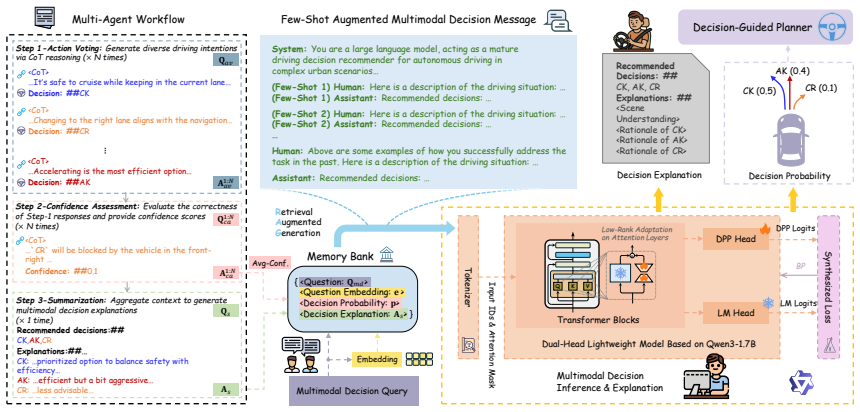
The central claim is that a multi-agent workflow of action voting, confidence assessment, and summarization agents can generate high-quality, confidence-annotated Chain-of-Thought decision demonstrations that, when distilled via confidence-aware fine-tuning and Retrieval Augmented Generation into a lightweight dual-head language model, enable joint prediction of decision probabilities and textual rationales, producing state-of-the-art success rates on the nuPlan benchmark in both regular and long-tail scenarios at low inference latency.
What carries the argument
The multi-agent collaborative workflow (action voting, confidence assessment, summarization) that produces confidence-annotated CoT demonstrations for distillation into the dual-head lightweight model.
If this is right
- The approach reaches state-of-the-art success rates in regular driving scenarios on nuPlan.
- The approach reaches state-of-the-art success rates in long-tail driving scenarios on nuPlan.
- Inference latency remains low enough for resource-constrained autonomous driving systems.
- Retrieval Augmented Generation improves the model's adaptability and data efficiency during fine-tuning.
- The dual-head design allows simultaneous output of action probabilities and textual rationales.
Where Pith is reading between the lines
- The same distillation pattern could be tested in other robotics domains that need both an action and a human-readable justification from a small model.
- Running the system on physical vehicles instead of simulation would test whether simulation-only demonstrations transfer without additional degradation.
- The per-decision confidence scores produced by the model could be monitored in real time to trigger fallback controllers when uncertainty rises.
Load-bearing premise
The demonstrations created by the multi-agent workflow are high enough in quality and accurately annotated with confidence that distillation into the smaller model preserves performance without major loss.
What would settle it
Closed-loop nuPlan experiments in which the distilled lightweight model either falls short of prior SOTA success rates in long-tail scenarios or shows inference latency too high for real-time control.
Figures
read the original abstract
Large Language Models (LLMs) and Multimodal LLMs (MLLMs) have demonstrated immense potential in autonomous driving (AD) by offering human-like reasoning and open-world generalization. However, the excessive computational overhead and high inference latency of these massive models severely hinder their deployment in resource-constrained AD systems. To address this challenge, we propose a novel decision-making framework utilizing a lightweight confidence-aware language model, which bridges the gap between complex multimodal intention reasoning and efficient inference. Specifically, we design a multi-agent collaborative workflow, comprising action voting, confidence assessment, and summarization agents, to generate high-quality, confidence-annotated decision demonstrations via explicit Chain-of-Thought (CoT) reasoning. These demonstrations are then distilled into a lightweight language model featuring a dual-head architecture, enabling the joint prediction of decision probabilities and the generation of textual rationales. The distillation is realized via a confidence-aware fine-tuning strategy coupled with Retrieval Augmented Generation (RAG) to enhance the model's adaptability and data efficiency. Comprehensive closed-loop experiments on the nuPlan benchmark demonstrate that our approach achieves state-of-the-art (SOTA) success rates in both regular and long-tail scenarios while maintaining low inference latency.
Editorial analysis
A structured set of objections, weighed in public.
Referee Report
Summary. The paper proposes a decision-making framework for autonomous driving that employs a multi-agent collaborative workflow (action voting, confidence assessment, summarization) to generate high-quality, confidence-annotated decision demonstrations via explicit Chain-of-Thought reasoning. These demonstrations are distilled into a lightweight dual-head language model that jointly predicts decision probabilities and generates textual rationales, using a confidence-aware fine-tuning strategy combined with Retrieval Augmented Generation (RAG). Closed-loop experiments on the nuPlan benchmark are claimed to achieve state-of-the-art success rates in both regular and long-tail scenarios while maintaining low inference latency.
Significance. If the empirical claims hold with proper validation, the work could meaningfully advance efficient deployment of reasoning-capable models in resource-constrained autonomous driving systems by reducing inference overhead while preserving open-world generalization and safety-critical performance.
major comments (1)
- [Abstract] Abstract: the central claim of achieving SOTA success rates on nuPlan is asserted without any quantitative metrics, baselines, error bars, ablation results, or experimental details, rendering the primary performance contribution impossible to evaluate or verify from the provided manuscript text.
Simulated Author's Rebuttal
We thank the referee for their feedback. We address the concern about the abstract below and will revise the manuscript accordingly.
read point-by-point responses
-
Referee: [Abstract] Abstract: the central claim of achieving SOTA success rates on nuPlan is asserted without any quantitative metrics, baselines, error bars, ablation results, or experimental details, rendering the primary performance contribution impossible to evaluate or verify from the provided manuscript text.
Authors: We agree that the abstract, as currently written, asserts the SOTA claim without supporting numerical values or experimental details, which reduces its standalone verifiability. The full manuscript contains the requested information in the experiments section (closed-loop nuPlan results, baseline comparisons, regular vs. long-tail scenarios, latency measurements, and ablations). To address the referee's point directly, we will revise the abstract to incorporate key quantitative metrics, baseline references, and a brief mention of the evaluation protocol. revision: yes
Circularity Check
No significant circularity
full rationale
The paper describes an empirical framework for distilling multi-agent CoT demonstrations into a lightweight dual-head LM, evaluated via closed-loop nuPlan experiments. No equations, parameter fittings, derivations, or self-citation chains appear in the abstract or described methods. Claims rest on external benchmark performance rather than any reduction of outputs to inputs by construction. This is the common case of a self-contained empirical contribution with no load-bearing circular steps.
Axiom & Free-Parameter Ledger
Forward citations
Cited by 1 Pith paper
-
LUNA-AD: Lightweight Uncertainty-Aware Language Model with Lifelong Learning for Autonomous Driving
LUNA-AD introduces a tri-system model with multi-agent hypothesis exploration, distilled lightweight inference, and reflection-driven lifelong learning that claims state-of-the-art success rates on nuPlan benchmarks w...
Reference graph
Works this paper leans on
-
[1]
A survey of motion planning and control techniques for self-driving urban vehicles,
B. Paden, M. ˇC´ap, S. Z. Yong, D. Yershov, and E. Frazzoli, “A survey of motion planning and control techniques for self-driving urban vehicles,”IEEE Transactions on Intelligent Vehicles, vol. 1, no. 1, pp. 33–55, 2016
2016
-
[2]
Active interaction in driv- ing: An intention-aware decision-making for autonomous vehicles,
Y . Zhang, Y . Zhu, L. Xiong, and C. Tang, “Active interaction in driv- ing: An intention-aware decision-making for autonomous vehicles,” inthe Proceedings of IEEE International Conference on Intelligent Transportation Systems, 2024, pp. 2266–2271
2024
-
[3]
A safe hierarchical planning framework for complex driving scenarios based on reinforce- ment learning,
J. Li, L. Sun, J. Chen, M. Tomizuka, and W. Zhan, “A safe hierarchical planning framework for complex driving scenarios based on reinforce- ment learning,” inthe Proceedings of IEEE International Conference on Robotics and Automation, 2021, pp. 2660–2666
2021
-
[4]
Interactive decision-making integrating graph neural networks and model predictive control for autonomous driving,
K. Yang, S. Li, M. Wang, and X. Tang, “Interactive decision-making integrating graph neural networks and model predictive control for autonomous driving,”IEEE Transactions on Intelligent Transportation Systems, vol. 26, no. 5, pp. 6991 – 7005, 2025
2025
-
[5]
DiLu: A knowledge-driven approach to autonomous driv- ing with large language models,
L. Wen, D. Fu, X. Li, X. Cai, M. Tao, P. Cai, M. Dou, B. Shi, L. He, and Y . Qiao, “DiLu: A knowledge-driven approach to autonomous driv- ing with large language models,” inthe Proceedings of International Conference on Learning Representations, 2024
2024
-
[6]
Continuously learning, adapting, and improving: A dual-process approach to autonomous driving,
J. Mei, Y . Ma, X. Yang, L. Wen, X. Cai, X. Li, D. Fu, B. Zhang, P. Cai, M. Douet al., “Continuously learning, adapting, and improving: A dual-process approach to autonomous driving,”Advances in Neural Information Processing Systems, vol. 37, pp. 123 261–123 290, 2024
2024
-
[7]
Towards interactive and learnable cooperative driving automation: A large language model-driven decision-making framework,
S. Fang, J. Liu, M. Ding, Y . Cui, C. Lv, P. Hang, and J. Sun, “Towards interactive and learnable cooperative driving automation: A large language model-driven decision-making framework,”IEEE Transactions on Vehicular Technology, vol. 74, no. 8, pp. 11 894– 11 905, 2025
2025
-
[8]
A survey on multimodal large language models for autonomous driving,
C. Cui, Y . Ma, X. Cao, W. Ye, Y . Zhou, K. Liang, J. Chen, J. Lu, Z. Yang, K.-D. Liaoet al., “A survey on multimodal large language models for autonomous driving,” inthe Proceedings of the IEEE/CVF Winter Conference on Applications of Computer Vision, 2024, pp. 958– 979
2024
-
[9]
LanguageMPC: Large language models as decision makers for autonomous driving,
H. Sha, Y . Mu, Y . Jiang, L. Chen, C. Xu, P. Luo, S. E. Li, M. Tomizuka, W. Zhan, and M. Ding, “LanguageMPC: Large language models as decision makers for autonomous driving,”arXiv preprint arXiv:2310.03026, 2023
-
[10]
LMDrive: Closed-loop end-to-end driving with large language models,
H. Shao, Y . Hu, L. Wang, G. Song, S. L. Waslander, Y . Liu, and H. Li, “LMDrive: Closed-loop end-to-end driving with large language models,” inthe Proceedings of the IEEE/CVF Conference on Computer Vision and Pattern Recognition, 2024, pp. 15 120–15 130
2024
-
[11]
Senna: Bridging Large Vision-Language Models and End-to-End Autonomous Driving
B. Jiang, S. Chen, B. Liao, X. Zhang, W. Yin, Q. Zhang, C. Huang, W. Liu, and X. Wang, “Senna: Bridging large vision-language models and end-to-end autonomous driving,”arXiv preprint arXiv:2410.22313, 2024
work page internal anchor Pith review Pith/arXiv arXiv 2024
-
[12]
W. Liu, P. Liu, and J. Ma, “DSDrive: Distilling large language model for lightweight end-to-end autonomous driving with unified reasoning and planning,”arXiv preprint arXiv:2505.05360, 2025
-
[13]
Vtgnet: A vision-based trajectory generation network for autonomous vehicles in urban environments,
P. Cai, Y . Sun, H. Wang, and M. Liu, “Vtgnet: A vision-based trajectory generation network for autonomous vehicles in urban environments,” IEEE Transactions on Intelligent Vehicles, vol. 6, no. 3, pp. 419–429, 2020
2020
-
[14]
Desire: Distant future prediction in dynamic scenes with interacting agents,
N. Lee, W. Choi, P. Vernaza, C. B. Choy, P. H. Torr, and M. Chan- draker, “Desire: Distant future prediction in dynamic scenes with interacting agents,” inthe Proceedings of the IEEE/CVF Conference on Computer Vision and Pattern Recognition, 2017, pp. 336–345
2017
-
[15]
CALMM-Drive: Confidence-aware autonomous driving with large multimodal model,
R. Yao, Y . Wang, H. Liu, R. Yang, Z. Peng, L. Zhu, and J. Ma, “CALMM-Drive: Confidence-aware autonomous driving with large multimodal model,”arXiv preprint arXiv:2412.04209, 2024
-
[16]
H. Fu, D. Zhang, Z. Zhao, J. Cui, D. Liang, C. Zhang, D. Zhang, H. Xie, B. Wang, and X. Bai, “Orion: A holistic end-to-end au- tonomous driving framework by vision-language instructed action generation,”arXiv preprint arXiv:2503.19755, 2025
work page internal anchor Pith review Pith/arXiv arXiv 2025
-
[17]
Fast and slow thinking,
D. Kahneman, “Fast and slow thinking,”Allen Lane and Penguin Books, New York, 2011
2011
-
[18]
GPT-Driver: Learning to Drive with GPT
J. Mao, Y . Qian, J. Ye, H. Zhao, and Y . Wang, “GPT-Driver: Learning to drive with GPT,”arXiv preprint arXiv:2310.01415, 2023
work page internal anchor Pith review Pith/arXiv arXiv 2023
-
[19]
Drive like a human: Rethinking autonomous driving with large language models,
D. Fu, X. Li, L. Wen, M. Dou, P. Cai, B. Shi, and Y . Qiao, “Drive like a human: Rethinking autonomous driving with large language models,” inthe Proceedings of the IEEE/CVF Winter Conference on Applications of Computer Vision, 2024, pp. 910–919
2024
-
[20]
A Survey on Knowledge Distillation of Large Language Models
X. Xu, M. Li, C. Tao, T. Shen, R. Cheng, J. Li, C. Xu, D. Tao, and T. Zhou, “A survey on knowledge distillation of large language models,”arXiv preprint arXiv:2402.13116, 2024
work page internal anchor Pith review Pith/arXiv arXiv 2024
-
[21]
LeapV AD: A leap in autonomous driving via cognitive per- ception and dual-process thinking,
Y . Ma, T. Wei, N. Zhong, J. Mei, T. Hu, L. Wen, X. Yang, B. Shi, and Y . Liu, “LeapV AD: A leap in autonomous driving via cognitive per- ception and dual-process thinking,”arXiv preprint arXiv:2501.08168, 2025
-
[22]
GenAD: Generative end-to-end autonomous driving,
W. Zheng, R. Song, X. Guo, C. Zhang, and L. Chen, “GenAD: Generative end-to-end autonomous driving,” inthe Proceedings of European Conference on Computer Vision, 2024, pp. 87–104
2024
-
[23]
Diffusion-based planning for autonomous driving with flexible guidance,
Y . Zheng, R. Liang, K. Zheng, J. Zheng, L. Mao, J. Li, W. Gu, R. Ai, S. E. Li, X. Zhanet al., “Diffusion-based planning for autonomous driving with flexible guidance,” inthe Proceedings of International Conference on Learning Representations, 2025
2025
-
[24]
Coplanner: An interactive motion planner with contingency-aware diffusion for autonomous driving,
R. Zhong, R. Yao, P. Liu, X. Chen, R. Yang, and J. Ma, “Coplanner: An interactive motion planner with contingency-aware diffusion for autonomous driving,”arXiv preprint arXiv:2509.17080, 2025
-
[25]
HE-Drive: Human-like end-to-end driving with vision language models,
J. Wang, X. Zhang, Z. Xing, S. Gu, X. Guo, Y . Hu, Z. Song, Q. Zhang, X. Long, and W. Yin, “HE-Drive: Human-like end-to-end driving with vision language models,”arXiv preprint arXiv:2410.05051, 2024
-
[26]
Distilling the Knowledge in a Neural Network
G. Hinton, O. Vinyals, and J. Dean, “Distilling the knowledge in a neural network,”arXiv preprint arXiv:1503.02531, 2015
work page internal anchor Pith review Pith/arXiv arXiv 2015
-
[27]
Knowledge distillation: A survey,
J. Gou, B. Yu, S. J. Maybank, and D. Tao, “Knowledge distillation: A survey,”International journal of computer vision, vol. 129, no. 6, pp. 1789–1819, 2021
2021
-
[28]
C.-Y . Hsieh, C.-L. Li, C.-K. Yeh, H. Nakhost, Y . Fujii, A. Ratner, R. Krishna, C.-Y . Lee, and T. Pfister, “Distilling step-by-step! outper- forming larger language models with less training data and smaller model sizes,”arXiv preprint arXiv:2305.02301, 2023
work page internal anchor Pith review Pith/arXiv arXiv 2023
-
[29]
Hydra-MDP: End-to-end Multimodal Planning with Multi-target Hydra-Distillation
Z. Li, K. Li, S. Wang, S. Lan, Z. Yu, Y . Ji, Z. Li, Z. Zhu, J. Kautz, Z. Wuet al., “Hydra-MDP: End-to-end multimodal planning with multi-target hydra-distillation,”arXiv preprint arXiv:2406.06978, 2024
work page internal anchor Pith review Pith/arXiv arXiv 2024
-
[30]
DistillDrive: End-to-end multi-mode autonomous driving distillation by isomorphic hetero-source planning model,
R. Yu, X. Zhang, R. Zhao, H. Yan, and M. Wang, “DistillDrive: End-to-end multi-mode autonomous driving distillation by isomorphic hetero-source planning model,” inthe Proceedings of the IEEE/CVF International Conference on Computer Vision, 2025, pp. 26 188– 26 197
2025
-
[31]
Enhancing trust in large language models with uncertainty-aware fine-tuning,
Y . Zhou, P. Xu, X. Wang, B. An, Y . Niu, and X. Liu, “Enhancing trust in large language models with uncertainty-aware fine-tuning,” inthe Proceedings of the AAAI Conference on Artificial Intelligence, vol. 38, no. 17, 2024, pp. 19 648–19 656
2024
-
[32]
Can LLMs express their uncertainty? An empirical evaluation of confidence elicitation in LLMs,
M. Xiong, Z. Hu, X. Lu, Y . LI, J. Fu, J. He, and B. Hooi, “Can LLMs express their uncertainty? An empirical evaluation of confidence elicitation in LLMs,” inthe Proceedings of International Conference on Learning Representations, 2024
2024
-
[33]
Conformity in large language models,
X. Zhu, C. Zhang, T. Stafford, N. Collier, and A. Vlachos, “Conformity in large language models,” inProceedings of the 63rd Annual Meeting of the Association for Computational Linguistics (Volume 1: Long Papers), 2025, pp. 3854–3872
2025
-
[34]
Diffusion-ES: Gradient-free planning with diffusion for autonomous and instruction-guided driving,
B. Yang, H. Su, N. Gkanatsios, T.-W. Ke, A. Jain, J. Schneider, and K. Fragkiadaki, “Diffusion-ES: Gradient-free planning with diffusion for autonomous and instruction-guided driving,” inthe Proceedings of the IEEE/CVF Conference on Computer Vision and Pattern Recogni- tion, 2024, pp. 15 342–15 353
2024
-
[35]
Generalized force model of traffic dynam- ics,
D. Helbing and B. Tilch, “Generalized force model of traffic dynam- ics,”Physical review E, vol. 58, no. 1, p. 133, 1998
1998
-
[36]
Parting with misconceptions about learning-based vehicle motion planning,
D. Dauner, M. Hallgarten, A. Geiger, and K. Chitta, “Parting with misconceptions about learning-based vehicle motion planning,” inthe Proceedings of Conference on Robot Learning, 2023, pp. 1268–1281
2023
-
[37]
Urban Driver: Learning to drive from real-world demonstrations using policy gradients,
O. Scheel, L. Bergamini, M. Wolczyk, B. Osi ´nski, and P. Ondruska, “Urban Driver: Learning to drive from real-world demonstrations using policy gradients,” inthe Proceedings of Conference on Robot Learning, 2022, pp. 718–728
2022
-
[38]
NuPlan: A closed-loop ML-based planning benchmark for autonomous vehicles
H. Caesar, J. Kabzan, K. S. Tan, W. K. Fong, E. Wolff, A. Lang, L. Fletcher, O. Beijbom, and S. Omari, “nuPlan: A closed-loop ML- based planning benchmark for autonomous vehicles,”arXiv preprint arXiv:2106.11810, 2021
work page internal anchor Pith review Pith/arXiv arXiv 2021
-
[39]
Rethinking imitation-based planners for autonomous driving,
J. Cheng, Y . Chen, X. Mei, B. Yang, B. Li, and M. Liu, “Rethinking imitation-based planners for autonomous driving,” inthe Proceedings of IEEE International Conference on Robotics and Automation, 2024, pp. 14 123–14 130
2024
-
[40]
GameFormer: Game-theoretic modeling and learning of transformer-based interactive prediction and planning for autonomous driving,
Z. Huang, H. Liu, and C. Lv, “GameFormer: Game-theoretic modeling and learning of transformer-based interactive prediction and planning for autonomous driving,” inthe Proceedings of the IEEE/CVF Inter- national Conference on Computer Vision, 2023, pp. 3903–3913
2023
-
[41]
PLUTO: Pushing the limit of imitation learning-based planning for autonomous driving,
J. Cheng, Y . Chen, and Q. Chen, “PLUTO: Pushing the limit of imitation learning-based planning for autonomous driving,”arXiv preprint arXiv:2404.14327, 2024
-
[42]
PlanAgent: A multi-modal large lan- guage agent for closed-loop vehicle motion planning,
Y . Zheng, Z. Xing, Q. Zhang, B. Jin, P. Li, Y . Zheng, Z. Xia, K. Zhan, X. Lang, Y . Chenet al., “PlanAgent: A multi-modal large lan- guage agent for closed-loop vehicle motion planning,”arXiv preprint arXiv:2406.01587, 2024
discussion (0)
Sign in with ORCID, Apple, or X to comment. Anyone can read and Pith papers without signing in.