On the boundary cost of source-consistent warp shells
Pith reviewed 2026-06-29 21:04 UTC · model grok-4.3
The pith
Source-consistent warp shells fail energy conditions at their vacuum transitions in every tested case.
A machine-rendered reading of the paper's core claim, the machinery that carries it, and where it could break.
Core claim
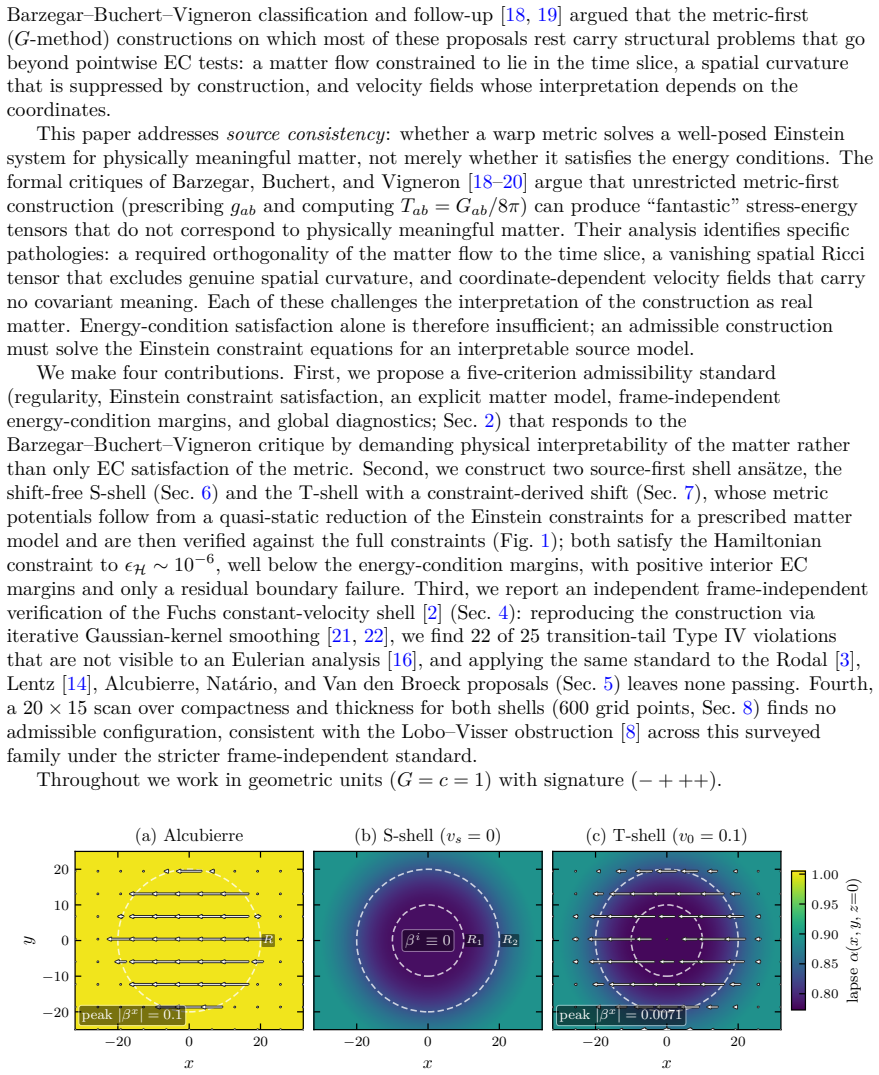
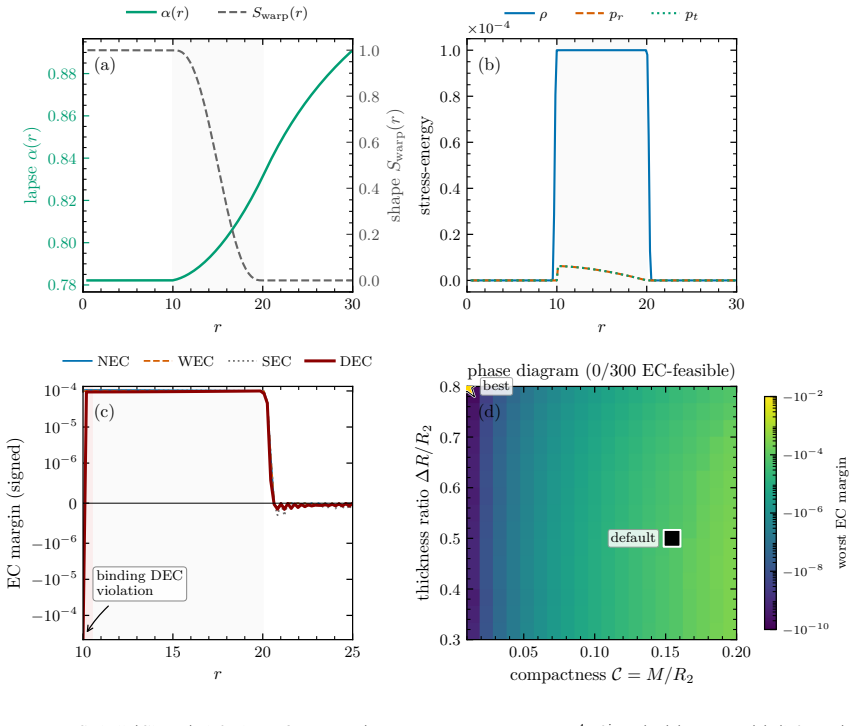
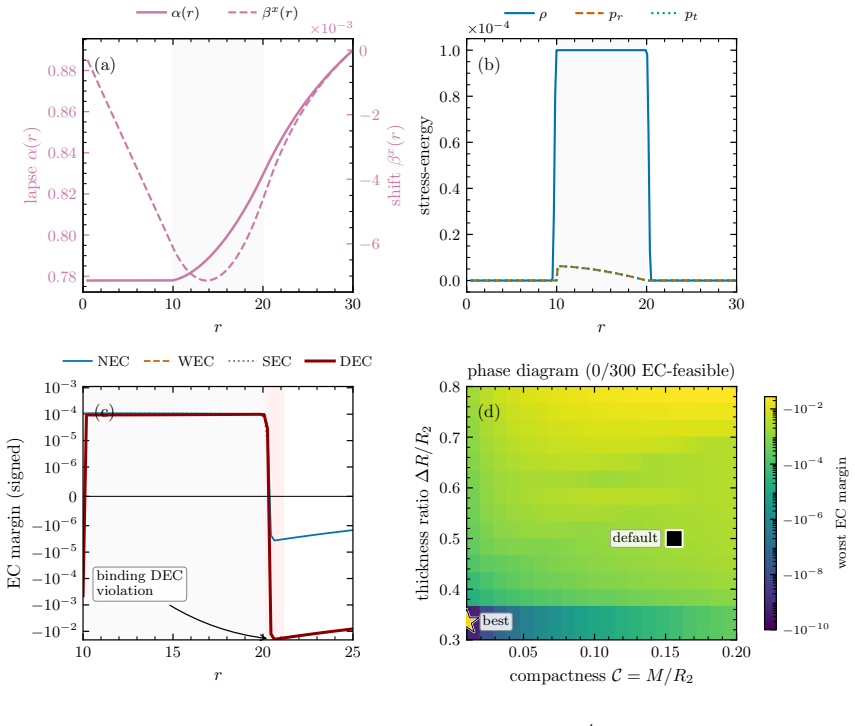
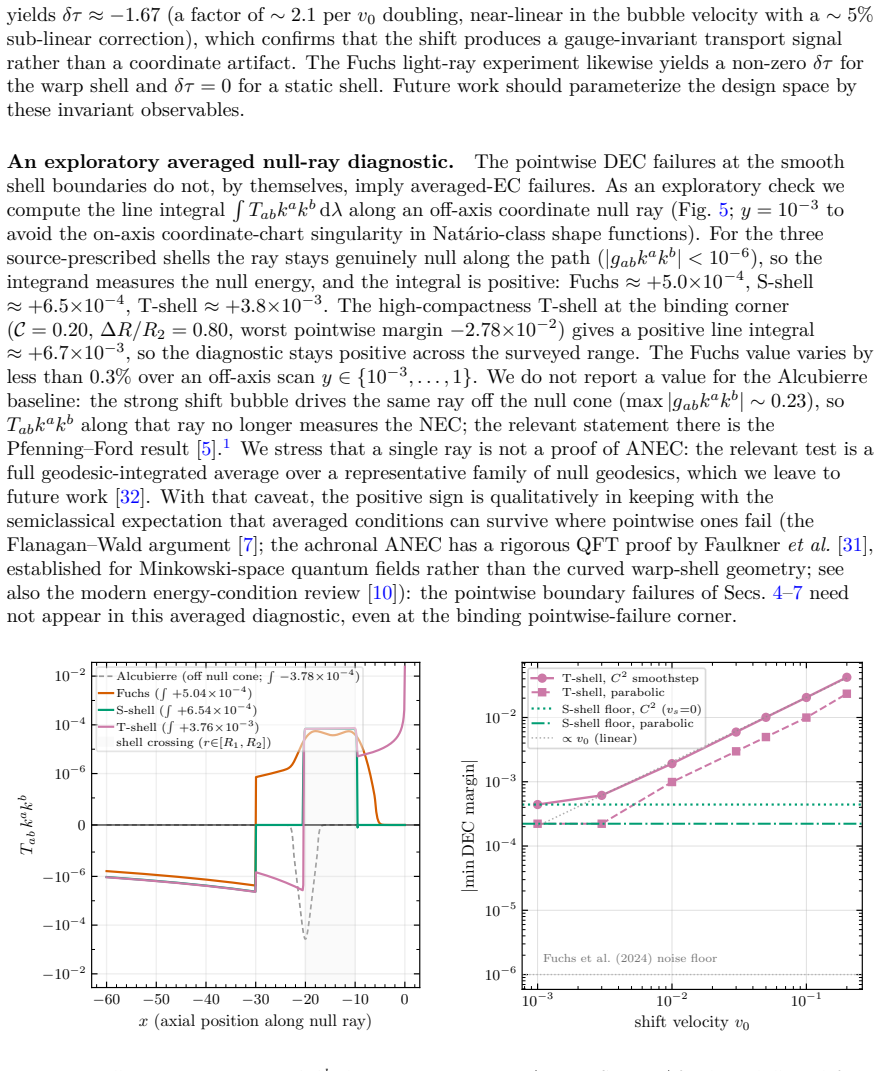
For the source-first S-shell and T-shell constructions of subluminal positive-energy warp shells, energy-condition failures are localized at the smooth source-vacuum transition rather than in the bulk interior. A frame-independent scan over shell compactness and thickness yields no admissible configuration in either source-first class. The same boundary deficit appears in the shift-free S-shell and persists in the static v0=0 limit. Along a representative off-axis null ray the null-energy line integral is nevertheless positive for every source-prescribed shell.
What carries the argument
The source-first shell ansatze whose metric potentials are obtained from the Einstein constraints for a prescribed matter model, evaluated by the five-criterion admissibility standard.
If this is right
- Energy-condition failures occur at the source-vacuum transitions rather than inside the bulk.
- The boundary deficit is independent of the shift and survives in the static limit.
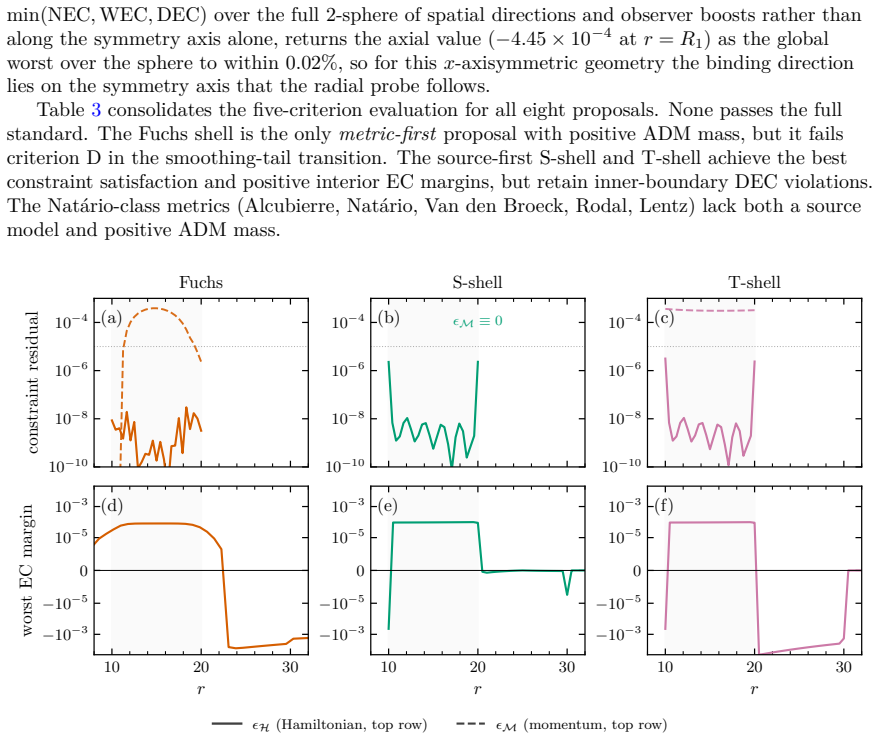
- Interior probes can satisfy energy conditions while the smoothing tails violate them.
- The null-energy line integral along an off-axis null ray remains positive despite pointwise violations.
- None of the eight examined constructions spanning canonical warp-drive classes meets the full standard.
Where Pith is reading between the lines
- Alternative smoothing profiles or different matter models might be required to eliminate the boundary violations.
- The positive null-energy integral raises the possibility that averaged energy conditions could still hold even when pointwise versions fail.
- The result suggests that any classical warp shell with explicit sources will face similar transition costs unless the geometry of the interface is altered.
- This boundary issue may extend to other exotic spacetimes that rely on smooth matching between sourced and vacuum regions.
Load-bearing premise
The five-criterion standard is the right and sufficient test for admissibility and the chosen matter models plus smoothing functions represent physically plausible sources.
What would settle it
Finding one source-first configuration that satisfies all five criteria, including zero energy-condition violations at the smoothing tails, would falsify the central claim.
Figures
read the original abstract
We study classical energy-condition admissibility for subluminal, positive-energy warp shells. For the constructions examined here, the energy-condition failures are localized at the smooth source--vacuum transition rather than in the bulk interior. We introduce two \emph{source-first} shell ans"atze whose metric potentials are obtained from the Einstein constraints for a prescribed matter model: a shift-free S-shell and a T-shell whose shift is derived from the momentum constraint. We assess them with a five-criterion standard comprising regularity, constraint satisfaction, an explicit matter model, frame-independent energy-condition margins, and global diagnostics; the standard responds to the source-consistency critique of Barzegar, Buchert, and Vigneron. Applied to eight constructions spanning the canonical warp-drive classes, none passes the full standard. An independent frame-independent verification of the Fuchs constant-velocity shell confirms interior energy-condition compliance (0 of 13 interior probes violate) but reveals Hawking--Ellis Type~IV violations in the smoothing tail beyond the nominal shell. A frame-independent scan over shell compactness and thickness (600 configurations) yields no admissible configuration in either source-first class. The same boundary deficit appears in the shift-free S-shell and persists in the static $v_0=0$ limit, which ties it to the transition geometry rather than to the shift. Along a representative off-axis null ray the null-energy line integral is nevertheless positive for every source-prescribed shell; this is an exploratory diagnostic rather than a proof of the averaged null energy condition, but it shows that the pointwise boundary failures need not appear in that integral.
Editorial analysis
A structured set of objections, weighed in public.
Referee Report
Summary. The paper constructs two source-first warp-shell ansatze (shift-free S-shell and T-shell with shift from the momentum constraint) whose metric potentials are obtained directly from the Einstein constraints for prescribed matter models. It applies a five-criterion admissibility standard (regularity, constraint satisfaction, explicit matter model, frame-independent energy-condition margins, global diagnostics) to eight constructions spanning canonical warp-drive classes, performs an independent frame-independent verification of the Fuchs constant-velocity shell, and reports a 600-configuration scan over shell compactness and thickness. No configuration in either source-first class satisfies the full standard; energy-condition failures are localized at the smooth source-vacuum transition. The same boundary deficit persists in the static v0=0 limit. Along a representative off-axis null ray the null-energy line integral remains positive for every source-prescribed shell.
Significance. If the central negative result holds under broader smoothing choices, the work would indicate that source-consistent warp shells generically incur Hawking-Ellis Type IV violations at the transition geometry, independent of the shift, thereby constraining classical positive-energy warp-drive constructions. Strengths include the explicit source-first constructions, the independent verification of a prior shell (0 of 13 interior probes violate), the large parameter scan, and the exploratory positive NEC line-integral diagnostic. These elements provide concrete, falsifiable content for the source-consistency critique.
major comments (2)
- [Abstract] Abstract: the claim that the boundary deficit 'ties it to the transition geometry rather than to the shift' rests on a scan that varies only compactness and thickness while holding the functional form of the smoothing profiles and matter models fixed. If a higher-order or alternate transition profile can eliminate the Type IV violations while preserving the other four criteria, the generality of the negative result for source-first constructions does not follow.
- [Abstract] Abstract (five-criterion standard): the standard is presented as responding to the Barzegar-Buchert-Vigneron critique, yet the manuscript does not demonstrate that the chosen explicit matter models plus smoothing functions are representative of the broader class of physically plausible sources; the negative scan result is therefore conditional on these specific choices.
Simulated Author's Rebuttal
We thank the referee for the careful and constructive report. We agree that the abstract wording on the generality of the boundary deficit and the scope of the five-criterion standard should be qualified to reflect the fixed functional forms and specific matter models examined. We will revise the manuscript to address both major comments.
read point-by-point responses
-
Referee: [Abstract] Abstract: the claim that the boundary deficit 'ties it to the transition geometry rather than to the shift' rests on a scan that varies only compactness and thickness while holding the functional form of the smoothing profiles and matter models fixed. If a higher-order or alternate transition profile can eliminate the Type IV violations while preserving the other four criteria, the generality of the negative result for source-first constructions does not follow.
Authors: We agree that the 600-configuration scan holds the functional forms of the smoothing profiles fixed. The statement that the deficit is tied to the transition geometry is supported by the explicit shift-free S-shell construction and the static v_0=0 limit, both of which exhibit the same localized violations independent of any shift. Nevertheless, we accept that this does not preclude the possibility that alternate or higher-order smoothing profiles might avoid the Type IV violations. We will revise the abstract to state that the observed tying holds within the examined family of profiles and matter models, thereby limiting the generality claim as noted. revision: yes
-
Referee: [Abstract] Abstract (five-criterion standard): the standard is presented as responding to the Barzegar-Buchert-Vigneron critique, yet the manuscript does not demonstrate that the chosen explicit matter models plus smoothing functions are representative of the broader class of physically plausible sources; the negative scan result is therefore conditional on these specific choices.
Authors: The five-criterion standard is proposed to implement the source-consistency requirement of the Barzegar-Buchert-Vigneron critique by requiring an explicit matter model. We do not claim or demonstrate that the specific models and smoothing functions are representative of all physically plausible sources. The negative results apply strictly to the eight constructions and the parameter scan within the chosen classes. We will revise the abstract and introduction to explicitly note that the conclusions are conditional on these modeling choices. revision: yes
Circularity Check
No significant circularity; claims rest on direct numerical scan of constructed metrics
full rationale
The paper derives metric potentials from the Einstein constraints given explicit matter models in two source-first ansatze (S-shell and T-shell), then applies a five-criterion admissibility test to 600 scanned configurations. No reported quantity reduces by the paper's equations to a fitted input or self-citation; the negative result (no admissible shells) is an output of the scan rather than a definitional or fitted tautology. The cited critique (Barzegar et al.) is external and not load-bearing for the construction. The analysis is self-contained.
Axiom & Free-Parameter Ledger
free parameters (2)
- shell compactness
- shell thickness
axioms (2)
- standard math Einstein field equations determine the metric potentials from a prescribed matter model
- domain assumption The five-criterion standard is the correct test for classical energy-condition admissibility
Forward citations
Cited by 2 Pith papers
-
Steering a warp drive without exotic matter
A positive-energy spacetime for steering a warp drive is constructed by matching an exact Kinnersley photon rocket exterior to a flat interior through a timelike shell that satisfies the dominant energy condition unde...
-
Steering a warp drive without exotic matter
A positive-energy steerable warp drive is constructed by matching the Kinnersley photon rocket to a flat passenger worldtube, with acceleration controlled by Bondi mass loss obeying a closed-form law.
Reference graph
Works this paper leans on
-
[1]
Quantum Grav.38105009 (Preprint2102.06824)
Bobrick A and Martire G 2021Class. Quantum Grav.38105009 (Preprint2102.06824)
-
[2]
Quantum Grav.41095013 (Preprint2405.02709)
Fuchs J, Helmerich C, Bobrick A, Sellers L, Melcher B and Martire G 2024Class. Quantum Grav.41095013 (Preprint2405.02709)
- [3]
- [4]
-
[5]
The unphysical nature of "Warp Drive"
Pfenning M J and Ford L H 1997Class. Quantum Grav.141743–1751 (Preprint gr-qc/9702026)
work page internal anchor Pith review Pith/arXiv arXiv
- [6]
- [7]
-
[8]
Fundamental limitations on "warp drive" spacetimes
Lobo F S N and Visser M 2004Class. Quantum Grav.215871–5892 (Preprint gr-qc/0406083)
work page internal anchor Pith review Pith/arXiv arXiv
-
[9]
Visser M 1995Lorentzian Wormholes: From Einstein to Hawking(New York: AIP Press)
-
[10]
Quantum Grav.37193001 (Preprint2003.01815)
Kontou E A and Sanders K 2020Class. Quantum Grav.37193001 (Preprint2003.01815)
- [11]
-
[12]
Observer-robust energy condition verification for warp drive spacetimes
Le A T 2026 Observer-robust energy condition verification for warp drive spacetimes arXiv:2602.18023 35 pp. (Preprint2602.18023)
work page internal anchor Pith review Pith/arXiv arXiv 2026
-
[13]
Hawking S W and Ellis G F R 1973The Large Scale Structure of Space-Time(Cambridge University Press)
-
[14]
Quantum Grav.38075015 (Preprint2006.07125)
Lentz E W 2021Class. Quantum Grav.38075015 (Preprint2006.07125)
-
[15]
Garattini R and Zatrimaylov K 2025 Positive-energy warp drive in a De Sitter universe (Preprint2502.13153)
work page internal anchor Pith review Pith/arXiv arXiv 2025
- [16]
- [17]
- [18]
-
[19]
Buchert T and Frackowiak A 2026Universe12132 (Preprint2605.03653)
work page internal anchor Pith review Pith/arXiv arXiv
- [20]
-
[21]
Weickert J 1998Anisotropic Diffusion in Image Processing(Stuttgart: Teubner-Verlag)
-
[22]
Getreuer P 2013Image Processing On Line3286–310
-
[23]
Israel W 1966Nuovo Cimento B441–14 erratumibid.48, 463 (1967)
1967
-
[24]
Bradbury J, Frostig R, Hawkins P, Johnson M J, Leary C, Maclaurin D, Necula G, Paszke A, VanderPlas J, Wanderman-Milne S and Zhang Q 2018 JAX: composable transformations of Python+NumPy programshttps://github.com/jax-ml/jax
2018
-
[25]
Carroll S M 2004Spacetime and Geometry: An Introduction to General Relativity (Addison-Wesley)
-
[26]
Rodal J 2026 Weakly birefringent screening disfavors fast Hawking–Ellis Type I warp drives via low-velocity cubic tilt scaling arXiv:2603.21352v2 (24 March 2026) (Preprint2603.21352)
work page internal anchor Pith review Pith/arXiv arXiv 2026
-
[27]
Quantum Grav.41095009 (Preprint2404.03095)
Helmerich C, Fuchs J, Bobrick A, Sellers L, Melcher B and Martire G 2024Class. Quantum Grav.41095009 (Preprint2404.03095)
-
[28]
Quantum Grav.11L73–L77 (Preprintgr-qc/0009013) 16
Alcubierre M 1994Class. Quantum Grav.11L73–L77 (Preprintgr-qc/0009013) 16
-
[29]
Quantum Grav.191157–1166 (Preprintgr-qc/0110086)
Natário J 2002Class. Quantum Grav.191157–1166 (Preprintgr-qc/0110086)
-
[30]
Quantum Grav.163973–3979 (Preprintgr-qc/9905084)
Van Den Broeck C 1999Class. Quantum Grav.163973–3979 (Preprintgr-qc/9905084)
-
[31]
Modular Hamiltonians for Deformed Half-Spaces and the Averaged Null Energy Condition
Faulkner T, Leigh R G, Parrikar O and Wang H 2016J. High Energy Phys.2016038 (Preprint1605.08072)
work page internal anchor Pith review Pith/arXiv arXiv
- [32]
-
[33]
Quantum Grav.38155020 (Preprint2104.06488)
Fell S D B and Heisenberg L 2021Class. Quantum Grav.38155020 (Preprint2104.06488)
-
[34]
Quantum Grav.41135007 (Preprint2311.07193)
Huey G 2024Class. Quantum Grav.41135007 (Preprint2311.07193)
- [35]
- [36]
-
[37]
thesis University of Oxford 17
Kidger P 2021On Neural Differential EquationsPh.D. thesis University of Oxford 17
discussion (0)
Sign in with ORCID, Apple, or X to comment. Anyone can read and Pith papers without signing in.