REVIEW 1 major objections 1 cited by
Renormalization group calculations on hierarchical lattices support the duality estimate for the permutation model's critical point in the replica limit.
Reviewed by Pith at T0; open to challenge. T0 means a machine referee read the full paper against a public rubric. the ladder, T0–T4 →
T0 review · grok-4.3
2026-06-29 19:51 UTC pith:CFURZHQ6
load-bearing objection This paper runs exact real-space RG on the b=3 hierarchical lattice for finite mn, extrapolates to the replica limit, and finds reasonable support for the duality prediction while noting extrapolation uncertainty. the 1 major comments →
Analysis of Critical Points in a Permutation Model on Hierarchical Lattices by Real-Space Renormalization Group
The pith
A machine-rendered reading of the paper's core claim, the machinery that carries it, and where it could break.
Core claim
Using exact real-space renormalization group on self-dual hierarchical lattices, finite-replica critical points are determined for q = mn = 2 to 6. Extrapolation of the b=3 data to mn o 0 yields values consistent with the duality-based estimate, while exposing the systematic uncertainty tied to the choice of extrapolation formula.
What carries the argument
The real-space renormalization group transformation applied to the permutation model on self-dual hierarchical lattices, followed by extrapolation to the replica limit mn o 0.
Load-bearing premise
The b=3 hierarchical lattice combined with the selected extrapolation formula accurately reproduces the critical behavior of the two-dimensional permutation model.
What would settle it
Performing the renormalization group calculation on a hierarchical lattice with a different branching factor, such as b=2 or b=4, and finding that the extrapolated critical point deviates from the duality prediction would challenge the support for that estimate.
If this is right
- The duality prediction from the Fourier transform of the symmetric group gives a good estimate for the critical point in two dimensions.
- The systematic uncertainty in the extrapolation formula can be assessed using the hierarchical lattice results.
- The phase transition in the permutation model aligns with the entanglement entropy transition point.
- Results for higher replica numbers approach the limiting behavior in line with the duality estimate.
Where Pith is reading between the lines
- Applying the same RG method to lattices with different branching factors could reduce extrapolation uncertainty.
- The confirmed transition point may help benchmark numerical simulations of entanglement in larger quantum circuits.
- Similar duality arguments might be testable in other spin models related to quantum information.
Editorial analysis
A structured set of objections, weighed in public.
Referee Report
Summary. The manuscript performs exact real-space renormalization group calculations on self-dual b=3 hierarchical lattices to obtain finite-replica critical points of the permutation model for mn = q = 2 to 6. These are compared to a duality prediction obtained from the Fourier transform of the symmetric group; the b=3 data are then extrapolated to the replica limit mn → 0 (effective dimension two). The central claim is that the comparison supports the duality-based estimate while quantifying the systematic uncertainty arising from the extrapolation formula.
Significance. If the numerical results and extrapolation hold, the work supplies a controlled test of the duality prediction for the critical point governing the area-to-volume law transition in random quantum circuits and tensor networks. The use of exact RSRG on hierarchical lattices together with explicit extrapolation to mn → 0 provides a transparent assessment of approximation error, which is a methodological strength for this class of models.
major comments (1)
- [Abstract] Abstract: the reported numerical critical-point values are given without error bars, convergence checks with respect to RG iterations, or the explicit functional form of the extrapolation formula to mn → 0. These omissions make it impossible to assess the statistical significance of the agreement with the duality prediction or the size of the quoted systematic uncertainty.
Simulated Author's Rebuttal
We thank the referee for the positive assessment and the constructive comment on the abstract. We address the point below.
read point-by-point responses
-
Referee: [Abstract] Abstract: the reported numerical critical-point values are given without error bars, convergence checks with respect to RG iterations, or the explicit functional form of the extrapolation formula to mn → 0. These omissions make it impossible to assess the statistical significance of the agreement with the duality prediction or the size of the quoted systematic uncertainty.
Authors: We agree that the abstract would benefit from greater transparency on these points. The main text already provides the RG iteration data, convergence behavior for the b=3 lattices, and the explicit extrapolation ansatz (a polynomial fit in 1/mn with coefficients determined from the q=2–6 points). In the revised manuscript we will update the abstract to include representative error bars on the critical points, a brief statement on convergence with RG steps, and the functional form of the extrapolation, while keeping the abstract concise. revision: yes
Circularity Check
No significant circularity; derivation is self-contained against external duality benchmark
full rationale
The paper computes critical points via exact real-space RG recursions on the b=3 hierarchical lattice for finite mn, extrapolates to mn→0, and compares the result to an independent duality prediction obtained from the Fourier transform of the symmetric group. The duality estimate is not constructed from the RG data, not fitted to it, and is not justified by self-citation within the present work. No step reduces by definition to its own inputs, no parameter is renamed as a prediction, and the central claim (support for the duality estimate plus quantification of extrapolation uncertainty) rests on standard hierarchical-lattice approximation whose errors are quantified internally by the extrapolation procedure itself. The derivation chain is therefore independent of the target result.
Axiom & Free-Parameter Ledger
read the original abstract
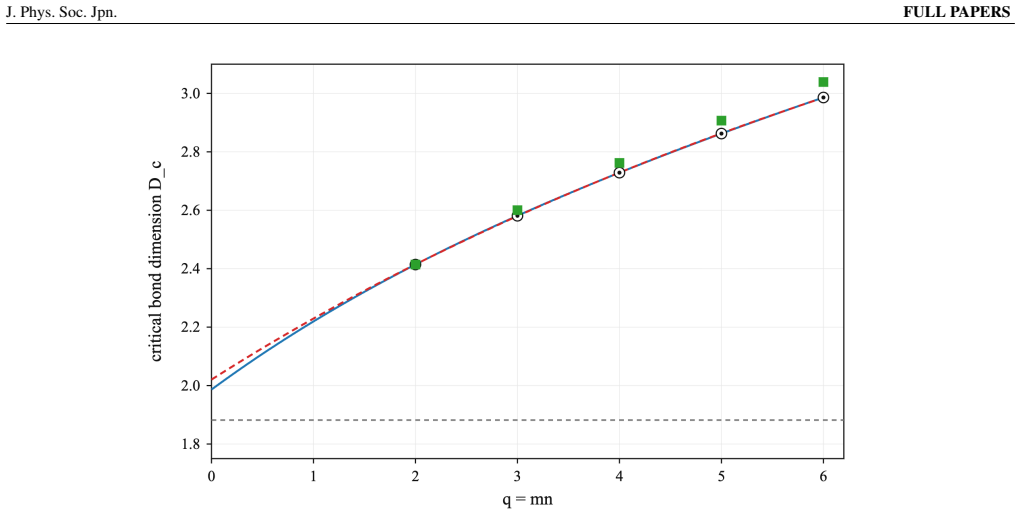
The permutation model is a classical spin system where elements of the symmetric group interact with one another. The partition function of this model is directly related to the entanglement structure of random quantum circuits and random tensor networks. In these contexts, the entanglement entropy undergoes a transition between area-law and volume-law scaling, depending on the model parameters. This transition point has attracted considerable attention. In the present work, we investigate the ferromagnetic-paramagnetic phase transition of the permutation model, which corresponds to the entanglement entropy transition. Using exact real-space renormalization group calculations on self-dual hierarchical lattices, we numerically determine finite-replica critical points for (q=mn=2,...,6). We compare the results with the duality prediction based on the Fourier transform of the symmetric group and then extrapolate the b=3 data toward the replica limit $mn\to0$, where the effective dimension is two. The comparison supports the duality-based estimate while also clarifying the systematic uncertainty associated with the extrapolation formula.
Figures


Forward citations
Cited by 1 Pith paper
-
Star-triangle duality estimates for triangular and honeycomb permutation models
Star-triangle block duality gives approximate critical bond dimensions D≈2.635 for the honeycomb permutation model and D≈1.476 for the triangular model.
Reference graph
Works this paper leans on
-
[1]
Introduction Current quantum devices are referred to as noisy intermediate-scale quantum (NISQ) computers, as they are subject to noise from environmental interactions, quantum gate operations, and measurement processes.1) It is well estab- lished that when the noise level is high, quantum computers fail to demonstrate an advantage over classical computer...
work page internal anchor Pith review Pith/arXiv arXiv 2026
-
[2]
Permutation model The permutation model is closely related to RTN, which are quantum states with inherent randomness defined on a net- work. Using the replica method to handle disorder in RTN, one finds that the entanglement entropy equals the differ- ence in free energies of theq-th permutation model with spe- cific boundary conditions, where the interac...
-
[3]
Real-space renormalization group on hierarchical lat- tice To validate the predictions obtained from duality analy- sis, we analyze the phase transition points of the permutation model using the RSRG on hierarchical lattices. A key advan- tage of RSRG on hierarchical lattices is that it yields exact recursion relations for edge Boltzmann factors without g...
-
[4]
du- ality analysis
Numerical experiments The critical points of theq-th permutation models obtained using RSRG analysis are plotted in Figures 3 and 4, and shown in Table I. In Figure 3, the curve represented by “du- ality analysis” corresponds to the predicted critical points, which were numerically solved from Eq. 4 for realq. The point atq=1 is not plotted because Eq. 4 ...
-
[5]
Using the real-space renor- malization group (RSRG) method on hierarchical lattices, we determined the critical points forq=2,
Conclusion In this paper, we numerically determined the ferromagnetic-paramagnetic phase transition points of permutation spin models related to random quantum circuits and random tensor networks. Using the real-space renor- malization group (RSRG) method on hierarchical lattices, we determined the critical points forq=2, . . . ,6 and, by extrapolating th...
-
[6]
Preskill: Quantum2(2018) 79
J. Preskill: Quantum2(2018) 79
2018
-
[7]
S. R. White: Phys. Rev. Lett.69(1992) 2863. 6 J. Phys. Soc. Jpn. FULL PAPERS Fitting function pext(n→0) pext −0.8903 RMSE on n=1, . . . ,4 Linear polynomial 0.83816 −0.05214 5.07×10 −3 Quadratic polynomial 0.86322 −0.02708 7.71×10 −4 Cubic polynomial 0.87528 −0.01502 <10 −12 Power function not finite atn→0 (α=−0.0286) 1.78×10 −4 Rational function 0.88915 ...
1992
-
[8]
Jordan, R
J. Jordan, R. Or ´us, G. Vidal, F. Verstraete, and J. I. Cirac: Phys. Rev. Lett.101(2008) 250602
2008
-
[9]
Arute, K
F. Arute, K. Arya, R. Babbush, D. Bacon, J. C. Bardin, R. Barends, R. Biswas, S. Boixo, F. G. S. L. Brandao, D. A. Buell, B. Burkett, Y . Chen, Z. Chen, B. Chiaro, R. Collins, W. Courtney, A. Dunsworth, E. Farhi, B. Foxen, A. Fowler, C. Gidney, M. Giustina, R. Graff, K. Guerin, S. Habegger, M. P. Harrigan, M. J. Hartmann, A. Ho, M. Hoffmann, T. Huang, T. ...
2019
-
[10]
A. P. Lund, M. J. Bremner, and T. C. Ralph: npj Quantum Information 3(2017)
2017
-
[11]
M. P. Fisher, V . Khemani, A. Nahum, and S. Vijay: Annual Review of Condensed Matter Physics14(2023) 335–379
2023
-
[12]
Jian, Y .-Z
C.-M. Jian, Y .-Z. You, R. Vasseur, and A. W. W. Ludwig: Phys. Rev. B 101(2020) 104302
2020
-
[13]
Y . Li, X. Chen, and M. P. A. Fisher: Phys. Rev. B100(2019) 134306
2019
-
[14]
Hayden, S
P. Hayden, S. Nezami, X.-L. Qi, N. Thomas, M. Walter, and Z. Yang: Journal of High Energy Physics2016(2016)
2016
-
[15]
Vasseur, A
R. Vasseur, A. C. Potter, Y .-Z. You, and A. W. W. Ludwig: Physical Review B100(2019)
2019
-
[16]
Ohzeki, H
M. Ohzeki, H. Nishimori, and A. N. Berker: Physical Review E77 (2008)
2008
-
[17]
Ohzeki: Physical Review E79(2009) 021129
M. Ohzeki: Physical Review E79(2009) 021129
2009
-
[18]
Ohzeki and J
M. Ohzeki and J. L. Jacobsen: Journal of Physics A: Mathematical and Theoretical48(2015) 095001
2015
-
[19]
Ohzeki: Progress of Theoretical and Experimental Physics (2024) ptae171
M. Ohzeki: Progress of Theoretical and Experimental Physics (2024) ptae171
2024
-
[20]
R. B. Griffiths and M. Kaufman: Phys. Rev. B26(1982) 5022. 7
1982
discussion (0)
Sign in with ORCID, Apple, or X to comment. Anyone can read and Pith papers without signing in.