Characterizing emergent multiscale dynamics in colloidal nanoparticle gels
Pith reviewed 2026-06-29 19:09 UTC · model grok-4.3
The pith
XPCS paired with tunable nanoparticle model systems can bridge nano-scale motions to macroscopic gel properties and enable programmable materials.
A machine-rendered reading of the paper's core claim, the machinery that carries it, and where it could break.
Core claim
The rapid expansion of XPCS capabilities at fourth-generation light sources, combined with complementary tools and robust model systems, positions the field to move beyond descriptive fundamental studies toward the design of nanoparticle gels with adaptive and programmable behaviors.
What carries the argument
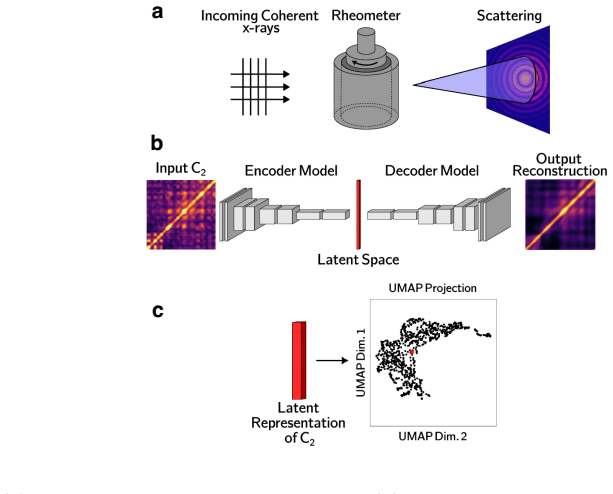
X-ray photon correlation spectroscopy (XPCS) and rheo-XPCS, used together with tunable primary nanoparticle model platforms, to map multiscale dynamics onto network mechanics.
If this is right
- Systematic changes in nanoparticle size, shape, and surface chemistry will generate datasets that test and refine models of gelation and aging.
- Simultaneous nanoscale motion and bulk rheology measurements will identify which particle rearrangements control macroscopic stiffness and yielding.
- Robust model systems will support development of theoretical bridges between nanoscopic interactions and emergent network properties.
- The same platform can be used to explore stimuli-responsive or programmable gel behaviors once the multiscale links are established.
Where Pith is reading between the lines
- The same multiscale characterization strategy could be applied to other hierarchically structured soft materials whose dynamics also resist single-scale description.
- If the tunable model systems succeed, they could serve as experimental benchmarks for simulation methods that aim to predict gel properties from particle-level inputs.
- Programmable gels designed this way might allow external fields or chemical cues to switch network connectivity on demand, extending the review's design goal into functional devices.
Load-bearing premise
Gel formation mechanisms depend so strongly on the specific assembly pathway and particle interactions that no single theory can yet connect nanoscopic rules to macroscopic network evolution.
What would settle it
A single theoretical framework that successfully predicts both structural evolution and network dynamics for gels formed by two or more qualitatively different pathways and interaction types would falsify the claim that pathway sensitivity currently blocks unification.
Figures
read the original abstract
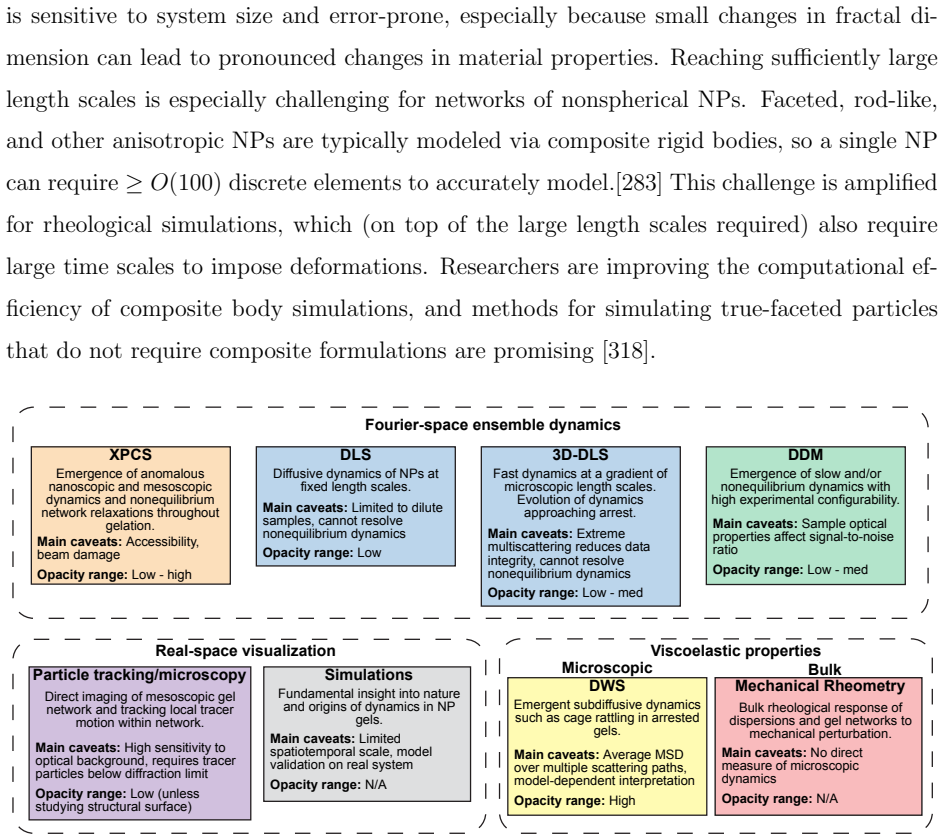
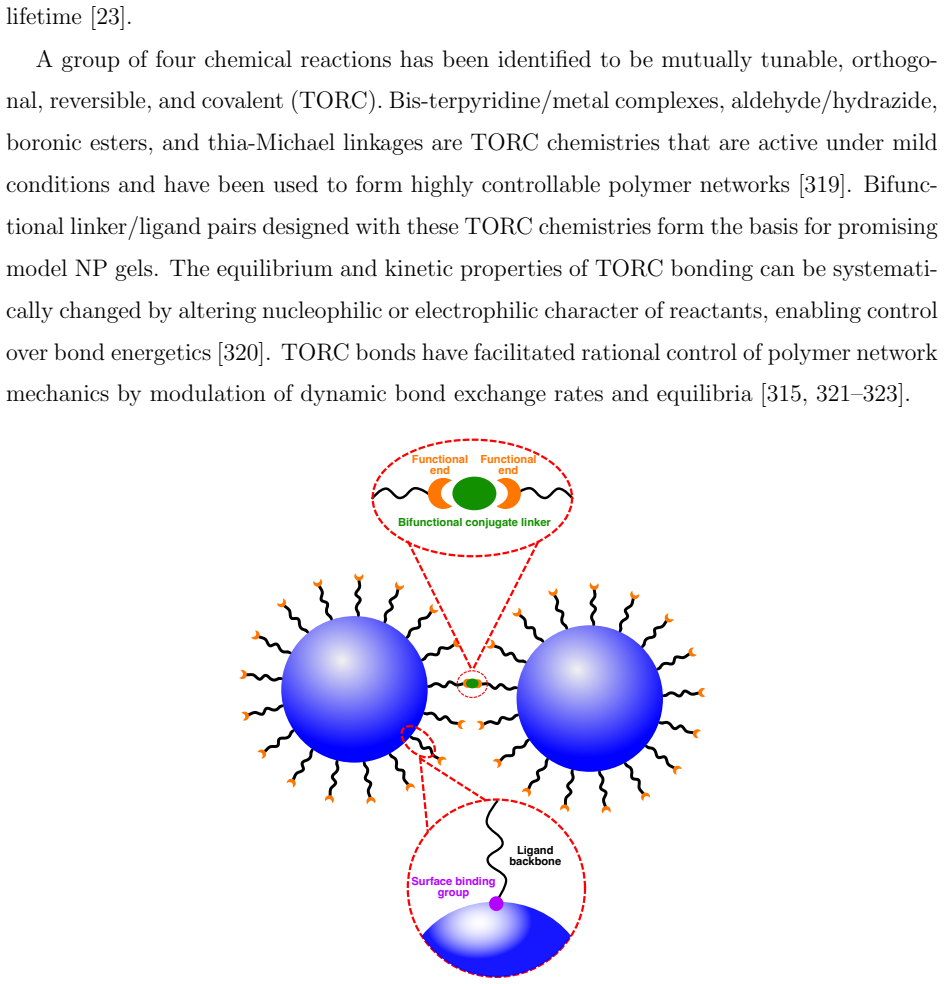
Colloidal gels assembled from nanoparticles (NPs) are a versatile class of soft network-based materials capable of rich dynamic, mechanical, and even optical or magnetic responses to stimuli. Understanding how their hierarchically organized processes relate to macroscopic network properties remains a broad and unresolved problem in soft matter physics. The mechanisms of gel formation can depend sensitively on the pathway and the nature of NP interactions, thus far preventing a unified theoretical bridge between nanoscopic interactions and structural evolution and network dynamics. Indirect measurement of dynamics using light-scattering techniques provides an experimental means to quantify underlying particle and network motion. X-ray photon correlation spectroscopy (XPCS) has emerged as a powerful tool for probing nanoscopic motion in nanoparticle gels, but alone cannot resolve the full spatiotemporal spectrum of dynamics that drive gelation, aging, and network mechanical properties. While in situ rheo-XPCS enables simultaneous probing of nanoscale and bulk mechanical responses, complementary light scattering, microscopy, or simulations can extend spatiotemporal characterization and, consequently, understanding of NP gel network physics. Implementing a modular model platform with tunable primary nanoparticle features allows systematic variation of nanoscopic characteristics that drive emergent gel responses and inform the development of theoretical models for a wide range of soft, dynamic, nanostructured materials. The rapid expansion of XPCS capabilities at fourth-generation light sources, combined with complementary tools and robust model systems, positions the field to move beyond descriptive fundamental studies toward the design of nanoparticle gels with adaptive and programmable behaviors.
Editorial analysis
A structured set of objections, weighed in public.
Referee Report
Summary. This perspective article reviews the challenges of linking nanoscopic interactions to emergent multiscale dynamics and macroscopic properties in colloidal nanoparticle gels, noting the pathway dependence of gelation mechanisms. It positions XPCS (including in situ rheo-XPCS) as a key probe for nanoscopic motion, while emphasizing the need for complementary light scattering, microscopy, and simulations to span spatiotemporal scales. The manuscript advocates for modular model systems with tunable NP features to inform theory and highlights how fourth-generation light sources will enable a transition from descriptive studies to the design of adaptive, programmable gels.
Significance. As a perspective, the manuscript provides a timely synthesis of XPCS capabilities and complementary tools in soft matter. If its outlook holds, it could usefully orient the community toward integrated experimental platforms and model systems that address the acknowledged gap between nanoscopic interactions and network dynamics, potentially accelerating progress in programmable nanostructured materials.
Simulated Author's Rebuttal
We thank the referee for their positive assessment of our perspective article and for recommending acceptance. The report accurately captures the manuscript's focus on multiscale dynamics in colloidal nanoparticle gels and the role of XPCS alongside complementary methods.
Circularity Check
No circularity: review/perspective with no derivations or load-bearing claims
full rationale
The manuscript is a perspective/review article summarizing challenges in nanoparticle gel dynamics and advocating for expanded use of XPCS and complementary techniques. It contains no equations, derivations, fitted parameters, predictions, or model constructions. The central statements are aspirational (e.g., future positioning of the field) and descriptive of known limitations (pathway dependence of gelation). No self-citation chains, ansatzes, or renamings of results are present that could reduce to inputs by construction. The text is self-contained as a review without internal circular reasoning.
Axiom & Free-Parameter Ledger
Reference graph
Works this paper leans on
-
[1]
Pomerantseva, F
E. Pomerantseva, F. Bonaccorso, X. Feng, Y. Cui, and Y. Gogotsi, Energy storage: The future enabled by nanomaterials, Science366, eaan8285 (2019)
2019
-
[2]
Li and Y
Z. Li and Y. Yin, Stimuli-responsive optical nanomaterials, Adv. Mater.31, 1807061 (2019)
2019
-
[3]
M. J. Kale, T. Avanesian, and P. Christopher, Direct photocatalysis by plasmonic nanos- tructures, ACS Catal.4, 116 (2014)
2014
-
[4]
P. D. Howes, R. Chandrawati, and M. M. Stevens, Colloidal nanoparticles as advanced bio- logical sensors, Science346, 1247390 (2014)
2014
-
[5]
N. S. Abadeer and C. J. Murphy, Recent progress in cancer thermal therapy using gold nanoparticles, J. Phys. Chem. C120, 4691 (2016). 49
2016
-
[6]
S. L. Brock, I. U. Arachchige, and K. K. Kalebaila, Metal chalcogenide gels, xerogels and aerogels, Comments Inorg. Chem.27, 103 (2006)
2006
-
[7]
Lesnyak, A
V. Lesnyak, A. Wolf, A. Dubavik, L. Borchardt, S. V. Voitekhovich, N. Gaponik, S. Kaskel, and A. Eychm¨ uller, 3D assembly of semiconductor and metal nanocrystals: Hybrid CdTe/Au structures with controlled content, J. Am. Chem. Soc.133, 13413 (2011)
2011
-
[8]
A. Wolf, V. Lesnyak, N. Gaponik, and A. Eychm¨ uller, Quantum-dot-based (aero) gels: Con- trol of the optical properties, J. Phys. Chem. Lett.3, 2188 (2012)
2012
-
[9]
J. Yeom, U. S. Santos, M. Chekini, M. Cha, A. F. de Moura, and N. A. Kotov, Chiromagnetic nanoparticles and gels, Science359, 309 (2018)
2018
-
[10]
Rosebrock, D
M. Rosebrock, D. Z´ amb´ o, P. Rusch, D. Pluta, F. Steinbach, P. Bessel, A. Schlosser, A. Feld- hoff, K. D. Hindricks, P. Behrens,et al., Spatial extent of fluorescence quenching in mixed semiconductor–metal nanoparticle gel networks, Adv. Funct. Mater.31, 2101628 (2021)
2021
-
[11]
J. Kang, S. A. Valenzuela, E. Y. Lin, M. N. Dominguez, Z. M. Sherman, T. M. Truskett, E. V. Anslyn, and D. J. Milliron, Colorimetric quantification of linking in thermoreversible nanocrystal gel assemblies, Sci. Adv.8, eabm7364 (2022)
2022
-
[12]
J. Kang, Z. M. Sherman, H. S. N. Crory, D. L. Conrad, M. W. Berry, B. J. Roman, E. V. Anslyn, T. M. Truskett, and D. J. Milliron, Modular mixing in plasmonic metal oxide nanocrystal gels with thermoreversible links, J. Chem. Phys.158, 024903 (2023)
2023
-
[13]
J. Kang, D. Qian, J. Lee, D. L. Conrad, J. D. Oberlander, M. W. Berry, J. Liu, E. V. Anslyn, T. M. Truskett, and D. J. Milliron, Colloidal Phase Control in Plasmonic Metal Oxide Nanocrystals via Competitive Metal-Ligand Equilibria, Angew. Chem. Int. Ed.64, e18965 (2025)
2025
-
[14]
D. A. Vecchio, M. D. Hammig, X. Xiao, A. Saha, P. Bogdan, and N. A. Kotov, Spanning Network Gels from Nanoparticles and Graph Theoretical Analysis of Their Structure and Properties, Adv. Mater.34, 2201313 (2022)
2022
-
[15]
Matter and M
F. Matter and M. Niederberger, Optimization of Mass and Light Transport in Nanoparticle- Based Titania Aerogels, Chem. Mater.35, 7995 (2023)
2023
-
[16]
Schlenkrich, D
J. Schlenkrich, D. Z´ amb´ o, A. Schlosser, P. Rusch, and N. C. Bigall, Revealing the effect of nanoscopic design on the charge carrier separation processes in semiconductor-metal nanopar- ticle gel networks, Adv, Opt. Mater.10, 2101712 (2022). 50
2022
-
[17]
Conrad, T
N. Conrad, T. Kennedy, D. K. Fygenson, and O. A. Saleh, Increasing valence pushes dna nanostar networks to the isostatic point, Proc. Natl. Acad. Sci.116, 7238 (2019)
2019
-
[18]
Le Roy, J
H. Le Roy, J. Song, D. Lundberg, A. V. Zhukhovitskiy, J. A. Johnson, G. H. McKinley, N. Holten-Andersen, and M. Lenz, Valence can control the nonexponential viscoelastic re- laxation of multivalent reversible gels, Sci. Adv.10, eadl5056 (2024)
2024
-
[19]
Ilg, Stimuli-responsive hydrogels cross-linked by magnetic nanoparticles, Soft Matter9, 3465 (2013)
P. Ilg, Stimuli-responsive hydrogels cross-linked by magnetic nanoparticles, Soft Matter9, 3465 (2013)
2013
-
[20]
Pastoriza-Santos, C
I. Pastoriza-Santos, C. Kinnear, J. P´ erez-Juste, P. Mulvaney, and L. M. Liz-Marz´ an, Plas- monic polymer nanocomposites, Nat. Rev. Mater.3, 375 (2018)
2018
-
[21]
Matter, A
F. Matter, A. L. Luna, and M. Niederberger, From colloidal dispersions to aerogels: How to master nanoparticle gelation, Nano Today30, 100827 (2020)
2020
-
[22]
Z. M. Sherman, A. M. Green, M. P. Howard, E. V. Anslyn, T. M. Truskett, and D. J. Milliron, Colloidal Nanocrystal Gels from Thermodynamic Principles, Acc. Chem. Res.54, 798 (2021)
2021
-
[23]
A. M. Green, C. K. Ofosu, J. Kang, E. V. Anslyn, T. M. Truskett, and D. J. Milliron, Assembling Inorganic Nanocrystal Gels, Nano Lett.22, 1457 (2022)
2022
-
[24]
Zaccarelli, Colloidal gels: equilibrium and non-equilibrium routes, J
E. Zaccarelli, Colloidal gels: equilibrium and non-equilibrium routes, J. Phys. Condens. Matter19, 323101 (2007)
2007
-
[25]
Petekidis and N
G. Petekidis and N. J. Wagner, Rheology of Colloidal Glasses and Gels, inTheory and Applications of Colloidal Suspension Rheology, Vol. 8, edited by N. J. Wagner and J. Mewis (Cambridge University Press, Cambridge, UK, 2021) pp. 173–226
2021
-
[26]
Meakin and F
P. Meakin and F. Family, Structure and kinetics of reaction-limited aggregation, Phys. Rev. A38, 2110 (1988)
1988
-
[27]
Lazzari, L
S. Lazzari, L. Nicoud, B. Jaquet, M. Lattuada, and M. Morbidelli, Fractal-like structures in colloid science, Adv. Colloid Interface Sci.235, 1 (2016)
2016
-
[28]
Family, P
F. Family, P. Meakin, and T. Vicsek, Cluster size distribution in chemically controlled cluster- cluster aggregation, J. Chem. Phys.83, 4144 (1985)
1985
-
[29]
Zaccone, H
A. Zaccone, H. H. Winter, M. Siebenb¨ urger, and M. Ballauff, Linking self-assembly, rheology, and gel transition in attractive colloids, J. Rheol.58, 1219 (2014)
2014
-
[30]
Jabbari-Farouji, G
S. Jabbari-Farouji, G. H. Wegdam, and D. Bonn, Gels and glasses in a single system: Evi- dence for an intricate free-energy landscape of glassy materials, Phys. Rev. Lett.99, 065701 51 (2007)
2007
-
[31]
H. Guo, S. Ramakrishnan, J. L. Harden, and R. L. Leheny, Gel formation and aging in weakly attractive nanocolloid suspensions at intermediate concentrations, J. Chem. Phys. 135, 154903 (2011)
2011
-
[32]
Shahin and Y
A. Shahin and Y. M. Joshi, Hyper-aging dynamics of nanoclay suspension, Langmuir28, 5826 (2012)
2012
-
[33]
A. Jain, F. Schulz, I. Lokteva, L. Frenzel, G. Gr¨ ubel, and F. Lehmk¨ uhler, Anisotropic and heterogeneous dynamics in an aging colloidal gel, Soft Matter16, 2864 (2020)
2020
-
[34]
Suman and N
K. Suman and N. J. Wagner, Anomalous rheological aging of a model thermoreversible colloidal gel following a thermal quench, J. Chem. Phys.157, 024901 (2022)
2022
-
[35]
Y. Chen, Q. Zhang, S. Ramakrishnan, and R. L. Leheny, Memory in aging colloidal gels with time-varying attraction, J. Chem. Phys.158, 024906 (2023)
2023
-
[36]
Ramos and L
L. Ramos and L. Cipelletti, Ultraslow Dynamics and Stress Relaxation in the Aging of a Soft Glassy System, Phys. Rev. Lett.87, 245503 (2001)
2001
-
[37]
Bouzid, J
M. Bouzid, J. Colombo, L. V. Barbosa, and E. Del Gado, Elastically driven intermittent microscopic dynamics in soft solids, Nat. Commun.8, 15846 (2017)
2017
-
[38]
Nixon-Luke and G
R. Nixon-Luke and G. Bryant, Differential dynamic microscopy to measure the translational diffusion coefficient of nanorods, J. Phys. Condens. Matter32, 115102 (2020)
2020
-
[39]
Jungblut, J.-O
S. Jungblut, J.-O. Joswig, and A. Eychm¨ uller, Diffusion- and reaction-limited cluster aggre- gation revisited, Phys. Chem. Chem. Phys.21, 5723 (2019)
2019
-
[40]
A. Jain, F. Schulz, F. Dallari, V. Markmann, F. Westermeier, Y. Zhang, G. Gr¨ ubel, and F. Lehmk¨ uhler, Three-step colloidal gelation revealed by time-resolved x-ray photon corre- lation spectroscopy, J. Chem. Phys.157, 184901 (2022)
2022
-
[41]
C. K. Ofosu, W. D. Brackett, D. L. Conrad, D. Qian, T.-L. Lee, J. Kang, J. Choi, A. Bess- mertnaya, J. D. Oberlander, A. M. Green,et al., Universal progression of structure and dynamics in colloidal nanocrystal gels during salt-accelerated aging, Sci. Adv.12, eaec4820 (2026)
2026
-
[42]
J. Song, Q. Zhang, F. de Quesada, M. H. Rizvi, J. B. Tracy, J. Ilavsky, S. Narayanan, E. Del Gado, R. L. Leheny, N. Holten-Andersen, and G. H. McKinley, Microscopic dynam- ics underlying the stress relaxation of arrested soft materials, Proc. Natl. Acad. Sci.119, e2201566119 (2022). 52
2022
-
[43]
M. Y. Ahmad, S. Liu, T. Tegafaw, A. K. A. A. Saidi, D. Zhao, Y. Liu, S.-W. Nam, Y. Chang, and G. H. Lee, Heavy Metal-Based Nanoparticles as High-Performance X-ray Computed Tomography Contrast Agents, Pharmaceuticals16, 1463 (2023)
2023
-
[44]
Villarreal, G
E. Villarreal, G. G. Li, Q. Zhang, X. Fu, and H. Wang, Nanoscale Surface Curvature Effects on Ligand-Nanoparticle Interactions: A Plasmon-Enhanced Spectroscopic Study of Thiolated Ligand Adsorption, Desorption, and Exchange on Gold Nanoparticles, Nano Lett.17, 4443 (2017)
2017
-
[45]
Moncure, J
P. Moncure, J. E. Millstone, and J. E. Laaser, Role of Ligand Shell Density in the Diffusive Behavior of Nanoparticles in Hydrogels, J. Phys. Chem. B127, 9366 (2023)
2023
-
[46]
K. M. Hatzis, X. Wei, M. Kincanon, A. Wo, J. Gandrapu, O. Zeiri, R. Hernandez, and C. J. Murphy, Gold Nanoparticle Ligand Structure Investigated with Solution NMR: Effects of Ligand Length on Headgroup Dynamics and Ion Penetration, Chem. Mater.37, 4881 (2025)
2025
-
[47]
Giorgi, D
F. Giorgi, D. Coglitore, J. M. Curran, D. Gilliland, P. Macko, M. Whelan, A. Worth, and E. A. Patterson, The influence of inter-particle forces on diffusion at the nanoscale, Sci. Rep. 9, 12689 (2019)
2019
-
[48]
A. Y. Cui and Q. Cui, Modulation of nanoparticle diffusion by surface ligand length and charge: Analysis with molecular dynamics simulations, J. Phys. Chem. B125, 4555 (2021)
2021
-
[49]
L. B. Weiss, V. Dahirel, V. Marry, and M. Jardat, Computation of the Hydrodynamic Radius of Charged Nanoparticles from Nonequilibrium Molecular Dynamics, J. Phys. Chem. B122, 5940 (2018)
2018
-
[50]
Huang, S
R. Huang, S. Fedeli, C.-M. Hirschbiegel, X. Zhang, and V. M. Rotello, Modulation of Gold Nanoparticle Ligand Structure–Dynamic Relationships Probed Using Solution NMR, ACS Nanosci. Au4, 62 (2024)
2024
-
[51]
A. M. Puertas, M. Fuchs, and M. E. Cates, Dynamical heterogeneities close to a colloidal gel, J. Chem. Phys.121, 2813 (2004)
2004
-
[52]
C. J. Dibble, M. Kogan, and M. J. Solomon, Structure and dynamics of colloidal depletion gels: Coincidence of transitions and heterogeneity, Phys. Rev. E74, 041403 (2006)
2006
-
[53]
C. J. Dibble, M. Kogan, and M. J. Solomon, Structural origins of dynamical heterogeneity in colloidal gels, Phys. Rev. E77, 050401 (2008). 53
2008
-
[54]
M. H. Lee and E. M. Furst, Response of a colloidal gel to a microscopic oscillatory strain, Phys. Rev. E77, 041408 (2008)
2008
-
[55]
Patrick Royall, S
C. Patrick Royall, S. R. Williams, T. Ohtsuka, and H. Tanaka, Direct observation of a local structural mechanism for dynamic arrest, Nat. Mater.7, 556 (2008)
2008
-
[56]
Tateno, T
M. Tateno, T. Yanagishima, and H. Tanaka, Microscopic structural origin behind slowing down of colloidal phase separation approaching gelation, J. Chem. Phys.156(2022)
2022
-
[57]
R. N. Zia, B. J. Landrum, and W. B. Russel, A micro-mechanical study of coarsening and rheology of colloidal gels: Cage building, cage hopping, and smoluchowski’s ratchet, J. Rheol. 58, 1121 (2014)
2014
-
[58]
Y. Wang, M. Tateno, and H. Tanaka, Distinct elastic properties and their origins in glasses and gels, Nat. Phys.20, 1171 (2024)
2024
-
[59]
J. A. Zheng, M. Holmes-Cerfon, D. J. Pine, and S. Marbach, Hopping and crawling DNA- coated colloids, Proc. Natl. Acad. Sci.121, e2318865121 (2024)
2024
-
[60]
Y. Cai, W. Peng, and P. Vana, Gold nanoparticle ring arrays from core–satellite nanostruc- tures made to order by hydrogen bond interactions, Nanoscale Adv.4, 2787 (2022)
2022
-
[61]
M. N. Dominguez, M. P. Howard, J. M. Maier, S. A. Valenzuela, Z. M. Sherman, J. F. Reuther, L. C. Reimnitz, J. Kang, S. H. Cho, S. L. Gibbs, A. K. Menta, D. L. Zhuang, A. van der Stok, S. J. Kline, E. V. Anslyn, T. M. Truskett, and D. J. Milliron, Assembly of Linked Nanocrystal Colloids by Reversible Covalent Bonds, Chem. Mater.32, 10235 (2020)
2020
-
[62]
Bengtzelius, W
U. Bengtzelius, W. Gotze, and A. Sjolander, Dynamics of supercooled liquids and the glass transition, J. Phys. C17, 5915 (1984)
1984
-
[63]
P. N. Pusey and W. Van Megen, Phase behaviour of concentrated suspensions of nearly hard colloidal spheres, Nature320, 340 (1986)
1986
-
[64]
Dawson, G
K. Dawson, G. Foffi, M. Fuchs, W. G¨ otze, F. Sciortino, M. Sperl, P. Tartaglia, T. Voigt- mann, and E. Zaccarelli, Higher-order glass-transition singularities in colloidal systems with attractive interactions, Phys. Rev. E63, 011401 (2000)
2000
-
[65]
Zaccarelli and W
E. Zaccarelli and W. C. K. Poon, Colloidal glasses and gels: The interplay of bonding and caging, Proc. Natl. Acad. Sci.106, 15203 (2009)
2009
-
[66]
M. E. Helgeson, Y. Gao, S. E. Moran, J. Lee, M. Godfrin, A. Tripathi, A. Bose, and P. S. Doyle, Homogeneous percolation versus arrested phase separation in attractively-driven na- noemulsion colloidal gels, Soft Matter10, 3122 (2014). 54
2014
-
[67]
Y. Gao, J. Kim, and M. E. Helgeson, Microdynamics and arrest of coarsening during spinodal decomposition in thermoreversible colloidal gels, Soft Matter11, 6360 (2015)
2015
-
[68]
X. Cao, H. Cummins, and J. Morris, Structural and rheological evolution of silica nanoparticle gels, Soft Matter6, 5425 (2010)
2010
-
[69]
S. Aime, L. Cipelletti, and L. Ramos, Power law viscoelasticity of a fractal colloidal gel, J. Rheol.62, 1429 (2018)
2018
-
[70]
S. M. Morozova, L. L´ opez-Flores, A. Gevorkian, H. Zhang, V. Adibnia, W. Shi, D. Nyky- panchuk, T. G. Statsenko, G. C. Walker, O. Gang,et al., Colloidal clusters and networks formed by oppositely charged nanoparticles with varying stiffnesses, ACS Nano17, 15012 (2023)
2023
-
[71]
D. A. Weitz, J. S. Huang, M. Y. Lin, and J. Sung, Dynamics of Diffusion-Limited Kinetic Aggregation, Phys. Rev. Lett.53, 1657 (1984)
1984
-
[72]
M. Y. Lin, H. M. Lindsay, D. A. Weitz, R. C. Ball, R. Klein, and P. Meakin, Universality in colloid aggregation, Nature339, 360 (1989)
1989
-
[73]
D. A. Weitz, J. S. Huang, M. Y. Lin, and J. Sung, Limits of the Fractal Dimension for Irreversible Kinetic Aggregation of Gold Colloids, Phys. Rev. Lett.54, 1416 (1985)
1985
-
[74]
Zaccone, H
A. Zaccone, H. Wu, and E. Del Gado, Elasticity of arrested short-ranged attractive colloids: Homogeneous and heterogeneous glasses, Phys. Rev. Lett.103, 208301 (2009)
2009
-
[75]
N. E. Valadez-P´ erez, Y. Liu, A. P. Eberle, N. J. Wagner, and R. Castaneda-Priego, Dynamical arrest in adhesive hard-sphere dispersions driven by rigidity percolation, Phys. Rev. E88, 060302 (2013)
2013
-
[76]
K. A. Whitaker, Z. Varga, L. C. Hsiao, M. J. Solomon, J. W. Swan, and E. M. Furst, Colloidal gel elasticity arises from the packing of locally glassy clusters, Nat. Commun.10, 2237 (2019)
2019
-
[77]
Zhang, L
S. Zhang, L. Zhang, M. Bouzid, D. Z. Rocklin, E. Del Gado, and X. Mao, Correlated rigidity percolation and colloidal gels, Phys. Rev. Lett.123, 058001 (2019)
2019
-
[78]
Nabizadeh, F
M. Nabizadeh, F. Nasirian, X. Li, Y. Saraswat, R. Waheibi, L. C. Hsiao, D. Bi, B. Ravandi, and S. Jamali, Network physics of attractive colloidal gels: Resilience, rigidity, and phase diagram, Proc. Nat. Acad. Sci.121, e2316394121 (2024)
2024
-
[79]
Tsurusawa, M
H. Tsurusawa, M. Leocmach, J. Russo, and H. Tanaka, Direct link between mechanical stability in gels and percolation of isostatic particles, Sci. Adv.5, eaav6090 (2019). 55
2019
-
[80]
P. J. Lu, E. Zaccarelli, F. Ciulla, A. B. Schofield, F. Sciortino, and D. A. Weitz, Gelation of particles with short-range attraction, Nature453, 499 (2008)
2008
discussion (0)
Sign in with ORCID, Apple, or X to comment. Anyone can read and Pith papers without signing in.