Effect of R² on the stability of de Sitter solution of the generalized Einsteinian cubic gravity
Pith reviewed 2026-06-29 19:48 UTC · model grok-4.3
The pith
Only the P cubic interaction produces a de Sitter solution in generalized Einsteinian cubic gravity, with the R² term required to complete its stability analysis.
A machine-rendered reading of the paper's core claim, the machinery that carries it, and where it could break.
Core claim
In the generalized Einsteinian cubic gravity where the cubic interactions P, C, and C' are placed on equal footing, analytic solution of the field equations yields a de Sitter solution generated exclusively by the P term. The equivalent fixed point of the associated dynamical system has an incomplete set of linearized perturbation equations that leave stability undetermined. Insertion of the R² term into the action supplies the missing equations, enabling stability determination without shifting the de Sitter solution itself.
What carries the argument
The dynamical system derived from the field equations of the generalized cubic gravity, whose perturbation matrix becomes fully determined only after the R² term is added to the action.
If this is right
- The de Sitter solution exists if and only if the P interaction is included.
- The C and C' cubic interactions do not affect the value of the de Sitter solution.
- The R² term supplies the missing entries in the perturbation matrix without changing the background de Sitter scale factor.
- Stability of the fixed point can be read off from the completed dynamical system once R² is present.
Where Pith is reading between the lines
- Similar incompleteness in perturbation equations may appear in other higher-curvature models that lack quadratic terms.
- The same R² addition could be tested for its effect on the spectrum of linear perturbations around other cosmological backgrounds such as power-law solutions.
- One could examine whether the completed system yields attractor behavior for a range of initial conditions near the fixed point.
Load-bearing premise
Converting the field equations to a dynamical system produces a complete set of perturbation equations sufficient to fix the stability of the de Sitter fixed point.
What would settle it
Explicit computation of the Jacobian eigenvalues for the perturbed dynamical system in the theory without the R² term would show whether any eigenvalues remain undetermined or become fully specified.
Figures
read the original abstract
In this paper, we would like to investigate whether a generalized Einsteinian cubic gravity, in which three possible cubic interactions ${\cal P}$, ${\cal C}$, and ${\cal C}'$ are treated on an equal footing, admits a de Sitter solution as its stable cosmological solution. As a result, we are able to confirm the existence of the corresponding de Sitter solution for this gravity by solving analytically its field equations. Remarkably, only the cubic interaction ${\cal P}$ gives rise to the existence of the de Sitter solution. Then, we convert the field equations into the corresponding dynamical system for a stability analysis purpose. A fixed point of this dynamical system is found and shown to be equivalent to the obtained de Sitter solution. However, the perturbed dynamical system turns out to be incomplete, leaving undetermined information of the stability of the fixed point (or equivalently the de Sitter solution). Fortunately, we show that this loophole can be cured once the well-known Starobinsky term $R^2$ is introduced into the action of the generalized Einsteinian cubic gravity, despite the fact that it contributes nothing to the value of the de Sitter solution.
Editorial analysis
A structured set of objections, weighed in public.
Referee Report
Summary. The manuscript claims that a generalized Einsteinian cubic gravity with three cubic curvature invariants (P, C, C') admits an analytic de Sitter solution generated solely by the P term. The field equations are recast as an autonomous dynamical system whose fixed point reproduces this background solution. Linearization around the fixed point yields an incomplete set of perturbation equations, leaving the stability of the de Sitter solution undetermined. Inclusion of the Starobinsky R² term is shown to supply the missing equation(s) and close the system while leaving the background de Sitter value unchanged.
Significance. If the reduction to a well-posed dynamical system and the explicit completion by R² are verified, the work supplies a concrete illustration of how quadratic curvature terms can resolve under-determination in the perturbation analysis of higher-order gravity models. The isolation of the P term's unique role in generating the solution and the parameter-free character of the background are positive features that could inform stability studies in modified gravity cosmology.
major comments (2)
- [§3] §3 (conversion to dynamical system): the reduction from the fourth-order field equations to the autonomous system must be shown to retain a complete, independent set of phase-space variables; the asserted incompleteness of the perturbed equations (one missing relation in the Jacobian) could arise from an inconsistent truncation or from Bianchi identities that were not imposed, rather than from the cubic terms themselves. Explicit display of the full perturbation matrix before and after the reduction is required.
- [§4] §4 (effect of R² on perturbations): the claim that R² closes the system without shifting the fixed point must be supported by the explicit additional perturbation equation(s) and by recomputation of the Jacobian eigenvalues; it is not shown whether the new term merely masks an underlying inconsistency or genuinely supplies an independent dynamical equation consistent with the original variational principle.
minor comments (2)
- [§2] The definitions of the three cubic invariants P, C, C' should be written out explicitly in §2 with reference to the original Einsteinian cubic gravity papers.
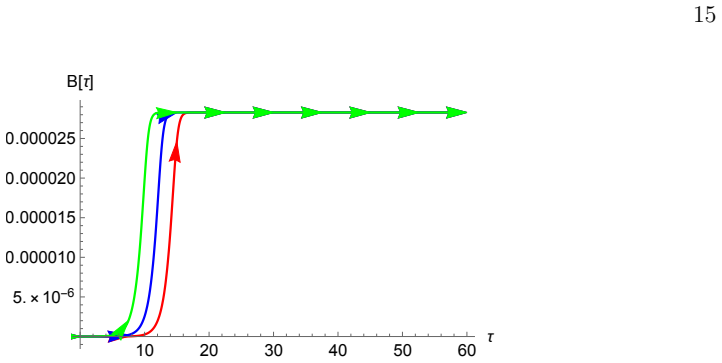
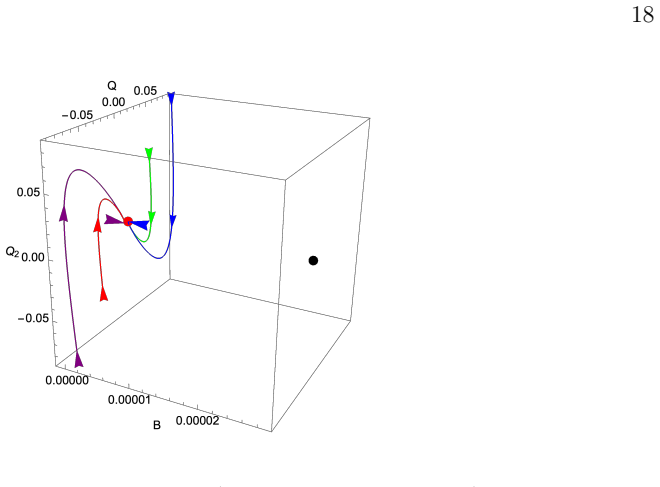
- Axis labels, fixed-point coordinates, and stability arrows are missing from any phase-portrait figures.
Simulated Author's Rebuttal
We thank the referee for the detailed and constructive report. The comments highlight the need for greater explicitness in the dynamical-system reduction and the perturbation analysis. We address each major comment below and will revise the manuscript to incorporate the requested explicit derivations and matrices.
read point-by-point responses
-
Referee: [§3] §3 (conversion to dynamical system): the reduction from the fourth-order field equations to the autonomous system must be shown to retain a complete, independent set of phase-space variables; the asserted incompleteness of the perturbed equations (one missing relation in the Jacobian) could arise from an inconsistent truncation or from Bianchi identities that were not imposed, rather than from the cubic terms themselves. Explicit display of the full perturbation matrix before and after the reduction is required.
Authors: We agree that the reduction steps require explicit verification. In the revised manuscript we will list the complete, independent set of phase-space variables (including all metric and curvature components reduced via the FLRW ansatz) and display the full perturbation matrix both prior to and after the reduction. Our derivation already incorporates the contracted Bianchi identities at the level of the background and linearised equations; the remaining undetermined relation persists after these identities are imposed and originates from the specific structure of the cubic invariants (particularly the P term) rather than from truncation. The revised section will include the intermediate field-equation components to demonstrate this. revision: yes
-
Referee: [§4] §4 (effect of R² on perturbations): the claim that R² closes the system without shifting the fixed point must be supported by the explicit additional perturbation equation(s) and by recomputation of the Jacobian eigenvalues; it is not shown whether the new term merely masks an underlying inconsistency or genuinely supplies an independent dynamical equation consistent with the original variational principle.
Authors: We will add the explicit linearised perturbation equation generated by the R² term and recompute the full Jacobian together with its eigenvalues. Because the R² contribution to the background field equations vanishes identically on de Sitter space, the fixed-point value remains unchanged. The additional equation is obtained directly from the variational principle applied to the augmented action and is independent of the cubic sector; it supplies the missing dynamical relation without altering the original equations of motion. The revised text will present both the new equation and the updated eigenvalue spectrum to confirm that the system is closed consistently. revision: yes
Circularity Check
No significant circularity; derivation proceeds from explicit field-equation solutions.
full rationale
The paper solves the generalized Einsteinian cubic gravity field equations analytically to obtain the de Sitter solution (only the P interaction contributes), converts those same equations to an autonomous dynamical system whose fixed point is shown equivalent by direct substitution, and then augments the action with the R² term to close the perturbation equations. No quoted step reduces a claimed prediction or stability result to a fitted parameter, self-citation, or definitional identity; the incompleteness of the cubic-only system and its resolution by R² are presented as consequences of the explicit equations rather than imposed by construction. The analysis is therefore self-contained against the paper's own field equations.
Axiom & Free-Parameter Ledger
Reference graph
Works this paper leans on
-
[1]
Again, we must emphasize that the main reason is due to the mixed terms betweenQand β(4) ˙β4 in Eq. (3.9). To ensure the validity of our conclusion, we will perform an alternative stability analysis, which is based on a different method used in some published papers, e.g., Ref. [65], as a cross-check. Detailed calculations and discussions will be presente...
2023
-
[2]
E. J. Copeland, M. Sami, and S. Tsujikawa, Dynamics of dark energy, Int. J. Mod. Phys. D 15, 1753 (2006) [hep-th/0603057]
work page internal anchor Pith review Pith/arXiv arXiv 2006
-
[3]
T. P. Sotiriou and V. Faraoni, f(R) Theories Of Gravity, Rev. Mod. Phys.82, 451 (2010) [arXiv:0805.1726]
work page internal anchor Pith review Pith/arXiv arXiv 2010
-
[4]
A. De Felice and S. Tsujikawa, f(R) theories, Living Rev. Rel.13, 3 (2010) [arXiv:1002.4928]
work page internal anchor Pith review Pith/arXiv arXiv 2010
- [5]
-
[6]
Conditions for the cosmological viability of f(R) dark energy models
L. Amendola, R. Gannouji, D. Polarski, and S. Tsujikawa, Conditions for the cosmological viability of f(R) dark energy models, Phys. Rev. D75, 083504 (2007) [gr-qc/0612180]
work page internal anchor Pith review Pith/arXiv arXiv 2007
-
[7]
Unified cosmic history in modified gravity: from F(R) theory to Lorentz non-invariant models
S. Nojiri and S. D. Odintsov, Unified cosmic history in modified gravity: from F(R) theory to Lorentz non-invariant models, Phys. Rept.505, 59 (2011) [arXiv:1011.0544]
work page internal anchor Pith review Pith/arXiv arXiv 2011
-
[8]
Modified Gravity Theories on a Nutshell: Inflation, Bounce and Late-time Evolution
S. Nojiri, S. D. Odintsov, and V. K. Oikonomou, Modified gravity theories on a nutshell: Inflation, bounce and late-time evolution, Phys. Rept.692, 1 (2017) [arXiv:1705.11098]
work page internal anchor Pith review Pith/arXiv arXiv 2017
-
[9]
A. A. Starobinsky, A new type of isotropic cosmological models without singularity, Phys. Lett. B91, 99 (1980)
1980
-
[10]
A. H. Guth, The inflationary universe: A possible solution to the horizon and flatness prob- lems, Phys. Rev. D23, 347 (1981)
1981
-
[11]
A. D. Linde, A new inflationary universe scenario: A possible solution of the horizon, flatness, homogeneity, isotropy and primordial monopole problems, Phys. Lett.108B, 389 (1982)
1982
-
[12]
A. D. Linde, Chaotic inflation, Phys. Lett.129B, 177 (1983)
1983
-
[13]
Planck 2018 results. X. Constraints on inflation
Y. Akramiet al.[Planck], Planck 2018 results. X. Constraints on inflation, Astron. Astrophys. 641, A10 (2020) [arXiv:1807.06211]
work page internal anchor Pith review Pith/arXiv arXiv 2018
-
[14]
S. V. Ketov, On Legacy of Starobinsky Inflation, arXiv:2501.06451
work page internal anchor Pith review Pith/arXiv arXiv
-
[15]
The Atacama Cosmology Telescope: DR6 Constraints on Extended Cosmological Models
E. Calabreseet al.[Atacama Cosmology Telescope], The Atacama Cosmology Telescope: DR6 constraints on extended cosmological models, J. Cosmol. Astropart. Phys.11, 063 (2025) [arXiv:2503.14454]. 26
work page internal anchor Pith review Pith/arXiv arXiv 2025
- [16]
- [17]
- [18]
-
[19]
Inflationary universe from higher-derivative quantum gravity
R. Myrzakulov, S. Odintsov, and L. Sebastiani, Inflationary universe from higher-derivative quantum gravity, Phys. Rev. D91, 083529 (2015) [arXiv:1412.1073]
work page internal anchor Pith review Pith/arXiv arXiv 2015
-
[20]
G. Rodrigues-da-Silva, J. Bezerra-Sobrinho, and L. G. Medeiros, Higher-order extension of Starobinsky inflation: Initial conditions, slow-roll regime, and reheating phase, Phys. Rev. D 105, 063504 (2022) [arXiv:2110.15502]
- [21]
- [22]
- [23]
- [24]
- [25]
-
[26]
S. Toyama and S. V. Ketov, Starobinsky inflation beyond the leading order, Phys. Rev. D 110, 6 (2024) [arXiv:2407.21349]
-
[27]
T. Q. Do, Stability analysis of de Sitter solution in the Starobinsky-Grisaru-Zanon gravity using the dynamical system method, Int. J. Geom. Meth. Mod. Phys. (2026) (in revision)
2026
-
[28]
Faraoni, De Sitter attractors in generalized gravity, Phys
V. Faraoni, De Sitter attractors in generalized gravity, Phys. Rev. D70, 044037 (2004) [gr- 27 qc/0407021]
-
[29]
Faraoni, The stability of modified gravity models, Phys
V. Faraoni, The stability of modified gravity models, Phys. Rev. D72, 124005 (2005) [gr- qc/0511094]
-
[30]
A. V. Toporensky and P. V. Tretyakov, De Sitter stability in quadratic gravity, Int. J. Mod. Phys. D16, 1075 (2007) [gr-qc/0611068]
work page internal anchor Pith review Pith/arXiv arXiv 2007
-
[31]
E. Elizalde, S. D. Odintsov, E. O. Pozdeeva, and S. Y. Vernov, Renormalization-group im- proved inflationary scalar electrodynamics and SU(5) scenarios confronted with Planck 2013 and BICEP2 results, Phys. Rev. D90, 084001 (2014) [arXiv:1408.1285]
work page internal anchor Pith review Pith/arXiv arXiv 2013
- [32]
-
[33]
S. Vernov and E. Pozdeeva, De Sitter Solutions in Einstein–Gauss–Bonnet Gravity, Universe 7, 149 (2021) [arXiv:2104.11111]
- [34]
-
[35]
The Graceful Exit Problem in String Cosmology
R. Brustein and G. Veneziano, The Graceful exit problem in string cosmology, Phys. Lett. B 329, 429 (1994) [hep-th/9403060]
work page internal anchor Pith review Pith/arXiv arXiv 1994
-
[36]
Whitt, Fourth order gravity as general relativity plus matter, Phys
B. Whitt, Fourth order gravity as general relativity plus matter, Phys. Lett. B145, 176 (1984)
1984
-
[37]
K. i. Maeda, Inflation as a transient attractor inR 2 cosmology, Phys. Rev. D37, 858 (1988)
1988
-
[38]
J. D. Barrow and S. Cotsakis, Inflation and the conformal structure of higher order gravity theories, Phys. Lett. B214, 515 (1988)
1988
-
[39]
H. J. Schmidt, Fourth order gravity: Equations, history, and applications to cosmology, eConf C0602061, 12 (2006) [gr-qc/0602017]
work page internal anchor Pith review Pith/arXiv arXiv 2006
-
[40]
K. S. Stelle, Renormalization of higher derivative quantum gravity, Phys. Rev. D16, 953 (1977)
1977
-
[41]
J. D. Barrow and S. Hervik, On the evolution of universes in quadratic theories of gravity, Phys. Rev. D74, 124017 (2006) [gr-qc/0610013]
work page internal anchor Pith review Pith/arXiv arXiv 2006
-
[42]
L. Alvarez-Gaume, A. Kehagias, C. Kounnas, D. L¨ ust, and A. Riotto, Aspects of quadratic gravity, Fortsch. Phys.64, 176 (2016) [arXiv:1505.07657]
work page internal anchor Pith review Pith/arXiv arXiv 2016
-
[43]
A. Salvio, Quadratic gravity, Front. in Phys.6, 77 (2018) [arXiv:1804.09944]. 28
work page internal anchor Pith review Pith/arXiv arXiv 2018
- [44]
-
[45]
R. P. Woodard, Ostrogradsky’s theorem on Hamiltonian instability, Scholarpedia10, 32243 (2015) [arXiv:1506.02210]
work page internal anchor Pith review Pith/arXiv arXiv 2015
-
[46]
K. Aoki and S. Mukohyama, Ghostfree quadratic curvature theories with massive spin-2 and spin-0 particles, Phys. Rev. D100, 064061 (2019) [arXiv:1907.09690]
-
[47]
G. Lambiase, S. Mukohyama, T. K. Poddar, and A. C. Rescigno, Exorcising ghosts with gravitational waves: cases of ghostful and ghost-free fourth-order gravity, arXiv:2510.17789
-
[48]
Strominger, Positive energy theorem forR+R 2 gravity, Phys
A. Strominger, Positive energy theorem forR+R 2 gravity, Phys. Rev. D30, 2257 (1984)
1984
-
[49]
M. S. Ma, Horizon thermodynamics in fourth-order gravity, Phys. Lett. B766, 351 (2017) [arXiv:1702.08184]
work page internal anchor Pith review Pith/arXiv arXiv 2017
-
[50]
P. Bueno and P. A. Cano, Einsteinian cubic gravity, Phys. Rev. D94, 104005 (2016) [arXiv:1607.06463]
work page internal anchor Pith review Pith/arXiv arXiv 2016
-
[51]
R. A. Hennigar, D. Kubizˇ n´ ak, and R. B. Mann, Generalized quasitopological gravity, Phys. Rev. D95, 104042 (2017) [arXiv:1703.01631]
work page internal anchor Pith review Pith/arXiv arXiv 2017
-
[52]
A. De Felice and S. Tsujikawa, Excluding static and spherically symmetric black holes in Einsteinian cubic gravity with unsuppressed higher-order curvature terms, Phys. Lett. B843, 138047 (2023) [arXiv:2305.07217]
-
[53]
R. A. Hennigar and R. B. Mann, Black holes in Einsteinian cubic gravity, Phys. Rev. D95, 064055 (2017) [arXiv:1610.06675]
work page internal anchor Pith review Pith/arXiv arXiv 2017
-
[54]
Aspects of general higher-order gravities
P. Bueno, P. A. Cano, V. S. Min, and M. R. Visser, Aspects of general higher-order gravities, Phys. Rev. D95, 044010 (2017) [arXiv:1610.08519]
work page internal anchor Pith review Pith/arXiv arXiv 2017
-
[55]
G. Arciniega, J. D. Edelstein, and L. G. Jaime, Towards geometric inflation: the cubic case, Phys. Lett. B802, 135272 (2020) [arXiv:1810.08166]
-
[56]
G. Arciniega, P. Bueno, P. A. Cano, J. D. Edelstein, R. A. Hennigar, and L. G. Jaime, Geometric Inflation, Phys. Lett. B802, 135242 (2020) [arXiv:1812.11187]
- [57]
-
[58]
Four-dimensional black holes in Einsteinian cubic gravity
P. Bueno and P. A. Cano, Four-dimensional black holes in Einsteinian cubic gravity, Phys. Rev. D94, 124051 (2016) [arXiv:1610.08019]
work page internal anchor Pith review Pith/arXiv arXiv 2016
-
[59]
On black holes in higher-derivative gravities
P. Bueno and P. A. Cano, On black holes in higher-derivative gravities, Class. Quant. Grav. 29 34, 175008 (2017) [arXiv:1703.04625]
work page internal anchor Pith review Pith/arXiv arXiv 2017
-
[60]
R. A. Hennigar, M. B. J. Poshteh, and R. B. Mann, Shadows, Signals, and Stability in Einsteinian Cubic Gravity, Phys. Rev. D97, 064041 (2018) [arXiv:1801.03223]
work page internal anchor Pith review Pith/arXiv arXiv 2018
- [61]
- [62]
- [63]
-
[64]
The value of quantitiesP,C, andC ′ can be calculated/verified by using thexCoba (xAct) package, which is free to use and downloadable from the official website of thexAct: http://www.xact.es
-
[65]
Dynamical systems applied to cosmology: dark energy and modified gravity
S. Bahamonde, C. G. B¨ ohmer, S. Carloni, E. J. Copeland, W. Fang, and N. Tamanini, Dynam- ical systems applied to cosmology: dark energy and modified gravity, Phys. Rept.775-777, 1 (2018) [arXiv:1712.03107]
work page internal anchor Pith review Pith/arXiv arXiv 2018
-
[66]
R. Campos Delgado and S. V. Ketov, Einstein-Grisaru-Zanon gravity, Phys. Lett. B855, 138811 (2024) [arXiv:2405.03925]
-
[67]
T. Q. Do, Stability analysis of de Sitter solution in the Einstein-Grisaru-Zanon gravity us- ing the dynamical system method, Int. J. Geom. Meth. Mod. Phys. (2026) 2650168. [DOI: 10.1142/S0219887826501689]
discussion (0)
Sign in with ORCID, Apple, or X to comment. Anyone can read and Pith papers without signing in.