Garment Particles: A 2D--3D Symmetric Garment Representation for Generation and Editing
Pith reviewed 2026-06-29 18:58 UTC · model grok-4.3
The pith
A 5D point-cloud representation jointly encodes 2D sewing patterns and 3D garment geometry for unified generation and editing.
A machine-rendered reading of the paper's core claim, the machinery that carries it, and where it could break.
Core claim
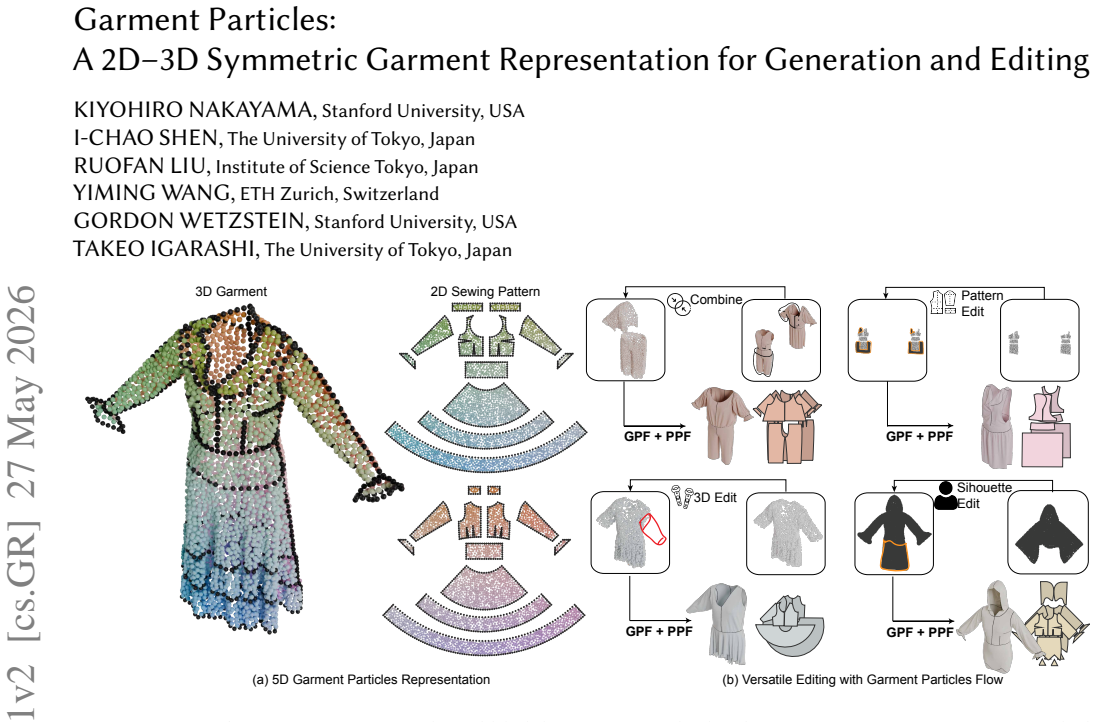
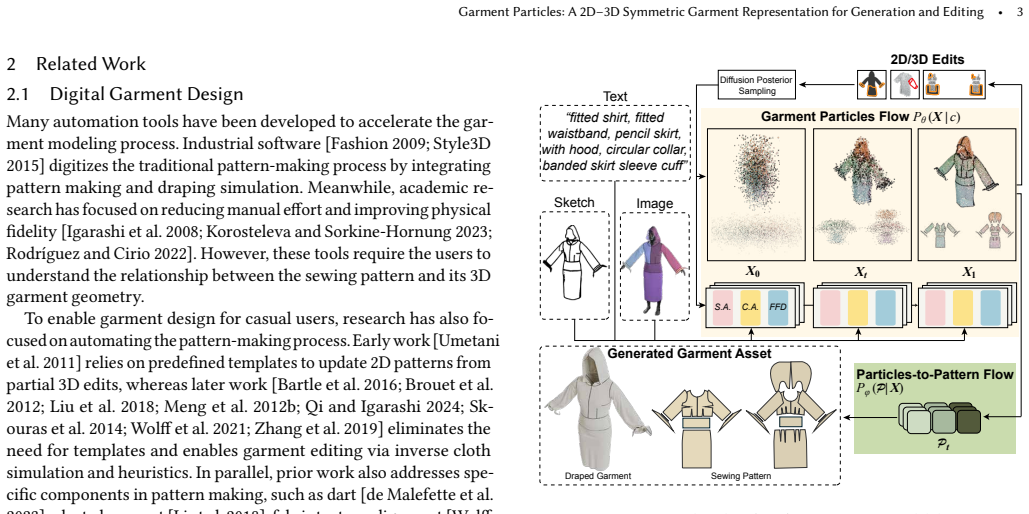
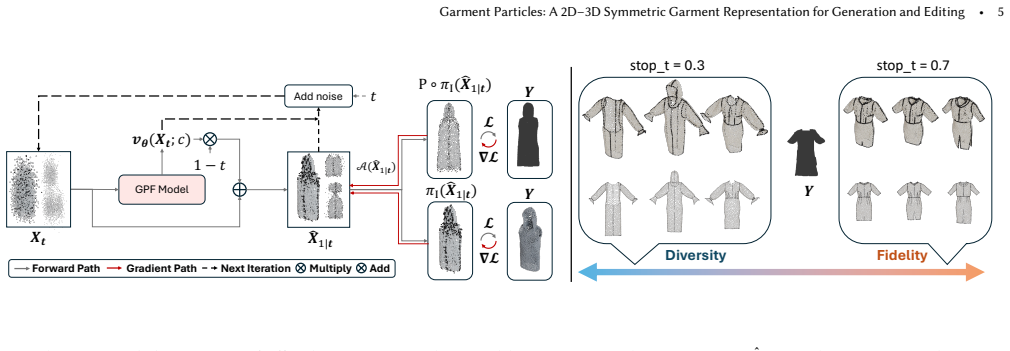
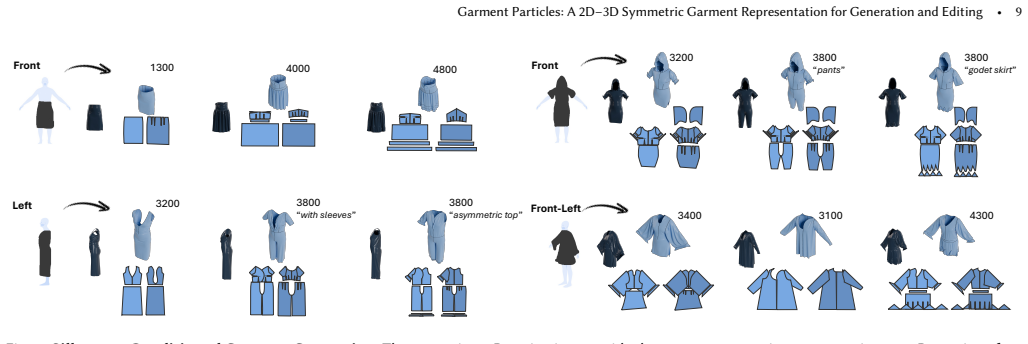
Garment Particles is a 5D point-cloud representation that jointly encodes 2D sewing patterns and 3D geometry. This representation enables Garment Particles Flow (GPF), a rectified flow framework that supports intuitive generation from high-level inputs (text, images, sketches) and various editing operations on 2D sewing patterns and 3D geometries via diffusion posterior sampling. Particles-to-Pattern Flow then converts generated garment particles into curved-based patterns for simulation.
What carries the argument
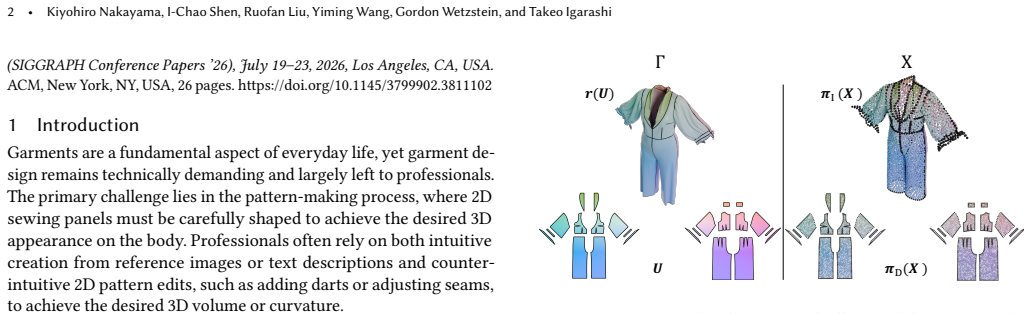
Garment Particles, the 5D point-cloud representation that jointly encodes 2D sewing patterns and 3D draped geometry in a single symmetric structure.
Load-bearing premise
The 5D point-cloud representation can jointly encode 2D sewing patterns and 3D draped geometry while preserving their complex interdependencies without critical information loss.
What would settle it
An experiment in which an edited 2D sewing pattern is run through conventional physics simulation and the resulting 3D shape differs substantially from the 3D geometry produced by editing the corresponding 5D particles.
Figures
read the original abstract
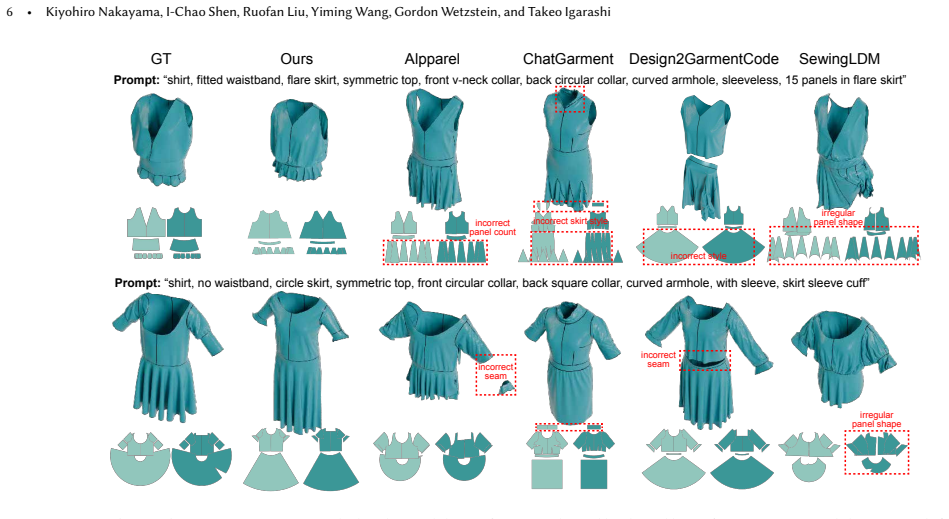
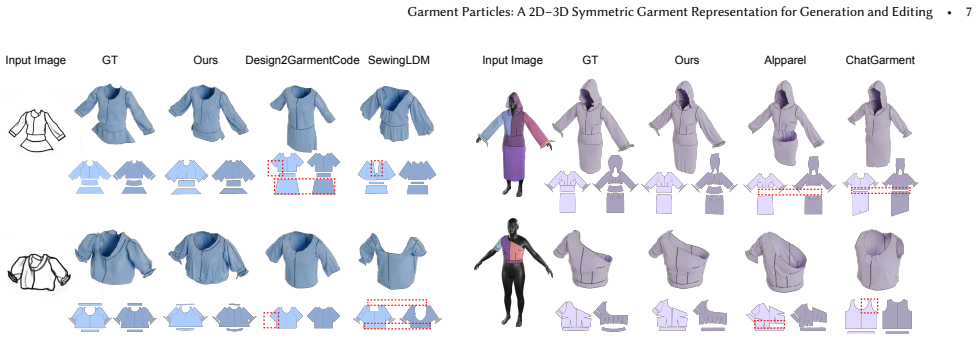
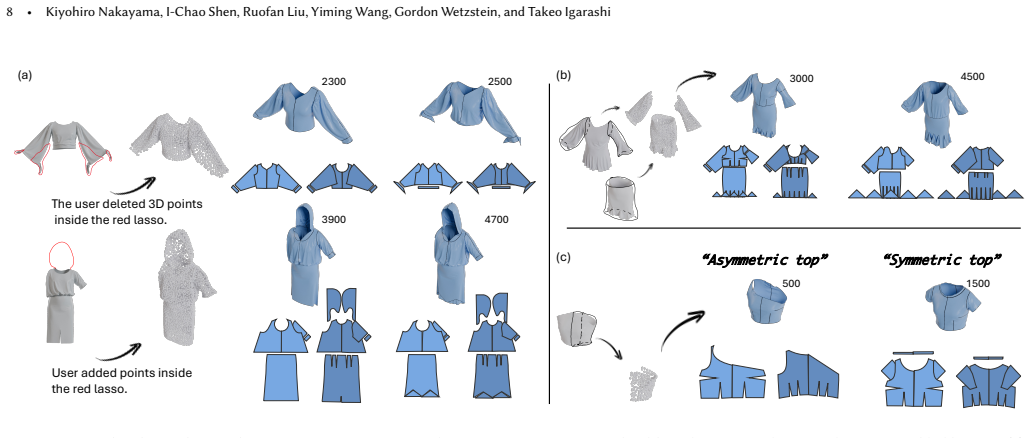
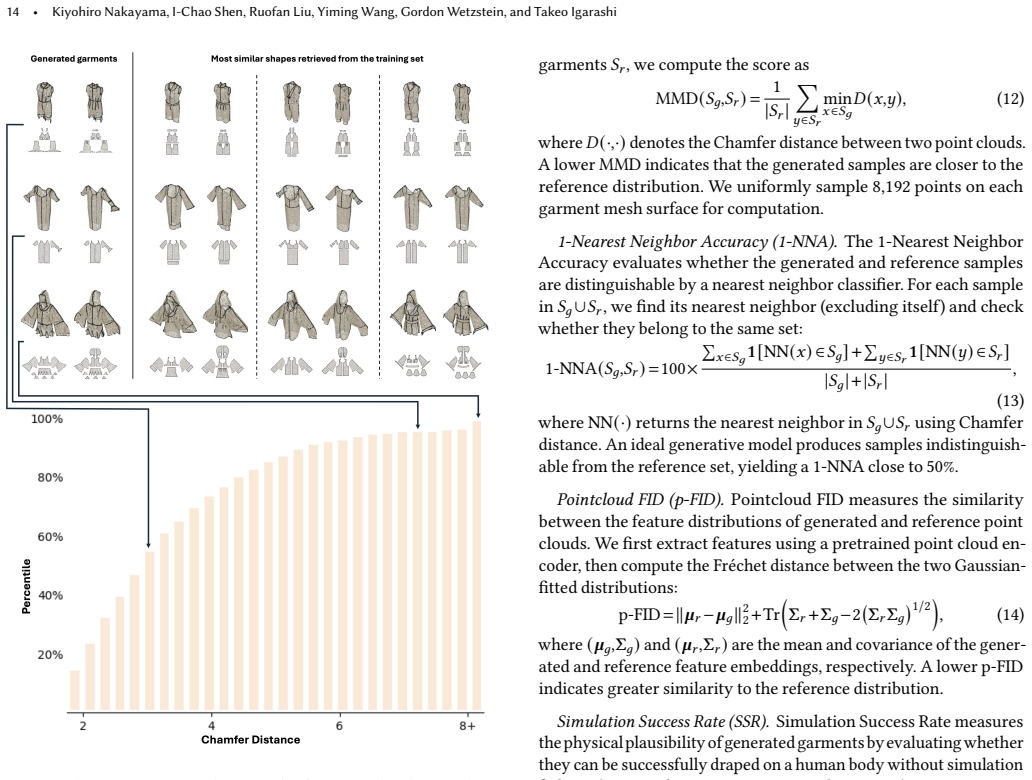
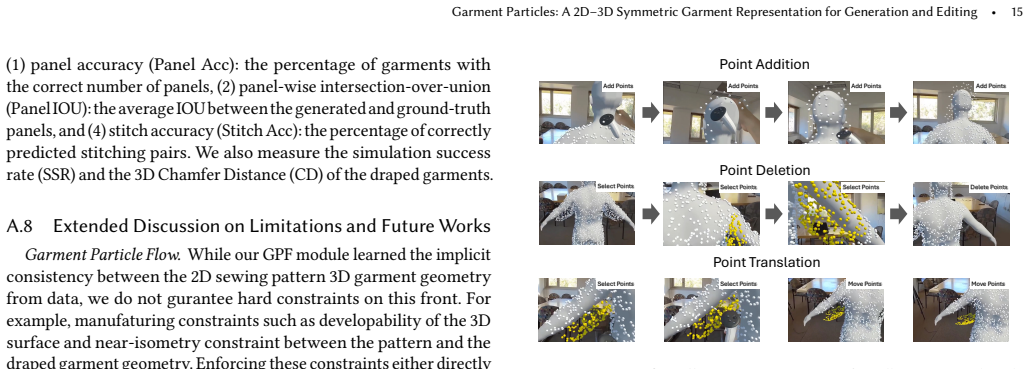
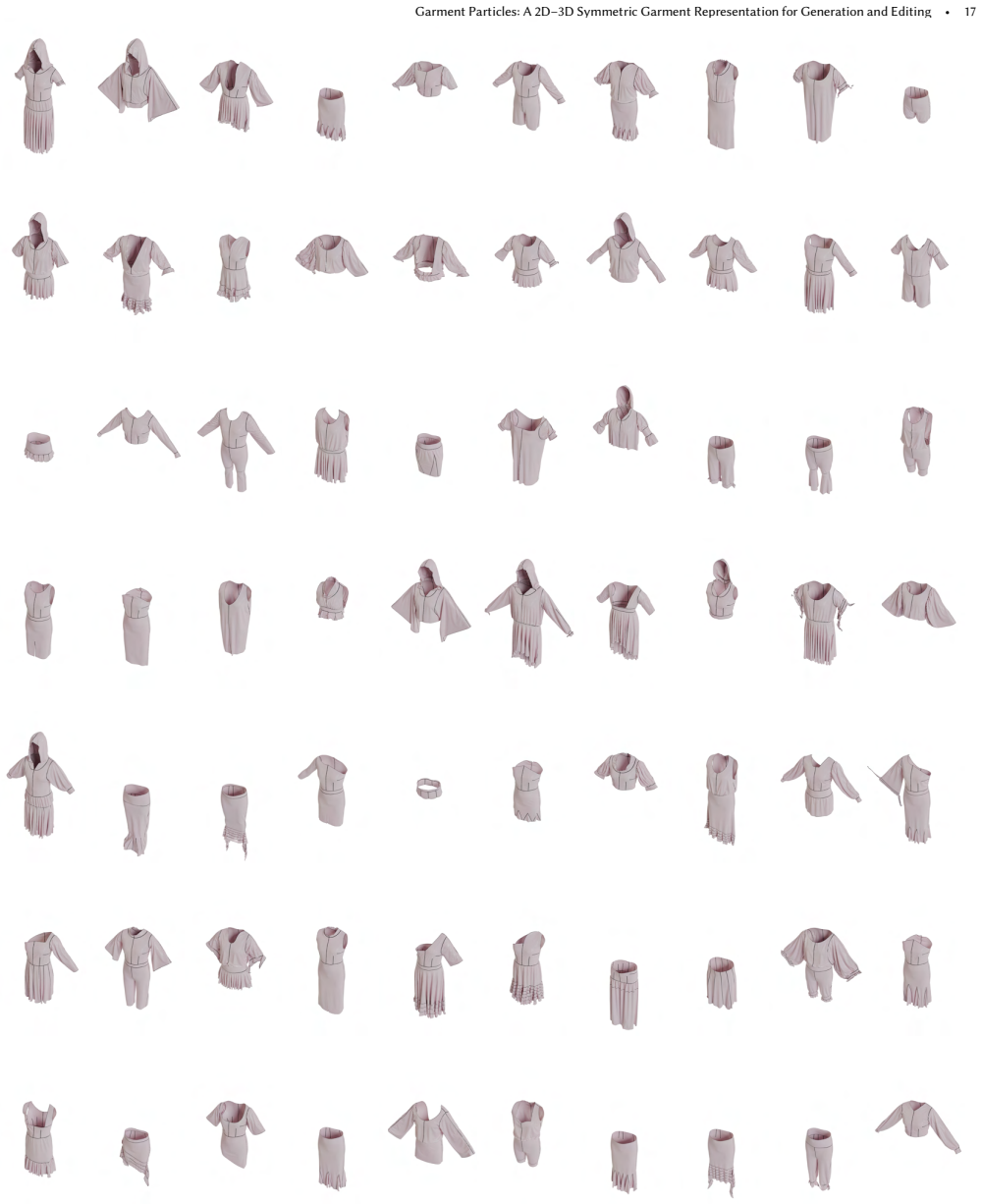
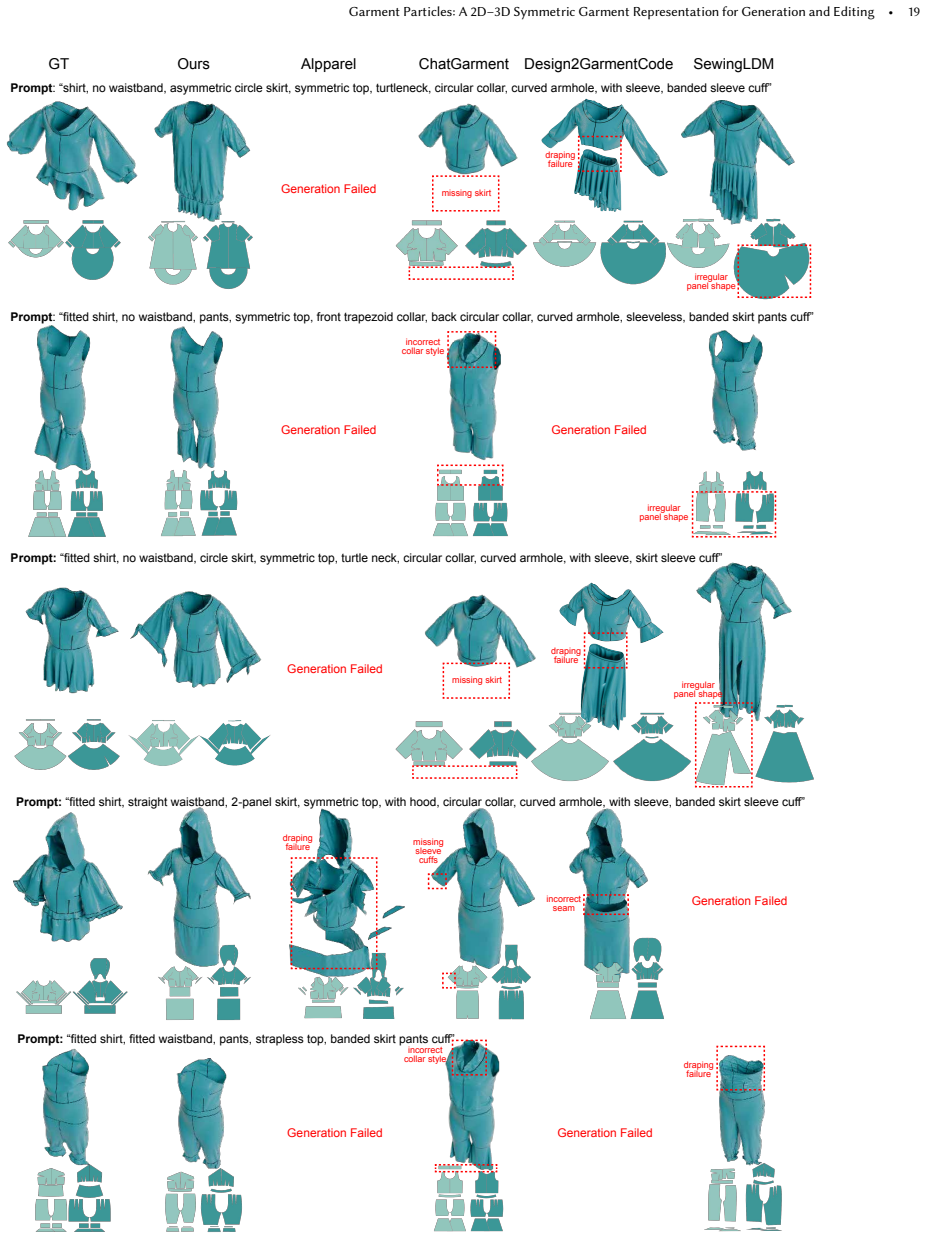
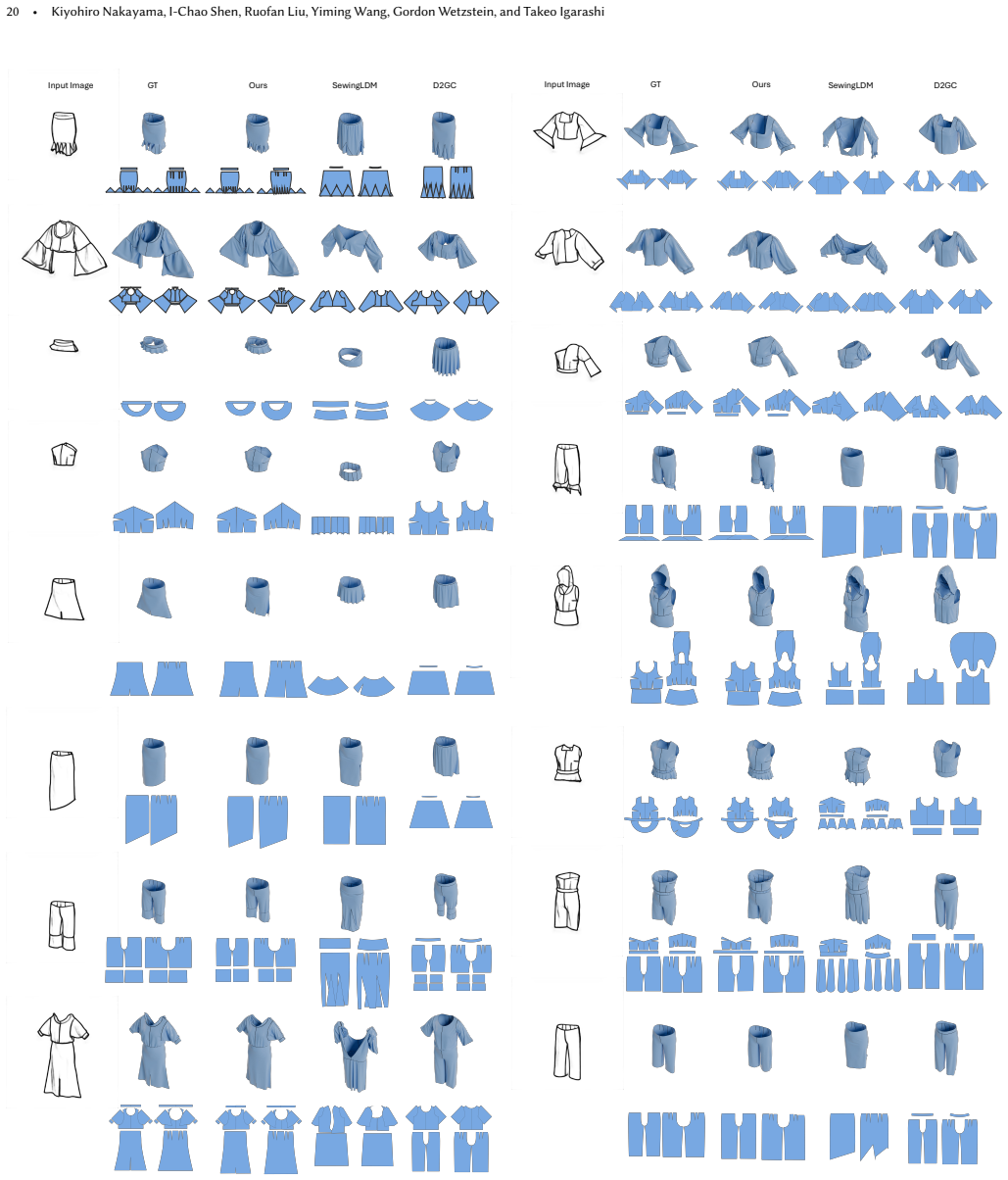
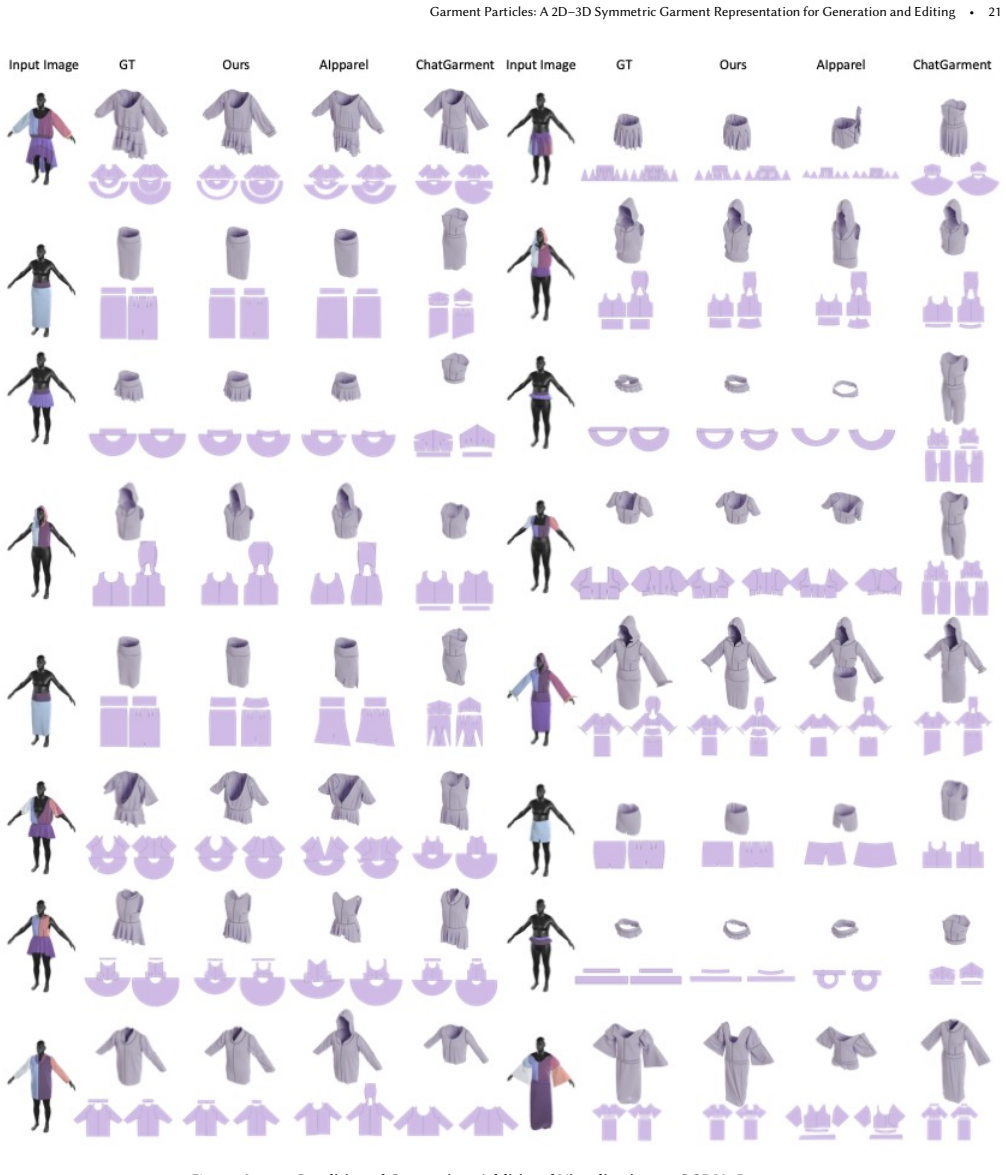
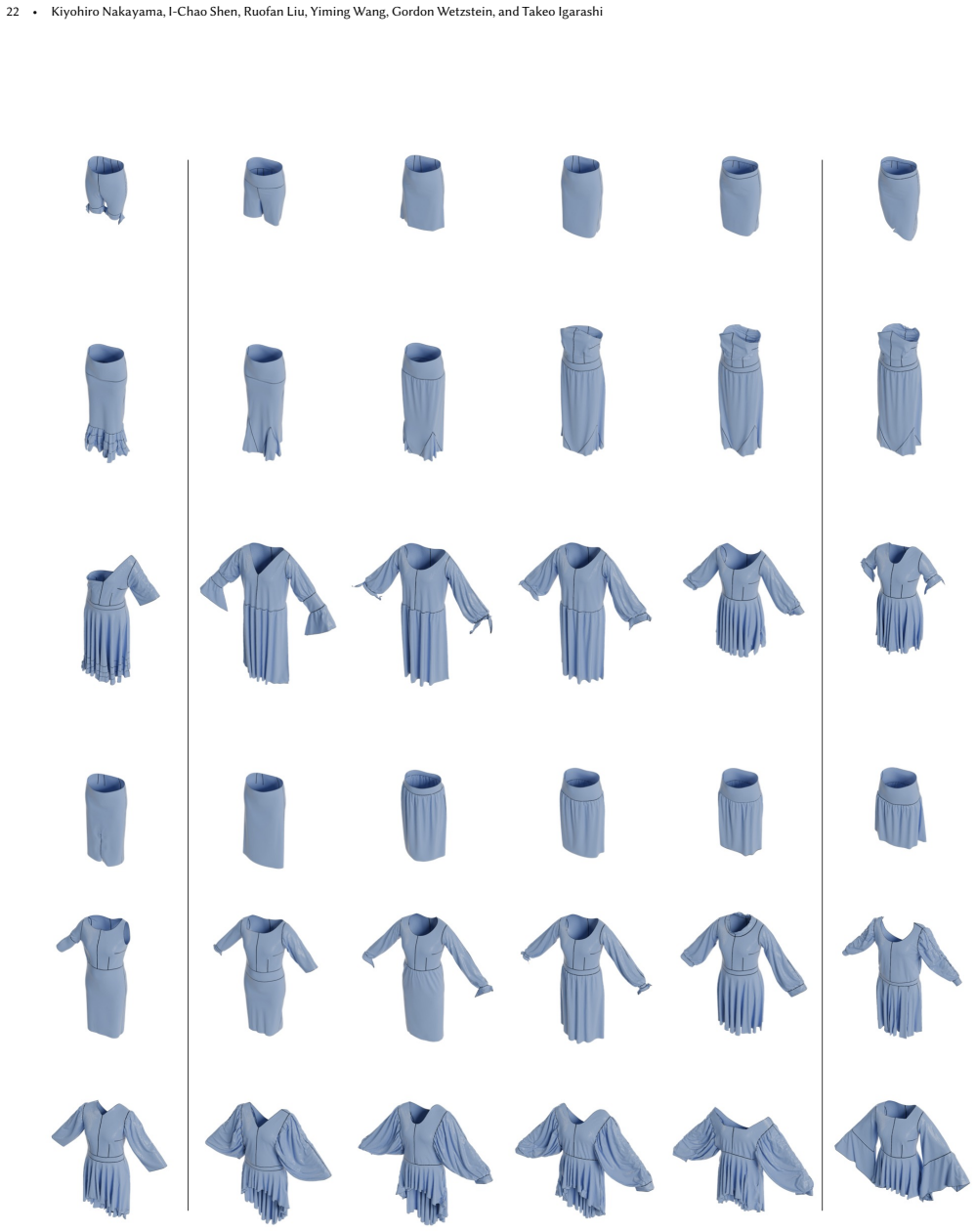
Practical garment design spans two modes: intuitive creation from high-level intent, such as a reference image or text description, and complex low-level editing across 2D sewing patterns and 3D draped geometry, which requires professional training to navigate their complex interdependencies. Yet existing frameworks address only part of this challenge, offering either garment generation from casual inputs or direct editing on sewing patterns. To support both ends of the spectrum, we propose Garment Particles, a 5D point-cloud representation that jointly encodes 2D sewing patterns and 3D geometry. This representation enables Garment Particles Flow (GPF), a rectified flow framework that supports intuitive generation from high-level inputs (text, images, sketches) and various editing operations on 2D sewing patterns and 3D geometries via diffusion posterior sampling. Finally, we introduce Particles-to-Pattern Flow that converts generated garment particles into curved-based patterns for simulation. We validate our model's generation ability on multiple datasets, achieving state-of-the-art garment generation results against competitive baselines. Our model also enables many garment editing scenarios, including garment interpolation, sewing pattern editing, point-cloud- and silhouette-conditioned garment generation. Our project website is at https://garment-particles.github.io .
Editorial analysis
A structured set of objections, weighed in public.
Referee Report
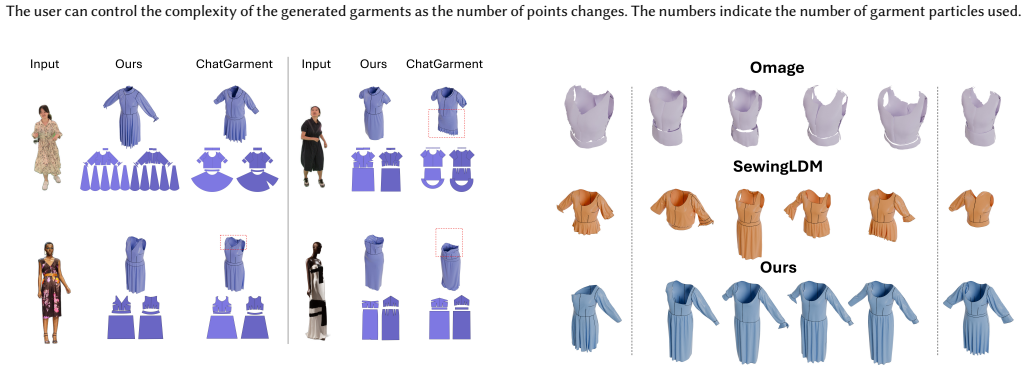
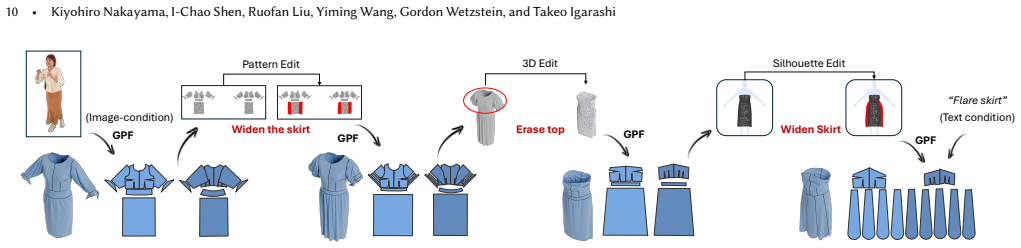
Summary. The paper proposes Garment Particles, a 5D point-cloud representation that jointly encodes 2D sewing patterns and 3D draped geometry in a symmetric manner. This representation underpins Garment Particles Flow (GPF), a rectified-flow model supporting generation from high-level inputs (text, images, sketches) and editing operations (interpolation, pattern editing, conditioned generation) via diffusion posterior sampling. The work also introduces a Particles-to-Pattern Flow conversion to produce curve-based patterns suitable for simulation. The authors claim state-of-the-art quantitative results on multiple garment datasets and demonstrate qualitative editing scenarios.
Significance. If the 5D representation successfully preserves interdependencies between 2D patterns and 3D geometry without critical loss, the unified framework would meaningfully advance garment modeling in computer graphics by bridging casual generation and professional editing. The application of rectified flow and posterior sampling to this domain, together with the explicit Particles-to-Pattern conversion step, constitutes a practical contribution. The stress-test concern regarding information loss in the joint encoding does not manifest as an internal inconsistency or unsupported step in the described pipeline; the central claims rest on established techniques applied to a novel representation rather than circular definitions.
minor comments (3)
- Abstract: the statement that results are 'state-of-the-art' against 'competitive baselines' would be strengthened by naming the datasets and reporting at least one key quantitative metric (e.g., Chamfer distance or IoU) directly in the abstract.
- Section 3: the construction of the 5D point cloud (how the two extra dimensions encode sewing pattern information alongside 3D coordinates) should include an explicit equation or pseudocode to clarify the joint encoding.
- The Particles-to-Pattern Flow conversion is introduced but its algorithmic details and any associated error metrics are not described in sufficient detail for reproducibility.
Simulated Author's Rebuttal
We thank the referee for their positive summary of our work, the favorable assessment of its significance, and the recommendation for minor revision. No major comments were listed in the report.
Circularity Check
No significant circularity detected
full rationale
The paper introduces Garment Particles as a novel 5D point-cloud representation jointly encoding 2D sewing patterns and 3D geometry, then applies established rectified flow (GPF) and diffusion posterior sampling for generation/editing, plus a Particles-to-Pattern conversion step. No derivation reduces by construction to fitted inputs, self-definitions, or load-bearing self-citations; the central claims rest on the proposed architecture and external benchmarks rather than tautological equivalences. The framework is self-contained against standard ML techniques without internal reduction to author-defined priors.
Axiom & Free-Parameter Ledger
invented entities (1)
-
Garment Particles (5D point-cloud representation)
no independent evidence
Reference graph
Works this paper leans on
-
[1]
Graph.35, 4, Article 50 (July 2016), 11 pages
Physics-driven pattern adjustment for direct 3D garment editing.ACM Trans. Graph.35, 4, Article 50 (July 2016), 11 pages. doi:10.1145/2897824.2925896 Siyuan Bian, Chenghao Xu, Yuliang Xiu, Artur Grigorev, Zhen Liu, Cewu Lu, Michael J Black, and Yao Feng
-
[2]
ChatGarment: Garment Estimation, Generation and Editing via Large Language Models. (2025). Remi Brouet, Alla Sheffer, Laurence Boissieux, and Marie-Paule Cani
2025
-
[3]
Graph.31, 4, Article 36 (July 2012), 11 pages
Design preserving garment transfer.ACM Trans. Graph.31, 4, Article 36 (July 2012), 11 pages. doi:10.1145/2185520.2185532 Selim Emir Can, Jan Ackermann, Kiyohiro Nakayama, Ruofan Liu, Tong Wu, Yang Zheng, Hugo Bertiche, Menglei Chai, Thabo Beeler, and Gordon Wetzstein
-
[4]
Image2Garment: Simulation-ready Garment Generation from a Single Image.arXiv preprint arXiv:2601.09658(2026). Hsiao-Yu Chen, Egor Larionov, Ladislav Kavan, Gene Lin, Doug Roble, Olga Sorkine- Hornung, and Tuur Stuyck
-
[5]
Dress Anyone: Automatic Physically-Based Garment Pattern Refitting.Proc. ACM Comput. Graph. Interact. Tech.8, 4, Article 56 (Aug. 2025), 17 pages. doi:10.1145/3747858 Hyungjin Chung, Jeongsol Kim, Michael Thompson Mccann, Marc Louis Klasky, and Jong Chul Ye
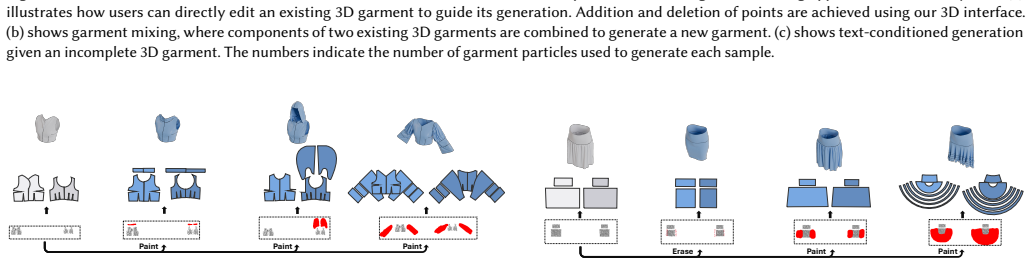
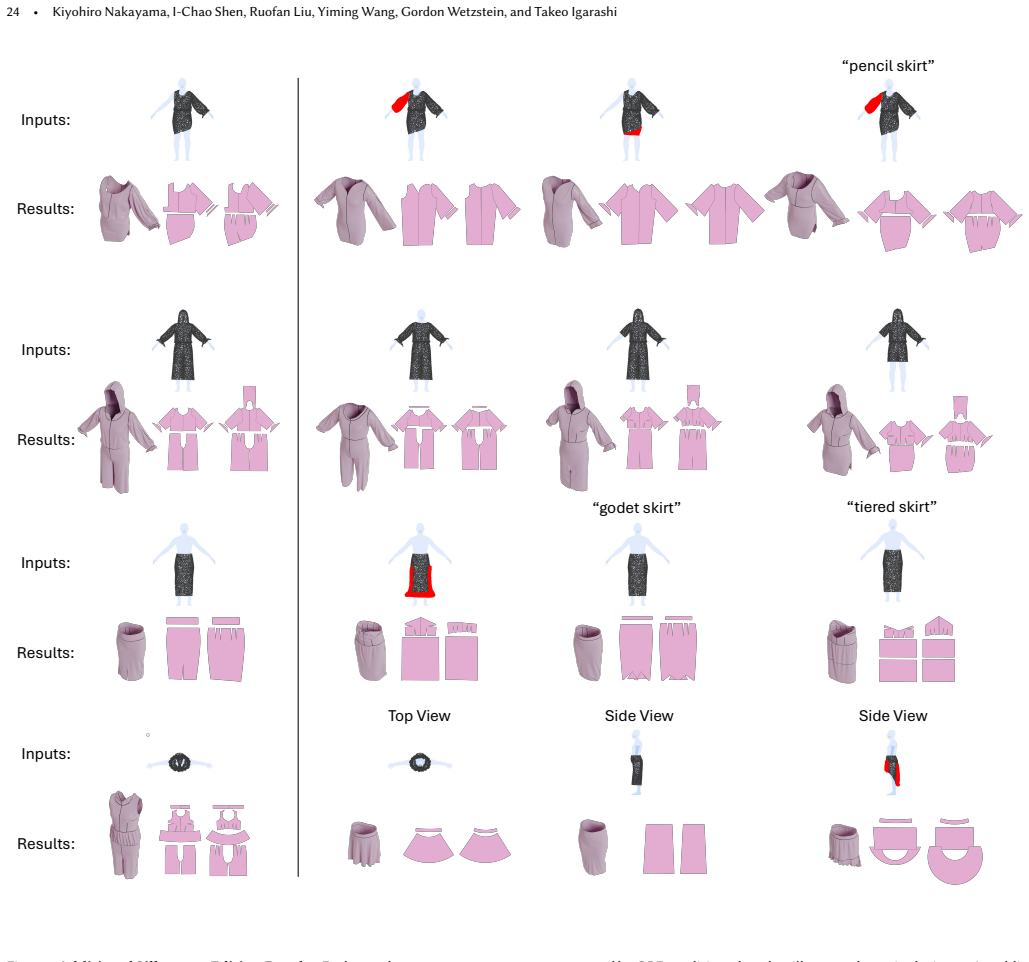
-
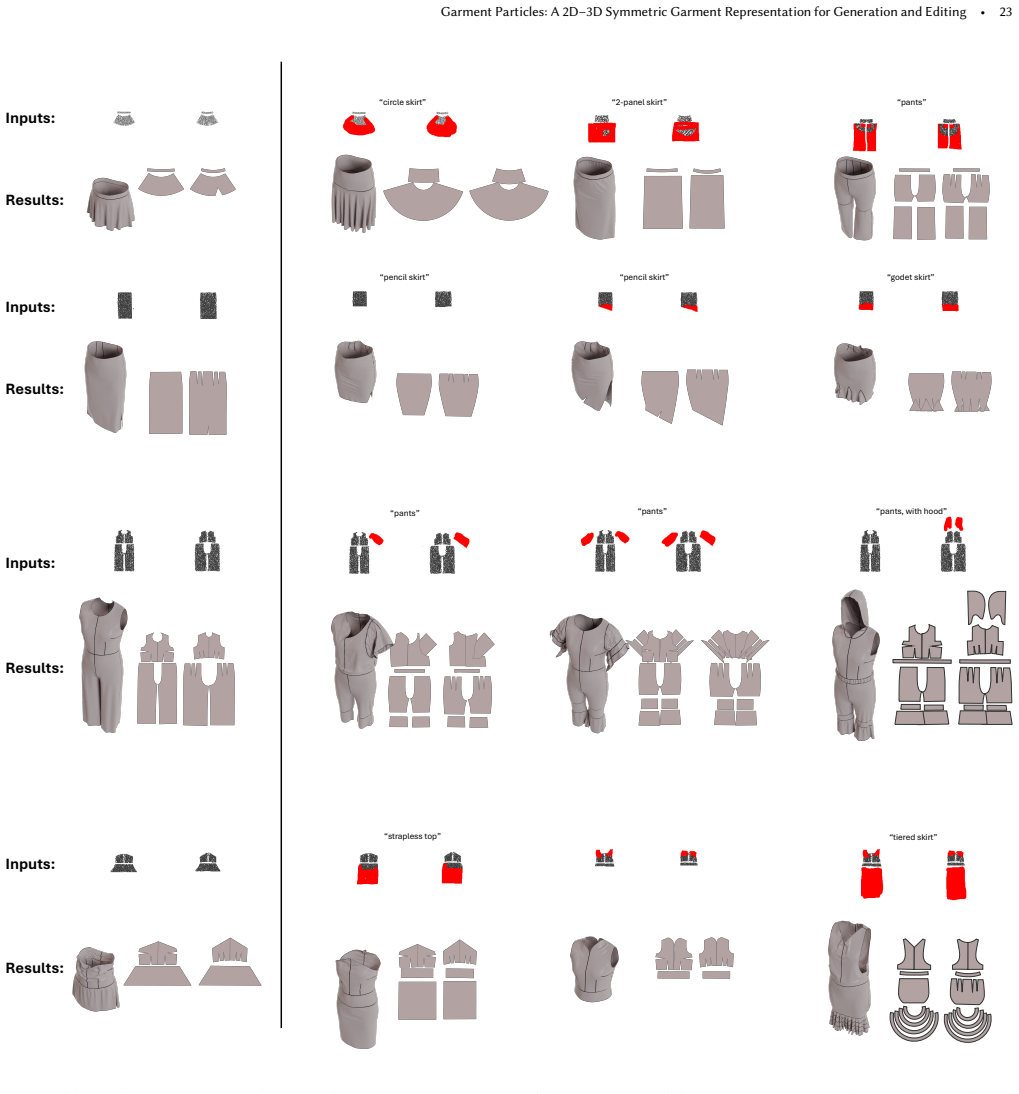
[6]
doi:10.1108/09556220810843502 Tri Dao, Daniel Y
Made-to-measure pattern development based on 3D whole body scans.International Journal of Clothing Science and Technology 20 (01 2008), 15–25. doi:10.1108/09556220810843502 Tri Dao, Daniel Y. Fu, Stefano Ermon, Atri Rudra, and Christopher Ré
-
[7]
FlashAttention: Fast and Memory-Efficient Exact Attention with IO-Awareness
FlashAttention: Fast and Memory-Efficient Exact Attention with IO-Awareness. arXiv:2205.14135 [cs.LG] https://arxiv.org/abs/2205.14135 Charles de Malefette, Anran Qi, Amal Dev Parakkat, Marie-Paule Cani, and Takeo Igarashi
work page internal anchor Pith review Pith/arXiv arXiv
-
[8]
In SIGGRAPH Asia 2023 Technical Communications(Sydney, NSW, Australia)(SA ’23)
PerfectDart: Automatic Dart Design for Garment Fitting. In SIGGRAPH Asia 2023 Technical Communications(Sydney, NSW, Australia)(SA ’23). Association for Computing Machinery, New York, NY, USA, Article 7, 4 pages. doi:10.1145/3610543.3626154 A. M. Eggler, R. Falque, M. Liu, T. Vidal-Calleja, O. Sorkine-Hornung, and N. Pietroni
-
[9]
Digital Garment Alteration.Computer Graphics Forum43, 7 (2024), e15248. arXiv:https://onlinelibrary.wiley.com/doi/pdf/10.1111/cgf.15248 doi:10.1111/cgf.15248 Slava Elizarov, Ciara Rowles, and Simon Donné
-
[10]
Geometry image diffusion: Fast and data-efficient text-to-3d with image-based surface representation.arXiv preprint arXiv:2409.03718(2024). CLO Virtual Fashion. 2009.CLO 3D – 3D fashion design software. https://www.clo3d.com/ Accessed: 2025-10-07. Xianfeng Gu, Steven J. Gortler, and Hugues Hoppe
-
[11]
Graph.21, 3 (July 2002), 355–361
Geometry images.ACM Trans. Graph.21, 3 (July 2002), 355–361. doi:10.1145/566654.566589 Kai He, Kaixin Yao, Qixuan Zhang, Jingyi Yu, Lingjie Liu, and Lan Xu. 2024b. Dress- Code: Autoregressively Sewing and Generating Garments from Text Guidance. arXiv:2401.16465 [cs.CV] https://arxiv.org/abs/2401.16465 Qingdong He, Jinlong Peng, Pengcheng Xu, Boyuan Jiang,...
-
[12]
CLIPScore: A Reference-free Evaluation Metric for Image Captioning
CLIPScore: A Reference-free Evaluation Metric for Image Captioning.ArXiv abs/2104.08718 (2021). https://api.semanticscholar.org/CorpusID:233296711 SIGGRAPH Conference Papers ’26, July 19–23, 2026, Los Angeles, CA, USA. Garment Particles: A 2D–3D Symmetric Garment Representation for Generation and Editing•11 Yuki Igarashi, Takeo Igarashi, and Hiromasa Suzuki
work page internal anchor Pith review Pith/arXiv arXiv 2021
-
[13]
InACM SIGGRAPH 2008 Posters(Los Angeles, California) (SIGGRAPH ’08)
Automatically adding seam allowance to cloth pattern. InACM SIGGRAPH 2008 Posters(Los Angeles, California) (SIGGRAPH ’08). Association for Computing Machinery, New York, NY, USA, Article 15, 1 pages. doi:10.1145/1400885.1400902 Menglin Jia, Mengyun Shi, Mikhail Sirotenko, Yin Cui, Claire Cardie, Bharath Hariharan, Hartwig Adam, and Serge Belongie
- [14]
-
[15]
arXiv:2405.17609 [cs.CV] https://arxiv.org/abs/2405.17609 Maria Korosteleva and Sung-Hee Lee
GarmentCodeData: A Dataset of 3D Made-to-Measure Garments With Sewing Patterns. arXiv:2405.17609 [cs.CV] https://arxiv.org/abs/2405.17609 Maria Korosteleva and Sung-Hee Lee
-
[16]
NeuralTailor: Reconstructing Sewing Pattern Structures from 3D Point Clouds of Garments.ACM Trans. Graph.41, 4 (2022), 16 pages. doi:10.1145/3528223.3530179 Maria Korosteleva and Olga Sorkine-Hornung
-
[17]
doi:10.1145/3618351 SIGGRAPH ASIA 2023 issue
GarmentCode: Programming Parametric Sewing Patterns.ACM Transaction on Graphics42, 6 (2023), 16 pages. doi:10.1145/3618351 SIGGRAPH ASIA 2023 issue. Mingi Lee, Dongsu Zhang, Clément Jambon, and Young Min Kim
-
[18]
BrepDiff: Single- Stage B-rep Diffusion Model. InProceedings of the Special Interest Group on Computer Graphics and Interactive Techniques Conference Conference Papers(Vancouver, BC, Canada)(SIGGRAPH Conference Papers ’25). Association for Computing Machinery, New York, NY, USA, Article 103, 11 pages. doi:10.1145/3721238.3730698 Minchen Li, Alla Sheffer, ...
-
[19]
Graph.37, 4, Article 133 (July 2018), 13 pages
Foldsketch: enriching garments with physically reproducible folds.ACM Trans. Graph.37, 4, Article 133 (July 2018), 13 pages. doi:10.1145/3197517.3201310 Ren Li, Cong Cao, Corentin Dumery, Yingxuan You, Hao Li, and Pascal Fua. 2025a. Single View Garment Reconstruction Using Diffusion Mapping Via Pattern Coordinates. InProceedings of the Special Interest Gr...
-
[20]
Flow-GRPO: Training Flow Matching Models via Online RL
ISP: Multi-Layered Garment Draping with Implicit Sewing Patterns. InAdvances in Neural Information Processing Systems. Shudong Li, Xiao Jiang, Matthew Tivnan, Grace J Gang, Yuan Shen, and J Webster Stayman. 2024b. CT reconstruction using diffusion posterior sampling conditioned on a nonlinear measurement model.Journal of Medical Imaging11, 4 (2024), 04350...
work page internal anchor Pith review Pith/arXiv arXiv doi:10.1145/3763271 2024
-
[21]
Computer-Aided Design104 (2018), 113–124
3D interactive garment pattern-making technology. Computer-Aided Design104 (2018), 113–124. doi:10.1016/j.cad.2018.07.003 Lijuan Liu, Xiangyu Xu, Zhijie Lin, Jiabin Liang, and Shuicheng Yan
-
[22]
Towards Garment Sewing Pattern Reconstruction from a Single Image.ACM Transactions on Graphics (SIGGRAPH Asia)(2023). Shengqi Liu, Yuhao Cheng, Zhuo Chen, Xingyu Ren, Wenhan Zhu, Lincheng Li, Mengxiao Bi, Xiaokang Yang, and Yichao Yan. 2025a. Multimodal Latent Diffusion Model for Complex Sewing Pattern Generation.International Conference on Computer Visio...
-
[23]
Computer Vision and Pattern Recognition (CVPR)(2025)
AIpparel: A Multimodal Foundation Model for Digital Garments. Computer Vision and Pattern Recognition (CVPR)(2025). Maxime Oquab, Timothée Darcet, Théo Moutakanni, Huy Vo, Marc Szafraniec, Vasil Khalidov, Pierre Fernandez, Daniel Haziza, Francisco Massa, Alaaeldin El-Nouby, et al
2025
-
[24]
DINOv2: Learning Robust Visual Features without Supervision
Dinov2: Learning robust visual features without supervision.arXiv preprint arXiv:2304.07193(2023). Maitreya Patel, Song Wen, Dimitris N. Metaxas, and Yezhou Yang
work page internal anchor Pith review Pith/arXiv arXiv 2023
-
[25]
William Peebles and Saining Xie
Steering Rectified Flow Models in the Vector Field for Controlled Image Generation.arXiv preprint arXiv:2412.00100(2024). William Peebles and Saining Xie
-
[26]
Scalable Diffusion Models with Transformers
Scalable Diffusion Models with Transformers. arXiv:2212.09748 [cs.CV] https://arxiv.org/abs/2212.09748 Nico Pietroni, Corentin Dumery, Raphael Falque, Mark Liu, Teresa A Vidal-Calleja, and Olga Sorkine-Hornung
work page internal anchor Pith review Pith/arXiv arXiv
-
[27]
Graph.41, 4 (2022), 157–1
Computational pattern making from 3D garment models.ACM Trans. Graph.41, 4 (2022), 157–1. Anran Qi and Takeo Igarashi
2022
-
[28]
PerfectTailor: Scale-Preserving 2-D Pattern Adjustment Driven by 3-D Garment Editing.IEEE Comput. Graph. Appl.44, 4 (July 2024), 126–132. doi:10.1109/MCG.2024.3378171 ANRAN QI, NICO PIETRONI, MARIA KOROSTELEVA, OLGA SORKINE-HORNUNG, and ADRIEN BOUSSEAU
-
[29]
In SIGGRAPH 2025 Conference Paper
Rags2Riches: Computational Garment Reuse. In SIGGRAPH 2025 Conference Paper. Alec Radford, Jong Wook Kim, Chris Hallacy, Aditya Ramesh, Gabriel Goh, Sandhini Agarwal, Girish Sastry, Amanda Askell, Pamela Mishkin, Jack Clark, Gretchen Krueger, and Ilya Sutskever
2025
-
[30]
Learning Transferable Visual Models From Natural Language Supervision
Learning Transferable Visual Models From Natural Language Supervision. arXiv:2103.00020 [cs.CV] https://arxiv.org/abs/2103.00020 Davis Rempe, Zhengyi Luo, Xue Bin Peng, Ye Yuan, Kris Kitani, Karsten Kreis, Sanja Fidler, and Or Litany
work page internal anchor Pith review Pith/arXiv arXiv
-
[31]
Graph.41, 4, Article 62 (July 2022), 16 pages
True seams: modeling seams in digital garments.ACM Trans. Graph.41, 4, Article 62 (July 2022), 16 pages. doi:10.1145/3528223.3530128 Yossi Rubner, Carlo Tomasi, and Leonidas J. Guibas
-
[32]
The Earth Mover’s Distance as a Metric for Image Retrieval.Int. J. Comput. Vision40, 2 (Nov. 2000), 99–121. doi:10.1023/A:1026543900054 Nicholas Sharp and Keenan Crane
-
[33]
Graph.37, 4 (2018)
Variational Surface Cutting.ACM Trans. Graph.37, 4 (2018). Yawar Siddiqui, Antonio Alliegro, Alexey Artemov, Tatiana Tommasi, Daniele Sirigatti, Vladislav Rosov, Angela Dai, and Matthias Nießner
2018
-
[34]
Graph.33, 4, Article 63 (July 2014), 10 pages
Designing inflatable structures.ACM Trans. Graph.33, 4, Article 63 (July 2014), 10 pages. doi:10.1145/2601097.2601166 Style3D. 2015.Style3D. https://www.style3d.com/ Accessed: 2025-10-07. Jianlin Su, Murtadha Ahmed, Yu Lu, Shengfeng Pan, Wen Bo, and Yunfeng Liu
-
[35]
Zhuo Su, Jiehua Zhang, Longguang Wang, Hua Zhang, Zhen Liu, Matti Pietikäinen, and Li Liu
Roformer: Enhanced transformer with rotary position embedding.Neurocomputing 568 (2024), 127063. Zhuo Su, Jiehua Zhang, Longguang Wang, Hua Zhang, Zhen Liu, Matti Pietikäinen, and Li Liu
2024
-
[36]
doi:10.1109/TPAMI.2023.3300513 Yuki Tatsukawa, Anran Qi, I-Chao Shen, and Takeo Igarashi
Lightweight Pixel Difference Networks for Efficient Visual Representation Learning.IEEE Transactions on Pattern Analysis and Machine Intelligence45, 12 (2023), 14956–14974. doi:10.1109/TPAMI.2023.3300513 Yuki Tatsukawa, Anran Qi, I-Chao Shen, and Takeo Igarashi
-
[37]
GarmentImage: Raster Encoding of Garment Sewing Patterns with Diverse Topologies. InProceedings of the Special Interest Group on Computer Graphics and Interactive Techniques Conference Conference Papers (SIGGRAPH Conference Papers ’25). Association for Computing Machinery, New York, NY, USA, Article 46, 11 pages. doi:10.1145/3721238.3730632 Mohammad H Tau...
-
[38]
Diffusion Model-Based Posterior Sampling in Full Waveform Inversion.arXiv preprint arXiv:2512.12797(2025). Hao Tian, Yu Cao, and P. Y. Mok
-
[39]
SewPCT: Sewing Pattern Reconstruction from Point Cloud with Transformer. InAdvances in Computer Graphics: 41st Computer Graphics International Conference, CGI 2024, Geneva, Switzerland, July 1–5, 2024, Proceedings, Part II(Geneva, Switzerland). Springer-Verlag, Berlin, Heidelberg, 211–223. doi:10.1007/978-3-031-82021-2_15 Nobuyuki Umetani, Danny M. Kaufma...
-
[40]
InACM SIGGRAPH 2011 Pa- pers(Vancouver, British Columbia, Canada)(SIGGRAPH ’11)
Sensi- tive couture for interactive garment modeling and editing. InACM SIGGRAPH 2011 Pa- pers(Vancouver, British Columbia, Canada)(SIGGRAPH ’11). Association for Comput- ing Machinery, New York, NY, USA, Article 90, 12 pages. doi:10.1145/1964921.1964985 Haoxuan Wang, Jinlong Peng, Qingdong He, Hao Yang, Ying Jin, Jiafu Wu, Xiaobin Hu, Yanjie Pan, Zhenye ...
-
[41]
SIGGRAPH Conference Papers ’26, July 19–23, 2026, Los Angeles, CA, USA
Unicombine: Unified multi- conditional combination with diffusion transformer.arXiv preprint arXiv:2503.09277 (2025). SIGGRAPH Conference Papers ’26, July 19–23, 2026, Los Angeles, CA, USA. 12•Kiyohiro Nakayama, I-Chao Shen, Ruofan Liu, Yiming Wang, Gordon Wetzstein, and Takeo Igarashi Tuanfeng Y. Wang, Duygu Ceylan, Jovan Popović, and Niloy J. Mitra
-
[42]
Learning a shared shape space for multimodal garment design.ACM Trans. Graph.37, 6, Article 203 (Dec. 2018), 13 pages. doi:10.1145/3272127.3275074 Wenbo Wang, Hsuan-I Ho, Chen Guo, Boxiang Rong, Artur Grigorev, Jie Song, Juan Jose Zarate, and Otmar Hilliges
-
[43]
https://api.semanticscholar.org/CorpusID:252383414 Katja Wolff and Olga Sorkine-Hornung
Designing Personalized Garments with Body Movement.Computer Graphics Forum42 (2021). https://api.semanticscholar.org/CorpusID:252383414 Katja Wolff and Olga Sorkine-Hornung
2021
-
[44]
Graph.38, 4, Article 62 (July 2019), 12 pages
Wallpaper pattern alignment along garment seams.ACM Trans. Graph.38, 4, Article 62 (July 2019), 12 pages. doi:10.1145/3306346.3322991 Tong Wu, Guandao Yang, Zhibing Li, Kai Zhang, Ziwei Liu, Leonidas Guibas, Dahua Lin, and Gordon Wetzstein
-
[45]
Structured 3D Latents for Scalable and Versatile 3D Generation
Structured 3D Latents for Scalable and Versatile 3D Generation.arXiv preprint arXiv:2412.01506(2024). Xiang Xu, Joseph G. Lambourne, Pradeep Kumar Jayaraman, Zhengqing Wang, Karl D. D. Willis, and Yasutaka Furukawa
work page internal anchor Pith review Pith/arXiv arXiv 2024
-
[46]
BrepGen: A B-rep Generative Diffusion Model with Structured Latent Geometry. arXiv:2401.15563 [cs.CV] https://arxiv.org/abs/2401.15563 Xingguang Yan, Han-Hung Lee, Ziyu Wan, and Angel X. Chang
-
[47]
An Object is Worth 64x64 Pixels: Generating 3D Object via Image Diffusion. arXiv:2408.03178 [cs.CV] https://arxiv.org/abs/2408.03178 Shan Yang, Zherong Pan, Tanya Amert, Ke Wang, Licheng Yu, Tamara Berg, and Ming C. Lin
-
[48]
Graph.37, 5, Article 170 (nov 2018), 14 pages
Physics-Inspired Garment Recovery from a Single-View Image.ACM Trans. Graph.37, 5, Article 170 (nov 2018), 14 pages. doi:10.1145/3026479 Jingfeng Yao, Cheng Wang, Wenyu Liu, and Xinggang Wang
-
[49]
Jingfeng Yao, Bin Yang, and Xinggang Wang
Fasterdit: Towards faster diffusion transformers training without architecture modification.Advances in Neural Information Processing Systems37 (2024), 56166–56189. Jingfeng Yao, Bin Yang, and Xinggang Wang
2024
-
[50]
IP-Adapter: Text Compatible Image Prompt Adapter for Text-to-Image Diffusion Models. (2023). Zeya Yin, Tin Lai, Lucas Barcelos, Jayadeep Jacob, Yonghui Li, and Fabio Ramos
2023
-
[51]
https://api.semanticscholar.org/CorpusID:281093556 Jingdong Zhang, Weikai Chen, Yuan Liu, Jionghao Wang, Zhengming Yu, Zhuowen Shen, Bo Yang, Wenping Wang, and Xin Li
Diverse Motion Planning with Stein Diffusion Trajectory Inference.2025 IEEE International Conference on Robotics and Automation (ICRA)(2025), 15610–15616. https://api.semanticscholar.org/CorpusID:281093556 Jingdong Zhang, Weikai Chen, Yuan Liu, Jionghao Wang, Zhengming Yu, Zhuowen Shen, Bo Yang, Wenping Wang, and Xin Li
2025
-
[52]
SPGen: Spherical Projection as Consistent and Flexible Representation for Single Image 3D Shape Generation.arXiv preprint arXiv:2509.12721(2025). Longwen Zhang, Ziyu Wang, Qixuan Zhang, Qiwei Qiu, Anqi Pang, Haoran Jiang, Wei Yang, Lan Xu, and Jingyi Yu. 2024b. Clay: A controllable large-scale generative model for creating high-quality 3d assets.ACM Trans...
-
[53]
Graph.38, 4, Article 109 (July 2019), 13 pages
Computational design of fabric formwork.ACM Trans. Graph.38, 4, Article 109 (July 2019), 13 pages. doi:10.1145/3306346.3322988 Feng Zhou, Ruiyang Liu, Chen Liu, Gaofeng He, Yong-Lu Li, Xiaogang Jin, and Huamin Wang
-
[54]
SIGGRAPH Conference Papers ’26, July 19–23, 2026, Los Angeles, CA, USA
Design2GarmentCode: Turning Design Concepts to Tangible Garments Through Program Synthesis.arXiv preprint arXiv:2412.08603(2024). SIGGRAPH Conference Papers ’26, July 19–23, 2026, Los Angeles, CA, USA. Garment Particles: A 2D–3D Symmetric Garment Representation for Generation and Editing•13 Supplementary Material for Garment Particles: A 2D–3D Symmetric G...
-
[55]
with” v.s. “without sleeves
The training takes around 1.5 days. A.3 Text Caption Dataset Construction We construct a new text caption dataset to train our text-conditioned GPF model. We procedurally generate the text captions from the design parameters given in the GCDv2 dataset. Each text prompt consists of a set of short, keyword phrases, describing the make of dif- ferent compone...
2025
-
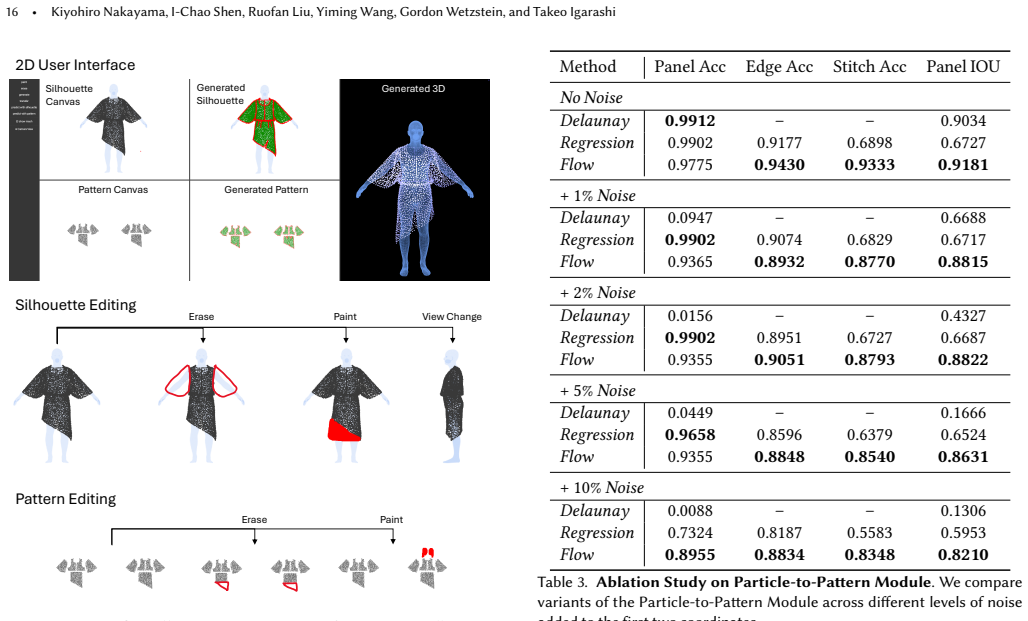
[56]
Editing operations are implemented through a canvas-based tool that allows users to paint or erase on both the silhouette and pattern canvases. The edited canvas is subsequently converted into a 2D point cloud via area sampling and forwarded to GPF for various guided generation tasks. C Additional Results C.1 Ablation Study on Particles-to-Pattern Flow We...
-
[57]
The left shows the original garment generated using GPF. The left shows garments generated after editing the input sewing pattern, with red paint in- dicating users’ input. The results show that our generated garments closely follow users’ edits to the 2D sewing pattern, while filling in missing details when the input is coarse. We optionally use text as ...
-
[58]
For a more detailed analysis, we also conduct a VLM study, adapting the setup from GPTEval3D [Wu et al
Our method achieves the highest score, indicating overall better alignment with text prompt, physical plausibility, and aesthetics compared with the baselines. For a more detailed analysis, we also conduct a VLM study, adapting the setup from GPTEval3D [Wu et al. 2024] to evaluate the same three SIGGRAPH Conference Papers ’26, July 19–23, 2026, Los Angele...
2024
-
[59]
We see that the general ranking trend aligns with that from the human study, but reveals variations in the baselines when evaluating the three criteria separately. For example, while Chatgarment is second-best in physi- cal plausibility, its text-prompt alignment is poor. In the meantime, De- sign2GarmentCode achieves a good balance among the three criter...
discussion (0)
Sign in with ORCID, Apple, or X to comment. Anyone can read and Pith papers without signing in.