REVIEW 2 major objections 1 minor 3 references
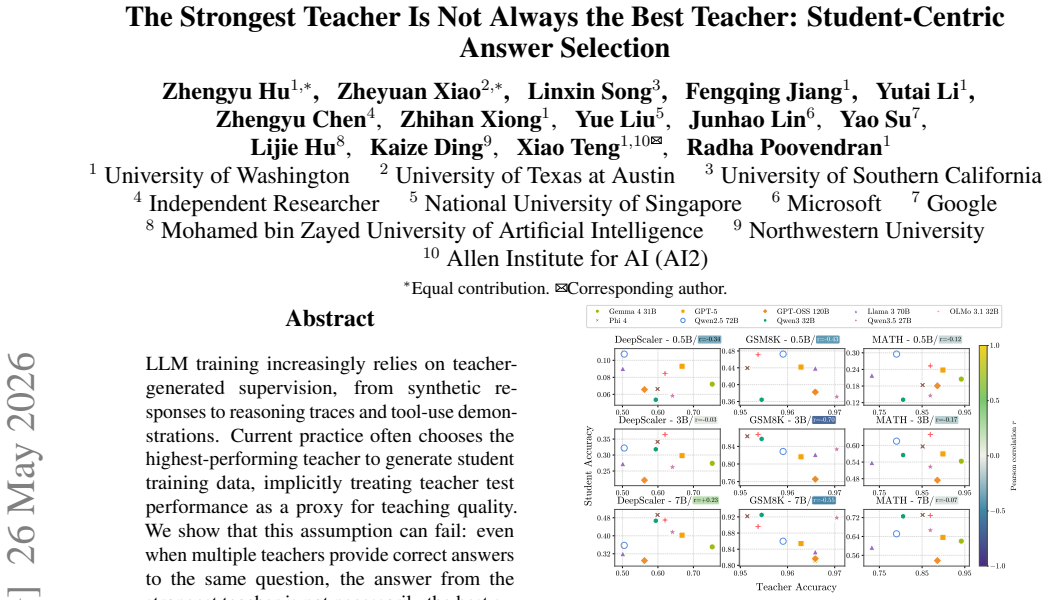
The answer from the strongest teacher is not necessarily the best supervision for a given student even when correct.
Reviewed by Pith at T0; open to challenge. T0 means a machine referee read the full paper against a public rubric. the ladder, T0–T4 →
T0 review · grok-4.3
2026-06-29 18:54 UTC pith:Q5YJVZOY
load-bearing objection SCAS shows student-matched answer selection can beat strongest-teacher distillation at scale, but the gradient proxy lacks direct validation against actual learning gains. the 2 major comments →
The Strongest Teacher Is Not Always the Best Teacher: Student-Centric Answer Selection
The pith
A machine-rendered reading of the paper's core claim, the machinery that carries it, and where it could break.
Core claim
The central claim is that teacher strength alone is not the right criterion for selecting supervision in distillation. Instead, answers should be sampled according to their student-centric learning cost, which can be approximated efficiently without backward passes. Applying this selection rule improves the student's final performance compared to always using the strongest teacher.
What carries the argument
Student-Centric Answer Sampling (SCAS) guided by a forward-only proxy for student-centric learning cost derived from token-wise gradient decomposition.
Load-bearing premise
The token-wise gradient decomposition yields an efficient forward-only proxy that accurately ranks answers by their actual benefit to the student's learning.
What would settle it
Running the full training with SCAS selection versus strongest-teacher selection on a new task where multiple correct answers exist and measuring if SCAS fails to improve or worsens student accuracy would falsify the claim.
If this is right
- Distillation performance improves when answers are chosen to minimize the student's learning cost rather than teacher capability.
- The approach works across a wide range of teacher and student models and tasks.
- Verified correct answers from weaker teachers can provide better training signal than those from stronger teachers.
- Effective teacher supervision requires matching to the current student's state.
Where Pith is reading between the lines
- Similar selection could be applied when generating multiple answers from a single teacher model.
- The proxy might help in designing adaptive curricula where difficulty is tuned per student.
- Extending the method to chain-of-thought or tool-use data could yield further gains in reasoning tasks.
- Large-scale training pipelines might benefit from per-student answer filtering at data generation time.
Editorial analysis
A structured set of objections, weighed in public.
Referee Report
Summary. The paper claims that the strongest teacher is not always the best for a given student even when multiple teachers provide correct answers to the same question. It introduces Student-Centric Answer Sampling (SCAS), which selects among verified teacher answers using an efficient forward-only proxy for student-centric learning cost derived from token-wise gradient decomposition, and reports that this yields consistent student performance gains across 30 teacher models, 6 student base models, and 6 tasks.
Significance. If the proxy is shown to track actual learning benefit rather than incidental answer properties, the result would challenge the default practice of using the highest-performing teacher for distillation and could improve the efficiency of LLM training by prioritizing supervision matched to the student's current state.
major comments (2)
- [Abstract] Abstract: the central claim that SCAS improves supervision via student-centric selection rests on the token-wise gradient decomposition yielding a proxy that ranks answers by true benefit to the student, yet the abstract supplies no derivation details, no direct validation (e.g., correlation with loss reduction or gradient magnitude when different verified answers are substituted), and no evidence that observed gains arise from the intended mechanism rather than length, style, or diversity of the selected answers.
- [Experiments] Experiments: the reported 'consistent improvements' lack error bars, statistical tests, baseline comparisons beyond the strongest-teacher condition, and information on data exclusion rules, which are necessary to establish that the gains are reliable and attributable to the proxy rather than other factors.
minor comments (1)
- [Abstract] Abstract: a brief parenthetical on the specific tasks (e.g., math, coding, reasoning) or model scale ranges would help readers gauge the scope without needing to reach the experimental section.
Simulated Author's Rebuttal
We thank the referee for their thoughtful review and constructive comments on our work. We address each major comment below, providing clarifications from the manuscript and indicating planned revisions where appropriate.
read point-by-point responses
-
Referee: [Abstract] Abstract: the central claim that SCAS improves supervision via student-centric selection rests on the token-wise gradient decomposition yielding a proxy that ranks answers by true benefit to the student, yet the abstract supplies no derivation details, no direct validation (e.g., correlation with loss reduction or gradient magnitude when different verified answers are substituted), and no evidence that observed gains arise from the intended mechanism rather than length, style, or diversity of the selected answers.
Authors: The abstract serves as a concise overview, while the full derivation of the token-wise gradient decomposition is presented in Section 3. The manuscript includes empirical validation in Section 4, demonstrating that the proxy correlates with improved student performance across diverse settings, and analyses indicate that gains are not attributable to superficial factors like length or style. To better address this in the abstract, we will revise it to briefly note the proxy's basis and the mechanism validation. revision: partial
-
Referee: [Experiments] Experiments: the reported 'consistent improvements' lack error bars, statistical tests, baseline comparisons beyond the strongest-teacher condition, and information on data exclusion rules, which are necessary to establish that the gains are reliable and attributable to the proxy rather than other factors.
Authors: We agree that including error bars and statistical significance tests would strengthen the experimental section. We will add these to the revised manuscript. The strongest-teacher condition is the key baseline representing standard practice, with additional comparisons (e.g., random selection) provided in the appendix. Data exclusion rules for verified answers are detailed in the experimental setup (Section 4.1). These revisions will clarify the reliability of the results. revision: yes
Circularity Check
No significant circularity detected in SCAS proxy derivation
full rationale
The paper presents the token-wise gradient decomposition as an independent first-principles motivation for deriving a forward-only proxy for student-centric learning cost. This derivation is not shown to reduce to a self-definition, a fitted parameter on the target data, or a self-citation chain. Experiments across 30 teachers, 6 students, and 6 tasks supply external performance evidence rather than tautological confirmation. No load-bearing uniqueness theorems or ansatzes imported from prior author work appear in the provided claims. The result is therefore self-contained against external benchmarks.
Axiom & Free-Parameter Ledger
read the original abstract
LLM training increasingly relies on teacher-generated supervision, from synthetic responses to reasoning traces and tool-use demonstrations. Current practice often chooses the highest-performing teacher to generate student training data, implicitly treating teacher test performance as a proxy for teaching quality. We show that this assumption can fail: even when multiple teachers provide correct answers to the same question, the answer from the strongest teacher is not necessarily the best supervision for a given student. To address this gap, we propose Student-Centric Answer Sampling (SCAS), a framework that selects from verified teacher-generated answers according to their estimated student-centric learning cost. Motivated by a token-wise gradient decomposition, we derive an efficient forward-only proxy for this cost and use it to guide answer selection during training. Experiments across 30 teacher models, 6 student base models, and 6 tasks show that SCAS consistently improves student performance, suggesting that effective distillation should prioritize supervision matched to the current student rather than teacher strength alone.
Figures



Reference graph
Works this paper leans on
-
[1]
Yarin Gal, Riashat Islam, and Zoubin Ghahramani
Knowledge distillation and dataset distillation of large language models: emerging trends, chal- lenges, and future directions.Artificial Intelligence Review, 59. Yarin Gal, Riashat Islam, and Zoubin Ghahramani
-
[2]
Deep Bayesian Active Learning with Image Data
Deep bayesian active learning with image data.ArXiv, abs/1703.02910. Yuxian Gu, Li Dong, Furu Wei, and Minlie Huang. 2023. Minillm: On-policy distillation of large language models. Chaoqun He, Yingfa Chen, Chaojun Xiao, Xu Han, and Lijie Wen. 2026. Student-in-the-loop chain-of- thought distillation via generation-time selection. Dan Hendrycks, Collin Burn...
work page internal anchor Pith review Pith/arXiv arXiv 2023
-
[3]
Synthetic data generation using large language models: Advances in text and code.IEEE Access, 13:134615–134633. Abhishek Panigrahi, Bing Liu, Sadhika Malladi, Sham M. Kakade, and Surbhi Goel. 2025. In good graces: Principled teacher selection for knowledge distillation.ArXiv, abs/2511.02833. Karl Pearson. 1895. Vii. note on regression and inheri- tance in...
discussion (0)
Sign in with ORCID, Apple, or X to comment. Anyone can read and Pith papers without signing in.