Cosmological Constraints from Bias-Robust Wavelet Scattering Statistics for Stage-IV Galaxy Surveys
Pith reviewed 2026-06-29 15:46 UTC · model grok-4.3
The pith
M-mode ratios of the wavelet scattering transform deliver unbiased cosmological constraints from galaxy surveys without explicit bias modeling.
A machine-rendered reading of the paper's core claim, the machinery that carries it, and where it could break.
Core claim
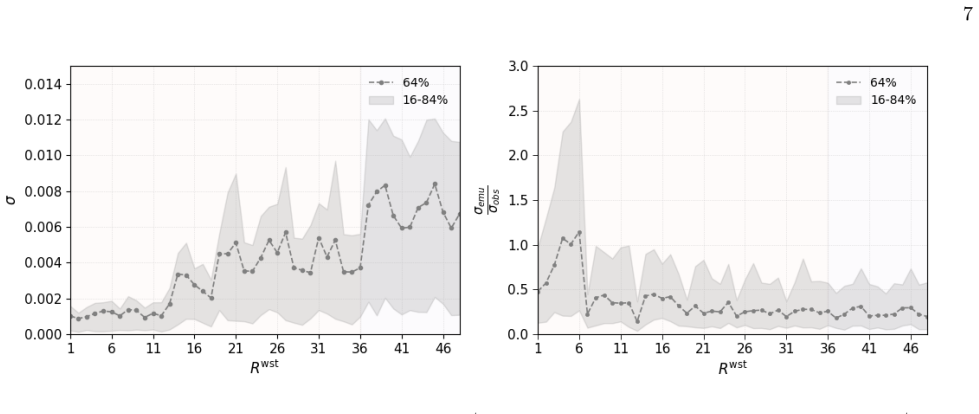
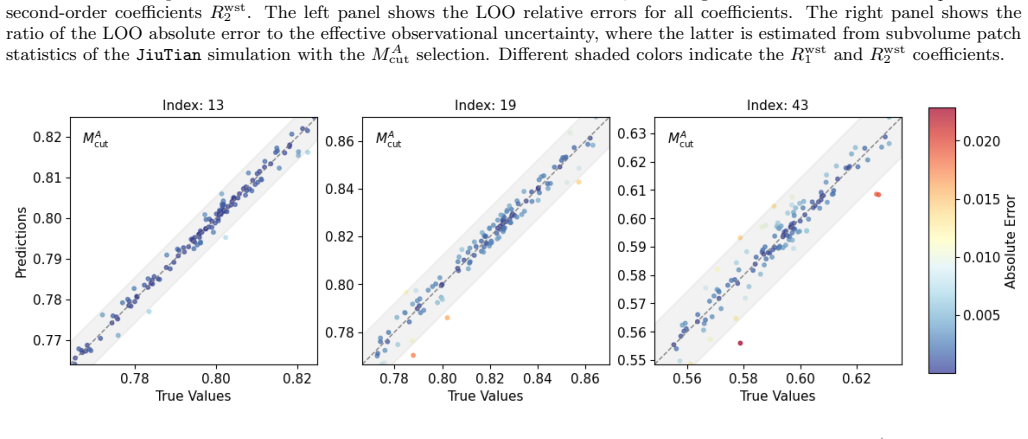
R^wst, a bias-robust statistic constructed from m-mode ratios of the wavelet scattering transform, yields unbiased constraints on Ω_m, σ_8, n_s, and w_0. It improves the breaking of the Ω_m--σ_8 degeneracy by about a factor of two compared with 2PCF. Its constraining power remains stable across a broad range of tracer-bias scenarios, demonstrating that R^wst can mitigate bias-induced systematics without explicit bias modeling. The emulator trained on the Kun suite reaches percent-level accuracy, sufficient for expected Stage-IV uncertainties.
What carries the argument
R^wst, the statistic formed from m-mode ratios of the wavelet scattering transform, which extracts higher-order correlations while remaining insensitive to tracer bias.
Load-bearing premise
The m-mode ratios of the wavelet scattering transform remain insensitive to tracer bias for the full range of realistic galaxy populations.
What would settle it
A statistically significant shift in recovered values of Ω_m or σ_8 when R^wst is applied to galaxy mocks whose bias properties lie outside the range covered by the Kun and JiuTian simulation suites.
Figures
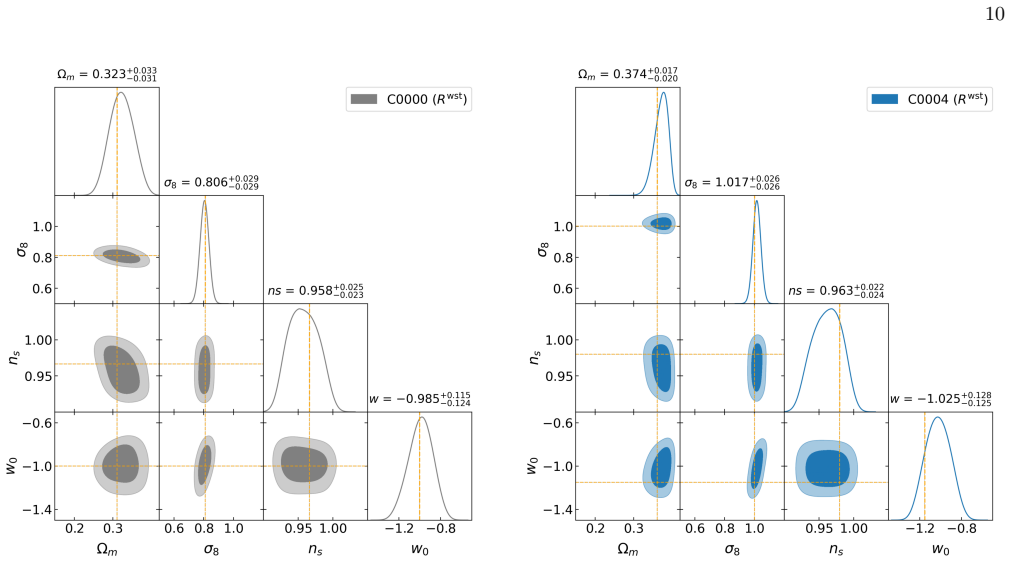
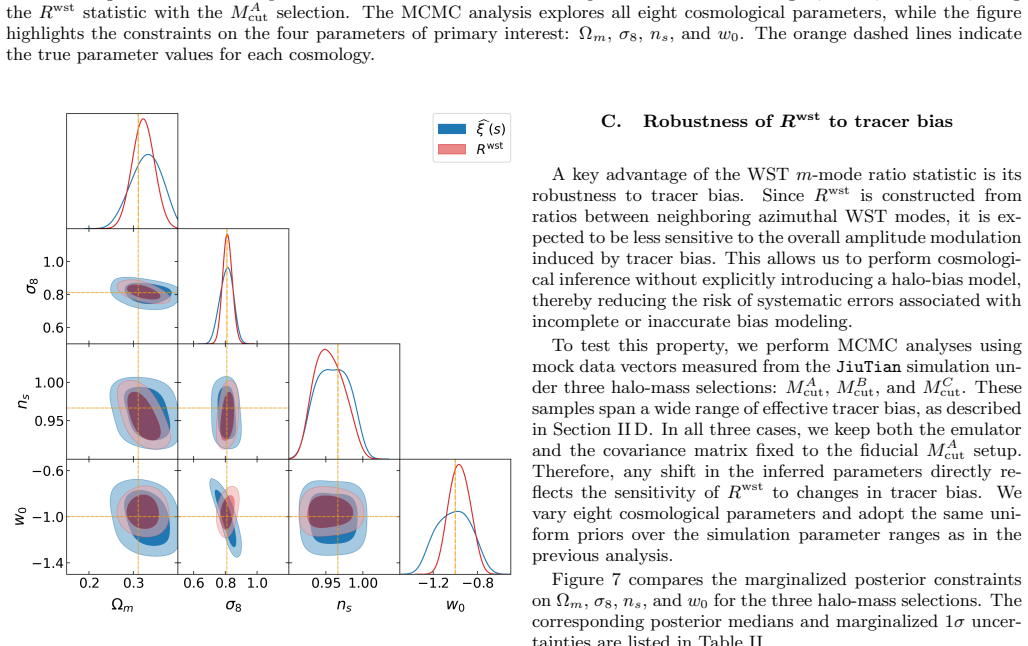
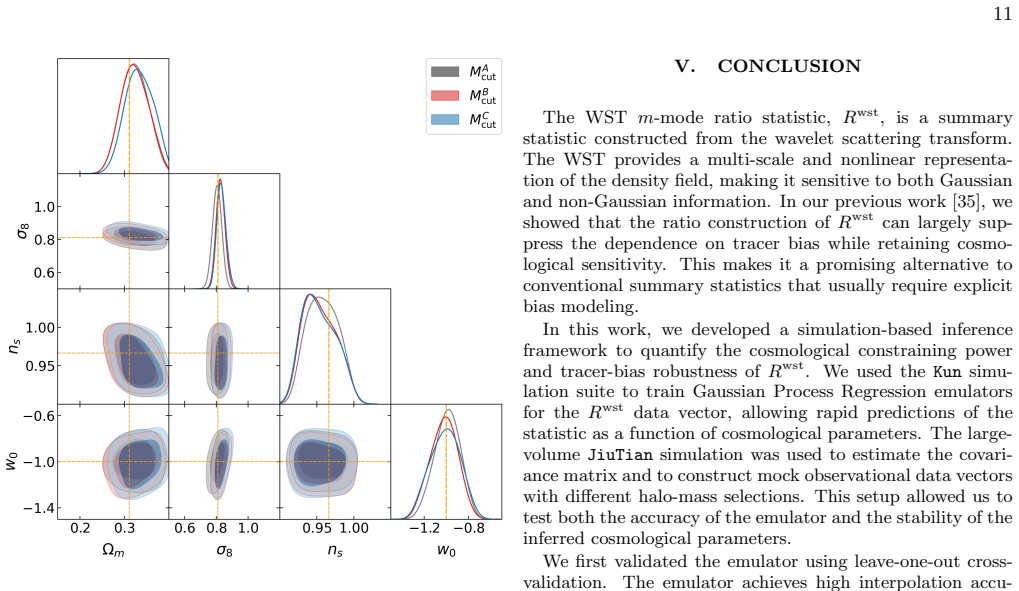
read the original abstract
A central challenge in precision cosmology with galaxy surveys is to extract non-Gaussian information from large-scale structure while controlling systematic uncertainties such as tracer bias. Conventional clustering statistics, such as the two-point correlation function (2PCF), capture limited nonlinear information and typically require explicit bias modeling, which can introduce systematic errors if the adopted bias prescription is inaccurate. To address this problem, we introduce $R^{\rm wst}$, a bias-robust statistic constructed from $m$-mode ratios of the wavelet scattering transform (WST). Using simulation-based inference, we train a Gaussian-process-regression emulator on the \texttt{Kun} simulation suite and use \texttt{JiuTian} simulations for covariance estimation and validation. The emulator achieves percent-level accuracy, sufficient for the expected observational uncertainties. We show that $R^{\rm wst}$ yields unbiased constraints on $\Omega_m$, $\sigma_8$, $n_s$, and $w_0$, and improves the breaking of the $\Omega_m$--$\sigma_8$ degeneracy by about a factor of two compared with 2PCF. Its constraining power remains stable across a broad range of tracer-bias scenarios, demonstrating that $R^{\rm wst}$ can mitigate bias-induced systematics without explicit bias modeling. These results establish $R^{\rm wst}$ as a powerful and robust statistic for precision cosmology with Stage-IV surveys.
Editorial analysis
A structured set of objections, weighed in public.
Referee Report
Summary. The paper introduces R^wst, a bias-robust statistic formed from m-mode ratios of the wavelet scattering transform (WST). Using simulation-based inference, a Gaussian-process emulator is trained on the Kun suite and validated with JiuTian simulations; the work claims that R^wst delivers unbiased constraints on Ω_m, σ_8, n_s and w_0, improves the Ω_m–σ_8 degeneracy breaking by a factor of approximately two relative to the 2PCF, and maintains constraining power across a range of tracer-bias scenarios without explicit bias modeling.
Significance. If the reported bias independence holds for realistic galaxy populations beyond the tested suites, the result would be significant for Stage-IV analyses: it would allow extraction of non-Gaussian information while sidestepping systematic errors from inaccurate bias prescriptions. The use of separate simulation suites for emulator training versus covariance/validation is a positive methodological feature that partially mitigates circularity.
major comments (3)
- [Abstract] Abstract: the central claim that m-mode ratios of the WST cancel tracer-bias dependence for arbitrary galaxy populations is supported only by empirical stability across HOD variations in the Kun and JiuTian suites; no analytic derivation is supplied showing why the ratio construction eliminates bias terms for a general bias operator b(δ). This is load-bearing for the assertion of unbiased constraints without explicit modeling.
- [Abstract] Abstract and validation sections: the statement that constraints remain unbiased and that degeneracy breaking improves by a factor of two is presented without reference to specific posterior bias metrics, coverage tests, or quantitative comparison of contour areas/Fisher information between R^wst and 2PCF; the percent-level emulator accuracy is noted but its propagation into the final error budget is not detailed.
- [Results] The robustness claim is tested only within the bias scenarios realized in the two simulation suites; if the cancellation is an artifact of those particular bias implementations rather than a structural property of the m-mode ratios, the unbiasedness would not necessarily extend to real Stage-IV data.
minor comments (2)
- [Methods] Notation for the m-mode ratios and the precise definition of R^wst should be introduced with an equation in the methods section for clarity.
- [Figures] Figure captions should explicitly state the bias scenarios (e.g., HOD parameter ranges) shown in each panel to allow readers to assess the breadth of the stability test.
Simulated Author's Rebuttal
We thank the referee for their constructive comments on our manuscript. We address each major point below and indicate revisions where the manuscript will be updated to improve clarity and completeness.
read point-by-point responses
-
Referee: [Abstract] Abstract: the central claim that m-mode ratios of the WST cancel tracer-bias dependence for arbitrary galaxy populations is supported only by empirical stability across HOD variations in the Kun and JiuTian suites; no analytic derivation is supplied showing why the ratio construction eliminates bias terms for a general bias operator b(δ). This is load-bearing for the assertion of unbiased constraints without explicit modeling.
Authors: We agree that the demonstration relies on empirical tests across HOD variations in the two suites rather than an analytic derivation for a general bias operator. We will revise the abstract to explicitly state that the bias-robustness is empirically validated on the tested scenarios. revision: partial
-
Referee: [Abstract] Abstract and validation sections: the statement that constraints remain unbiased and that degeneracy breaking improves by a factor of two is presented without reference to specific posterior bias metrics, coverage tests, or quantitative comparison of contour areas/Fisher information between R^wst and 2PCF; the percent-level emulator accuracy is noted but its propagation into the final error budget is not detailed.
Authors: We will update the abstract and validation sections to reference specific posterior bias metrics, coverage tests, and quantitative comparisons (contour areas) between R^wst and 2PCF. We will also add details on how emulator accuracy enters the final error budget. revision: yes
-
Referee: [Results] The robustness claim is tested only within the bias scenarios realized in the two simulation suites; if the cancellation is an artifact of those particular bias implementations rather than a structural property of the m-mode ratios, the unbiasedness would not necessarily extend to real Stage-IV data.
Authors: The suites include a broad range of HOD variations. We will expand the results section to acknowledge that the tests are limited to these implementations while noting the consistency across them as evidence for a structural property, and suggest further validation for full Stage-IV applicability. revision: partial
- Analytic derivation showing why m-mode ratios eliminate bias terms for a general bias operator b(δ)
Circularity Check
No circularity: bias robustness shown via empirical validation on independent simulation suites rather than by construction or self-citation.
full rationale
The paper defines R^wst explicitly as m-mode ratios of the wavelet scattering transform and validates its bias robustness and cosmological constraining power through simulation-based inference. Training occurs on the Kun suite while covariance and validation use the separate JiuTian suite, with direct recovery of input cosmological parameters (Ω_m, σ_8, n_s, w_0) serving as the test. No load-bearing step reduces a claimed prediction to a fitted parameter by definition, invokes a self-citation for uniqueness, or renames an input as output; the stability across HOD variations is an empirical result external to the statistic's construction. The chain is therefore self-contained against the simulation benchmarks.
Axiom & Free-Parameter Ledger
Reference graph
Works this paper leans on
-
[1]
to test whetherR wst can be emulated with sufficient accuracy for observational applications
-
[2]
to assess whether it provides competitive cosmologi- cal constraints beyond traditional two-point information
-
[3]
This work therefore provides a critical step toward applying inter- pretable, bias-robust, non-Gaussian WST statistics to fu- ture Stage-IV galaxy surveys such as CSST
to examine whether its robustness to tracer bias persists in a full parameter-inference setting. This work therefore provides a critical step toward applying inter- pretable, bias-robust, non-Gaussian WST statistics to fu- ture Stage-IV galaxy surveys such as CSST. The paper is organized as follows. In Section II, we briefly review the WSTm-mode ratio sta...
-
[4]
The simulationc0000corresponds to the fiducialPlanck2018 cosmology
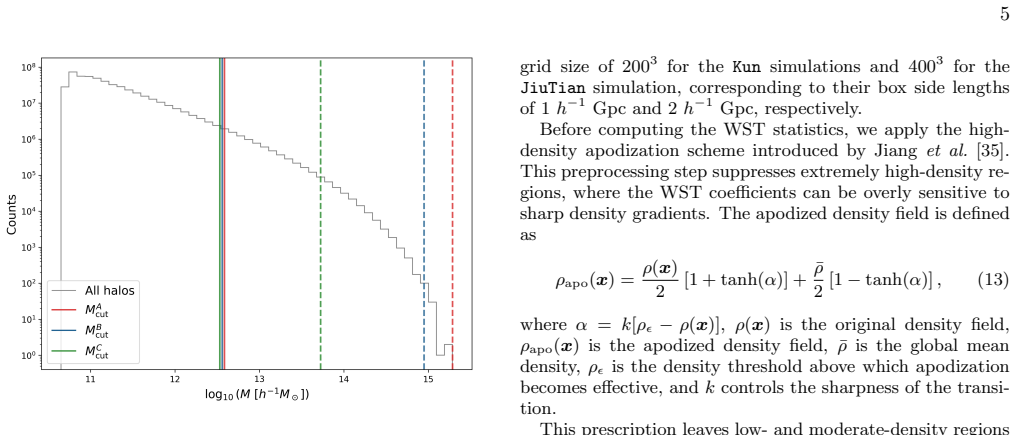
We use the 129Kunsimulations, labeledc0000--c0128, to construct the training and validation data for our emulator. The simulationc0000corresponds to the fiducialPlanck2018 cosmology. For covariance matrix estimation, we use the large-volume JiuTiansimulation from theJiuTiansuite [46]. This simula- tion follows thePlanck2018 cosmology (the same cosmology a...
2021
-
[5]
D. H. Weinberg, M. J. Mortonson, D. J. Eisenstein, C. Hi- rata, A. G. Riess, and E. Rozo, Observational probes of cosmic acceleration, Physics Reports530, 87 (2013), arXiv:1201.2434 [astro-ph.CO]
work page internal anchor Pith review Pith/arXiv arXiv 2013
-
[6]
The 2dF Galaxy Redshift Survey: Final Data Release
M. Colless, B. A. Peterson, C. Jackson, J. A. Peacock, S. Cole, P. Norberg, I. K. Baldry, C. M. Baugh, J. Bland- Hawthorn, T. Bridges, R. Cannon, C. Collins, W. Couch, N. Cross, G. Dalton, R. De Propris, S. P. Driver, G. Ef- stathiou, R. S. Ellis, C. S. Frenk, K. Glazebrook, O. La- hav, I. Lewis, S. Lumsden, S. Maddox, D. Madgwick, W. Sutherland, and K. T...
work page internal anchor Pith review Pith/arXiv arXiv 2003
-
[7]
Beutler, C
F. Beutler, C. Blake, M. Colless, D. H. Jones, L. Staveley- Smith, G. B. Poole, L. Campbell, Q. Parker, W. Saun- ders, and F. Watson, The 6dF Galaxy Survey:z≈0 measurements of the growth rate andσ 8: 6dFGS:z≈0 measurements off σ 8 andσ 8, Monthly Notices of the Royal Astronomical Society423, 3430 (2012)
2012
-
[8]
F. Beutler, H.-J. Seo, S. Saito, C.-H. Chuang, A. J. Cuesta, D. J. Eisenstein, H. Gil-Mar´ ın, J. N. Grieb, N. Hand, F.-S. Kitaura, C. Modi, R. C. Nichol, M. D. Olmstead, W. J. Percival, F. Prada, A. G. S´ anchez, S. Rodriguez-Torres, A. J. Ross, N. P. Ross, D. P. Schneider, J. Tinker, R. Tojeiro, and M. Vargas-Maga˜ na, The clustering of galaxies in the ...
work page internal anchor Pith review Pith/arXiv arXiv 2017
-
[9]
The WiggleZ Dark Energy Survey: the growth rate of cosmic structure since redshift z=0.9
C. Blake, S. Brough, M. Colless, C. Contreras, W. Couch, S. Croom, T. Davis, M. J. Drinkwater, K. Forster, D. Gilbank, M. Gladders, K. Glazebrook, B. Jelliffe, R. J. Jurek, I.-H. Li, B. Madore, D. C. Martin, K. Pimb- blet, G. B. Poole, M. Pracy, R. Sharp, E. Wisnioski, D. Woods, T. K. Wyder, and H. K. C. Yee, The WiggleZ Dark Energy Survey: the growth rat...
work page internal anchor Pith review Pith/arXiv arXiv 2011
-
[10]
C. Blake, K. Glazebrook, T. M. Davis, S. Brough, M. Col- less, C. Contreras, W. Couch, S. Croom, M. J. Drinkwa- ter, K. Forster, D. Gilbank, M. Gladders, B. Jelliffe, R. J. Jurek, I.-H. Li, B. Madore, D. C. Martin, K. Pimb- blet, G. B. Poole, M. Pracy, R. Sharp, E. Wisnioski, D. Woods, T. K. Wyder, and H. K. C. Yee, The Wig- gleZ Dark Energy Survey: measu...
work page internal anchor Pith review Pith/arXiv arXiv 2011
-
[11]
D. G. York, J. Adelman, J. E. Anderson, Jr., S. F. Anderson, J. Annis, N. A. Bahcall, J. A. Bakken, R. Barkhouser, S. Bastian, E. Berman, W. N. Boroski, S. Bracker, C. Briegel, J. W. Briggs, J. Brinkmann, R. Brunner, S. Burles, L. Carey, M. A. Carr, F. J. Ca- stander, B. Chen, P. L. Colestock, A. J. Connolly, J. H. Crocker, I. Csabai, P. C. Czarapata, J. ...
work page internal anchor Pith review Pith/arXiv arXiv 2000
-
[12]
D. J. Eisenstein, I. Zehavi, D. W. Hogg, R. Scoccimarro, M. R. Blanton, R. C. Nichol, R. Scranton, H.-J. Seo, M. Tegmark, Z. Zheng, S. F. Anderson, J. Annis, N. Bah- call, J. Brinkmann, S. Burles, F. J. Castander, A. Con- nolly, I. Csabai, M. Doi, M. Fukugita, J. A. Frieman, K. Glazebrook, J. E. Gunn, J. S. Hendry, G. Hennessy, Z. Ivezi´ c, S. Kent, G. R....
work page internal anchor Pith review Pith/arXiv arXiv 2005
-
[13]
W. J. Percival, S. Cole, D. J. Eisenstein, R. C. Nichol, J. A. Peacock, A. C. Pope, and A. S. Szalay, Measuring the Baryon Acoustic Oscillation scale using the Sloan Digital Sky Survey and 2dF Galaxy Redshift Survey, Monthly Notices of the Royal Astronomical Society381, 1053 (2007), arXiv:0705.3323
work page internal anchor Pith review Pith/arXiv arXiv 2007
-
[14]
S. Alam, M. Ata, S. Bailey, F. Beutler, D. Bizyaev, J. A. Blazek, A. S. Bolton, J. R. Brownstein, A. Burden, C.-H. Chuang, J. Comparat, A. J. Cuesta, K. S. Daw- son, D. J. Eisenstein, S. Escoffier, H. Gil-Mar´ ın, J. N. Grieb, N. Hand, S. Ho, K. Kinemuchi, D. Kirkby, F. Ki- taura, E. Malanushenko, V. Malanushenko, C. Maras- ton, C. K. McBride, R. C. Nicho...
work page internal anchor Pith review Pith/arXiv arXiv 2017
-
[15]
L. Anderson, E. Aubourg, S. Bailey, D. Bizyaev, M. Blan- ton, A. S. Bolton, J. Brinkmann, J. R. Brownstein, A. Burden, A. J. Cuesta, L. A. N. da Costa, K. S. Dawson, R. de Putter, D. J. Eisenstein, J. E. Gunn, H. Guo, J.-C. Hamilton, P. Harding, S. Ho, K. Honscheid, E. Kazin, D. Kirkby, J.-P. Kneib, A. Labatie, C. Loomis, R. H. Lupton, E. Malanushenko, V....
work page internal anchor Pith review Pith/arXiv arXiv 2012
-
[16]
M. Levi, C. Bebek, T. Beers, R. Blum, R. Cahn, D. Eisen- stein, B. Flaugher, K. Honscheid, R. Kron, O. Lahav, P. McDonald, N. Roe, D. Schlegel, and r. t. D. collabora- tion, The DESI Experiment, a whitepaper for Snowmass 2013 (2013), arXiv:1308.0847 [astro-ph]
work page internal anchor Pith review Pith/arXiv arXiv 2013
-
[17]
L. S. Collaboration, P. A. Abell, J. Allison, S. F. An- derson, J. R. Andrew, J. R. P. Angel, L. Armus, D. Ar- nett, S. J. Asztalos, T. S. Axelrod, S. Bailey, D. R. Bal- lantyne, J. R. Bankert, W. A. Barkhouse, J. D. Barr, L. F. Barrientos, A. J. Barth, J. G. Bartlett, A. C. Becker, J. Becla, T. C. Beers, J. P. Bernstein, R. Biswas, M. R. Blanton, J. S. B...
work page internal anchor Pith review Pith/arXiv arXiv 2009
-
[18]
Euclid Definition Study Report
R. Laureijs, J. Amiaux, S. Arduini, J.-L. Augu` eres, J. Brinchmann, R. Cole, M. Cropper, C. Dabin, L. Du- vet, A. Ealet, B. Garilli, P. Gondoin, L. Guzzo, J. Hoar, H. Hoekstra, R. Holmes, T. Kitching, T. Maciaszek, Y. Mellier, F. Pasian, W. Percival, J. Rhodes, G. S. Criado, M. Sauvage, R. Scaramella, L. Valenziano, S. Warren, R. Bender, F. Castander, A....
work page internal anchor Pith review Pith/arXiv arXiv 2011
-
[19]
Eifler, H
T. Eifler, H. Miyatake, E. Krause, C. Heinrich, V. Mi- randa, C. Hirata, J. Xu, S. Hemmati, M. Simet, P. Ca- pak, A. Choi, O. Dor´ e, C. Doux, X. Fang, R. Houn- sell, E. Huff, H.-J. Huang, M. Jarvis, J. Kruk, D. Mas- ters, E. Rozo, D. Scolnic, D. N. Spergel, M. Troxel, A. von der Linden, Y. Wang, D. H. Weinberg, L. Wenzl, and H.-Y. Wu, Cosmology with theR...
2021
-
[20]
H. Zhan, Consideration for a large-scale multi-color imag- ing and slitless spectroscopy survey on the Chinese space station and its application in dark energy research, SSPMA41, 1441 (2011), publisher: Science China Press
2011
-
[21]
J. L. Tinker, B. E. Robertson, A. V. Kravtsov, A. Klypin, M. S. Warren, G. Yepes, and S. Gottl¨ ober, The Large- scale Bias of Dark Matter Halos: Numerical Calibra- tion and Model Tests, Astrophys. J.724, 878 (2010), arXiv:1001.3162 [astro-ph.CO]
work page internal anchor Pith review Pith/arXiv arXiv 2010
-
[22]
A. J. Benson, S. Cole, C. S. Frenk, C. M. Baugh, and C. G. Lacey, The Nature of galaxy bias and clus- tering, Mon. Not. Roy. Astron. Soc.311, 793 (2000), arXiv:astro-ph/9903343
work page internal anchor Pith review Pith/arXiv arXiv 2000
-
[23]
Desjacques, D
V. Desjacques, D. Jeong, and F. Schmidt, Large-scale galaxy bias, Physics Reports733, 1 (2018)
2018
-
[24]
E. I. Buchbinder, J. Khoury, and B. A. Ovrut, Non- Gaussianities in New Ekpyrotic Cosmology, Physical Re- view Letters100, 171302 (2008)
2008
-
[25]
L. Xiao, L. Lai, Z. Jiang, X.-D. Li, and L. Zhang, Tomo- graphic Alcock-Paczynski Test with Marked Correlation Functions (2025), arXiv:2504.20478 [astro-ph]
work page internal anchor Pith review Pith/arXiv arXiv 2025
- [26]
-
[27]
A. K. Gon and Y.-C. Cai, Turning dispersion into sig- nal: density-split analyses of pairwise velocities (2025), arXiv:2505.00608 [astro-ph]
work page internal anchor Pith review Pith/arXiv arXiv 2025
-
[28]
Ribli, B
D. Ribli, B. ´A. Pataki, J. M. Zorrilla Matilla, D. Hsu, Z. Haiman, and I. Csabai, Weak lensing cosmology with convolutional neural networks on noisy data, Monthly Notices of the Royal Astronomical Society490, 1843 (2019)
2019
-
[29]
Mallat, Group Invariant Scattering, Comm Pure Appl Math65, 1331 (2012)
S. Mallat, Group Invariant Scattering, Comm Pure Appl Math65, 1331 (2012)
2012
-
[30]
A. B. Romeo, C. Horellou, and J. Bergh, N-body simula- tions with two-orders-of-magnitude higher performance using wavelets, Monthly Notices of the Royal Astronom- ical Society342, 337 (2003), publisher: OUP ADS Bib- code: 2003MNRAS.342..337R
2003
-
[31]
A. B. Romeo, C. Horellou, and J. Bergh, A wavelet add- on code for new-generation N-body simulations and data de-noising (JOFILUREN), Monthly Notices of the Royal Astronomical Society354, 1208 (2004), publisher: OUP ADS Bibcode: 2004MNRAS.354.1208R
2004
-
[32]
A. B. Romeo, O. Agertz, B. Moore, and J. Stadel, 15 Discreteness Effects inλCDM Simulations: A Wavelet-Statistical View, The Astrophysical Jour- nal686, 1 (2008), publisher: IOP ADS Bibcode: 2008ApJ...686....1R
2008
-
[33]
H. Shimabukuro, Y. Xu, and Y. Shao, Analyzing the 21cm forest with Wavelet Scattering Transform: Insight into non-Gaussian features of the 21cm forest (2025), arXiv:2504.14656 [astro-ph]
- [34]
-
[35]
B. Greig, Y.-S. Ting, and A. A. Kaurov, Exploring the cosmic 21-cm signal from the Epoch of Reionisation us- ing the Wavelet Scattering Transform, Monthly Notices of the Royal Astronomical Society513, 1719 (2022), arXiv:2204.02544 [astro-ph]
-
[36]
B. Greig, Y.-S. Ting, and A. A. Kaurov, Detecting the non-Gaussianity of the 21-cm signal during reionisation with the Wavelet Scattering Transform, Monthly No- tices of the Royal Astronomical Society519, 5288 (2023), arXiv:2207.09082 [astro-ph]
-
[37]
S. Cheng, Y.-S. Ting, B. M´ enard, and J. Bruna, A new approach to observational cosmology using the scattering transform, Monthly Notices of the Royal Astronomical Society499, 5902 (2020), arXiv:2006.08561 [astro-ph]
-
[38]
G. Valogiannis and C. Dvorkin, Towards an Optimal Es- timation of Cosmological Parameters with the Wavelet Scattering Transform, Phys. Rev. D105, 103534 (2022), arXiv:2108.07821 [astro-ph]
-
[39]
Jiang, X
Z. Jiang, X. Luo, W. Du, Z. Min, F. Yin, L. Feng, J. Ding, L. Zhang, and X.-D. Li, A New Wavelet Scatter- ing Transform-based Statistic for Cosmological Analysis of Large-scale Structure, The Astrophysical Journal993, 143 (2025)
2025
-
[40]
G. Valogiannis and C. Dvorkin, Going Beyond the Galaxy Power Spectrum: an Analysis of BOSS Data with Wavelet Scattering Transforms, Phys. Rev. D106, 103509 (2022), arXiv:2204.13717 [astro-ph]
- [41]
- [42]
-
[43]
The Coyote Universe I: Precision Determination of the Nonlinear Matter Power Spectrum
K. Heitmann, M. White, C. Wagner, S. Habib, and D. Higdon, The Coyote Universe I: Precision Determi- nation of the Nonlinear Matter Power Spectrum, The Astrophysical Journal715, 104 (2010), arXiv:0812.1052 [astro-ph]
work page internal anchor Pith review Pith/arXiv arXiv 2010
-
[44]
Heitmann, E
K. Heitmann, E. Lawrence, J. Kwan, S. Habib, and D. Higdon, THE COYOTE UNIVERSE EX- TENDED: PRECISION EMULATION OF THE MAT- TER POWER SPECTRUM, The Astrophysical Journal 780, 111 (2013)
2013
-
[45]
R. E. Angulo, M. Zennaro, S. Contreras, G. Aric` o, M. Pellejero-Iba˜ nez, and J. St¨ ucker, The BACCO sim- ulation project: exploiting the full power of large-scale structure for cosmology, Monthly Notices of the Royal Astronomical Society507, 5869 (2021)
2021
-
[46]
Knabenhans, J
Euclid Collaboration, M. Knabenhans, J. Stadel, S. Marelli, D. Potter, R. Teyssier, L. Legrand, A. Schnei- der, B. Sudret, L. Blot, S. Awan, C. Burigana, C. S. Carvalho, H. Kurki-Suonio, and G. Sirri,Euclid preparation: II. The<span style=”font-variant:small- caps;”>EuclidEmulator</span>– a tool to compute the cosmology dependence of the nonlinear matter ...
2019
-
[47]
Z. Zhai, J. L. Tinker, M. R. Becker, J. DeRose, Y.-Y. Mao, T. McClintock, S. McLaughlin, E. Rozo, and R. H. Wechsler, The Aemulus Project. III. Emulation of the Galaxy Correlation Function, The Astrophysical Journal 874, 95 (2019)
2019
-
[48]
Z. Chen, Y. Yu, J. Han, and Y. Jing, CSST cosmolog- ical emulator I: Matter power spectrum emulation with one percent accuracy to k = 10h Mpc-1, Science China Physics, Mechanics & Astronomy68, 289512 (2025)
2025
-
[49]
M. Eickenberg, G. Exarchakis, M. Hirn, S. Mallat, and L. Thiry, Solid Harmonic Wavelet Scattering for Predic- tions of Molecule Properties, The Journal of Chemical Physics148, 241732 (2018), arXiv:1805.00571 [physics]
-
[50]
J. Han, M. Li, W. Jiang, Z. Chen, H. Wang, C. Wei, F. He, J. He, J. Zhang, Y. Liu, W. Cui, Y. Gu, Q. Guo, Y. Jing, X. Kang, G. Li, X. Luo, Y. Luo, W. Pei, Y. Qiu, Z. Tan, L. Xie, X. Yang, H.-R. Yu, Y. Yu, and J. Zhou, The Jiutian simulations for the CSST extra-galactic sur- veys (2025), arXiv:2503.21368 [astro-ph]
-
[51]
Chen, J.-J
B.-H. Chen, J.-J. Zhao, H.-R. Yu, Y. Liu, J.-H. He, and Y. Jing, Cosmological Simulations with Massive Neutri- nos: Efficiency and Accuracy, Universe11, 212 (2025)
2025
-
[52]
Yu, B.-H
H.-R. Yu, B.-H. Chen, K. Xu, M.-J. Sheng, J. Han, Y. Jing, and H. Cui, CUBE2: A parallel N-body sim- ulation code for scalability, accuracy, and memory effi- ciency, Science China Physics, Mechanics & Astronomy 69, 269511 (2026)
2026
-
[53]
F. He, J. Han, H. Gao, and J. Zhang, Extending the uni- fied subhalo model to warm dark matter, Monthly No- tices of the Royal Astronomical Society526, 3156 (2023)
2023
-
[54]
Zhang, R
J. Zhang, R. An, W. Luo, Z. Li, S. Liao, and B. Wang, The First Constraint from SDSS Galaxy–Galaxy Weak Lensing Measurements on Interacting Dark Energy Mod- els, The Astrophysical Journal Letters875, L11 (2019)
2019
-
[55]
X. Luo, H. Wang, W. Cui, H. Mo, R. Li, Y. Jing, N. Katz, R. Dav´ e, X. Yang, Y. Chen, H. Li, and S. Huang, ELU- CID. VIII. Simulating the Coma Galaxy Cluster to Cal- ibrate Model and Understand Feedback, The Astrophys- ical Journal966, 236 (2024)
2024
-
[56]
W. Pei, Q. Guo, M. Li, Q. Wang, J. Han, J. Hu, T. Su, L. Gao, J. Wang, Y. Luo, and C. Wei, Simulating emis- sion line galaxies for the next generation of large-scale structure surveys, Monthly Notices of the Royal Astro- nomical Society529, 4958 (2024)
2024
-
[57]
Y. Gu, X. Yang, J. Han, Y. Wang, Q. Li, Z. Tan, W. Jiang, Y. Wang, J. Wang, A. Katsianis, X. Xu, H. Xu, W. Hong, H. Mo, R. Wen, X. Zheng, F. Shi, P. Zhang, Z. Zhai, C. Liu, W. Wang, Y. Zu, H. Guo, Y. Zhang, Y. Lu, Y. Zheng, Y. Han, H. Zou, X. Wang, C. Wei, M. Li, and Y. Luo, CSST large-scale structure analysis pipeline: I. Constructing reference mock gala...
2024
-
[58]
Z. Tan, L. Xie, J. Han, Y. Qiu, F. Fontanot, G. De Lucia, Q. Guo, Q. Li, J. Zhou, W. Jiang, X. Wang, F. He, C. Jin, Y. Jing, M. Li, X. Li, W. Pei, W. Wang, X. Yang, and Y. Yu, A semi-analytical mock galaxy catalog for the 16 CSST extragalactic surveys from the Jiutian simulations (2025), version Number: 2
2025
-
[59]
C.-L. Wei, Y. Luo, H. Tian, M. Li, Y.-S. Qiu, G.-L. Li, Y.-D. Fang, X. Zhang, D.-Z. Liu, N. Li, R. Li, H.-Y. Shan, L. Nie, Z. He, L. Wang, X. Kang, D. Fan, Y. Chen, X. Fu, and C. Liu, Mock Observations for the CSST Mis- sion: Main Surveys–The Mock Catalog, Research in As- tronomy and Astrophysics26, 024004 (2026)
2026
-
[60]
Wei, G.-L
C.-L. Wei, G.-L. Li, Y.-D. Fang, X. Zhang, Y. Luo, H. Tian, D.-Z. Liu, X.-M. Meng, Z. Ban, X.-B. Li, Z. Luo, J.-T. Xian, W. Wang, X.-Y. Peng, N. Li, R. Li, L. Shao, T.-M. Zhang, J. Tang, Y. Chen, Z.-X. Qi, Z.-H. Cao, H.-Y. Shan, L. Nie, Z. Yan, L. Wang, Z. He, R.-B. Luo, and Q.-Y. Liu, Mock Observations for the CSST Mission: Main Surveys–An Overview of Fr...
2026
-
[61]
Aghanim, Y
Planck Collaboration, N. Aghanim, Y. Akrami, M. Ash- down, J. Aumont, C. Baccigalupi, M. Ballardini, A. J. Banday, R. B. Barreiro, N. Bartolo, S. Basak, R. Battye, K. Benabed, J.-P. Bernard, M. Bersanelli, P. Bielewicz, J. J. Bock, J. R. Bond, J. Borrill, F. R. Bouchet, F. Boulanger, M. Bucher, C. Burigana, R. C. But- ler, E. Calabrese, J.-F. Cardoso, J. ...
2020
-
[62]
Springel, S
V. Springel, S. D. M. White, G. Tormen, and G. Kauff- mann, Populating a cluster of galaxies - I. Results at \fontshape{it}{z}=0, Monthly Notices of the Royal As- tronomical Society328, 726 (2001)
2001
-
[63]
P. S. Behroozi, R. H. Wechsler, and H.-Y. Wu, THE ROCKSTAR PHASE-SPACE TEMPORAL HALO FINDER AND THE VELOCITY OFFSETS OF CLUS- TER CORES, The Astrophysical Journal762, 109 (2013)
2013
-
[64]
G. Valogiannis, S. Yuan, and C. Dvorkin, Precise cos- mological constraints from BOSS galaxy clustering with a simulation-based emulator of the wavelet scatter- ing transform, Physical Review D109, 10.1103/phys- revd.109.103503 (2024)
-
[65]
C. E. Rasmussen and C. K. I. Williams,Gaussian pro- cesses for machine learning, 3rd ed., Adaptive compu- tation and machine learning (MIT Press, Cambridge, Mass., 2008)
2008
-
[66]
S. Yuan, L. H. Garrison, D. J. Eisenstein, and R. H. Wechsler, Stringentσ 8 constraints from small-scale galaxy clustering using a hybrid MCMC + emulator framework, Monthly Notices of the Royal Astronomical Society515, 871 (2022)
2022
-
[67]
Foreman-Mackey, D
D. Foreman-Mackey, D. W. Hogg, D. Lang, and J. Good- man, emcee : The MCMC Hammer, Publications of the Astronomical Society of the Pacific125, 306 (2013)
2013
discussion (0)
Sign in with ORCID, Apple, or X to comment. Anyone can read and Pith papers without signing in.