A Levitated Random Telegraph Noise Spectrometer
Pith reviewed 2026-06-29 14:57 UTC · model grok-4.3
The pith
A levitated microparticle sensor measures random telegraph noise spectra over six decades by showing a thousand-fold increase in position fluctuations.
A machine-rendered reading of the paper's core claim, the machinery that carries it, and where it could break.
Core claim
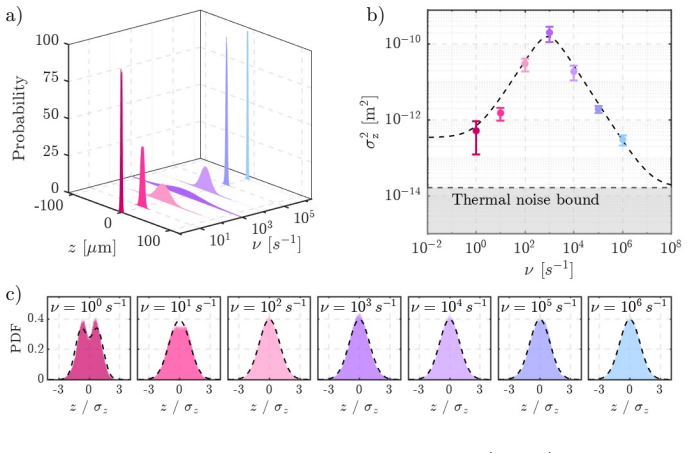
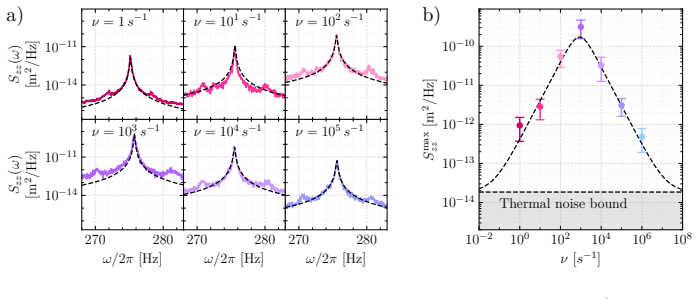
A levitated microparticle sensor whose dynamics are driven almost entirely by random telegraph noise exhibits a thousand-fold increase in underdamped position fluctuations, enabling measurement of the noise spectral properties over six decades of timescale.
What carries the argument
The levitated microparticle sensor driven by random telegraph noise, whose resonant amplification arises from the noise's non-white spectrum.
If this is right
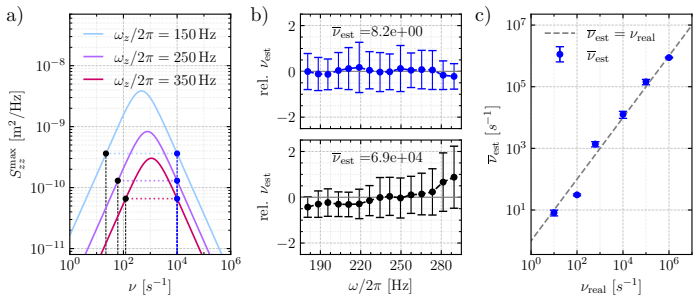
- The sensor directly yields the spectral density of random telegraph noise over six decades of timescale.
- The platform enables controlled study of non-equilibrium stochastic dynamics under realistic non-white noise.
- The approach applies to characterizing noise that affects micro-, nano-, and quantum-technology reliability.
- Similar sensors could probe stochastic processes in biological and social systems.
Where Pith is reading between the lines
- The same resonant mechanism could be tested with other colored-noise sources to map response functions.
- Varying the telegraph switching rates in a controlled source would allow direct calibration of the amplification factor.
- The method might reveal how non-white noise influences long-term stability in precision levitated systems.
Load-bearing premise
The sensor dynamics are driven almost entirely by the random telegraph noise rather than thermal or other environmental sources.
What would settle it
An experiment in which the observed position-fluctuation increase falls well below a factor of one thousand when the microparticle is subjected to controlled random telegraph noise, or in which the extracted spectrum fails to span six decades consistently.
Figures
read the original abstract
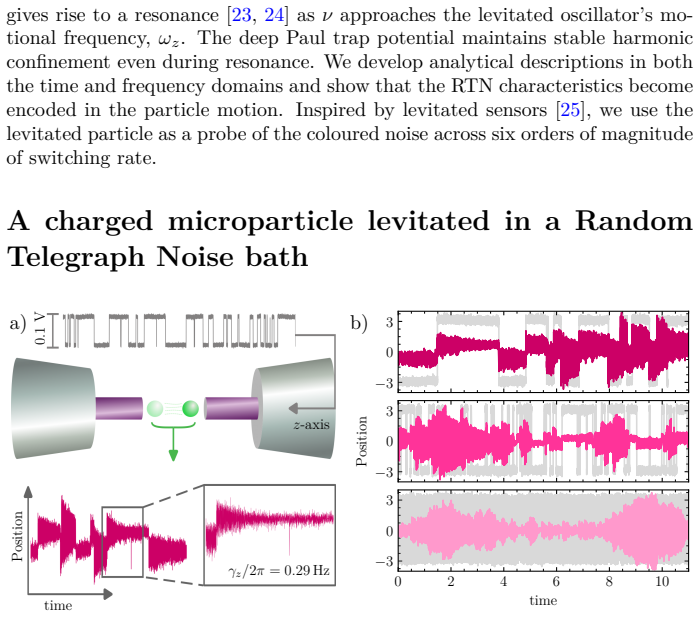
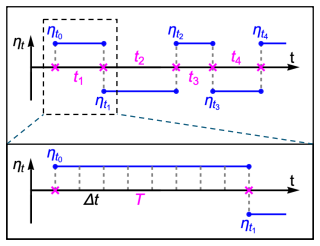
Random Telegraph Noise is a ubiquitous process manifesting across technology and the natural world. It is characterized by random jumps between two distinct states with Poissonian waiting times, and is the origin of 1/f noise. Understanding and characterizing this noise is critical for the reliable operation of micro-, nano- and quantum-technologies. In this work we probe random telegraph noise using a levitated microparticle sensor whose dynamics are driven almost entirely by this non-white source of noise. We observe a startling resonant behaviour, characterized by a thousand-fold increase in the underdamped sensor's position fluctuations, enabling us to measure the spectral properties of the noise over six decades of timescale. This work not only provides a unique way to probe random telegraph noise, but also demonstrates a platform for studying non-equilibrium stochastic dynamics in the presence of realistic non-white noise, with applications from biology to social behaviour.
Editorial analysis
A structured set of objections, weighed in public.
Referee Report
Summary. The manuscript proposes a levitated microparticle sensor for characterizing random telegraph noise (RTN). It claims that the sensor's dynamics are driven almost entirely by this non-white noise, resulting in a resonant behavior with a thousand-fold increase in underdamped position fluctuations. This enables the measurement of the noise's spectral properties over six decades of timescale. The work is presented as a platform for studying non-equilibrium stochastic dynamics in realistic noise environments, with applications ranging from biology to social behaviour.
Significance. If the result holds, this approach could provide a unique and powerful method for probing RTN, which is important for the reliable operation of micro-, nano-, and quantum-technologies. The ability to measure over six decades is significant for noise spectroscopy, and the demonstration of non-equilibrium dynamics with non-white noise could have broad implications.
major comments (1)
- [Abstract] Abstract: the claim that the sensor dynamics are driven almost entirely by the random telegraph noise lacks quantitative support such as a variance ratio with/without the RTN source or a PSD decomposition showing the RTN Lorentzian dominating the mechanical resonance. This premise is load-bearing for the central claim of RTN-specific resonant amplification over thermal or technical noise.
Simulated Author's Rebuttal
We thank the referee for their careful reading and constructive feedback on our manuscript. We respond to the single major comment below.
read point-by-point responses
-
Referee: [Abstract] Abstract: the claim that the sensor dynamics are driven almost entirely by the random telegraph noise lacks quantitative support such as a variance ratio with/without the RTN source or a PSD decomposition showing the RTN Lorentzian dominating the mechanical resonance. This premise is load-bearing for the central claim of RTN-specific resonant amplification over thermal or technical noise.
Authors: The abstract is necessarily concise, but the manuscript body contains the quantitative support requested. The results section includes a PSD decomposition demonstrating that the RTN Lorentzian dominates the mechanical resonance, together with a direct variance comparison (with versus without the RTN source) that quantifies the dominance. The reported thousand-fold increase in position fluctuations is the outcome of this comparison. We agree that a brief reference to these quantitative elements would improve the abstract and will revise it accordingly. revision: yes
Circularity Check
No significant circularity detected
full rationale
The paper presents an experimental platform using a levitated microparticle to probe random telegraph noise, with the central claim resting on observed resonant amplification of position fluctuations under RTN drive. No equations, fitting procedures, or self-citations are referenced in the provided abstract or summary that would reduce any claimed prediction or uniqueness result to an input by construction. The argument structure relies on standard driven-oscillator dynamics once the premise of RTN dominance is granted, with no load-bearing steps that invoke self-defined parameters, fitted inputs renamed as predictions, or imported uniqueness theorems. The derivation chain is therefore self-contained against external benchmarks and does not exhibit any of the enumerated circularity patterns.
Axiom & Free-Parameter Ledger
Reference graph
Works this paper leans on
-
[1]
Telegraph frequency noise in electromechanical resonators
F. Sun, J. Zou, Z. A. Maizelis, and H. B. Chan. “Telegraph frequency noise in electromechanical resonators”. In:Phys. Rev. B91 (17 May 2015), p. 174102
2015
-
[2]
Modelling the effect of telegraph noise in the SIRS epidemic model using Markovian switching
D. Greenhalgh, Y. Liang, and X. Mao. “Modelling the effect of telegraph noise in the SIRS epidemic model using Markovian switching”. In:Physica A: Statistical Mechanics and its Applications462 (2016), pp. 684–704
2016
-
[3]
Singular response of bistable systems driven by telegraph noise
Akihisa Ichiki, Yukihiro Tadokoro, and M. I. Dykman. “Singular response of bistable systems driven by telegraph noise”. In:Phys. Rev. E85 (3 Mar. 2012), p. 031106
2012
-
[4]
Colored Noise in Dynamical Systems
Peter H¨ aunggi and Peter Jung. “Colored Noise in Dynamical Systems”. In:Advances in Chemical Physics. John Wiley & Sons, Ltd, 1994, pp. 239– 326. 17
1994
-
[5]
(In- vited) Random Telegraph Noise: From a Device Physicist’s Dream to a Designer’s Nightmare
Eddy Simoen, Ben Kaczer, Maria Toledano-Luque, and Cor Claeys. “(In- vited) Random Telegraph Noise: From a Device Physicist’s Dream to a Designer’s Nightmare”. In:ECS Transactions39.1 (Sept. 2011), p. 3
2011
-
[6]
Advanced Character- ization and Analysis of Random Telegraph Noise in CMOS Devices
J. Martin-Martinez, R. Rodriguez, and M. Nafria. “Advanced Character- ization and Analysis of Random Telegraph Noise in CMOS Devices”. In: Noise in Nanoscale Semiconductor Devices. Ed. by Tibor Grasser. Cham: Springer International Publishing, 2020, pp. 467–493
2020
-
[7]
Emergent 1/fNoise in Ensem- bles of Random Telegraph Noise Oscillators
Barry N. Costanzi and E. Dan Dahlberg. “Emergent 1/fNoise in Ensem- bles of Random Telegraph Noise Oscillators”. In:Phys. Rev. Lett.119 (9 Aug. 2017), p. 097201
2017
-
[8]
Random telegraph noise analysis in time domain
Y. Yuzhelevski, M. Yuzhelevski, and G. Jung. “Random telegraph noise analysis in time domain”. In:Rev. Sci. Instrum.71 (4 2000), pp. 1681– 1688
2000
-
[9]
The Impact of Electrostatic Interactions Between Defects on the Characteristics of Ran- dom Telegraph Noise
Sara Vecchi, Paolo Pavan, and Francesco Maria Puglisi. “The Impact of Electrostatic Interactions Between Defects on the Characteristics of Ran- dom Telegraph Noise”. In:IEEE Transactions on Electron Devices69.12 (2022), pp. 6991–6998
2022
-
[10]
RTNinja: A generalized machine learning framework for analyzing random telegraph noise signals in nanoelectronic devices
Anirudh Varanasi, Robin Degraeve, Philippe Roussel, and Clement Mer- ckling. “RTNinja: A generalized machine learning framework for analyzing random telegraph noise signals in nanoelectronic devices”. In:APL Ma- chine Learning3.4 (Dec. 2025), p. 046109
2025
-
[11]
Rigidity generation by non- thermal fluctuations
R. Sheshka, P. Recho, and L. Truskinovsky. “Rigidity generation by non- thermal fluctuations”. In:Phys. Rev. E93 (5 May 2016), p. 052604
2016
-
[12]
On financial markets based on telegraph processes
Nikita Ratanov and Alexander Melnikov. “On financial markets based on telegraph processes”. In:Stochastics80.2-3 (Apr. 2008), pp. 247–268
2008
-
[13]
Langevin dynamics with dichotomous noise; direct simulation and applications
Debashis Barik, Pulak Kumar Ghosh, and Deb Shankar Ray. “Langevin dynamics with dichotomous noise; direct simulation and applications”. In: Journal of Statistical Mechanics: Theory and Experiment2006.03 (Mar. 2006), P03010
2006
-
[14]
Single Particle Thermodynamics with Levitated Nanoparticles
James Millen and Jan Gieseler. “Single Particle Thermodynamics with Levitated Nanoparticles”. In:Thermodynamics in the Quantum Regime: Fundamental Aspects and New Directions. Cham: Springer International Publishing, 2018, pp. 853–885
2018
-
[15]
Resonances arising from hydrodynamic memory in Brownian motion
Thomas Franosch et al. “Resonances arising from hydrodynamic memory in Brownian motion”. In:Nature478.7367 (Oct. 2011), pp. 85–88
2011
-
[16]
Levitodynamics: Levitation and control of microscopic ob- jects in vacuum
C. Gonzalez-Ballestero, M. Aspelmeyer, L. Novotny, R. Quidant, and O. Romero-Isart. “Levitodynamics: Levitation and control of microscopic ob- jects in vacuum”. In:Science374.6564 (2021), eabg3027
2021
-
[17]
Optomechanics with levitated particles
James Millen, Tania S Monteiro, Robert Pettit, and A Nick Vamivakas. “Optomechanics with levitated particles”. In:Reports on Progress in Physics 83.2 (Jan. 2020), p. 026401. 18
2020
-
[18]
Cambridge University Press, 2025
Udo Seifert.Stochastic Thermodynamics. Cambridge University Press, 2025
2025
-
[19]
Mea- surement of the Instantaneous Velocity of a Brownian Particle
Tongcang Li, Simon Kheifets, David Medellin, and Mark G. Raizen. “Mea- surement of the Instantaneous Velocity of a Brownian Particle”. In:Sci- ence328.5986 (2010), pp. 1673–1675
2010
-
[20]
Direct measurement of Kramers turnover with a levitated nanoparticle
Lo¨ ıc Rondin, Jan Gieseler, Francesco Ricci, Romain Quidant, Christoph Dellago, and Lukas Novotny. “Direct measurement of Kramers turnover with a levitated nanoparticle”. In:Nature Nanotechnology12.12 (Dec. 2017), pp. 1130–1133
2017
-
[21]
A single-atom heat engine
Johannes Roßnagel et al. “A single-atom heat engine”. In:Science352.6283 (2016), pp. 325–329
2016
-
[22]
Extreme-Temperature Single-Particle Heat Engine
M. Message et al. “Extreme-Temperature Single-Particle Heat Engine”. In:Phys. Rev. Lett.135 (21 Nov. 2025), p. 217101
2025
-
[23]
Escape dynamics of active particles in multistable po- tentials
A. Militaru, M. Innerbichler, M. Frimmer, F. Tebbenjohanns, L. Novotny, and C. Dellago. “Escape dynamics of active particles in multistable po- tentials”. In:Nature Communications12 (2021), p. 2446
2021
-
[24]
Ef- fects of Colored Noise on Stochastic Resonance in Sensory Neurons
Daichi Nozaki, Douglas J. Mar, Peter Grigg, and James J. Collins. “Ef- fects of Colored Noise on Stochastic Resonance in Sensory Neurons”. In: Physical Review Letters82.11 (1999), pp. 2402–2405
1999
-
[25]
Yoctonewton force detection based on optically levitated oscillator
Tao Liang et al. “Yoctonewton force detection based on optically levitated oscillator”. In:Fundamental Research3.1 (2023), pp. 57–62
2023
-
[26]
Event-based imaging of levitated microparticles
Yugang Ren et al. “Event-based imaging of levitated microparticles”. In: Applied Physics Letters121.11 (Sept. 2022), p. 113506
2022
-
[27]
Brownian Carnot engine
I. A. Mart´ ınez, ´E Rold´ an, L. Dinis, D. Petrov, J. M. R. Parrondo, and R. A. Rica. “Brownian Carnot engine”. In:Nature Physics12.1 (Jan. 2016), pp. 67–70
2016
-
[28]
Neuromorphic detection and cooling of microparticles in arrays
Yugang Ren et al. “Neuromorphic detection and cooling of microparticles in arrays”. In:Nature Communications16.1 (Nov. 2025), p. 10658
2025
-
[29]
Spatially resolved random telegraph fluctu- ations of a single trap at the Si/SiO2 interface
Megan Cowie, Procopios C. Constantinou, Neil J. Curson, Taylor J. Z. Stock, and Peter Gr¨ utter. “Spatially resolved random telegraph fluctu- ations of a single trap at the Si/SiO2 interface”. In:Proceedings of the National Academy of Sciences121.44 (2024), e2404456121
2024
-
[30]
Direct loading of nanoparticles under high vacuum into a Paul trap for levitodynamical experiments
Dmitry S. Bykov, Pau Mestres, Lorenzo Dania, Lisa Schm¨ oger, and Tracy E. Northup. “Direct loading of nanoparticles under high vacuum into a Paul trap for levitodynamical experiments”. In:Applied Physics Letters 115.3 (July 2019), p. 034101
2019
-
[31]
Di- rect and Clean Loading of Nanoparticles into Optical Traps at Millibar Pressures
Maryam Nikkhou, Yanhui Hu, James A. Sabin, and James Millen. “Di- rect and Clean Loading of Nanoparticles into Optical Traps at Millibar Pressures”. In:Photonics8.11 (2021)
2021
-
[32]
Event-based imaging of levitated microparticles
Yugang Ren et al. “Event-based imaging of levitated microparticles”. In: Applied Physics Letters121.11 (Sept. 2022), p. 113506. 19
2022
discussion (0)
Sign in with ORCID, Apple, or X to comment. Anyone can read and Pith papers without signing in.