GENESIS: Harnessing AI Agents for Autonomous 6G RAN Synthesis, Research, and Testing
Pith reviewed 2026-06-29 15:00 UTC · model grok-4.3
The pith
GENESIS converts RAN intents such as specification clauses or anomalies into solutions validated by over-the-air experiments and stored in a persistent knowledge base.
A machine-rendered reading of the paper's core claim, the machinery that carries it, and where it could break.
Core claim
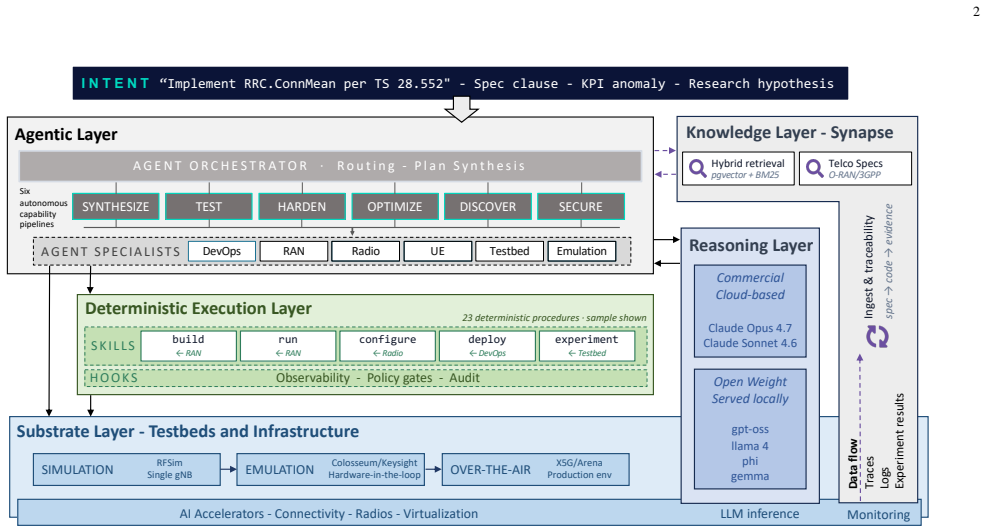
GENESIS is an agentic AI framework that converts intents into solutions validated with over-the-air experiments, fed back into a persistent knowledge base. It is built on three composable primitives (agents, skills, hooks) and a knowledge layer (SYNAPSE) that doubles as the source of ground truth and the recipient of every artifact the framework produces, making capabilities compound across runs.
What carries the argument
Three composable primitives (agents, skills, hooks) plus the SYNAPSE knowledge layer that supplies ground truth and accumulates every produced artifact.
If this is right
- Feature synthesis from standards or papers becomes an automated pipeline ending in OTA validation.
- Conformance testing, anomaly hardening, and data-driven optimization run without manual intervention.
- Novel waveform discovery and security hardening proceed from research hypotheses to hardware tests.
- Every artifact enriches the shared knowledge base so later runs start from accumulated results.
- The six structural bottlenecks that currently consume months per iteration are addressed in a single loop.
Where Pith is reading between the lines
- If the loop holds, the dominant cost in 6G R&D shifts from engineering labor to defining clear intents.
- The same structure could be tested on other hardware-in-the-loop domains where simulation-reality gaps are costly.
- Over repeated runs the knowledge base may encode domain-specific patterns that general LLMs lack.
- Failure to close the loop would appear first as repeated API hallucinations on successive intents.
Load-bearing premise
The three primitives and SYNAPSE layer can prevent LLM hallucinations of APIs and ensure solutions transfer from simulation to real RAN hardware.
What would settle it
A test in which GENESIS receives a standards clause, emits code, and the code fails interoperability checks on actual RAN equipment because of an incorrect API call.
Figures
read the original abstract
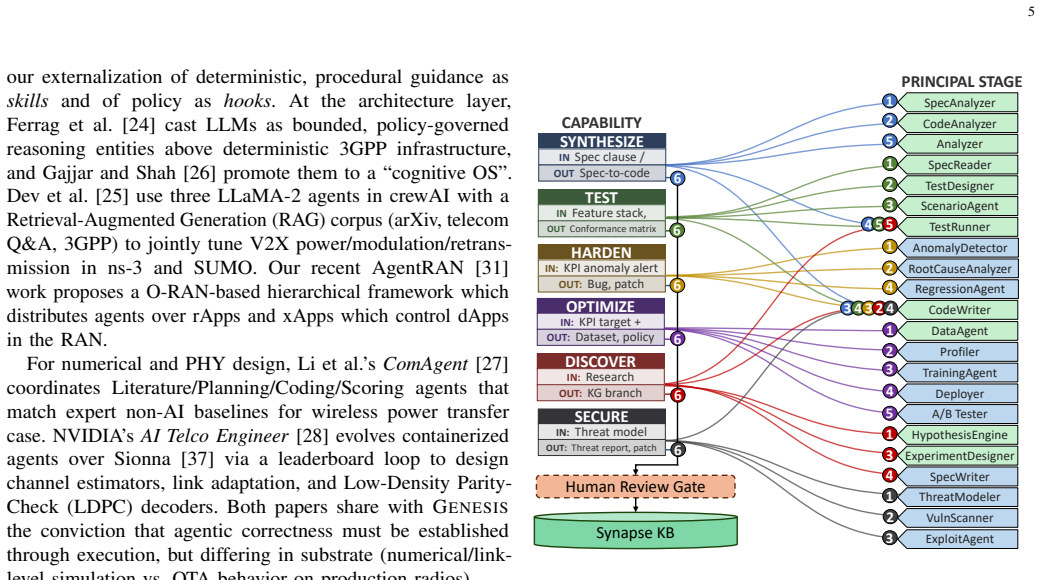
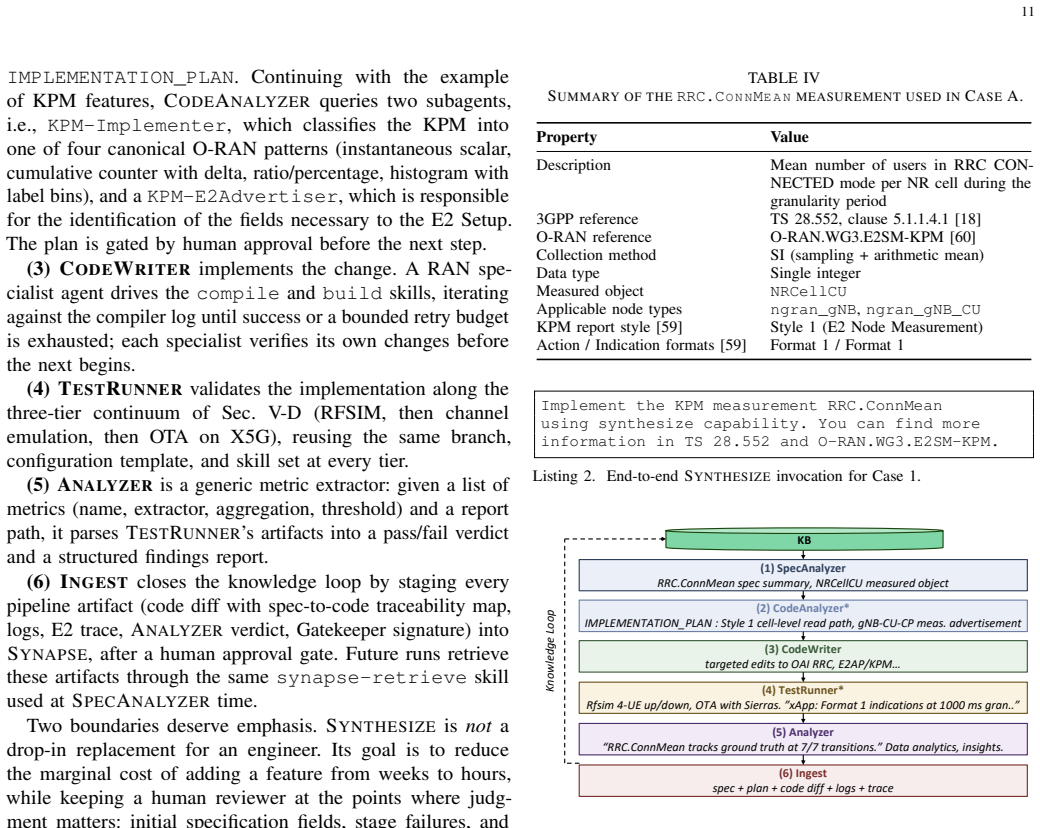
Cellular research and development (R&D) is throttled by six structural processes that each consume months of manual engineering work per iteration: (i) synthesizing new features from standards or research papers into production code; (ii) conformance and interoperability testing; (iii) hardening against field anomalies and diverse deployment environments; (iv) data-driven optimization of network functionalities; (v) discovering and prototyping novel waveforms, functionalities, and capabilities for future standards; and (vi) securing the stack against vulnerabilities. Although Large Language Models (LLMs) have compressed comparable R&D work in general software engineering from days to minutes, their known pitfalls worsen on Radio Access Network (RAN) use cases: they hallucinate Application Programming Interfaces (APIs) and mis-read specifications, which kills interoperability of RAN components at the first mistake, and they heavily rely on simulations for designing algorithms, which is notorious for breaking when transferred to real hardware. To address these challenges, we present GENESIS, an agentic Artificial Intelligence (AI) framework that converts intents (e.g., a specification clause, a telemetry anomaly, or a research hypothesis) into solutions validated with over-the-air experiments, fed back into a persistent knowledge base. GENESIS is built on three composable primitives (agents, skills, hooks) and a knowledge layer (SYNAPSE) that doubles as the source of ground truth and the recipient of every artifact the framework produces, making capabilities compound across runs.
Editorial analysis
A structured set of objections, weighed in public.
Referee Report
Summary. The paper presents GENESIS, an agentic AI framework for automating six labor-intensive 6G RAN R&D processes (feature synthesis from standards, conformance testing, anomaly hardening, data-driven optimization, waveform discovery, and security). It claims that GENESIS converts high-level intents (specification clauses, telemetry anomalies, or research hypotheses) into solutions validated via over-the-air experiments, with all artifacts fed back into a persistent SYNAPSE knowledge base. The framework is built from three composable primitives (agents, skills, hooks) that compound capabilities across runs while mitigating LLM pitfalls such as API hallucination and sim-to-real transfer failures.
Significance. If the claimed end-to-end capability were demonstrated, the work would be highly significant for cellular R&D: it could compress multi-month manual cycles into automated, compounding iterations and directly address the documented LLM failure modes that currently block reliable use in standards-compliant RAN hardware. The emphasis on OTA validation and a persistent ground-truth knowledge layer distinguishes it from simulation-only agentic proposals.
major comments (2)
- [Abstract] Abstract: the central claim that GENESIS 'converts intents ... into solutions validated with over-the-air experiments' is unsupported by any experimental results, error metrics, failure cases, implementation details, or even high-level pseudocode; without these the claim cannot be evaluated and remains a system sketch rather than a substantiated contribution.
- [System Architecture / Primitives] The description of the three primitives (agents, skills, hooks) and SYNAPSE does not specify concrete mechanisms, guardrails, or verification steps that would prevent the documented LLM failure modes (API hallucination, non-transferable simulation results) when the framework is applied to real RAN hardware and 3GPP specifications.
Simulated Author's Rebuttal
We thank the referee for the constructive and detailed feedback. The comments correctly identify that the current manuscript is primarily a system description and that stronger substantiation is needed for the central claims. We address each point below and commit to revisions that improve clarity and technical detail without overstating the current evidence.
read point-by-point responses
-
Referee: [Abstract] Abstract: the central claim that GENESIS 'converts intents ... into solutions validated with over-the-air experiments' is unsupported by any experimental results, error metrics, failure cases, implementation details, or even high-level pseudocode; without these the claim cannot be evaluated and remains a system sketch rather than a substantiated contribution.
Authors: We agree that the abstract phrasing overstates what is demonstrated. The manuscript presents the framework architecture and intended workflow rather than completed end-to-end OTA experiments. In revision we will (i) rephrase the abstract to state that GENESIS is designed to produce OTA-validated solutions via the described primitives and knowledge layer, (ii) add high-level pseudocode for the core agent loop, and (iii) include a dedicated section on example workflows with explicit discussion of failure modes and mitigation strategies. Full quantitative OTA results with error metrics remain future work and will not be claimed in this paper. revision: partial
-
Referee: [System Architecture / Primitives] The description of the three primitives (agents, skills, hooks) and SYNAPSE does not specify concrete mechanisms, guardrails, or verification steps that would prevent the documented LLM failure modes (API hallucination, non-transferable simulation results) when the framework is applied to real RAN hardware and 3GPP specifications.
Authors: The referee is correct that the current text remains at the level of high-level primitives. We will expand the System Architecture and SYNAPSE sections to include: (a) explicit guardrails such as schema-based API validation against 3GPP reference implementations inside skills, (b) multi-agent cross-verification hooks that require consensus before any code or configuration is emitted, (c) simulation-to-real transfer checks that compare against a curated set of hardware benchmarks stored in SYNAPSE, and (d) provenance tracking that records every artifact's verification status. These concrete mechanisms will be described with pseudocode and will directly target the hallucination and transfer issues raised. revision: yes
Circularity Check
No significant circularity detected
full rationale
The paper presents a high-level architectural description of the GENESIS framework built on agents, skills, hooks, and the SYNAPSE knowledge layer. No equations, derivations, fitted parameters, or mathematical claims appear in the provided text. The central claims are descriptive and system-level rather than derived from self-referential loops, self-citations that bear the load of uniqueness, or renamings of known results. No instances of the enumerated circularity patterns are present, and the argument remains self-contained against external benchmarks.
Axiom & Free-Parameter Ledger
invented entities (2)
-
GENESIS
no independent evidence
-
SYNAPSE
no independent evidence
Reference graph
Works this paper leans on
-
[1]
OpenAirInterface 5G source code repository,
OpenAirInterface Software Alliance, “OpenAirInterface 5G source code repository,” 2026, accessed: May 2026. [Online]. Available: https://gitlab.eurecom.fr/oai/openairinterface5g
2026
-
[2]
5G radio network design for ultra-reliable low-latency communication,
J. Sachs, G. Wikstrom, T. Dudda, R. Baldemair, and K. Kittichokechai, “5G radio network design for ultra-reliable low-latency communication,” IEEE Netw., vol. 32, no. 2, pp. 24–31, Apr. 2018
2018
-
[3]
On integrated access and backhaul networks: Current status and potentials,
C. Madapatha, B. Makki, C. Fang, O. Teyeb, E. Dahlman, M.-S. Alouini, and T. Svensson, “On integrated access and backhaul networks: Current status and potentials,”IEEE Open J. Commun. Soc., vol. 1, pp. 1374– 1389, Sep. 2020. 17
2020
-
[4]
Ultra-reliable low-latency in 5G: A close reality or a distant goal?
A. Maghsoudnia, E. Vlad, A. Gong, D. M. Dumitriu, and H. Hassanieh, “Ultra-reliable low-latency in 5G: A close reality or a distant goal?” in Proc. 23rd ACM Workshop Hot Topics Netw., Irvine, CA, USA, Nov. 2024, p. 111–120
2024
-
[5]
Understand- ing O-RAN: Architecture, interfaces, algorithms, security, and research challenges,
M. Polese, L. Bonati, S. D’oro, S. Basagni, and T. Melodia, “Understand- ing O-RAN: Architecture, interfaces, algorithms, security, and research challenges,”IEEE Commun. Surveys Tuts., vol. 25, no. 2, pp. 1376–1411, 2nd Quart. 2023
2023
-
[6]
AI-RAN alliance,
AI-RAN Alliance, “AI-RAN alliance,” 2026, accessed: May 2026. [Online]. Available: https://ai-ran.org/
2026
-
[7]
AutoGen: Enabling next-gen LLM applications via multi-agent conversations,
Q. Wu, G. Bansal, J. Zhang, Y . Wu, B. Li, E. Zhu, L. Jiang, X. Zhang, S. Zhang, J. Liu, A. H. Awadallah, R. W. White, D. Burger, and C. Wang, “AutoGen: Enabling next-gen LLM applications via multi-agent conversations,” inProc. First Conf. Lang. Model. (COLM), Aug. 2024, p. 1–43. [Online]. Available: https://openreview.net/forum?id=BAakY1hNKS
2024
-
[8]
MetaGPT: Meta programming for a multi-agent collaborative framework,
S. Hong, M. Zhuge, J. Chen, X. Zheng, Y . Cheng, C. Zhang, J. Wang, Z. Wang, S. K. S. Yau, Z. Lin, L. Zhou, C. Ran, L. Xiao, C. Wu, and J. Schmidhuber, “MetaGPT: Meta programming for a multi-agent collaborative framework,” inProc. 12th Int. Conf. Learn. Represent. (ICLR), Apr. 2023. [Online]. Available: https://openreview.net/forum?id=VtmBAGCN7o
2023
-
[9]
CrewAI: Framework for orchestrating role-playing autonomous AI agents,
CrewAI Inc., “CrewAI: Framework for orchestrating role-playing autonomous AI agents,” 2026. [Online]. Available: https://github.com/ crewAIInc/crewAI
2026
-
[10]
Claude code: Agents and sub-agents,
Anthropic, “Claude code: Agents and sub-agents,” 2026, accessed: 2026- 05-20. [Online]. Available: https://code.claude.com/docs/en/sub-agents
2026
-
[11]
SWE-bench: Can Language Models Resolve Real-World GitHub Issues?
C. E. Jimenez, J. Yang, A. Wettig, S. Yao, K. Pei, O. Press, and K. Narasimhan, “SWE-bench: Can language models resolve real-world GitHub issues?” Nov. 2024. [Online]. Available: https: //arxiv.org/abs/2310.06770
work page internal anchor Pith review Pith/arXiv arXiv 2024
-
[12]
CoderEval: A benchmark of pragmatic code generation with generative pre-trained models,
H. Yu, B. Shen, D. Ran, J. Zhang, Q. Zhang, Y . Ma, G. Liang, Y . Li, Q. Wang, and T. Xie, “CoderEval: A benchmark of pragmatic code generation with generative pre-trained models,” inProc. IEEE/ACM 46th Int. Conf. Softw. Eng., Lisbon, Portugal, Apr. 2024, pp. 428–439
2024
-
[13]
Who is using AI to code? Global diffusion and impact of generative AI,
S. Daniotti, J. Wachs, X. Feng, and F. Neffke, “Who is using AI to code? Global diffusion and impact of generative AI,”Science, vol. 391, no. 6787, pp. 831–835, Jan. 2026
2026
-
[14]
Colosseum: Large-scale wireless exper- imentation through hardware-in-the-loop network emulation,
L. Bonati, P. Johari, M. Polese, S. D’Oro, S. Mohanti, M. Tehrani- Moayyed, D. Villa, S. Shrivastava, C. Tassie, K. Yoder, A. Bagga, P. Patel, V . Petkov, M. Seltser, F. Restuccia, A. Gosain, K. R. Chowdhury, S. Basagni, and T. Melodia, “Colosseum: Large-scale wireless exper- imentation through hardware-in-the-loop network emulation,” inProc. IEEE Int. Sy...
2021
-
[15]
X5G: An open, programmable, multi- vendor, end-to-end, private 5G O-RAN testbed with NVIDIA ARC and OpenAirInterface,
D. Villa, I. Khan, F. Kaltenberger, N. Hedberg, R. S. da Silva, S. Maxenti, L. Bonati, A. Kelkar, C. Dick, E. Baena, J. M. Jornet, T. Melodia, M. Polese, and D. Koutsonikolas, “X5G: An open, programmable, multi- vendor, end-to-end, private 5G O-RAN testbed with NVIDIA ARC and OpenAirInterface,”IEEE Trans. Mobile Comput., vol. 24, no. 11, pp. 11 305–11 322...
2025
-
[16]
Arena: A 64-antenna SDR-based ceiling grid testing platform for sub-6 GHz 5G-and-beyond radio spectrum research,
L. Bertizzolo, L. Bonati, E. Demirors, A. Al-Shawabka, S. D’Oro, F. Restuccia, and T. Melodia, “Arena: A 64-antenna SDR-based ceiling grid testing platform for sub-6 GHz 5G-and-beyond radio spectrum research,”Comput. Netw., vol. 181, pp. 1–17, Nov. 2020
2020
-
[17]
AutoRAN: Automated and Zero-Touch Open RAN systems,
S. Maxenti, R. Shirkhani, M. Elkael, L. Bonati, S. D’Oro, T. Melodia, and M. Polese, “AutoRAN: Automated and Zero-Touch Open RAN systems,” IEEE Trans. Mobile Comput., pp. 1–18, Jan. 2026, early access
2026
-
[18]
5G; Management and orchestration; 5G performance measurements, version 17.7.1,
“5G; Management and orchestration; 5G performance measurements, version 17.7.1,” 3rd Gener. Partnership Project (3GPP), TS 28.552, Jul
-
[19]
Available: http://www.3gpp.org/DynaReport/28552.htm
[Online]. Available: http://www.3gpp.org/DynaReport/28552.htm
-
[20]
ALL- STaR: Automated LLM-driven scheduler generation and testing for intent-based RAN,
M. Elkael, M. Polese, R. Prasad, S. Maxenti, and T. Melodia, “ALLSTaR: Automated LLM-driven scheduler generation and testing for intent-based RAN,” Oct. 2025. [Online]. Available: http://arxiv.org/abs/2505.18389
-
[21]
Voyager: An Open-Ended Embodied Agent with Large Language Models
G. Wang, Y . Xie, Y . Jiang, A. Mandlekar, C. Xiao, Y . Zhu, L. Fan, and A. Anandkumar, “V oyager: An open-ended embodied agent with large language models,” Oct. 2023. [Online]. Available: https://arxiv.org/abs/2305.16291
work page internal anchor Pith review Pith/arXiv arXiv 2023
-
[22]
Glia: A human-inspired AI for automated systems design and optimization,
P. Hamadanian, P. Karimi, A. Nasr-Esfahany, K. Noorbakhsh, J. Chandler, A. ParandehGheibi, M. Alizadeh, and H. Balakrishnan, “Glia: A human-inspired AI for automated systems design and optimization,” Oct
-
[23]
Glia: A Human-Inspired AI for Automated Systems Design and Optimization
[Online]. Available: https://arxiv.org/abs/2510.27176
work page internal anchor Pith review Pith/arXiv arXiv
-
[24]
H. Navidan, M. Cheraghinia, J. Fontaine, M. Seif, E. D. Poorter, H. V . Poor, I. Moerman, and A. Shahid, “Toward autonomous O-RAN: A multi-scale agentic AI framework for real-time network control and management,” Feb. 2026. [Online]. Available: https: //arxiv.org/abs/2602.14117
work page internal anchor Pith review Pith/arXiv arXiv 2026
-
[25]
Agentic AI empowered intent-based networking for 6G,
G. Jiang, K. Wang, X. Chen, and Y . Huang, “Agentic AI empowered intent-based networking for 6G,” Jan. 2026. [Online]. Available: https://arxiv.org/abs/2601.06640
-
[26]
6G Needs Agents: Toward Agentic AI-Native Networks for Autonomous Intelligence
M. A. Ferrag, A. Lakas, and M. Debbah, “6G needs agents: Toward agentic AI-native networks for autonomous intelligence,” May 2026. [Online]. Available: https://arxiv.org/abs/2605.01546
work page internal anchor Pith review Pith/arXiv arXiv 2026
-
[27]
Advanced architectures integrated with agentic AI for next-generation wireless networks,
K. Dev, S. A. Khowaja, E. Zeydan, K. Singh, and M. Debbah, “Advanced architectures integrated with agentic AI for next-generation wireless networks,”IEEE Commun. Standards Mag., pp. 1–8, Nov. 2025, early access
2025
-
[28]
Agents Should Replace Narrow Predictive AI as the Orchestrator in 6G AI-RAN
P. Gajjar and V . K. Shah, “Agents should replace narrow predictive AI as the orchestrator in 6G AI-RAN,” May 2026. [Online]. Available: https://arxiv.org/abs/2605.11516
work page internal anchor Pith review Pith/arXiv arXiv 2026
-
[29]
ComAgent: Multi-LLM based agentic AI empowered intelligent wire- less networks,
H. Li, M. Xiao, K. Wang, R. Schober, D. I. Kim, and Y . L. Guan, “ComAgent: Multi-LLM based agentic AI empowered intelligent wireless networks,” Jan. 2026. [Online]. Available: https: //arxiv.org/abs/2601.19607
-
[30]
The AI Telco Engineer: Toward Autonomous Discovery of Wireless Communications Algorithms
F. A. Aoudia, J. Hoydis, S. Cammerer, L. Maggi, G. Marti, and A. Keller, “The AI telco engineer: Toward autonomous discovery of wireless communications algorithms,” Apr. 2026. [Online]. Available: https://arxiv.org/abs/2604.19803
work page internal anchor Pith review Pith/arXiv arXiv 2026
-
[31]
A practical approach to defining a framework for developing an agentic AIOps system,
R. D. Zota, C. B ˘arbulescu, and R. Constantinescu, “A practical approach to defining a framework for developing an agentic AIOps system,”Electronics, vol. 14, no. 9, Apr. 2025. [Online]. Available: https://www.mdpi.com/2079-9292/14/9/1775
2025
-
[32]
5GReasoner: A property-directed security and privacy analysis framework for 5G cellular network protocol,
S. R. Hussain, M. Echeverria, I. Karim, O. Chowdhury, and E. Bertino, “5GReasoner: A property-directed security and privacy analysis framework for 5G cellular network protocol,” inProc. ACM SIGSAC Conf. Comput. Commun. Security, Nov. 2019, pp. 669–684
2019
-
[33]
AgentRAN: An Agentic AI Architecture for Autonomous Control of Open 6G Networks,
M. Elkael, S. D’Oro, L. Bonati, M. Polese, Y . Lee, K. Furueda, and T. Melodia, “AgentRAN: An Agentic AI Architecture for Autonomous Control of Open 6G Networks,”IEEE Commun. Mag., pp. 1–7, May 2026, early access
2026
-
[34]
ChatDev: Communicative agents for software development,
C. Qian, W. Liu, H. Liu, N. Chen, Y . Dang, J. Li, C. Yang, W. Chen, Y . Su, X. Cong, J. Xu, D. Li, Z. Liu, and M. Sun, “ChatDev: Communicative agents for software development,” inProc. 62nd Annu. Meeting Assoc. Comput. Linguistics (Long Papers), Jun. 2024, pp. 15 174–15 186
2024
-
[35]
LangGraph: Building stateful, multi-agent applications with LLMs,
LangChain Inc., “LangGraph: Building stateful, multi-agent applications with LLMs,” 2026, accessed: 2026-04-26. [Online]. Available: https://github.com/langchain-ai/langgraph
2026
-
[36]
OpenAI agents SDK,
OpenAI, “OpenAI agents SDK,” 2026, accessed: 2026-05-20. [Online]. Available: https://github.com/openai/openai-agents-python
2026
-
[37]
Externalization in LLM Agents: A Unified Review of Memory, Skills, Protocols and Harness Engineering
C. Zhou, H. Chai, W. Chen, Z. Guo, R. Shan, Y . Song, T. Xu, Y . Yang, A. Yu, W. Zhang, C. Zheng, J. Zhu, Z. Zheng, Z. Zhang, X. Lou, C. Zhang, Z. Fu, J. Wang, W. Liu, J. Lin, and W. Zhang, “Externalization in LLM agents: A unified review of memory, skills, protocols and harness engineering,” Apr. 2026. [Online]. Available: https://arxiv.org/abs/2604.08224
work page internal anchor Pith review Pith/arXiv arXiv 2026
-
[38]
From large AI models to agentic AI: A tutorial on future intelligent communications,
F. Jiang, C. Pan, K. Wang, P. Michiardi, O. A. Dobre, and M. Debbah, “From large AI models to agentic AI: A tutorial on future intelligent communications,”IEEE J. Sel. Areas Commun., vol. 44, pp. 3507–3540, Feb. 2026
2026
-
[39]
Sionna: An Open-Source Li- brary for Next-Generation Physical Layer Research,
J. Hoydis, S. Cammerer, F. A. Aoudia, A. Vem, N. Binder, G. Marcus, and A. Keller, “Sionna: An open-source library for next-generation physical layer research,” Mar. 2023. [Online]. Available: https://arxiv.org/abs/2203.11854
-
[40]
SWE-agent: Agent-computer interfaces enable automated software engineering,
J. Yang, C. E. Jimenez, A. Wettig, K. Lieret, S. Yao, K. Narasimhan, and O. Press, “SWE-agent: Agent-computer interfaces enable automated software engineering,”Proc. Adv. Neural Inf. Process. Syst. (NeurIPS), vol. 37, pp. 50 528–50 652, Dec. 2024
2024
-
[41]
Is self-repair a silver bullet for code generation?
T. X. Olausson, J. P. Inala, C. Wang, J. Gao, and A. Solar-Lezama, “Is self-repair a silver bullet for code generation?” inProc. 12th Int. Conf. Learn. Represent. (ICLR), Jan. 2024
2024
-
[42]
DEMO: AI5GTest: LLM based automation for 5G O-RAN testing,
A. Ganiyu, P. Gajjar, and V . K. Shah, “DEMO: AI5GTest: LLM based automation for 5G O-RAN testing,” inProc. 18th ACM Conf. Secur. Privacy Wireless Mobile Netw. (WiSec), Jun. 2025, p. 298–299
2025
-
[43]
TSpec-LLM: An open- source dataset for LLM understanding of 3GPP specifications,
R. Nikbakht, M. Benzaghta, and G. Geraci, “TSpec-LLM: An open- source dataset for LLM understanding of 3GPP specifications,” inProc. IEEE Globecom Workshops (GC Wkshps), Dec. 2024, pp. 1–6
2024
-
[44]
PROSPER: Extracting protocol specifi- cations using large language models,
P. Sharma and V . Yegneswaran, “PROSPER: Extracting protocol specifi- cations using large language models,” inProc. 22nd ACM Wkshps. Hot Topics Netw. (HotNets), Nov. 2023, pp. 41–47
2023
-
[45]
ORANSight-2.0: Foundational LLMs for O- RAN,
P. Gajjar and V . K. Shah, “ORANSight-2.0: Foundational LLMs for O- RAN,”IEEE Trans. Machine Learn. Commun. Netw., vol. 3, pp. 903–920, Jul. 2025. 18
2025
-
[46]
TeleResilienceBench: Quantifying Resilience for LLM Reasoning in Telecommunications
P. Gajjar, E. Ojo, and V . K. Shah, “TeleResilienceBench: Quantifying resilience for LLM reasoning in telecommunications,” May 2026. [Online]. Available: https://arxiv.org/html/2605.09929v1
work page internal anchor Pith review Pith/arXiv arXiv 2026
-
[47]
An experimental reservoir-augmented foundation model: 6G O-RAN case study,
F. Rezazadeh, R. Zhao, J. Dai, A. A. Gargari, H. Chergui, and L. Liu, “An experimental reservoir-augmented foundation model: 6G O-RAN case study,” inProc. 2nd Int. Gener. AI Comput. Lang. Model. Conf. (GACLM), Aug. 2025, pp. 338–342
2025
-
[48]
An introduction to deep learning for the physical layer,
T. O’Shea and J. Hoydis, “An introduction to deep learning for the physical layer,”IEEE Trans. Cognit. Commun. Netw., vol. 3, no. 4, pp. 563–575, Dec. 2017
2017
-
[49]
Threat modeling: Uncover security design flaws using the STRIDE approach,
S. Hernan, S. Lambert, T. Ostwald, and A. Shostack, “Threat modeling: Uncover security design flaws using the STRIDE approach,” MSDN Mag., Nov. 2006, Microsoft Corporation. [Online]. Avail- able: https://learn.microsoft.com/en-us/archive/msdn-magazine/2006/ november/uncover-security-design-flaws-using-the-stride-approach
2006
-
[50]
Russell and P
S. Russell and P. Norvig,Artificial Intelligence: A Modern Approach, 4th ed. Hoboken, NJ: Pearson, 2020
2020
-
[51]
ReAct: Synergizing reasoning and acting in language models,
S. Yao, J. Zhao, D. Yu, N. Du, I. Shafran, K. Narasimhan, and Y . Cao, “ReAct: Synergizing reasoning and acting in language models,” inProc. 11th Int. Conf. Learn. Represent. (ICLR), Mar. 2023
2023
-
[52]
Hooks reference - claude code documentation,
Anthropic, “Hooks reference - claude code documentation,” 2026, accessed: May 2026. [Online]. Available: https://docs.claude.com/en/ docs/claude-code/hooks
2026
-
[53]
The OpenAir- Interface 5G New Radio Implementation: Current Status and Roadmap,
F. Kaltenberger, G. De Souza, R. Knopp, and H. Wang, “The OpenAir- Interface 5G New Radio Implementation: Current Status and Roadmap,” inITG WS, 2019
2019
-
[54]
srsLTE: An open-source platform for LTE evolution and experimentation,
I. Gomez-Miguelez, A. Garcia-Saavedra, P. D. Sutton, P. Serrano, C. Cano, and D. J. Leith, “srsLTE: An open-source platform for LTE evolution and experimentation,” inProc. ACM Int. Wkshps. Wireless Netw. Testbeds, Exper. Eval. Charac. (WiNTECH), Oct. 2016, pp. 25–32
2016
-
[55]
Blog: Introducing the Initial OCUDU Technical Project Release, 26.04,
Linux Foundation, “Blog: Introducing the Initial OCUDU Technical Project Release, 26.04,” 2026, accessed: May 2026. [Online]. Available: https://ocudu.org/news/ blog-introducing-the-initial-ocudu-technical-project-release-26-04/
2026
-
[56]
Near-Realtime RAN Intelligent Controller (RIC),
O-RAN Software Community, “Near-Realtime RAN Intelligent Controller (RIC),” 2024, Linux Foundation Project. [Online]. Available: https://wiki.o-ran-sc.org/display/RICP
2024
-
[57]
FlexRIC: An SDK for next- generation SD-RANs,
R. Schmidt, M. Irazabal, and N. Nikaein, “FlexRIC: An SDK for next- generation SD-RANs,” inProc. 17th Int. Conf. Emerging Netw. Exper. Technol., Dec. 2021, p. 411–425
2021
-
[58]
dApps: Enabling real-time AI-based open RAN control,
A. Lacava, L. Bonati, N. Mohamadi, R. Gangula, F. Kaltenberger, P. Johari, S. D’Oro, F. Cuomo, M. Polese, and T. Melodia, “dApps: Enabling real-time AI-based open RAN control,”Comput. Netw., vol. 269, p. 111342, Sep. 2025
2025
-
[59]
NVIDIA Aerial CUDA-accelerated RAN documentation,
NVIDIA Corporation, “NVIDIA Aerial CUDA-accelerated RAN documentation,” 2026, accessed: 2026-05-20. [Online]. Available: https://docs.nvidia.com/aerial/cuda-accelerated-ran/latest/index.html
2026
-
[60]
OpenAirInterface: A flexible platform for 5G research,
N. Nikaein, M. K. Marina, S. Manickam, A. Dawson, R. Knopp, and C. Bonnet, “OpenAirInterface: A flexible platform for 5G research,” SIGCOMM Comput. Commun. Rev., vol. 44, no. 5, p. 33–38, Oct. 2014
2014
-
[61]
A. Feraudo, S. Maxenti, A. Lacava, L. Bonati, P. Bellavista, M. Polese, and T. Melodia, “xDevSM: An open-source framework for portable, AI-ready xApps across heterogeneous O-RAN deployments,” Feb. 2026. [Online]. Available: https://arxiv.org/abs/2602.03821
-
[62]
O-RAN working group 3, Near-RT RIC and E2 interface, E2 service model (E2SM), KPM, version 07.00,
O-RAN Alliance, “O-RAN working group 3, Near-RT RIC and E2 interface, E2 service model (E2SM), KPM, version 07.00,” O-RAN Alliance, Tech. Spec. O-RAN.WG3.TS.E2SM-KPM-R004-v07.00, 2026
2026
-
[63]
5G; NR; Radio Resource Control (RRC); Protocol specification, version 16.1.0,
“5G; NR; Radio Resource Control (RRC); Protocol specification, version 16.1.0,” 3rd Gener. Partnership Project (3GPP), TS 38.331, Jul. 2020. [Online]. Available: http://www.3gpp.org/DynaReport/38331.htm
2020
-
[64]
5G; NR; NR and NG-RAN overall description; Stage-2, version 16.4.0,
“5G; NR; NR and NG-RAN overall description; Stage-2, version 16.4.0,” 3rd Gener. Partnership Project (3GPP), TS 38.300, Jan. 2021. [Online]. Available: http://www.3gpp.org/DynaReport/38300.htm
2021
-
[65]
5G; NG-RAN; F1 Application Protocol (F1AP), version 17.6.0,
“5G; NG-RAN; F1 Application Protocol (F1AP), version 17.6.0,” 3rd Gener. Partnership Project (3GPP), TS 38.473, Oct. 2023. [Online]. Available: http://www.3gpp.org/DynaReport/38473.htm
2023
-
[66]
O-RAN working group 3, Near-RT RIC and E2 interface, E2 service model (E2SM), RAN control, version 03.00,
O-RAN Alliance, “O-RAN working group 3, Near-RT RIC and E2 interface, E2 service model (E2SM), RAN control, version 03.00,” O- RAN Alliance, Tech. Spec. O-RAN.WG3.E2SM-RC-R003-v03.00, 2023
2023
-
[67]
API pricing,
Anthropic, “API pricing,” Open standard, online documentation, 2026, accessed: May 2026. [Online]. Available: https://claude.com/pricing#api
2026
discussion (0)
Sign in with ORCID, Apple, or X to comment. Anyone can read and Pith papers without signing in.