Probing Dynamical Inverse Seesaw with Low-frequency Gravitational Waves
Pith reviewed 2026-06-29 16:39 UTC · model grok-4.3
The pith
Making the inverse seesaw dynamical generates a low-scale phase transition whose gravitational waves fall in the pulsar timing array band.
A machine-rendered reading of the paper's core claim, the machinery that carries it, and where it could break.
Core claim
Dynamical generation of the lepton-number violating term in the inverse seesaw naturally produces a low-scale first-order phase transition whose resulting gravitational-wave background lies within the frequency window currently probed by pulsar timing arrays, while also opening sensitivity to small active-sterile mixing angles.
What carries the argument
Dynamical lepton-number violating scalar whose vacuum expectation value sets the sub-MeV Majorana mass and triggers a first-order phase transition.
If this is right
- Detection of a nanohertz gravitational-wave background would fix the lepton-number violating scale to lie near the sub-MeV range.
- The gravitational-wave signal remains visible even when active-sterile mixing is too small for heavy-neutral-lepton searches at colliders or fixed-target experiments.
- The same phase transition can generate a baryon asymmetry through leptogenesis at the same low scale.
- Complementary limits from big-bang nucleosynthesis and cosmic microwave background measurements would further restrict the allowed transition temperature.
Where Pith is reading between the lines
- If the gravitational-wave signal is observed, future interferometers at higher frequencies could search for the same transition's high-frequency tail.
- The dynamical scalar could couple to dark matter and alter the predicted relic density in ways testable by direct-detection experiments.
- Similar dynamical mechanisms could be applied to other low-scale neutrino-mass models to predict additional gravitational-wave targets.
Load-bearing premise
The lepton-number violating scale stays below a few MeV and its dynamical realization produces a first-order phase transition whose gravitational-wave spectrum reaches the pulsar timing array frequency band.
What would settle it
A null result for a stochastic gravitational-wave background in the nanohertz to microhertz range, after subtracting known astrophysical sources, would exclude the sub-MeV dynamical inverse-seesaw parameter space that produces an observable signal.
Figures
read the original abstract
We study the possibility of probing the dynamical inverse seesaw mechanism for the origin of light neutrino masses via the detection of stochastic gravitational waves (GW) in the low-frequency regime currently being probed by pulsar timing arrays. As the lepton number-violating term in inverse seesaw typically remains in the sub-MeV ballpark, its dynamical origin naturally brings the possibility of a low-scale first-order phase transition, which can be probed at low-frequency GW experiments. We also find interesting complementarity with heavy neutral lepton searches, as GW experiments remain sensitive to parameter space with small active-sterile mixing, which is out of reach for most particle physics experiments.
Editorial analysis
A structured set of objections, weighed in public.
Referee Report
Summary. The manuscript claims that the dynamical inverse seesaw mechanism, in which the lepton-number-violating parameter μ is generated by a scalar field, naturally produces a low-scale first-order phase transition whose stochastic gravitational-wave spectrum falls in the nHz band accessible to pulsar timing arrays. It further asserts complementarity with heavy neutral lepton searches, since GW signals remain sensitive to regions of small active-sterile mixing that are out of reach for most particle-physics experiments.
Significance. If the central claim is substantiated, the work would identify a new cosmological probe of neutrino-mass generation that exploits the sub-MeV scale of μ to predict a phase transition at T ~ 100 keV. This would furnish falsifiable predictions for PTA experiments and cover parameter space complementary to direct HNL searches. No machine-checked proofs, reproducible code, or parameter-free derivations are presented.
major comments (1)
- [Abstract] The assertion in the abstract that the dynamical origin of μ 'naturally' yields a first-order phase transition with GW peak frequency in the PTA window is not supported by any derivation of the scalar potential, the finite-temperature effective potential, or the nucleation parameters α and β/H. Without these quantities the frequency match and first-order character remain unverified assumptions rather than demonstrated results.
Simulated Author's Rebuttal
We thank the referee for the careful reading and the constructive comment on the abstract. We address it below.
read point-by-point responses
-
Referee: [Abstract] The assertion in the abstract that the dynamical origin of μ 'naturally' yields a first-order phase transition with GW peak frequency in the PTA window is not supported by any derivation of the scalar potential, the finite-temperature effective potential, or the nucleation parameters α and β/H. Without these quantities the frequency match and first-order character remain unverified assumptions rather than demonstrated results.
Authors: We agree with the referee that the current manuscript does not contain explicit derivations of the scalar potential, the finite-temperature effective potential, or the nucleation parameters α and β/H. The abstract statement relies on the sub-MeV scale of the lepton-number-violating parameter μ implying a low-scale transition, but this remains an assumption rather than a calculated result. We will revise the abstract to replace 'naturally' with 'suggests the possibility of' and will add a clarifying paragraph in the introduction or conclusions noting the assumptions and the need for dedicated follow-up calculations of the phase-transition parameters. revision: yes
- The manuscript does not contain the requested derivations of the scalar potential, finite-temperature effective potential, or nucleation parameters.
Circularity Check
No significant circularity detected
full rationale
The paper asserts that dynamical generation of the sub-MeV LNV term in inverse seesaw 'naturally' produces a low-scale FOPT whose GW spectrum falls in the PTA band, with complementarity to HNL searches. No equations, parameter fits, or self-citations are exhibited in the provided text that reduce any claimed prediction or first-principles result to the inputs by construction (e.g., no fitted scale renamed as prediction, no uniqueness theorem imported from the same authors, no ansatz smuggled via prior work). The central claim is presented as an exploratory possibility rather than a derived quantity forced by self-reference or redefinition, rendering the derivation self-contained against the enumerated circularity patterns.
Axiom & Free-Parameter Ledger
Reference graph
Works this paper leans on
-
[1]
We study the possibility of a MeV scale first-order phase transition (FOPT) driven by the singlet scalar fieldϕ
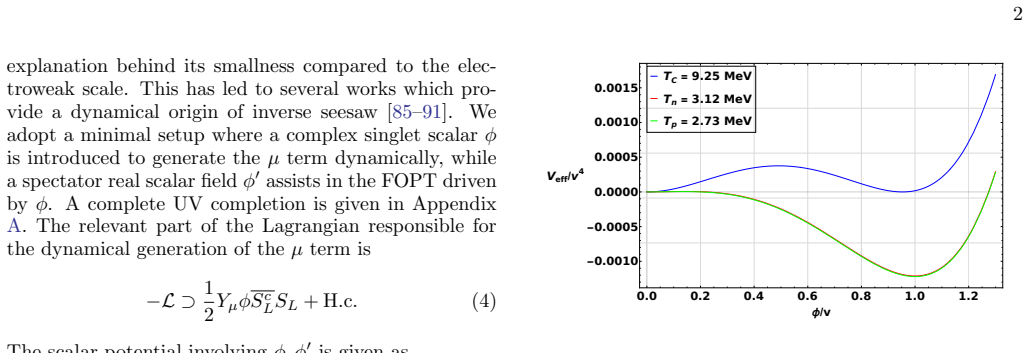
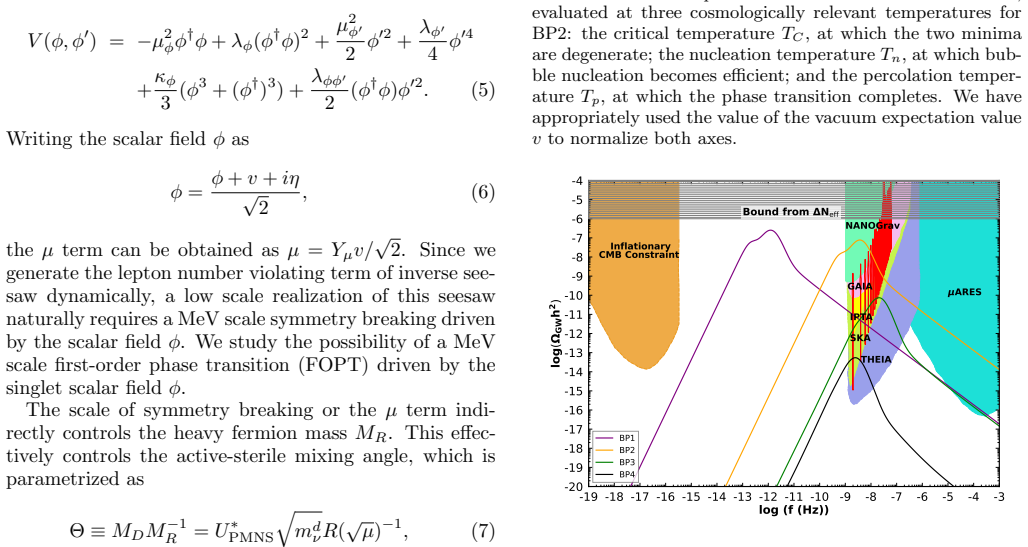
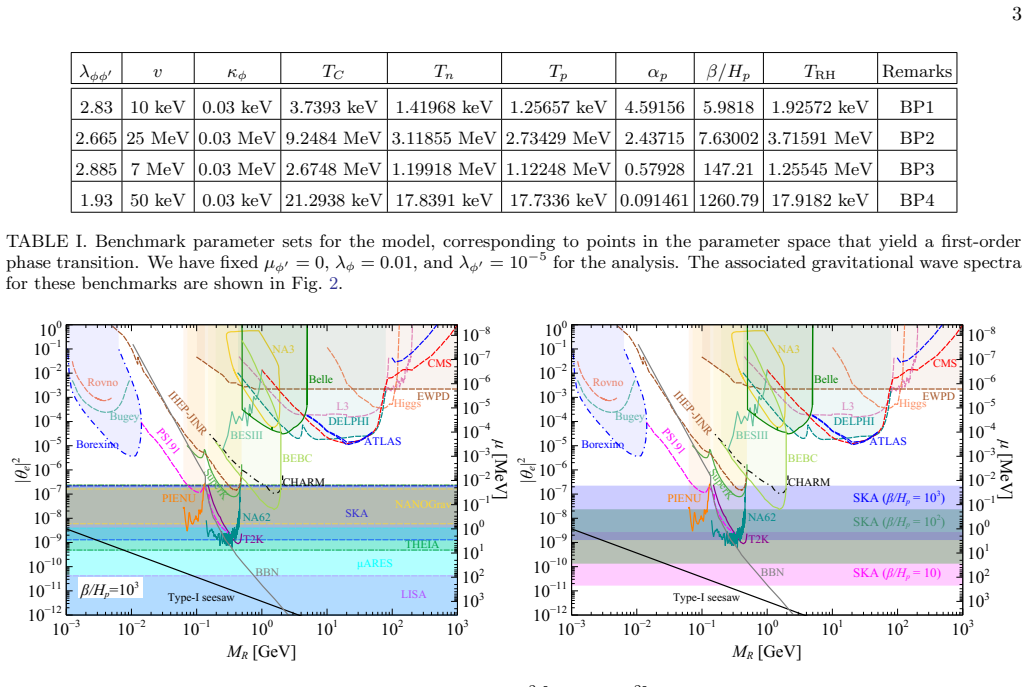
Since we generate the lepton number violating term of inverse see- saw dynamically, a low scale realization of this seesaw naturally requires a MeV scale symmetry breaking driven by the scalar fieldϕ. We study the possibility of a MeV scale first-order phase transition (FOPT) driven by the singlet scalar fieldϕ. The scale of symmetry breaking or theµterm ...
-
[2]
Navaset al.(Particle Data Group), Review of particle physics, Phys
S. Navaset al.(Particle Data Group), Review of particle physics, Phys. Rev. D110, 030001 (2024)
2024
-
[3]
Minkowski,µ→eγat a Rate of One Out of 10 9 Muon Decays?, Phys
P. Minkowski,µ→eγat a Rate of One Out of 10 9 Muon Decays?, Phys. Lett.B67, 421 (1977)
1977
-
[4]
Complex Spinors and Unified Theories
M. Gell-Mann, P. Ramond, and R. Slansky, Complex Spinors and Unified Theories,Supergravity Workshop Stony Brook, New York, September 27-28, 1979, Conf. Proc.C790927, 315 (1979), arXiv:1306.4669 [hep-th]
work page internal anchor Pith review Pith/arXiv arXiv 1979
-
[5]
R. N. Mohapatra and G. Senjanovic, Neutrino Mass and Spontaneous Parity Violation, Phys. Rev. Lett.44, 912 (1980)
1980
-
[6]
Sawada and A
O. Sawada and A. Sugamoto, eds.,Proceedings: Work- shop on the Unified Theories and the Baryon Number in the Universe: Tsukuba, Japan, February 13-14, 1979 (Natl.Lab.High Energy Phys., Tsukuba, Japan, 1979)
1979
-
[7]
Yanagida, Horizontal Symmetry and Masses of Neu- trinos, Prog
T. Yanagida, Horizontal Symmetry and Masses of Neu- trinos, Prog. Theor. Phys.64, 1103 (1980)
1980
-
[8]
Schechter and J
J. Schechter and J. W. F. Valle, Neutrino Masses in SU(2) x U(1) Theories, Phys. Rev.D22, 2227 (1980)
1980
-
[9]
R. N. Mohapatra and G. Senjanovic, Neutrino Masses and Mixings in Gauge Models with Spontaneous Parity Violation, Phys. Rev.D23, 165 (1981)
1981
-
[10]
Schechter and J
J. Schechter and J. W. F. Valle, Neutrino Decay and Spontaneous Violation of Lepton Number, Phys. Rev. D25, 774 (1982)
1982
-
[11]
Wetterich, Neutrino Masses and the Scale of B-L Violation, Nucl
C. Wetterich, Neutrino Masses and the Scale of B-L Violation, Nucl. Phys.B187, 343 (1981)
1981
-
[12]
Lazarides, Q
G. Lazarides, Q. Shafi, and C. Wetterich, Proton Life- time and Fermion Masses in an SO(10) Model, Nucl. Phys.B181, 287 (1981)
1981
-
[13]
B. Brahmachari and R. N. Mohapatra, Unified expla- nation of the solar and atmospheric neutrino puzzles in 7 a minimal supersymmetric SO(10) model, Phys. Rev. D58, 015001 (1998), arXiv:hep-ph/9710371 [hep-ph]
work page internal anchor Pith review Pith/arXiv arXiv 1998
-
[14]
R. Foot, H. Lew, X. G. He, and G. C. Joshi, Seesaw Neutrino Masses Induced by a Triplet of Leptons, Z. Phys.C44, 441 (1989)
1989
-
[15]
A possible symmetry of the $\nu$MSM
M. Shaposhnikov, A Possible symmetry of the nuMSM, Nucl. Phys. B763, 49 (2007), arXiv:hep-ph/0605047
work page internal anchor Pith review Pith/arXiv arXiv 2007
-
[16]
Right-Handed Neutrinos at LHC and the Mechanism of Neutrino Mass Generation
J. Kersten and A. Y. Smirnov, Right-Handed Neutri- nos at CERN LHC and the Mechanism of Neutrino Mass Generation, Phys. Rev. D76, 073005 (2007), arXiv:0705.3221 [hep-ph]
work page internal anchor Pith review Pith/arXiv arXiv 2007
-
[17]
K. Moffat, S. Pascoli, and C. Weiland, Equivalence be- tween massless neutrinos and lepton number conser- vation in fermionic singlet extensions of the Standard Model, (2017), arXiv:1712.07611 [hep-ph]
work page internal anchor Pith review Pith/arXiv arXiv 2017
-
[18]
J. Klari´ c, M. Shaposhnikov, and I. Timiryasov, Uniting Low-Scale Leptogenesis Mechanisms, Phys. Rev. Lett. 127, 111802 (2021), arXiv:2008.13771 [hep-ph]
- [19]
-
[20]
P. Hernandez, J. Lopez-Pavon, N. Rius, and S. Sandner, Bounds on right-handed neutrino parameters from ob- servable leptogenesis, JHEP12, 012, arXiv:2207.01651 [hep-ph]
- [21]
-
[22]
R. N. Mohapatra, Mechanism for Understanding Small Neutrino Mass in Superstring Theories, Phys. Rev. Lett. 56, 561 (1986)
1986
-
[23]
R. N. Mohapatra and J. W. F. Valle, Neutrino Mass and Baryon Number Nonconservation in Superstring Models,Sixty years of double beta decay: From nuclear physics to beyond standard model particle physics, Phys. Rev.D34, 1642 (1986), [,235(1986)]
1986
-
[24]
M. C. Gonzalez-Garcia and J. W. F. Valle, Fast De- caying Neutrinos and Observable Flavor Violation in a New Class of Majoron Models, Phys. Lett. B216, 360 (1989)
1989
-
[25]
Bernabeu, A
J. Bernabeu, A. Santamaria, J. Vidal, A. Mendez, and J. W. F. Valle, Lepton Flavor Nonconservation at High- Energies in a Superstring Inspired Standard Model, Phys. Lett. B187, 303 (1987)
1987
-
[26]
M. B. Gavela, T. Hambye, D. Hernandez, and P. Her- nandez, Minimal Flavour Seesaw Models, JHEP09, 038, arXiv:0906.1461 [hep-ph]
work page internal anchor Pith review Pith/arXiv arXiv
-
[27]
M. E. Catano, R. Martinez, and F. Ochoa, Neutrino masses in a 331 model with right-handed neutrinos with- out doubly charged Higgs bosons via inverse and dou- ble seesaw mechanisms, Phys. Rev.D86, 073015 (2012), arXiv:1206.1966 [hep-ph]
work page internal anchor Pith review Pith/arXiv arXiv 2012
- [28]
- [29]
-
[30]
B. Fornal and B. Shams Es Haghi, Baryon and Lep- ton Number Violation from Gravitational Waves, Phys. Rev. D102, 115037 (2020), arXiv:2008.05111 [hep-ph]
-
[31]
R. Samanta and S. Datta, Gravitational wave com- plementarity and impact of NANOGrav data on gravitational leptogenesis: cosmic strings, (2020), arXiv:2009.13452 [hep-ph]
- [32]
-
[33]
P. Huang and K.-P. Xie, Leptogenesis triggered by a first-order phase transition, (2022), arXiv:2206.04691 [hep-ph]
-
[34]
A. Dasgupta, P. S. B. Dev, A. Ghoshal, and A. Mazum- dar, Gravitational Wave Pathway to Testable Leptoge- nesis, (2022), arXiv:2206.07032 [hep-ph]
-
[35]
Probing the seesaw scale with gravitational waves
N. Okada and O. Seto, Probing the seesaw scale with gravitational waves, Phys. Rev. D98, 063532 (2018), arXiv:1807.00336 [hep-ph]
work page internal anchor Pith review Pith/arXiv arXiv 2018
-
[36]
Gravitational waves from the minimal gauged $U(1)_{B-L}$ model
T. Hasegawa, N. Okada, and O. Seto, Gravitational waves from the minimal gaugedU(1) B−L model, Phys. Rev. D99, 095039 (2019), arXiv:1904.03020 [hep-ph]
work page internal anchor Pith review Pith/arXiv arXiv 2019
- [37]
- [38]
- [39]
- [40]
-
[41]
Gravitational waves from seesaw assisted collapsing domain walls
D. Borah and I. Saha, Gravitational waves from seesaw assisted collapsing domain walls, (2025), arXiv:2512.22339 [hep-ph]
work page internal anchor Pith review Pith/arXiv arXiv 2025
- [42]
-
[43]
A review of gravitational waves from cosmic domain walls
K. Saikawa, A review of gravitational waves from cosmic domain walls, Universe3, 40 (2017), arXiv:1703.02576 [hep-ph]
work page internal anchor Pith review Pith/arXiv arXiv 2017
-
[44]
R. Roshan and G. White, Using gravitational waves to see the first second of the Universe, (2024), arXiv:2401.04388 [hep-ph]
-
[45]
S. Bhattacharya, N. Mondal, R. Roshan, and D. Vat- syayan, Leptogenesis, dark matter and gravitational waves from discrete symmetry breaking, JCAP06, 029, arXiv:2312.15053 [hep-ph]
- [46]
- [47]
- [48]
- [49]
- [50]
-
[51]
The NANOGrav 15-year Data Set: Evidence for a Gravitational-Wave Background
G. Agazieet al.(NANOGrav), The NANOGrav 15 yr Data Set: Evidence for a Gravitational-wave Background, Astrophys. J. Lett.951, L8 (2023), arXiv:2306.16213 [astro-ph.HE]
work page internal anchor Pith review Pith/arXiv arXiv 2023
-
[52]
J. Antoniadiset al.(EPTA, InPTA:), The second data release from the European Pulsar Timing Array - III. Search for gravitational wave signals, Astron. Astro- phys.678, A50 (2023), arXiv:2306.16214 [astro-ph.HE]
work page internal anchor Pith review Pith/arXiv arXiv 2023
-
[53]
D. J. Reardonet al., Search for an Isotropic Gravitational-wave Background with the Parkes Pul- sar Timing Array, Astrophys. J. Lett.951, L6 (2023), arXiv:2306.16215 [astro-ph.HE]
work page internal anchor Pith review Pith/arXiv arXiv 2023
-
[54]
G. Agazieet al.(NANOGrav), The NANOGrav 15 yr Data Set: Detector Characterization and Noise Budget, Astrophys. J. Lett.951, L10 (2023), arXiv:2306.16218 [astro-ph.HE]
-
[55]
J. Garcia-Bellido, H. Murayama, and G. White, Explor- ing the Early Universe with Gaia and THEIA, (2021), arXiv:2104.04778 [hep-ph]
-
[56]
Unveiling the Gravitational Universe at \mu-Hz Frequencies
A. Sesanaet al., Unveiling the gravitational universe atµ-Hz frequencies, Exper. Astron.51, 1333 (2021), arXiv:1908.11391 [astro-ph.IM]
work page internal anchor Pith review Pith/arXiv arXiv 2021
-
[57]
Weltmanet al., Fundamental physics with the Square Kilometre Array, Publ
A. Weltmanet al., Fundamental physics with the Square Kilometre Array, Publ. Astron. Soc. Austral.37, e002 (2020), arXiv:1810.02680 [astro-ph.CO]
-
[58]
A. M. Sirunyanet al.(CMS), Search for heavy neutral leptons in events with three charged leptons in proton- proton collisions at √s= 13 TeV, Phys. Rev. Lett.120, 221801 (2018), arXiv:1802.02965 [hep-ex]
work page internal anchor Pith review Pith/arXiv arXiv 2018
-
[59]
A. M. Sirunyanet al.(CMS), Search for heavy Majo- rana neutrinos in same-sign dilepton channels in proton- proton collisions at √s= 13 TeV, JHEP01, 122, arXiv:1806.10905 [hep-ex]
work page internal anchor Pith review Pith/arXiv arXiv
- [60]
-
[61]
Search for heavy Majorana neutrinos with the ATLAS detector in pp collisions at $\sqrt{s} = 8$ TeV
G. Aadet al.(ATLAS), Search for heavy Majorana neutrinos with the ATLAS detector in pp collisions at√s= 8 TeV, JHEP07, 162, arXiv:1506.06020 [hep-ex]
work page internal anchor Pith review Pith/arXiv arXiv
-
[62]
Abreuet al.(DELPHI), Search for neutral heavy lep- tons produced in Z decays, Z
P. Abreuet al.(DELPHI), Search for neutral heavy lep- tons produced in Z decays, Z. Phys. C74, 57 (1997), [Erratum: Z.Phys.C 75, 580 (1997)]
1997
-
[63]
Adrianiet al.(L3), Search for isosinglet neutral heavy leptons in Z0 decays, Phys
O. Adrianiet al.(L3), Search for isosinglet neutral heavy leptons in Z0 decays, Phys. Lett. B295, 371 (1992)
1992
-
[64]
Search for Heavy Isosinglet Neutrino in e+e- Annihilation at LEP
P. Achardet al.(L3), Search for heavy isosinglet neu- trino ine +e− annihilation at LEP, Phys. Lett. B517, 67 (2001), arXiv:hep-ex/0107014
work page internal anchor Pith review Pith/arXiv arXiv 2001
-
[65]
Search for heavy neutrinos at Belle
D. Liventsevet al.(Belle), Search for heavy neutrinos at Belle, Phys. Rev. D87, 071102 (2013), [Erratum: Phys.Rev.D 95, 099903 (2017)], arXiv:1301.1105 [hep- ex]
work page internal anchor Pith review Pith/arXiv arXiv 2013
-
[66]
Bergsmaet al.(CHARM), A Search for Decays of Heavy Neutrinos in the Mass Range 0.5-GeV to 2.8- GeV, Phys
F. Bergsmaet al.(CHARM), A Search for Decays of Heavy Neutrinos in the Mass Range 0.5-GeV to 2.8- GeV, Phys. Lett. B166, 473 (1986)
1986
-
[67]
Vilainet al.(CHARM II), Search for heavy isosinglet neutrinos, Phys
P. Vilainet al.(CHARM II), Search for heavy isosinglet neutrinos, Phys. Lett. B343, 453 (1995)
1995
-
[68]
Bernardiet al., FURTHER LIMITS ON HEAVY NEUTRINO COUPLINGS, Phys
G. Bernardiet al., FURTHER LIMITS ON HEAVY NEUTRINO COUPLINGS, Phys. Lett. B203, 332 (1988)
1988
-
[69]
R. Barouki, G. Marocco, and S. Sarkar, Blast from the past II: Constraints on heavy neutral leptons from the BEBC WA66 beam dump experiment, SciPost Phys.13, 118 (2022), arXiv:2208.00416 [hep-ph]
-
[70]
Badieret al.(NA3), Mass and Lifetime Limits on New Longlived Particles in 300-GeV/cπ − Interactions, Z
J. Badieret al.(NA3), Mass and Lifetime Limits on New Longlived Particles in 300-GeV/cπ − Interactions, Z. Phys. C31, 21 (1986)
1986
-
[71]
E. Cortina Gilet al.(NA62), Search for heavy neu- tral lepton production in K+ decays to positrons, Phys. Lett. B807, 135599 (2020), arXiv:2005.09575 [hep-ex]
-
[72]
Search for heavy Majorana neutrino in lepton number violating decays of D-> K pi e+ e+
M. Ablikimet al.(BESIII), Search for heavy Majo- rana neutrino in lepton number violating decays of D→Kπe +e+, Phys. Rev. D99, 112002 (2019), arXiv:1902.02450 [hep-ex]
work page internal anchor Pith review Pith/arXiv arXiv 2019
-
[73]
Non-Unitarity, sterile neutrinos, and Non-Standard neutrino Interactions
M. Blennow, P. Coloma, E. Fernandez-Martinez, J. Hernandez-Garcia, and J. Lopez-Pavon, Non- Unitarity, sterile neutrinos, and Non-Standard neutrino Interactions, JHEP04, 153, arXiv:1609.08637 [hep-ph]
work page internal anchor Pith review Pith/arXiv arXiv
-
[74]
Effects of new leptons in Electroweak Precision Data
F. del Aguila, J. de Blas, and M. Perez-Victoria, Effects of new leptons in Electroweak Precision Data, Phys. Rev.D78, 013010 (2008), arXiv:0803.4008 [hep-ph]
work page internal anchor Pith review Pith/arXiv arXiv 2008
-
[75]
Electroweak limits on physics beyond the Standard Model
J. de Blas, Electroweak limits on physics beyond the Standard Model, EPJ Web Conf.60, 19008 (2013), arXiv:1307.6173 [hep-ph]
work page internal anchor Pith review Pith/arXiv arXiv 2013
-
[76]
Non-unitarity of the leptonic mixing matrix: Present bounds and future sensitivities
S. Antusch and O. Fischer, Non-unitarity of the leptonic mixing matrix: Present bounds and future sensitivities, JHEP10, 094, arXiv:1407.6607 [hep-ph]
work page internal anchor Pith review Pith/arXiv arXiv
-
[77]
A. Das, P. S. B. Dev, and C. S. Kim, Constraining Ster- ile Neutrinos from Precision Higgs Data, Phys. Rev. D 95, 115013 (2017), arXiv:1704.00880 [hep-ph]
work page internal anchor Pith review Pith/arXiv arXiv 2017
-
[78]
G. Belliniet al.(Borexino), New limits on heavy ster- ile neutrino mixing in B8 decay obtained with the Borexino detector, Phys. Rev. D88, 072010 (2013), arXiv:1311.5347 [hep-ex]
work page internal anchor Pith review Pith/arXiv arXiv 2013
-
[79]
Hagner, M
C. Hagner, M. Altmann, F. von Feilitzsch, L. Oberauer, Y. Declais, and E. Kajfasz, Experimental search for the neutrino decay neutrino (3) —>j-neutrino + e+ + e- and limits on neutrino mixing, Phys. Rev. D52, 1343 (1995)
1995
-
[80]
A. I. Derbin, A. V. Chernyi, L. A. Popeko, V. N. Mu- ratova, G. A. Shishkina, and S. I. Bakhlanov, Experi- ment on anti-neutrino scattering by electrons at a reac- tor of the Rovno nuclear power plant, JETP Lett.57, 768 (1993)
1993
discussion (0)
Sign in with ORCID, Apple, or X to comment. Anyone can read and Pith papers without signing in.