Full Quantum and Mixed Quantum--Classical Dynamics of Hot Exciton Cooling in Semiconductor Nanocrystals
Pith reviewed 2026-06-29 14:26 UTC · model grok-4.3
The pith
Mapping approach to surface hopping matches full quantum dynamics for hot exciton cooling in CdSe nanocrystals.
A machine-rendered reading of the paper's core claim, the machinery that carries it, and where it could break.
Core claim
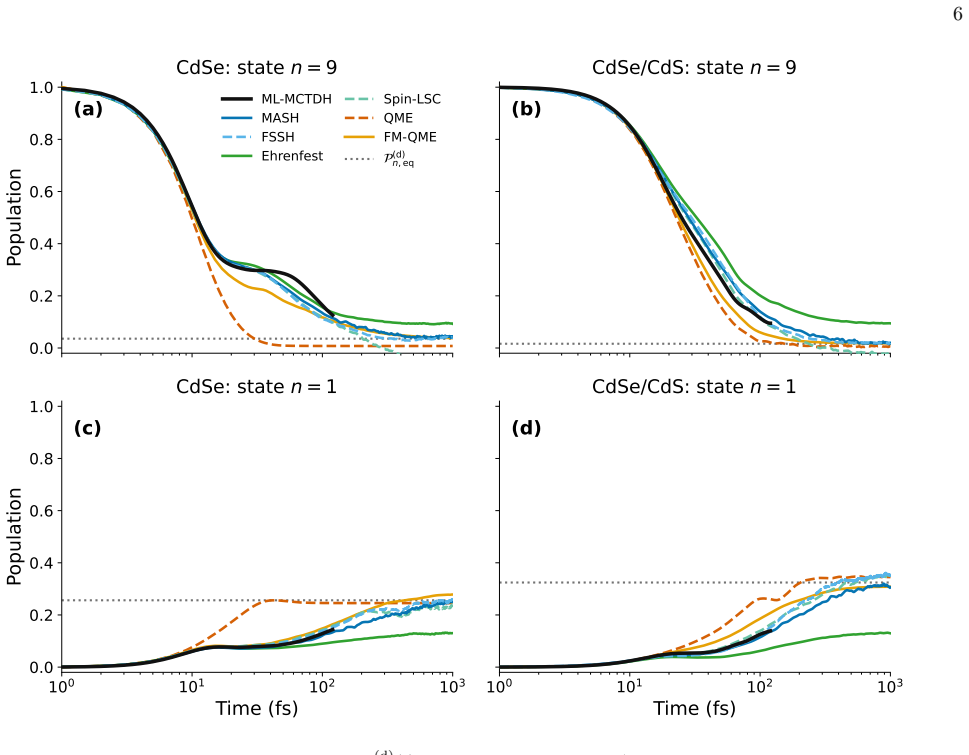
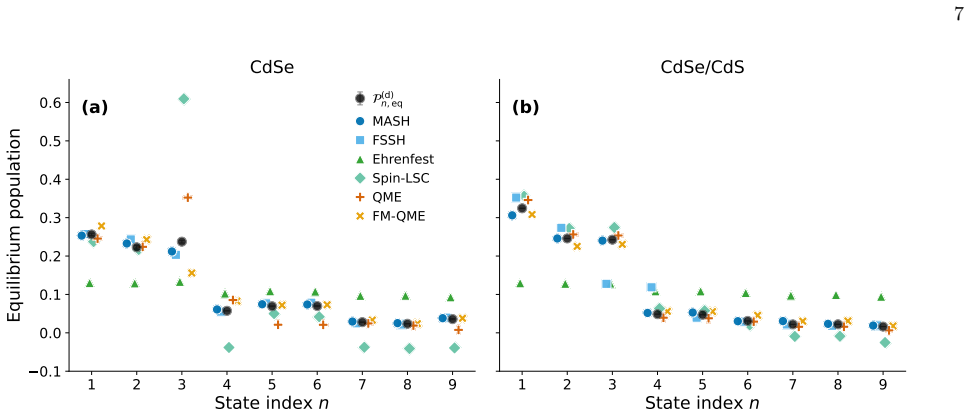
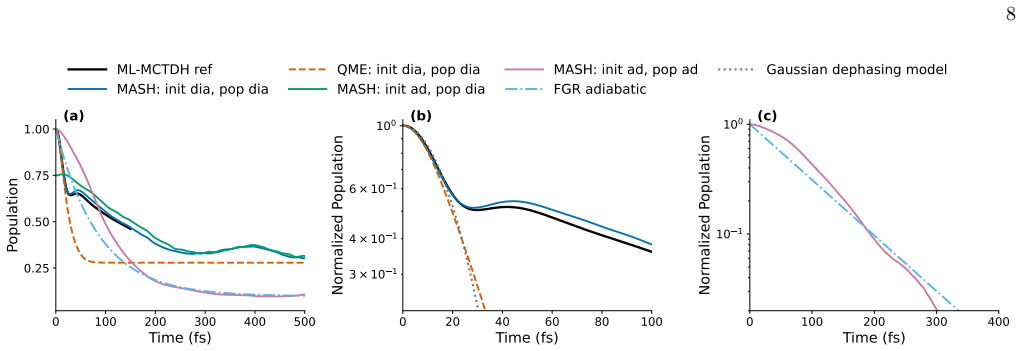
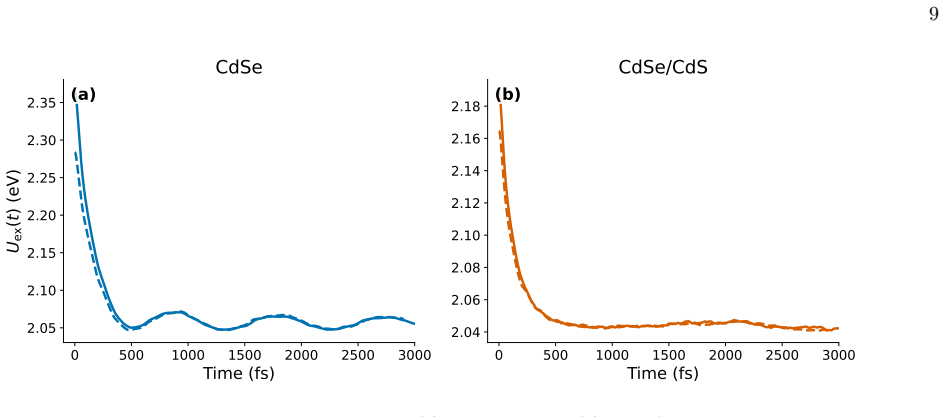
Using fully quantum mechanical reference calculations on CdSe core and CdSe/CdS core-shell models, the work shows that the ultrafast component of exciton cooling arises from rapid diabatic state mixing induced by thermal fluctuations of low-frequency phonons rather than from nuclear-assisted energy relaxation. The perturbative quantum master equation captures this initial fast decay but can fail for the subsequent slower relaxation when formulated in the diabatic representation. Among the tested approximate methods, the mapping approach to surface hopping produces the most consistent agreement with both the reference dynamics and the equilibrium state populations.
What carries the argument
The mapping approach to surface hopping (MASH), which approximates the quantum exciton-phonon dynamics through classical trajectories with stochastic surface hops.
Load-bearing premise
The atomistically parameterized exciton-phonon Hamiltonians for the CdSe and core-shell models are accurate enough to separate diabatic mixing from energy relaxation and to serve as a reliable benchmark.
What would settle it
A higher-accuracy full-quantum calculation or direct experimental measurement on the identical CdSe model Hamiltonian that produced decay rates or final populations differing from MASH predictions would falsify the claim of consistent agreement.
Figures
read the original abstract
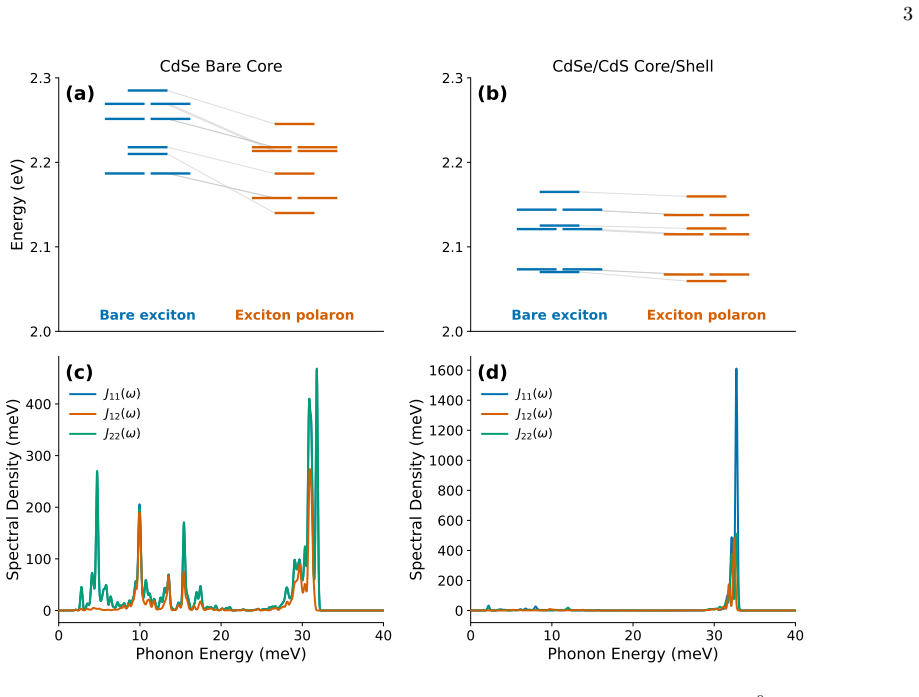
Hot-exciton relaxation in semiconductor nanocrystals (NCs) is often described using perturbative theories, but their accuracy is difficult to assess for realistic exciton--phonon Hamiltonians. Here, we benchmark the perturbative quantum master equation (QME) and several mixed quantum--classical (MQC) methods against fully quantum mechanical dynamics. Using atomistically parameterized models for CdSe core and CdSe/CdS core--shell NCs, we find that bare CdSe exhibits an ultrafast initial decay followed by slower cooling, whereas the core--shell system is dominated by the slower component. Analysis of reduced models shows that the ultrafast component arises from rapid diabatic state mixing driven by thermal fluctuations of low-frequency phonons, rather than from nuclear-assisted energy relaxation. The QME captures the initial fast decay but can fail for the slower relaxation in the diabatic representation, while the mapping approach to surface hopping (MASH) gives the most consistent agreement with both benchmark dynamics and equilibrium populations. These results establish a benchmark for exciton-cooling dynamics in NCs and clarify the physical regimes in which widely used approximate methods are reliable.
Editorial analysis
A structured set of objections, weighed in public.
Referee Report
Summary. The manuscript benchmarks the perturbative quantum master equation (QME) and several mixed quantum-classical (MQC) methods, including the mapping approach to surface hopping (MASH), against fully quantum mechanical dynamics for hot-exciton cooling in CdSe core and CdSe/CdS core-shell nanocrystals. Using atomistically parameterized exciton-phonon Hamiltonians, it reports an ultrafast initial decay in bare CdSe driven by diabatic state mixing from low-frequency phonons (rather than energy relaxation), slower cooling in the core-shell system, limitations of QME in the diabatic representation, and superior consistency of MASH with both the benchmark dynamics and equilibrium populations.
Significance. If the Hamiltonians are faithful, the work supplies a useful benchmark set for approximate methods on realistic NC models and clarifies the physical regimes separating diabatic mixing from phonon-assisted relaxation. The direct comparison to full quantum dynamics on atomistically derived Hamiltonians is a methodological strength.
major comments (2)
- [Abstract] Abstract and model-construction paragraphs: the central claims (ultrafast component arises from diabatic mixing, MASH is most consistent) rest on the atomistically parameterized exciton-phonon Hamiltonians faithfully separating diabatic gaps from low-frequency phonon couplings. No external validation (computed vs. measured relaxation timescales, absorption spectra, or phonon densities of states) is supplied, rendering the full-quantum reference and method ranking model-dependent rather than general.
- [Reduced models] Reduced-model analysis section: the attribution of the ultrafast decay specifically to thermal fluctuations of low-frequency phonons (rather than nuclear-assisted relaxation) requires quantitative demonstration that the full quantum trajectories on the chosen Hamiltonians reproduce independent observables; absent such checks, the mechanism identification cannot be cleanly separated from possible Hamiltonian inaccuracies.
minor comments (1)
- The abstract would be clearer if it stated the quantitative metrics (e.g., population RMSE, equilibrium deviation) used to rank method agreement.
Simulated Author's Rebuttal
We thank the referee for their positive assessment of the significance of our work and for the constructive major comments. We address each point below and propose revisions to clarify the scope and limitations of our study.
read point-by-point responses
-
Referee: [Abstract] Abstract and model-construction paragraphs: the central claims (ultrafast component arises from diabatic mixing, MASH is most consistent) rest on the atomistically parameterized exciton-phonon Hamiltonians faithfully separating diabatic gaps from low-frequency phonon couplings. No external validation (computed vs. measured relaxation timescales, absorption spectra, or phonon densities of states) is supplied, rendering the full-quantum reference and method ranking model-dependent rather than general.
Authors: We agree that our conclusions are tied to the specific Hamiltonians used and that the absence of direct comparison to experimental data makes the results model-dependent. The manuscript's focus is on providing a benchmark comparison of methods using the same atomistically parameterized models for CdSe and CdSe/CdS NCs, as detailed in the methods. The parameterization follows established procedures from prior literature on these systems. To address this, we will revise the abstract and relevant paragraphs to explicitly note that the findings pertain to these models and to emphasize the model dependence. We cannot provide new external validation within the scope of this study. revision: partial
-
Referee: [Reduced models] Reduced-model analysis section: the attribution of the ultrafast decay specifically to thermal fluctuations of low-frequency phonons (rather than nuclear-assisted relaxation) requires quantitative demonstration that the full quantum trajectories on the chosen Hamiltonians reproduce independent observables; absent such checks, the mechanism identification cannot be cleanly separated from possible Hamiltonian inaccuracies.
Authors: The reduced models are constructed by selectively including or excluding phonon modes from the full Hamiltonian to isolate the role of low-frequency modes in driving diabatic mixing. Since the full quantum dynamics are solved exactly on the Hamiltonian, the observed ultrafast decay is a direct consequence of the dynamics on that model. We recognize that without matching to independent observables, the physical interpretation remains conditional on the Hamiltonian's accuracy. We will add clarifying text in the reduced-model section to state this explicitly and to note that the mechanism attribution is within the context of the parameterized model. revision: partial
- External validation of the atomistically parameterized Hamiltonians against experimental data such as relaxation timescales or spectra.
Circularity Check
No circularity detected; derivation self-contained against independent benchmarks
full rationale
The paper computes full quantum dynamics on atomistically parameterized exciton-phonon Hamiltonians for CdSe and CdSe/CdS models, then benchmarks QME and MQC methods (including MASH) against those dynamics and equilibrium populations. No quoted step reduces a claimed prediction to a fitted parameter by construction, invokes a self-citation as the sole justification for a uniqueness theorem, or renames an input as an output. The full quantum reference is generated on the same Hamiltonians but is not equivalent to the approximate methods' results; the analysis of diabatic mixing versus relaxation is performed via reduced models without self-referential definitions. This is the normal case of an independent benchmark comparison.
Axiom & Free-Parameter Ledger
axioms (1)
- domain assumption Atomistically parameterized exciton-phonon Hamiltonians for CdSe and CdSe/CdS NCs accurately represent real physical systems.
Reference graph
Works this paper leans on
-
[1]
1X. Zhou, D. Ward, J. Martin, F. Van Swol, J. Cruz-Campa, and D. Zubia, Phys. Rev. B88, 085309 (2013). 2S. Plimpton, J. Comput. Phys.117, 1 (1995). 3E. Rabani, B. Hetenyi, B. J. Berne, and L. E. Brus, J. Chem. Phys.110, 5355 (1999). 4D. Jasrasaria, D. Weinberg, J. P. Philbin, and E. Rabani, J. Chem. Phys.157, 020901 (2022). 5S. Toledo and E. Rabani, J. Co...
discussion (0)
Sign in with ORCID, Apple, or X to comment. Anyone can read and Pith papers without signing in.