Shadow, acoustic redshift, and transfer observables of Lorentz-violating rotating acoustic black holes
Pith reviewed 2026-06-29 11:23 UTC · model grok-4.3
The pith
In Lorentz-violating rotating acoustic black holes the shadow width, centroid, redshift asymmetry and flux asymmetry form a hierarchy that isolates symmetry-breaking and rotational effects.
A machine-rendered reading of the paper's core claim, the machinery that carries it, and where it could break.
Core claim
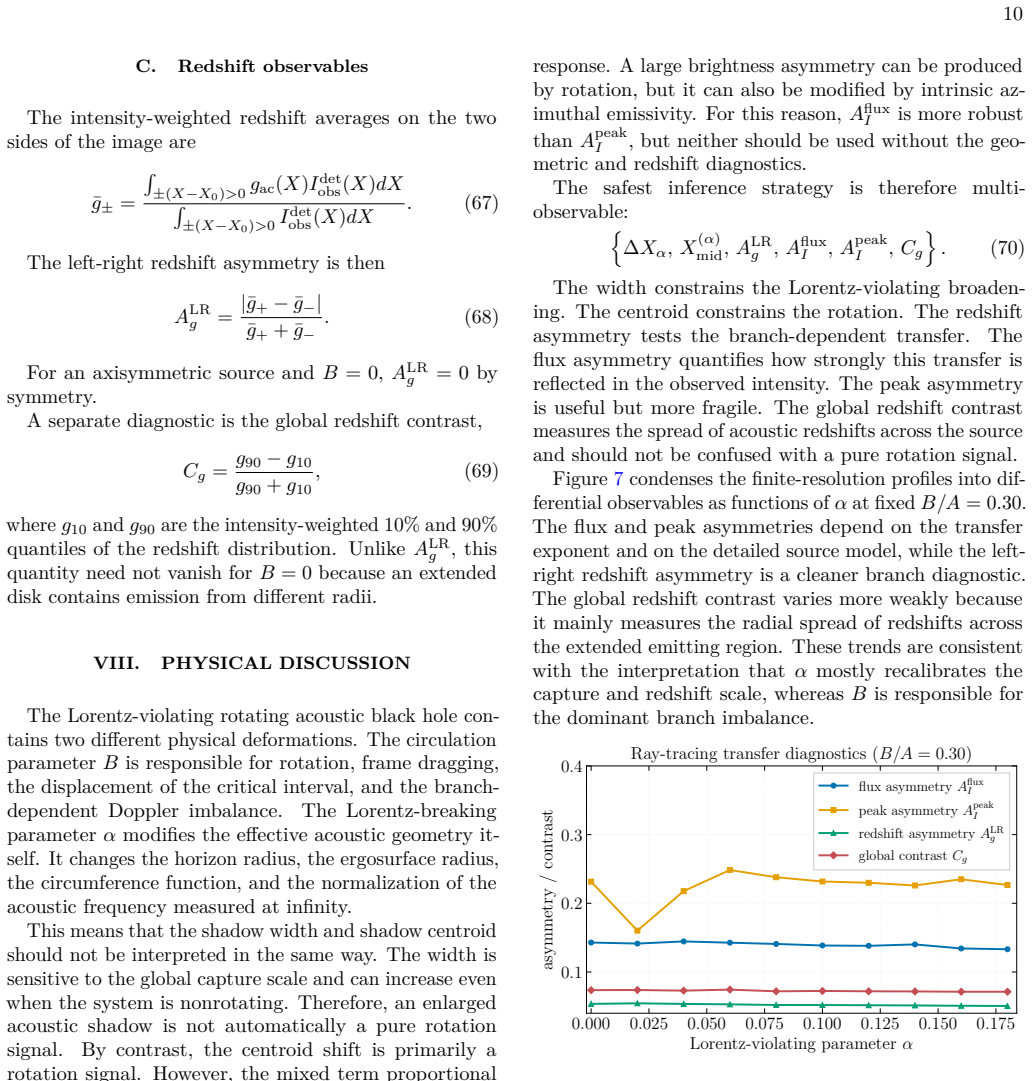
The central claim is that the observables form a hierarchy in which the shadow width probes Lorentz-violating broadening, the shadow centroid traces rotation, the left-right acoustic-redshift asymmetry tests branch-dependent Doppler and frame-dragging effects, and the integrated flux asymmetry measures their imprint on the observed intensity, all obtained from the deformed effective acoustic metric with draining parameter A, circulation parameter B, and Lorentz-breaking parameter α.
What carries the argument
Impact-parameter-resolved transfer analysis applied to the Lorentz-violating draining-bathtub geometry, which supplies the null-ray equations, critical-impact-parameter conditions, acoustic shadow interval, and redshift transfer factor.
If this is right
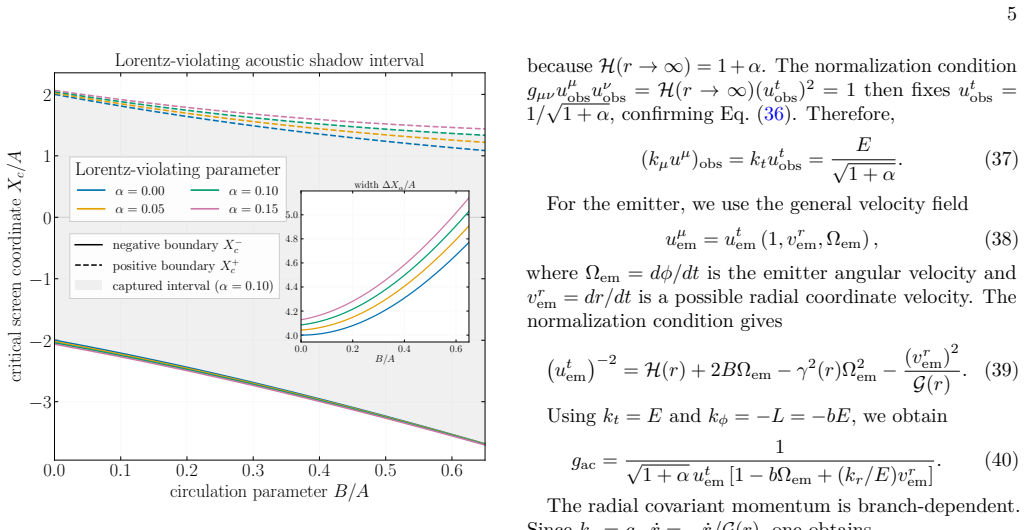
- Shadow width increases with the Lorentz-breaking parameter α and thereby isolates symmetry violation.
- Shadow centroid displacement scales with the circulation parameter B and thereby isolates rotational effects.
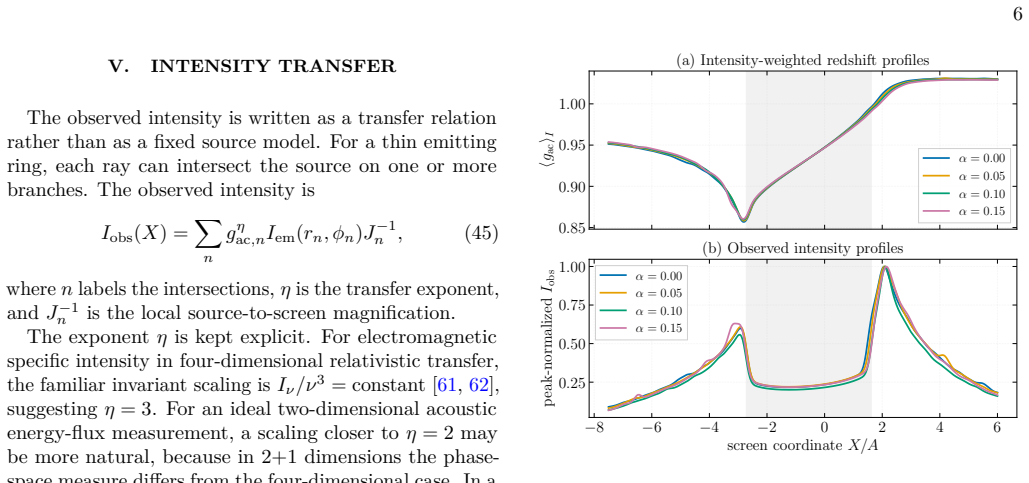
- Left-right acoustic-redshift asymmetry distinguishes branch-dependent Doppler shifts from frame-dragging.
- Integrated flux asymmetry quantifies the net imprint of both parameters on observed intensity.
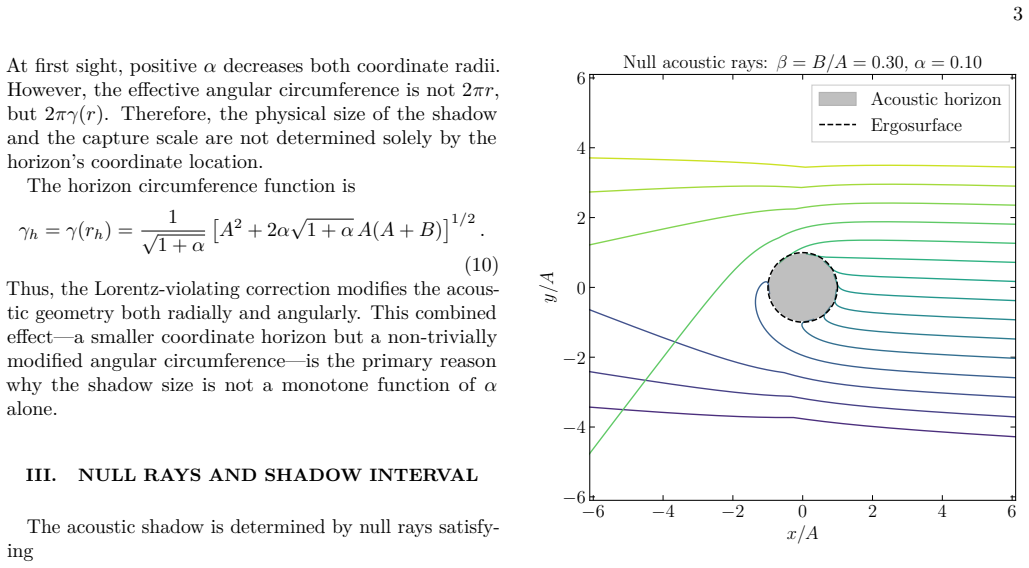
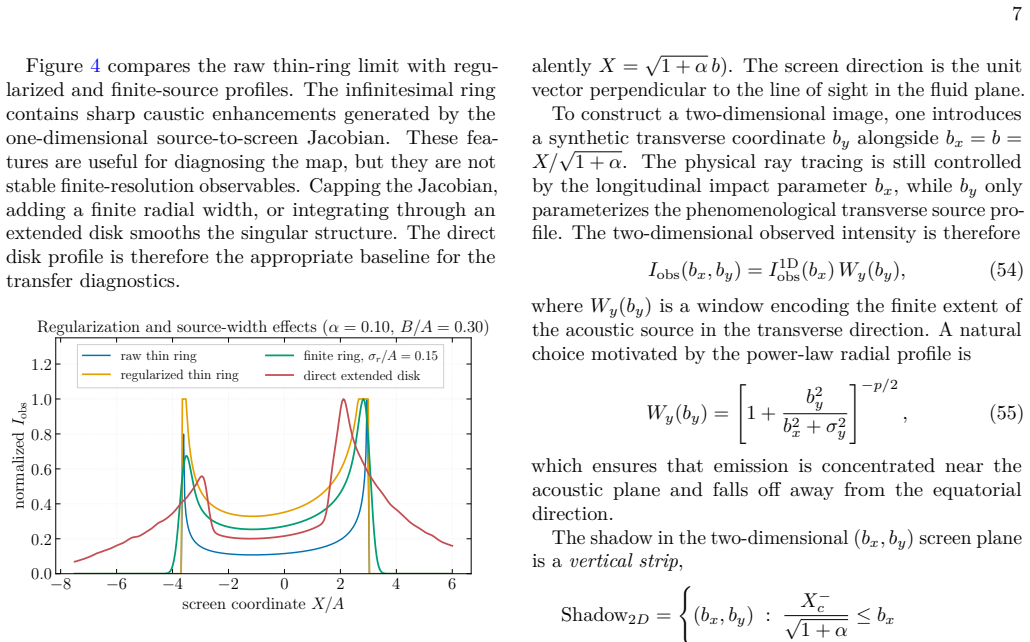
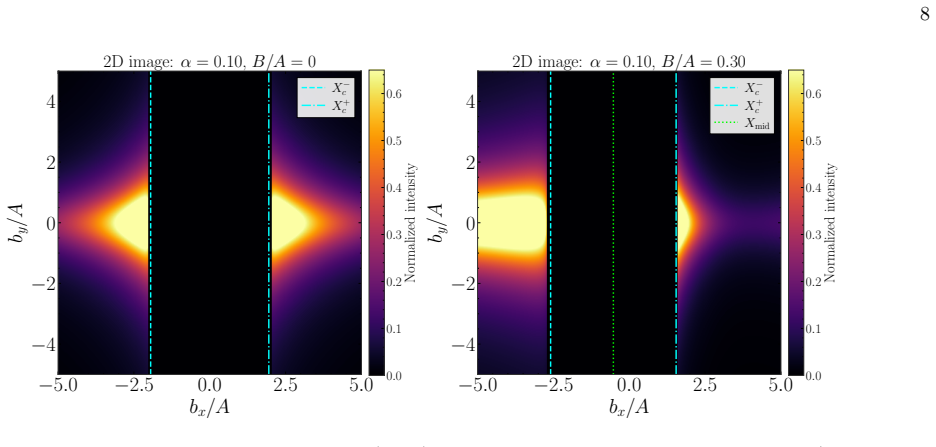
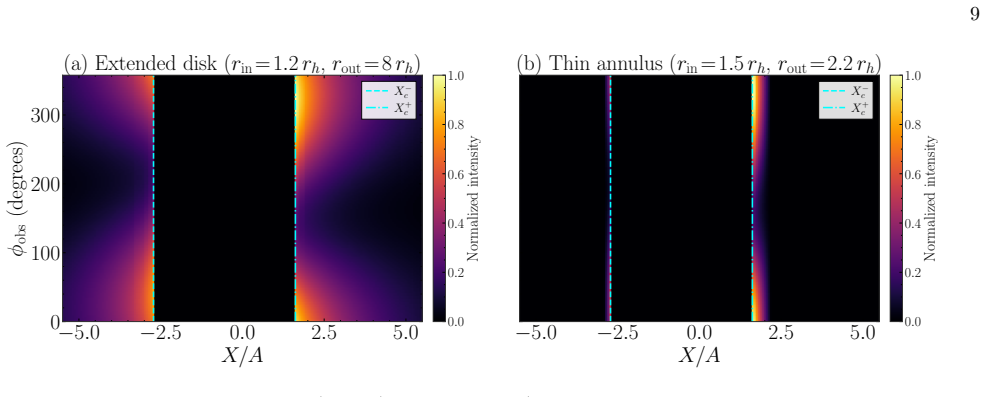
- Two-dimensional synthetic maps display the capture interval as a vertical strip displaced by B and broadened by α.
Where Pith is reading between the lines
- Laboratory fluid experiments could exploit the hierarchy to search for Lorentz-violation signatures that standard acoustic-black-hole models would miss.
- The (2+1)-dimensional restriction leaves open whether vertical structure in three-dimensional analogs would add polarization-dependent observables.
- The transfer prescription supplies a ready template for studying other analog spacetimes that incorporate modified dispersion relations.
- Direct numerical integration of ray paths in the same geometry would provide an independent check on the analytic critical-impact-parameter conditions.
Load-bearing premise
The draining-bathtub flow with an added Lorentz-breaking parameter supplies an accurate effective metric for the acoustic black hole outside the sonic horizon.
What would settle it
If acoustic-shadow measurements in a rotating fluid analog show no measurable increase in width as the Lorentz-breaking parameter is increased while holding draining and circulation fixed, the broadening claim is falsified.
Figures
read the original abstract
We develop an impact-parameter-resolved transfer analysis for the rotating acoustic black hole with Lorentz symmetry violation. The background is the $(2+1)$-dimensional Lorentz-violating draining-bathtub geometry, where the draining parameter $A$ fixes the sonic horizon, the circulation parameter $B$ controls rotation, and the Lorentz-breaking parameter $\alpha$ deforms the effective acoustic metric. We derive the null-ray equations, the critical-impact-parameter conditions, the acoustic shadow interval, and the redshift transfer factor. We then formulate an intensity-transfer prescription for thin rings and extended disks that accounts for source emissivity, emitter motion, finite source width, and detector convolution. The resulting observables form a hierarchy: the shadow width probes Lorentz-violating broadening, the shadow centroid traces rotation, the left-right acoustic-redshift asymmetry tests branch-dependent Doppler and frame-dragging effects, and the integrated flux asymmetry measures their imprint on the observed intensity. We also construct synthetic two-dimensional acoustic screen maps, showing that the $(2+1)$-dimensional capture interval is naturally represented as a vertical strip whose displacement and brightness imbalance encode the combined effects of $B$ and $\alpha$. We focus on the exterior-regular regime $\alpha\geq0$, with $\alpha=0$ retained as the Lorentz-symmetric benchmark.
Editorial analysis
A structured set of objections, weighed in public.
Referee Report
Summary. The paper develops an impact-parameter-resolved transfer analysis for the (2+1)-dimensional Lorentz-violating rotating acoustic black hole in the draining-bathtub geometry. Parameters A, B, and α control the sonic horizon, rotation, and metric deformation, respectively. The authors derive the null-ray equations, critical-impact-parameter conditions, acoustic shadow interval, redshift transfer factor, and an intensity-transfer prescription for thin rings and extended disks that incorporates emissivity, motion, source width, and detector convolution. They interpret the resulting observables as forming a hierarchy (shadow width for Lorentz-violating broadening, centroid for rotation, left-right redshift asymmetry for Doppler/frame-dragging, flux asymmetry for intensity effects) and construct synthetic 2D acoustic screen maps representing the capture interval as a displaced vertical strip. The analysis is restricted to the exterior-regular regime α ≥ 0.
Significance. If the derivations are correct, the work supplies a concrete mapping from the three metric parameters to a set of distinguishable observables in an analog-gravity setting. The explicit hierarchy and the construction of synthetic maps are useful for guiding future analog experiments. The retention of the α = 0 benchmark and the clear statement of the α ≥ 0 restriction strengthen the presentation.
minor comments (3)
- [Abstract] Abstract, paragraph 3: the statement that the (2+1)D capture interval 'is naturally represented as a vertical strip' should be accompanied by a brief geometric justification (e.g., a one-sentence reference to the coordinate choice or projection used in §3).
- The intensity-transfer prescription is described in general terms; the manuscript would benefit from an explicit equation (or numbered step) showing how the finite-source-width convolution is implemented before the detector convolution.
- Figure captions for the synthetic maps should state the specific numerical values of A, B, and α employed, together with the range of impact parameters sampled.
Simulated Author's Rebuttal
We thank the referee for the careful reading, positive assessment of the significance of the work, and the recommendation for minor revision. The summary accurately captures the scope and structure of the analysis. Since the report lists no specific major comments, we provide no point-by-point rebuttals below.
Circularity Check
No significant circularity identified
full rationale
The paper takes the (2+1)D Lorentz-violating draining-bathtub metric with explicit parameters A (sonic horizon), B (rotation), and α (Lorentz violation) as given input. It then derives null-ray equations, critical impact parameters, acoustic shadow interval, redshift transfer factor, and an intensity-transfer prescription for rings/disks. The resulting observables (shadow width/centroid, redshift asymmetry, flux asymmetry) are computed directly from these inputs and presented as functions of A, B, α. No step reduces a derived quantity back to a fitted constant by construction, no load-bearing self-citation is invoked for the central claims, and the construction remains self-contained against the stated metric. This is the standard direct-calculation pattern with no reduction to inputs.
Axiom & Free-Parameter Ledger
free parameters (1)
- α
axioms (1)
- domain assumption Sound propagation obeys the geometric-optics limit on the effective acoustic metric deformed by the Lorentz-violating term α.
Reference graph
Works this paper leans on
-
[1]
W. G. Unruh, Phys. Rev. Lett.46, 1351 (1981). [2] M. Visser, Class. Quantum Grav.15, 1767 (1998), arXiv:gr-qc/9712010. 13
work page internal anchor Pith review Pith/arXiv arXiv 1981
-
[2]
C. Barcelo, S. Liberati, and M. Visser, Living Rev. Relativ. 14, 3 (2011), arXiv:gr-qc/0505065
-
[3]
Novello, M
M. Novello, M. Visser, and G. E. Volovik, World Scientific (2002)
2002
-
[4]
L. J. Garay, J. R. Anglin, J. I. Cirac, and P. Zoller, Phys. Rev. Lett.85, 4643 (2000), arXiv:gr-qc/0002015
work page internal anchor Pith review Pith/arXiv arXiv 2000
-
[5]
T. G. Philbin, C. Kuklewicz, S. Robertson, S. Hill, F. Konig, and U. Leonhardt, Science319, 1367 (2008)
2008
-
[6]
Realization of a sonic black hole analogue in a Bose-Einstein condensate
O. Lahav, A. Itah, A. Blumkin, C. Gordon, S. Rinott, A. Zayats, and J. Steinhauer, Phys. Rev. Lett.105, 240401 (2010), arXiv:0906.1337
work page internal anchor Pith review Pith/arXiv arXiv 2010
-
[7]
Measurement of stimulated Hawking emission in an analogue system
S. Weinfurtner, E. W. Tedford, M. C. J. Penrice, W. G. Unruh, and G. A. Lawrence, Phys. Rev. Lett.106, 021302 (2011), arXiv:1008.1911
work page internal anchor Pith review Pith/arXiv arXiv 2011
-
[8]
Steinhauer, Nature Phys.12, 959 (2016)
J. Steinhauer, Nature Phys.12, 959 (2016)
2016
-
[9]
Observation of superradiance in a vortex flow
T. Torres, S. Patrick, A. Coutant, M. Richartz, E. W. Tedford, and S. Weinfurtner, Nature Phys.13, 833 (2017), arXiv:1612.06180
work page internal anchor Pith review Pith/arXiv arXiv 2017
-
[10]
Black hole quasibound states from a draining bathtub vortex flow
S. Patrick, A. Coutant, M. Richartz, and S. Weinfurtner, Phys. Rev. Lett.121, 061101 (2018), arXiv:1801.08473
work page internal anchor Pith review Pith/arXiv arXiv 2018
-
[11]
J. R. Munoz de Nova, K. Golubkov, V. I. Kolobov, and J. Steinhauer, Nature569, 688 (2019)
2019
-
[12]
V. I. Kolobov, K. Golubkov, J. R. Munoz de Nova, and J. Steinhauer, Nature Phys.17, 362 (2021)
2021
-
[13]
P. O. Fedichev and U. R. Fischer, Phys. Rev. A69, 033602 (2004), arXiv:cond-mat/0303063
work page internal anchor Pith review Pith/arXiv arXiv 2004
-
[14]
U. R. Fischer and R. Schützhold, Phys. Rev. A70, 063615 (2004), arXiv:cond-mat/0406470
work page internal anchor Pith review Pith/arXiv arXiv 2004
-
[15]
P. O. Fedichev and U. R. Fischer, Phys. Rev. Lett.91, 240407 (2003), arXiv:cond-mat/0304342
work page internal anchor Pith review Pith/arXiv arXiv 2003
-
[16]
P. O. Fedichev and U. R. Fischer, Phys. Rev. D69, 064021 (2004), arXiv:cond-mat/0307200
work page internal anchor Pith review Pith/arXiv arXiv 2004
-
[17]
S.-Y. Chä and U. R. Fischer, Phys. Rev. Lett.118, 130404 (2017), arXiv:1609.06155
work page internal anchor Pith review Pith/arXiv arXiv 2017
- [18]
-
[19]
Schützhold, M
R. Schützhold, M. Uhlmann, Y. Xu, and U. R. Fischer, Phys. Rev. D72, 105005 (2005)
2005
- [20]
- [21]
-
[22]
U. R. Fischer and M. Visser, Phys. Rev. Lett.88, 110201 (2002)
2002
-
[23]
`Superresonance' from a rotating acoustic black hole
S. Basak and P. Majumdar, Class. Quantum Grav.20, 3907 (2003), arXiv:gr-qc/0203059
work page internal anchor Pith review Pith/arXiv arXiv 2003
-
[24]
Quasinormal modes and classical wave propagation in analogue black holes
E. Berti, V. Cardoso, and J. P. S. Lemos, Phys. Rev. D 70, 124006 (2004), arXiv:gr-qc/0408099
work page internal anchor Pith review Pith/arXiv arXiv 2004
-
[25]
Quasinormal modes of Schwarzschild black holes in four and higher dimensions
V. Cardoso, J. P. S. Lemos, and S. Yoshida, Phys. Rev. D69, 044004 (2004), arXiv:gr-qc/0309112
work page internal anchor Pith review Pith/arXiv arXiv 2004
-
[26]
S. R. Dolan, Class. Quantum Grav.25, 235002 (2008), arXiv:0801.3805
work page internal anchor Pith review Pith/arXiv arXiv 2008
-
[27]
E. S. Oliveira, S. R. Dolan, and L. C. B. Crispino, Phys. Rev. D81, 124013 (2010), arXiv:1005.4038
work page internal anchor Pith review Pith/arXiv arXiv 2010
-
[28]
S. R. Dolan, L. A. Oliveira, and L. C. B. Crispino, Phys. Rev. D85, 044031 (2012), arXiv:1105.1795
work page internal anchor Pith review Pith/arXiv arXiv 2012
-
[29]
S. R. Dolan, L. A. Oliveira, and L. C. B. Crispino, Phys. Rev. D87, 124026 (2013), arXiv:1211.3751
work page internal anchor Pith review Pith/arXiv arXiv 2013
-
[30]
Quasinormal modes of black holes and black branes
E. Berti, V. Cardoso, and A. O. Starinets, Class. Quantum Grav.26, 163001 (2009), arXiv:0905.2975
work page internal anchor Pith review Pith/arXiv arXiv 2009
-
[31]
CPT Violation and the Standard Model
D. Colladay and V. A. Kostelecky, Phys. Rev. D55, 6760 (1997), arXiv:hep-ph/9703464
work page internal anchor Pith review Pith/arXiv arXiv 1997
-
[32]
Lorentz-Violating Extension of the Standard Model
D. Colladay and V. A. Kostelecky, Phys. Rev. D58, 116002 (1998), arXiv:hep-ph/9809521
work page internal anchor Pith review Pith/arXiv arXiv 1998
-
[33]
V. A. Kostelecky, Phys. Rev. D69, 105009 (2004), arXiv:hep-th/0312310
work page internal anchor Pith review Pith/arXiv arXiv 2004
-
[34]
D. Mattingly, Living Rev. Relativ.8, 5 (2005), arXiv:gr- qc/0502097
-
[35]
Tests of Lorentz invariance: a 2013 update
S. Liberati, Class. Quantum Grav.30, 133001 (2013), arXiv:1304.5795
work page internal anchor Pith review Pith/arXiv arXiv 2013
-
[36]
M. A. Anacleto, F. A. Brito, and E. Passos, Phys. Lett. B703, 609 (2011), arXiv:1101.2891
work page internal anchor Pith review Pith/arXiv arXiv 2011
-
[37]
M. A. Anacleto, F. A. Brito, and E. Passos, Phys. Rev. D86, 125015 (2012), arXiv:1208.2615
work page internal anchor Pith review Pith/arXiv arXiv 2012
-
[38]
M. A. Anacleto, F. A. Brito, and E. Passos, Phys. Lett. B788, 231 (2019)
2019
-
[39]
J. A. V. Campos, M. A. Anacleto, F. A. Brito, E. Passos, and A. R. Queiroz, arXiv preprint (2026), arXiv:2604.06137 [gr-qc]
work page internal anchor Pith review Pith/arXiv arXiv 2026
-
[40]
J. L. Synge, Mon. Not. R. Astron. Soc.131, 463 (1966)
1966
-
[41]
J. M. Bardeen, inBlack Holes, edited by C. DeWitt and B. S. DeWitt (Gordon and Breach, New York, 1973) pp. 215–239
1973
-
[42]
C. T. Cunningham and J. M. Bardeen, Astrophys. J.183, 237 (1973)
1973
-
[43]
Luminet, Astron
J.-P. Luminet, Astron. Astrophys.75, 228 (1979)
1979
-
[44]
Viewing the Shadow of the Black Hole at the Galactic Center
H. Falcke, F. Melia, and E. Agol, Astrophys. J. Lett.528, L13 (2000), arXiv:astro-ph/9912263
work page internal anchor Pith review Pith/arXiv arXiv 2000
-
[45]
P. V. P. Cunha and C. A. R. Herdeiro, Gen. Relativ. Gravit.50, 42 (2018), arXiv:1801.00860
work page internal anchor Pith review Pith/arXiv arXiv 2018
-
[46]
S. E. Gralla, D. E. Holz, and R. M. Wald, Phys. Rev. D 100, 024018 (2019), arXiv:1906.00873
work page internal anchor Pith review Pith/arXiv arXiv 2019
- [47]
- [48]
-
[49]
V. Perlick and O. Y. Tsupko, Phys. Rep.947, 1 (2022), arXiv:2105.07101
-
[50]
Event Horizon Telescope Collaboration, Astrophys. J. Lett.875, L1 (2019), arXiv:1906.11238
work page internal anchor Pith review Pith/arXiv arXiv 2019
-
[51]
Event Horizon Telescope Collaboration, Astrophys. J. Lett.875, L6 (2019), arXiv:1906.11243
work page internal anchor Pith review Pith/arXiv arXiv 2019
-
[52]
Event Horizon Telescope Collaboration, Astrophys. J. Lett.930, L12 (2022)
2022
-
[53]
Event Horizon Telescope Collaboration, Astrophys. J. Lett.930, L17 (2022)
2022
-
[54]
R. Narayan, M. D. Johnson, and C. F. Gammie, Astro- phys. J. Lett.885, L33 (2019), arXiv:1910.02957
-
[55]
A public code for general relativistic, polarised radiative transfer around spinning black holes
J. Dexter, Mon. Not. R. Astron. Soc.462, 115 (2016), arXiv:1602.03184
work page internal anchor Pith review Pith/arXiv arXiv 2016
- [56]
- [57]
- [58]
-
[59]
F. Ahmed, A. Al-Badawi, F. M. Belchior, and E. O. Silva, arXiv preprint (2026), arXiv:2605.20354 [gr-qc]
work page internal anchor Pith review Pith/arXiv arXiv 2026
-
[60]
R. W. Lindquist, Ann. Phys.37, 487 (1966)
1966
-
[61]
Chandrasekhar,The Mathematical Theory of Black Holes(Oxford University Press, Oxford, 1983)
S. Chandrasekhar,The Mathematical Theory of Black Holes(Oxford University Press, Oxford, 1983)
1983
discussion (0)
Sign in with ORCID, Apple, or X to comment. Anyone can read and Pith papers without signing in.