A first extraction of gluon TMDs from Higgs data at the LHC
Pith reviewed 2026-06-29 11:20 UTC · model grok-4.3
The pith
LHC Higgs q_T spectra yield the first extraction of the unpolarised gluon TMD.
A machine-rendered reading of the paper's core claim, the machinery that carries it, and where it could break.
Core claim
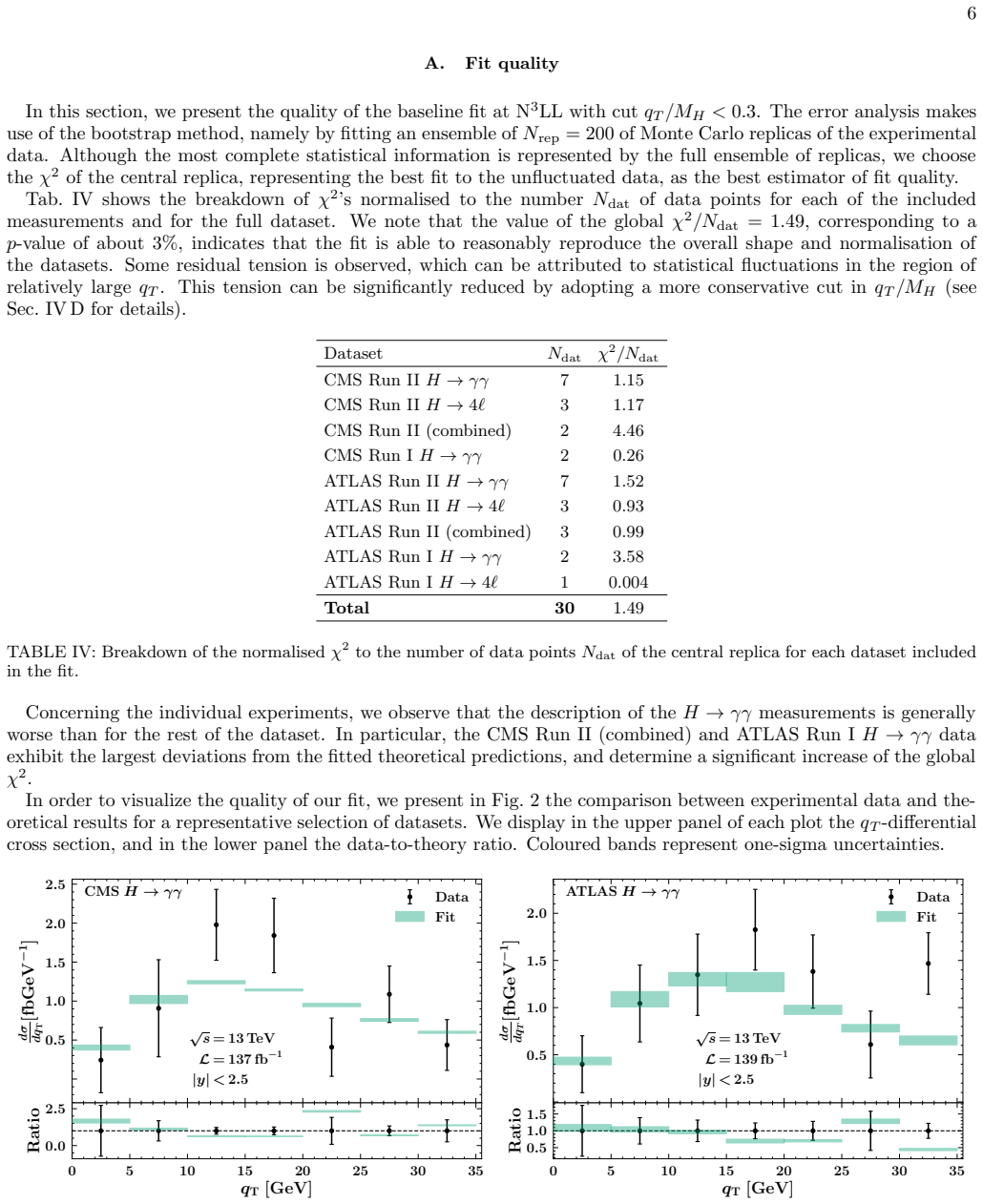
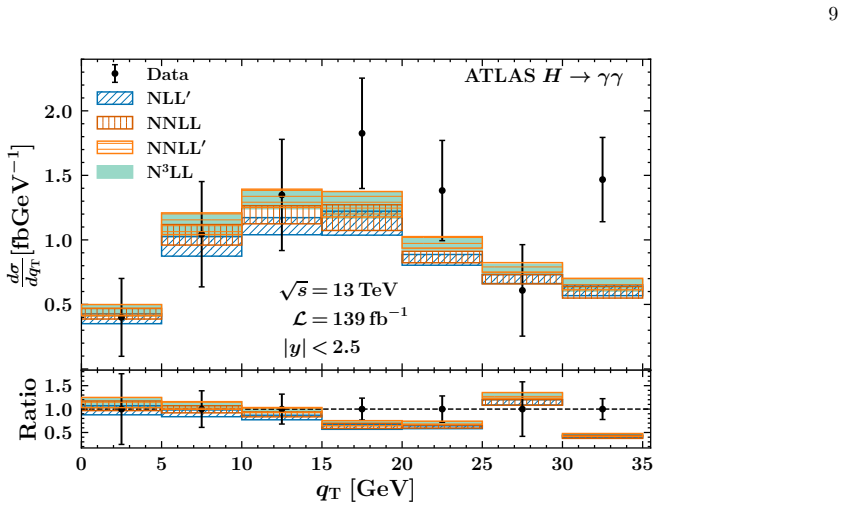
Within the TMD factorisation framework the unpolarised gluon TMD is extracted for the first time from Higgs production data at the LHC. The resulting distribution reproduces the experimental q_T spectra measured by ATLAS and CMS at 8 and 13 TeV in both diphoton and four-lepton decay modes, with predictions computed to N3LL accuracy and fiducial cuts applied consistently.
What carries the argument
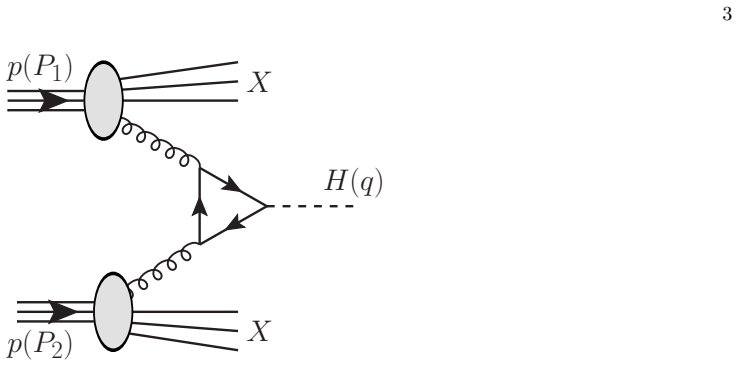
TMD factorisation for Higgs boson production, which isolates the nonperturbative gluon TMD from perturbative evolution in the small transverse-momentum region.
If this is right
- The extracted TMD can serve as a baseline when combining LHC Higgs data with other gluon-sensitive observables.
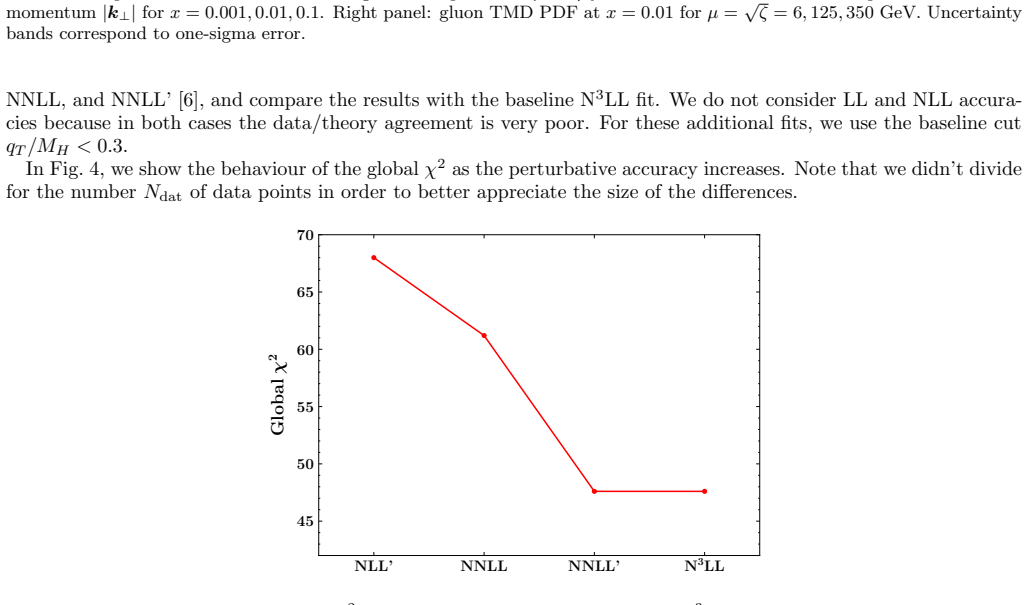
- The perturbative series shows good convergence inside the fitted q_T interval.
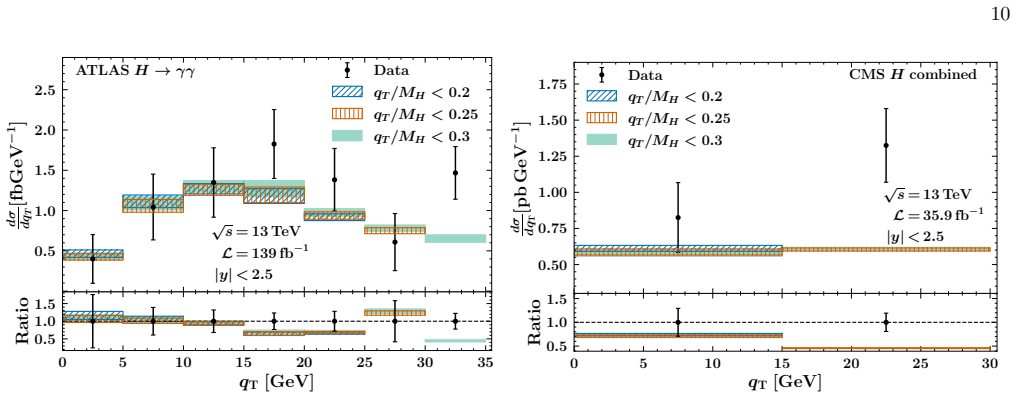
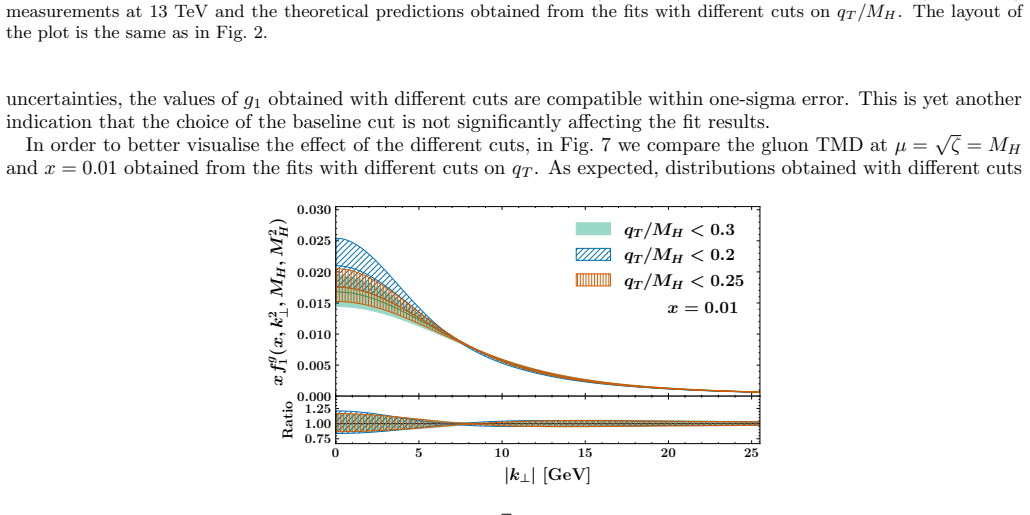
- Varying the upper q_T cut leaves the extracted distribution stable.
- Current data give only moderate constraints on the nonperturbative content of the gluon TMD.
Where Pith is reading between the lines
- Additional high-luminosity data in the same channels could reduce uncertainties on the nonperturbative parameters.
- Testing the same TMD against dijet or heavy-flavour production would probe its process independence.
- Separate measurements sensitive to the linearly polarised gluon TMD could provide further constraints.
Load-bearing premise
TMD factorisation remains valid and the small-q_T region plus chosen fiducial cuts contain negligible contamination from power-suppressed or higher-order effects.
What would settle it
A new Higgs q_T measurement at higher statistics or in a different final state that lies outside the uncertainties of predictions based on the extracted TMD.
Figures
read the original abstract
We present the first extraction of the unpolarised gluon transverse-momentum-dependent (TMD) parton distribution from Higgs-boson production data at the LHC within the framework of TMD factorisation. The analysis is based on the currently available set of ATLAS and CMS measurements of the Higgs $q_T$ distribution at $\sqrt{s} = 8$ and $13$ TeV in the diphoton and four-lepton decay channels, restricted to the small-$q_T$ region where TMD factorisation is applicable. Theoretical predictions are computed up to N$^3$LL accuracy, with the contribution of the linearly polarised gluon TMD $h_1^{\perp g}$ accounted for. Fiducial selections are consistently incorporated for both two- (diphoton) and four-body (four-lepton) final states. The fit reproduces both the shape and the normalisation of the experimental data, and yields a moderate sensitivity to the nonperturbative content of gluon TMDs. We further assess the convergence of the perturbative expansion and the stability of the extracted distribution under variations of the $q_T$ cut. This analysis provides a baseline for future extractions combining LHC Higgs measurements with other gluon-sensitive processes spanning a broader range of hard scales.
Editorial analysis
A structured set of objections, weighed in public.
Referee Report
Summary. The paper presents the first extraction of the unpolarised gluon TMD from LHC Higgs production data (ATLAS and CMS diphoton and four-lepton channels at 8 and 13 TeV), restricted to the small-q_T region. Predictions are computed at N3LL accuracy within TMD factorisation, incorporating the linearly polarised gluon TMD h_1^{\perp g} and consistent fiducial cuts for two- and four-body final states. The fit is reported to reproduce both shape and normalisation of the data, with moderate sensitivity to non-perturbative content; perturbative convergence and stability under q_T-cut variations are assessed. This is positioned as a baseline for future multi-process gluon TMD studies.
Significance. If robust, this constitutes a valuable first direct extraction of gluon TMDs from a gluon-initiated process at high perturbative accuracy. The consistent treatment of fiducial selections across decay channels and the explicit stability checks under q_T variations are strengths. The work supplies a useful reference point for combining Higgs data with other gluon-sensitive observables to map TMD evolution over scales. No machine-checked proofs or fully parameter-free results are claimed, but the N3LL implementation and data reproduction provide a concrete starting point for the TMD community.
major comments (2)
- [Abstract and small-q_T applicability discussion] Abstract and the section on the small-q_T region: the central claim that the extracted unpolarised gluon TMD is obtained from data in the region where TMD factorisation applies lacks a quantitative estimate or subtraction of power-suppressed corrections O(q_T^2/m_H^2). Without this, any non-negligible contamination could be absorbed into the fitted TMD parameters, directly affecting the interpretation of the result as a genuine TMD extraction rather than an effective description.
- [Stability and non-perturbative content assessment] Section assessing stability under q_T-cut variations and non-perturbative sensitivity: while variations of the q_T cut are performed and moderate sensitivity to non-perturbative content is stated, no explicit metrics (e.g., changes in extracted parameters or χ^{2} under different NP models) or comparison to external gluon TMD determinations are provided. This leaves the robustness of the central extraction claim difficult to quantify.
minor comments (2)
- [Abstract] The abstract would be strengthened by reporting the total number of data points used and the achieved χ^{2}/dof for the fit.
- [Figure captions] Figure captions should explicitly distinguish curves with and without the h_1^{\perp g} contribution and label all experimental datasets (ATLAS/CMS, 8/13 TeV) for immediate clarity.
Simulated Author's Rebuttal
We thank the referee for the constructive report and positive overall assessment. We address each major comment below.
read point-by-point responses
-
Referee: [Abstract and small-q_T applicability discussion] Abstract and the section on the small-q_T region: the central claim that the extracted unpolarised gluon TMD is obtained from data in the region where TMD factorisation applies lacks a quantitative estimate or subtraction of power-suppressed corrections O(q_T^2/m_H^2). Without this, any non-negligible contamination could be absorbed into the fitted TMD parameters, directly affecting the interpretation of the result as a genuine TMD extraction rather than an effective description.
Authors: We agree that an explicit estimate of power corrections would strengthen the interpretation. In the present work the data are restricted to q_T < 0.25 m_H, a region where analogous studies in Drell-Yan TMD factorisation indicate that O(q_T^2/Q^2) contributions remain below the 10% level. A full subtraction, however, would require a dedicated higher-twist calculation for gluon-initiated processes that is not yet available at N^3LL. We will revise the manuscript to include this literature-based estimate together with an expanded discussion of the applicability region, making the limitation explicit. revision: partial
-
Referee: [Stability and non-perturbative content assessment] Section assessing stability under q_T-cut variations and non-perturbative sensitivity: while variations of the q_T cut are performed and moderate sensitivity to non-perturbative content is stated, no explicit metrics (e.g., changes in extracted parameters or χ² under different NP models) or comparison to external gluon TMD determinations are provided. This leaves the robustness of the central extraction claim difficult to quantify.
Authors: We accept the point. The revised manuscript will contain additional tables and figures that report the numerical shifts in the fitted TMD parameters and the corresponding χ² values under the different non-perturbative models and q_T-cut choices already explored. A brief comparison to existing gluon TMD extractions from other processes will also be added where a meaningful overlap exists. revision: yes
Circularity Check
No significant circularity; extraction is a standard data fit
full rationale
The paper performs a fit of non-perturbative gluon TMD parameters to LHC Higgs q_T data in the small-q_T region and reports that the fit reproduces the data shape and normalisation. This reproduction is the expected and direct result of any least-squares or likelihood fit to the same dataset, not a claimed independent first-principles prediction that reduces to the inputs by construction. No self-definitional steps, fitted inputs relabelled as predictions, load-bearing self-citations, uniqueness theorems, or ansatzes smuggled via citation are present in the provided text. The central result is explicitly the outcome of the fit itself, with TMD factorisation treated as an external assumption rather than derived within the paper. This is the normal structure of a PDF/TMD extraction and does not trigger the enumerated circularity patterns.
Axiom & Free-Parameter Ledger
axioms (1)
- domain assumption TMD factorisation holds for Higgs production in the small-q_T region at the stated energies and fiducial selections.
Forward citations
Cited by 1 Pith paper
-
Neural-Network extraction of TMDs with SIDIS data
Neural-network parametrization yields first global unpolarized TMD extraction from DY plus SIDIS data at N³LL, producing broader PDFs with smaller uncertainties than DY-only NN fits.
Reference graph
Works this paper leans on
-
[1]
Hadron Physics 2030
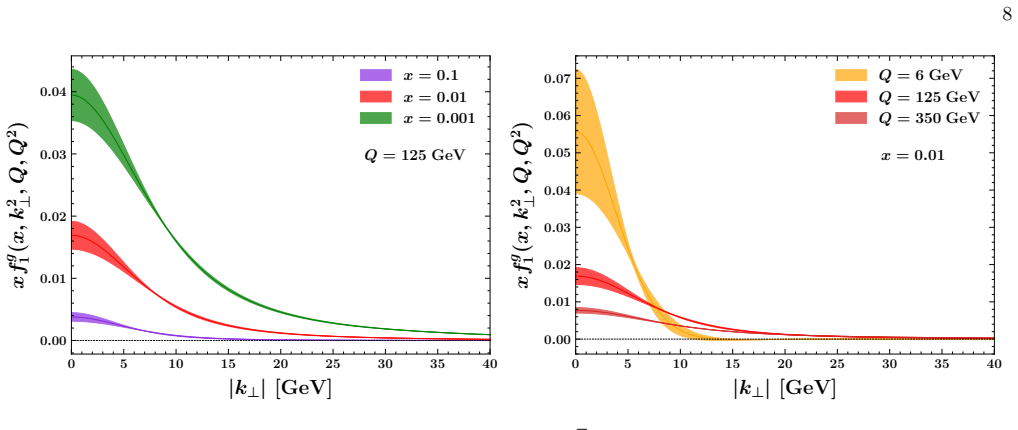
obtaining g1 = 14.4±5.1 GeV 2 ,(14) which allows us to calculate gluon TMDs at values ofµ= √ζ=Qdifferent fromM H. We note that the value ofg 1 is close to the totalg, indicating that, within the current kinematic coverage, the nonperturbative evolution contribution is small. This confirms the current limited sensitivity of Higgs measurements on nonperturb...
2030
-
[2]
(A1) reads P(q) = Z fid
Cuts on the two-particle final state For the diphoton final state, Eq. (A1) reads P(q) = Z fid. reg. d4p1 d4p2 δ(p2 1)δ(p 2 2)θ(p 1,0)θ(p 2,0)δ (4)(p1 +p 2 −q) M(p1, p2) 2 Z d4p1 d4p2 δ(p2 1)δ(p 2 2)θ(p 1,0)θ(p 2,0)δ (4)(p1 +p 2 −q) M(p1, p2) 2 ,(A3) wherep 1 andp 2 are the four-momenta of the outgoing photons,q=p 1 +p 2, andM(p 1, p2) is the amplitude fo...
-
[3]
Cuts on the four-particle final state We now extend the calculation of the phase-space reduction factorPto the four-lepton final state, P(q) = Z fid. reg. dΦ4 M(p1, p2, p3, p4) 2 Z dΦ4 M(p1, p2, p3, p4) 2 ,(A11) wherep i (i= 1, . . . ,4) are the lepton four-momenta,Mis the amplitude for the decayH→ZZ→4ℓ, anddΦ 4 is the four-body Lorentz-invariant phase sp...
-
[4]
Inserting two unit factors of the form R dQ2 i δ(q2 i −Q 2 i ) into Eq. (A2), the four-body phase space factorises as dΦ4(q;p 1, p2, p3, p4) = dQ2 1 dQ2 2 (2π)2 dΦ2(q;q 1, q2)dΦ 2(q1;p 1, p2)dΦ 2(q2;p 3, p4).(A16) This decomposition is particularly well suited for a Monte Carlo implementation: each two-body sub-phase space is parametrised by two angular v...
-
[5]
J. C. Collins, D. E. Soper, and G. F. Sterman, Nucl. Phys. B250, 199 (1985)
1985
-
[6]
Collins,Foundations of Perturbative QCD, vol
J. Collins,Foundations of Perturbative QCD, vol. 32 (Cambridge University Press, 2011), ISBN 978-1-009-40184-5, 978-1- 009-40183-8, 978-1-009-40182-1
2011
-
[7]
A. Bacchetta, F. Delcarro, C. Pisano, M. Radici, and A. Signori, JHEP06, 081 (2017), [Erratum: JHEP 06, 051 (2019)], 1703.10157
work page internal anchor Pith review Pith/arXiv arXiv 2017
-
[8]
V. Bertone, I. Scimemi, and A. Vladimirov, JHEP06, 028 (2019), 1902.08474
work page internal anchor Pith review Pith/arXiv arXiv 2019
- [9]
-
[10]
A. Bacchetta, V. Bertone, C. Bissolotti, G. Bozzi, F. Delcarro, F. Piacenza, and M. Radici, JHEP07, 117 (2020), 1912.07550
-
[11]
A. Bacchetta, V. Bertone, C. Bissolotti, G. Bozzi, M. Cerutti, F. Piacenza, M. Radici, and A. Signori (MAP (Multi- dimensional Analyses of Partonic distributions)), JHEP10, 127 (2022), 2206.07598
- [12]
- [13]
-
[14]
A. Bacchetta, V. Bertone, C. Bissolotti, G. Bozzi, M. Cerutti, F. Delcarro, M. Radici, L. Rossi, and A. Signori (MAP (Multi-dimensional Analyses of Partonic distributions)), JHEP08, 232 (2024), 2405.13833
- [15]
-
[16]
A. Bacchetta, V. Bertone, C. Bissolotti, M. Cerutti, M. Radici, S. Rodini, and L. Rossi (MAP (Multi-dimensional Analyses of Partonic distributions)), Phys. Rev. Lett.135, 021904 (2025), 2502.04166
-
[17]
Infrared factorization of tree-level QCD amplitudes at the next-to-next-to-leading order and beyond
S. Catani and M. Grazzini, Nucl. Phys. B570, 287 (2000), hep-ph/9908523
work page internal anchor Pith review Pith/arXiv arXiv 2000
-
[18]
Universality of non-leading logarithmic contributions in transverse-momentum distributions
S. Catani, D. de Florian, and M. Grazzini, Nucl. Phys. B596, 299 (2001), hep-ph/0008184
work page internal anchor Pith review Pith/arXiv arXiv 2001
-
[19]
Transverse-momentum resummation and the spectrum of the Higgs boson at the LHC
G. Bozzi, S. Catani, D. de Florian, and M. Grazzini, Nucl. Phys. B737, 73 (2006), hep-ph/0508068
work page internal anchor Pith review Pith/arXiv arXiv 2006
- [20]
-
[21]
J.-P. Lansberg, C. Pisano, F. Scarpa, and M. Schlegel, Phys. Lett. B784, 217 (2018), [Erratum: Phys.Lett.B 791, 420–421 (2019)], 1710.01684
work page internal anchor Pith review Pith/arXiv arXiv 2018
-
[22]
Gluon Distribution Functions and Higgs Boson Production at Moderate Transverse Momentum
P. Sun, B.-W. Xiao, and F. Yuan, Phys. Rev. D84, 094005 (2011), 1109.1354
work page internal anchor Pith review Pith/arXiv arXiv 2011
-
[23]
D. Boer, W. J. den Dunnen, C. Pisano, M. Schlegel, and W. Vogelsang, Phys. Rev. Lett.108, 032002 (2012), 1109.1444
work page internal anchor Pith review Pith/arXiv arXiv 2012
-
[24]
D. Boer, W. J. den Dunnen, C. Pisano, and M. Schlegel, Phys. Rev. Lett.111, 032002 (2013), 1304.2654
work page internal anchor Pith review Pith/arXiv arXiv 2013
-
[25]
Impact of gluon polarization on Higgs plus jet production at the LHC
D. Boer and C. Pisano, Phys. Rev. D91, 074024 (2015), 1412.5556
work page internal anchor Pith review Pith/arXiv arXiv 2015
-
[26]
TMD evolution and the Higgs transverse momentum distribution
D. Boer and W. J. den Dunnen, Nucl. Phys. B886, 421 (2014), 1404.6753
work page internal anchor Pith review Pith/arXiv arXiv 2014
-
[27]
A. Bacchetta, F. G. Celiberto, M. Radici, and P. Taels, Eur. Phys. J. C80, 733 (2020), 2005.02288
-
[28]
A. Bacchetta, F. G. Celiberto, and M. Radici, Eur. Phys. J. C84, 576 (2024), 2402.17556
-
[29]
R. P. Kauffman, Phys. Rev. D44, 1415 (1991)
1991
-
[30]
C. P. Yuan, Phys. Lett. B283, 395 (1992)
1992
-
[31]
W. Bizo´ n, X. Chen, A. Gehrmann-De Ridder, T. Gehrmann, N. Glover, A. Huss, P. F. Monni, E. Re, L. Rottoli, and P. Torrielli, JHEP12, 132 (2018), 1805.05916
- [32]
-
[33]
P. J. Mulders and J. Rodrigues, Phys. Rev. D63, 094021 (2001), hep-ph/0009343
work page internal anchor Pith review Pith/arXiv arXiv 2001
-
[34]
QCD transverse-momentum resummation in gluon fusion processes
S. Catani and M. Grazzini, Nucl. Phys. B845, 297 (2011), 1011.3918
work page internal anchor Pith review Pith/arXiv arXiv 2011
-
[35]
Higgs-Boson Production at Small Transverse Momentum
T. Becher, M. Neubert, and D. Wilhelm, JHEP05, 110 (2013), 1212.2621
work page internal anchor Pith review Pith/arXiv arXiv 2013
-
[36]
D. Gutierrez-Reyes, S. Leal-Gomez, I. Scimemi, and A. Vladimirov, JHEP11, 121 (2019), 1907.03780
-
[37]
R. K. Ellis, W. J. Stirling, and B. R. Webber,QCD and collider physics, vol. 8 (Cambridge University Press, 2011), ISBN 978-0-511-82328-2, 978-0-521-54589-1
2011
-
[38]
R. D. Ball et al. (NNPDF), Eur. Phys. J. C77, 663 (2017), 1706.00428
work page internal anchor Pith review Pith/arXiv arXiv 2017
-
[39]
LHAPDF6: parton density access in the LHC precision era
A. Buckley, J. Ferrando, S. Lloyd, K. Nordstr¨ om, B. Page, M. R¨ ufenacht, M. Sch¨ onherr, and G. Watt, Eur. Phys. J. C75, 132 (2015), 1412.7420
work page internal anchor Pith review Pith/arXiv arXiv 2015
- [40]
- [41]
- [42]
-
[43]
A. M. Sirunyan et al. (CMS), Phys. Lett. B792, 369 (2019), 1812.06504
work page internal anchor Pith review Pith/arXiv arXiv 2019
-
[44]
V. Khachatryan et al. (CMS), Eur. Phys. J. C76, 13 (2016), 1508.07819
work page internal anchor Pith review Pith/arXiv arXiv 2016
- [45]
- [46]
-
[47]
M. Aaboud et al. (ATLAS), Phys. Lett. B786, 114 (2018), 1805.10197
work page internal anchor Pith review Pith/arXiv arXiv 2018
-
[48]
G. Aad et al. (ATLAS), JHEP09, 112 (2014), 1407.4222
work page internal anchor Pith review Pith/arXiv arXiv 2014
-
[49]
G. Aad et al. (ATLAS), Phys. Lett. B738, 234 (2014), 1408.3226
work page internal anchor Pith review Pith/arXiv arXiv 2014
-
[50]
M. Cerutti, L. Rossi, S. Venturini, A. Bacchetta, V. Bertone, C. Bissolotti, and M. Radici (MAP (Multi-dimensional Analyses of Partonic distributions)), Phys. Rev. D107, 014014 (2023), 2210.01733
-
[51]
A. Bacchetta, A. Bongallino, M. Cerutti, M. Radici, and L. Rossi (MAP (Multi-dimensional Analyses of Partonic distri- butions)), Phys. Rev. Lett.134, 121901 (2025), 2409.18078
-
[52]
New insights from the flavor dependence of quark transverse momentum distributions in the pion
L. Rossi, A. Bacchetta, M. Cerutti, and M. Radici (MAP (Multi-dimensional Analyses of Partonic distributions)) (2025), 2509.25098. 15
work page internal anchor Pith review Pith/arXiv arXiv 2025
-
[53]
S. Camarda, G. Ferrera, and L. Rossi, JHEP01, 150 (2026), 2508.06201
-
[54]
A. Avkhadiev, V. Bertone, C. Bissolotti, M. Cerutti, Y. Fu, S. Rodini, P. Shanahan, M. Wagman, and Y. Zhao, Phys. Rev. Lett.136, 171902 (2026), 2510.26489
-
[55]
C. Hadjidakis et al., Phys. Rept.911, 1 (2021), 1807.00603
-
[56]
C. A. Aidala et al. (2019), 1901.08002
work page internal anchor Pith review Pith/arXiv arXiv 2019
discussion (0)
Sign in with ORCID, Apple, or X to comment. Anyone can read and Pith papers without signing in.