Eccentric and unbound compact binaries in the LIGO-Virgo-KAGRA catalog: parameter estimation and waveform systematics with SEOBNRv6EHM
Pith reviewed 2026-06-29 10:33 UTC · model grok-4.3
The pith
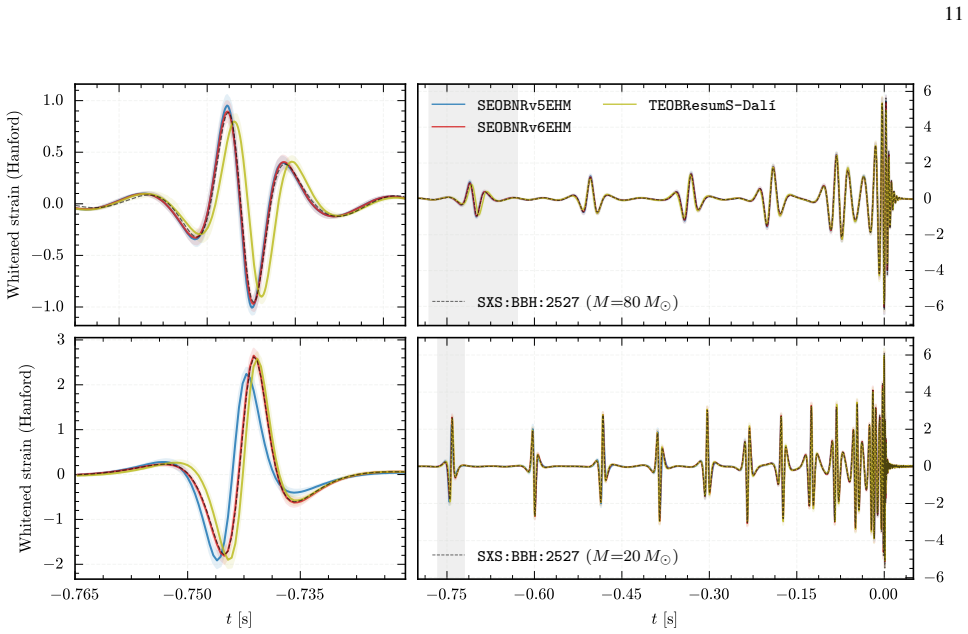
SEOBNRv6EHM reduces biases in eccentricity, masses, and spins for gravitational-wave signals from eccentric binaries and shows mild support for eccentricity in five catalog events.
A machine-rendered reading of the paper's core claim, the machinery that carries it, and where it could break.
Core claim
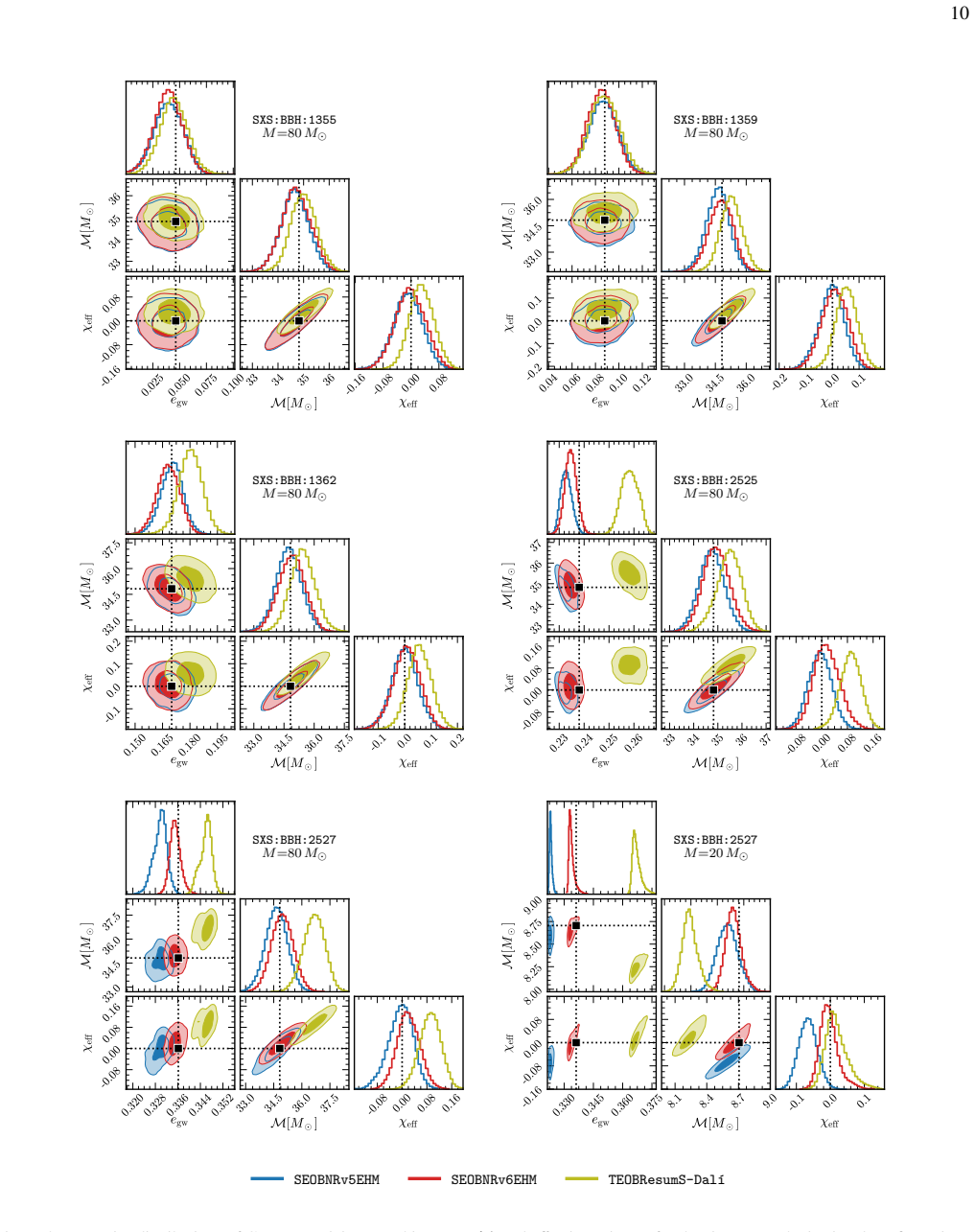
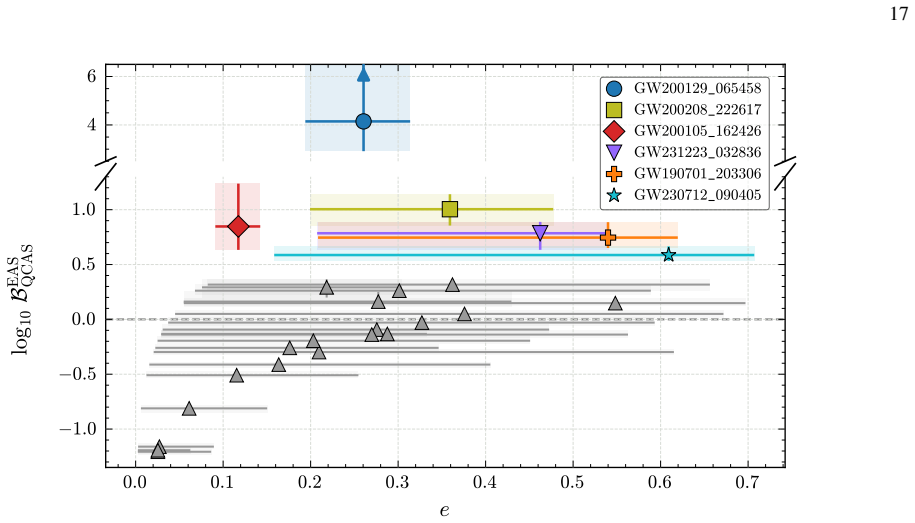
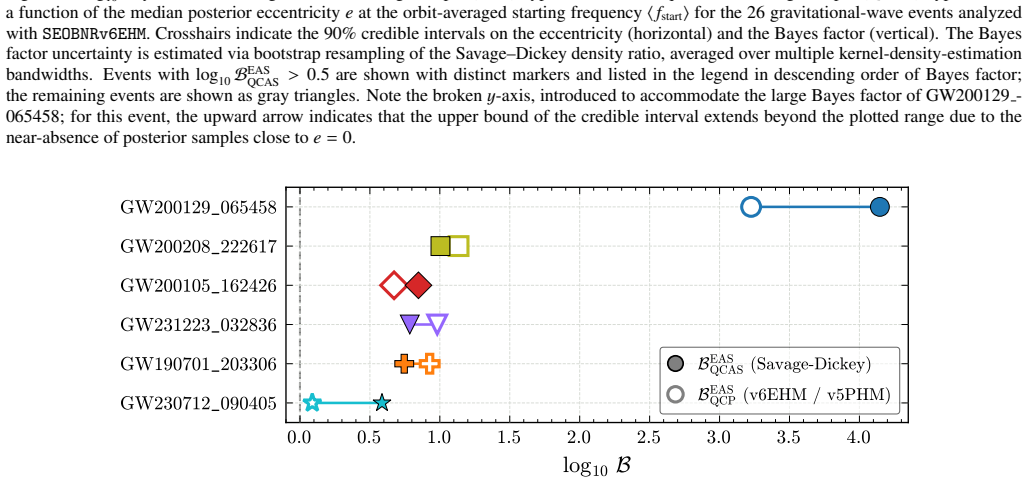
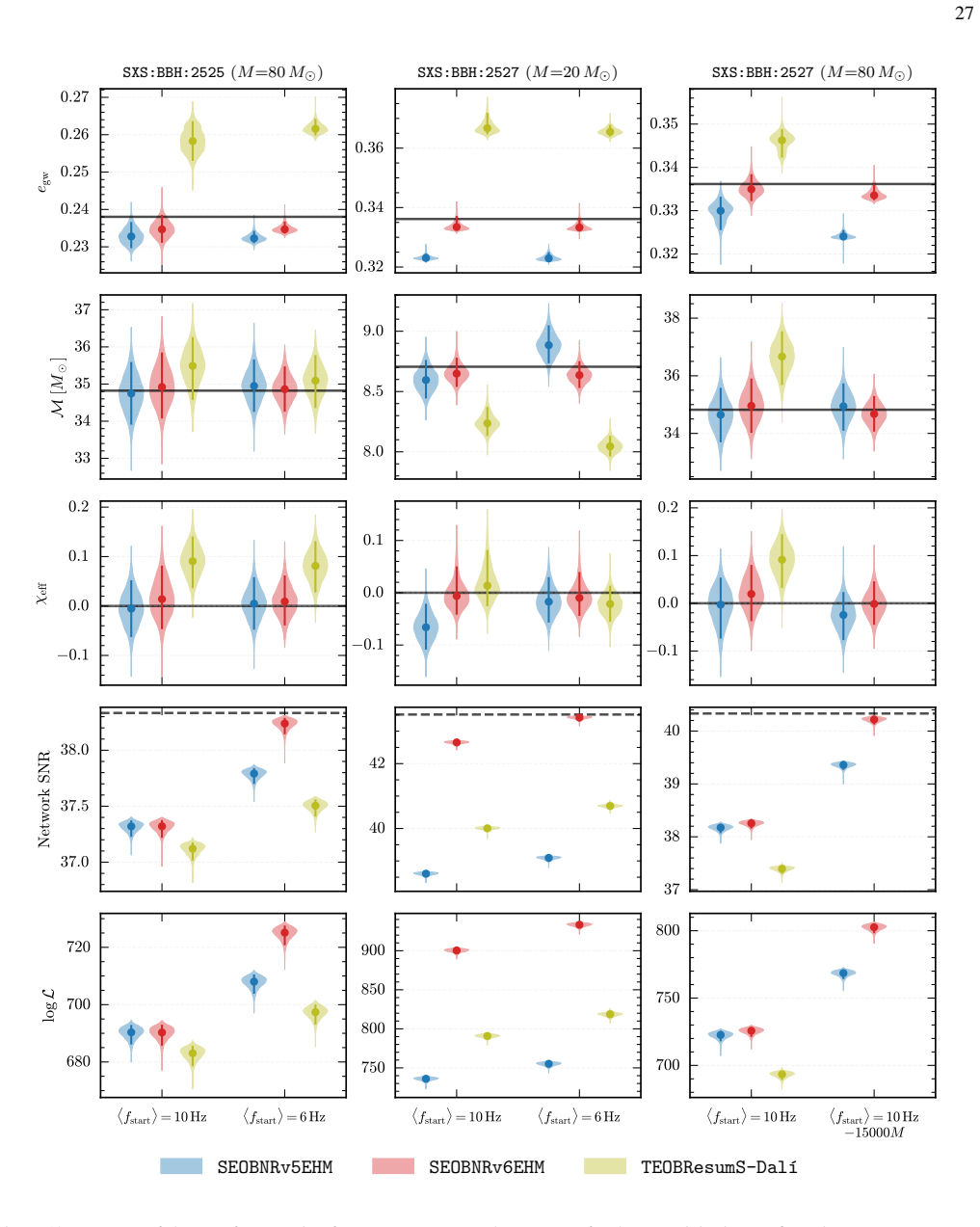
SEOBNRv6EHM significantly reduces biases in eccentricity, masses, and spins relative to earlier eccentric models; five events have log10 B_EAS_QCP > 0.5 and three high-mass events including GW190521 have log10 B_unbound_QCP approximately 0.2 to 0.6, though the recovered unbound configurations remain astrophysically unrealistic and cannot be confidently separated from highly eccentric bound orbits.
What carries the argument
The SEOBNRv6EHM effective-one-body waveform model for generic planar binaries, which enables parameter estimation with eccentricity and unbound initial conditions.
Load-bearing premise
The long, highly eccentric numerical-relativity waveforms used as synthetic signals represent the relevant parameter space and any remaining model error does not systematically affect the Bayes-factor comparisons.
What would settle it
Recovery of the same synthetic signals with SEOBNRv6EHM producing eccentricity or mass biases comparable to those from SEOBNRv5EHM would falsify the reduction in bias.
Figures
read the original abstract
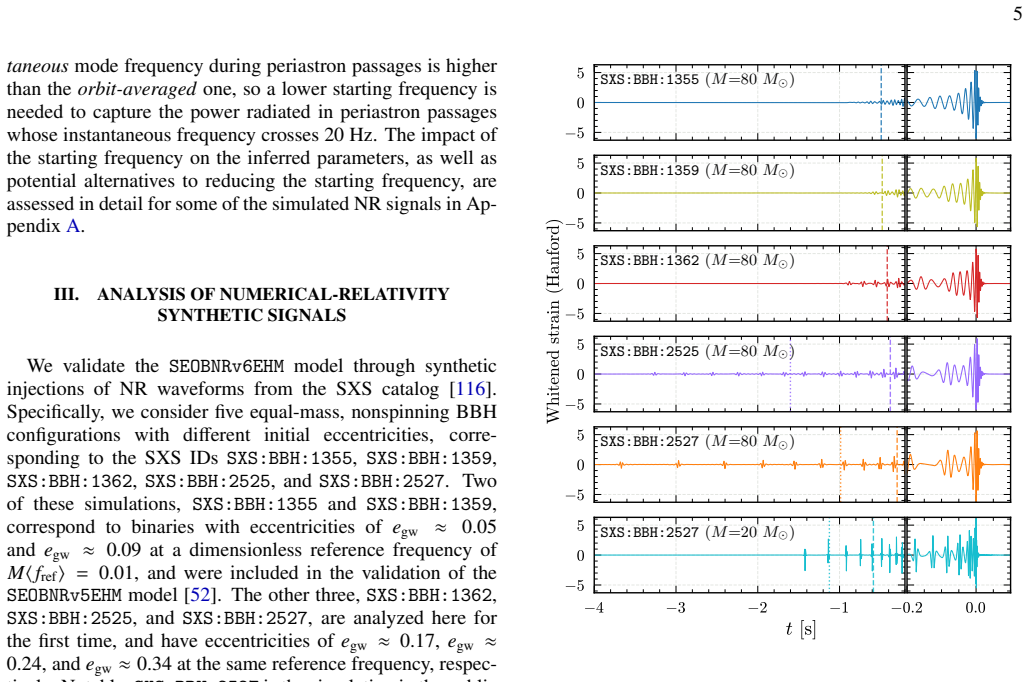
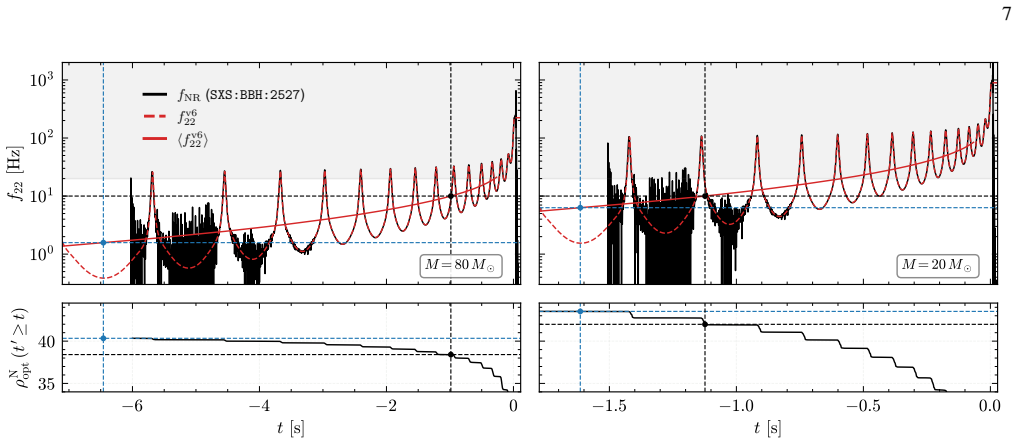
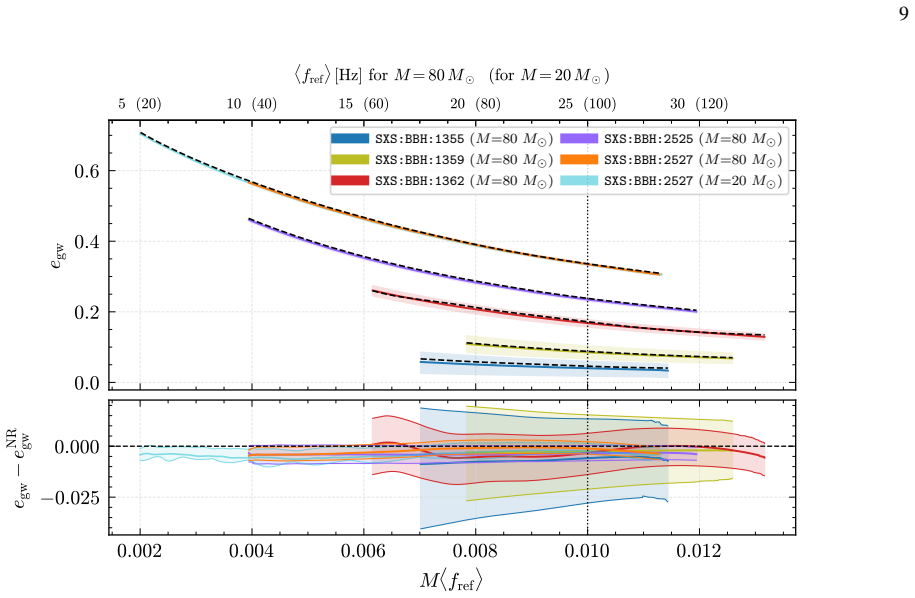
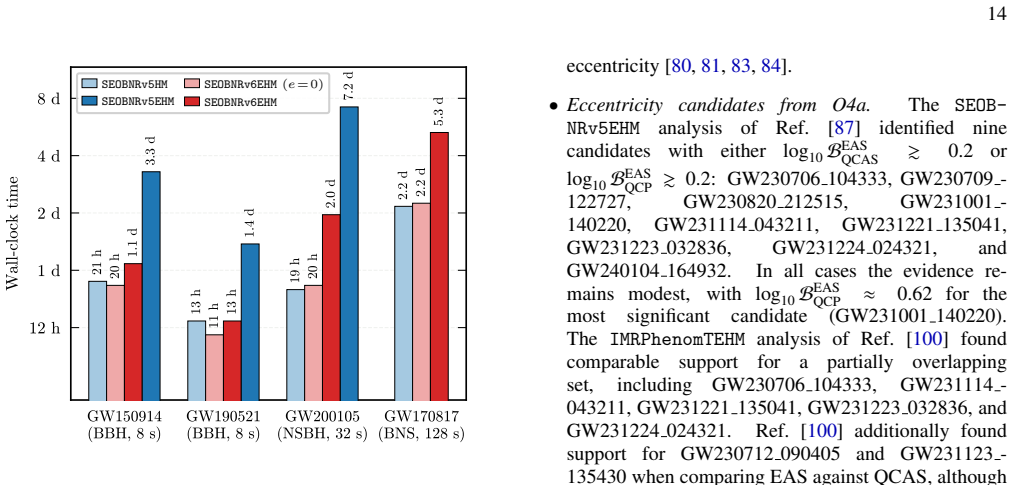
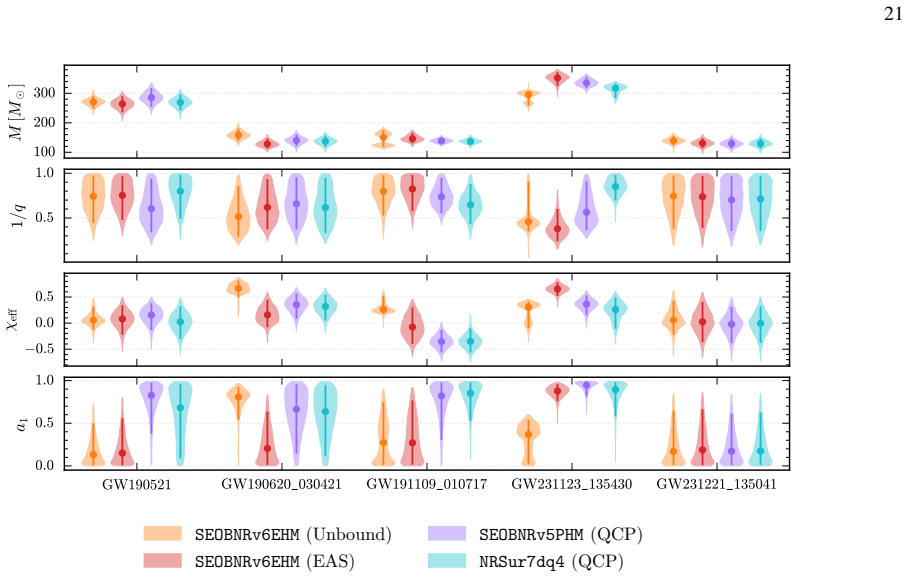
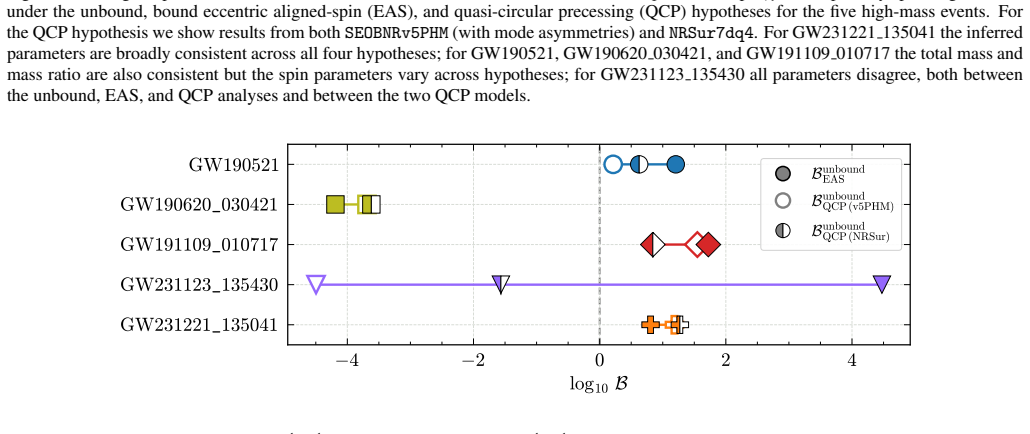
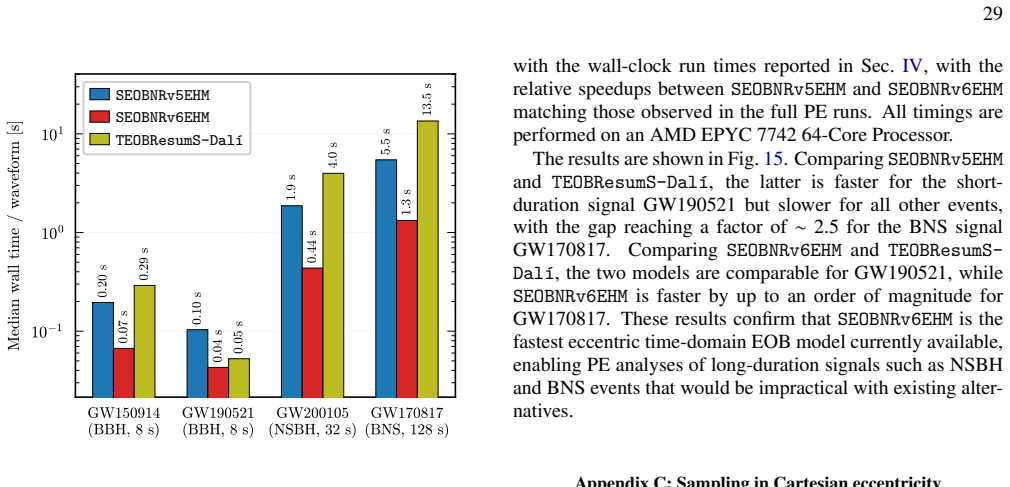
Orbital eccentricity encodes key information about compact-binary formation channels and astrophysical environments, making it a critical target for gravitational-wave (GW) inference. We present parameter-estimation (PE) analyses of GWs from eccentric compact binaries with the SEOBNRv6EHM waveform model. Using long, highly eccentric numerical-relativity waveforms as synthetic signals, we compare parameter recovery across state-of-the-art eccentric models. We find that SEOBNRv5EHM and TEOBResumS-Dal\'i can yield biased estimates of eccentricity, masses, and spins in the most challenging configurations, while SEOBNRv6EHM significantly reduces these biases. Applying SEOBNRv6EHM to 26 GW events from the O1--O4 LIGO--Virgo--KAGRA observing runs -- including binary black hole, neutron-star--black-hole, and binary neutron-star mergers -- we identify five events with mild support for eccentricity over the quasi-circular precessing-spin hypothesis, with Bayes factors $\log_{10} \mathcal{B}^{\text{EAS}}_{\text{QCP}} > 0.5$. Since SEOBNRv6EHM is applicable to generic planar binaries, we reanalyze five high-mass events allowing for unbound initial conditions. For three of them -- including GW190521, previously claimed to originate from a dynamical capture -- a direct-capture configuration is comparable to, or marginally favored over, both the eccentric aligned-spin and quasi-circular precessing-spin hypotheses ($\log_{10}\mathcal{B}^{\rm unbound}_{\rm QCP} \approx 0.2$--$0.6$ for GW190521). The recovered configurations are, however, astrophysically unrealistic and cannot be confidently discriminated from highly eccentric bound orbits, so these results do not, by themselves, support an unbound origin for these events. SEOBNRv6EHM is approximately three times faster in PE analyses than SEOBNRv5EHM, while improving waveform accuracy, enabling efficient, large-scale GW inference with eccentric waveforms.
Editorial analysis
A structured set of objections, weighed in public.
Referee Report
Summary. The manuscript introduces the SEOBNRv6EHM waveform model for eccentric and unbound compact binaries. Using long, highly eccentric numerical-relativity waveforms as synthetic signals, it demonstrates that SEOBNRv6EHM reduces biases in recovered eccentricity, masses, and spins relative to SEOBNRv5EHM and TEOBResumS-Dalí. The model is applied to 26 events from the O1–O4 LIGO-Virgo-KAGRA catalog, identifying five events with mild support for eccentricity (log10 B_EAS_QCP > 0.5) and three high-mass events (including GW190521) with mild support for unbound initial conditions (log10 B_unbound_QCP ≈ 0.2–0.6), while explicitly noting that recovered unbound configurations are astrophysically unrealistic and cannot be confidently distinguished from highly eccentric bound orbits. The model is also reported to be approximately three times faster than SEOBNRv5EHM in parameter estimation.
Significance. If the reported bias reductions hold under the full set of tests, the work provides a practically useful improvement in eccentric waveform modeling that supports more reliable eccentricity measurements from gravitational-wave data, which is directly relevant to formation-channel studies. The speed improvement and the systematic application to the catalog (with built-in caveats on the mild Bayes factors) strengthen the contribution for enabling larger-scale analyses.
minor comments (1)
- [Abstract] Abstract: the claim that SEOBNRv6EHM is 'approximately three times faster in PE analyses' should include a specific cross-reference to the timing benchmarks or table in the methods or results sections.
Simulated Author's Rebuttal
We thank the referee for their positive assessment of our manuscript, the recognition of SEOBNRv6EHM's improvements in reducing parameter biases for eccentric binaries, the speed gains, and the appropriate caveats on the mild Bayes factors. We appreciate the recommendation for minor revision.
Circularity Check
No significant circularity identified
full rationale
The paper validates SEOBNRv6EHM by injecting independent long highly eccentric NR waveforms and recovering parameters, then applies the model to real catalog events to compute Bayes factors. No equations or central claims reduce by construction to fitted inputs from the same data, self-definitional loops, or load-bearing self-citations whose validity depends on the present work. The reported bias reductions and mild log10 B values are externally falsifiable against NR and catalog data, with explicit caveats on astrophysical interpretation, rendering the derivation chain self-contained.
Axiom & Free-Parameter Ledger
Forward citations
Cited by 4 Pith papers
-
Joint inference of line-of-sight acceleration and orbital eccentricity in neutron-star--black-hole binaries
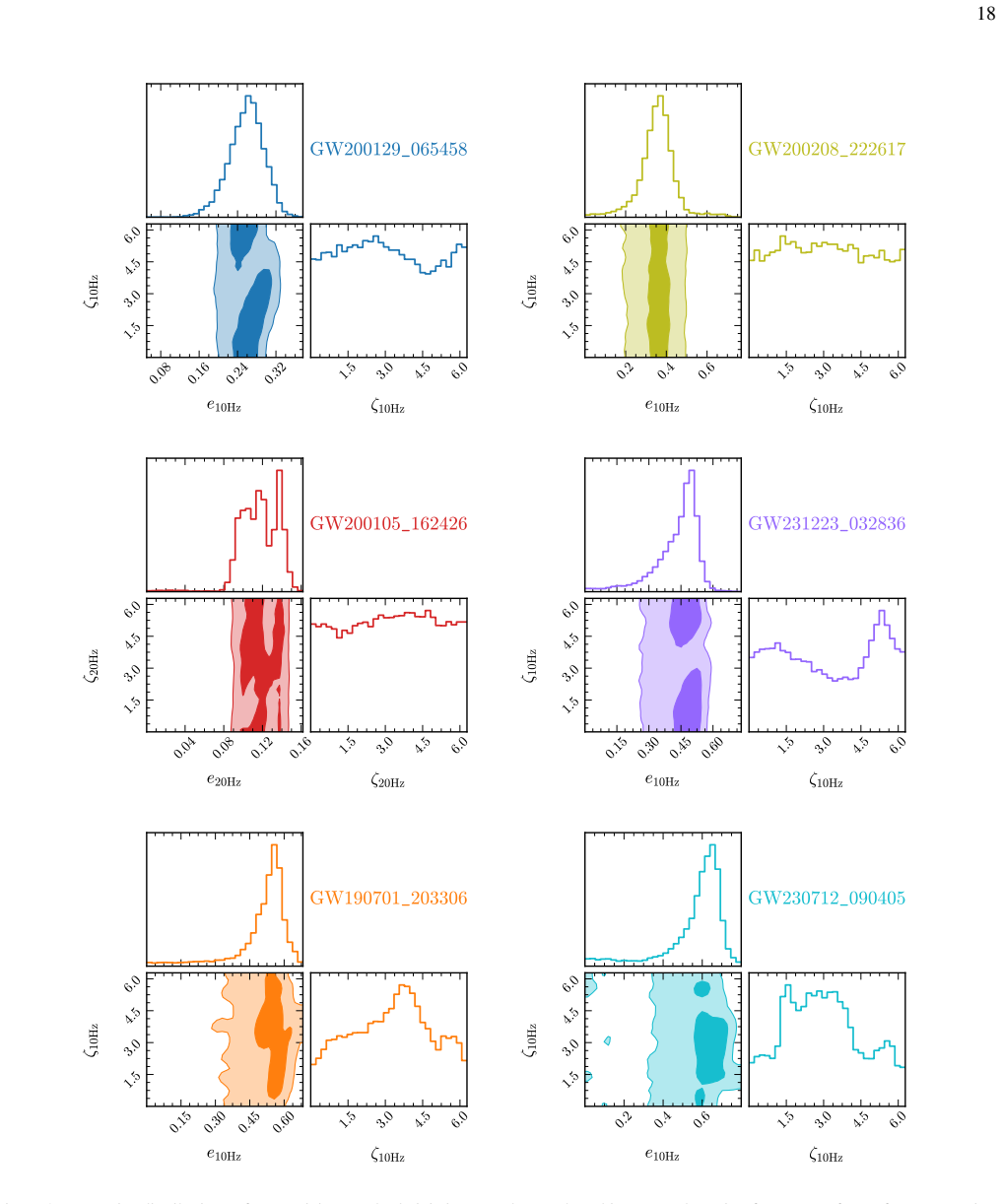
All five NSBH events are consistent with zero line-of-sight acceleration; the joint posterior for GW200105_162426 disfavors both zero LOSA and zero eccentricity at 90% credibility.
-
Horizon absorption in eccentric precessing binary black hole inspirals and its importance for gravitational wave data analysis
First leading-PN derivation of horizon absorption in eccentric precessing BBH inspirals, incorporated into pyEFPEHM, with estimates showing parameter biases in eccentric systems at moderate SNR.
-
Intrinsic handedness in O1-O4a black-hole mergers: probing orbital precession, remnant retention in dense environments and cosmological mirror asymmetry
92% of 91 LIGO black hole mergers favor non-zero V_GW, constraining bound remnants to at most 8% and finding no cosmological handedness preference with average near zero.
-
Line-of-sight acceleration in compact binaries with higher harmonics and eccentricity
Implements consistent line-of-sight acceleration corrections in quasi-circular and eccentric GW waveform models, applies them to GWTC-3 events, and reports no substantial evidence for acceleration while warning of bia...
Reference graph
Works this paper leans on
-
[1]
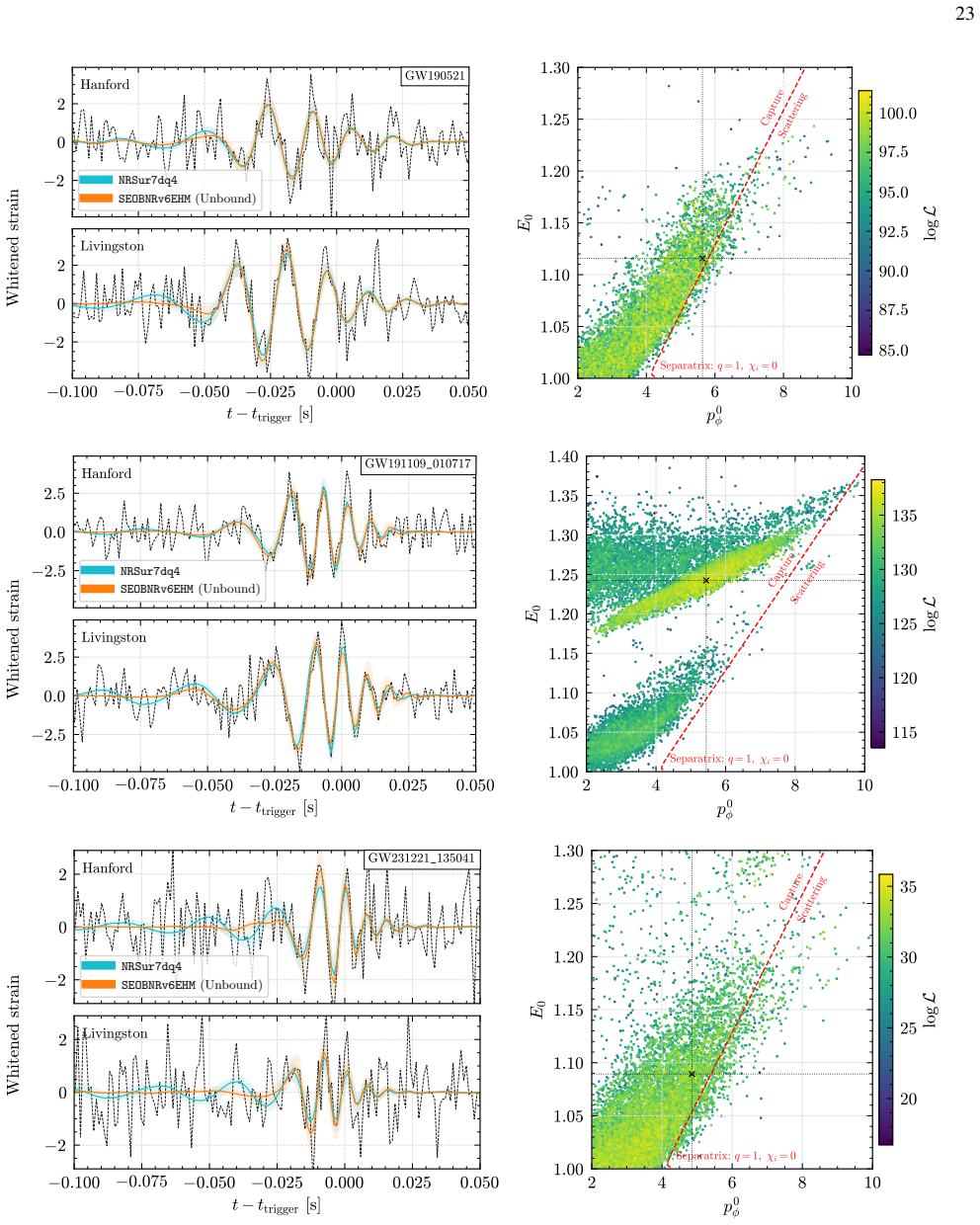
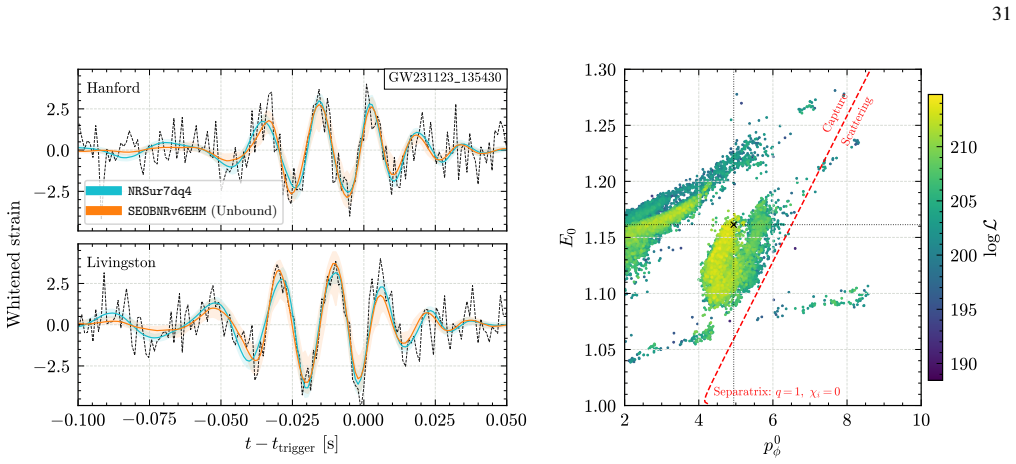
For GW231221 135041 the unbound hypothesis exceeds both QCP analyses—which yield almost identical SNR and logL—by∆ρ N mf ≈0.6 and∆logL ≈4.4, with the EAS anal- ysis lying in between (Table VI). The whitened waveform reconstructions (left panels of Fig. 12) show that the unboundSEOBNRv6EHMandNR- Sur7dq4models track the data closely during the merger and ri...
-
[2]
LIGO Scientificcollaboration, J. Aasi et al.,Advanced LIGO, Class. Quant. Grav.32(2015) 074001 [1411.4547]
work page internal anchor Pith review Pith/arXiv arXiv 2015
-
[3]
Advanced Virgo: a 2nd generation interferometric gravitational wave detector
VIRGO collaboration, F. Acernese et al.,Advanced Virgo: a second-generation interferometric gravitational wave detector,Class. Quant. Grav.32(2015) 024001 [1408.3978]
work page internal anchor Pith review Pith/arXiv arXiv 2015
-
[4]
Overview of KAGRA: De- tector design and construction history,
KAGRA collaboration, T. Akutsu et al.,Overview of KAGRA: Detector design and construction history,PTEP2021(2021) 05A101 [2005.05574]
-
[5]
LIGO Scientific, Virgocollaboration, B. P. Abbott et al., Observation of Gravitational Waves from a Binary Black Hole Merger,Phys. Rev. Lett.116(2016) 061102 [1602.03837]
work page internal anchor Pith review Pith/arXiv arXiv 2016
-
[6]
LIGO Scientific, Virgocollaboration, B. P. Abbott et al., GWTC-1: A Gravitational-Wave Transient Catalog of Compact Binary Mergers Observed by LIGO and Virgo during the First and Second Observing Runs,Phys. Rev. X9 (2019) 031040 [1811.12907]
work page internal anchor Pith review Pith/arXiv arXiv 2019
-
[7]
LIGO Scientific, Virgocollaboration, R. Abbott et al., GWTC-2: Compact Binary Coalescences Observed by LIGO and Virgo During the First Half of the Third Observing Run, Phys. Rev. X11(2021) 021053 [2010.14527]
work page internal anchor Pith review Pith/arXiv arXiv 2021
-
[8]
LIGO Scientific, VIRGO collaboration, R. Abbott et al., GWTC-2.1: Deep extended catalog of compact binary coalescences observed by LIGO and Virgo during the first half of the third observing run,Phys. Rev. D109(2024) 022001 [2108.01045]
work page internal anchor Pith review Pith/arXiv arXiv 2024
-
[9]
KAGRA, VIRGO, LIGO Scientificcollaboration, R. Abbott et al.,GWTC-3: Compact Binary Coalescences Observed by LIGO and Virgo during the Second Part of the Third Observing Run,Phys. Rev. X13(2023) 041039 [2111.03606]
work page internal anchor Pith review Pith/arXiv arXiv 2023
-
[10]
LIGO Scientific, VIRGO, KAGRA collaboration, A. G. Abac et al.,GWTC-4.0: Updating the Gravitational-Wave Transient Catalog with Observations from the First Part of the Fourth LIGO-Virgo-KAGRA Observing Run, 31 −2.5 0.0 2.5 Hanford GW231123_135430 NRSur7dq4 SEOBNRv6EHM (Unbound) −0.100 −0.075 −0.050 −0.025 0.000 0.025 0.050 t − ttrigger [s] −2.5 0.0 2.5 Li...
work page internal anchor Pith review Pith/arXiv arXiv
-
[11]
LIGO Scientific, VIRGO, KAGRA collaboration, A. G. Abac et al.,GWTC-4.0: Population Properties of Merging Compact Binaries,2508.18083
work page internal anchor Pith review Pith/arXiv arXiv
-
[12]
H. A. Bethe and G. E. Brown,Evolution of binary compact objects which merge,Astrophys. J.506(1998) 780 [astro-ph/9802084]
work page internal anchor Pith review Pith/arXiv arXiv 1998
-
[13]
K. Belczynski, V . Kalogera and T. Bulik,A Comprehensive study of binary compact objects as gravitational wave sources: Evolutionary channels, rates, and physical properties,Astrophys. J.572(2001) 407 [astro-ph/0111452]
work page internal anchor Pith review Pith/arXiv arXiv 2001
-
[14]
Double Compact Objects I: The Significance Of The Common Envelope On Merger Rates
M. Dominik, K. Belczynski, C. Fryer, D. Holz, E. Berti, T. Bulik et al.,Double Compact Objects I: The Significance of the Common Envelope on Merger Rates,Astrophys. J.759 (2012) 52 [1202.4901]
work page internal anchor Pith review Pith/arXiv arXiv 2012
-
[15]
Formation of the first three gravitational-wave observations through isolated binary evolution
S. Stevenson, A. Vigna-G ´omez, I. Mandel, J. W. Barrett, C. J. Neijssel, D. Perkins et al.,Formation of the first three gravitational-wave observations through isolated binary evolution,Nature Commun.8(2017) 14906 [1704.01352]
work page internal anchor Pith review Pith/arXiv arXiv 2017
-
[16]
Peters and J
P. Peters and J. Mathews,Gravitational radiation from point masses in a Keplerian orbit,Phys.Rev.131(1963) 435
1963
-
[17]
P. C. Peters,Gravitational Radiation and the Motion of Two Point Masses,Phys. Rev.136(1964) B1224
1964
-
[18]
Circularization and Final Spin in Eccentric Binary Black Hole Inspirals
I. Hinder, B. Vaishnav, F. Herrmann, D. Shoemaker and P. Laguna,Universality and final spin in eccentric binary black hole inspirals,Phys. Rev. D77(2008) 081502 [0710.5167]
work page internal anchor Pith review Pith/arXiv arXiv 2008
-
[19]
Eccentric binary black-hole mergers: The transition from inspiral to plunge in general relativity
U. Sperhake, E. Berti, V . Cardoso, J. A. Gonzalez, B. Bruegmann and M. Ansorg,Eccentric binary black-hole mergers: The Transition from inspiral to plunge in general relativity,Phys. Rev. D78(2008) 064069 [0710.3823]
work page internal anchor Pith review Pith/arXiv arXiv 2008
-
[20]
M. C. Miller and D. P. Hamilton,Production of intermediate-mass black holes in globular clusters,Mon. Not. Roy. Astron. Soc.330(2002) 232 [astro-ph/0106188]
work page internal anchor Pith review Pith/arXiv arXiv 2002
-
[21]
M. C. Miller and D. P. Hamilton,Four-body effects in globular cluster black hole coalescence,Astrophys. J.576 (2002) 894 [astro-ph/0202298]
work page internal anchor Pith review Pith/arXiv arXiv 2002
-
[22]
R. M. O’Leary, F. A. Rasio, J. M. Fregeau, N. Ivanova and R. W. O’Shaughnessy,Binary mergers and growth of black holes in dense star clusters,Astrophys. J.637(2006) 937 [astro-ph/0508224]
work page internal anchor Pith review Pith/arXiv arXiv 2006
-
[23]
R. M. O’Leary, B. Kocsis and A. Loeb,Gravitational waves from scattering of stellar-mass black holes in galactic nuclei, Mon. Not. Roy. Astron. Soc.395(2009) 2127 [0807.2638]
work page internal anchor Pith review Pith/arXiv arXiv 2009
-
[24]
J. Samsing, M. MacLeod and E. Ramirez-Ruiz,The Formation of Eccentric Compact Binary Inspirals and the Role of Gravitational Wave Emission in Binary-Single Stellar Encounters,Astrophys. J.784(2014) 71 [1308.2964]
work page internal anchor Pith review Pith/arXiv arXiv 2014
-
[25]
Eccentric Black Hole Mergers in Dense Star Clusters: The Role of Binary-Binary Encounters
M. Zevin, J. Samsing, C. Rodriguez, C.-J. Haster and E. Ramirez-Ruiz,Eccentric Black Hole Mergers in Dense Star Clusters: The Role of Binary–Binary Encounters, Astrophys. J.871(2019) 91 [1810.00901]
work page internal anchor Pith review Pith/arXiv arXiv 2019
-
[26]
D. Chattopadhyay, J. Stegmann, F. Antonini, J. Barber and I. M. Romero-Shaw,Double black hole mergers in nuclear star clusters: eccentricities, spins, masses, and the growth of massive seeds,Mon. Not. Roy. Astron. Soc.526(2023) 4908 [2308.10884]
-
[27]
von Zeipel,Sur l’application des s´ eries de M
H. von Zeipel,Sur l’application des s´ eries de M. Lindstedt ` a l’´ etude du mouvement des com` etes p´ eriodiques, Astronomische Nachrichten183(1910) 345
1910
-
[28]
Kozai,Secular perturbations of asteroids with high inclination and eccentricity,The Astronomical Journal67 (1962) 591
Y . Kozai,Secular perturbations of asteroids with high inclination and eccentricity,The Astronomical Journal67 (1962) 591
1962
-
[29]
M. L. Lidov,The evolution of orbits of artificial satellites of planets under the action of gravitational perturbations of external bodies,Planetary and Space Science9(1962) 719
1962
-
[30]
L. Wen,On the eccentricity distribution of coalescing black hole binaries driven by the Kozai mechanism in globular clusters,Astrophys. J.598(2003) 419 [astro-ph/0211492]
work page internal anchor Pith review Pith/arXiv arXiv 2003
-
[31]
Eccentric Black Hole Mergers Forming in Globular Clusters
J. Samsing,Eccentric Black Hole Mergers Forming in Globular Clusters,Phys. Rev. D97(2018) 103014 [1711.07452]
work page internal anchor Pith review Pith/arXiv arXiv 2018
-
[32]
On the Assembly Rate of Highly Eccentric Binary Black Hole Mergers
J. Samsing and E. Ramirez-Ruiz,On the Assembly Rate of Highly Eccentric Binary Black Hole Mergers,Astrophys. J. Lett.840(2017) L14 [1703.09703]
work page internal anchor Pith review Pith/arXiv arXiv 2017
-
[33]
C. L. Rodriguez, P. Amaro-Seoane, S. Chatterjee, K. Kremer, F. A. Rasio, J. Samsing et al.,Post-Newtonian Dynamics in 32 Dense Star Clusters: Formation, Masses, and Merger Rates of Highly-Eccentric Black Hole Binaries,Phys. Rev. D98 (2018) 123005 [1811.04926]
work page internal anchor Pith review Pith/arXiv arXiv 2018
-
[34]
J. Samsing, I. Bartos, D. J. D’Orazio, Z. Haiman, B. Kocsis, N. W. C. Leigh et al.,AGN as potential factories for eccentric black hole mergers,Nature603(2022) 237 [2010.09765]
- [35]
-
[36]
L. Gond ´an and B. Kocsis,High eccentricities and high masses characterize gravitational-wave captures in galactic nuclei as seen by Earth-based detectors,Mon. Not. Roy. Astron. Soc.506(2021) 1665 [2011.02507]
- [37]
-
[38]
Comparisons of eccentric binary black hole simulations with post-Newtonian models
I. Hinder, F. Herrmann, P. Laguna and D. Shoemaker, Comparisons of eccentric binary black hole simulations with post-Newtonian models,Phys. Rev. D82(2010) 024033 [0806.1037]
work page internal anchor Pith review Pith/arXiv arXiv 2010
-
[39]
A. H. Mroue, H. P. Pfeiffer, L. E. Kidder and S. A. Teukolsky, Measuring orbital eccentricity and periastron advance in quasi-circular black hole simulations,Phys. Rev. D82(2010) 124016 [1004.4697]
work page internal anchor Pith review Pith/arXiv arXiv 2010
-
[40]
I. Hinder, L. E. Kidder and H. P. Pfeiffer,Eccentric binary black hole inspiral-merger-ringdown gravitational waveform model from numerical relativity and post-Newtonian theory, Phys. Rev. D98(2018) 044015 [1709.02007]
work page internal anchor Pith review Pith/arXiv arXiv 2018
-
[41]
Foundations of an effective-one-body model for coalescing binaries on eccentric orbits
T. Hinderer and S. Babak,Foundations of an effective-one-body model for coalescing binaries on eccentric orbits,Phys. Rev. D96(2017) 104048 [1707.08426]
work page internal anchor Pith review Pith/arXiv arXiv 2017
-
[42]
Z. Cao and W.-B. Han,Waveform model for an eccentric binary black hole based on the effective-one-body-numerical-relativity formalism,Phys. Rev. D96(2017) 044028 [1708.00166]
work page internal anchor Pith review Pith/arXiv arXiv 2017
-
[43]
A. Ramos-Buades, S. Husa, G. Pratten, H. Estell ´es, C. Garc´ıa-Quir´os, M. Mateu-Lucena et al.,First survey of spinning eccentric black hole mergers: Numerical relativity simulations, hybrid waveforms, and parameter estimation, Phys. Rev. D101(2020) 083015 [1909.11011]
-
[44]
D. Chiaramello and A. Nagar,Faithful analytical effective-one-body waveform model for spin-aligned, moderately eccentric, coalescing black hole binaries,Phys. Rev. D101(2020) 101501 [2001.11736]
- [45]
- [46]
-
[47]
A. Ramos-Buades, A. Buonanno, M. Khalil and S. Ossokine, Effective-one-body multipolar waveforms for eccentric binary black holes with nonprecessing spins,Phys. Rev. D 105(2022) 044035 [2112.06952]
-
[48]
A. Ramos-Buades, M. van de Meent, H. P. Pfeiffer, H. R. R¨uter, M. A. Scheel, M. Boyle et al.,Eccentric binary black holes: Comparing numerical relativity and small mass-ratio perturbation theory,Phys. Rev. D106(2022) 124040 [2209.03390]
-
[49]
J. Healy and C. O. Lousto,Fourth RIT binary black hole simulations catalog: Extension to eccentric orbits,Phys. Rev. D105(2022) 124010 [2202.00018]
-
[50]
S. Albanesi, S. Bernuzzi, T. Damour, A. Nagar and A. Placidi, Faithful effective-one-body waveform of small-mass-ratio coalescing black hole binaries: The eccentric, nonspinning case,Phys. Rev. D108(2023) 084037 [2305.19336]
- [51]
-
[52]
A. Nagar, D. Chiaramello, R. Gamba, S. Albanesi, S. Bernuzzi, V . Fantini et al.,Effective-one-body waveform model for noncircularized, planar, coalescing black hole binaries. II. High accuracy by improving logarithmic terms in resummations,Phys. Rev. D111(2025) 064050 [2407.04762]
-
[53]
A. Gamboa et al.,Accurate waveforms for eccentric, aligned-spin binary black holes: The multipolar effective-one-body model seobnrv5ehm,Phys. Rev. D112 (2025) 044038 [2412.12823]
- [54]
- [55]
- [56]
- [57]
- [58]
- [59]
- [60]
- [61]
- [62]
-
[63]
S. Albanesi, R. Gamba, S. Bernuzzi, J. Fontbut ´e, A. Gonzalez and A. Nagar,Effective-one-body modeling for generic compact binaries with arbitrary orbits,Phys. Rev. D112 (2025) L121503 [2503.14580]
-
[64]
A. Ramos-Buades, Q. Henry and M. Haney,Fast frequency-domain phenomenological modeling of eccentric aligned-spin binary black holes,2601.03340
-
[65]
G. Morras, G. Pratten, P. Schmidt and A. Buonanno, Post-Newtonian inspiral waveform model for eccentric 33 precessing binaries with higher-order modes and matter effects,2604.11903
work page internal anchor Pith review Pith/arXiv arXiv
-
[66]
G. Faggioli, A. Buonanno, M. van de Meent and G. Khanna, Modeling the merger-ringdown of an eccentric test-mass inspiral into a Kerr black hole using the effective-one-body framework,2603.19913
-
[67]
S. Albanesi, S. Bernuzzi and A. Nagar,Ringdown modeling for effective-one-body waveforms in the test-mass limit for eccentric equatorial orbits around a Kerr black hole, 2603.19413
- [68]
- [69]
- [70]
- [71]
-
[72]
V . Gayathri, J. Healy, J. Lange, B. O’Brien, M. Szczepanczyk, I. Bartos et al.,Eccentricity estimate for black hole mergers with numerical relativity simulations, Nature Astron.6(2022) 344 [2009.05461]
-
[73]
E. O’Shea and P. Kumar,Correlations in gravitational-wave reconstructions from eccentric binaries: A case study with GW151226 and GW170608,Phys. Rev. D108(2023) 104018 [2107.07981]
- [74]
- [75]
- [76]
- [77]
-
[78]
A. Ramos-Buades, A. Buonanno and J. Gair,Bayesian inference of binary black holes with inspiral-merger-ringdown waveforms using two eccentric parameters,Phys. Rev. D108(2023) 124063 [2309.15528]
-
[79]
Evidence for eccentricity in the population of binary black holes observed by LIGO-Virgo-KAGRA
N. Gupte et al.,Evidence for eccentricity in the population of binary black holes observed by LIGO-Virgo-KAGRA,Phys. Rev. D112(2025) 104045 [2404.14286]
work page internal anchor Pith review Pith/arXiv arXiv 2025
-
[80]
Fei and Y
Q. Fei and Y . Yang,Test of the Brans–Dicke theory with GW200105 and GW200115,Commun. Theor. Phys.76 (2024) 075402
2024
discussion (0)
Sign in with ORCID, Apple, or X to comment. Anyone can read and Pith papers without signing in.