REVIEW 3 minor 5 cited by
Exact integral R2 improvement is the measure of the Tchebycheff shadow between scalarization envelopes.
Reviewed by Pith at T0; open to challenge. T0 means a machine referee read the full paper against a public rubric. the ladder, T0–T4 →
T0 review · grok-4.3
2026-06-29 10:25 UTC pith:JM7AKXEF
load-bearing objection The paper proves that exact integral R2 improvement is a scalarization-space volume (Tchebycheff shadow measure) rather than any ordinary weighted hypervolume, and derives exact computation methods from that geometry.
Preference-Shaped Expected Hypervolume and R2 Improvement: Exact Computation and Monotonicity
The pith
A machine-rendered reading of the paper's core claim, the machinery that carries it, and where it could break.
Core claim
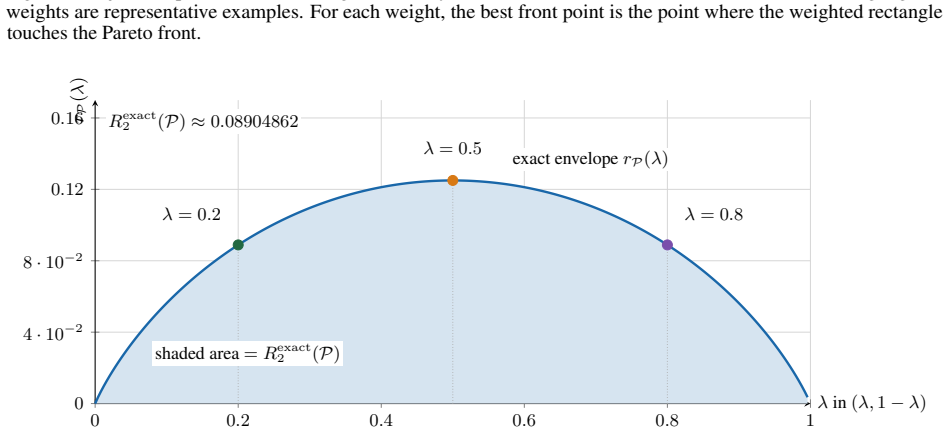
Exact integral R2 improvement is exactly a scalarization-space volume, namely the measure of the Tchebycheff shadow between the incumbent scalarization envelope and the reference envelope. This representation yields finite-sum ER2I algorithms for discrete R2, quadrature methods for exact integral R2, and an achievement-space Gaussian surrogate formulation in which ER2I is an integral of scalar Gaussian expected improvements.
What carries the argument
The Tchebycheff shadow measure in scalarization space, which captures the volume between the incumbent and reference scalarization envelopes.
Load-bearing premise
The preference transformations separate into cases that preserve exactness, Pareto compatibility, and monotonicity without non-monotonicity issues.
What would settle it
A specific instance where the integral R2 improvement value does not match the computed Tchebycheff shadow volume measure.
If this is right
- Finite-sum algorithms for discrete R2 improvement
- Quadrature methods for computing exact integral R2 improvement
- Achievement-space Gaussian surrogate where ER2I reduces to integral of scalar expected improvements
Where Pith is reading between the lines
- This formulation may extend to other scalarization-based indicators beyond R2.
- Connecting the shadow volume to Gaussian process models could improve surrogate accuracy in achievement space.
- Preference shaping via linear cone transformations might apply to other volume-based indicators.
Editorial analysis
A structured set of objections, weighed in public.
Referee Report
Summary. This paper studies preference-shaped expected improvement criteria for Bayesian multiobjective optimization. It revisits canonical EHVI through the Deng representation, formulates product-density weighted EHVI in desirability coordinates, discusses cone-based EHVI as ordinary EHVI after a linear cone transformation, and separates these from truncated EHVI. For the R2 indicator, it proves that exact integral R2 improvement is not an ordinary objective-space weighted hypervolume due to lower-dimensional boundary obstructions, but is exactly the Lebesgue measure of the Tchebycheff shadow between the incumbent scalarization envelope and the reference envelope in scalarization space. This yields finite-sum ER2I algorithms for discrete R2, quadrature methods for exact integral R2, and an achievement-space Gaussian surrogate formulation in which ER2I reduces to an integral of scalar Gaussian expected improvements.
Significance. If the derivations and proofs hold, the work is significant for establishing precise geometric conditions under which preference transformations preserve exact computation, Pareto compatibility, and monotonicity for both EHVI and R2 families. The scalarization-space volume representation for ER2I and its reduction to scalar EIs provide a clean theoretical foundation that avoids the obstructions of Lebesgue-density hypervolume, enabling practical exact algorithms and surrogates. The explicit case distinctions (Deng, product-density, cone-based, truncated) and the achievement-space formulation strengthen the design of preference-aware acquisition functions in multiobjective Bayesian optimization.
minor comments (3)
- [Abstract] The abstract mentions 'the Deng representation' without a forward reference to the section or equation where it is formally introduced; adding such a pointer would improve readability for readers focused on the EHVI variants.
- In the discussion of truncated EHVI, the statement that 'variance monotonicity may fail' is noted but not accompanied by a concrete counter-example or condition; a brief illustrative example or reference to a specific proposition would clarify the boundary of applicability.
- The term 'Tchebycheff shadow' is central to the R2 result; its first formal definition should be accompanied by a diagram or explicit integral expression to make the geometric claim immediately accessible.
Simulated Author's Rebuttal
We thank the referee for the positive and accurate summary of our contributions on preference-shaped EHVI and ER2I, as well as for the favorable significance assessment and recommendation of minor revision. We will address any minor points in the revised version.
Circularity Check
No significant circularity; derivation is geometrically self-contained
full rationale
The central claim—that exact integral R2 improvement equals the Lebesgue measure of the Tchebycheff shadow between incumbent and reference scalarization envelopes—is derived from the geometric distinction that Lebesgue-density hypervolume cannot capture certain boundary contributions visible to Tchebycheff scalarizations. This is presented as a direct proof without reduction to fitted parameters, self-citations, or prior ansatzes by the same authors. The separations among Deng representation, product-density, cone-based, and truncated EHVI cases are introduced as explicit definitional distinctions that preserve exactness and monotonicity where claimed, with no evidence that any step collapses to its own inputs by construction. The paper is self-contained against external benchmarks for the stated geometric argument.
Axiom & Free-Parameter Ledger
read the original abstract
This paper studies preference-shaped expected improvement criteria for Bayesian multiobjective optimization. We consider two indicator families which are often used for similar algorithmic purposes, but which are geometrically different. The hypervolume indicator is based on a dystopian reference point and measures dominated volume in objective space. The R2 indicator is based on a utopian point and evaluates approximation sets through weighted Tchebycheff scalarization envelopes. The purpose of the paper is to make precise which preference transformations preserve exact computation, Pareto compatibility, and monotonicity properties, and which transformations change the underlying geometry. On the hypervolume side, we revisit canonical EHVI through the Deng representation, formulate product-density weighted EHVI in desirability coordinates, discuss cone-based EHVI as ordinary EHVI after a linear cone transformation, and separate these cases from truncated EHVI, where variance monotonicity may fail. On the R2 side, we prove that exact integral R2 improvement is not, in general, an ordinary objective-space weighted hypervolume. The obstruction is lower-dimensional: Lebesgue-density hypervolume cannot see certain boundary contributions that Tchebycheff scalarizations still detect. We then show that exact integral R2 improvement is exactly a scalarization-space volume, namely the measure of the Tchebycheff shadow between the incumbent scalarization envelope and the reference envelope. This representation yields finite-sum ER2I algorithms for discrete R2, quadrature methods for exact integral R2, and an achievement-space Gaussian surrogate formulation in which ER2I is an integral of scalar Gaussian expected improvements.
Figures



Forward citations
Cited by 5 Pith papers
-
Computing the Integral R2 Indicator by Perspective Mapping and Box Decomposition
A bidirectional perspective mapping reduces integral R2 computation to weighted hypervolume differences, enabling box-decomposition algorithms to compute it in O(n log n) time for N=2,3 objectives.
-
Computing the Integral R2 Indicator by Perspective Mapping and Box Decomposition
A bidirectional perspective mapping equates integral R2 computation to weighted hypervolume differences over anchored box decompositions, yielding output-sensitive algorithms with stated time complexities for fixed nu...
-
Computing the Integral R2 Indicator by Perspective Mapping and Box Decomposition
A bidirectional perspective mapping reduces integral R2 computation to weighted hypervolume differences over box decompositions, enabling reuse of existing algorithms with output-sensitive overhead O(2^N M) and specif...
-
Three-Objective Integral R2 Subset Selection: NP-Hardness and Submodular Approximation
Proves NP-hardness of exact 3-objective integral R2 subset selection and shows the improvement function is monotone submodular for greedy approximation.
-
Exact and Fast Subset Selection Algorithms for the Bi-objective Integral R2 Indicator
Exact O(kn) algorithm for fixed-cardinality subset selection under the continuous integral bi-objective R2 indicator via adjacent-neighbor decomposition and Monge matrix search.
Reference graph
Works this paper leans on
-
[1]
On the properties of theR2 indicator
Brockhoff, D., Wagner, T., and Trautmann, H. On the properties of theR2 indicator. InProceedings of the 14th Annual Conference on Genetic and Evolutionary Computation, pages 465–472, 2012
2012
-
[2]
Expected hypervolume improvement is a particular hypervolume improvement
Deng, J., Sun, J., Zhang, Q., and Li, H. Expected hypervolume improvement is a particular hypervolume improvement. InAAAI Conference on Artificial Intelligence, 2025
2025
-
[3]
H., Emmerich, M
Deutz, A. H., Emmerich, M. T. M., and Yang, K. The expectedR2-indicator improvement for multi-objective Bayesian optimization. InEvolutionary Multi-Criterion Optimization, LNCS 11411, pages 359–370. Springer, 2019
2019
-
[4]
Emmerich, M. T. M.Single- and Multiobjective Evolutionary Design Optimization Assisted by Gaussian Random Field Metamodels. Doctoral dissertation, TU Dortmund, 2005
2005
-
[5]
Emmerich, M. T. M., Giannakoglou, K. C., and Naujoks, B. Single- and multiobjective evolutionary optimization assisted by Gaussian random field metamodels.IEEE Transactions on Evolutionary Computation, 10(4):421–439, 2006
2006
-
[6]
Emmerich, M. T. M., Deutz, A. H., and Klinkenberg, J. W. Hypervolume-based expected improvement: mono- tonicity properties and exact computation. InIEEE Congress on Evolutionary Computation, 2011
2011
-
[7]
Emmerich, M. T. M., Deutz, A. H., Kruisselbrink, J., and Shukla, P. K. Cone-based hypervolume indicators: construction, properties, and efficient computation. InEvolutionary Multi-Criterion Optimization, LNCS 7811, 2013
2013
-
[8]
Emmerich, M. T. M., Deutz, A. H., and Yevseyeva, I. On reference point free weighted hypervolume indicators based on desirability functions and their probabilistic interpretation.Procedia Technology, 2014
2014
-
[9]
Emmerich, M. T. M. The magnitude of dominated sets: a Pareto compliant indicator grounded in metric geometry. arXiv preprint arXiv:2604.18147, 2026
work page internal anchor Pith review Pith/arXiv arXiv 2026
-
[10]
Hansen, M. P. and Jaszkiewicz, A. Evaluating the quality of approximations to the non-dominated set. Technical report, IMM, Department of Mathematical Modelling, Technical University of Denmark, Copenhagen, 1994
1994
-
[11]
and Zielniewicz, P
Jaszkiewicz, A. and Zielniewicz, P. Exact calculation and properties of theR2 multiobjective quality indicator. IEEE Transactions on Evolutionary Computation, 29(4):1227–1238, 2025. 16 Preference-Shaped Expected Hypervolume and R2 Improvement
2025
-
[12]
Liang, M., Shavazipour, B., Saini, B., and Emmerich, M. T. M. D-PHI: desirability-based hypervolume indicator for interactive multiobjective optimization using aspiration and reservation levels as preferences. Accepted for Parallel Problem Solving from Nature – PPSN 2026, 2026
2026
-
[13]
and Kerschke, P
Schaepermeier, L. and Kerschke, P. Reinvestigating theR2 indicator: achieving Pareto compliance by integration. InParallel Problem Solving from Nature – PPSN XVIII, LNCS 15151, pages 194–209. Springer, 2024
2024
-
[14]
Shang, K., Ishibuchi, H., and Ni, X.R2-based hypervolume contribution approximation.IEEE Transactions on Evolutionary Computation, 24(1):185–192, 2019
2019
-
[15]
Wagner, T., Emmerich, M. T. M., Deutz, A. H., and Ponweiser, W. On expected-improvement criteria for model-based multi-objective optimization. InParallel Problem Solving from Nature – PPSN XI, LNCS 6238, pages 718–727. Springer, 2010
2010
-
[16]
Preference articulation by means of the R2 indicator
Wagner, T., Trautmann, H., and Brockhoff, D. Preference articulation by means of the R2 indicator. In International Conference on Evolutionary Multi-Criterion Optimization, pages 81–95. Springer, 2013
2013
-
[17]
H., Bäck, T., and Emmerich, M
Yang, K., Li, L., Deutz, A. H., Bäck, T., and Emmerich, M. T. M. Preference-based multiobjective optimization using truncated expected hypervolume improvement. InICNC-FSKD, 2016. 17
2016
discussion (0)
Sign in with ORCID, Apple, or X to comment. Anyone can read and Pith papers without signing in.