Maximum phase-space density of linearly polarized gluon TMDs in the saturation region
Pith reviewed 2026-06-29 11:23 UTC · model grok-4.3
The pith
The linearly polarized gluon TMD reaches twice the unpolarized maximum phase-space density in the dipole saturation region.
A machine-rendered reading of the paper's core claim, the machinery that carries it, and where it could break.
Core claim
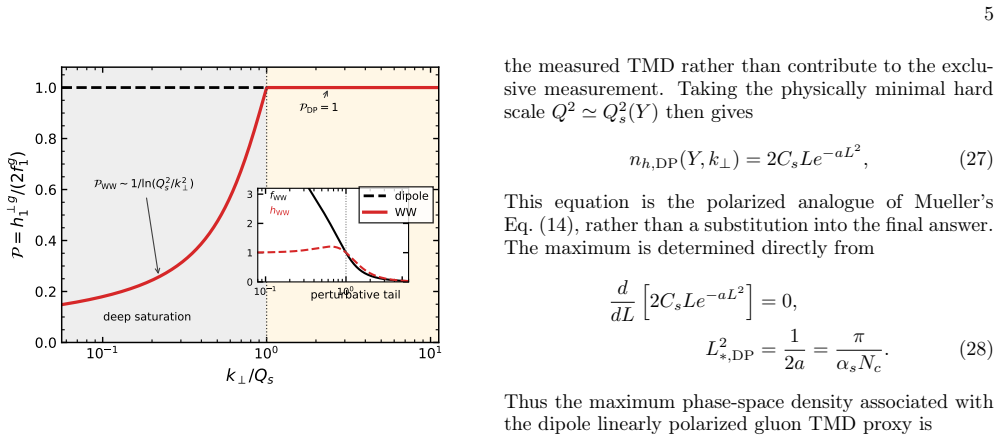
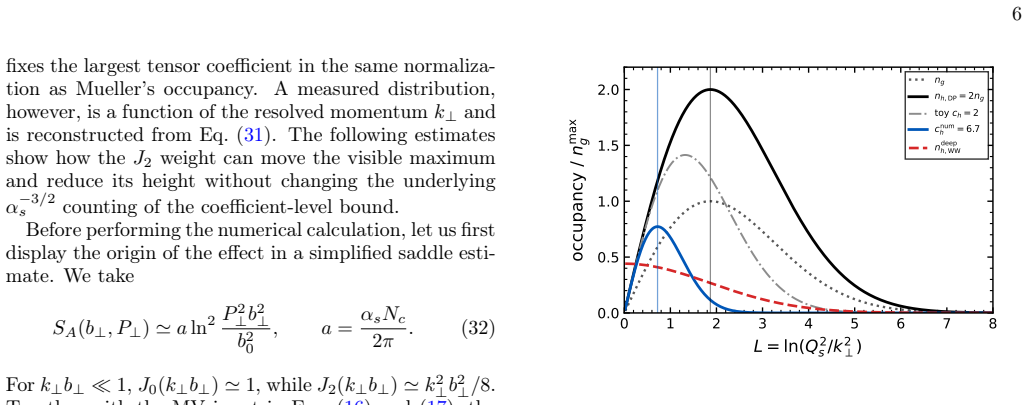
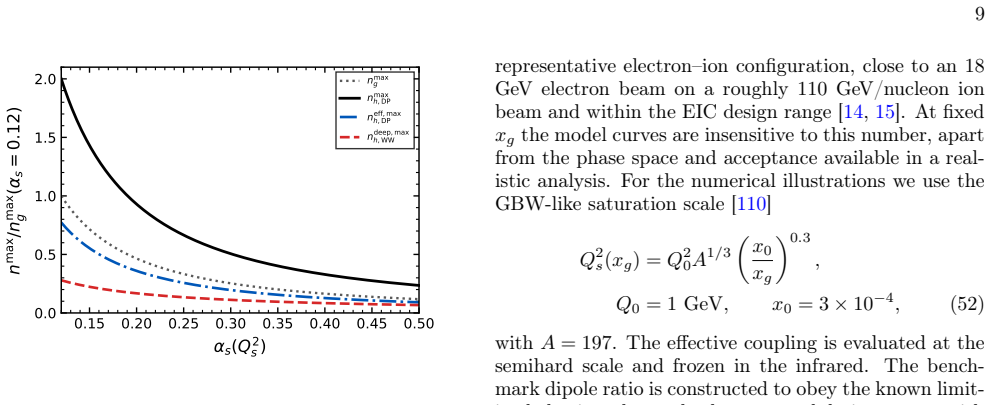
Using Mueller's occupancy argument together with the small-x Weizsacker-Williams and dipole gluon distributions, the maximum phase-space density n_h,DP^max equals 2 n_g^max and is approximately 2 alpha_s^{-3/2} for the dipole distribution in the same phase-space normalization. This dipole result is a process-dependent TMD proxy, not a literal gluon number density. For the WW distribution the deep-saturation tensor coefficient lacks the logarithmic enhancement needed for the Mueller saddle, so the maximum is pushed toward the saturation boundary.
What carries the argument
Mueller's occupancy argument applied to the linearly polarized gluon TMD coefficient h1^⊥g together with the small-x WW and dipole distributions of Metz and Zhou.
If this is right
- The dipole TMD proxy saturates at twice the unpolarized gluon maximum density.
- The WW distribution maximum is shifted to the saturation boundary because it lacks the required logarithmic enhancement.
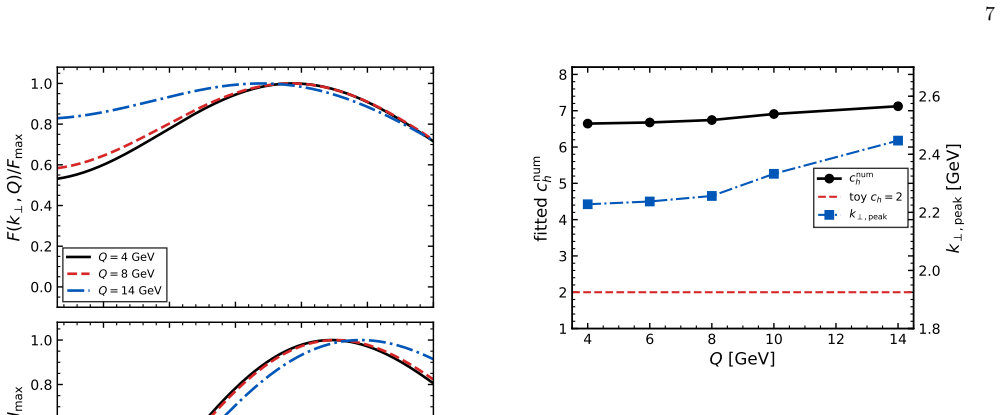
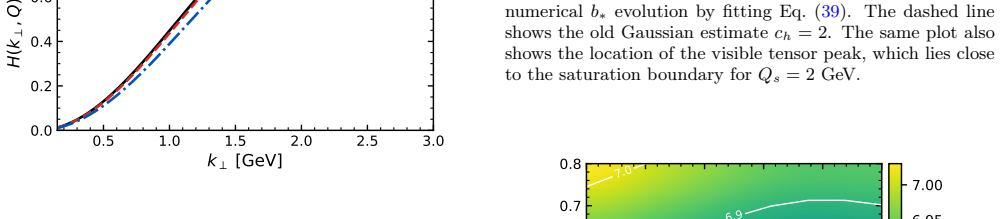
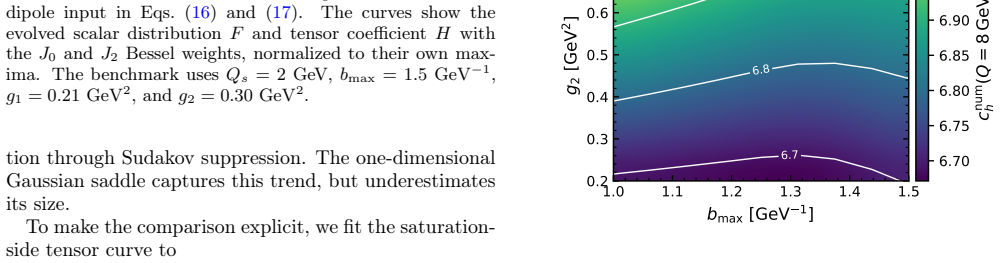
- Numerical Collins-Soper evolution with the J2 Bessel weight reduces the resolved peak height to c_h^num approximately 6.6 to 7.1 at representative EIC scales.
- The dipole result remains a process-dependent proxy rather than a literal number density.
Where Pith is reading between the lines
- Future collider data could distinguish whether different TMD observables saturate at different maximum densities.
- The factor-of-two enhancement may appear in other tensor TMD coefficients at small x if the same occupancy logic applies.
- Extending the argument beyond the dipole and WW cases could map out how polarization affects saturation limits across processes.
Load-bearing premise
Mueller's occupancy argument applies directly to the linearly polarized coefficient h1^⊥g when combined with the small-x WW and dipole gluon distributions.
What would settle it
A direct calculation or EIC measurement showing that the phase-space density of h1^⊥g does not reach twice the unpolarized gluon value inside the saturation region would falsify the central scaling result.
Figures
read the original abstract
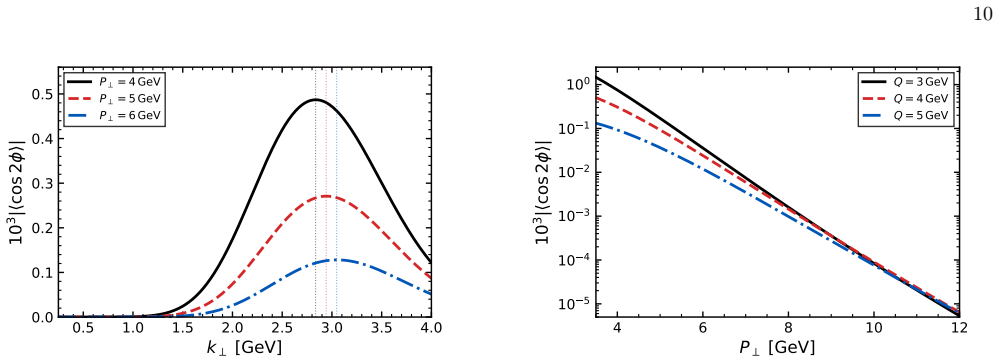
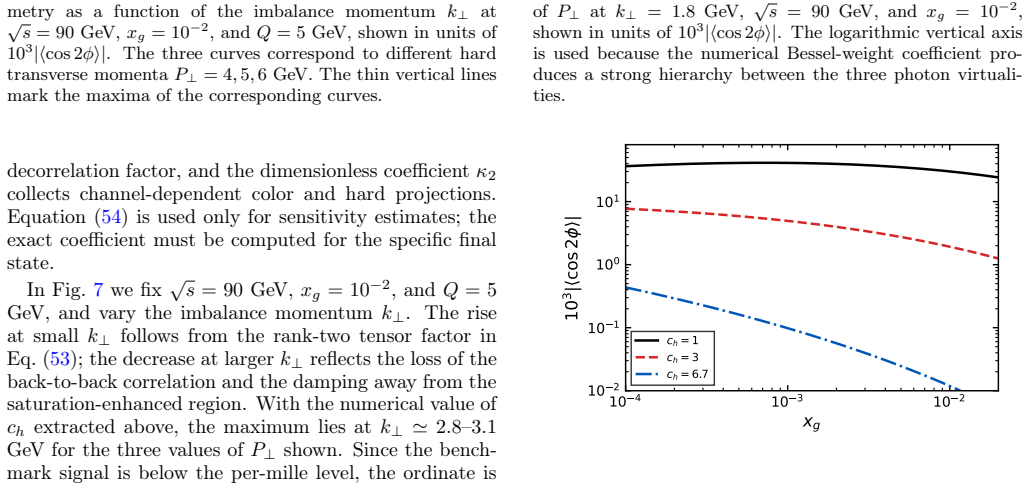
We calculate the Sudakov-limited maximum phase-space density associated with the linearly polarized gluon TMD coefficient $h_1^{\perp g}$ in the saturation region. Using Mueller's occupancy argument together with the small-$x$ Weizs\"acker-Williams (WW) and dipole gluon distributions of Metz and Zhou, we find $n_{h,{\rm DP}}^{\rm max}=2n_g^{\rm max}\sim2\alpha_s^{-3/2}$ for the dipole distribution in the same phase-space normalization. This dipole result is a process-dependent TMD proxy, not a literal gluon number density. For the WW distribution, the deep-saturation tensor coefficient lacks the logarithmic enhancement needed for the Mueller saddle, so the maximum is pushed toward the saturation boundary. We also perform a numerical Collins-Soper evolution study and find that the $J_2$ Bessel weight in the tensor TMD definition reduces the resolved peak, giving $c_h^{\rm num}\simeq6.6$--$7.1$ for representative EIC scales.
Editorial analysis
A structured set of objections, weighed in public.
Referee Report
Summary. The paper calculates the Sudakov-limited maximum phase-space density for the linearly polarized gluon TMD coefficient h_1^⊥g in the saturation region. Applying Mueller's occupancy argument to the small-x WW and dipole gluon distributions of Metz and Zhou, it reports n_{h,DP}^max = 2 n_g^max ∼ 2 α_s^{-3/2} for the dipole case (a process-dependent TMD proxy) while noting that the WW tensor coefficient lacks logarithmic enhancement and thus has its maximum pushed to the saturation boundary. A numerical Collins-Soper evolution study yields c_h^num ≃ 6.6–7.1 for representative EIC scales, with the J_2 Bessel weight reducing the resolved peak.
Significance. If the central extension of Mueller's argument holds, the work provides a concrete bound on the phase-space density of a polarized TMD in saturation, distinguishing WW and dipole cases and including a numerical evolution check. The explicit acknowledgment that the dipole result is a process-dependent proxy rather than a literal gluon density is a strength, as is the numerical Collins-Soper study that quantifies the effect of the J_2 weight.
major comments (2)
- [Abstract] Abstract (paragraph 2): the extension of Mueller's occupancy argument to the tensor coefficient h_1^⊥g is asserted without explicit demonstration that the saddle-point condition remains valid once the J_2-weighted definition and process-dependent normalization are inserted; the noted absence of log enhancement in the WW case already indicates that the saddle condition is distribution-dependent, so the factor-of-2 relation for the dipole case requires supporting algebra to establish it is not an artifact of the chosen proxy.
- [Abstract] Abstract (paragraph 2) and numerical study: the claim that the WW deep-saturation tensor coefficient lacks the logarithmic enhancement needed for the Mueller saddle is stated without visible derivation steps or error estimates against the paper's own equations; this directly affects whether the maximum is indeed pushed to the saturation boundary.
minor comments (1)
- The normalization convention for the phase-space density n_h should be stated explicitly when comparing the dipole and WW cases, as the process dependence is emphasized but the precise phase-space measure is not detailed in the abstract.
Simulated Author's Rebuttal
We thank the referee for the thorough review and valuable comments on our manuscript. We address each major comment below and will make revisions to improve the clarity of the derivations as suggested.
read point-by-point responses
-
Referee: [Abstract] Abstract (paragraph 2): the extension of Mueller's occupancy argument to the tensor coefficient h_1^⊥g is asserted without explicit demonstration that the saddle-point condition remains valid once the J_2-weighted definition and process-dependent normalization are inserted; the noted absence of log enhancement in the WW case already indicates that the saddle condition is distribution-dependent, so the factor-of-2 relation for the dipole case requires supporting algebra to establish it is not an artifact of the chosen proxy.
Authors: We agree that an explicit demonstration of the saddle-point condition for the J_2-weighted tensor coefficient is necessary to support the extension of Mueller's argument. In the revised manuscript, we will add the supporting algebra in the main text or an appendix, showing how the dipole distribution's form leads to the factor-of-2 relation while maintaining the saddle validity, and contrast it with the WW case to confirm it is not an artifact. revision: yes
-
Referee: [Abstract] Abstract (paragraph 2) and numerical study: the claim that the WW deep-saturation tensor coefficient lacks the logarithmic enhancement needed for the Mueller saddle is stated without visible derivation steps or error estimates against the paper's own equations; this directly affects whether the maximum is indeed pushed to the saturation boundary.
Authors: The claim follows directly from the functional forms of the WW and dipole distributions as defined in the paper. We will include explicit derivation steps comparing the tensor coefficients to the relevant equations, along with error estimates from the numerical Collins-Soper study, to substantiate that the maximum for WW is pushed to the saturation boundary. revision: yes
Circularity Check
No significant circularity detected
full rationale
The paper derives its central result n_{h,DP}^max=2n_g^max by applying Mueller's occupancy argument to the independent small-x WW and dipole distributions of Metz and Zhou, then supplements with a separate numerical Collins-Soper evolution study that produces c_h^num from evolution equations rather than any fit to the target maximum. No self-citations appear in the load-bearing steps, no parameter is fitted to a subset and renamed as a prediction, and no ansatz or uniqueness theorem is imported from the authors' own prior work. The derivation therefore remains self-contained against external benchmarks and does not reduce to its inputs by construction.
Axiom & Free-Parameter Ledger
axioms (2)
- domain assumption Mueller's occupancy argument applies to the linearly polarized gluon TMD coefficient h1^⊥g in the saturation region
- domain assumption The small-x Weizsacker-Williams and dipole gluon distributions of Metz and Zhou are valid inputs in the saturation regime
Reference graph
Works this paper leans on
-
[1]
L. D. McLerran and R. Venugopalan,Computing quark and gluon distribution functions for very large nuclei, Phys. Rev. D49, 2233 (1994), arXiv:hep-ph/9309289
work page internal anchor Pith review Pith/arXiv arXiv 1994
- [2]
-
[3]
L. D. McLerran and R. Venugopalan,Green’s functions in the color field of a large nucleus, Phys. Rev. D50, 2225 (1994), arXiv:hep-ph/9402335
work page internal anchor Pith review Pith/arXiv arXiv 1994
-
[4]
Nonlinear Gluon Evolution in the Color Glass Condensate: I
E. Iancu, A. Leonidov, and L. D. McLerran,The Color Glass Condensate: An effective theory for high-energy scattering in QCD, Nucl. Phys. A692, 583 (2001), arXiv:hep-ph/0011241
work page internal anchor Pith review Pith/arXiv arXiv 2001
-
[5]
The Color Glass Condensate and High Energy Scattering in QCD
E. Iancu and R. Venugopalan,The Color Glass Conden- sate and high energy scattering in QCD, inQuark Gluon Plasma 3, edited by R. C. Hwa and X.-N. Wang (World Scientific, Singapore, 2004), arXiv:hep-ph/0303204
work page internal anchor Pith review Pith/arXiv arXiv 2004
-
[6]
F. Gelis, E. Iancu, J. Jalilian-Marian, and R. Venu- gopalan,The Color Glass Condensate, Ann. Rev. Nucl. Part. Sci.60, 463 (2010), arXiv:1002.0333
work page internal anchor Pith review Pith/arXiv arXiv 2010
-
[7]
J. Jalilian-Marian and Y. V. Kovchegov,Satura- tion physics and deuteron-gold collisions at RHIC, Prog. Part. Nucl. Phys.56, 104 (2006), arXiv:hep- ph/0505052
-
[8]
Balitsky,Operator expansion for high-energy scat- tering, Nucl
I. Balitsky,Operator expansion for high-energy scat- tering, Nucl. Phys. B463, 99 (1996), arXiv:hep- ph/9509348
-
[9]
Y. V. Kovchegov,Small-x F2 structure function of a nu- cleus including multiple pomeron exchanges, Phys. Rev. D60, 034008 (1999), arXiv:hep-ph/9901281
work page internal anchor Pith review Pith/arXiv arXiv 1999
-
[10]
The Intrinsic Glue Distribution at Very Small x
J. Jalilian-Marian, A. Kovner, L. D. McLerran, and H. Weigert,The intrinsic glue distribution at very small x, Phys.Rev.D55, 5414(1997), arXiv:hep-ph/9606337
work page internal anchor Pith review Pith/arXiv arXiv 1997
-
[11]
Rapidity evolution of gluon TMD from low to moderate x
I. Balitsky and A. Tarasov,Rapidity evolution of gluon TMD from low to moderatex, JHEP10, 017 (2015), arXiv:1505.02151
work page internal anchor Pith review Pith/arXiv arXiv 2015
-
[12]
Bottom-up thermalization in heavy ion collisions
R. Baier, A. H. Mueller, D. Schiff, and D. T. Son, Bottom-up thermalization in heavy ion collisions, Phys. Lett. B502, 51 (2001), arXiv:hep-ph/0009237
work page internal anchor Pith review Pith/arXiv arXiv 2001
-
[13]
Isotropization and hydrodynamization in weakly coupled heavy-ion collisions
A. Kurkela and Y. Zhu,Isotropization and hydrody- namization in weakly coupled heavy-ion collisions, Phys. Rev. Lett.115, 182301 (2015), arXiv:1506.06647
work page internal anchor Pith review Pith/arXiv arXiv 2015
-
[14]
Electron Ion Collider: The Next QCD Frontier - Understanding the glue that binds us all
A. Accardiet al.,Electron ion collider: The next QCD frontier, Eur. Phys. J. A52, 268 (2016), arXiv:1212.1701
work page internal anchor Pith review Pith/arXiv arXiv 2016
-
[15]
Science Requirements and Detector Concepts for the Electron-Ion Collider: EIC Yellow Report
R. Abdul Khaleket al.,Science requirements and detector concepts for the Electron-Ion Collider: EIC Yellow Report, Nucl. Phys. A1026, 122447 (2022), arXiv:2103.05419
work page internal anchor Pith review Pith/arXiv arXiv 2022
-
[16]
Gluons and the quark sea at high energies: distributions, polarization, tomography
D. Boeret al.,Gluons and the quark sea at high energies: Distributions, polarization, tomography, arXiv:1108.1713
work page internal anchor Pith review Pith/arXiv arXiv
-
[17]
M. Anselminoet al.,Transverse momentum depen- dent distribution and fragmentation functions at an Electron-Ion Collider, Eur. Phys. J. A47, 35 (2011), arXiv:1101.4199
work page internal anchor Pith review Pith/arXiv arXiv 2011
- [18]
- [20]
-
[21]
Photon production in high energy proton-nucleus collisions
F. Gelis and J. Jalilian-Marian,Photon production in high energy proton nucleus collisions, Phys. Rev. D66, 014021 (2002), arXiv:hep-ph/0205037
work page internal anchor Pith review Pith/arXiv arXiv 2002
-
[22]
Scattering of Gluons from the Color Glass Condensate
A. Dumitru and J. Jalilian-Marian,Forward quark jets from protons shattering the colored glass, Phys. Lett. B 547, 15 (2002), arXiv:hep-ph/0111357
work page internal anchor Pith review Pith/arXiv arXiv 2002
-
[23]
Forward Quark Jets from Protons Shattering the Colored Glass
A. Dumitru and J. Jalilian-Marian,Scattering of gluons from the color glass condensate, Phys. Rev. Lett.89, 022301 (2002), arXiv:hep-ph/0204028
work page internal anchor Pith review Pith/arXiv arXiv 2002
-
[24]
A. Bacchetta, D. Boer, C. Pisano, and P. Taels, Gluon TMDs and NRQCD matrix elements inJ/ψpro- duction at an EIC, Eur. Phys. J. C80, 72 (2020), arXiv:1809.02056
-
[25]
T. Altinoluk, C. Marquet, and P. Taels,Low-ximproved TMD approach to dihadron production in DIS, JHEP 06, 085 (2021), arXiv:2103.14495
-
[26]
R. Boussarie, H. Mantysaari, F. Salazar, and B. Schenke,The importance of kinematic twists and genuine saturation effects in dijet production at the Electron-Ion Collider, JHEP09, 178 (2021), arXiv:2106.11301
-
[27]
A. Dumitru, V. Skokov, and T. Ullrich,Measuring the Weizsäcker-Williams distribution of linearly polar- ized gluons at an electron-ion collider through dijet az- imuthal asymmetries, Phys. Rev. C99, 015204 (2019), arXiv:1809.02615
work page internal anchor Pith review Pith/arXiv arXiv 2019
-
[28]
Y. Hatta, B.-W. Xiao, F. Yuan, and J. Zhou,Anisotropy in dijet production in exclusive and inclusive processes, Phys. Rev. Lett.126, 142001 (2021), arXiv:2010.10774
-
[29]
Y. Hatta, B.-W. Xiao, F. Yuan, and J. Zhou,Az- imuthal angular asymmetry of soft gluon radiation in jet production, Phys. Rev. D104, 054037 (2021), arXiv:2106.05307
-
[30]
A. van Hameren, P. Kotko, K. Kutak, and S. Sapeta, Sudakov effects in forward-forward dijet production in high energy factorization, arXiv:2106.13964
-
[31]
X. Tong, B.-W. Xiao, and Y.-Y. Zhang,Harmonics of saturation and EIC dijet azimuthal correlations, Phys. Rev. Lett.130, 151902 (2023), arXiv:2211.01647
-
[32]
C. Zhang, Q.-S. Dai, and D. Y. Shao,Azimuthal decor- relation for photon induced dijet production in ultra- peripheral collisions of heavy ions, JHEP02, 002(2023), arXiv:2211.07071
- [33]
- [34]
- [35]
-
[36]
Relations between generalized and transverse momentum dependent parton distributions
S. Meissner, A. Metz, and K. Goeke,Relations be- tween generalized and transverse momentum dependent parton distributions, Phys. Rev. D76, 034002 (2007), 15 arXiv:hep-ph/0703176
work page internal anchor Pith review Pith/arXiv arXiv 2007
-
[37]
P. J. Mulders and R. D. Tangerman,The complete tree-level result up to order1/Qfor polarized deep- inelastic leptoproduction, Nucl. Phys. B461, 197 (1996), arXiv:hep-ph/9510301
work page internal anchor Pith review Pith/arXiv arXiv 1996
-
[38]
Semi-inclusive deep inelastic scattering at small transverse momentum
A. Bacchetta, M. Diehl, K. Goeke, A. Metz, P. J. Mul- ders, andM.Schlegel,Semi-inclusive deep inelastic scat- tering at small transverse momentum, JHEP02, 093 (2007), arXiv:hep-ph/0611265
work page internal anchor Pith review Pith/arXiv arXiv 2007
-
[39]
M. G. Buffing, A. Mukherjee, and P. J. Mulders, Generalized universality of higher transverse moments of quark TMD correlators, Phys. Rev. D86, 074030 (2012), arXiv:1207.3221
work page internal anchor Pith review Pith/arXiv arXiv 2012
-
[40]
Time-reversal odd distribution functions in leptoproduction
D. Boer and P. J. Mulders,Time-reversal odd distri- bution functions in leptoproduction, Phys. Rev. D57, 5780 (1998), arXiv:hep-ph/9711485
work page internal anchor Pith review Pith/arXiv arXiv 1998
-
[41]
D. Boer, P. J. Mulders, and C. Pisano,Dijet imbalance in hadronic collisions, Phys. Rev. D80, 094017 (2009), arXiv:0909.4652
work page internal anchor Pith review Pith/arXiv arXiv 2009
-
[42]
D. Boer, S. J. Brodsky, P. J. Mulders, and C. Pisano, Direct probes of linearly polarized gluons inside unpo- larized hadrons, Phys. Rev. Lett.106, 132001 (2011), arXiv:1011.4225
work page internal anchor Pith review Pith/arXiv arXiv 2011
-
[43]
J.-W. Qiu, M. Schlegel, and W. Vogelsang,Probing glu- onic spin-orbit correlations in photon pair production, Phys. Rev. Lett.107, 062001 (2011), arXiv:1103.3861
work page internal anchor Pith review Pith/arXiv arXiv 2011
-
[44]
Linear polarization of gluons and photons in unpolarized collider experiments
C. Pisano, D. Boer, S. J. Brodsky, M. G. A. Buffing, and P. J. Mulders,Linear polarization of gluons and photons in unpolarized collider experiments, JHEP10, 024 (2013), arXiv:1307.3417
work page internal anchor Pith review Pith/arXiv arXiv 2013
-
[45]
Polarized gluon studies with charmonium and bottomonium at LHCb and AFTER
D. Boer and C. Pisano,Polarized gluon studies with charmonium and bottomonium at LHCb and AFTER, Phys. Rev. D86, 094007 (2012), arXiv:1208.3642
work page internal anchor Pith review Pith/arXiv arXiv 2012
-
[46]
W. J. den Dunnen, J.-P. Lansberg, C. Pisano, and M. Schlegel,Accessing the transverse dynamics and po- larization of gluons inside the proton at the LHC, Phys. Rev. Lett.112, 212001 (2014), arXiv:1401.7611
work page internal anchor Pith review Pith/arXiv arXiv 2014
-
[47]
M. G. Echevarria, T. Kasemets, P. J. Mulders, and C. Pisano,QCD evolution of the linearly polarized gluon distribution and Higgs boson production, JHEP07, 158 (2015), arXiv:1502.05354
work page internal anchor Pith review Pith/arXiv arXiv 2015
-
[48]
D. Boer, W. J. den Dunnen, C. Pisano, M. Schlegel, and W. Vogelsang,Linearly polarized gluons and the Higgs transverse momentum distribution, Phys. Rev. Lett.108, 032002 (2012), arXiv:1109.1444
work page internal anchor Pith review Pith/arXiv arXiv 2012
-
[49]
J. Wang, C. S. Li, Z. Li, C.-P. Yuan, and H. T. Li,Soft gluon resummation for Higgs boson plus jet production at hadron colliders, Phys. Rev. D86, 094026 (2012), arXiv:1205.4311
work page internal anchor Pith review Pith/arXiv arXiv 2012
-
[50]
D. Boer, W. J. den Dunnen, C. Pisano, and M. Schlegel, Determining the Higgs spin and parity in the diphoton decay channel, Phys. Rev. Lett.111, 032002 (2013), arXiv:1304.2654
work page internal anchor Pith review Pith/arXiv arXiv 2013
-
[51]
TMD evolution and the Higgs transverse momentum distribution
D. Boer and W. J. den Dunnen,TMD evolution and the Higgs transverse momentum distribution, Nucl. Phys. B 886, 421 (2014), arXiv:1404.6753
work page internal anchor Pith review Pith/arXiv arXiv 2014
-
[52]
Universality of transverse-momentum resummation and hard factors at the NNLO
S. Catani, L. Cieri, D. de Florian, G. Ferrera, and M. Grazzini,Vector boson production at hadron collid- ers: Transverse-momentum resummation and leptonic decay, Nucl. Phys. B881, 414 (2014), arXiv:1311.1654
work page internal anchor Pith review Pith/arXiv arXiv 2014
-
[53]
J.-P. Ma, J. X. Wang, and S. Zhao,Transverse momen- tum dependent factorization for quarkonium production at low transverse momentum, Phys. Rev. D88, 014027 (2013), arXiv:1211.7144
work page internal anchor Pith review Pith/arXiv arXiv 2013
-
[54]
G.-P. Zhang,Probing transverse momentum depen- dent gluon distribution functions from hadronic quarko- nium pair production, Phys. Rev. D90, 094011 (2014), arXiv:1406.5476
work page internal anchor Pith review Pith/arXiv arXiv 2014
-
[55]
QCD Factorization for Quarkonium Production in Hadron Collions at Low Transverse Momentum
J.-P. Ma and C. Wang,QCD factorization for quarko- nium production in hadron collisions at low trans- verse momentum, Phys. Rev. D93, 014025 (2016), arXiv:1509.04421
work page internal anchor Pith review Pith/arXiv arXiv 2016
-
[56]
D. Boer, P. J. Mulders, C. Pisano, and J. Zhou,Asym- metries in heavy quark pair and dijet production at an EIC, JHEP08, 001 (2016), arXiv:1605.07934
work page internal anchor Pith review Pith/arXiv arXiv 2016
-
[57]
Linearly-polarized small-x gluons in forward heavy-quark pair production
C. Marquet, C. Roiesnel, and P. Taels,Linearly polar- ized small-xgluons in forward heavy-quark pair produc- tion, Phys.Rev.D97, 014004(2018), arXiv:1710.05698
work page internal anchor Pith review Pith/arXiv arXiv 2018
-
[58]
Accessing Linearly Polarized Gluon Distribution in $J/\psi$ Production at the Electron-Ion Collider
R. Kishore and A. Mukherjee,Accessing linearly po- larized gluon distribution inJ/ψproduction at the Electron-Ion Collider, Phys. Rev. D99, 054012 (2019), arXiv:1811.07495
work page internal anchor Pith review Pith/arXiv arXiv 2019
- [59]
-
[60]
C. Li, J. Zhou, and Y.-j. Zhou,Probing the linear polar- ization of photons in ultraperipheral heavy ion collisions, Phys. Lett. B795, 576 (2019), arXiv:1903.10084
work page internal anchor Pith review Pith/arXiv arXiv 2019
- [61]
- [62]
-
[63]
R. Kishore, A. Mukherjee, and M. Siddiqah,cos(2ϕh) asymmetry inJ/ψproduction in unpolarizedepcollision in NRQCD, arXiv:2107.01821
-
[64]
R. Kishore, A. Mukherjee, A. Pawar, and M. Siddiqah, cos 2φt azimuthal asymmetry in back-to-backJ/ψ-jet production at the EIC,Phys.Rev.D106, 034009(2022), arXiv:2203.13516
- [65]
-
[66]
D. Chakrabarti, R. Kishore, A. Mukherjee, and S. Ra- jesh,Azimuthal asymmetries inJ/ψ-photon produc- tion at the EIC, Phys. Rev. D107, 014008 (2023), arXiv:2211.08709
- [67]
- [68]
-
[69]
R. Kishore, A. Mukherjee, A. Pawar, S. Rajesh, and M. Siddiqah,TMD evolution effect oncos 2ϕazimuthal asymmetry in a back-to-back production ofJ/ψand a jet at the EIC, Phys. Rev. D111, 014003 (2025), arXiv:2408.05698
-
[70]
C. Marquet, Y. Shi, and B.-W. Xiao,Azimuthal angu- lar correlations of forward dihadron production in high energy collisions, arXiv:2510.18949. 16
-
[71]
Y. Gao, C. Marquet, Y. Shi, and B.-W. Xiao,Heavy me- son pair correlations in forward pA collisions: Sudakov resummation meets saturation, arXiv:2605.01527
work page internal anchor Pith review Pith/arXiv arXiv
-
[72]
On the elliptic flow of heavy quarkonia in $pA$ collisions
C. Zhang, C. Marquet, G.-Y. Qin, Y. Shi, L. Wang, S.- Y. Wei, B.-W. Xiao, and J. Zhou,Collectivity of heavy mesons in proton-nucleus collisions, Phys. Rev. Lett. 122, 172302 (2019), arXiv:1901.10320
work page internal anchor Pith review Pith/arXiv arXiv 2019
-
[73]
Universality of Unintegrated Gluon Distributions at small x
F. Dominguez, C. Marquet, B.-W. Xiao, and F. Yuan, Universality of unintegrated gluon distributions at small x, Phys. Rev. D83, 105005 (2011), arXiv:1101.0715
work page internal anchor Pith review Pith/arXiv arXiv 2011
-
[74]
Distribution of linearly polarized gluons inside a large nucleus
A. Metz and J. Zhou,Distribution of linearly polar- ized gluons inside a large nucleus, Phys. Rev. D84, 051503(R) (2011), arXiv:1105.1991
work page internal anchor Pith review Pith/arXiv arXiv 2011
-
[75]
Y. V. Kovchegov,Non-Abelian Weizsäcker-Williams field and a two-dimensional effective color charge den- sity for a very large nucleus, Phys. Rev. D54, 5463 (1996), arXiv:hep-ph/9605446
work page internal anchor Pith review Pith/arXiv arXiv 1996
-
[76]
B.-W. Xiao, F. Yuan, and J. Zhou,Transverse momen- tum dependent parton distributions at smallx, Nucl. Phys. B921, 104 (2017), arXiv:1703.06163
work page internal anchor Pith review Pith/arXiv arXiv 2017
-
[77]
On the linearly polarized gluon distributions in the color dipole model
F. Dominguez, J.-W. Qiu, B.-W. Xiao, and F. Yuan, On the linearly polarized gluon distributions in the color dipole model, Phys. Rev. D85, 045003 (2012), arXiv:1109.6293
work page internal anchor Pith review Pith/arXiv arXiv 2012
-
[78]
D. Boer, S. Cotogno, T. van Daal, P. J. Mulders, A. Signori, and Y.-J. Zhou,Gluon and Wilson loop TMDs for hadrons of spin≤1, JHEP10, 013 (2016), arXiv:1607.01654
work page internal anchor Pith review Pith/arXiv arXiv 2016
-
[79]
The elliptic gluon GTMD inside a large nucleus
J. Zhou,Elliptic gluon generalized transverse- momentum-dependent distribution inside a large nucleus, Phys. Rev. D94, 114017 (2016), arXiv:1611.02397
work page internal anchor Pith review Pith/arXiv arXiv 2016
-
[80]
Elliptic flow from color-dipole orientation in pp and pA collisions
E. Iancu and A. H. Rezaeian,Elliptic flow from color- dipole orientation in pp and pA collisions, Phys. Rev. D95, 094003 (2017), arXiv:1702.03943
work page internal anchor Pith review Pith/arXiv arXiv 2017
-
[81]
D. Boer, P. J. Mulders, J. Zhou, and Y.-j. Zhou,Sup- pression of maximal linear gluon polarization in an- gular asymmetries, Phys. Rev. D101, 096014 (2020), arXiv:1702.08195
work page internal anchor Pith review Pith/arXiv arXiv 2020
discussion (0)
Sign in with ORCID, Apple, or X to comment. Anyone can read and Pith papers without signing in.