Graph-based emulation of d-dimensional curved spaces with superconducting arrays
Pith reviewed 2026-06-29 09:11 UTC · model grok-4.3
The pith
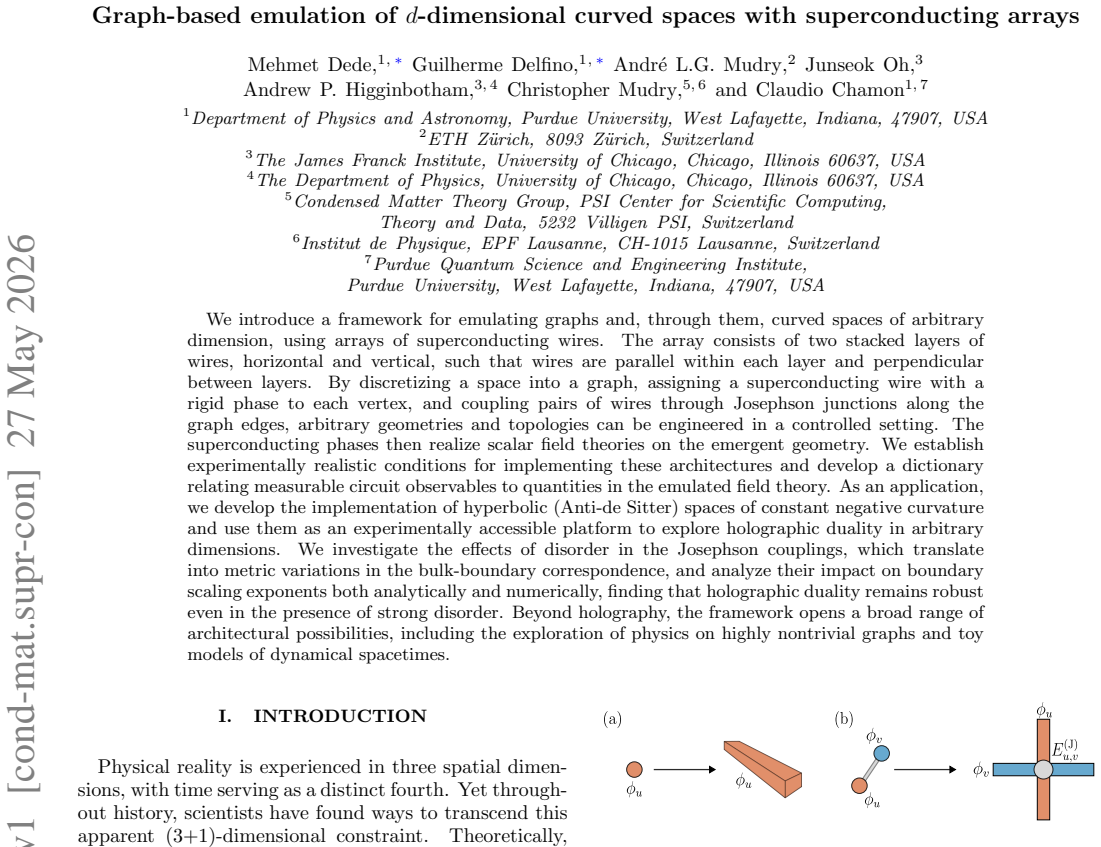
Superconducting wire arrays emulate d-dimensional curved spaces by mapping graphs to Josephson-coupled phases that realize scalar field theories.
A machine-rendered reading of the paper's core claim, the machinery that carries it, and where it could break.
Core claim
Two-layer superconducting wire arrays with Josephson junctions at graph edges discretize arbitrary d-dimensional geometries; the phases on the wires then furnish scalar field theories on those geometries, and holographic duality in Anti-de Sitter space stays intact under strong disorder in the couplings.
What carries the argument
The two-layer wire array with rigid-phase wires at vertices and Josephson junctions on graph edges, which directly realizes the scalar field on the emergent curved geometry.
If this is right
- Circuit observables become direct proxies for field-theory quantities via the supplied dictionary.
- Holographic duality in any dimension can be studied in a controlled laboratory setting.
- Metric fluctuations induced by disordered couplings leave boundary scaling exponents unchanged.
- The same architecture can host physics on arbitrary nontrivial graphs and simple dynamical spacetimes.
Where Pith is reading between the lines
- The platform could let experimenters scan curvature and dimension continuously by rewiring the junction network.
- Adding tunable time-dependent couplings might allow laboratory analogs of evolving geometries.
- Coupling the array to existing superconducting qubit readouts could give direct access to entanglement measures on the boundary.
Load-bearing premise
The superconducting phases stay rigid and the Josephson couplings dominate over parasitic effects, so the circuit really reproduces the target field theory on the graph geometry.
What would settle it
Measurement of boundary two-point functions that deviate from the expected holographic power-law scaling once Josephson coupling disorder exceeds a moderate threshold would falsify the robustness claim.
Figures

read the original abstract
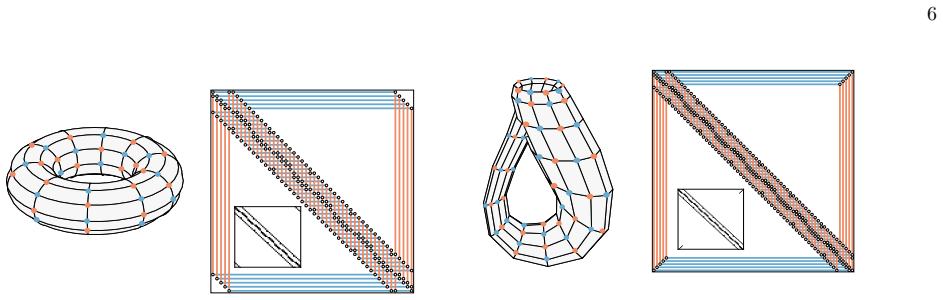
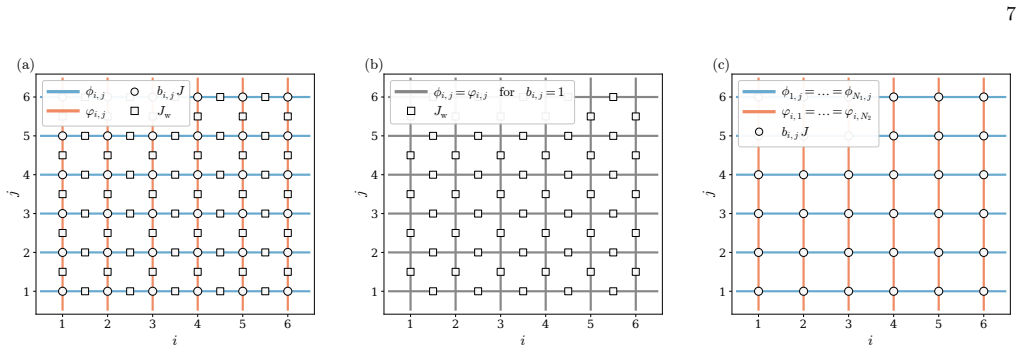
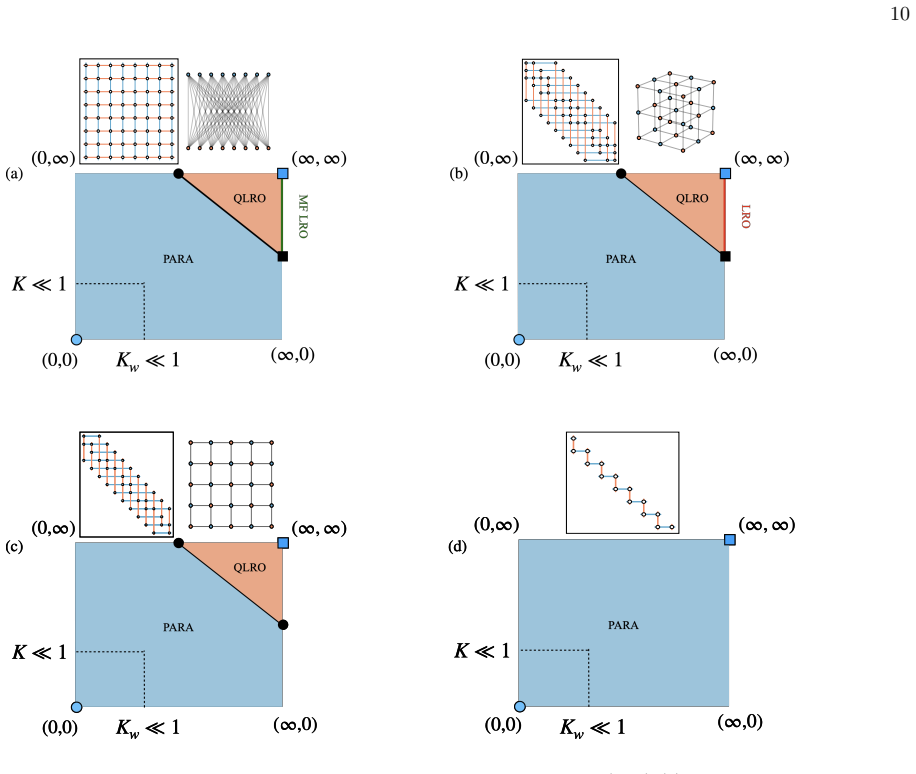
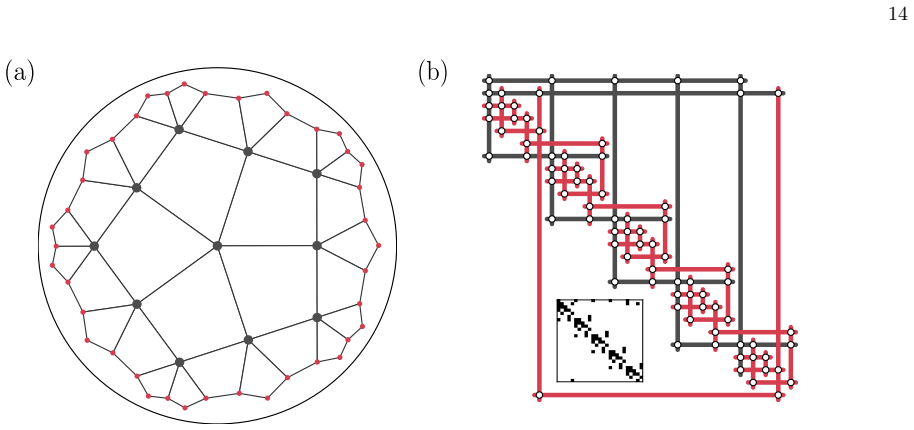
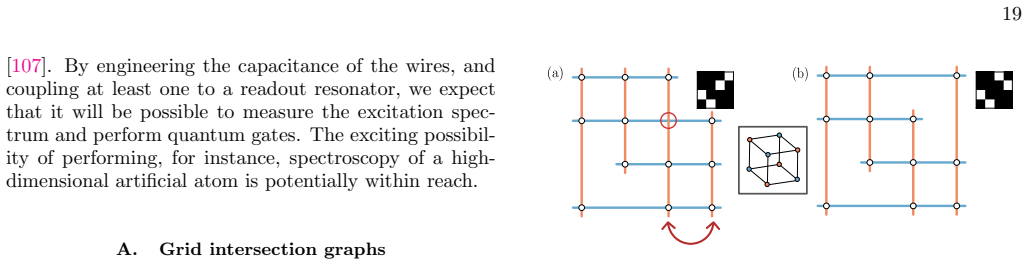
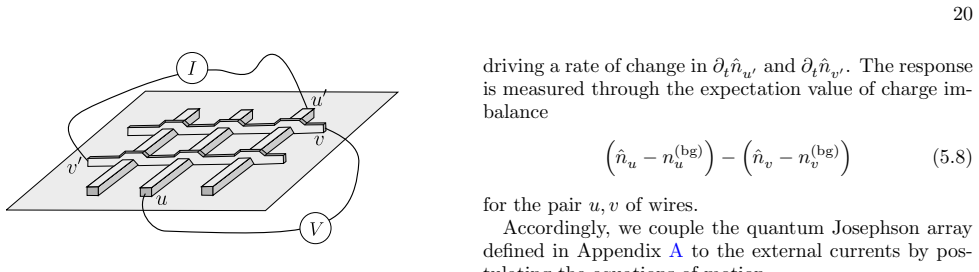
We introduce a framework for emulating graphs and, through them, curved spaces of arbitrary dimension, using arrays of superconducting wires. The array consists of two stacked layers of wires, horizontal and vertical, such that wires are parallel within each layer and perpendicular between layers. By discretizing a space into a graph, assigning a superconducting wire with a rigid phase to each vertex, and coupling pairs of wires through Josephson junctions according to the graph edges, arbitrary geometries and topologies can be engineered in a controlled setting. The superconducting phases then realize scalar field theories on the emergent geometry. We establish experimentally realistic conditions for implementing these architectures and develop a dictionary relating measurable circuit observables to quantities in the emulated field theory. As an application, we develop the implementation of hyperbolic (Anti-de Sitter) spaces of constant negative curvature and use them as an experimentally accessible platform to explore holographic duality in arbitrary dimensions. We investigate the effects of disorder in the Josephson couplings, which translate into metric variations in the bulk-boundary correspondence, and analyze their impact on boundary scaling exponents both analytically and numerically, finding that holographic duality remains robust even in the presence of strong disorder. Beyond holography, the framework opens a broad range of architectural possibilities, including the exploration of physics on highly nontrivial graphs and toy models of dynamical spacetimes.
Editorial analysis
A structured set of objections, weighed in public.
Referee Report
Summary. The paper introduces a framework for emulating graphs and d-dimensional curved spaces (including AdS) via stacked layers of superconducting wires coupled by Josephson junctions according to graph edges, with wire phases realizing scalar field theories on the emergent geometry. It claims to derive experimentally realistic conditions, a dictionary mapping circuit observables to field-theory quantities, and to show analytically and numerically that holographic duality remains robust under strong disorder in the Josephson couplings (which induce metric variations).
Significance. If the emulation mapping and dictionary are rigorously established, the work would provide a controllable experimental platform for scalar fields on nontrivial geometries and for testing holographic duality in arbitrary dimensions, including under disorder. The graph-based discretization approach and explicit treatment of disorder effects are strengths that could enable new toy models of dynamical spacetimes.
major comments (3)
- [Framework description] Framework section (abstract and main text description): the central claim that assigning rigid-phase wires to vertices and Josephson junctions to edges realizes the desired discrete scalar field theory on the emergent geometry rests on an unshown reduction of the circuit Hamiltonian; no explicit derivation or error analysis is supplied showing that parasitic effects (self-inductance, shunt capacitance, quasiparticle tunneling, phase slips) remain subdominant to the tunable Josephson energies for the disorder strengths considered.
- [Holographic application] Holographic duality application (abstract): the statement that duality remains robust to strong disorder is load-bearing for the main result, yet the manuscript supplies neither the analytical expressions for boundary scaling exponents nor the numerical data/figures demonstrating robustness; this absence prevents assessment of the quantitative impact of metric variations.
- [Dictionary relating observables] Dictionary construction: the mapping from measurable circuit observables (e.g., currents, voltages) to field-theory quantities is asserted but not constructed explicitly with equations relating Josephson energies, phases, and correlation functions; without this, the claim of experimental accessibility cannot be evaluated.
minor comments (2)
- [Framework] Notation for the graph Laplacian and weighted edges should be defined consistently when relating the Josephson cosine potential to the discrete action.
- [Abstract] The abstract mentions 'arbitrary dimension' but the concrete implementation focuses on hyperbolic spaces; a brief statement on the dimensional limitation would improve clarity.
Simulated Author's Rebuttal
We thank the referee for their careful reading and constructive comments, which help clarify the presentation of our framework. We address each major comment below and indicate the revisions we will implement.
read point-by-point responses
-
Referee: [Framework description] Framework section (abstract and main text description): the central claim that assigning rigid-phase wires to vertices and Josephson junctions to edges realizes the desired discrete scalar field theory on the emergent geometry rests on an unshown reduction of the circuit Hamiltonian; no explicit derivation or error analysis is supplied showing that parasitic effects (self-inductance, shunt capacitance, quasiparticle tunneling, phase slips) remain subdominant to the tunable Josephson energies for the disorder strengths considered.
Authors: We agree that an explicit derivation of the effective scalar-field Hamiltonian from the full circuit model, together with a quantitative error analysis for parasitic effects, would strengthen the manuscript. In the revised version we will add a dedicated subsection (or appendix) containing the step-by-step reduction of the circuit Hamiltonian and order-of-magnitude estimates demonstrating that self-inductance, shunt capacitance, quasiparticle tunneling and phase slips remain subdominant for the experimentally realistic Josephson energies and disorder strengths considered. revision: yes
-
Referee: [Holographic application] Holographic duality application (abstract): the statement that duality remains robust to strong disorder is load-bearing for the main result, yet the manuscript supplies neither the analytical expressions for boundary scaling exponents nor the numerical data/figures demonstrating robustness; this absence prevents assessment of the quantitative impact of metric variations.
Authors: We acknowledge that the explicit analytical expressions for the boundary scaling exponents and the supporting numerical data were not presented with sufficient clarity or prominence. In the revision we will insert the closed-form expressions for the scaling exponents, add a dedicated paragraph summarizing the analytical robustness argument, and include (or augment) numerical figures that directly compare scaling exponents across a range of disorder strengths, thereby allowing quantitative evaluation of the effect of metric variations. revision: yes
-
Referee: [Dictionary relating observables] Dictionary construction: the mapping from measurable circuit observables (e.g., currents, voltages) to field-theory quantities is asserted but not constructed explicitly with equations relating Josephson energies, phases, and correlation functions; without this, the claim of experimental accessibility cannot be evaluated.
Authors: We agree that the dictionary mapping must be made fully explicit. We will revise the manuscript to include a new subsection that supplies the concrete equations relating measurable quantities (Josephson energies, phase differences, currents and voltages) to the correlation functions and other observables of the emulated scalar field theory, thereby making the experimental accessibility claim directly verifiable. revision: yes
Circularity Check
No circularity in derivation; framework rests on independent JJ physics and graph discretization.
full rationale
The paper introduces an emulation framework by assigning rigid-phase wires to graph vertices and Josephson junctions to edges to realize scalar fields on emergent geometries, then applies it to AdS holography with disorder analysis. No quoted steps reduce a claimed prediction or result to a fitted parameter, self-definition, or self-citation chain by construction. The dictionary to observables and robustness findings are presented as consequences of the circuit-to-field mapping under stated conditions, without tautological equivalence to inputs. This is the common case of a self-contained proposal grounded in standard circuit QED.
Axiom & Free-Parameter Ledger
axioms (1)
- domain assumption Superconducting phases remain rigid and Josephson couplings realize the desired graph edges to emulate scalar fields on the geometry.
Forward citations
Cited by 2 Pith papers
-
Magnetic long-range order at finite temperature in two-dimensional hyperbolic lattices
Spin-wave theory on hyperbolic lattices shows Goldstone modes have vanishing local weight and a bulk gap, allowing finite-temperature magnetic order that evades the Mermin-Wagner theorem.
-
Experimental observation of hyperbolic spacetime dynamics
First experimental emulation of fermionic wave packet dynamics in Lorentzian AdS2 spacetime using photonic waveguide arrays, showing mass-independent geodesic oscillations and curvature-dependent Zitterbewegung.
Reference graph
Works this paper leans on
-
[1]
We also added mass regulators
Proof of the upper bound (3.7) We consider the energy (3.3e) in the spin-wave approx- imation, i.e., we expand the arguments of the cosine of the classical ferromagnetic XY model to second order in its argument, EΛ,G(J) := J 2 N1X i=1 N2X j=1 bi,j ϕi,j −φ i,j 2 + Jw 2 N1X i=1 N2X j=1 ϕi,j −ϕ i+1,j 2 + Jw 2 N1X i=1 N2X j=1 φi,j −φ i,j+1 2 + m2 2 N1X i=1 N2...
-
[2]
Proof of the upper bound (3.9) To put an estimate for the right-hand side of the in- equality (3.7a), we use the spin-wave approximation as in Sec. B 1. Expanding the arguments of the cosine of the classical ferromagnetic nearest-neighborXYmodel along a chain made ofMsites yields the partition function Zhar M (Kw) := MY j=1 Z R dθj e − Kw 2 MP j=1...
-
[3]
Josephson plasma en- ergy
Proof of the upper bound (3.11) Equation (3.11) follows from replacing in the partition function (B7a) the linear chain by a square lattice with lattice spacingaand cardinalityN 1N2. We can also understand Eq. (3.11) at the level of the approximation by which we replace the lattice action Slat = Kw 2 X ⟨ij⟩ (ϕi −ϕ j)2 ,(B10) with the sum over all directed...
-
[4]
These are the 5 regu- lar (convex) polyhedra, also known as the Pla- tonic solids
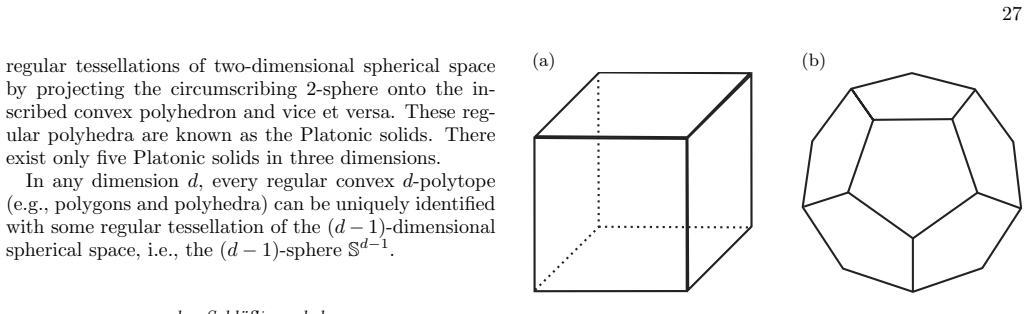
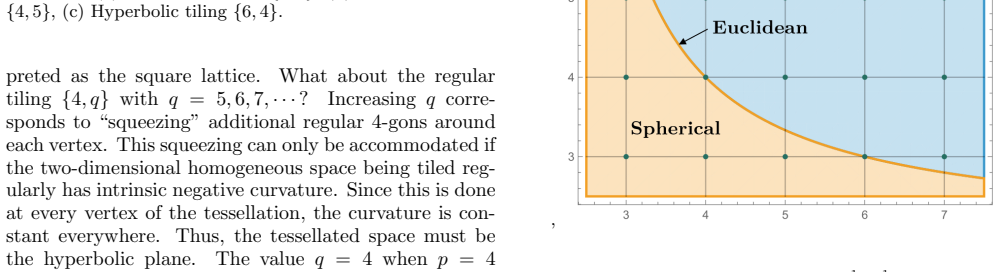
There are exactly 5 regular tilings of the two- dimensional sphereS 2. These are the 5 regu- lar (convex) polyhedra, also known as the Pla- tonic solids. They are:{3,3}(tetrahedron),{4,3} (cube),{3,4}(octahedron),{5,3}(dodecahedron), and{3,5}(icosahedron). , FIG. 18. Region plot for the function, 1 p + 1 q . Integer coordi- nates realize regular tilings o...
-
[5]
They are:{6,3} (triangular tiling),{4,4}(square tiling), and{3,6} (hexagonal tiling)
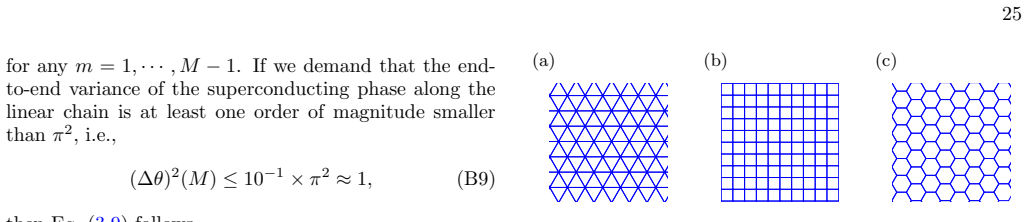
There are exactly 3 regular tilings of the two- dimensional Euclidean planeE 2. They are:{6,3} (triangular tiling),{4,4}(square tiling), and{3,6} (hexagonal tiling)
-
[6]
The Python packageHypertiling[144] provides efficient tools for constructing and manipulating two-dimensional {p,q}tessellations
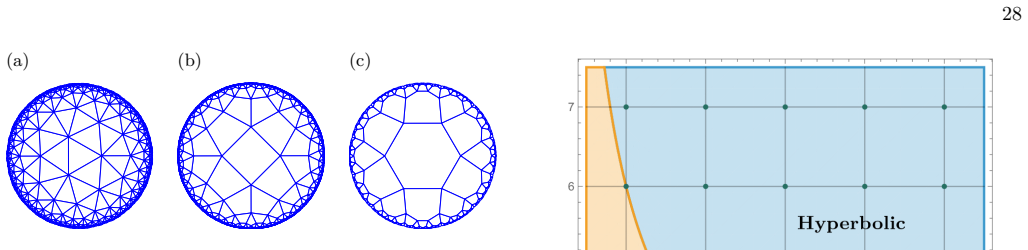
There are infinitely many regular tilings of the two-dimensional hyperbolic planeH 2. The Python packageHypertiling[144] provides efficient tools for constructing and manipulating two-dimensional {p,q}tessellations. For three-dimensional homogeneous spaces, the set of Schl¨ afli symbols that we consider are labeled by three integersp, q, r= 3,4,5,· · ·and...
-
[7]
There are exactly six regular tessellations of three- dimensional spherical space, which correspond to the six regular convex 4-polytopes
-
[8]
There is exactly one regular tessellation of three dimensional space:{4,3,4}(cubic honeycomb)
-
[9]
Schl¨ afli symbols in arbitrary dimensions are defined recursively
There are exactly four compact regular tessellations of hyperbolic space. Schl¨ afli symbols in arbitrary dimensions are defined recursively. Letd∈N ≥2 be the dimensionality of space. The Schl¨ afli symbols we consider are of the form {r1, r2,· · ·, r d−1, rd}, r 1,· · ·, r d ≥3.(C10) The associated tessellation ofd-dimensional spaces with constant sectio...
-
[10]
Construction of regular tessellations with Coxeter groups We now turn to the explicit construction of regular tessellations. Our goal is to construct a simple graph that delivers a regular tessellation of spherical, Euclidean, or hyperbolic space by way of an algorithm that can be implemented efficiently on a computer. Equipped with the adjacency matrix o...
-
[11]
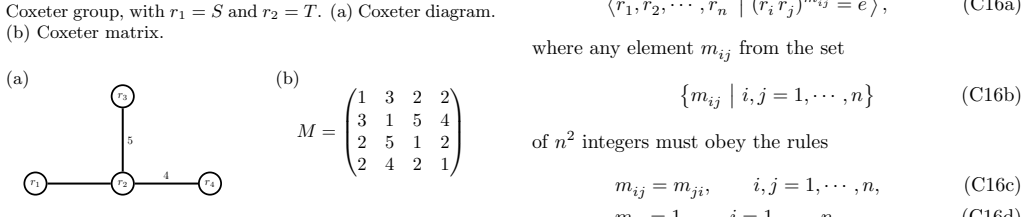
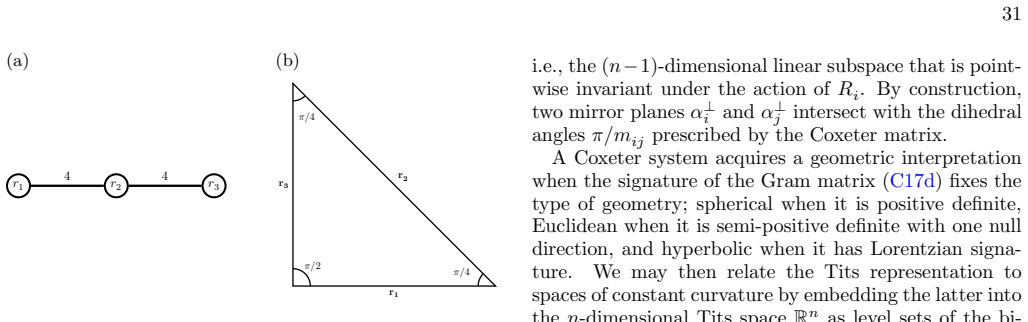
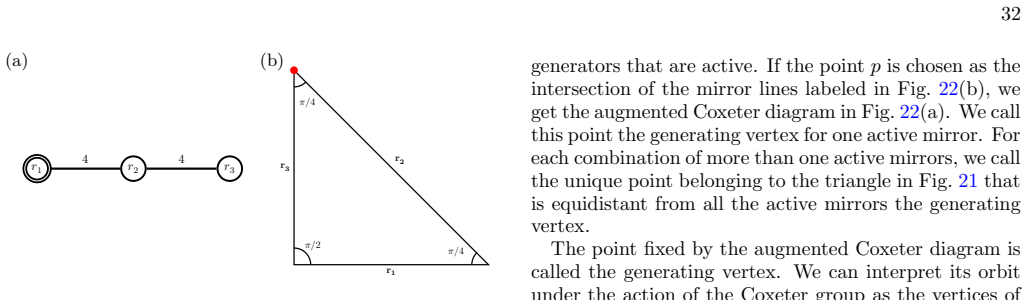
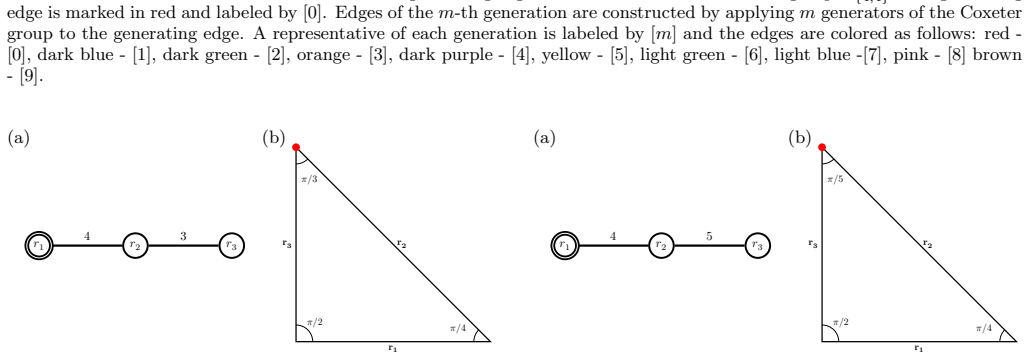
Figure 20 shows a Coxeter group generated by four reflections. b. Tits representation of Coxeter groups We begin by making use of the following abstract def- inition of a Coxeter system. We then give the conditions for which a Coxeter system is naturally associated to a space of constant curvature via the so-called Tits repre- sentation. 31 (a) r1 r2 r3 4...
-
[12]
The orbit ofv 0 andE 0 under the action of Gresults in a regular tessellation ofX d with curvature determined by the Schl¨ afli symbols
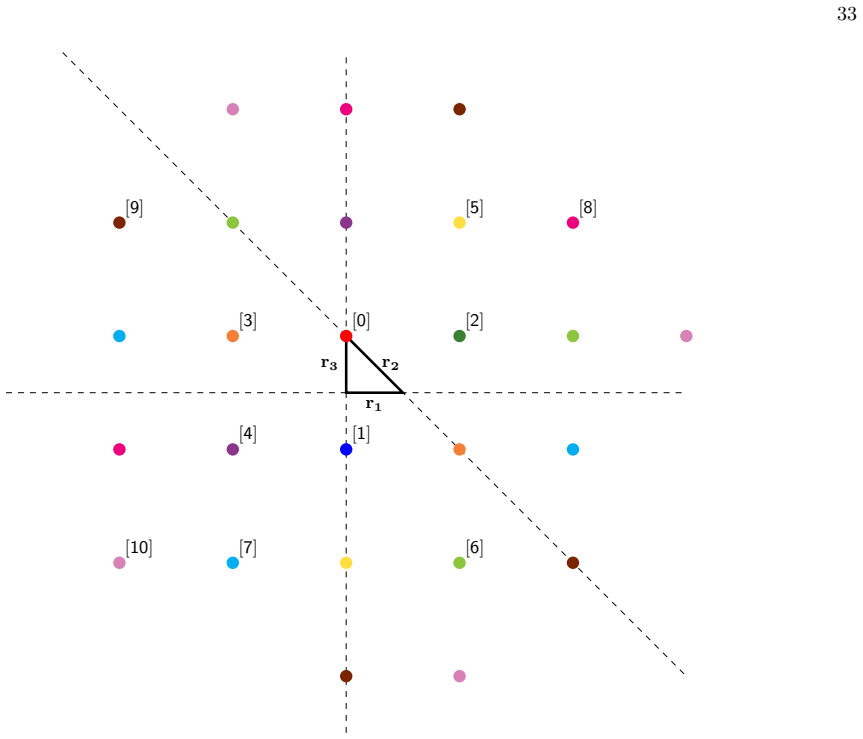
Let v0 ∈X d (C27b) be the generating vertex and E0 = [v0, r 1 ·v0] (C27c) the generating edge designated in the augmented Coxeter diagram. The orbit ofv 0 andE 0 under the action of Gresults in a regular tessellation ofX d with curvature determined by the Schl¨ afli symbols
-
[13]
The vertices of the tessellation{q 1,· · ·, q d}are in a one-to-one correspondence with the cosets t Gv0 , t∈G,(C27d) 36 of the quotientG/G v0, where Gv0 =⟨r 2,· · ·, r d+1⟩< G(C27e) is the stabilizer ofv 0
-
[14]
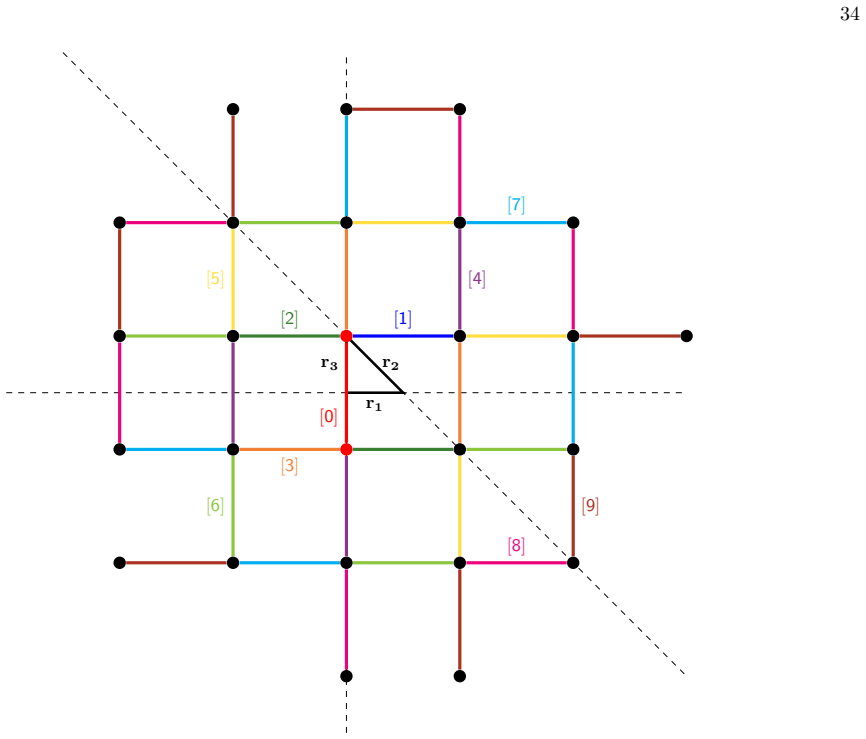
All edges of the tessellation are in one-to-one correspondence with the unordered pairs of cosets t Gv0 ,(t r 1)G v0 , t∈G.(C27h)
The coset e Gv0 =G v0 (C27f) corresponds to the generating vertex, and the unordered pair of cosets Gv0 , r 1Gv0 (C27g) corresponds to the generating edge. All edges of the tessellation are in one-to-one correspondence with the unordered pairs of cosets t Gv0 ,(t r 1)G v0 , t∈G.(C27h)
-
[15]
The simple graph resulting from the above correspondence characterizes fully the original regular tessellation. As a corollary, in order to construct the simple graph (and its adjacency matrix) that is described by the regular tessellation with the Schl¨ afli symbol{q1, q2,· · ·, q d}, we only need to identify the cosets of the quotientG/G v0 . This can b...
-
[16]
Kaluza, Zum Unit¨ atsproblem der Physik, Sitzungs- ber
T. Kaluza, Zum Unit¨ atsproblem der Physik, Sitzungs- ber. Preuss. Akad. Wiss. Berlin (Math. Phys. )1921, 966 (1921), arXiv:1803.08616 [physics.hist-ph]
Pith/arXiv arXiv 1921
-
[17]
Klein, Quantum Theory and Five-Dimensional The- ory of Relativity
O. Klein, Quantum Theory and Five-Dimensional The- ory of Relativity. (In German and English), Z. Phys.37, 895 (1926)
1926
-
[18]
Hiyamizu, T
S. Hiyamizu, T. Mimura, T. Fujii, and K. Nanb, High mobility of two-dimensional electrons at the GaAs/n- AlGaAs heterojunction interface, Applied Physics Let- ters37, 805 (1980)
1980
-
[19]
K. v. Klitzing, G. Dorda, and M. Pepper, New method for high-accuracy determination of the fine-structure constant based on quantized Hall resistance, Phys. Rev. Lett.45, 494 (1980)
1980
-
[20]
K. S. Novoselov, A. K. Geim, S. V. Morozov, D. Jiang, Y. Zhang, S. V. Dubonos, I. V. Grigorieva, and A. A. Firsov, Electric field effect in atomically thin carbon films, Science306, 666–669 (2004)
2004
-
[21]
Zhang, Y.-W
Y. Zhang, Y.-W. Tan, H. L. Stormer, and P. Kim, Ex- perimental observation of the quantum Hall effect and Berry’s phase in graphene, Nature438, 201 (2005)
2005
-
[22]
Bockrath, D
M. Bockrath, D. H. Cobden, J. Lu, A. G. Rinzler, R. E. Smalley, L. Balents, and P. L. McEuen, Luttinger-liquid behaviour in carbon nanotubes, Nature397, 598 (1999)
1999
-
[23]
Moreno, C
M. Moreno, C. J. B. Ford, Y. Jin, J. P. Griffiths, I. Far- rer, G. A. C. Jones, D. A. Ritchie, O. Tsyplyatyev, and A. J. Schofield, Nonlinear spectra of spinons and holons in short GaAs quantum wires, Nature Communications 7, 12784 (2016)
2016
-
[24]
Radushkevich and V
L. Radushkevich and V. ´ a. Lukyanovich, O strukture ugleroda, obrazujucegosja pri termiceskom razlozenii okisi ugleroda na zeleznom kontakte, Zurn Fisic Chim 26, 88 (1952)
1952
-
[25]
Iijima, Helical microtubules of graphitic carbon, Na- ture354, 56 (1991)
S. Iijima, Helical microtubules of graphitic carbon, Na- ture354, 56 (1991)
1991
-
[26]
A. I. Ekimov, Quantum size effect in three-dimensional microscopic semiconductor crystals, Jetp Lett.34, 345 (1981)
1981
-
[27]
L. E. Brus, Electron–electron and electron-hole inter- actions in small semiconductor crystallites: The size dependence of the lowest excited electronic state, The Journal of Chemical Physics80, 4403 (1984)
1984
-
[28]
H. W. Kroto, J. R. Heath, S. C. O’Brien, R. F. Curl, and R. E. Smalley, C60: Buckminsterfullerene, Nature 318, 162 (1985)
1985
-
[29]
D. Yu, W. Song, L. Wang, R. Srikanth, S. Kaushik Srid- har, T. Chen, C. Huang, G. Li, X. Qiao, X. Wu,et al., Comprehensive review on developments of synthetic di- mensions, Photonics Insights4, R06 (2025)
2025
-
[30]
A. J. Kollar, M. Fitzpatrick, and A. A. Houck, Hyper- bolic lattices in circuit quantum electrodynamics, Na- ture571, 45 (2019)
2019
-
[31]
P. M. Lenggenhager, A. Stegmaier, L. K. Upreti, T. Hof- mann, T. Helbig, A. Vollhardt, M. Greiter, C. H. Lee, S. Imhof, H. Brand, T. Kießling, I. Boettcher, T. Neu- pert, R. Thomale, and T. Bzduˇ sek, Simulating hyper- bolic space on a circuit board, Nature Communications 13, 4373 (2022)
2022
-
[32]
Zhang, H
W. Zhang, H. Yuan, N. Sun, H. Sun, and X. Zhang, Observation of novel topological states in hyperbolic lat- tices, Nature Communications13, 1466 (2022)
2022
-
[33]
A. Chen, H. Brand, T. Helbig, T. Hofmann, S. Imhof, A. Fritzsche, T. Kießling, A. Stegmaier, L. K. Upreti, T. Neupert,et al., Hyperbolic matter in electrical cir- cuits with tunable complex phases, Nature Communi- cations14, 622 (2023)
2023
-
[34]
W. Zhang, F. Di, X. Zheng, H. Sun, and X. Zhang, Hy- perbolic band topology with non-trivial second Chern numbers, Nature Communications14, 10.1038/s41467- 023-36767-8 (2023)
-
[35]
N. H. Patino, C. Rasmussen, and M. Ruzzene, Hyperbolic-space spectral characteristics for a network of mechanical linkages, Physical Review Applied22, 014048 (2024)
2024
-
[36]
H. Yuan, W. Zhang, Q. Pei, and X. Zhang, Hyper- bolic topological flat bands, Phys. Rev. B109, L041109 (2024)
2024
-
[37]
Q. Chen, Z. Zhang, H. Qin, A. Bossart, Y. Yang, H. Chen, and R. Fleury, Anomalous and Chern topo- logical waves in hyperbolic networks, Nature Communi- cations15, 2293 (2024)
2024
-
[38]
L. Huang, L. He, W. Zhang, H. Zhang, D. Liu, X. Feng, F. Liu, K. Cui, Y. Huang, W. Zhang, and X. Zhang, Hy- perbolic photonic topological insulators, Nature Com- munications15, 10.1038/s41467-024-46035-y (2024)
-
[39]
P. Lai, X. Chen, Y. Tang, Y. Hu, Z. Pu, H. Liu, W. Deng, H. Cheng, Z. Liu, and S. Chen, Observa- tion of exceptional topology and nonlocal skin effect in Klein bottle electric circuits, arXiv:2601.07615 preprint (2026)
arXiv 2026
-
[40]
S. S. Cairns, Triangulation of the manifold of class one, Bulletin of the American Mathematical Society41, 549 (1935)
1935
-
[41]
J. H. C. Whitehead, Simplicial spaces, nuclei and m- groups, Proceedings of the London Mathematical Soci- etys2-45, 243 (1939)
1939
-
[42]
J. Maldacena, The large-n limit of superconformal field theories and supergravity, International Journal of The- oretical Physics38, 10.1023/A:1026654312961 (1999), arXiv:hep-th/9711200
work page internal anchor Pith review Pith/arXiv arXiv doi:10.1023/a:1026654312961 1999
-
[43]
Witten, Anti de Sitter space and holography, Adv
E. Witten, Anti de Sitter space and holography, Adv. Theor. Math. Phys.2, 253 (1998), arXiv:hep- th/9802150
arXiv 1998
-
[44]
M´ ezard, G
M. M´ ezard, G. Parisi, M. A. Virasoro, and D. J. Thou- less, Spin glass theory and beyond (1988)
1988
-
[45]
Serre,Trees, Springer Monographs in Mathematics (Springer, Berlin, 2002)
J.-P. Serre,Trees, Springer Monographs in Mathematics (Springer, Berlin, 2002)
2002
-
[46]
N. H. Christ, R. Friedberg, and T. D. Lee, Weights of Links and Plaquettes in a Random Lattice, Nucl. Phys. B210, 337 (1982)
1982
-
[47]
Vinokur, L
V. Vinokur, L. Ioffe, and A. Larkin, Set of Josephson- junctions as a model of a spin-glass, Zhurnal eksperi- mentalnoi i teoreticheskoi fiziki /93, 343 (1987)
1987
-
[48]
Feigel’man, L
M. Feigel’man, L. Ioffe, A. Larkin, and V. Vinokur, Random Josephson networks and spin glasses, Modern Physics Letters B1, 27 (1987)
1987
-
[49]
L. L. Sohn, M. S. Rzchowski, J. U. Free, and M. Tin- kham, Phase transitions in Josephson-junction arrays with long-range interaction, Phys. Rev. B47, 967 (1993)
1993
-
[50]
L. L. Sohn, M. T. Tuominen, M. S. Rzchowski, J. U. Free, and M. Tinkham, AC and DC properties of 39 Josephson-junction arrays with long-range interaction, Phys. Rev. B47, 975 (1993)
1993
-
[51]
Chandra, L
P. Chandra, L. Ioffe, and D. Sherrington, Possible glassi- ness in a periodic long-range Josephson array, Physical review letters75, 713 (1995)
1995
-
[52]
Chandra, M
P. Chandra, M. Feigelman, and L. Ioffe, Glass forma- tion in a periodic long-range Josephson array, Physical review letters76, 4805 (1996)
1996
-
[53]
H. R. Shea and M. Tinkham, Transition temperature of Josephson junction arrays with long-range interaction, Phys. Rev. Lett.79, 2324 (1997)
1997
-
[54]
R. C. Brower, C. V. Cogburn, A. L. Fitzpatrick, D. Howarth, and C.-I. Tan, Lattice setup for quantum field theory in AdS2, Phys. Rev. D103, 094507 (2021)
2021
-
[55]
R. C. Brower, C. V. Cogburn, and E. Owen, Hyperbolic lattice for scalar field theory in AdS3, Phys. Rev. D105, 114503 (2022)
2022
-
[56]
Asaduzzaman, S
M. Asaduzzaman, S. Catterall, J. Hubisz, R. Nelson, and J. Unmuth-Yockey, Holography on tessellations of hyperbolic space, Phys. Rev. D102, 034511 (2020)
2020
-
[57]
Maciejko and S
J. Maciejko and S. Rayan, Hyperbolic band theory, Sci- ence Advances7, eabe9170 (2021)
2021
-
[58]
Maciejko and S
J. Maciejko and S. Rayan, Automorphic Bloch theo- rems for hyperbolic lattices, Proceedings of the National Academy of Sciences119, e2116869119 (2022)
2022
-
[59]
Boettcher, A
I. Boettcher, A. V. Gorshkov, A. J. Kollar, J. Maciejko, S. Rayan, and R. Thomale, Crystallography of hyper- bolic lattices, Physical Review B105, 125118 (2022)
2022
-
[60]
D. M. Urwyler, P. M. Lenggenhager, T. Bzdusek, J. Ma- ciejko, R. Thomale, and T. Neupert, Hyperbolic topo- logical band insulators, Nature Communications13, 1466 (2022)
2022
-
[61]
Shankar and J
G. Shankar and J. Maciejko, Hyperbolic lattices and two-dimensional yang-mills theory, Physical Review Letters130, 076401 (2023)
2023
-
[62]
H. Qin, W. Zhang, and X. Zhang, Boundary-dominated photonic Chern insulators with hyperbolic lattice geom- etry, Phys. Rev. B110, 155123 (2024)
2024
-
[63]
C. Sun, A. Chen, T. Bzduscek, and J. Maciejko, Topo- logical linear response of hyperbolic Chern insulators, SciPost Physics17, 124 (2024)
2024
-
[64]
J. Chen, L. Yang, and Z. Gao, Dynamic transfer of chi- ral edge states in topological type-II hyperbolic lattices, Communications Physics8, 10.1038/s42005-025-01990- w (2025)
-
[65]
P. Rajbongshi and R. Modak, Topological properties of curved spacetime Su-Schrieffer-Heeger model, arXiv preprint arXiv:2504.16200 (2025)
arXiv 2025
-
[66]
A. Djordjevi´ c, M. D. ´Ciri´ c, and V. Juriˇ ci´ c, Symmetry- based theory of Dirac fermions on two-dimensional hy- perbolic crystals: Coupling to the spin connection, arXiv preprint arXiv:2507.08276 (2025)
arXiv 2025
-
[67]
C. A. Leong and B. Roy, Amplified magnetic catalysis in non-Hermitian Euclidean and hyperbolic Dirac liquids, arXiv preprint arXiv:2510.02304 (2025)
arXiv 2025
-
[68]
C. A. Leong and B. Roy, Strained hyperbolic Dirac fermions: Zero modes, flat bands, and competing or- ders, arXiv preprint arXiv:2511.16667 (2025)
arXiv 2025
-
[69]
C. A. Leong, D. J. Salib, and B. Roy, Global phase dia- gram of two-dimensional dirty hyperbolic Dirac liquids, arXiv preprint arXiv:2512.05109 (2025)
arXiv 2025
-
[70]
M. Pavliuk, T. Bzduˇ sek, and A. Iliasov, Supercon- ductivity in hyperbolic spaces: Cayley trees, hyper- bolic continuum, and BCS theory, arXiv preprint arXiv:2510.26528 (2025)
arXiv 2025
-
[71]
A. Chen, J. Maciejko, and I. Boettcher, Anderson lo- calization transition in disordered hyperbolic lattices, Phys. Rev. Lett.133, 066101 (2024)
2024
-
[72]
T. Li, Y. Peng, Y. Wang, and H. Hu, Anderson transi- tion and mobility edges on hyperbolic lattices with ran- domly connected boundaries, Communications Physics 7, 371 (2024)
2024
-
[73]
A. Altland, T. Micklitz, D. Sharma, M. Usoltcev, and C. Wille, Theory of Anderson localization on the hyper- bolic plane (2026), arXiv:2604.24917 [cond-mat.dis-nn]
Pith/arXiv arXiv 2026
-
[74]
C. G. Callan and F. Wilczek, Infrared behavior at neg- ative curvature, Nuclear Physics B340, 366 (1990)
1990
-
[75]
Series and Y
C. Series and Y. G. Sinai, Ising models on the Lobachevsky plane, Communications in mathematical physics128, 63 (1990)
1990
-
[76]
C. C. Wu, Ising models on hyperbolic graphs, Journal of statistical physics85, 251 (1996)
1996
-
[77]
Rietman, B
R. Rietman, B. Nienhuis, and J. Oitmaa, The Ising model on hyperlattices, Journal of Physics A: Mathe- matical and General25, 6577 (1992)
1992
-
[78]
J. A. d’Auriac, R. M´ elin, P. Chandra, and B. Dou¸ cot, Spin models on non-Euclidean hyperlattices: Griffiths phases without extrinsic disorder, Journal of Physics A: Mathematical and General34, 675 (2001)
2001
-
[79]
Doyon and P
B. Doyon and P. Fonseca, Ising field theory on a pseu- dosphere, Journal of Statistical Mechanics: Theory and Experiment2004, P07002 (2004)
2004
-
[80]
MADRAS and C
N. MADRAS and C. C. WU, Self-avoiding walks on hy- perbolic graphs, Combinatorics, Probability and Com- puting14, 523 (2005)
2005
discussion (0)
Sign in with ORCID, Apple, or X to comment. Anyone can read and Pith papers without signing in.