Local Strong-to-Weak Spontaneous Symmetry Breaking
Pith reviewed 2026-06-29 11:18 UTC · model grok-4.3
The pith
A local one-point fidelity correlator defines strong-to-weak spontaneous symmetry breaking that stays well-defined in the thermodynamic limit.
A machine-rendered reading of the paper's core claim, the machinery that carries it, and where it could break.
Core claim
We propose a local notion of strong-to-weak spontaneous symmetry breaking (SW-SSB) through a local one-point fidelity correlator. Compared with the previous definition in terms of a two-point fidelity correlator, our local formulation offers two key advantages: it is easier to detect in large systems and the local SW-SSB order remains well defined in the thermodynamic limit, where the density matrix itself is not well defined. We show that key features of SW-SSB, including stability under finite-depth symmetric channels and long-range conditional mutual information, persist within this local framework.
What carries the argument
The local one-point fidelity correlator, which compares a local reduced density matrix to its image under a symmetry transformation and thereby serves as an order parameter for local SW-SSB.
If this is right
- Detection of the order becomes feasible with poly(N) resources up to O(log N) volume scales.
- The order parameter stays well-defined when the global density matrix is no longer defined.
- Stability under finite-depth symmetric channels holds for the local version.
- Long-range conditional mutual information remains a signature of the local order.
- In critical systems the correlator defines a class of defect problems with universal scaling in CFTs and free-fermion metals.
Where Pith is reading between the lines
- Numerical studies of SW-SSB can now target substantially larger system sizes than the two-point definition permitted.
- The analogy with local thermalization under ETH suggests that local SW-SSB may classify eigenstates in a manner parallel to thermalization diagnostics.
- The local formulation may extend naturally to open quantum systems or to symmetry-protected phases in quantum circuits.
Load-bearing premise
The local one-point fidelity correlator fully captures the essential physics of the earlier two-point definition, so that stability and long-range mutual information automatically transfer without further conditions.
What would settle it
A concrete system in which the two-point fidelity detects SW-SSB but the local one-point version shows no order, or in which the local version loses stability under a finite-depth symmetric channel that preserves the two-point order.
Figures
read the original abstract
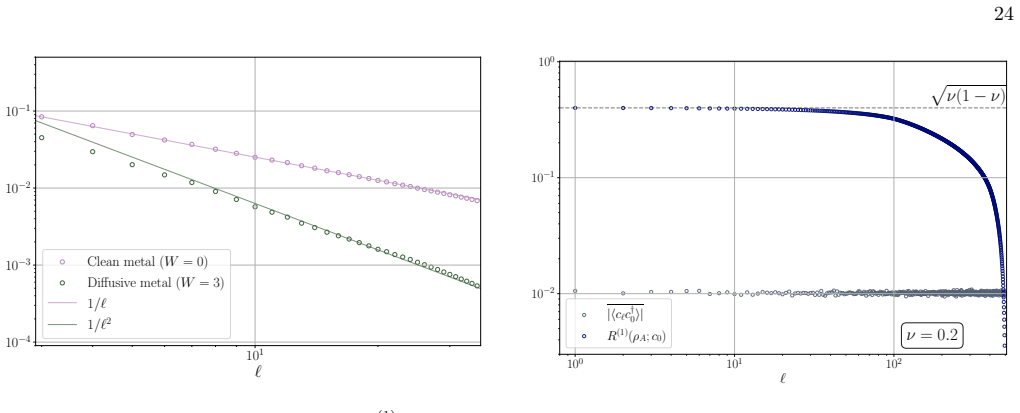
We propose a local notion of strong-to-weak spontaneous symmetry breaking (SW-SSB), through a local one-point fidelity correlator. Compared with the previous definition in terms of a two-point fidelity correlator, our local formulation offers two key advantages: (1) it is easier to detect in large systems: for a system of size $N$ and with ${\rm poly}(N)$ amount of resources, one can detect the local fidelity order up to volume scale $O(\log(N))$; and (2) the local SW-SSB order remains well defined in the thermodynamic limit, where the density matrix itself is not well defined. We show that key features of SW-SSB, including stability under finite-depth symmetric channels and long-range conditional mutual information, persist within this local framework. Our definition is conceptually analogous to local thermalization, as exemplified by pure states obeying the eigenstate thermalization hypothesis (ETH). For critical states, the local one-point fidelity correlator defines an interesting class of defect problems. We demonstrate the applicability of the local formulation through several concrete examples, and derive the universal scaling behavior of the local fidelity correlator in a range of critical systems, including ground states of conformal field theories as well as ballistic and diffusive free-fermion metals.
Editorial analysis
A structured set of objections, weighed in public.
Referee Report
Summary. The manuscript proposes a local definition of strong-to-weak spontaneous symmetry breaking (SW-SSB) using a one-point fidelity correlator. It claims two advantages over the prior two-point version: easier detection in large systems (poly(N) resources up to O(log N) volume) and well-definedness in the thermodynamic limit. The authors assert that core properties—stability under finite-depth symmetric channels and long-range conditional mutual information—persist, demonstrate this via concrete examples, and derive universal scaling of the correlator for CFT ground states as well as ballistic and diffusive free-fermion metals. The local order is presented as analogous to local thermalization under ETH.
Significance. If the persistence of the listed features is established, the local formulation supplies a more experimentally accessible and thermodynamically robust diagnostic for SW-SSB. The explicit scaling results in CFTs and free-fermion systems, together with the defect-problem interpretation, would furnish concrete, falsifiable predictions for critical states. The connection to ETH-style local thermalization is conceptually useful for linking symmetry-breaking diagnostics to eigenstate properties.
minor comments (2)
- The abstract states that stability and long-range CMI 'persist within this local framework' and are shown via examples; the main text should include an explicit statement (perhaps in the section introducing the local correlator) of any additional conditions required for the carry-over from the two-point definition.
- Figure captions and the scaling derivations for the free-fermion cases would benefit from a brief remark on the system sizes or cutoffs used to extract the universal exponents, to facilitate direct comparison with the CFT results.
Simulated Author's Rebuttal
We thank the referee for their positive assessment of our work and for recommending minor revision. No specific major comments were raised in the report.
Circularity Check
No significant circularity identified
full rationale
The paper defines a new local one-point fidelity correlator for SW-SSB, distinct from the prior two-point version, and demonstrates persistence of stability and long-range CMI through explicit examples plus independent scaling derivations in CFTs and free-fermion models. These calculations rely on standard techniques (ETH analogy, conformal invariance, ballistic/diffusive transport) rather than reducing to a fitted parameter, self-citation chain, or definitional equivalence. The extension is self-contained; no load-bearing step collapses by construction to its inputs.
Axiom & Free-Parameter Ledger
Forward citations
Cited by 2 Pith papers
-
From Topological Order to Mixed-State Phases: A Ground-State Probe of Fractionalized Excitations
Reduced density matrices of 2D topological orders at entanglement cuts realize 1D mixed-state phases whose properties detect fractionalized excitations such as anyons and spinons.
-
Strong-to-Weak Spontaneous Symmetry Breaking
SW-SSB extends symmetry breaking to mixed states and serves as a unifying perspective connecting topological orders, emergent hydrodynamics, and information-theoretic characterizations of phases in open systems.
Reference graph
Works this paper leans on
-
[1]
IfA⊂Bare finite regions containing the support ofO x, R(1)(ρA;O x)≥R (1)(ρB;O x).(70)
-
[2]
averaged
For any finite regionAcontainingO x, F(ρ A;O x)2 ≤R (1)(ρA;O x)≤ ∥O x∥∞ F(ρ A;O x).(71) Proof.To establish monotonicity, letC=B\A, and letD C = dimH C, the dimension of the Hilbert space ofC. IfO x is unitary, the monotonicity follows from the standard data processing inequality of the Holevo fidelity Tr(√ρ√σ). For generalO x, we can relate the reduced de...
-
[3]
(110), we can relate the SW-SSB properties ofρ p to the RBIM at the Nishimori line
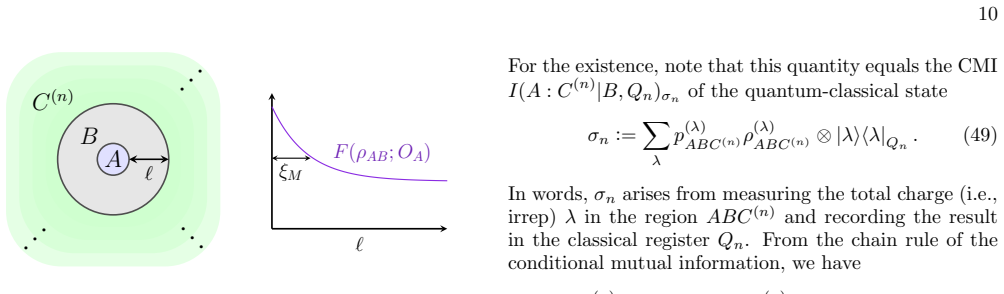
Local fidelity correlator From Eq. (110), we can relate the SW-SSB properties ofρ p to the RBIM at the Nishimori line. Namely, the 5 This statement can be formalized by noting that the relative homologyH 1(A, ∂Ac) =Z |∂Ac| 2 . 17 local fidelity correlator assumes the following form: F(ρ A;Z x) = X s √psps+ˆex (111) ∝ X s,b Zs,b sP b Zs+ˆex,bP b Zs,b (112)...
-
[4]
Replica calculation and boundary magnetization By employing the expression ofp s from Eq. (109), we can relate the one-point R´ enyi-2kmeasure R(2k)(ρp,A;Z x),k∈Z >0, to a 2k-replica calculation: R(2k)(ρp,A;Z x) = X s pk s pk s+ˆex (114) ∝ X s X η(α) eK P2k α=1 HA[η(α)] 2kY α=k+1 η(α) x !Y i∈A 2kY α=1 (η(α) i )si (115) = X η(α) eK P2k α=1 HA[η(α)] 2kY α=k...
-
[5]
Two dimensional CFTs Let us consider two-dimensional CFTs (D= 1 + 1). Crucially, we will show that the one-point R´ enyi-1 corre- lator for a primary operatorO, on a finite regionAcan be mapped to a conventional two-point function in the complex plane via the uniformization map. Therefore, the R´ enyi-1 correlator is completely fixed by the normal- izatio...
-
[6]
Thus, forD≥3 the one-point R´ enyi correlator is instead mapped to a nontrivial codimension-two twist defect problem
Higher-dimensional CFTs The uniformization map method does not generalize directly to higher dimensions, because∂Ais no longer a set of isolated points, and the branch cut cannot be re- moved by a conformal transformation. Thus, forD≥3 the one-point R´ enyi correlator is instead mapped to a nontrivial codimension-two twist defect problem. How- ever, as we...
-
[7]
R´ enyi-1 correlators in free fermion systems A useful property of free fermions is that Wick’s the- orem holds for correlation functions restricted to any re- gionA. Consequently, the reduced density matrixρ A of a Gaussian state on regionAis also a Gaussian state, and specifyingρ A is equivalent to specifying the two-point correlation matrix CA(x, y) =⟨...
-
[8]
The ground state is |GSkF ⟩= Y |k|≤kF c† k |vac⟩,(146) where|vac⟩denotes the empty state
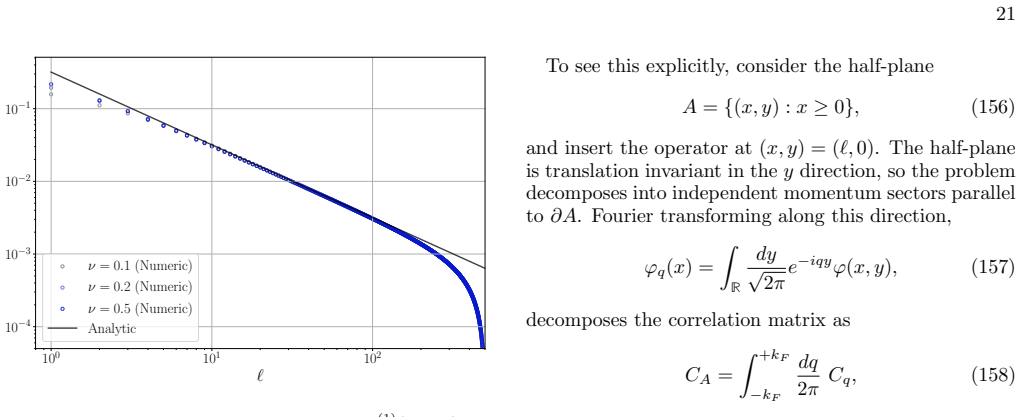
Fermi gas in1d Consider a one-dimensional Fermi gas with Fermi mo- mentumk F . The ground state is |GSkF ⟩= Y |k|≤kF c† k |vac⟩,(146) where|vac⟩denotes the empty state. The low-energy physics is described by two-Fermi points, and thus by a free Dirac CFT. Therefore, after accounting for the normalization of the microscopic two-point function, ⟨GSkF |c† xc...
-
[9]
We make two simplifications
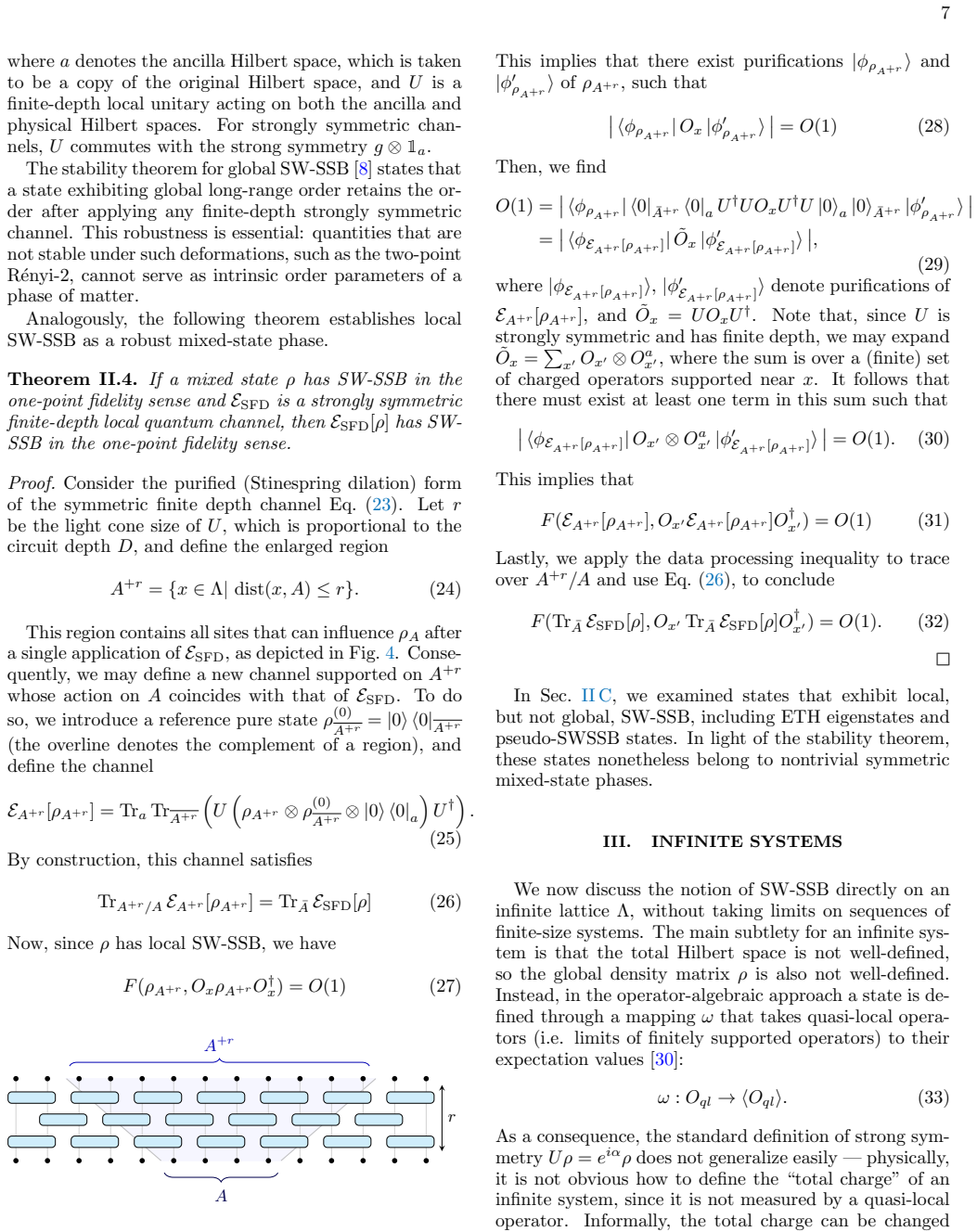
We now show this explicitly; the same structure will later be used to analyze higher-dimensional Fermi gases. We make two simplifications. First, we take the region to be the semi-infinite lineA= [0,∞) and insert the operator atx=ℓ. This is equivalent to considering the finite intervalA= [−ℓ, R], inserting the operator atx= 0, and then takingR→ ∞, withℓfi...
-
[10]
Consider first the right-moving chiral fermionψR, with filled momentap <0
Explicitly, we write cx ≃e ikF xψR(x) +e −ikF xψL(x),(148) whereψ R andψ L annihilate right and left-moving low- energy chiral fermions near momentak F and−k F , re- spectively. Consider first the right-moving chiral fermionψR, with filled momentap <0. The correlation kernel is [43] CR(x, x′) = 1 2π Z p<0 eip(x−x′) = 1 2 δ(x−x ′)− i 2π 1 x−x ′ , (149) whe...
-
[11]
In this case, the ground state is specified not only by the volume enclosed by the Fermi surface, but also by its shape
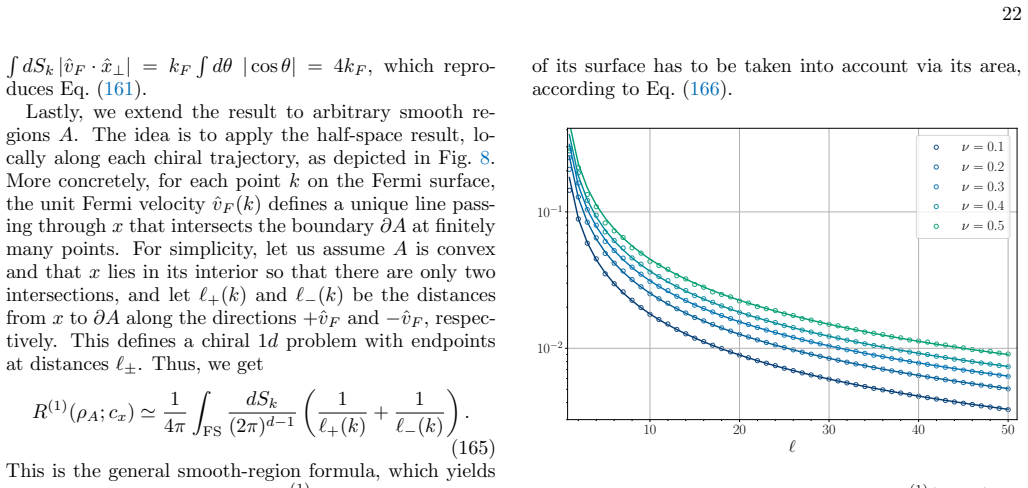
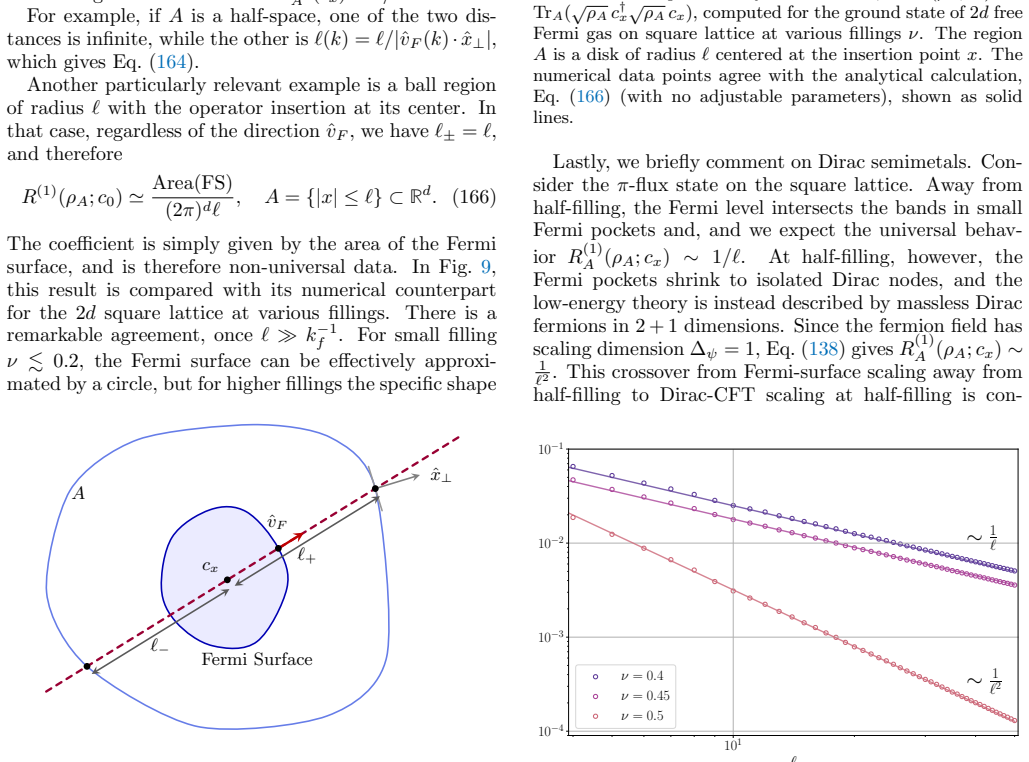
Fermi Metals ind≥2 We now turn to Fermi metals ind≥2. In this case, the ground state is specified not only by the volume enclosed by the Fermi surface, but also by its shape. Alternatively, one may specify the single-particle dispersionϵ(k). For illustration, we begin with the two-dimensional Fermi gas with a circular Fermi surface, and then general- ize ...
-
[12]
This argument encompasses metals and semimet- als discussed above, and also allows us to extend the dis- cussion to weakly disordered diffusive metals
General argument and diffusive metals We now present a more general way of understanding the scaling of the R´ enyi-1 correlation in free-fermion sys- tems. This argument encompasses metals and semimet- als discussed above, and also allows us to extend the dis- cussion to weakly disordered diffusive metals. We start by considering a replicated version of ...
-
[13]
The local one-point fidelity measure of SW-SSB is non-vanishing: F(ω;O x) =: lim |A|→∞ max |v|=1 F(ρ A;v·O x)>0.(183)
-
[14]
The state does not exhibit ordinary SSB: lim|x−y|→∞⟨O(α) x O(β) y ⟩ω = 0 for allα, β. The following result provides an equivalent expression for the order parameter solely in terms of purifications and, in particular, does not involve any explicit optimiza- tion overv. Lemma VII.2.LetO (α) x transform in ann-dimensional irreducible representation of some ...
-
[15]
The state has a non-vanishing local SW-SSB mea- sure for the multiplet, max |v|=1 F(ρ;v·O x)>0,(186)
-
[16]
In any basisO (α) x , there exists at least one compo- nentαsuch that lim |A|→∞ F(ρ A;O (α) x )>0.(187)
-
[17]
Proof.First, we show the equivalence between 1 and
The fidelity lim |A|→∞ F(ρ A, τO[ρA])>0,(188) whereτ O = 1 n Pn α=1 O(α) x [·](O(α) x )†. Proof.First, we show the equivalence between 1 and
-
[18]
Then, by Lemma VII.2, for allA, there existsU∈ U(H ′ A) such that Pn α=1 ⟨ΨA|U⊗O (α) x |ΨA⟩ 2 ≥c 2, for any basis O(α) x
Assume that lim |A|→∞ F(ρ;v·O x) =c > 0 for some unit-normv. Then, by Lemma VII.2, for allA, there existsU∈ U(H ′ A) such that Pn α=1 ⟨ΨA|U⊗O (α) x |ΨA⟩ 2 ≥c 2, for any basis O(α) x . This implies thatnmax α F(ρ A;O (α) x )2 ≥Pn α=1 F(ρ A;O (α) x )2 ≥c 2. We now take the covering limit, which commutes with the optimization overαbe- causenis finite. Theref...
-
[19]
local thermaliza- tion
The converse direction is immediate by noting that maxv F(ρ A;v·O x)≥F(ρ A;O (α) x ) for all bases and allα. Now, we show the equivalence between 2 and 3. To do that, we will show that there existsαsuch that 1√n F(ρ;O (α) x )≤F(ρ, τ O[ρ])≤ √n F(ρ;O (α) x ) (189) Write F(ρ A, τO[ρA]) = Tr s 1 n X β XβX † β (190) whereX β = √ρAO(β) x √ρA is a positive opera...
2020
-
[20]
For comparison, the R´ enyi-1 and R´ enyi-2 connected matrices for the same example are R(1) c = 1 4 1 0−1 0 1 0 −1 0 1 , R (2) c = 1 8 3 1−1 1 3 1 −1 1 3 , (B2) which are both positive-semidefinite. Even if we ask for the operatorsO x to pairwise com- mute, there are essentially classical counterexamples: By taking a pure stateρ=|ψ⟩⟨ψ|and...
-
[21]
It was shown in Ref. [8] that this state exhibits SW- SSB, with two-point fidelity given in the thermodynamic limit by lim |i−j|→∞ F(ρ;Z iZj) = 1 cosh2 β .(C2) As a result, the one-point fidelity is finite at any finite temperature,β <∞. It is instructive to see how this arises. Althoughρ + is strongly symmetric, the reduced den- sity matrix onAis not, al...
-
[22]
A note on symmetry reductions of the Lindblad equation: transport in constrained open spin chains
B. Buˇ ca and T. Prosen, New Journal of Physics14, 073007 (2012), arXiv:1203.0943 [quant-ph]
work page internal anchor Pith review Pith/arXiv arXiv 2012
-
[23]
V. V. Albert and L. Jiang, Phys. Rev. A89, 022118 (2014)
2014
-
[24]
de Groot, A
C. de Groot, A. Turzillo, and N. Schuch, Quantum6, 856 (2022)
2022
-
[25]
Ma and C
R. Ma and C. Wang, Physical Review X13, 031016 (2023)
2023
- [26]
-
[27]
Ma and A
R. Ma and A. Turzillo, PRX Quantum6, 010348 (2025)
2025
-
[28]
Ma, J.-H
R. Ma, J.-H. Zhang, Z. Bi, M. Cheng, and C. Wang, Physical Review X15, 021062 (2025)
2025
- [29]
-
[30]
P. Sala, S. Gopalakrishnan, M. Oshikawa, and Y. You, Physical Review B110, 155150 (2024)
2024
-
[31]
Y.-H. Chen and T. Grover, PRX Quantum5, 030310 (2024), arXiv:2310.07286 [quant-ph]
-
[32]
S. Sang and T. H. Hsieh, Stability of mixed-state quantum phases via finite markov length (2024), arXiv:2404.07251 [quant-ph]
- [33]
-
[34]
Sohal and A
R. Sohal and A. Prem, PRX Quantum6, 010313 (2025)
2025
-
[35]
Z. Wang, Z. Wu, and Z. Wang, PRX Quantum6, 010314 (2025)
2025
- [36]
- [37]
-
[38]
O. Ogunnaike, J. Feldmeier, and J. Y. Lee, Phys. Rev. Lett.131, 220403 (2023), arXiv:2304.13028 [cond- mat.str-el]
-
[39]
Moudgalya and O
S. Moudgalya and O. I. Motrunich, PRX Quantum5, 040330 (2024)
2024
-
[40]
D. Gu, Z. Wang, and Z. Wang, Phys. Rev. B112, 245123 (2025), arXiv:2406.19381 [quant-ph]
work page internal anchor Pith review Pith/arXiv arXiv 2025
-
[41]
Huang, M
X. Huang, M. Qi, J.-H. Zhang, and A. Lucas, Physical Review B111, 125147 (2025)
2025
- [42]
-
[43]
S. Wang, T. G. Kiely, D. Tell, J. Obermeyer, M. Baren- dregt, P. Bojovi´ c, P. M. Preiss, A. Sarma, T. Franz, M. P. A. Fisher, C. Xu, and I. Bloch, arXiv e-prints , arXiv:2604.16137 (2026), arXiv:2604.16137 [cond- mat.quant-gas]
work page internal anchor Pith review Pith/arXiv arXiv 2026
- [44]
-
[45]
Fawzi and R
O. Fawzi and R. Renner, Communications in Mathemat- ical Physics340, 575 (2015)
2015
-
[46]
Junge, R
M. Junge, R. Renner, D. Sutter, M. M. Wilde, and A. Winter, Annales Henri Poincar´ e19, 2955 (2018)
2018
-
[47]
From Quantum Chaos and Eigenstate Thermalization to Statistical Mechanics and Thermodynamics
L. D’Alessio, Y. Kafri, A. Polkovnikov, and M. Rigol, Advances in Physics65, 239 (2016), arXiv:1509.06411 [cond-mat.stat-mech]
work page internal anchor Pith review Pith/arXiv arXiv 2016
-
[48]
A. Dymarsky, N. Lashkari, and H. Liu, Phys. Rev. E97, 012140 (2018), arXiv:1611.08764 [cond-mat.stat-mech]
work page internal anchor Pith review Pith/arXiv arXiv 2018
-
[49]
J. R. Garrison and T. Grover, Physical Review X8, 021026 (2018), arXiv:1503.00729 [cond-mat.str-el]
work page internal anchor Pith review Pith/arXiv arXiv 2018
- [50]
-
[51]
Bratteli and D
O. Bratteli and D. W. Robinson,Operator Algebras and Quantum Statistical Mechanics: Volume 1: C*- and W*- Algebras. Symmetry Groups. Decomposition of States (Springer Science & Business Media, 2012)
2012
-
[52]
Uhlmann, Reports on Mathematical Physics9, 273 (1976)
A. Uhlmann, Reports on Mathematical Physics9, 273 (1976)
1976
-
[53]
P. M. Alberti, Letters in Mathematical Physics7, 25 (1983)
1983
-
[54]
Z. Li, R. Firanko, and T. H. Hsieh, A Unified Framework for Locally Stable Phases (2026)
2026
- [55]
-
[56]
M. A. Nielsen and I. L. Chuang,Quantum Computation and Quantum Information: 10th Anniversary Edition (Cambridge University Press, Cambridge, 2010)
2010
-
[57]
Y. Kusuki, S. Pal, and H. Tajima, Resource-Theoretic Quantifiers of Weak and Strong Symmetry Breaking: Strong Entanglement Asymmetry and Beyond (2026), arXiv:2601.20924 [hep-th]
work page internal anchor Pith review Pith/arXiv arXiv 2026
-
[58]
Levin, Communications in Mathematical Physics 378, 1081 (2020)
M. Levin, Communications in Mathematical Physics 378, 1081 (2020)
2020
-
[59]
Z. Weinstein, Phys. Rev. Lett.134, 150405 (2025), arXiv:2410.23512 [quant-ph]
-
[60]
Tasaki, inThe Physics and Mathematics of Elliott Lieb(European Mathematical Society - EMS - Publish- ing House GmbH, 2022) pp
H. Tasaki, inThe Physics and Mathematics of Elliott Lieb(European Mathematical Society - EMS - Publish- ing House GmbH, 2022) pp. 405–446
2022
-
[61]
Calabrese and J
P. Calabrese and J. Cardy, Journal of statistical mechan- ics: theory and experiment2004, P06002 (2004)
2004
-
[62]
Calabrese and J
P. Calabrese and J. Cardy, Journal of physics a: mathe- matical and theoretical42, 504005 (2009)
2009
-
[63]
Casini, M
H. Casini, M. Huerta, and R. C. Myers, Journal of High Energy Physics2011, 36 (2011)
2011
-
[64]
H. Casini and M. Huerta, Class. Quant. Grav.26, 185005 (2009), arXiv:0903.5284 [hep-th]
-
[65]
Altland and B
A. Altland and B. D. Simons,Condensed Matter Field 31 Theory, 2nd ed. (Cambridge University Press, 2010)
2010
-
[66]
Evers and A
F. Evers and A. D. Mirlin, Rev. Mod. Phys.80, 1355 (2008)
2008
-
[67]
J. M. Mag´ an, Phys. Rev. Lett.116, 030401 (2016)
2016
-
[68]
S. J. Garratt and J. T. Chalker, Phys. Rev. Lett.127, 026802 (2021)
2021
-
[69]
Surpassing the en- ergy resolution limit with ferromagnetic torque sensors,
U. Agrawal, Physical Review X12, 10.1103/Phys- RevX.12.041002 (2022)
-
[70]
Barratt, U
F. Barratt, U. Agrawal, A. C. Potter, S. Gopalakrishnan, and R. Vasseur, Physical Review Letters129, 200602 (2022)
2022
-
[71]
Singh, R
H. Singh, R. Vasseur, A. C. Potter, and S. Gopalakrish- nan, Physical Review B113, 054305 (2026)
2026
-
[72]
Vijay and J
A. Vijay and J. Y. Lee, Holographically Emergent Gauge Theory in Symmetric Quantum Circuits (2025)
2025
-
[73]
J. Y. Lee, Charge Scrambling in Strong-to-Weak Spon- taneous Symmetry Breaking (2026)
2026
-
[74]
R. Liu, J. Yi, and D. Else, To appear (2026)
2026
-
[75]
Zhang, To appear (2026)
C. Zhang, To appear (2026)
2026
-
[76]
Yi and C
J. Yi and C. Wang, To appear (2026)
2026
discussion (0)
Sign in with ORCID, Apple, or X to comment. Anyone can read and Pith papers without signing in.