Three-dimensional Conditional Diffusion Models for Cosmological 21 cm Lightcone Emulation
Pith reviewed 2026-06-29 09:24 UTC · model grok-4.3
The pith
Yeo-Johnson preprocessing plus moderate amplitude compression yields the most stable training and lowest normalized errors for three-dimensional 21 cm lightcone diffusion models.
A machine-rendered reading of the paper's core claim, the machinery that carries it, and where it could break.
Core claim
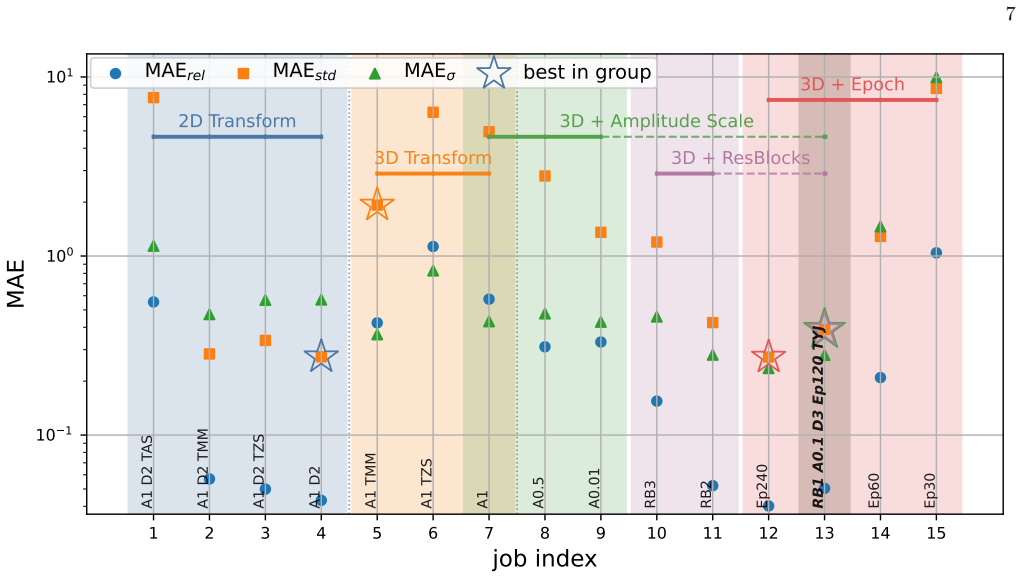
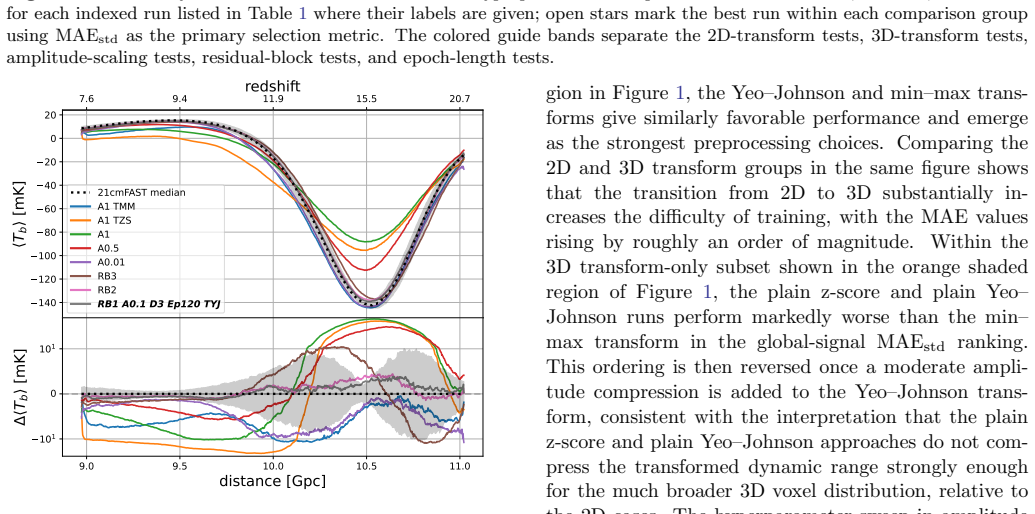
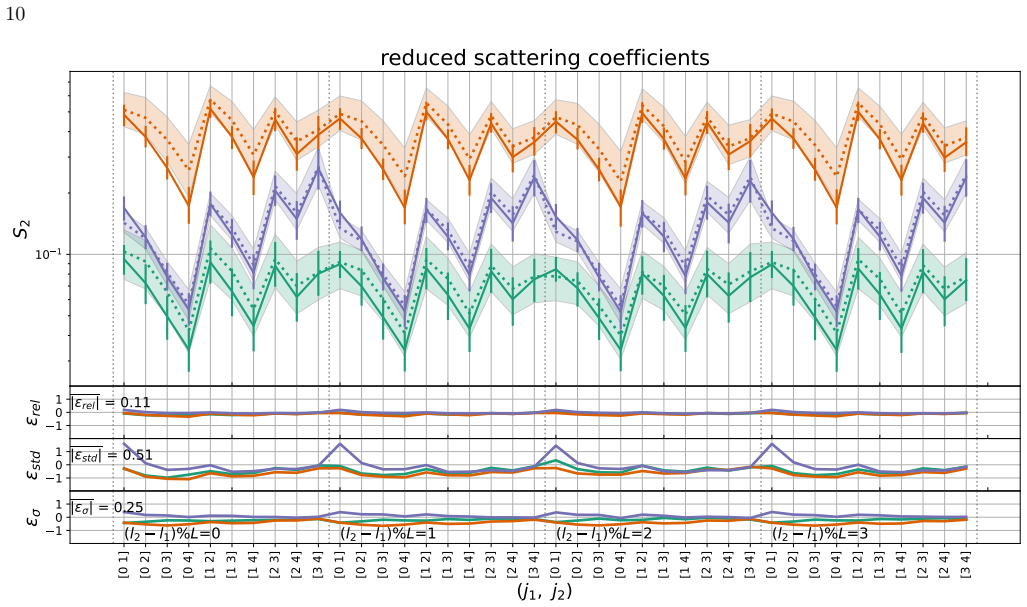
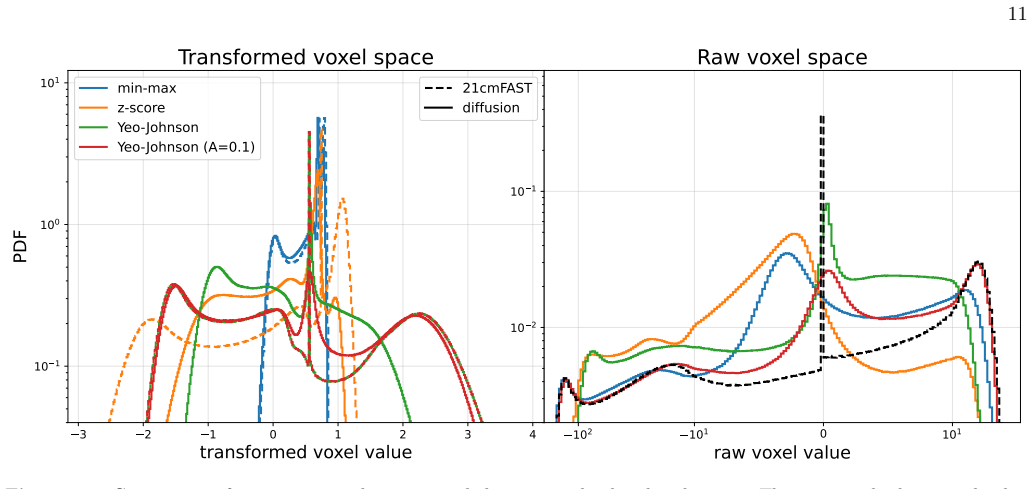
Preprocessing is the dominant factor governing stable training and physical fidelity in three-dimensional conditional diffusion models for 21 cm lightcones; among the configurations tested, Yeo-Johnson preprocessing combined with moderate amplitude compression produces the most consistently favorable trade-off according to standard-deviation-normalized mean absolute error of the global signal and qualitatively compatible results on slices, power spectra, and scattering coefficients.
What carries the argument
Conditional diffusion model applied to three-dimensional 21 cm lightcones, with preprocessing (Yeo-Johnson transformation) and amplitude compression as the primary controls on training stability and output fidelity.
If this is right
- Future 3D emulation studies can adopt Yeo-Johnson preprocessing with moderate compression as a starting point rather than re-exploring the full preprocessing space.
- Any claim of physical fidelity for these models must still be checked against two-point and higher-order statistics even when slices look realistic.
- The same architecture can serve as a simulation-level baseline once more realistic observational effects are added.
- Memory-efficient 3D training remains the main engineering barrier that future work must solve to reach larger volumes.
Where Pith is reading between the lines
- If the diagnostics turn out to be incomplete, the ranking of preprocessing choices could shift once full lightcone power spectra or cross-correlations with other tracers are examined.
- The approach could be extended to joint emulation of multiple reionization fields by conditioning on additional astrophysical parameters without changing the preprocessing recipe.
- The residual statistical biases suggest that adding a physics-informed loss term on the power spectrum during training might close the remaining gap.
Load-bearing premise
The chosen set of image and summary-statistic diagnostics is enough to establish that generated lightcones are physically faithful for cosmological use.
What would settle it
A new configuration or loss term that produces lower MAE_std on the global signal while simultaneously reducing the reported biases in the power spectrum and scattering coefficients at fixed cosmology points.
Figures
read the original abstract
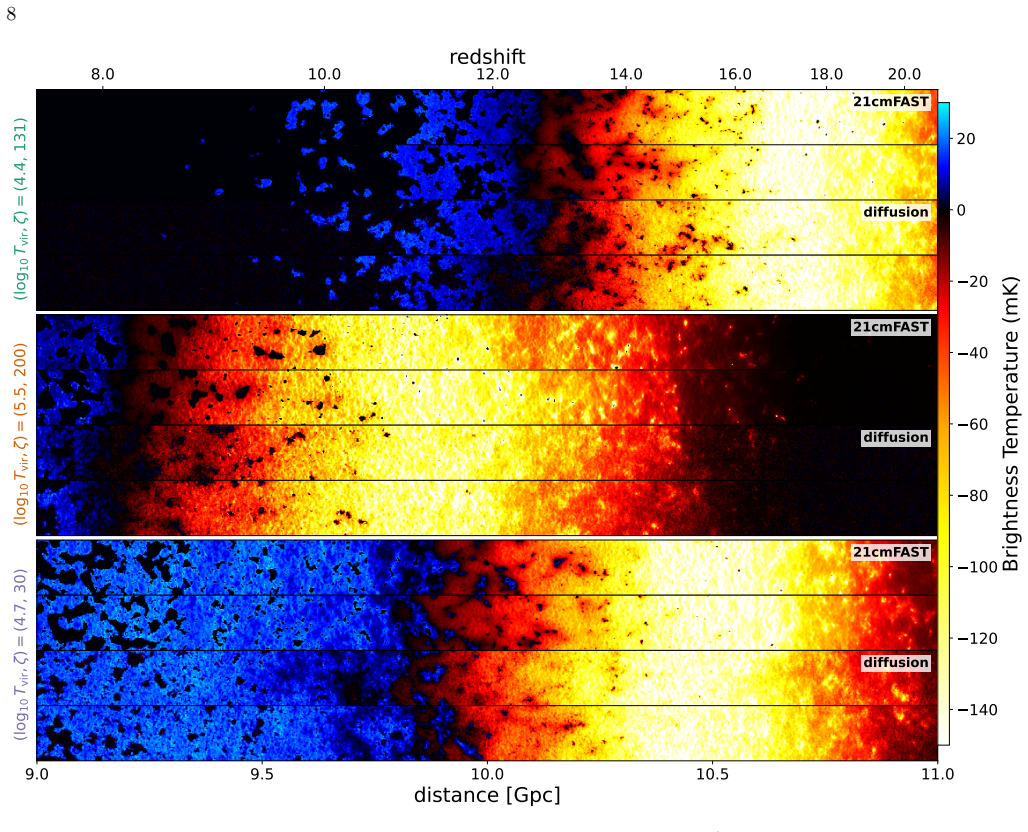
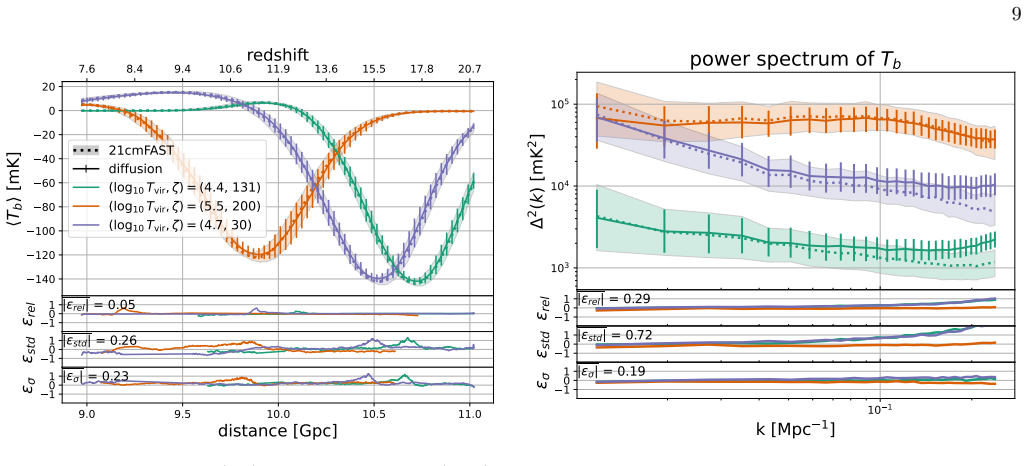
We investigate conditional diffusion modeling for three-dimensional 21 cm lightcone emulation, focusing on cubes with a sky-plane size of $64\times64$ and a line-of-sight depth up to 1024 cells. Relative to earlier 2D studies, the 3D setting is substantially harder because memory limits enforce very small micro-batches while the underlying voxel distribution is highly skewed and long tailed. We perform controlled comparisons across preprocessing choices, dynamic-range compression settings, architecture depth, and training duration using $25{,}600$ training lightcones and validation ensembles at fixed parameter points. For validation, each reference parameter point contains 800 21cmFAST realizations with independent initial conditions, and we use 800 samples per model and per reference set for the reported ensemble comparisons. We evaluate generated lightcones with complementary diagnostics in both image and summary-statistic spaces: brightness-temperature slices, the global signal, the power spectrum, and reduced scattering coefficients. Across the tested configurations, preprocessing is the dominant factor governing stable training and the resulting physical fidelity. Among the configurations explored here, Yeo-Johnson preprocessing combined with moderate amplitude compression gives the most consistently favorable trade-off, with the strongest quantitative support coming from rankings based on the standard-deviation-normalized mean absolute error ($\mathrm{MAE}_{\rm std}$) of the global signal and qualitatively compatible behavior in the complementary diagnostics. At the same time, visually plausible 3D samples still retain measurable biases in two-point and higher-order statistics. We therefore view the present work as a simulation-level baseline for three-dimensional 21 cm emulation and for future studies that incorporate more realistic observational effects.
Editorial analysis
A structured set of objections, weighed in public.
Referee Report
Summary. The manuscript investigates conditional diffusion models for emulating three-dimensional 21 cm lightcones (64x64 sky plane, up to 1024 cells along the line of sight) from 21cmFAST simulations. It conducts controlled comparisons of preprocessing choices (including Yeo-Johnson), amplitude compression settings, architecture depth, and training duration using 25,600 training lightcones and validation ensembles of 800 independent realizations per reference parameter point. Generated samples are evaluated via brightness-temperature slices, global signal, power spectrum, and reduced scattering coefficients. The central claim is that Yeo-Johnson preprocessing combined with moderate amplitude compression provides the most favorable trade-off, with strongest quantitative support from rankings on standard-deviation-normalized MAE of the global signal and qualitatively compatible behavior in the other diagnostics; the work positions itself as a simulation-level baseline, noting that even the best samples retain measurable biases in two-point and higher-order statistics.
Significance. If the chosen diagnostics are jointly sufficient to establish physical fidelity for cosmological applications, the work provides a useful baseline for 3D 21 cm emulation under memory constraints and skewed voxel distributions. The controlled experimental design with fixed validation ensembles and multiple complementary diagnostics is a strength, as is the explicit acknowledgment of remaining biases in higher-order statistics.
major comments (1)
- [Abstract] Abstract: The central ranking of configurations (Yeo-Johnson + moderate compression as best) rests on the assumption that the four diagnostics—brightness-temperature slices, global signal (via MAE_std), power spectrum, and reduced scattering coefficients—are jointly sufficient to detect biases that would affect downstream cosmological use cases such as parameter inference. The abstract itself states that 'visually plausible 3D samples still retain measurable biases in two-point and higher-order statistics,' yet provides no quantitative test (e.g., bispectrum comparison or propagation of residuals to parameter constraints) demonstrating that the selected diagnostics are sensitive to the biases that matter for 21 cm cosmology.
minor comments (1)
- [Abstract] The abstract reports 25,600 training lightcones and 800 validation realizations per reference set but does not specify how many distinct reference parameter points were used or how the 800 samples per model were generated (e.g., same random seeds or independent).
Simulated Author's Rebuttal
We thank the referee for the constructive feedback on the sufficiency of our diagnostics. We address the major comment below.
read point-by-point responses
-
Referee: [Abstract] Abstract: The central ranking of configurations (Yeo-Johnson + moderate compression as best) rests on the assumption that the four diagnostics—brightness-temperature slices, global signal (via MAE_std), power spectrum, and reduced scattering coefficients—are jointly sufficient to detect biases that would affect downstream cosmological use cases such as parameter inference. The abstract itself states that 'visually plausible 3D samples still retain measurable biases in two-point and higher-order statistics,' yet provides no quantitative test (e.g., bispectrum comparison or propagation of residuals to parameter constraints) demonstrating that the selected diagnostics are sensitive to the biases that matter for 21 cm cosmology.
Authors: We agree that the manuscript does not include explicit quantitative tests such as bispectrum comparisons or propagation of emulation residuals through parameter inference pipelines to demonstrate that the chosen diagnostics fully capture all biases relevant to downstream 21 cm cosmological applications. The power spectrum directly addresses two-point statistics while reduced scattering coefficients target higher-order information, but these are not exhaustive. The work is explicitly framed as a simulation-level baseline under memory and distribution constraints, with the abstract already noting remaining measurable biases. We have revised the abstract to clarify that the configuration ranking is based on the reported diagnostics and that further targeted validation (e.g., for specific inference tasks) would be required for full cosmological use. revision: partial
Circularity Check
No circularity: empirical ranking on independent held-out validation ensembles
full rationale
The paper conducts controlled empirical comparisons of preprocessing, compression, and architecture choices for 3D diffusion models. Training uses 25,600 lightcones; validation employs separate 800-realization ensembles with independent initial conditions. Reported metrics (MAE_std on global signal, plus qualitative checks on slices/power spectrum/scattering coefficients) are computed post-training on these held-out sets and are not inputs to model fitting or parameter selection. No self-definitional equations, no fitted quantities renamed as predictions, no load-bearing self-citations, and no uniqueness theorems invoked. The derivation chain consists of standard training + evaluation steps that remain independent of the final ranking claim.
Axiom & Free-Parameter Ledger
free parameters (2)
- Yeo-Johnson transformation parameter
- amplitude compression setting
axioms (1)
- domain assumption 21cmFAST realizations with independent initial conditions accurately represent the target distribution of 21 cm lightcones
Reference graph
Works this paper leans on
-
[1]
Abdurashidova, Z., Aguirre, J. E., Alexander, P., et al. 2022a, ApJ, 925, 221, doi: 10.3847/1538-4357/ac1c78
-
[2]
Abdurashidova, Z., Aguirre, J. E., Alexander, P., et al. 2022b, ApJ, 924, 51, doi: 10.3847/1538-4357/ac2ffc
-
[3]
A., Aghanim, N., Arnaud, M., et al
Ade, P. A., Aghanim, N., Arnaud, M., et al. 2016, Astronomy & Astrophysics, 594, A13
2016
-
[4]
2020, Journal of Machine Learning Research, 21, 1
Andreux, M., Angles, T., Exarchakis, G., et al. 2020, Journal of Machine Learning Research, 21, 1
2020
-
[5]
2022, arXiv e-prints, arXiv:2211.05000, doi: 10.48550/arXiv.2211.05000
Andrianomena, S., Villaescusa-Navarro, F., & Hassan, S. 2022, arXiv e-prints, arXiv:2211.05000, doi: 10.48550/arXiv.2211.05000
-
[6]
2001, PhR, 349, 125, doi: 10.1016/S0370-1573(01)00019-9
Barkana, R., & Loeb, A. 2001, PhR, 349, 125, doi: 10.1016/S0370-1573(01)00019-9
-
[7]
2020, Monthly Notices of the Royal Astronomical Society, 499, 5902, doi: 10.1093/mnras/staa3165
Cheng, S., Ting, Y.-S., Ménard, B., & Bruna, J. 2020, Monthly Notices of the Royal Astronomical Society, 499, 5902, doi: 10.1093/mnras/staa3165
-
[8]
DeBoer, D. R., Parsons, A. R., Aguirre, J. E., et al. 2017, PASP, 129, 045001, doi: 10.1088/1538-3873/129/974/045001
-
[9]
2021, Advances in neural information processing systems, 34, 8780
Dhariwal, P., & Nichol, A. 2021, Advances in neural information processing systems, 34, 8780
2021
-
[10]
2023, arXiv e-prints, arXiv:2307.04976, doi: 10.48550/arXiv.2307.04976
Diao, K., & Mao, Y. 2023, arXiv e-prints, arXiv:2307.04976, doi: 10.48550/arXiv.2307.04976
-
[11]
2025, ApJ, 992, 173, doi: 10.3847/1538-4357/ae0325
Diao, K., & Mao, Y. 2025, ApJ, 992, 173, doi: 10.3847/1538-4357/ae0325
-
[12]
R., Oh, S
Furlanetto, S. R., Oh, S. P., & Briggs, F. H. 2006, Physics reports, 433, 181
2006
-
[13]
2021, Monthly Notices of the Royal Astronomical Society, 504, 4716, doi: 10.1093/mnras/stab1158
Gagnon-Hartman, S., Cui, Y., Liu, A., & Ravanbakhsh, S. 2021, Monthly Notices of the Royal Astronomical Society, 504, 4716, doi: 10.1093/mnras/stab1158
-
[14]
Generative Adversarial Networks
Goodfellow, I. J., Pouget-Abadie, J., Mirza, M., et al. 2014, arXiv e-prints, arXiv:1406.2661, doi: 10.48550/arXiv.1406.2661
work page internal anchor Pith review Pith/arXiv arXiv doi:10.48550/arxiv.1406.2661 2014
-
[15]
2017, Proceedings of the International Astronomical Union, 12, 1821, doi: 10.1017/S1743921317011103
Greig, B., & Mesinger, A. 2017, Proceedings of the International Astronomical Union, 12, 1821, doi: 10.1017/S1743921317011103
-
[16]
2018, MNRAS, 477, 3217, doi: 10.1093/mnras/sty796
Greig, B., & Mesinger, A. 2018, MNRAS, 477, 3217, doi: 10.1093/mnras/sty796
-
[17]
Greig, B., Ting, Y.-S., & Kaurov, A. A. 2023, MNRAS, 519, 5288, doi: 10.1093/mnras/stac3822
-
[18]
Harris, C. R., Millman, K. J., van der Walt, S. J., et al. 2020, Nature, 585, 357, doi: 10.1038/s41586-020-2649-2
-
[19]
2020, Advances in neural information processing systems, 33, 6840
Ho, J., Jain, A., & Abbeel, P. 2020, Advances in neural information processing systems, 33, 6840
2020
-
[20]
2026, A&A, 706, A15, doi: 10.1051/0004-6361/202555896
Hothi, I., Allys, E., Semelin, B., & Meriot, R. 2026, A&A, 706, A15, doi: 10.1051/0004-6361/202555896
-
[21]
Hunter, J. D. 2007, Computing in Science & Engineering, 9, 90, doi: 10.1109/MCSE.2007.55
-
[22]
2015, SKA
Koopmans, L., Pritchard, J., Mellema, G., et al. 2015, SKA
2015
-
[23]
List, F., & Lewis, G. F. 2020, Monthly Notices of the Royal Astronomical Society, 493, 5913, doi: 10.1093/mnras/staa523
-
[24]
Mesinger, A., Furlanetto, S., & Cen, R. 2011, MNRAS, 411, 955, doi: 10.1111/j.1365-2966.2010.17731.x
-
[25]
Morales, M. F., & Wyithe, J. S. B. 2010, ARA&A, 48, 127, doi: 10.1146/annurev-astro-081309-130936
-
[26]
2019, in Advances in Neural Information Processing Systems 32 Prelogovi´ c, D., & Mesinger, A
Paszke, A., Gross, S., Massa, F., et al. 2019, in Advances in Neural Information Processing Systems 32 Prelogovi´ c, D., & Mesinger, A. 2024, A&A, 688, A199, doi: 10.1051/0004-6361/202449309 Prelogovi´ c, D., Mesinger, A., Murray, S., Fiameni, G., &
-
[27]
2021, Monthly Notices of the Royal Astronomical Society, 509, 3852, doi: 10.1093/mnras/stab3215
Gillet, N. 2021, Monthly Notices of the Royal Astronomical Society, 509, 3852, doi: 10.1093/mnras/stab3215
-
[28]
R., & Loeb, A
Pritchard, J. R., & Loeb, A. 2012, Reports on Progress in Physics, 75, 086901 15
2012
-
[29]
2024, PhRvD, 109, 123536, doi: 10.1103/PhysRevD.109.123536
Lee, K. 2024, PhRvD, 109, 123536, doi: 10.1103/PhysRevD.109.123536
-
[30]
Tingay, S. J., Goeke, R., Bowman, J. D., et al. 2013, PASA, 30, e007, doi: 10.1017/pasa.2012.007 van Haarlem, M. P., Wise, M. W., Gunst, A. W., et al. 2013, A&A, 556, A2, doi: 10.1051/0004-6361/201220873
-
[31]
2021, ApJ, 907, 44, doi: 10.3847/1538-4357/abd245
Villanueva-Domingo, P., & Villaescusa-Navarro, F. 2021, ApJ, 907, 44, doi: 10.3847/1538-4357/abd245
-
[32]
Zhao, X., Mao, Y., Cheng, C., & Wandelt, B. D. 2022, The Astrophysical Journal, 926, 151, doi: 10.3847/1538-4357/ac457d
-
[33]
Zhao, X., Mao, Y., Zuo, S., & Wandelt, B. D. 2024, ApJ, 973, 41, doi: 10.3847/1538-4357/ad5ff0
-
[34]
2023, Monthly Notices of the Royal Astronomical Society, 526, 1699
Zhao, X., Ting, Y.-S., Diao, K., & Mao, Y. 2023, Monthly Notices of the Royal Astronomical Society, 526, 1699
2023
discussion (0)
Sign in with ORCID, Apple, or X to comment. Anyone can read and Pith papers without signing in.