Ejected Surface Regolith as a Potential Source Material for Centaur Rings
Pith reviewed 2026-06-29 09:32 UTC · model grok-4.3
The pith
Regolith ejected from cometary outbursts on ellipsoidal Centaurs can be captured into stable proto-ring disks lasting at least 100 rotations.
A machine-rendered reading of the paper's core claim, the machinery that carries it, and where it could break.
Core claim
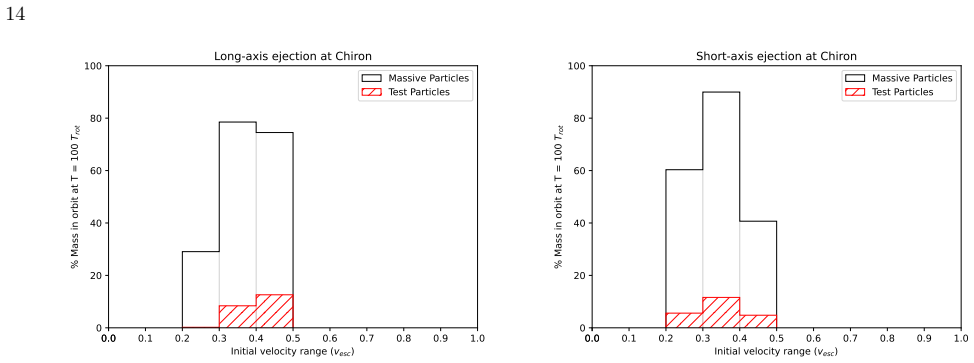
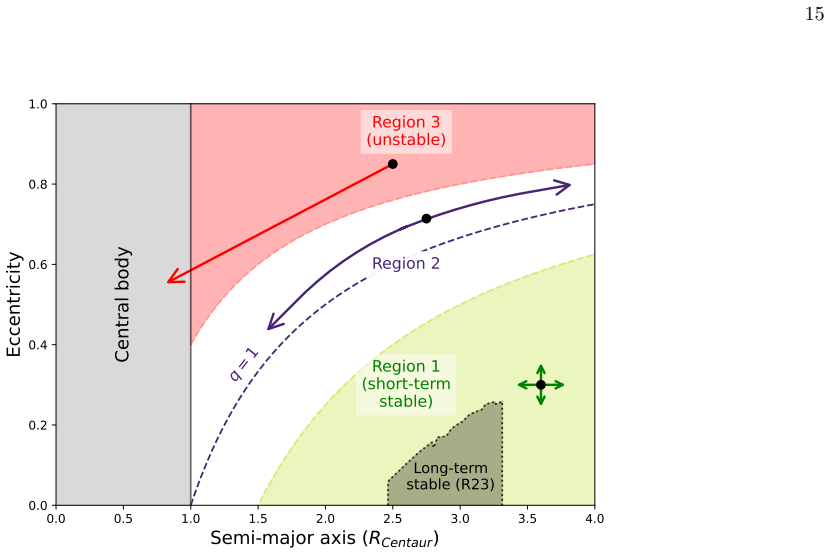
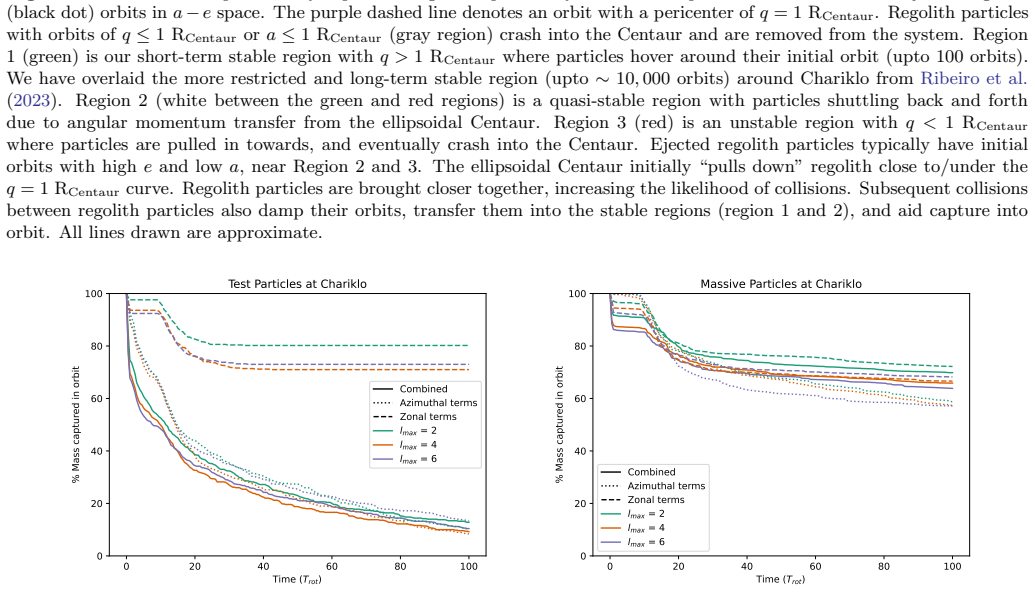
We show that ejected surface regolith is captured in orbit around ellipsoidal Centaurs like Chariklo and Chiron to form a proto-ring disk for at least 100 rotations. This captured disk may serve as a starting point that can evolve into observed ring systems. Inter-particle collisions and the ellipsoidal gravity field facilitate this capture. Among the tested scenarios, a landslide or avalanche-like ejection from the equatorial plane shows the highest rate of capture, ~30 - 90% depending on the initial ejection parameters. This implies that rings could be an indicator of past activity on a Centaur and may be a more common feature among Centaurs depending on their shape and frequency of outbur
What carries the argument
N-body simulations with collisional fragmentation and higher-order gravitational harmonics that track how ejected regolith particles are captured into orbit around an ellipsoidal body.
If this is right
- The captured proto-ring disk persists long enough to serve as a starting point that can evolve into observed ring systems.
- Landslide or avalanche-style ejection from the equatorial plane produces the highest capture rates of 30-90 percent.
- Rings around Centaurs could indicate past cometary outbursts on the body.
- Such proto-rings may be more common among Centaurs depending on their ellipsoidal shape and outburst frequency.
Where Pith is reading between the lines
- Similar ejection and capture could occur on other small bodies with irregular shapes even if they lack observed rings today.
- Future surveys could check whether Centaurs with rings show more signs of recent activity than those without rings.
- The mechanism offers one way rings might form and persist despite the short dynamical lifetimes of Centaurs.
- Adding gas drag or more detailed outburst physics to the simulations would test how sensitive the capture rates are to those details.
Load-bearing premise
The simulations assume that landslide-style ejection from the equatorial plane represents plausible physical conditions during real cometary outbursts and that the ellipsoidal shape plus inter-particle collisions are the main factors enabling capture.
What would settle it
A simulation or observation showing that captured material disperses or escapes within fewer than 100 rotations when using realistic particle sizes, velocities, and rotation rates for an ellipsoidal Centaur.
Figures
read the original abstract
Ring systems have been observed around Centaur Chariklo (10199) and other small bodies but their origin and dynamical histories are still debated. These small body ring systems challenge conventional models for the origin of planetary rings, especially when considering Centaurs' often erratic cometary activity, their non-spherical shapes, and their relatively short dynamical lifetimes (~$10^7$ years). A collisional origin for these rings is disfavored based on the low probability of collisions within their lifetimes, and so their mechanism of formation remains an open question. In this work, we use Swiftest, a N-body integrator with collisional fragmentation and higher-order gravitational harmonics, to test a hypothesis that rings could be formed from regolith ejected from a cometary outburst that is subsequently captured into a stable orbit. We show that ejected surface regolith is captured in orbit around ellipsoidal Centaurs like Chariklo and Chiron to form a proto-ring disk for at least 100 rotations. This captured disk may serve as a starting point that can evolve into observed ring systems. Inter-particle collisions and the ellipsoidal gravity field facilitate this capture. Among the tested scenarios, a landslide or avalanche-like ejection from the equatorial plane shows the highest rate of capture, ~30 - 90% depending on the initial ejection parameters. This implies that rings could be an indicator of past activity on a Centaur and may be a more common feature among Centaurs depending on their shape and frequency of outbursts.
Editorial analysis
A structured set of objections, weighed in public.
Referee Report
Summary. The paper uses N-body simulations with Swiftest (including collisional fragmentation and higher-order gravitational harmonics) to test whether regolith ejected during cometary outbursts on ellipsoidal Centaurs such as Chariklo and Chiron can be captured into bound orbits, forming a proto-ring disk that persists for at least 100 rotations. The central result is that capture occurs, with the highest efficiencies (30–90 %) for landslide-style ejection from the equatorial plane; inter-particle collisions and the ellipsoidal gravity field are identified as facilitating mechanisms. The authors conclude that rings may indicate past activity and could be more common among Centaurs than previously thought.
Significance. If the reported capture efficiencies hold under physically motivated ejection conditions, the work supplies a non-collisional formation channel for small-body rings that links ring presence directly to episodic cometary activity. This would be a substantive contribution to the origin debate for Chariklo-type rings, especially given the short dynamical lifetimes of Centaurs. The use of an integrator that self-consistently treats both collisions and non-spherical gravity is a methodological strength.
major comments (2)
- [Abstract] Abstract and (presumed) Methods: The headline capture fractions of 30–90 % are obtained exclusively for a narrow subset of initial conditions (landslide-style ejection from the equatorial plane). No quantitative comparison is provided showing that the adopted ejection velocities, angles, and source latitudes fall within the range expected from observed or modeled Centaur outbursts; if real ejections are more isotropic or higher-velocity, the reported efficiencies would not apply and the proto-disk would not form.
- [Abstract] Abstract: The claim that the captured material forms a 'proto-ring disk' that 'may serve as a starting point' for observed rings rests on integrations lasting only 100 rotations. No demonstration is given that the resulting disk is dynamically stable on the longer timescales relevant to Centaur ring lifetimes or that it can evolve into the narrow, dense rings observed.
minor comments (1)
- The manuscript should include explicit tables or figures documenting the full range of ejection parameters tested, convergence checks on particle number and timestep, and quantitative error estimates on the reported capture fractions.
Simulated Author's Rebuttal
We thank the referee for their constructive review and for recognizing the methodological strengths of the Swiftest simulations. We respond point-by-point to the major comments below.
read point-by-point responses
-
Referee: [Abstract] Abstract and (presumed) Methods: The headline capture fractions of 30–90 % are obtained exclusively for a narrow subset of initial conditions (landslide-style ejection from the equatorial plane). No quantitative comparison is provided showing that the adopted ejection velocities, angles, and source latitudes fall within the range expected from observed or modeled Centaur outbursts; if real ejections are more isotropic or higher-velocity, the reported efficiencies would not apply and the proto-disk would not form.
Authors: We agree that the highest efficiencies (30–90 %) are reported for the equatorial landslide case and that the manuscript does not include a direct quantitative mapping of our parameter choices onto specific outburst models. The paper does explore a range of latitudes, velocities, and angles, with equatorial avalanches yielding the peak capture rates, but we accept that additional context is needed. We will revise the manuscript to add a dedicated discussion subsection that compares the adopted ejection velocities (typically a few m/s), angles, and source latitudes to published models of Centaur and comet outbursts (e.g., those derived for 67P/Churyumov–Gerasimenko and other active small bodies). This will clarify the physical plausibility of the landslide-like conditions while retaining the result that capture is possible under those conditions. revision: yes
-
Referee: [Abstract] Abstract: The claim that the captured material forms a 'proto-ring disk' that 'may serve as a starting point' for observed rings rests on integrations lasting only 100 rotations. No demonstration is given that the resulting disk is dynamically stable on the longer timescales relevant to Centaur ring lifetimes or that it can evolve into the narrow, dense rings observed.
Authors: The 100-rotation integration length was selected to demonstrate prompt capture and the formation of a bound, collisionally evolving disk structure. We acknowledge that this duration is short compared with Centaur dynamical lifetimes (~10^7 yr) and does not address subsequent viscous spreading, shepherding, or collisional grinding into narrow rings. We will revise the abstract and conclusions to explicitly state the limited integration time, rephrase the 'starting point' language to emphasize that the captured material provides an initial reservoir whose longer-term evolution remains to be explored, and note that extended simulations incorporating additional physics would be required to assess multi-year stability. revision: partial
Circularity Check
No circularity; forward N-body simulations produce capture fractions as direct outputs
full rationale
The paper reports results exclusively from forward dynamical integrations in Swiftest for specified ejection scenarios (landslide-style from equatorial plane, varying velocities/angles). Capture rates of 30-90% for ≥100 rotations are simulation outputs under those initial conditions, not quantities fitted to observed ring properties, not self-defined via equations, and not justified by self-citation chains. The central claim (ejected regolith can form a proto-disk) follows directly from the integrator runs without reduction to inputs by construction. No load-bearing self-citations, ansatzes, or uniqueness theorems appear in the provided text.
Axiom & Free-Parameter Ledger
free parameters (1)
- ejection velocity, angle, and location parameters
axioms (2)
- domain assumption Centaurs can be modeled as ellipsoids whose gravity includes higher-order harmonics sufficient to influence particle capture
- domain assumption Inter-particle collisions and the non-spherical gravity field are the primary mechanisms enabling capture rather than other unmodeled effects
Reference graph
Works this paper leans on
-
[1]
Araujo, R. A., Winter, O. C., & Sfair, R. 2018, Monthly Notices of the Royal Astronomical Society, 479, 4770, doi: 10.1093/MNRAS/STY1770
-
[2]
Araujo, R. A. N., Sfair, R., & Winter, O. C. 2016, The Astrophysical Journal, 824, 80, doi: 10.3847/0004-637X/824/2/80
-
[3]
Bauer, J. M., Choi, Y.-J., Weissman, P. R., et al. 2008, PASP, 120, 393, doi: 10.1086/587552
-
[4]
2010, Icarus, 210, 472, doi: 10.1016/j.icarus.2010.06.005
Belskaya, I., Bagnulo, S., Barucci, M., et al. 2010, Icarus, 210, 472, doi: 10.1016/j.icarus.2010.06.005
-
[5]
Braga-Ribas, F., Sicardy, B., Ortiz, J. L., et al. 2014, Nature, 508, 72, doi: 10.1038/nature13155
-
[6]
Braga-Ribas, F., Pereira, C. L., Sicardy, B., et al. 2023, Astrophysics A&A, 676, 72, doi: 10.1051/0004-6361/202346749
-
[7]
2025, in Centaurs (IOP Publishing Bristol, UK), doi: 10.1088/2514-3433/ada267ch13
Brisset, J., Blum, J., H´ enault, E., et al. 2025, in Centaurs (IOP Publishing Bristol, UK), doi: 10.1088/2514-3433/ada267ch13
-
[8]
2024, AAS Division for Planetary Sciences meeting #56, id
Brisset, J., Westcott, C., Lowers, R., Lea, M., & Durham, A. 2024, AAS Division for Planetary Sciences meeting #56, id. 113.04. <ALTJOURNAL>Bulletin of the American Astronomical Society, Vol. 56, No. 8 e-id 2024n8i113p04</ALTJOURNAL>, 56, 113.04. https://ui.adsabs.harvard.edu/abs/2024DPS... .5611304B/abstract
2024
-
[9]
Brown, M. E., Barkume, K. M., Ragozzine, D., & Schaller, E. L. 2007, Nature, 446, 294, doi: 10.1038/nature05619
-
[10]
Brunetti, M. T., & Peruccacci, S. 2023, Oxford Research Encyclopedia of Planetary Science, doi: 10.1093/ACREFORE/9780190647926.013.254
-
[11]
Bus, S. J., A’Hearn, M. F., Bowell, E., & Stern, S. A. 2001, Icarus, 150, 94, doi: 10.1006/ICAR.2000.6555
-
[12]
Charnoz, S., Canup, R. M., Crida, A., & Dones, L. 2018, Planetary Ring Systems: Properties, Structure, and Evolution, 517, doi: 10.1017/9781316286791.018
-
[13]
Cikota, S., Fern´ andez-Valenzuela, E., Ortiz, J. L., et al. 2018, Monthly Notices of the Royal Astronomical Society, 475, 2512, doi: 10.1093/mnras/stx3352
-
[14]
Dobson, M. M., Schwamb, M. E., Fitzsimmons, A., et al. 2024, The Planetary Science Journal, 5, 165, doi: 10.3847/PSJ/ad543c 19
-
[15]
Duncan, M. J., Levison, H. F., & Lee, M. H. 1998, The Astronomical Journal, 116, 2067, doi: 10.1086/300541/FULLTEXT/
-
[16]
2014, Astronomy & Astrophysics, 568, L11, doi: 10.1051/0004-6361/201424439 Giuliatti Winter, S
Fornasier, S., Lazzaro, D., Alvarez-Candal, A., et al. 2014, Astronomy & Astrophysics, 568, L11, doi: 10.1051/0004-6361/201424439 Giuliatti Winter, S. M., Madeira, G., Ribeiro, T., et al. 2023, Astronomy and Astrophysics, 679, A62, doi: 10.1051/0004-6361/202345864
-
[17]
2023, 55th Annual Meeting of the Division for Planetary Sciences, id
Hahn, J., Hamilton, D., Rimlinger, T., & Lu, Y. 2023, 55th Annual Meeting of the Division for Planetary Sciences, id. 110.03. Bulletin of the American Astronomical
2023
-
[18]
Nature , year = 2020, volume = 585, pages =
Harris, C. R., Millman, K. J., van der Walt, S. J., et al. 2020, Nature 2020 585:7825, 585, 357, doi: 10.1038/s41586-020-2649-2
-
[19]
Holsapple, K. A., & Michel, P. 2008, Icarus, 193, 283, doi: 10.1016/J.ICARUS.2007.09.011
-
[20]
2016, The Astrophysical Journal Letters, 828, doi: 10.3847/2041-8205/828/1/L8
Hyodo, R., Charnoz, S., Genda, H., & Ohtsuki, K. 2016, The Astrophysical Journal Letters, 828, doi: 10.3847/2041-8205/828/1/L8
-
[21]
2009, Astronomical Journal, 137, 4296, doi: 10.1088/0004-6256/137/5/4296
Jewitt, D. 2009, Astronomical Journal, 137, 4296, doi: 10.1088/0004-6256/137/5/4296
-
[22]
2024, Comets III, 767, doi: 10.2458/azu{ }uapress{ }9780816553631-ch023
Jewitt, D., & Hsieh, H. 2024, Comets III, 767, doi: 10.2458/azu{ }uapress{ }9780816553631-ch023
work page doi:10.2458/azu 2024
-
[23]
Kareta, T., Schambeau, C. A., Firgard, M., et al. 2025, PSJ, 6, 119, doi: 10.3847/PSJ/ADCE07
-
[24]
2019, The Astronomical Journal, 158, 255, doi: 10.3847/1538-3881/AB505F
Kareta, T., Sharkey, B., Noonan, J., et al. 2019, The Astronomical Journal, 158, 255, doi: 10.3847/1538-3881/AB505F
-
[25]
E., Minton, D
Laipert, F. E., Minton, D. A., & Longuski, J. M. 2014, in Lunar and Planetary Science Conference
2014
-
[26]
Leinhardt, Z. M., & Stewart, S. T. 2012, The Astrophysical Journal, 745, 79, doi: 10.1088/0004-637X/745/1/79
-
[27]
Leiva, R., Sicardy, B., Camargo, J. I. B., et al. 2017, The Astronomical Journal, 154, 159, doi: 10.3847/1538-3881/aa8956
-
[28]
Levison, H. F., & Duncan, M. J. 1994, Icarus, 108, 18, doi: 10.1006/ICAR.1994.1039
-
[29]
2000, Icarus, 143, 415, doi: 10.1006/ICAR.1999.6313
Dones, L. 2000, Icarus, 143, 415, doi: 10.1006/ICAR.1999.6313
-
[30]
2024, The Astrophysical Journal Letters, 960, L8, doi: 10.3847/2041-8213/ad1606
Lilly, E., Jevˇ c´ ak, P., Schambeau, C., et al. 2024, The Astrophysical Journal Letters, 960, L8, doi: 10.3847/2041-8213/ad1606
-
[31]
Lisse, C. M., Steckloff, J. K., Prialnik, D., et al. 2022, The Planetary Science Journal, 3, 251, doi: 10.3847/PSJ/AC9468
-
[32]
Luu, J. X., & Jewitt, D. C. 1990, Astronomical Journal v.100, p.913, 100, 913, doi: 10.1086/115571
-
[33]
Meech, K. J., & Belton, M. J. S. 1990, Astronomical Journal v.100, p.1323, 100, 1323, doi: 10.1086/115600
-
[34]
Melita, M. D., Duffard, R., Ortiz, J. L., & Campo-Bagatin, A. 2017, A&A, 602, 27, doi: 10.1051/0004-6361/201629858
-
[35]
2017, The Astrophysical Journal Letters, 837, doi: 10.3847/2041-8213/aa6256
Michikoshi, S., & Kokubo, E. 2017, The Astrophysical Journal Letters, 837, doi: 10.3847/2041-8213/aa6256
-
[36]
E., Sicardy, B., Braga-Ribas, F., et al
Morgado, B. E., Sicardy, B., Braga-Ribas, F., et al. 2021, doi: 10.1051/0004-6361/202141543 —. 2023, Nature, 614, 239, doi: 10.1038/s41586-022-05629-6 M¨ uller, D. R., Altwegg, K., Berthelier, J.-J., et al. 2024, MNRAS, 529, 2763, doi: 10.1093/MNRAS/STAE622
-
[37]
Murray, C. D., & Dermott, S. F. 2000, Solar System Dynamics, doi: 10.1017/CBO9781139174817
-
[38]
L., Duffard, R., Pinilla-Alonso, N., et al
Ortiz, J. L., Duffard, R., Pinilla-Alonso, N., et al. 2015, Astronomy and Astrophysics, 576, doi: 10.1051/0004-6361/201424461
-
[39]
L., Santos-Sanz, P., Sicardy, B., et al
Ortiz, J. L., Santos-Sanz, P., Sicardy, B., et al. 2017, Nature, 550, 219, doi: 10.1038/nature24051
-
[40]
Ortiz, J. L., Pereira, C. L., Sicardy, B., et al. 2023, A&A, 676, L12, doi: 10.1051/0004-6361/202347025
-
[41]
2016, The Astrophysical Journal, 821, 18, doi: 10.3847/0004-637X/821/1/18
Pan, M., & Wu, Y. 2016, The Astrophysical Journal, 821, 18, doi: 10.3847/0004-637X/821/1/18
-
[42]
Pereira, C. L., Sicardy, B., Morgado, B. E., et al. 2023, A&A, 673, L4, doi: 10.1051/0004-6361/202346365
-
[43]
L., Braga-Ribas, F., Sicardy, B., et al
Pereira, C. L., Braga-Ribas, F., Sicardy, B., et al. 2024, MNRAS, 527, 29, doi: 10.1093/mnras/stad3318 —. 2025, The Astrophysical Journal Letters, 992, L19, doi: 10.3847/2041-8213/ae0b6d
-
[44]
2024, Astronomy and Astrophysics, 692, L11, doi: 10.1051/0004-6361/202450124
Pinilla-Alonso, N., Licandro, J., Brunetto, R., et al. 2024, Astronomy and Astrophysics, 692, L11, doi: 10.1051/0004-6361/202450124
-
[45]
C., Madeira, G., & Giuliatti Winter, S
Ribeiro, T., Winter, O. C., Madeira, G., & Giuliatti Winter, S. M. 2023, Monthly Notices of the Royal Astronomical Society, 525, 44, doi: 10.1093/MNRAS/STAD2362
-
[46]
P., Hahn, J
Rimlinger, T., Hamilton, D. P., Hahn, J. M., et al. 2017, DPS, 49, 501.03. https://ui.adsabs.harvard.edu/abs/ 2017DPS....4950103R/abstract
2017
-
[47]
2021, MNRAS, 507, 3444, doi: 10.1093/MNRAS/STAB2379
Rousselot, P., Kryszczy´ nska, A., Bartczak, P., et al. 2021, MNRAS, 507, 3444, doi: 10.1093/MNRAS/STAB2379
-
[48]
D., Bosh, A
Ruprecht, J. D., Bosh, A. S., Person, M. J., et al. 2015,
2015
-
[49]
271-276., 252, 271, doi: 10.1016/J.ICARUS.2015.01.015
Icarus, Volume 252, p. 271-276., 252, 271, doi: 10.1016/J.ICARUS.2015.01.015
-
[50]
2021, in European Planetary Science Congress, Vol
Salo, H., Sicardy, B., Mondino-Llermanos, A., et al. 2021, in European Planetary Science Congress, Vol. 15, 2021–338, doi: 10.5194/epsc2021-338
-
[51]
2024, doi: 10.3847/2041-8213/ad18d9 20
Shi, X., Hu, X., Agarwal, J., et al. 2024, doi: 10.3847/2041-8213/ad18d9 20
-
[52]
2019, Nature Astronomy, 3, 146, doi: 10.1038/s41550-018-0616-8
Sicardy, B., Leiva, R., Renner, S., et al. 2019, Nature Astronomy, 3, 146, doi: 10.1038/s41550-018-0616-8
-
[53]
2021, in European Planetary Science Congress, Vol
Sicardy, B., Salo, H., Souami, D., et al. 2021, in European Planetary Science Congress, Vol. 15, 2021–91, doi: 10.5194/epsc2021-91
-
[54]
2025, RSPTA, 383, 20240193, doi: 10.1098/RSTA.2024.0193
Sicardy, B., El Moutamid, M., Renner, S., et al. 2025, RSPTA, 383, 20240193, doi: 10.1098/RSTA.2024.0193
-
[55]
Sickafoose, A. A., Levine, S. E., Bosh, A. S., et al. 2023, Planetary Science Journal, 4, doi: 10.3847/PSJ/AD0632
-
[56]
Sickafoose, A. A., & Lewis, M. C. 2024, The Planetary Science Journal, 5, 32, doi: 10.3847/PSJ/AD151C
-
[57]
Sickafoose, A. A., Bosh, A. S., Emery, J. P., et al. 2020, MNRAS, 491, 3643, doi: 10.1093/mnras/stz3079
-
[58]
2023, That’s The Way The Comet Crumbles: Identifying Comet 67P’s Mass-Wasting-Driven Outburst Plumes·Vol
Steckloff, J. 2023, That’s The Way The Comet Crumbles: Identifying Comet 67P’s Mass-Wasting-Driven Outburst Plumes·Vol. 55, Issue 8 (DPS55 Abstracts). https://baas.aas.org/pub/2023n8i408p04/release/1
2023
-
[59]
Stewart, S. T., & Leinhardt, Z. M. 2009, ApJL, 691, L133, doi: 10.1088/0004-637X/691/2/L133
-
[60]
2013, Astrophysical Journal Letters, 765, doi: 10.1088/2041-8205/765/2/L28
Castillo-Rogez, J. 2013, Astrophysical Journal Letters, 765, doi: 10.1088/2041-8205/765/2/L28
-
[61]
Tiscareno, M. S., & Malhotra, R. 2003, The Astronomical Journal, 126, 3122, doi: 10.1086/379554/FULLTEXT/
-
[62]
Virtanen, P., Gommers, R., Oliphant, T. E., et al. 2020, Nature Methods 2020 17:3, 17, 261, doi: 10.1038/s41592-019-0686-2 Weso lowski, M., Gronkowski, P., Tralle, I., et al. 2020, Icar, 352, 114005, doi: 10.1016/J.ICARUS.2020.114005
-
[63]
Wieczorek, M. A. 2015, Treatise on Geophysics: Second Edition, 10, 153, doi: 10.1016/B978-0-444-53802-4.00169-X
-
[64]
A., & Meschede, M
Wieczorek, M. A., & Meschede, M. 2018, Geochemistry,
2018
-
[65]
Geophysics, Geosystems, 19, 2574, doi: 10.1029/2018GC007529
-
[66]
2023, Journal of Open Source Software, 8, 5409, doi: 10.21105/joss.05409
Wishard, C., Pouplin, J., Elliott, J., et al. 2023, Journal of Open Source Software, 8, 5409, doi: 10.21105/joss.05409
-
[67]
Wood, J., Horner, J., Hinse, T. C., & Marsden, S. C. 2017, The Astronomical Journal, 153, 245, doi: 10.3847/1538-3881/aa6981
discussion (0)
Sign in with ORCID, Apple, or X to comment. Anyone can read and Pith papers without signing in.