Asymptotically Safe Gravitational Form Factors from the Proper-Time Flow Equation
Pith reviewed 2026-06-29 10:19 UTC · model grok-4.3
The pith
Asymptotically safe gravitational form factors are finite and scale-independent only if the ultraviolet boundary condition selects the non-Gaussian fixed point
A machine-rendered reading of the paper's core claim, the machinery that carries it, and where it could break.
Core claim
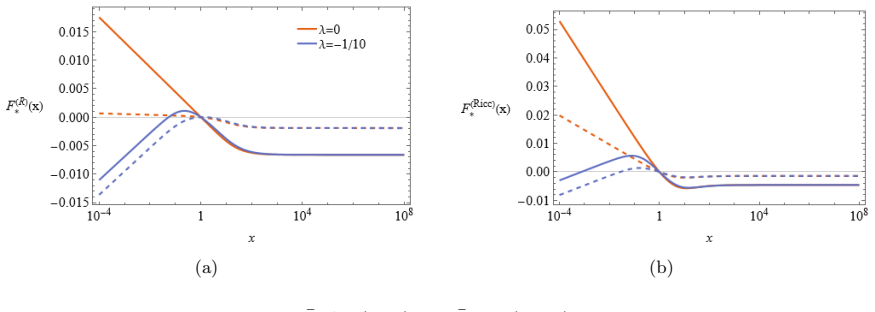
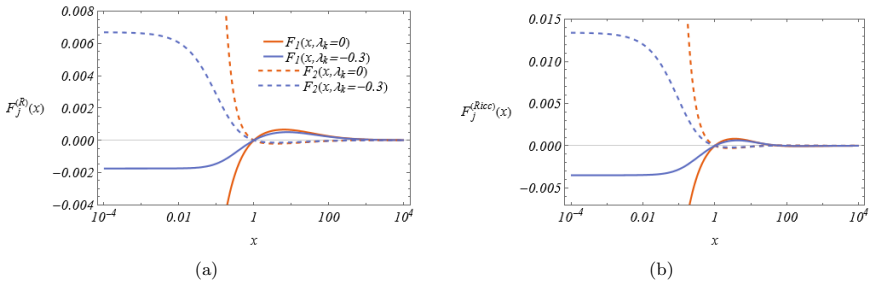
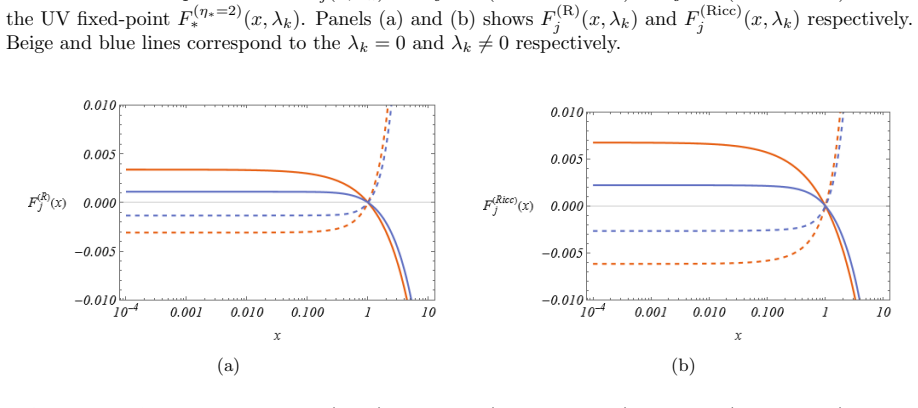
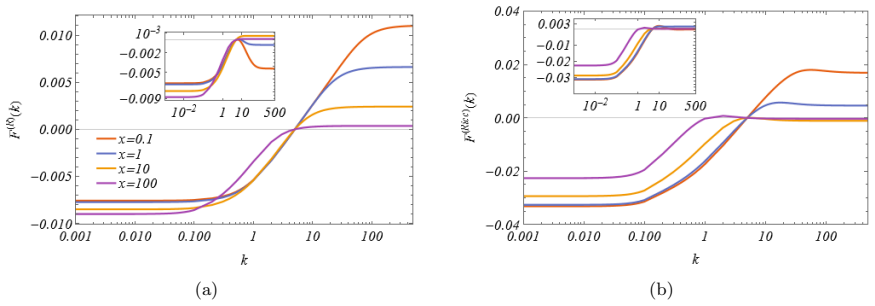
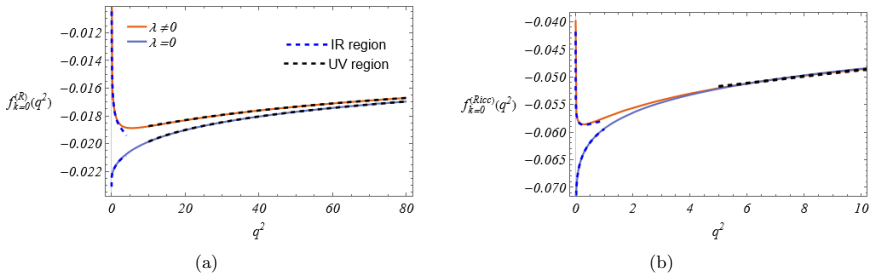
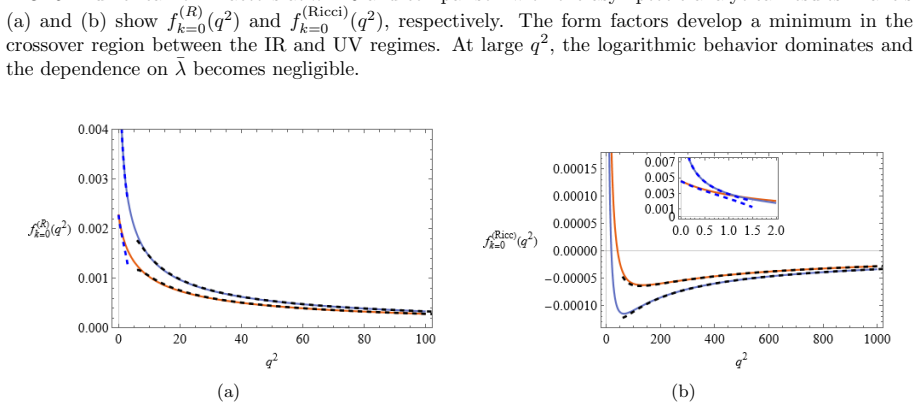
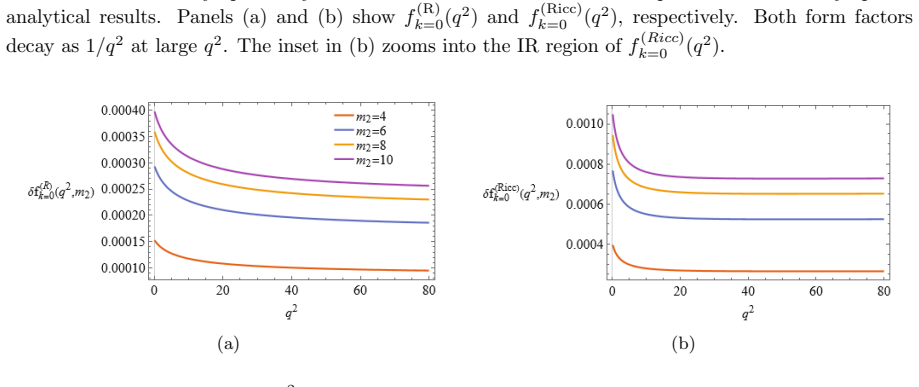
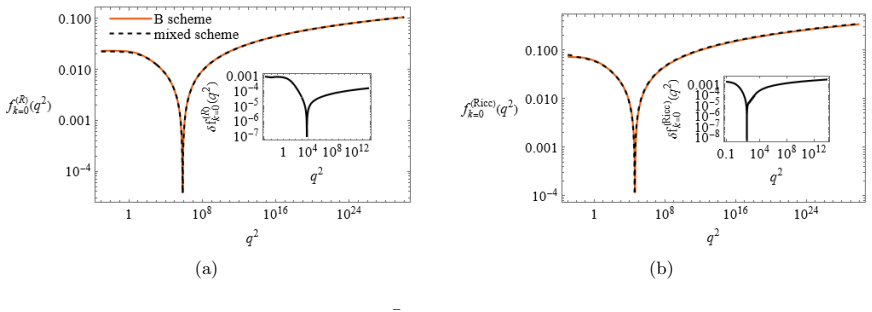
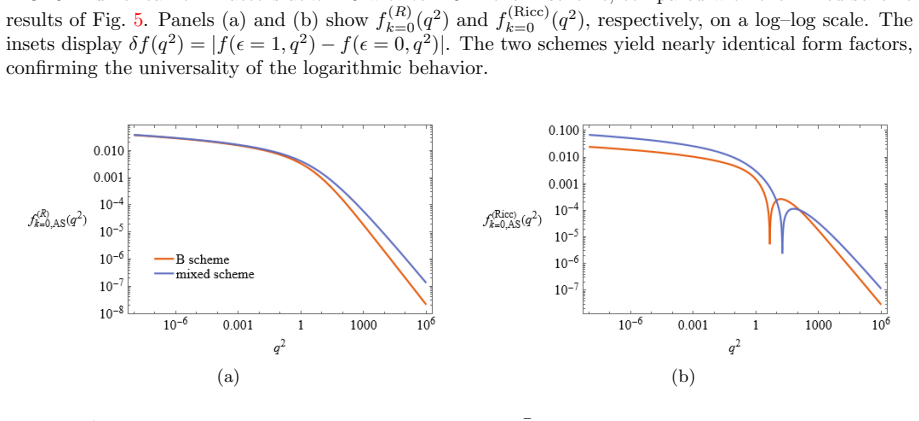
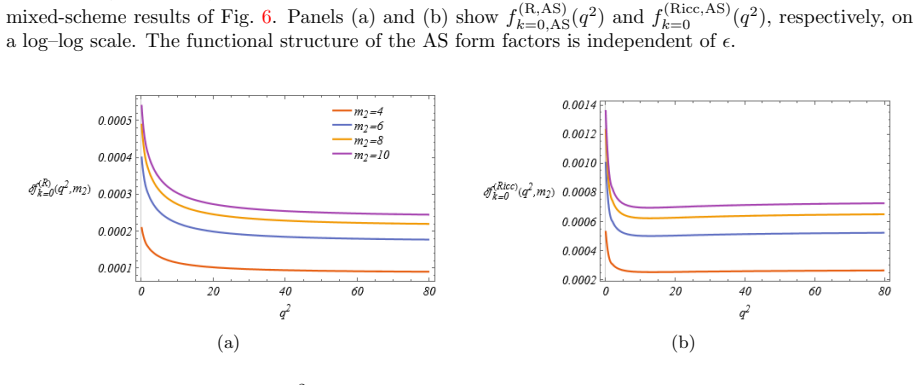
Within the proper-time formalism at quadratic order in the curvature expansion, the flow equations for gravitational form factors integrate to k equals zero. Asymptotic safety alone leaves a logarithmic divergence in the Lambda to infinity limit, requiring an additional renormalization condition. Only the non-Gaussian fixed point as ultraviolet boundary condition removes these divergences, yielding finite dimensionful form factors that are independent of the renormalization scale mu, decay as one over q squared in the ultraviolet, and exhibit the expected logarithmic structure in the infrared with the Planck scale in place of mu.
What carries the argument
The proper-time flow equation for non-local gravitational form factors, integrated from the non-Gaussian fixed point at quadratic order in curvature, which enforces finiteness and scale independence
If this is right
- The renormalized form factors become independent of the renormalization scale mu
- The ultraviolet momentum dependence follows a power-law decay proportional to 1/q squared
- The infrared structure matches expected logs but with the Planck scale setting the scale
- Finite dimensionful form factors are obtained without ultraviolet logarithmic contributions
Where Pith is reading between the lines
- If higher curvature orders preserve the fixed point selection, the result would hold more generally
- This method could be compared to other flow equation schemes for consistency in form factor predictions
- The Planck scale dominance in IR might influence effective field theory matching at low energies
Load-bearing premise
Integrating the flow at only quadratic order in the curvature expansion captures the momentum dependence without higher terms affecting the UV finiteness or boundary condition
What would settle it
Computing the form factors including cubic curvature terms and checking if the Lambda to infinity limit remains finite when starting from the non-Gaussian fixed point would test the claim
Figures
read the original abstract
We study the renormalization group flow of non-local form factors in four-dimensional quantum gravity within the proper-time formalism at quadratic order in the curvature expansion. We show that the flow equations can be integrated down to $k=0$, allowing the reconstruction of the full momentum dependence of the form factors. Within this framework, we construct asymptotically safe solutions at this order. We find that asymptotic safety of the flow does not automatically ensure a finite cutoff-independent $\Lambda\to\infty$ limit for the integrated solutions, which in general develop a logarithmic divergence $\ln(q^2/\Lambda^2)$, so that a renormalization condition is still required. A finite $\Lambda\to\infty$ limit compatible with asymptotic safety is obtained only when the ultraviolet boundary condition selects the non-Gaussian fixed point. This yields finite dimensionful form factors, removes UV logarithmic contributions, and ensures independence from the renormalization scale $\mu$. The resulting renormalized asymptotically safe form factors display a power-law decay $\sim1/q^2$ in the ultraviolet and reproduce the expected logarithmic structure in the infrared, with the Planck scale replacing the renormalization scale.
Editorial analysis
A structured set of objections, weighed in public.
Referee Report
Summary. The manuscript studies the renormalization group flow of non-local gravitational form factors in four-dimensional quantum gravity within the proper-time formalism, truncated at quadratic order in the curvature expansion. The flow equations are integrated explicitly down to k=0 to reconstruct the full momentum dependence. Asymptotically safe solutions are constructed, but a finite, cutoff-independent limit as Λ→∞ is not automatic and requires selecting the non-Gaussian fixed point as the ultraviolet boundary condition; this removes logarithmic divergences ln(q²/Λ²), yields finite dimensionful form factors independent of the renormalization scale μ, produces a power-law decay ∼1/q² in the ultraviolet, and reproduces the expected logarithmic structure in the infrared with the Planck scale replacing μ.
Significance. If the central result holds within the stated truncation, the work supplies an explicit construction of renormalized asymptotically safe form factors with cutoff-independent physical properties. Credit is due for the explicit integration of the flow equations to k=0, which is a concrete strength of the proper-time approach and allows direct reconstruction of momentum dependence. This contributes a calculational example to the asymptotic-safety program for momentum-dependent quantities.
major comments (1)
- [Discussion of UV boundary conditions and integrated solutions (following the statement of the flow equations)] The demonstration that only the non-Gaussian fixed point as UV boundary condition produces a finite Λ→∞ limit (removing the logarithmic divergence) is performed exclusively at quadratic order in the curvature expansion. Higher-order curvature invariants enter the proper-time beta functions for the form factors and can alter the fixed-point structure or the integrated flow, potentially reintroducing divergences; the manuscript provides no estimate or argument for the stability of the finiteness property under truncation extension. This is load-bearing for the claim that the NGFP selection ensures a finite cutoff-independent result compatible with asymptotic safety.
minor comments (2)
- [Abstract and introduction] The abstract and early sections introduce the form factors without an explicit definition or reference to their precise operator structure; adding this would improve readability.
- [Section on the proper-time flow equation] The manuscript could clarify the precise form of the proper-time regulator and cutoff function used in the flow equation, including any assumptions about its shape.
Simulated Author's Rebuttal
We thank the referee for the positive evaluation and the constructive major comment. We respond to it below.
read point-by-point responses
-
Referee: The demonstration that only the non-Gaussian fixed point as UV boundary condition produces a finite Λ→∞ limit (removing the logarithmic divergence) is performed exclusively at quadratic order in the curvature expansion. Higher-order curvature invariants enter the proper-time beta functions for the form factors and can alter the fixed-point structure or the integrated flow, potentially reintroducing divergences; the manuscript provides no estimate or argument for the stability of the finiteness property under truncation extension. This is load-bearing for the claim that the NGFP selection ensures a finite cutoff-independent result compatible with asymptotic safety.
Authors: We agree that the demonstration is performed exclusively within the quadratic curvature truncation, as stated repeatedly in the manuscript (including the abstract and the section following the flow equations). At this order the selection of the non-Gaussian fixed point removes the logarithmic divergence and yields a finite, cutoff-independent result. Higher-order curvature invariants would indeed enter the beta functions and could modify the fixed-point structure or the integrated flow. The manuscript contains no estimate of stability under truncation extension because performing such an estimate requires a systematic extension of the truncation, which lies outside the scope of the present work. We have revised the conclusions to include an explicit statement that the finiteness property is established at quadratic order and that its robustness against higher-order corrections is an open question for future investigations. revision: yes
Circularity Check
No significant circularity; derivation follows from explicit integration of flow equations
full rationale
The paper integrates the proper-time flow equations at quadratic curvature order to reconstruct form-factor momentum dependence, then demonstrates by direct solution that a generic UV boundary produces ln(q²/Λ²) divergences while the non-Gaussian fixed point boundary removes them and yields μ-independent finite results. This outcome is obtained from the differential equations themselves rather than by definitional fiat or self-citation. No load-bearing self-citations, ansatze imported from prior author work, or fitted inputs renamed as predictions appear in the abstract or described chain. The truncation limitation is acknowledged as an assumption but does not render the reported computation circular within the stated order.
Axiom & Free-Parameter Ledger
free parameters (1)
- UV boundary condition at non-Gaussian fixed point
axioms (2)
- domain assumption The proper-time flow equation remains reliable when truncated to quadratic order in curvature.
- domain assumption A non-Gaussian fixed point exists and can be used as a UV boundary condition without higher-order corrections altering its location.
Forward citations
Cited by 4 Pith papers
-
Spectral Functions of Lorentzian Quantum Gravity
Spectral functions for graviton and scalar graviton modes are derived in Lorentzian asymptotically safe quantum gravity via adapted FRG flow equations, yielding normalisable results consistent with infrared effective theory.
-
The Graviton Propagator in Asymptotically Safe Gravity with Non-Local Form Factors
At quadratic order in asymptotically safe gravity, the graviton propagator has a single pole at q²=0 with positive residue, no ghost poles, and yields a regular Newtonian potential at r=0.
-
The pole truth: an analytical graviton propagator from Asymptotic Safety
Analytical approximation to the graviton propagator from Asymptotic Safety shows no extra poles and identifies a mechanism where spurious pole residues vanish at higher orders.
-
Asymptotically safe quantum gravity and its phenomenology -- a review
Review surveying progress toward realistic asymptotically safe quantum gravity with quantum scale symmetry and observational implications.
Reference graph
Works this paper leans on
-
[1]
Status of the asymptotic safety paradigm for quantum gravity and matter
A. Eichhorn, Status of the asymptotic safety paradigm for quantum gravity and matter, Found. Phys.48, 1407 (2018), arXiv:1709.03696 [gr-qc]
work page internal anchor Pith review Pith/arXiv arXiv 2018
-
[2]
A. Bonanno, A. Eichhorn, H. Gies, J. M. Pawlowski, R. Percacci, M. Reuter, F. Saueressig, and G. P. Vacca, Critical reflections on asymptotically safe gravity, Front. in Phys.8, 269 (2020), arXiv:2004.06810 [gr-qc]. 52
-
[3]
The Asymptotic Safety Scenario in Quantum Gravity -- An Introduction
M. Niedermaier, The Asymptotic safety scenario in quantum gravity: An Introduction, Class. Quant. Grav.24, R171 (2007), arXiv:gr-qc/0610018
work page internal anchor Pith review Pith/arXiv arXiv 2007
-
[4]
M. Reuter and F. Saueressig, Quantum Einstein Gravity, New J. Phys.14, 055022 (2012), arXiv:1202.2274 [hep-th]
work page internal anchor Pith review Pith/arXiv arXiv 2012
- [5]
-
[6]
Pawlowski and M
J. Pawlowski and M. Reichert, Quantum gravity: A fluctuating point of view, Frontiers in Physics 8, 551848 (2021)
2021
-
[7]
Percacci,An Introduction to Covariant Quantum Gravity and Asymptotic Safety(World Scien- tific, 2017) pp
R. Percacci,An Introduction to Covariant Quantum Gravity and Asymptotic Safety(World Scien- tific, 2017) pp. 1–300
2017
-
[8]
Saueressig, The Functional Renormalization Group in Quantum Gravity (2023) arXiv:2302.14152 [hep-th]
F. Saueressig, The Functional Renormalization Group in Quantum Gravity (2023) arXiv:2302.14152 [hep-th]
-
[9]
Reuter and F
M. Reuter and F. Saueressig,Quantum Gravity and the Functional Renormalization Group: The Road towards Asymptotic Safety, Cambridge Monographs on Mathematical Physics (Cambridge University Press, 2019)
2019
-
[10]
T. R. Morris, The Exact renormalization group and approximate solutions, Int. J. Mod. Phys. A 9, 2411 (1994), arXiv:hep-ph/9308265
work page internal anchor Pith review Pith/arXiv arXiv 1994
-
[11]
Wetterich, Exact evolution equation for the effective potential, Physics Letters B301, 90 (1993)
C. Wetterich, Exact evolution equation for the effective potential, Physics Letters B301, 90 (1993)
1993
-
[12]
Flow Equations for N Point Functions and Bound States
U. Ellwanger, FLow equations for N point functions and bound states, Z. Phys. C62, 503 (1994), arXiv:hep-ph/9308260
work page internal anchor Pith review Pith/arXiv arXiv 1994
-
[13]
P. F. Machado and F. Saueressig, On the renormalization group flow of f(R)-gravity, Phys. Rev. D 77, 124045 (2008), arXiv:0712.0445 [hep-th]
work page internal anchor Pith review Pith/arXiv arXiv 2008
-
[14]
Investigating the Ultraviolet Properties of Gravity with a Wilsonian Renormalization Group Equation
A. Codello, R. Percacci, and C. Rahmede, Investigating the Ultraviolet Properties of Gravity with a Wilsonian Renormalization Group Equation, Annals Phys.324, 414 (2009), arXiv:0805.2909 [hep-th]
work page internal anchor Pith review Pith/arXiv arXiv 2009
-
[15]
A bootstrap strategy for asymptotic safety
K. Falls, D. F. Litim, K. Nikolakopoulos, and C. Rahmede, A bootstrap towards asymptotic safety (2013), arXiv:1301.4191 [hep-th]
work page internal anchor Pith review Pith/arXiv arXiv 2013
-
[16]
Further evidence for asymptotic safety of quantum gravity
K. Falls, D. F. Litim, K. Nikolakopoulos, and C. Rahmede, Further evidence for asymptotic safety of quantum gravity, Phys. Rev. D93, 104022 (2016), arXiv:1410.4815 [hep-th]
work page internal anchor Pith review Pith/arXiv arXiv 2016
-
[17]
K. G. Falls, D. F. Litim, and J. Schr¨ oder, Aspects of asymptotic safety for quantum gravity, Phys. Rev. D99, 126015 (2019), arXiv:1810.08550 [gr-qc]
work page internal anchor Pith review Pith/arXiv arXiv 2019
-
[18]
Ultraviolet properties of f(R)-Gravity
A. Codello, R. Percacci, and C. Rahmede, Ultraviolet properties of f(R)-gravity, Int. J. Mod. Phys. A23, 143 (2008), arXiv:0705.1769 [hep-th]
work page internal anchor Pith review Pith/arXiv arXiv 2008
-
[19]
Asymptotically safe f(R)-gravity coupled to matter I: the polynomial case
N. Alkofer and F. Saueressig, Asymptotically safef(R)-gravity coupled to matter I: the polynomial case, Annals Phys.396, 173 (2018), arXiv:1802.00498 [hep-th]. 53
work page internal anchor Pith review Pith/arXiv arXiv 2018
-
[20]
N. Ohta, R. Percacci, and G. P. Vacca, Renormalization Group Equation and scaling solutions for f(R) gravity in exponential parametrization, Eur. Phys. J. C76, 46 (2016), arXiv:1511.09393 [hep-th]
work page internal anchor Pith review Pith/arXiv arXiv 2016
-
[21]
N. Ohta, R. Percacci, and G. P. Vacca, Flow equation forf(R) gravity and some of its exact solutions, Phys. Rev. D92, 061501 (2015), arXiv:1507.00968 [hep-th]
work page internal anchor Pith review Pith/arXiv arXiv 2015
-
[22]
Renormalization Group Equation for $f(R)$ gravity on hyperbolic spaces
K. Falls and N. Ohta, Renormalization Group Equation forf(R) gravity on hyperbolic spaces, Phys. Rev. D94, 084005 (2016), arXiv:1607.08460 [hep-th]
work page internal anchor Pith review Pith/arXiv arXiv 2016
-
[23]
N. Ohta, R. Percacci, and A. D. Pereira, Gauges and functional measures in quantum gravity I: Einstein theory, JHEP06, 115, arXiv:1605.00454 [hep-th]
work page internal anchor Pith review Pith/arXiv arXiv
-
[24]
J. D. Gon¸ calves, T. de Paula Netto, and I. L. Shapiro, Gauge and parametrization ambiguity in quantum gravity, Phys. Rev. D97, 026015 (2018), arXiv:1712.03338 [hep-th]
work page internal anchor Pith review Pith/arXiv arXiv 2018
-
[25]
Field Parametrization Dependence in Asymptotically Safe Quantum Gravity
A. Nink, Field Parametrization Dependence in Asymptotically Safe Quantum Gravity, Phys. Rev. D91, 044030 (2015), arXiv:1410.7816 [hep-th]
work page internal anchor Pith review Pith/arXiv arXiv 2015
-
[26]
Renormalisation of Newton's constant
K. Falls, Renormalization of Newton’s constant, Phys. Rev. D92, 124057 (2015), arXiv:1501.05331 [hep-th]
work page internal anchor Pith review Pith/arXiv arXiv 2015
-
[27]
H. Gies, B. Knorr, and S. Lippoldt, Generalized Parametrization Dependence in Quantum Gravity, Phys. Rev. D92, 084020 (2015), arXiv:1507.08859 [hep-th]
work page internal anchor Pith review Pith/arXiv arXiv 2015
-
[28]
Gauge Dependence of the Effective Average Action in Einstein Gravity
S. Falkenberg and S. D. Odintsov, Gauge dependence of the effective average action in Einstein gravity, Int. J. Mod. Phys. A13, 607 (1998), arXiv:hep-th/9612019
work page internal anchor Pith review Pith/arXiv arXiv 1998
-
[29]
Gauge and Cutoff Function Dependence of the Ultraviolet Fixed Point in Quantum Gravity
W. Souma, Gauge and cutoff function dependence of the ultraviolet fixed point in quantum gravity (2000), arXiv:gr-qc/0006008
work page internal anchor Pith review Pith/arXiv arXiv 2000
- [30]
-
[31]
A. Bonanno, G. Oglialoro, and D. Zappal` a, Gauge and parametrization dependence of quantum Einstein gravity within the proper time flow, Phys. Rev. D112, 026002 (2025), arXiv:2504.07877 [hep-th]
-
[32]
N. Ohta, R. Percacci, and A. D. Pereira, Gauges and functional measures in quantum gravity II: Higher derivative gravity, Eur. Phys. J. C77, 611 (2017), arXiv:1610.07991 [hep-th]
work page internal anchor Pith review Pith/arXiv arXiv 2017
-
[33]
Asymptotic safety of quantum gravity beyond Ricci scalars
K. Falls, C. R. King, D. F. Litim, K. Nikolakopoulos, and C. Rahmede, Asymptotic safety of quantum gravity beyond Ricci scalars, Phys. Rev. D97, 086006 (2018), arXiv:1801.00162 [hep-th]
work page internal anchor Pith review Pith/arXiv arXiv 2018
-
[34]
M. H. Goroff and A. Sagnotti, The ultraviolet behavior of einstein gravity, Nuclear Physics B266, 709 (1986)
1986
-
[35]
J. Ambjorn, J. Jurkiewicz, and R. Loll, Reconstructing the universe, Phys. Rev. D72, 064014 (2005), arXiv:hep-th/0505154. 54
work page internal anchor Pith review Pith/arXiv arXiv 2005
-
[36]
Evidence for Asymptotic Safety from Lattice Quantum Gravity
J. Laiho and D. Coumbe, Evidence for Asymptotic Safety from Lattice Quantum Gravity, Phys. Rev. Lett.107, 161301 (2011), arXiv:1104.5505 [hep-lat]
work page internal anchor Pith review Pith/arXiv arXiv 2011
-
[37]
Nonperturbative Quantum Gravity
J. Ambjorn, A. Goerlich, J. Jurkiewicz, and R. Loll, Nonperturbative Quantum Gravity, Phys. Rept.519, 127 (2012), arXiv:1203.3591 [hep-th]
work page internal anchor Pith review Pith/arXiv arXiv 2012
-
[38]
Exploring Euclidean Dynamical Triangulations with a Non-trivial Measure Term
D. Coumbe and J. Laiho, Exploring Euclidean Dynamical Triangulations with a Non-trivial Mea- sure Term, JHEP04, 028, arXiv:1401.3299 [hep-th]
work page internal anchor Pith review Pith/arXiv arXiv
-
[39]
Lattice Quantum Gravity and Asymptotic Safety
J. Laiho, S. Bassler, D. Coumbe, D. Du, and J. T. Neelakanta, Lattice Quantum Gravity and Asymptotic Safety, Phys. Rev. D96, 064015 (2017), arXiv:1604.02745 [hep-th]
work page internal anchor Pith review Pith/arXiv arXiv 2017
-
[40]
The phase structure of Causal Dynamical Triangulations with toroidal spatial topology
J. Ambjørn, J. Gizbert-Studnicki, A. G¨ orlich, J. Jurkiewicz, and D. N´ emeth, The phase structure of Causal Dynamical Triangulations with toroidal spatial topology, JHEP06, 111, arXiv:1802.10434 [hep-th]
work page internal anchor Pith review Pith/arXiv arXiv
-
[41]
Loll, Quantum Gravity from Causal Dynamical Triangulations: A Review, Class
R. Loll, Quantum Gravity from Causal Dynamical Triangulations: A Review, Class. Quant. Grav. 37, 013002 (2020), arXiv:1905.08669 [hep-th]
-
[42]
J. Ambjorn, Z. Drogosz, J. Gizbert-Studnicki, A. G¨ orlich, J. Jurkiewicz, and D. N` emeth, CDT Quantum Toroidal Spacetimes: An Overview, Universe7, 79 (2021), arXiv:2103.15610 [gr-qc]
-
[43]
S. Bassler, J. Laiho, M. Schiffer, and J. Unmuth-Yockey, The de Sitter Instanton from Euclidean Dynamical Triangulations, Phys. Rev. D103, 114504 (2021), arXiv:2103.06973 [hep-lat]
-
[44]
J. F. Donoghue, Leading quantum correction to the Newtonian potential, Phys. Rev. Lett.72, 2996 (1994), arXiv:gr-qc/9310024
work page internal anchor Pith review Pith/arXiv arXiv 1994
-
[45]
J. F. Donoghue, General relativity as an effective field theory: The leading quantum corrections, Phys. Rev. D50, 3874 (1994), arXiv:gr-qc/9405057
work page internal anchor Pith review Pith/arXiv arXiv 1994
-
[46]
B. R. Holstein and J. F. Donoghue, Classical physics and quantum loops, Phys. Rev. Lett.93, 201602 (2004), arXiv:hep-th/0405239
work page internal anchor Pith review Pith/arXiv arXiv 2004
-
[47]
A. A. Akhundov, S. Bellucci, and A. Shiekh, Gravitational interaction to one loop in effective quantum gravity, Phys. Lett. B395, 16 (1997), arXiv:gr-qc/9611018
work page internal anchor Pith review Pith/arXiv arXiv 1997
-
[48]
On the covariant formalism of the effective field theory of gravity and leading order corrections
A. Codello and R. K. Jain, On the covariant formalism of the effective field theory of gravity and leading order corrections, Class. Quant. Grav.33, 225006 (2016), arXiv:1507.06308 [gr-qc]
work page internal anchor Pith review Pith/arXiv arXiv 2016
-
[49]
’t Hooft and M
G. ’t Hooft and M. J. G. Veltman, One-loop divergencies in the theory of gravitation, Ann. Inst. H. Poincare Phys. Theor. A20, 69 (1974)
1974
-
[50]
A. O. Barvinsky and G. A. Vilkovisky, Covariant perturbation theory. 2: Second order in the curvature. General algorithms, Nucl. Phys. B333, 471 (1990)
1990
-
[51]
A. O. Barvinsky and G. A. Vilkovisky, Beyond the schwinger-dewitt technique: Converting loops into trees and in-in currents, Nuclear Physics282, 163 (1987)
1987
-
[52]
A. O. Barvinsky and G. A. Vilkovisky, Covariant perturbation theory. 3: Spectral representations of the third order form-factors, Nucl. Phys. B333, 512 (1990). 55
1990
-
[53]
A. O. Barvinsky, Y. V. Gusev, V. V. Zhytnikov, and G. A. Vilkovisky, Covariant perturbation theory. 4. Third order in the curvature (1993), arXiv:0911.1168 [hep-th]
work page internal anchor Pith review Pith/arXiv arXiv 1993
-
[54]
I. G. Avramidi,Heat kernel and quantum gravity, Vol. 64 (Springer, New York, 2000)
2000
- [55]
- [56]
- [57]
-
[58]
B. Knorr and M. Schiffer, Non-Perturbative Propagators in Quantum Gravity, Universe7, 216 (2021), arXiv:2105.04566 [hep-th]
-
[59]
Polyakov Effective Action from Functional Renormalization Group Equation
A. Codello, Polyakov Effective Action from Functional Renormalization Group Equation, Annals Phys.325, 1727 (2010), arXiv:1004.2171 [hep-th]
work page internal anchor Pith review Pith/arXiv arXiv 2010
-
[60]
A. Satz, A. Codello, and F. D. Mazzitelli, Low energy Quantum Gravity from the Effective Average Action, Phys. Rev. D82, 084011 (2010), arXiv:1006.3808 [hep-th]
work page internal anchor Pith review Pith/arXiv arXiv 2010
-
[61]
Fixed points and infrared completion of quantum gravity
N. Christiansen, D. F. Litim, J. M. Pawlowski, and A. Rodigast, Fixed points and infrared com- pletion of quantum gravity, Phys. Lett. B728, 114 (2014), arXiv:1209.4038 [hep-th]
work page internal anchor Pith review Pith/arXiv arXiv 2014
-
[62]
Global Flows in Quantum Gravity
N. Christiansen, B. Knorr, J. M. Pawlowski, and A. Rodigast, Global Flows in Quantum Gravity, Phys. Rev. D93, 044036 (2016), arXiv:1403.1232 [hep-th]
work page internal anchor Pith review Pith/arXiv arXiv 2016
-
[63]
N. Christiansen, B. Knorr, J. Meibohm, J. M. Pawlowski, and M. Reichert, Local Quantum Gravity, Phys. Rev. D92, 121501 (2015), arXiv:1506.07016 [hep-th]
work page internal anchor Pith review Pith/arXiv arXiv 2015
-
[64]
T. Denz, J. M. Pawlowski, and M. Reichert, Towards apparent convergence in asymptotically safe quantum gravity, Eur. Phys. J. C78, 336 (2018), arXiv:1612.07315 [hep-th]
work page internal anchor Pith review Pith/arXiv arXiv 2018
-
[65]
A. Bonanno, T. Denz, J. M. Pawlowski, and M. Reichert, Reconstructing the graviton, SciPost Phys.12, 001 (2022), arXiv:2102.02217 [hep-th]
-
[66]
A. Bonanno and M. Reuter, Proper time flow equation for gravity, JHEP02, 035, arXiv:hep- th/0410191
-
[67]
E. M. Glaviano and A. Bonanno, Proper-time flow equation and non-local truncations in quantum gravity, in17th Marcel Grossmann Meeting: On Recent Developments in Theoretical and Exper- imental General Relativity, Gravitation, and Relativistic Field Theories(2024) arXiv:2410.23696 [gr-qc]
-
[68]
A. Bonanno and D. Zappala, Towards an accurate determination of the critical exponents with the renormalization group flow equations, Phys. Lett. B504, 181 (2001), arXiv:hep-th/0010095
work page internal anchor Pith review Pith/arXiv arXiv 2001
-
[69]
Proper time regulator and Renormalization Group flow
M. Mazza and D. Zappala, Proper time regulator and renormalization group flow, Phys. Rev. D 64, 105013 (2001), arXiv:hep-th/0106230. 56
work page internal anchor Pith review Pith/arXiv arXiv 2001
-
[70]
A. M. Bonanno, D. Buccio, E. M. Glaviano, and F. Saueressig, Scaling Solutions of Matter Form Factors in Asymptotically Safe Quantum Gravity (2026), arXiv:2605.11805 [hep-th]
work page internal anchor Pith review Pith/arXiv arXiv 2026
-
[71]
G. Giacometti, D. Rizzo, and D. Zappala, On the universal content of the proper time flow in scalar and Yang-Mills theories (2025), arXiv:2510.04896 [hep-th]
-
[72]
Quantum gravity contributions to the gauge and Yukawa couplings in proper time flow
G. Giacometti, K. Kowalska, D. Rizzo, E. M. Sessolo, and D. Zappala, Quantum gravity contribu- tions to the gauge and Yukawa couplings in proper time flow (2026), arXiv:2604.03033 [hep-ph]
work page internal anchor Pith review Pith/arXiv arXiv 2026
- [73]
-
[74]
G. Giacometti, A. Bonanno, S. Plumari, and D. Zappal` a, Spontaneous breaking of diffeomorphism invariance in conformally reduced quantum gravity (2024), arXiv:2410.08916 [gr-qc]
-
[75]
A. Bonanno, M. Conti, and D. Zappal` a, The conformal sector of Quantum Einstein Gravity beyond the local potential approximation, Phys. Lett. B847, 138311 (2023), arXiv:2309.15514 [hep-th]
- [76]
-
[77]
Universality and symmetry breaking in conformally reduced quantum gravity
A. Bonanno and F. Guarnieri, Universality and Symmetry Breaking in Conformally Reduced Quan- tum Gravity, Phys. Rev. D86, 105027 (2012), arXiv:1206.6531 [hep-th]
work page internal anchor Pith review Pith/arXiv arXiv 2012
-
[78]
Proper-time functional renormalization in $O(N)$ scalar models coupled to gravity
A. Bonanno, E. Glaviano, and G. P. Vacca, Proper-time functional renormalization inO(N) scalar models coupled to gravity (2025), arXiv:2508.00807 [hep-th]
work page internal anchor Pith review Pith/arXiv arXiv 2025
-
[79]
A. M. Bonanno and E. M. Glaviano, Gravitationally Induced UV Completion of anO(N) Scalar Theory (2026), arXiv:2601.20820 [hep-th]
work page internal anchor Pith review Pith/arXiv arXiv 2026
-
[80]
A. Spina, Black Holes in Asymptotic Safety: A Review of Solutions and Phenomenology (2025), arXiv:2510.14552 [gr-qc]
discussion (0)
Sign in with ORCID, Apple, or X to comment. Anyone can read and Pith papers without signing in.