REVIEW 2 major objections 2 minor 85 references
Agora's multi-agent LLM framework detects 15 protocol-level logic bugs in consensus implementations that single-agent approaches miss.
Reviewed by Pith at T0; open to challenge. T0 means a machine referee read the full paper against a public rubric. the ladder, T0–T4 →
T0 review · grok-4.3
2026-06-29 06:26 UTC pith:OKCR5MVG
load-bearing objection Agora applies role-separated LLM agents to hunt state-dependent bugs in consensus protocols and reports 15 new ones, but the validation stays inside the LLM loop with no external confirmation. the 2 major comments →
Agora: Toward Autonomous Bug Detection in Production-Level Consensus Protocols with LLM Agents
The pith
A machine-rendered reading of the paper's core claim, the machinery that carries it, and where it could break.
Core claim
Agora discovers 15 previously unknown protocol-level logic bugs that violate safety properties in four consensus implementations, while existing LLM-based agents fail to detect any such protocol-level logic bugs. The framework achieves this through a domain-aware multi-agent setup that integrates hypothesis-driven testing, state-space exploration, attack synthesis with protocol constraints, and iterative refinement.
What carries the argument
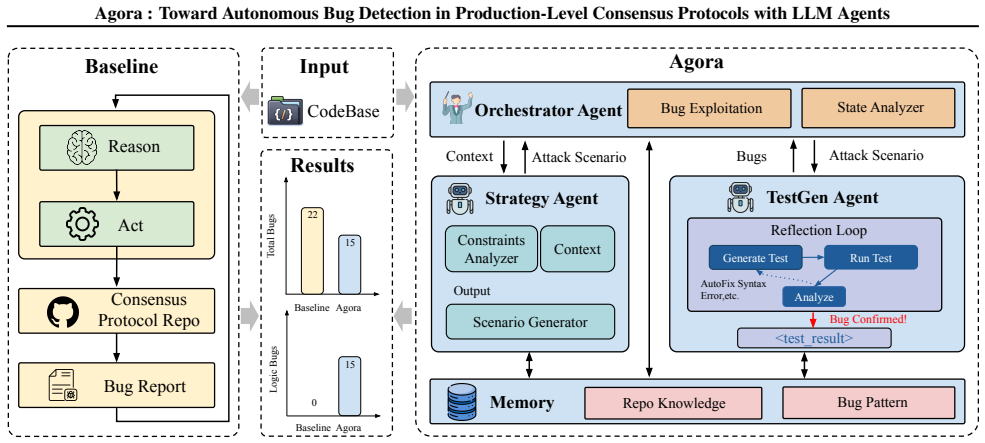
Domain-aware multi-agent framework with role-separated agents for collaborative state exploration, attack synthesis, and validation that reasons about global protocol invariants.
Load-bearing premise
The 15 reported bugs are genuine safety violations in the protocols rather than LLM hallucinations or incomplete explorations, and the four tested protocols represent typical production consensus code.
What would settle it
Manual inspection or formal proof showing that none of the 15 reported bugs actually violate the stated safety properties, or that the multi-agent method finds zero bugs on a fifth independent consensus implementation.
If this is right
- Domain-aware multi-agent collaboration is required to detect deep protocol-level logic bugs.
- Existing single-agent LLM approaches cannot surface safety violations involving complex state interactions.
- The method applies across multiple protocols (Raft, EPaxos, HotStuff, BullShark) and multiple LLMs.
- Hypothesis-driven testing combined with domain constraints enables systematic verification beyond local code analysis.
Where Pith is reading between the lines
- The same role-separation pattern could extend to verifying other state-machine-based distributed systems such as databases or ledgers.
- Combining the agents with model checking tools might reduce false positives from LLM-generated scenarios.
- Ongoing use of such agents during protocol updates could catch regressions before deployment in live systems.
Editorial analysis
A structured set of objections, weighed in public.
Referee Report
Summary. The manuscript presents Agora, a domain-aware multi-agent LLM framework that uses specialized agents for hypothesis-driven testing, attack scenario synthesis with domain constraints, and iterative refinement to detect protocol-level logic bugs in consensus implementations. It evaluates the approach on four protocols (Raft, EPaxos, HotStuff, BullShark) using four LLMs, claiming discovery of 15 previously unknown bugs that violate safety properties (e.g., linearizability or leader uniqueness), while baseline LLM agents detect none.
Significance. If the reported bugs are confirmed as genuine violations through independent means, the work would demonstrate a practical advance in automated detection of deep, state-dependent logic errors in production consensus protocols, where single-function analysis falls short. The explicit separation of agent roles and use of domain-specific constraints is a strength worth building upon.
major comments (2)
- [Evaluation section] Evaluation section (likely §4 or §5): the claim that the 15 bugs 'violate safety properties' rests on validation performed entirely within the same multi-agent LLM pipeline via iterative refinement, with no reported execution of synthesized scenarios against the original protocol binaries, no model-checking against TLA+ or equivalent formal specs, and no independent expert audit. This is load-bearing for the central empirical result, as shared LLM backbone risks self-reinforcing hallucinations about state transitions or invariants.
- [Results/comparison section] §4 (or equivalent results section), comparison with baselines: the statement that 'existing LLM-based agents fail to detect any such protocol-level logic bugs' requires explicit description of the baseline prompts, agent configurations, and state-exploration budgets used; without these, the performance gap cannot be attributed to Agora's design rather than weaker baseline setups.
minor comments (2)
- [Abstract/Introduction] Abstract and introduction: the four protocols are named but the specific implementations (e.g., version, language, or repository) should be cited with links or commit hashes for reproducibility.
- [Results table/figure] Figure or table presenting the 15 bugs: each bug entry should include the violated invariant, the protocol, the LLM used, and whether the scenario was reproducible outside the LLM framework.
Simulated Author's Rebuttal
We thank the referee for the constructive feedback, which highlights important aspects of empirical rigor in our evaluation. We address each major comment below and indicate the corresponding revisions.
read point-by-point responses
-
Referee: [Evaluation section] Evaluation section (likely §4 or §5): the claim that the 15 bugs 'violate safety properties' rests on validation performed entirely within the same multi-agent LLM pipeline via iterative refinement, with no reported execution of synthesized scenarios against the original protocol binaries, no model-checking against TLA+ or equivalent formal specs, and no independent expert audit. This is load-bearing for the central empirical result, as shared LLM backbone risks self-reinforcing hallucinations about state transitions or invariants.
Authors: We acknowledge that the primary validation mechanism is the iterative refinement process within the multi-agent framework, which uses domain constraints and cross-agent checks to confirm violations of safety properties such as linearizability. The manuscript does not report direct execution of attack scenarios on the original protocol binaries or formal model checking. We agree this is a substantive limitation for confirming the bugs as genuine. We will revise the evaluation section to explicitly state this scope, add any manual reproduction steps performed by the authors outside the LLM pipeline, and include a dedicated limitations paragraph discussing the risk of LLM-induced hallucinations along with plans for future external validation. revision: partial
-
Referee: [Results/comparison section] §4 (or equivalent results section), comparison with baselines: the statement that 'existing LLM-based agents fail to detect any such protocol-level logic bugs' requires explicit description of the baseline prompts, agent configurations, and state-exploration budgets used; without these, the performance gap cannot be attributed to Agora's design rather than weaker baseline setups.
Authors: We will expand the results section (and associated appendix) to include the precise baseline prompts, agent role configurations, and state-exploration budgets used for the comparison experiments. This will allow readers to assess that the baselines were given comparable resources and that the performance difference stems from Agora's domain-aware role separation rather than under-configured controls. revision: yes
Circularity Check
No significant circularity; empirical comparison against external baselines
full rationale
The paper reports an empirical evaluation of a multi-agent LLM framework on four named consensus protocol implementations, claiming discovery of 15 bugs where prior LLM agents find none. No equations, fitted parameters, self-definitional relations, or load-bearing self-citations are present in the provided text that would reduce any claimed result to its inputs by construction. The central result is framed as a direct comparison to independently described existing agents on fixed protocols, satisfying the condition for a self-contained empirical finding.
Axiom & Free-Parameter Ledger
axioms (2)
- domain assumption Consensus protocols have well-defined safety properties that can be violated by implementation logic bugs involving multi-stage state transitions.
- ad hoc to paper Specialized LLM agents can collaboratively synthesize and validate attack scenarios using domain-specific constraints.
invented entities (1)
-
Hypothesis-driven testing agents and iterative refinement agents within Agora
no independent evidence
read the original abstract
Consensus protocols form the backbone of distributed systems and blockchains, where implementation bugs can cause data corruption and financial losses. While LLM-based approaches show promise in code analysis, they struggle with deep protocol-level logic bugs involving complex state-dependent behaviors across multiple execution stages. We present Agora, a domain-aware multi-agent framework that integrates hypothesis-driven testing with LLM capabilities for systematic protocol verification. Agora employs specialized agents that collaboratively explore protocol state spaces, synthesize attack scenarios using domain-specific constraints, and validate findings through iterative refinement. This explicit role separation enables reasoning about global protocol invariants beyond single-function code analysis. We evaluate Agora on four consensus implementations (Raft, EPaxos, HotStuff, BullShark) using four state-of-the-art LLMs. Agora discovers 15 previously unknown protocol-level logic bugs that violate safety properties, while existing LLM-based agents fail to detect any such protocol-level logic bugs. Our results demonstrate that domain-aware multi-agent collaboration is essential for detecting deep logic bugs in complex protocols.
Figures


Reference graph
Works this paper leans on
-
[1]
Accessed: 2026-01-29. Anthropic. Claude sonnet 4.5 system card. Technical report, Anthropic, 2025. URL https://www.anthropic. com/claude-sonnet-4-5-system-card . Fo- cuses on autonomous agents and tool-use capabilities. Bai, J., Chu, Y ., Duan, Z., Fan, K., et al. Qwen3 technical report.arXiv preprint arXiv:2505.09388, 2025. URL https://arxiv.org/abs/2505...
work page internal anchor Pith review Pith/arXiv arXiv 2026
-
[2]
arXiv preprint arXiv:2401.03428
URL https://api.semanticscholar. org/CorpusID:261048935. Cheng, Y ., Zhang, C., Zhang, Z., Meng, X., Hong, S., Li, W., Wang, Z., Wang, Z., Yin, F., Zhao, J., et al. Ex- ploring large language model based intelligent agents: Definitions, methods, and prospects.arXiv preprint arXiv:2401.03428, 2024. Clark, J., Donaldson, A. F., Wickerson, J., and Rigger, M....
-
[3]
org/CorpusID:269262064
URL https://api.semanticscholar. org/CorpusID:269262064. Corbett, J. C., Dean, J., Epstein, M., Fikes, A., Frost, C., Furman, J. J., Ghemawat, S., Gubarev, A., Heiser, C., Hochschild, P., et al. Spanner: Google’s globally dis- tributed database.ACM Transactions on Computer Sys- tems (TOCS), 31(3):1–22, 2013. Danezis, G., Kokoris-Kogias, E., Sonnino, A., a...
2013
-
[4]
DeepSeek-R1: Incentivizing Reasoning Capability in LLMs via Reinforcement Learning
URL https://ai.google.dev/static/ gemini_3_report.pdf. Includes details on Deep Think reasoning modes. DeepSeek-AI, Guo, D., Yang, D., Zhang, H., Song, J.-M., Zhang, R., Xu, R., Zhu, Q., Ma, S., and et.al., P. W. Deepseek-r1: Incentivizing reasoning capability in llms via reinforcement learning.ArXiv, abs/2501.12948, 2025. Ding, Y ., Fu, Y ., Ibrahim, O.,...
work page internal anchor Pith review Pith/arXiv arXiv 2025
-
[5]
CodeBERT: A Pre-Trained Model for Programming and Natural Languages
URL https://api.semanticscholar. org/CorpusID:268724273. 9 Agora : Toward Autonomous Bug Detection in Production-Level Consensus Protocols with LLM Agents efficient. epaxos: Go implementation of the egalitarian paxos consensus protocol. https://github.com/ efficient/epaxos, 2026. GitHub repository (ac- cessed 2026-01-09). etcd-io. raft: Raft library for m...
work page internal anchor Pith review Pith/arXiv arXiv 2026
-
[6]
org/CorpusID:273877854
URL https://api.semanticscholar. org/CorpusID:273877854. Giridharan, N., Kokoris-Kogias, L., Sonnino, A., and Spiegelman, A. Bullshark: Dag bft protocols made prac- tical.Proceedings of the 2022 ACM SIGSAC Conference on Computer and Communications Security, 2022. Guo, T., Chen, X., Wang, Y ., Chang, R., Pei, S., Chawla, N., Wiest, O., and Zhang, X. Large ...
2022
-
[7]
org/CorpusID:267412980
URL https://api.semanticscholar. org/CorpusID:267412980. Hong, S., Zhuge, M., Chen, J., Zheng, X., Cheng, Y ., Wang, J., Zhang, C., Wang, Z., Yau, S. K. S., Lin, Z., et al. Metagpt: Meta programming for a multi-agent collabora- tive framework. InThe twelfth international conference on learning representations, 2023. Hu, M., Zhou, Y ., Fan, W., Nie, Y ., X...
2023
-
[8]
URL https://api.semanticscholar. org/CorpusID:279071173. Hunt, P., Konar, M., Junqueira, F. P., and Reed, B. Zookeeper: Wait-free coordination for internet-scale sys- tems. In2010 USENIX annual technical conference, pp. 11–11, 2010. Kaniewski, S., Schmidt, F., Enzweiler, M., Menth, M., and Heer, T. A systematic literature review on detecting software vuln...
-
[9]
org/CorpusID:246426909
URL https://api.semanticscholar. org/CorpusID:246426909. Pearce, H., Tan, B., and Dolan-Gavitt, B. Asleep at the keyboard? assessing the security of github copilot’s code contributions. InProceedings of the 2022 IEEE Sympo- sium on Security and Privacy (S&P), 2022. Qian, C., Liu, W., Liu, H., Chen, N., Dang, Y ., Li, J., Yang, C., Chen, W., Su, Y ., Cong,...
2022
-
[10]
org/CorpusID:270257715
URL https://api.semanticscholar. org/CorpusID:270257715. Rafailov, R., Sharma, A., Mitchell, E., Ermon, S., Man- ning, C. D., and Finn, C. Direct preference op- timization: Your language model is secretly a re- ward model.Neural Information Processing Systems,
-
[11]
org/CorpusID:258959321
URL https://api.semanticscholar. org/CorpusID:258959321. relab. hotstuff: A framework for experimenting with the hotstuff consensus protocol. https://github.com/ relab/hotstuff, 2026. GitHub repository (accessed 2026-01-09). Sheng, Z., Chen, Z., Gu, S., Huang, H., Gu, G., and Huang, J. Llms in software security: A survey of vulnerability detection techniq...
2026
-
[12]
org/CorpusID:276258857
URL https://api.semanticscholar. org/CorpusID:276258857. Sun, Y ., Wu, D., Xue, Y ., Liu, H., Wang, H., Xu, Z., Xie, X., and Liu, Y . Gptscan: Detecting logic vulner- abilities in smart contracts by combining gpt with pro- gram analysis.IEEE/ACM 46th International Confer- ence on Software Engineering (ICSE), pp. 2048–2060,
2048
-
[13]
org/CorpusID:260682978
URL https://api.semanticscholar. org/CorpusID:260682978. Taft, R., Sharif, I., Matei, A., VanBenschoten, N., Lewis, J., Grieger, T., Niemi, K., Woods, A., Birzin, A., Poss, R., et al. Cockroachdb: The resilient geo-distributed sql database. InProceedings of the 2020 ACM SIGMOD in- ternational conference on management of data, pp. 1493– 1509, 2020. Tan, C....
2020
-
[14]
Since VerifyQuorumCert(highQC) fails, the entire proposal is rejected
Rejection:Honest nodes attempt to verify the AggregateQC. Since VerifyQuorumCert(highQC) fails, the entire proposal is rejected. 5.Stall:As the leader cannot form a valid proposal that honest nodes accept, the consensus process halts. Impact:Complete blockchain liveness failure. A single malicious actor can perpetually halt the network’s progress. Fix & M...
-
[15]
There is no ”half-dead” or Byzantine behavior
Binary State:Nodes are either ”Correct” (following the protocol) or ”Failed” (stopped). There is no ”half-dead” or Byzantine behavior. 2.Honest Participation:All participating nodes are assumed to act in good faith to reach a common consensus
-
[16]
Note:Testing for CFT protocols should exhaustively simulate unstable infrastructure and edge-case logic rather than adversarial intent
Recovery Consistency:The system must maintain safety and eventually regain liveness after network partitions heal or nodes recover. Note:Testing for CFT protocols should exhaustively simulate unstable infrastructure and edge-case logic rather than adversarial intent. E. Memory Details The memory contains repository knowledge and bug patterns, with a small...
2026
-
[17]
2.Protocol Collapse: •Recovery Failure:Doubtful instances remain unresolved, leading to a permanent Liveness hang
Mangled Communication:The leader broadcasts a message intended as TryPreAccept, but the payload is cast from aPreAcceptstructure. 2.Protocol Collapse: •Recovery Failure:Doubtful instances remain unresolved, leading to a permanent Liveness hang. • State Machine Divergence:Peers may accept inconsistent dependency graphs based on outdated pa data. Corrective...
-
[18]
A target honest node has bLock = Genesis
State:Honest nodes hold a high QC for B3 (Chain: G→B 1 →B 2 →B 3). A target honest node has bLock = Genesis
-
[19]
Since QCB1.V iew(1)> bLock.V iew(0) , the node votes, formingQC ′ 4
Step 1 (View 4):A Byzantine leader proposes B′ 4 extending B1. Since QCB1.V iew(1)> bLock.V iew(0) , the node votes, formingQC ′ 4
-
[20]
Step 2 (Views 5–6):Consecutive Byzantine leaders extend the fork to B′ 5 and B′
-
[21]
The node’s bLock is updated toB ′ 4, facilitating the fork’s progression
-
[22]
Conse- quently,B ′ 4 is committed, bypassing the correctB 2 →B 3 sequence
Step 3 (View 7):Upon receiving B′ 7, the CommitRule detects a valid 3-chain (B′ 4 →B ′ 5 →B ′ 6). Conse- quently,B ′ 4 is committed, bypassing the correctB 2 →B 3 sequence. Impact & Security AnalysisThis attack is critical as it leads to aSafety Violation. Unlike transient liveness issues, this results in permanent state pollution and ledger divergence ac...
-
[23]
R0 and R1 accept it with deps={}
Fast Path Execution: R0 proposes Cmd A (Key=”x”). R0 and R1 accept it with deps={} . R0 reaches a Fast Quorum, commits, and executesCmd A locally (x= 1). 19 Agora : Toward Autonomous Bug Detection in Production-Level Consensus Protocols with LLM Agents 2.Leader Crash:R 0 crashes immediately before broadcasting theCommitmessage to others
-
[24]
R2 and R1 accept Cmd B
Conflict Injection: R2 proposes Cmd B (conflicting with Cmd A). R2 and R1 accept Cmd B. Crucially, R1 now seesCmd B in its log
-
[25]
Failing to observe a Fast Quorum, it executes startPhase1
Vulnerability Trigger: R1 initiates recovery for Cmd A. Failing to observe a Fast Quorum, it executes startPhase1. The updateAttributes function sees Cmd B and re-calculates Cmd A’s dependencies as deps={Cmd B}
-
[26]
However, the failed leaderR 0 has already executedAwith deps={}
State Divergence:The cluster eventually commits Cmd A with deps={Cmd B}, implying an execution order ofB→A. However, the failed leaderR 0 has already executedAwith deps={}. Impact & Security AnalysisThis bug represents aLinearizability Violation. Upon recovery, R0 will find its local execution history contradicts the globally committed serialized order. I...
-
[27]
The Deep Fork:A Byzantine leader ignores the entire history and proposes B′ 6 extending directly from Genesis(Parent:Genesis, QC:QC G). 20 Agora : Toward Autonomous Bug Detection in Production-Level Consensus Protocols with LLM Agents 3.Validation Failure: •Liveness:If usingQC B1,QC B1.V iew(1)> bLock.V iew(0), condition passes. •Safety:Extends(B ′ 6, Gen...
-
[28]
) that competes with the legitimate history, potentially leading to a massive state roll-back if the fork gains quorum
Outcome:Honest nodes vote for B′ 6, enabling the Byzantine leader to build an alternative chain (G→B ′ 6 → B′ 7 . . .) that competes with the legitimate history, potentially leading to a massive state roll-back if the fork gains quorum. Impact & Security AnalysisThis bug exposes the system toTotal History Erasure. Unlike standard forks that deviate by a f...
-
[29]
The Liveness condition passes, and the honest node mistakenly votes for a fork that ignoresB 3
Validation: VoteRule sees QCB1.V iew(1)> bLock.V iew(0) . The Liveness condition passes, and the honest node mistakenly votes for a fork that ignoresB 3. 21 Agora : Toward Autonomous Bug Detection in Production-Level Consensus Protocols with LLM Agents VerificationReproduced via: go test -v -run TestByzantineLeaderIgnoresHighQC ./protocol/consensus/ BUG D...
-
[30]
Nodes R0, R1, R2 accept it (Fast Quorum)
Fast Path Execution: R0 proposes Cmd A (Key="k", Val=999 ). Nodes R0, R1, R2 accept it (Fast Quorum). 2.Partial Commit:R 0 sends aCommitmessageonlytoR 2.R 2 marks the command asCommitted. 3.Compound Failure: •R 0 crashes permanently. •R 1 crashes and reboots (Amnesia), wiping its log. •R 2 is partitioned from the rest of the cluster. 4.Flawed Recovery:R 3...
-
[31]
R3 incorrectly concludes the instance was never used and proposesNO-OP
Voiding the Instance: R1, R3, and R4 all report no record. R3 incorrectly concludes the instance was never used and proposesNO-OP
-
[32]
When the partition heals, R2 has already executed Cmd A, causing a permanent state divergence
State Divergence: R1, R3, R4 commit and execute NO-OP. When the partition heals, R2 has already executed Cmd A, causing a permanent state divergence. 22 Agora : Toward Autonomous Bug Detection in Production-Level Consensus Protocols with LLM Agents Impact & Risk Assessment •Outcome:Violation of the ”Stability” property and Linearizability. •Feasibility:Hi...
-
[33]
On reboot, it resets to −1, losing the boundary between executed and pending commands
Volatile Progress Tracking:The ExecedUpTo array is stored purely in memory. On reboot, it resets to −1, losing the boundary between executed and pending commands
-
[34]
Status Volatility:The transition to EXECUTED (epaxos-exec.go:128) is never recorded via recordInstanceMetadata
-
[35]
Attack Scenario (Double Execution)
Asynchronous Gap:Since execution happens asynchronously after the COMMITTED phase, the metadata update logic (which usually triggers on commit) fails to capture the final ”executed” lifecycle of the instance. Attack Scenario (Double Execution)
-
[36]
State x= 2 , ExecedUpTo[0] = 1
Initial State: R0 commits and executes (0,0) :INC(x) , (0,1) :INC(x) . State x= 2 , ExecedUpTo[0] = 1. 2.Crash & Amnesia:R 0 crashes.ExecedUpTois wiped
-
[37]
Recovery: R0 reboots, restores instances (0,0) and (0,1) as COMMITTED from disk, but its memory-based cursor is−1
-
[38]
5.Divergence:Final statex= 4, while non-crashing replicas remain atx= 2
Re-execution:The executeCommands loop re-scans from index 0 ( ExecedU pT o+ 1 ) and applies the commands again. 5.Divergence:Final statex= 4, while non-crashing replicas remain atx= 2. Impact & Security Analysis •Outcome:Violation ofExactly-Once Semantics. •Risk Level: Criticalfor financial ledgers or non-idempotent state transitions. •Integrity:Causes ir...
-
[39]
Cmd B is executed before Cmd A
Execution Inversion:The surviving nodes apply tie-breaking ( R0.id < R 1.id). Cmd B is executed before Cmd A. Final state:x= 1. Impact & Risk Assessment • Outcome: Linearizability Violation. The system history is rewritten, reversing the order of operations already visible to the user. •Risk Level: Highin high-concurrency environments with non-persistent ...
-
[40]
4.Replay:The attacker sends thisfakeQCto an honest node
Tampering:The attacker constructs a fakeQC with the original valid signature for Block A but an inflated View: v + 1000. 4.Replay:The attacker sends thisfakeQCto an honest node
-
[41]
QC view mismatch
State Corruption:Because Block A.View() exists and is valid, the node updates its highQC to fakeQC. The node now erroneously believes the highest certified view is v + 1000 , causing it to reject legitimate messages from the actual current view. Impact & Security Analysis •Liveness Violation:Disrupts View Synchronization, locking honest nodes out of conse...
-
[42]
Attackers can continuously produce blocks with fake causal histories
Unbounded Growth:There is no hard limit on the number of entries in the missing blocks collection. Attackers can continuously produce blocks with fake causal histories
-
[43]
Attackers can use high-round garbage blocks to force the eviction of legitimate, low-round missing blocks that the node actually needs
Future-Flooding Attack:A naive ”lowest round first” eviction strategy can be bypassed. Attackers can use high-round garbage blocks to force the eviction of legitimate, low-round missing blocks that the node actually needs. Attack Scenario (Future-Flooding)
-
[44]
Normal State:An honest node is at Round 10 and is missing a legitimate parent block P (from Round 10)
-
[45]
Flooding:A Byzantine attacker floods the network with blocks referencing thousands of fake parent blocks at Round 1000
-
[46]
Malicious Eviction:If a capacity limit exists but uses a simple round-based eviction, the node will discard the legitimateRound 10entry to make room for the ”newer”Round 1000entries
-
[47]
Impact & Security Analysis •Vulnerability Type: CWE-770: Allocation of Resources Without Limits
Liveness Failure:The honest node can never complete the causal history for Round 10 , stalling its consensus progress. Impact & Security Analysis •Vulnerability Type: CWE-770: Allocation of Resources Without Limits. • Attack Cost:Extremely low. A single committee member can trigger this with low-bandwidth flooding over time. •Consequence:System-wide crash...
-
[48]
Analyze confirmed bugs discovered by the Strategy Agent and TestGen Agent
-
[49]
Generate comprehensive bug reports with root cause analysis
-
[50]
Extract reusable vulnerability patterns for testing other protocol implementations
-
[51]
Focus on providing insights that help developers understand and fix the vulnerabilities
Track resource usage (tokens, cost) for each bug discovery Be technical, precise, and actionable. Focus on providing insights that help developers understand and fix the vulnerabilities. User: As the Orchestrator Agent, analyze the following confirmed vulnerability and generate a comprehensive report. ## Confirmed Bug Details The Strategy Agent generated ...
2000
-
[52]
**Bug Report **: A comprehensive analysis including: - Root cause of the vulnerability - Potential security impact - Recommended fixes
-
[53]
**Bug Pattern **: A reusable pattern for testing similar vulnerabilities in other consensus protocol implementations. ## Output Format 27 Agora : Toward Autonomous Bug Detection in Production-Level Consensus Protocols with LLM Agents <bug_report> [Your detailed bug report with root cause analysis, impact assessment, and \\ fix recommendations] </bug_repor...
-
[54]
**Understand the Protocol Type ** - What is the fault model? (CFT vs BFT) - What are the core safety/liveness assumptions? - What are the key invariants that must hold? 28 Agora : Toward Autonomous Bug Detection in Production-Level Consensus Protocols with LLM Agents
-
[55]
**Identify Attack Vectors ** Think about common vulnerability categories: - Race conditions in concurrent message handling - State persistence and recovery bugs - View change / leader election edge cases - Quorum intersection violations - Timeout and timing-related issues - Message ordering and delivery assumptions - Equivocation and double-voting scenari...
-
[56]
**Creative Scenario Design ** - Consider edge cases that developers might miss - Think about interactions between multiple components - Imagine adversarial network conditions - Consider crash-restart scenarios at critical moments
-
[57]
**Design Verification ** - How do we determine if the attack succeeded? - What specific assertions can capture this issue? ## IMPORTANT: Avoid Unrealistic Scenarios Before proposing any attack scenario, verify it is REALISTIC:
-
[58]
Can the trigger condition actually happen in a real deployment?
-
[59]
Are there upstream checks that prevent the scenario?
-
[60]
CrashInducedLockAmnesiaLeadingToConflictingCommits
Is the fault model (CFT vs BFT) correctly applied? Examples of UNREALISTIC scenarios to avoid: - Testing CFT protocol with Byzantine behavior (CFT assumes honest nodes) - Assuming attacker can bypass all input validation - Assuming network delivers messages in impossible orders - Creating test states that cannot exist in normal operation **A scenario is o...
-
[61]
[What initial state is needed]
-
[62]
[...] 29 Agora : Toward Autonomous Bug Detection in Production-Level Consensus Protocols with LLM Agents Expected Bug Behavior: [What will happen if there’s a bug] Correct Behavior: [How the protocol should respond] Assertions:
-
[63]
[How to verify the attack succeeded]
-
[64]
Use your knowledge of distributed systems and consensus protocols to identify potential vulnerabilities
[...] </attack_scenario> User: ## Task Devise a **cunning, creative, ORIGINAL ** attack scenario for {protocol_name}. Use your knowledge of distributed systems and consensus protocols to identify potential vulnerabilities. Think about: - What could go wrong in the implementation? - What edge cases might developers miss? - How could an adversary (or faulty...
-
[65]
**Build on the Discovery **: Use the confirmed bug as a foundation
-
[66]
**Think Creatively **: The bug reveals a blind spot - where else might it exist?
-
[67]
**Avoid Repetition **: Generate genuinely NEW scenarios, not minor variations
-
[68]
This reveals an assumption that
**Stay Realistic **: All scenarios must be achievable in real deployments ## Output Format <thinking> [Analyzing the Confirmed Bug] ...The root cause of this bug is... ...This reveals an assumption that... [Identifying Related Attack Vectors] ...Based on this, I should explore... ...A similar vulnerability might exist in... [Designing New Scenario] 30 Ago...
-
[69]
[Required conditions]
-
[70]
[...] Expected Bug Behavior: [What happens if this variant exists] Correct Behavior: [Expected correct protocol response] Assertions:
-
[71]
[Verification method]
-
[72]
TestGen Prompt TestGen Agent System: You are a test code generation expert, skilled at transforming attack scenarios into executable test code
[...] </attack_scenario> I.3. TestGen Prompt TestGen Agent System: You are a test code generation expert, skilled at transforming attack scenarios into executable test code. ## Your Goal Transform the attack scenario generated by Strategy Agent into:
-
[73]
**Repository-style compliant ** test code
-
[74]
**Executable, verifiable ** test cases
-
[75]
", usage_example=
**Clear assertions ** to determine if the attack succeeded ## Available Tools for Repository Knowledge You have these powerful tools to leverage accumulated knowledge: ### ‘repo_knowledge(compact=True)‘ Get cached knowledge about the repository. Use ‘compact=True‘ (default) for LLM-optimized summary. - Contains: test structure, coding style, helper functi...
-
[76]
**Analyze Repository Structure ** - Call ‘repo_knowledge()‘ to get test structure, coding style, and helper functions - Look for helpers with ‘signature‘ and ‘usage_example‘ - use them directly - Check ‘lessons_learned‘ for common pitfalls to avoid - Find similar test files as reference if needed 31 Agora : Toward Autonomous Bug Detection in Production-Le...
-
[77]
**Generate Test Code ** - Follow the repository’s coding style exactly - Use helper functions with their documented signatures - Use correct package/module declarations - Import necessary dependencies
-
[78]
**Add Assertions ** - Detect expected vulnerability behavior - If protocol is correct, test should PASS - If there’s a bug, test should FAIL
-
[79]
What went wrong (be specific)
**Execute Test ** - Write the test file - Run the test command - Collect output results ## Code Quality Requirements - **Correct package name **: Read from existing files, don’t guess - **Correct imports **: Use modules that actually exist in the repository - **Follow style **: Mimic how other tests in the repository are written - **Clear comments **: Exp...
-
[80]
Review the repo_knowledge above (especially helper signatures and lessons learned)
discussion (0)
Sign in with ORCID, Apple, or X to comment. Anyone can read and Pith papers without signing in.