The Architecture of the 14 Herculis System Suggests Primordial Ejection of a Massive Planet
Pith reviewed 2026-06-29 05:51 UTC · model grok-4.3
The pith
14 Herculis' misaligned eccentric super-Jupiters formed only if extra planets were ejected early on.
A machine-rendered reading of the paper's core claim, the machinery that carries it, and where it could break.
Core claim
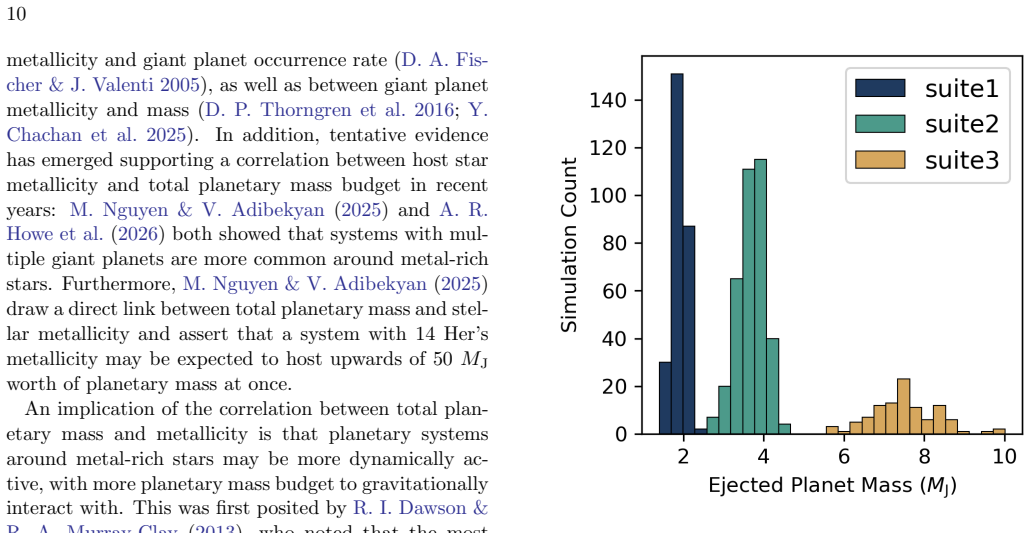
Planet-planet scattering reproduces 14 Her's peculiar orbital architecture, but only if additional massive bodies were initially present in the system that were subsequently ejected. The mass of any such ejected planet can constrain the system's initial configuration. Present-day secular evolution shows likely nontrivial eccentricity and inclination oscillations, yet their magnitudes are not strong enough for tidal forces to alter the architecture meaningfully.
What carries the argument
N-body simulations of initial multi-planet configurations that undergo scattering and ejection of extra bodies.
If this is right
- The current architecture requires initial extra planets that were ejected through scattering.
- The mass of any ejected planet limits the possible initial system configurations.
- Secular eccentricity and inclination oscillations occur but remain too weak for meaningful tidal alteration.
- Future Gaia and Roman observations can place 14 Her within a population-level dynamical framework.
Where Pith is reading between the lines
- Many other systems with eccentric misaligned giants may also have lost planets through early scattering.
- Ejection signatures could be searched for in debris or by comparing to systems without such misalignments.
- The requirement for extra initial planets offers a testable prediction for occurrence rates of ejected worlds.
Load-bearing premise
The observed orbits are the direct outcome of an early multi-planet scattering phase rather than migration, other formation channels, or selection effects.
What would settle it
An N-body run starting with only the two known planets that matches their current eccentric and misaligned orbits would falsify the need for extra ejected bodies.
Figures

read the original abstract
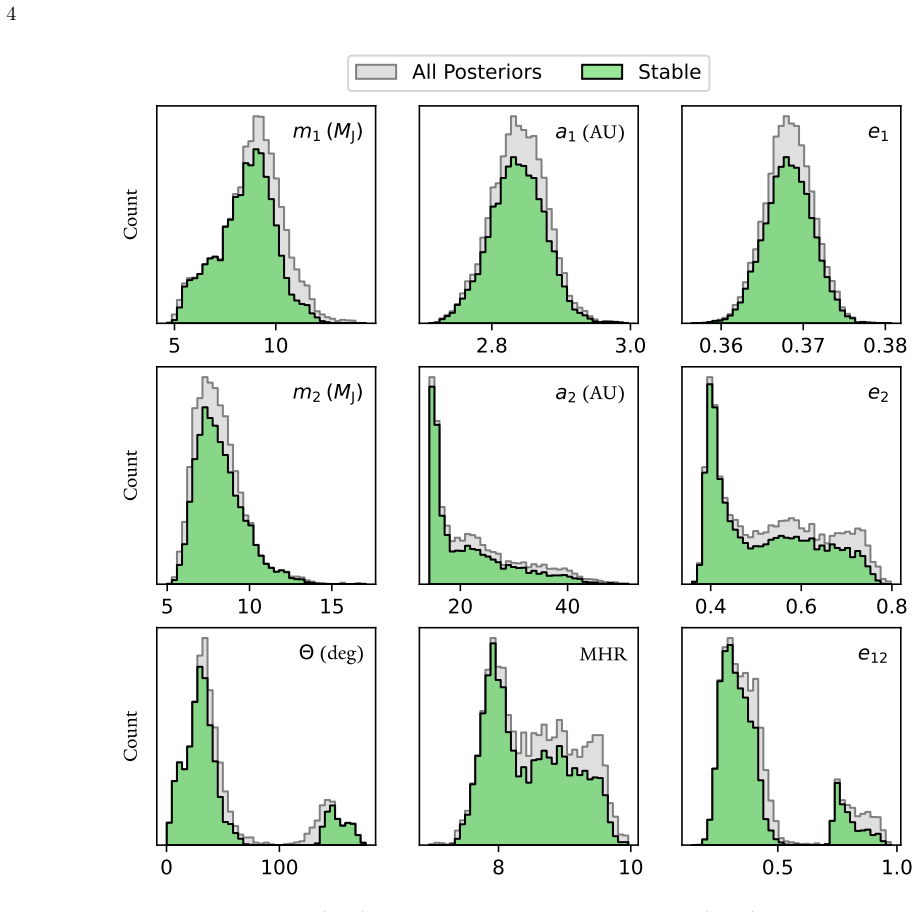
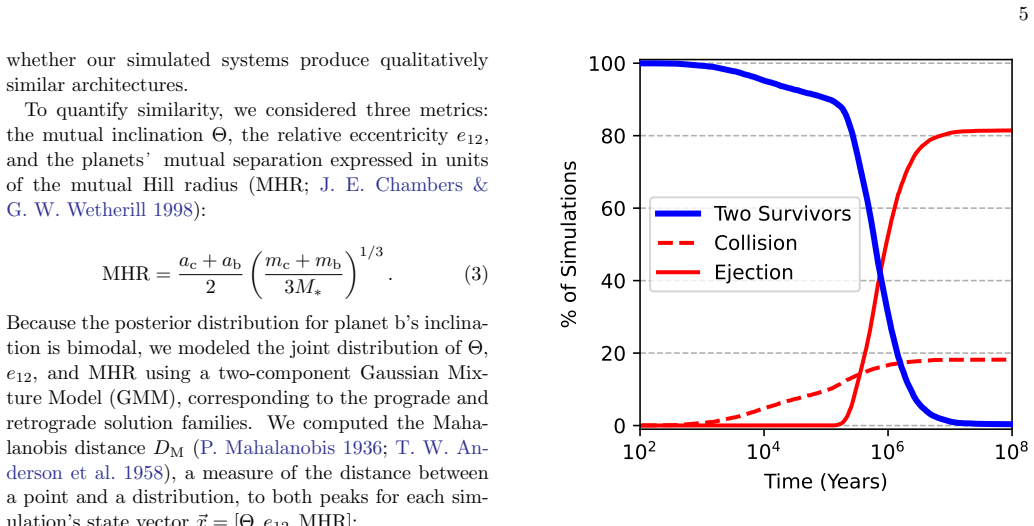
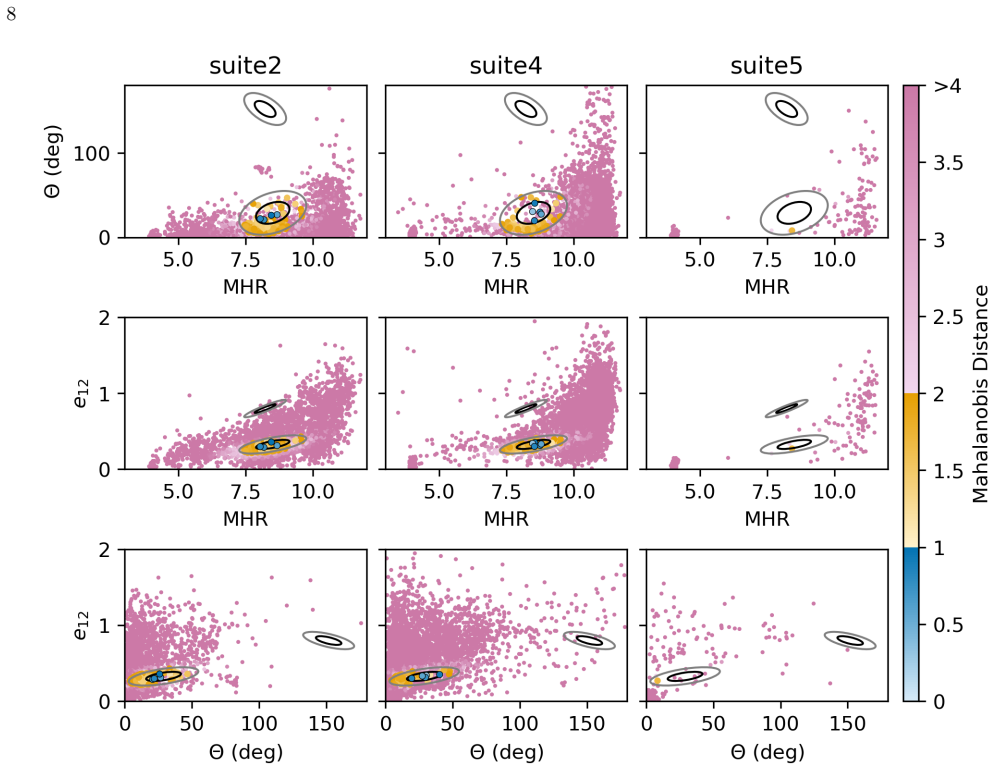
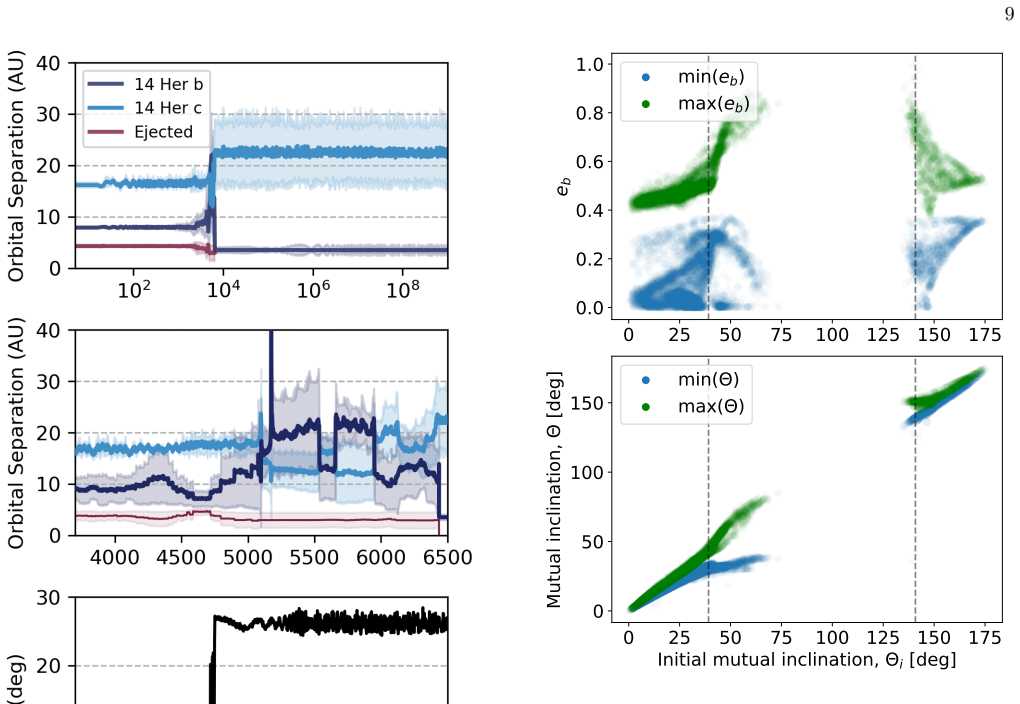
The 14 Herculis system hosts two super-Jupiters on eccentric, significantly misaligned orbits. This orbital architecture represents a dynamical puzzle that demands explanation. In this work, we reproduce the system's dynamical history and current architecture using a large suite of N-body simulations of planet-planet scattering. Our results demonstrate that planet-planet scattering is able to reproduce 14 Her's peculiar orbital architecture, but only if additional massive bodies were initially present in the system that were subsequently ejected. The mass of any such ejected planet can in turn constrain the system's initial configuration. We also analyze the present-day secular evolution of the system and conclude that while there are most likely nontrivial eccentricity and inclination oscillations currently occurring, the magnitudes of these oscillations are not strong enough to allow tidal forces to meaningfully alter the system's architecture. Finally, we discuss how forthcoming observations from future Gaia data releases and the Roman mission may situate 14 Her's dynamical history within a broader, population-level framework.
Editorial analysis
A structured set of objections, weighed in public.
Referee Report
Summary. The paper claims that N-body simulations of planet-planet scattering can reproduce the observed eccentric and mutually misaligned orbits of the two super-Jupiters in the 14 Herculis system only when at least one additional massive body is included in the initial configuration and subsequently ejected. The work supplies initial-condition ranges, reports outcome statistics, analyzes present-day secular evolution (finding eccentricity/inclination oscillations too weak for significant tidal evolution), and discusses constraints from future Gaia and Roman observations.
Significance. If the central result holds after fuller documentation of the simulation suite, the manuscript would provide a concrete dynamical pathway linking an observed multi-planet architecture to primordial ejection, thereby tightening constraints on formation scenarios for systems with misaligned, eccentric giants. The explicit mapping from ejected-planet mass to viable initial conditions and the secular-evolution analysis are useful contributions.
major comments (2)
- [Methods / Simulation setup] Simulation methods section: the assertion that the observed architecture is reproduced 'only if' an additional massive body is ejected (Abstract and main results) rests on an unspecified number of N-body runs, an incompletely described sampling strategy over the free parameters (initial planet masses, semi-major axes, eccentricities, inclinations), and the absence of reported convergence or stability tests. Without these details it is not possible to evaluate whether the 'only if' conclusion is robust or an artifact of limited exploration.
- [Results] Results on ejection requirement: the paper states that scattering reproduces the architecture only with ejection, yet provides no quantitative breakdown (e.g., success fraction with vs. without an extra body, or the minimum number of runs needed to reach that conditional statement). This information is load-bearing for the central claim.
minor comments (1)
- [Figures and Methods] Figure captions and text should explicitly state the total number of integrations performed and the precise ranges and sampling method used for each initial parameter.
Simulated Author's Rebuttal
We thank the referee for their constructive comments, which identify important gaps in the documentation of our simulation suite. We address each point below and will revise the manuscript accordingly to strengthen the presentation of our methods and results.
read point-by-point responses
-
Referee: [Methods / Simulation setup] Simulation methods section: the assertion that the observed architecture is reproduced 'only if' an additional massive body is ejected (Abstract and main results) rests on an unspecified number of N-body runs, an incompletely described sampling strategy over the free parameters (initial planet masses, semi-major axes, eccentricities, inclinations), and the absence of reported convergence or stability tests. Without these details it is not possible to evaluate whether the 'only if' conclusion is robust or an artifact of limited exploration.
Authors: We agree that the current Methods section lacks sufficient detail on the numerical experiments. In the revised manuscript we will add: the total number of integrations performed, the precise parameter ranges and sampling strategy (including distributions for masses, semi-major axes, eccentricities, and inclinations), convergence tests performed with varied random seeds, and long-term stability checks on the final configurations. These additions will allow readers to assess the robustness of the reported requirement for an ejected body. revision: yes
-
Referee: [Results] Results on ejection requirement: the paper states that scattering reproduces the architecture only with ejection, yet provides no quantitative breakdown (e.g., success fraction with vs. without an extra body, or the minimum number of runs needed to reach that conditional statement). This information is load-bearing for the central claim.
Authors: We concur that quantitative success rates are necessary to support the central claim. The revised manuscript will include a table reporting success fractions for the two-planet scattering case (zero successful reproductions of the observed architecture) versus cases that include an additional ejected planet (with success rates broken down by ejected-planet mass), along with the total number of runs and the precise success criteria. This will make the conditional statement quantitatively grounded. revision: yes
Circularity Check
No significant circularity detected
full rationale
The paper's central result is obtained from forward N-body scattering simulations that numerically integrate initial conditions and report outcome statistics (e.g., final eccentricities, inclinations, and ejection events). These simulations constitute independent numerical experiments whose outputs are not algebraically or statistically forced to match the inputs by construction. No self-definitional steps, fitted parameters renamed as predictions, or load-bearing self-citations appear in the derivation chain. The claim that scattering reproduces the architecture only with an ejected body is a conditional statement evaluated against external observational data and is therefore self-contained.
Axiom & Free-Parameter Ledger
free parameters (1)
- initial planet masses, semi-major axes, eccentricities, and inclinations
axioms (1)
- domain assumption Newtonian point-mass gravity plus standard N-body integrators accurately capture the long-term evolution of the system
Reference graph
Works this paper leans on
-
[1]
An, Q., Lu, T., Brandt, G. M., Brandt, T. D., & Li, G. 2025, AJ, 169, 22, doi: 10.3847/1538-3881/ad90b4 10 Though D. A. Yahalomi et al. (2026) cautions that circular planet pairs in 2:1 mean motion resonance may masquerade as single eccentric planets inGaiadata, which would represent a very different dynamical interpretation
-
[2]
Anderson, K. R., Lai, D., & Pu, B. 2020, MNRAS, 491, 1369, doi: 10.1093/mnras/stz3119
-
[3]
W., & Math´ ematicien, E.-U
Anderson, T. W., & Math´ ematicien, E.-U. 1958, An introduction to multivariate statistical analysis, Vol. 2 (Wiley New York)
1958
-
[4]
Armitage, P. J. 2010, Astrophysics of Planet Formation 12 Bardalez Gagliuffi, D. C., Faherty, J. K., Li, Y., et al. 2021, ApJL, 922, L43, doi: 10.3847/2041-8213/ac382c Bardalez Gagliuffi, D. C., Balmer, W. O., Pueyo, L., et al. 2025, ApJL, 988, L18, doi: 10.3847/2041-8213/ade30f Beaug´ e, C., & Nesvorn´ y, D. 2012, ApJ, 751, 119, doi: 10.1088/0004-637X/751/2/119
-
[5]
Bhaskar, H. G., & Perets, H. 2024, ApJ, 973, 108, doi: 10.3847/1538-4357/ad62f9
-
[6]
J., Koch, D., Basri, G., et al
Borucki, W. J., Koch, D., Basri, G., et al. 2010, Science, 327, 977, doi: 10.1126/science.1185402
-
[7]
2017, MNRAS, 470, 1360, doi: 10.1093/mnras/stx1277
Bovy, J. 2017, MNRAS, 470, 1360, doi: 10.1093/mnras/stx1277
-
[8]
Brandt, T. D. 2018, ApJS, 239, 31, doi: 10.3847/1538-4365/aaec06
-
[9]
Butler, R. P., Marcy, G. W., Vogt, S. S., et al. 2003, ApJ, 582, 455, doi: 10.1086/344570
-
[10]
2025, ApJ, 994, 43, doi: 10.3847/1538-4357/ae0cbf
Murray-Clay, R. 2025, ApJ, 994, 43, doi: 10.3847/1538-4357/ae0cbf
-
[11]
Chambers, J. E., & Wetherill, G. W. 1998, Icarus, 136, 304, doi: 10.1006/icar.1998.6007
-
[12]
Chambers, J. E., Wetherill, G. W., & Boss, A. P. 1996, Icarus, 119, 261, doi: 10.1006/icar.1996.0019
-
[13]
Chatterjee, S., Ford, E. B., Matsumura, S., & Rasio, F. A. 2008, ApJ, 686, 580, doi: 10.1086/590227
-
[14]
2017, ApJ, 834, 17, doi: 10.3847/1538-4357/834/1/17
Chen, J., & Kipping, D. 2017, ApJ, 834, 17, doi: 10.3847/1538-4357/834/1/17
-
[15]
Cresswell, P., Dirksen, G., Kley, W., & Nelson, R. P. 2007, A&A, 473, 329, doi: 10.1051/0004-6361:20077666
-
[16]
Dawson, R. I., & Murray-Clay, R. A. 2013, ApJL, 767, L24, doi: 10.1088/2041-8205/767/2/L24
-
[17]
Deck, K. M., Holman, M. J., Agol, E., et al. 2012, ApJL, 755, L21, doi: 10.1088/2041-8205/755/1/L21
-
[18]
2026, arXiv e-prints, arXiv:2603.22426, doi: 10.48550/arXiv.2603.22426
Gupta, A. 2026, arXiv e-prints, arXiv:2603.22426, doi: 10.48550/arXiv.2603.22426
-
[19]
2026, arXiv e-prints, arXiv:2603.22409, doi: 10.48550/arXiv.2603.22409
Esposito, J., Li, G., & Wang, S. 2026, arXiv e-prints, arXiv:2603.22409, doi: 10.48550/arXiv.2603.22409
-
[20]
Fernandes, R. B., Mulders, G. D., Pascucci, I., Mordasini, C., & Emsenhuber, A. 2019, ApJ, 874, 81, doi: 10.3847/1538-4357/ab0300
-
[21]
Fischer, D. A., & Valenti, J. 2005, ApJ, 622, 1102, doi: 10.1086/428383
-
[22]
B., Havlickova, M., & Rasio, F
Ford, E. B., Havlickova, M., & Rasio, F. A. 2001, Icarus, 150, 303, doi: 10.1006/icar.2001.6588
-
[23]
Ford, E. B., & Rasio, F. A. 2008, ApJ, 686, 621, doi: 10.1086/590926
-
[24]
2016, The Journal of Open Source Software, 1, 24, doi: 10.21105/joss.00024
Foreman-Mackey, D. 2016, The Journal of Open Source Software, 1, 24, doi: 10.21105/joss.00024
-
[25]
Fulton, B. J., Rosenthal, L. J., Hirsch, L. A., et al. 2021, ApJS, 255, 14, doi: 10.3847/1538-4365/abfcc1 Gaia Collaboration, Vallenari, A., Brown, A. G. A., et al. 2023, A&A, 674, A1, doi: 10.1051/0004-6361/202243940
-
[26]
1993, Icarus, 106, 247, doi: 10.1006/icar.1993.1169
Gladman, B. 1993, Icarus, 106, 247, doi: 10.1006/icar.1993.1169
-
[27]
1980, ApJ, 241, 425, doi: 10.1086/158356
Goldreich, P., & Tremaine, S. 1980, ApJ, 241, 425, doi: 10.1086/158356
-
[28]
2018, AJ, 156, 95, doi: 10.3847/1538-3881/aad32c
Hadden, S., & Lithwick, Y. 2018, AJ, 156, 95, doi: 10.3847/1538-3881/aad32c
-
[29]
Hahn, J. M., & Malhotra, R. 1999, AJ, 117, 3041, doi: 10.1086/300891
-
[30]
Hernandez, D. M., Zeebe, R. E., & Hadden, S. 2022, MNRAS, 510, 4302, doi: 10.1093/mnras/stab3664
-
[31]
Hill, G. W. 1878, American Journal of Mathematics, 1, 5, doi: 10.2307/2369433
-
[32]
Howe, A. R., Becker, J. C., & Adams, F. C. 2026, AJ, 171, 148, doi: 10.3847/1538-3881/ae3aa6
-
[33]
Hunter, J. D. 2007, Computing in Science & Engineering, 9, 90, doi: 10.1109/MCSE.2007.55
-
[34]
Ida, S., & Lin, D. N. C. 2004, ApJ, 616, 567, doi: 10.1086/424830
-
[35]
Izidoro, A., Bitsch, B., Raymond, S. N., et al. 2021, A&A, 650, A152, doi: 10.1051/0004-6361/201935336
-
[36]
2002, https://www.osti.gov/biblio/15002962
Jette, M., Dunlap, C., Garlick, J., & Grondona, M. 2002, https://www.osti.gov/biblio/15002962
arXiv 2002
-
[37]
Johnson, S. A., Penny, M., Gaudi, B. S., et al. 2020, AJ, 160, 123, doi: 10.3847/1538-3881/aba75b Juri´ c, M., & Tremaine, S. 2008, ApJ, 686, 603, doi: 10.1086/590047
-
[38]
Keenan, P. C., & McNeil, R. C. 1989, ApJS, 71, 245, doi: 10.1086/191373
-
[39]
R., Duncan, M., Brasser, R., & Levison, H
Kirsh, D. R., Duncan, M., Brasser, R., & Levison, H. F. 2009, Icarus, 199, 197, doi: 10.1016/j.icarus.2008.05.028
-
[40]
Lammers, C., & Winn, J. N. 2024, ApJL, 968, L12, doi: 10.3847/2041-8213/ad50d2
-
[41]
Lammers, C., & Winn, J. N. 2026, AJ, 171, 18, doi: 10.3847/1538-3881/ae21de
-
[42]
2020, in European Planetary Science Congress, EPSC2020–228, doi: 10.5194/epsc2020-228
Li, D., Mustill, A., & Davies, M. 2020, in European Planetary Science Congress, EPSC2020–228, doi: 10.5194/epsc2020-228
-
[43]
Lidov, M. L. 1962, Planetary and Space Science, 9, 719
1962
-
[44]
Lin, D. N. C., Bodenheimer, P., & Richardson, D. C. 1996, Nature, 380, 606, doi: 10.1038/380606a0
-
[45]
2014, Proceedings of the National Academy of Science, 111, 12610, doi: 10.1073/pnas.1308261110
Lithwick, Y., & Wu, Y. 2014, Proceedings of the National Academy of Science, 111, 12610, doi: 10.1073/pnas.1308261110
-
[46]
2025a, ApJ, 979, 218, doi: 10.3847/1538-4357/ad9b79 13
Lu, T., An, Q., Li, G., et al. 2025a, ApJ, 979, 218, doi: 10.3847/1538-4357/ad9b79 13
-
[47]
Lu, T., Hernandez, D. M., & Rein, H. 2024, MNRAS, 533, 3708, doi: 10.1093/mnras/stae1982
-
[48]
Lu, T., Li, G., Cassese, B., & Lin, D. N. C. 2025b, ApJ, 980, 39, doi: 10.3847/1538-4357/ada4b2
-
[49]
2023, The Astrophysical Journal, 948, 41, doi: 10.3847/1538-4357/acc06d
Lu, T., Rein, H., Tamayo, D., et al. 2023, The Astrophysical Journal, 948, 41, doi: 10.3847/1538-4357/acc06d
-
[50]
1936, Sankhy¯ a: The Indian Journal of Statistics (1933-1960), 2, 411
Mahalanobis, P. 1936, Sankhy¯ a: The Indian Journal of Statistics (1933-1960), 2, 411
1936
-
[51]
2011, MNRAS, 411, 2439, doi: 10.1111/j.1365-2966.2010.17855.x 20
Malmberg, D., Davies, M. B., & Heggie, D. C. 2011, MNRAS, 411, 859, doi: 10.1111/j.1365-2966.2010.17730.x
-
[52]
Mardling, R. A. 2010, MNRAS, 407, 1048, doi: 10.1111/j.1365-2966.2010.16814.x
-
[53]
2025, MNRAS, 536, 422, doi: 10.1093/mnras/stae2602
Marzari, F. 2025, MNRAS, 536, 422, doi: 10.1093/mnras/stae2602
-
[54]
2017, ApJL, 849, L33, doi: 10.3847/2041-8213/aa9714
Millholland, S., Wang, S., & Laughlin, G. 2017, ApJL, 849, L33, doi: 10.3847/2041-8213/aa9714
-
[55]
2011, The Astrophysical Journal, 742, 72
Nagasawa, M., & Ida, S. 2011, The Astrophysical Journal, 742, 72
2011
-
[56]
2025, AJ, 170, 334, doi: 10.3847/1538-3881/ae1466
Nguyen, M., & Adibekyan, V. 2025, AJ, 170, 334, doi: 10.3847/1538-3881/ae1466
-
[57]
2017, Icarus, 293, 52, doi: 10.1016/j.icarus.2017.04.010
Obertas, A., Van Laerhoven, C., & Tamayo, D. 2017, Icarus, 293, 52, doi: 10.1016/j.icarus.2017.04.010
-
[58]
2006,, USA: Trelgol Publishing http://www.numpy.org/
Oliphant, T. 2006,, USA: Trelgol Publishing http://www.numpy.org/
2006
-
[59]
2014, ApJ, 786, 101, doi: 10.1088/0004-637X/786/2/101
Petrovich, C., Tremaine, S., & Rafikov, R. 2014, ApJ, 786, 101, doi: 10.1088/0004-637X/786/2/101
-
[60]
2015, ApJ, 807, 44, doi: 10.1088/0004-637X/807/1/44
Pu, B., & Wu, Y. 2015, ApJ, 807, 44, doi: 10.1088/0004-637X/807/1/44
-
[61]
Raymond, S. N., Barnes, R., Armitage, P. J., & Gorelick, N. 2008, ApJL, 687, L107, doi: 10.1086/593301
-
[62]
Rein, H., & Liu, S. F. 2012, A&A, 537, A128, doi: 10.1051/0004-6361/201118085
work page internal anchor Pith review doi:10.1051/0004-6361/201118085 2012
-
[63]
2015, MNRAS, 452, 376, doi: 10.1093/mnras/stv1257
Rein, H., & Tamayo, D. 2015, MNRAS, 452, 376, doi: 10.1093/mnras/stv1257
-
[64]
2017, MNRAS, 467, 2377, doi: 10.1093/mnras/stx232
Rein, H., & Tamayo, D. 2017, MNRAS, 467, 2377, doi: 10.1093/mnras/stx232
-
[65]
Rice, W. K. M., Armitage, P. J., Bonnell, I. A., et al. 2003, MNRAS, 346, L36, doi: 10.1111/j.1365-2966.2003.07317.x
-
[66]
Ricker, G. R., Winn, J. N., Vanderspek, R., et al. 2015, Journal of Astronomical Telescopes, Instruments, and Systems, 1, 014003, doi: 10.1117/1.JATIS.1.1.014003
work page internal anchor Pith review doi:10.1117/1.jatis.1.1.014003 2015
-
[67]
Safronov, V. S. 1972, Evolution of the protoplanetary cloud and formation of the earth and planets
1972
-
[68]
2010, A&A, 515, A111, doi: 10.1051/0004-6361/201014247 Stef´ ansson, G., Mahadevan, S., Winn, J
Caillo, A. 2010, A&A, 515, A111, doi: 10.1051/0004-6361/201014247 Stef´ ansson, G., Mahadevan, S., Winn, J. N., et al. 2025, AJ, 169, 107, doi: 10.3847/1538-3881/ada9e1
-
[69]
2025, ApJ, 986, 11, doi: 10.3847/1538-4357/adc1c4
Tamayo, D., & Hadden, S. 2025, ApJ, 986, 11, doi: 10.3847/1538-4357/adc1c4
-
[70]
Tamayo, D., Rein, H., Shi, P., & Hernandez, D. M. 2020a, MNRAS, 491, 2885, doi: 10.1093/mnras/stz2870
-
[71]
2020b, Proceedings of the National Academy of Science, 117, 18194, doi: 10.1073/pnas.2001258117
Tamayo, D., Cranmer, M., Hadden, S., et al. 2020b, Proceedings of the National Academy of Science, 117, 18194, doi: 10.1073/pnas.2001258117
-
[72]
Lopez, E. D. 2016, ApJ, 831, 64, doi: 10.3847/0004-637X/831/1/64
work page internal anchor Pith review doi:10.3847/0004-637x/831/1/64 2016
-
[73]
2023, Dynamics of Planetary Systems van der Walt, S., Colbert, S
Tremaine, S. 2023, Dynamics of Planetary Systems van der Walt, S., Colbert, S. C., & Varoquaux, G. 2011, Computing in Science and Engineering, 13, 22, doi: 10.1109/MCSE.2011.37
-
[74]
Virtanen, P., Gommers, R., Oliphant, T. E., et al. 2020, Nature methods, 17, 261 von Zeipel, H. 1910, Astronomische Nachrichten, 183, 345, doi: 10.1002/asna.19091832202
-
[75]
Wang, J. J., Graham, J. R., Dawson, R., et al. 2018, AJ, 156, 192, doi: 10.3847/1538-3881/aae150
-
[76]
Weidenschilling, S. J., & Marzari, F. 1996, Nature, 384, 619, doi: 10.1038/384619a0
-
[77]
Weiss, L. M., Marcy, G. W., Petigura, E. A., et al. 2018, AJ, 155, 48, doi: 10.3847/1538-3881/aa9ff6
-
[78]
2015, AJ, 150, 127, doi: 10.1088/0004-6256/150/4/127
Wisdom, J. 2015, AJ, 150, 127, doi: 10.1088/0004-6256/150/4/127
-
[79]
Wittenmyer, R. A., Endl, M., & Cochran, W. D. 2007, ApJ, 654, 625, doi: 10.1086/509110
-
[80]
A., Wang, S., Horner, J., et al
Wittenmyer, R. A., Wang, S., Horner, J., et al. 2020, MNRAS, 492, 377, doi: 10.1093/mnras/stz3436
discussion (0)
Sign in with ORCID, Apple, or X to comment. Anyone can read and Pith papers without signing in.