Carr criterion and mass gaps in non-singular primordial black hole formation
Pith reviewed 2026-06-29 05:46 UTC · model grok-4.3
The pith
A gravitational regulator of length ℓ induces a mass gap for primordial black holes of order c²ℓ/G and strengthens the Carr criterion when the horizon radius matches ℓ.
A machine-rendered reading of the paper's core claim, the machinery that carries it, and where it could break.
Core claim
In non-singular gravitational theories the collapse of matter shells obeys effective Friedmann equations modified by a regulator ℓ; these equations forbid black-hole formation for masses below M_gap(ℓ, R_H) ~ c²ℓ/G, which in turn replaces the standard Carr condition with the stricter requirement δ_H > 2G M_gap/R_H − 1 whenever R_H is of order ℓ.
What carries the argument
Effective Friedmann equations for matter shells in the presence of gravitational regulator ℓ, which generate the mass gap M_gap(ℓ, R_H) and the associated Carr-like threshold on δ_H.
If this is right
- No primordial black holes form below the regulator-dependent mass M_gap.
- The formation threshold becomes δ_H > 2G M_gap/R_H − 1 instead of the classical value.
- When R_H ∼ ℓ the new threshold is stronger than the usual Carr criterion across equations of state ω = 0 to 1/3.
- The expected number density of primordial black holes is directly sensitive to the regulator scale.
Where Pith is reading between the lines
- If future observations constrain the low-mass end of the primordial black hole spectrum, they could place an upper bound on the regulator length ℓ.
- The same regulator that sets the mass gap may alter the spectrum of gravitational waves produced during the collapse epoch.
- Models of non-singular early-universe cosmology that introduce ℓ must be checked for consistency with any measured primordial black hole abundance.
Load-bearing premise
The effective Friedmann equations derived for matter shells with the regulator ℓ correctly describe the full collapse dynamics and produce the stated mass gap without further assumptions on the regulator's detailed form or the matter equation of state.
What would settle it
A direct numerical integration of the modified collapse equations that produces a black hole with mass appreciably below c²ℓ/G when R_H ≈ ℓ would falsify the mass-gap claim.
Figures
read the original abstract
Non-singular gravitational theories are expected to be relevant in the early universe. In this paper, we derive a set of effective Friedmann equations describing the dynamics of matter shells in the presence of a gravitational regulator $\ell$. We find that such a regulator induces a primordial black hole mass gap such that below a certain mass $M_\text{gap}(\ell, R_H)$ no black holes can form. The order of magnitude of this mass gap is set by the regulator $\sim c^2\ell/G$, with subleading dependence on the horizon radius at time of formation $R_H$. Finally, we show that over a wide range of equation of state parameters $\omega = 0 \dots 1/3$, the mass gap implies a Carr criterion of the form $\delta_H > 2G M_\text{gap}/R_H - 1$. If the horizon size is of the same order of the regulator, $R_H \sim \ell$, this new criterion is stronger than the traditional Carr criterion for primordial black hole formation. This connects the primordial black hole abundance directly to the presence of gravitational regulators.
Editorial analysis
A structured set of objections, weighed in public.
Referee Report
Summary. The manuscript derives effective Friedmann equations for matter shells in non-singular gravity with regulator ℓ, reports a resulting primordial black hole mass gap M_gap(ℓ, R_H) of order c²ℓ/G, and shows that this gap implies a modified Carr criterion δ_H > 2G M_gap/R_H - 1 that strengthens the standard threshold when R_H ∼ ℓ over ω ∈ [0, 1/3].
Significance. If the derivation of the mass gap from the effective equations is robust, the work supplies a concrete link between the regulator scale in non-singular theories and observable PBH abundance, offering a falsifiable route to constrain such theories via early-universe cosmology.
major comments (3)
- [Abstract / central derivation of effective Friedmann equations] Abstract and central derivation: the abstract states that the effective equations lead to the gap and criterion but supplies no derivation steps, error estimates, or validation against known limits, leaving open whether the gap M_gap ~ c²ℓ/G is a genuine consequence of the regulator or an artifact of the approximation.
- [Mass gap and modified Carr criterion] Mass gap definition: M_gap is defined in terms of the input regulator ℓ and then used to rewrite the Carr criterion; the result is therefore dependent on the choice of ℓ rather than an independent prediction from the non-singular theory.
- [Effective equations for shells] Shell model validity: the effective Friedmann equations for matter shells must be shown to remain valid at horizon scales for ω ∈ [0, 1/3] and to produce the stated mass gap without additional unstated assumptions on the regulator implementation or equation of state.
Simulated Author's Rebuttal
We thank the referee for the careful reading and constructive comments. We address each major comment point by point below, indicating revisions where they strengthen the manuscript without altering its core claims.
read point-by-point responses
-
Referee: Abstract and central derivation: the abstract states that the effective equations lead to the gap and criterion but supplies no derivation steps, error estimates, or validation against known limits, leaving open whether the gap M_gap ~ c²ℓ/G is a genuine consequence of the regulator or an artifact of the approximation.
Authors: The abstract is a concise summary and does not include derivation details by design. The full derivation of the effective Friedmann equations appears in Section 2, proceeding from the regulated metric to the shell equations of motion. Consistency with the GR limit (ℓ → 0) is recovered explicitly in Section 3, and approximation error estimates are given in Appendix A. We will revise the abstract to include a one-sentence outline of the derivation approach and key limits, and add a short summary paragraph in the introduction. revision: yes
-
Referee: Mass gap definition: M_gap is defined in terms of the input regulator ℓ and then used to rewrite the Carr criterion; the result is therefore dependent on the choice of ℓ rather than an independent prediction from the non-singular theory.
Authors: The regulator ℓ is an intrinsic parameter of the non-singular theory, not an arbitrary input. The mass gap M_gap(ℓ, R_H) follows directly from the effective equations once the regulator is included, yielding a concrete prediction for the modified threshold. Expressing the Carr criterion in terms of this gap connects the theory's scale to observable PBH abundance, which is the intended outcome. This dependence is therefore a feature of the result rather than a shortcoming. revision: no
-
Referee: Shell model validity: the effective Friedmann equations for matter shells must be shown to remain valid at horizon scales for ω ∈ [0, 1/3] and to produce the stated mass gap without additional unstated assumptions on the regulator implementation or equation of state.
Authors: Section 3 derives the shell equations and verifies their behavior for ω ∈ [0, 1/3] via both analytic limits and numerical integration of the collapse dynamics. The regulator implementation follows the standard form given in Section 2.1 with no extra assumptions. The mass gap appears when the shell radius reaches order ℓ. We will add a dedicated subsection confirming validity specifically at R_H ∼ ℓ and tabulate the gap for the full ω interval to make the checks explicit. revision: partial
Circularity Check
No significant circularity; derivation is forward from regulator to gap to criterion
full rationale
The paper derives effective Friedmann equations for matter shells incorporating the gravitational regulator ℓ, obtains a mass gap M_gap(ℓ, R_H) ~ c²ℓ/G as a consequence, and shows this implies the modified Carr criterion δ_H > 2G M_gap/R_H - 1. No step reduces by construction to its inputs (no self-definitional loop where the criterion is presupposed to define the gap, no fitted parameter renamed as prediction, no load-bearing self-citation). The dependence on ℓ is an explicit model input, not a hidden tautology. The chain is self-contained as a theoretical consequence within the non-singular setup and does not require external verification to avoid circularity.
Axiom & Free-Parameter Ledger
free parameters (1)
- regulator ℓ
axioms (1)
- domain assumption Effective Friedmann equations describe the dynamics of matter shells in the presence of the gravitational regulator ℓ
invented entities (1)
-
gravitational regulator ℓ
no independent evidence
Reference graph
Works this paper leans on
-
[1]
Point mass For a point massMwith density ρ=M δ (3)(x) (16) one obtains the effective density ρeff = M (4πℓ2)3/2 exp −(x−x ′)2 4ℓ2 ,(17) corresponding to the well-known potential [52, 53, 56, 57] ϕ=− GM r erf r 2ℓ .(18) The effective density corresponds to a three-dimensional Gaussian profile of width 2ℓ, and its normalization en- sures that in the limit o...
-
[2]
This result matches the potential obtained from the hol- low sphere mass density (19) and the Green function (8), as expected
Spherical shell Let us now consider a hollow sphere of massMand radiusR, whose density is given by ρ= M 4πR2 δ(r−R).(19) Utilizing (14) we find for the effective density ρeff = M 8π3/2ℓRr exp − r2 +R 2 4ℓ2 sinh rR 2ℓ2 ,(20) giving rise to the potential ϕ=− GM r ( 1 2 1 + r R erf r+R 2ℓ + 1 2 1− r R erf r−R 2ℓ (21) − ℓ√πR exp −(r−R) 2 4ℓ2 −exp −(r+R) 2 4ℓ2...
-
[3]
(15), the effective density can be calcu- lated: ρeff = 3M 4πR3 1 2 erf r+R 2ℓ −erf r−R 2ℓ + ℓ√πr exp −(r+R) 2 4ℓ2 (23) − ℓ√πr exp −(r−R) 2 4ℓ2
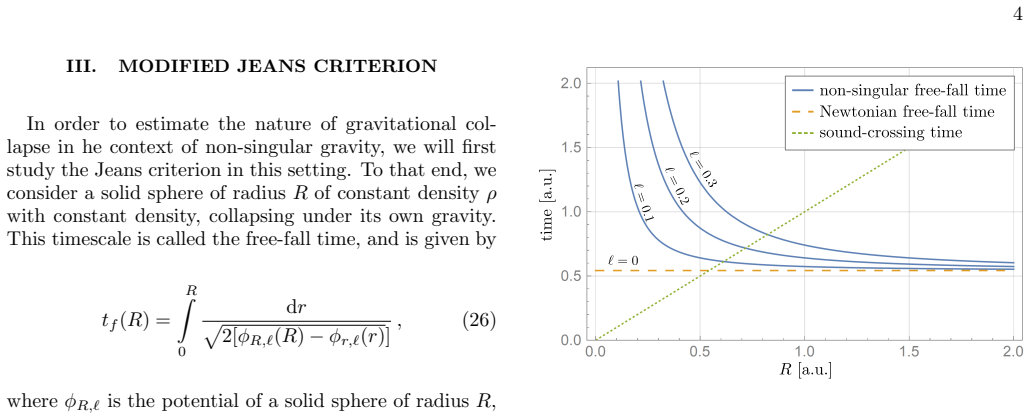
Solid sphere Finally, we focus on a solid sphere, whose density is 2 ρ= 3M 4πR3 θ(R−r).(22) Using now Eq. (15), the effective density can be calcu- lated: ρeff = 3M 4πR3 1 2 erf r+R 2ℓ −erf r−R 2ℓ + ℓ√πr exp −(r+R) 2 4ℓ2 (23) − ℓ√πr exp −(r−R) 2 4ℓ2 . The resulting potential takes the somewhat lengthy but exact form: ϕ=− GM r ( 1 2 1− r R 2 r 2R + 1 erf r...
-
[4]
smearing out
Modified Friedmann equations However, in the absence of a fundamental theory, it is not clear what constitutes the equivalent of the Fried- mann equations in non-singular gravity. As a heuristic approach, we notice that the effect of the regulator is a “smearing out” of the gravitational field. This idea has been discussed in nonlocal gravity [59, 60] as ...
-
[5]
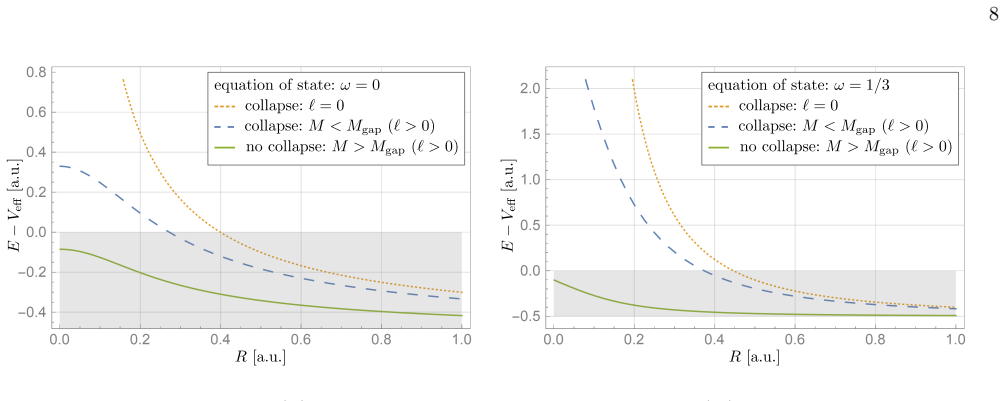
Infinite universe Embedded in an infinite universe we setR max =∞as well asE(R max) =−1/2 in Eq. (43) and obtain ˜E(R) =− 1 2 + 3GM ℓ 2√πR2 1 + 1−exp − R2 ℓ2 ℓ2 R2 , (46) 6 For small distancesR≪ℓwe find ˜E−V eff =− 1 2 + 3GM 4 √ 4ℓ +O(R 2).(47) Collapse becomes impossible ifV eff > E(R) for all values ofR, which in this case corresponds to GM < GM gap = 2...
-
[6]
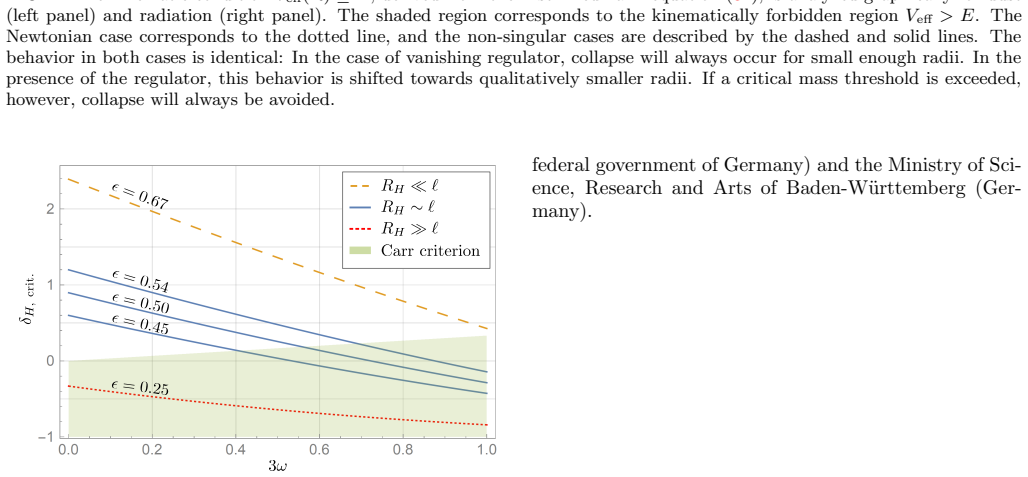
Carr criterion We are now ready to embed this collapse criterion in a simplified model of the early Universe to study its impli- cations for the formation criterion on primordial black holes via density fluctuations. We assume the back- ground universe evolution to be flat (k= 0) such that the background densityρ b is given directly from the un- modified ...
-
[7]
Testing the nature of dark compact objects: a status report
V. Cardoso and P. Pani, “Testing the nature of dark com- pact objects: a status report,” Living Rev. Rel.22, 4 (2019), 1904.05363 [gr-qc]
work page internal anchor Pith review Pith/arXiv arXiv 2019
-
[8]
Renormalization of higher-derivative quan- tum gravity,
K. S. Stelle, “Renormalization of higher-derivative quan- tum gravity,” Phys. Rev. D16, 953 (1977)
1977
-
[9]
A. Salvio, “Quadratic gravity,” Front. in Phys.6, 77 (2018), 1804.09944 [hep-th]
work page internal anchor Pith review Pith/arXiv arXiv 2018
-
[10]
A. Bonanno, A. Eichhorn, H. Gies, J. M. Pawlowski, R. Percacci, M. Reuter, F. Saueressig and G. P. Vacca, “Critical reflections on asymptotically safe gravity,” Front. in Phys.8, 269 (2020) 2004.06810 [gr-qc]
-
[11]
L. Buoninfante, B. Knorr, K. S. Kumar, A. Platania, D. Anselmi, I. Basile, N. E. J. Bjerrum-Bohr, R. Bran- denberger, M. Carrillo Gonz´ alez and A. C. Davis,et al. “Visions in quantum gravity,” 2412.08696 [hep-th]
-
[12]
Black Holes in Higher-Derivative Gravity
H. Lu, A. Perkins, C. N. Pope and K. S. Stelle, “Black holes in higher-derivative gravity,” Phys. Rev. Lett.114, 171601 (2015), 1502.01028 [hep-th]. 9
work page internal anchor Pith review Pith/arXiv arXiv 2015
-
[13]
S. Vagnozzi and L. Visinelli, “Hunting for extra dimen- sions in the shadow of M87*,” Phys. Rev. D100, 024020 (2019), 1905.12421 [gr-qc]
-
[14]
Black holes with scalar hair in light of the Event Horizon Telescope,
M. Khodadi, A. Allahyari, S. Vagnozzi and D. F. Mota, “Black holes with scalar hair in light of the Event Horizon Telescope,” JCAP09, 026 (2020), 2005.05992 [gr-qc]
-
[15]
Con- straints on black hole charges with the 2017 EHT ob- servations of M87*,
P. Kocherlakotaet al.[Event Horizon Telescope], “Con- straints on black hole charges with the 2017 EHT ob- servations of M87*,” Phys. Rev. D103, 104047 (2021), 2105.09343 [gr-qc]
-
[16]
Gravitationally collapsed objects of very low mass,
S. Hawking, “Gravitationally collapsed objects of very low mass,” Mon. Not. Roy. Astron. Soc.152, 75 (1971)
1971
-
[17]
Black holes in the early Universe,
B. J. Carr and S. W. Hawking, “Black holes in the early Universe,” Mon. Not. Roy. Astron. Soc.168, 399 (1974)
1974
-
[18]
The primordial black hole mass spectrum,
B. J. Carr, “The primordial black hole mass spectrum,” Astrophys. J.201, 1 (1975)
1975
-
[19]
M. Y. Khlopov, “Primordial Black Holes,” Res. Astron. Astrophys.10, 495-528 (2010), 0801.0116 [astro-ph]
work page internal anchor Pith review Pith/arXiv arXiv 2010
-
[20]
New cosmological constraints on primordial black holes
B. J. Carr, K. Kohri, Y. Sendouda and J. Yokoyama, “New cosmological constraints on primordial black holes,” Phys. Rev. D81, 104019 (2010), 0912.5297 [astro- ph.CO]
work page internal anchor Pith review Pith/arXiv arXiv 2010
-
[21]
Constraints on Primordial Black Holes
B. Carr, K. Kohri, Y. Sendouda and J. Yokoyama, “Con- straints on primordial black holes,” Rept. Prog. Phys.84, 116902 (2021), 2002.12778 [astro-ph.CO]
work page internal anchor Pith review Pith/arXiv arXiv 2021
-
[22]
The history of primordial black holes,
B. J. Carr and A. M. Green, “The history of primordial black holes,” 2406.05736 [astro-ph.CO]
-
[23]
Signatures of primordial black hole dark matter
K. M. Belotsky, A. D. Dmitriev, E. A. Esipova, V. A. Gani, A. V. Grobov, M. Y. Khlopov, A. A. Kir- illov, S. G. Rubin and I. V. Svadkovsky, “Signatures of primordial black hole dark matter,” Mod. Phys. Lett. A 29, 1440005 (2014), 1410.0203 [astro-ph.CO]
work page internal anchor Pith review Pith/arXiv arXiv 2014
-
[24]
Primordial black hole dark matter from single field inflation
G. Ballesteros and M. Taoso, “Primordial black hole dark matter from single field inflation,” Phys. Rev. D97, 023501 (2018), 1709.05565 [hep-ph]
work page internal anchor Pith review Pith/arXiv arXiv 2018
-
[25]
Seven Hints for Primordial Black Hole Dark Matter
S. Clesse and J. Garc´ ıa-Bellido, “Seven hints for primor- dial black hole dark matter,” Phys. Dark Univ.22, 137 (2018), 1711.10458 [astro-ph.CO]
work page internal anchor Pith review Pith/arXiv arXiv 2018
-
[26]
Direct detection of primordial black hole relics as dark matter,
B. V. Lehmann, C. Johnson, S. Profumo and T. Schwem- berger, “Direct detection of primordial black hole relics as dark matter,” JCAP10, 046 (2019), 1906.06348 [hep- ph]
-
[27]
Primordial Black Holes as Dark Matter: Recent Developments
B. Carr and F. Kuhnel, “Primordial black holes as dark matter: Recent developments,” Ann. Rev. Nucl. Part. Sci.70, 355 (2020), 2006.02838 [astro-ph.CO]
work page internal anchor Pith review Pith/arXiv arXiv 2020
-
[28]
Primordial Black Holes as a dark matter candidate
A. M. Green and B. J. Kavanagh, “Primordial black holes as a dark matter candidate,” J. Phys. G48, 043001 (2021), 2007.10722 [astro-ph.CO]
work page internal anchor Pith review Pith/arXiv arXiv 2021
-
[29]
Primordial reg- ular black holes as all the dark matter. I. Time-radial- symmetric metrics,
M. Calz` a, D. Pedrotti and S. Vagnozzi, “Primordial reg- ular black holes as all the dark matter. I. Time-radial- symmetric metrics,” Phys. Rev. D111, 024009 (2025), 2409.02804 [gr-qc]
-
[30]
Non- singular black holes as dark matter,
P. C. W. Davies, D. A. Easson and P. B. Levin, “Non- singular black holes as dark matter,” Phys. Rev. D111, 103512 (2025), 2410.21577 [hep-th]
-
[31]
M. Calz` a, D. Pedrotti and S. Vagnozzi, “Primordial regu- lar black holes as all the dark matter. II. Non-time-radial- symmetric and loop quantum gravity-inspired metrics,” Phys. Rev. D111, 024010 (2025), 2409.02807 [gr-qc]
-
[32]
M. Calz` a, D. Pedrotti, G. W. Yuan and S. Vagnozzi, “Pri- mordial regular black holes as all the dark matter. III. Co- variant canonical quantum gravity models,” 2507.02396 [gr-qc]
-
[33]
New models of nonsingular black hole dark matter from limiting cur- vature,
S. A¸ smano˘ glu, J. Boos and C. D. Carone, “New models of nonsingular black hole dark matter from limiting cur- vature,” Phys. Rev. D112, 095019 (2025), 2507.18322 [gr-qc]
-
[34]
Pri- mordial black holes as cosmic expansion accelerators,
K. Dialektopoulos, T. Papanikolaou and V. Zarikas, “Pri- mordial black holes as cosmic expansion accelerators,” arXiv:2502.18352 [gr-qc]
-
[35]
Separate Universes Do Not Constrain Primordial Black Hole Formation
M. Kopp, S. Hofmann and J. Weller, “Separate universes do not constrain primordial black hole formation,” Phys. Rev. D83, 124025 (2011), 1012.4369 [astro-ph.CO]
work page internal anchor Pith review Pith/arXiv arXiv 2011
-
[36]
Threshold of primordial black hole formation
T. Harada, C. M. Yoo and K. Kohri, “Threshold of pri- mordial black hole formation,” Phys. Rev. D88, 084051 (2013) [Erratum: Phys. Rev. D89, 029903 (2014)], 1309.4201 [astro-ph.CO]
work page internal anchor Pith review Pith/arXiv arXiv 2013
-
[37]
Threshold for primordial black holes: Depen- dence on the shape of the cosmological perturbations,
I. Musco, “Threshold for primordial black holes: Depen- dence on the shape of the cosmological perturbations,” Phys. Rev. D100, 123524 (2019), 1809.02127 [gr-qc]
-
[38]
S. Young, “The primordial black hole formation crite- rion re-examined: Parametrisation, timing and the choice of window function,” Int. J. Mod. Phys. D29, 2030002 (2019), 1905.01230 [astro-ph.CO]
-
[39]
The basics of primordial black hole for- mation and abundance estimation,
C. M. Yoo, “The basics of primordial black hole for- mation and abundance estimation,” Galaxies10, 112 (2022), 2211.13512 [astro-ph.CO]
-
[40]
Dynamics of Primordial Black Hole Formation
J. C. Niemeyer and K. Jedamzik, “Dynamics of primor- dial black hole formation,” Phys. Rev. D59, 124013 (1999) astro-ph/9901292
work page internal anchor Pith review Pith/arXiv arXiv 1999
-
[41]
Black hole formation in the Friedmann universe: Formulation and computation in numerical relativity
M. Shibata and M. Sasaki, “Black hole formation in the Friedmann universe: Formulation and computation in numerical relativity,” Phys. Rev. D60, 084002 (1999), gr-qc/9905064
work page internal anchor Pith review Pith/arXiv arXiv 1999
-
[42]
The dynamics of primordial black hole formation,
I. Hawke and J. M. Stewart, “The dynamics of primordial black hole formation,” Class. Quant. Grav.19, 3687-3707 (2002)
2002
-
[43]
Computations of primordial black hole formation
I. Musco, J. C. Miller and L. Rezzolla, “Computations of primordial black hole formation,” Class. Quant. Grav. 22, 1405 (2005), gr-qc/0412063
work page internal anchor Pith review Pith/arXiv arXiv 2005
-
[44]
Curvature profiles as initial conditions for primordial black hole formation
A. G. Polnarev and I. Musco, “Curvature profiles as initial conditions for primordial black hole formation,” Class. Quant. Grav.24, 1405 (2007), gr-qc/0605122
work page internal anchor Pith review Pith/arXiv arXiv 2007
-
[45]
I. Musco, J. C. Miller and A. G. Polnarev, “Primordial black hole formation in the radiative era: Investigation of the critical nature of the collapse,” Class. Quant. Grav. 26, 235001 (2009), 0811.1452 [gr-qc]
work page internal anchor Pith review Pith/arXiv arXiv 2009
-
[46]
Primordial black hole formation in the matter-dominated phase of the Universe
T. Harada, C. M. Yoo, K. Kohri, K. i. Nakao and S. Jhin- gan, “Primordial black hole formation in the matter- dominated phase of the Universe,” Astrophys. J.833, 61 (2016), 1609.01588 [astro-ph.CO]
work page internal anchor Pith review Pith/arXiv arXiv 2016
-
[47]
Universal threshold for primordial black hole formation,
A. Escriv` a, C. Germani and R. K. Sheth, “Universal threshold for primordial black hole formation,” Phys. Rev. D101, 044022 (2020), 1907.13311 [gr-qc]
-
[48]
Non-singular general relativistic grav- itational collapse,
J. M. Bardeen, “Non-singular general relativistic grav- itational collapse,” in:Proceedings of the International Conference GR5(Tbilisi, U.S.S.R., 1968)
1968
-
[49]
Vacuum nonsingular black hole,
I. Dymnikova, “Vacuum nonsingular black hole,” Gen. Rel. Grav.24, 235 (1992)
1992
-
[50]
Renormalization group improved black hole spacetimes
A. Bonanno and M. Reuter, “Renormalization group im- proved black hole spacetimes,” Phys. Rev. D62, 043008 (2000), hep-th/0002196
work page internal anchor Pith review Pith/arXiv arXiv 2000
-
[51]
Formation and evaporation of regular black holes,
S. A. Hayward, “Formation and evaporation of regular black holes,” Phys. Rev. Lett.96, 031103 (2006), gr- qc/0506126
-
[52]
Information loss problem and a `black hole' model with a closed apparent horizon
V. P. Frolov, “Information loss problem and a ‘black hole’ model with a closed apparent horizon,” JHEP05, 049 10 (2014), 1402.5446 [hep-th]
work page internal anchor Pith review Pith/arXiv arXiv 2014
-
[53]
Notes on non-singular models of black holes
V. P. Frolov, “Notes on nonsingular models of black holes,” Phys. Rev. D94, 104056 (2016), 1609.01758 [gr- qc]
work page internal anchor Pith review Pith/arXiv arXiv 2016
-
[54]
Towards a non- singular paradigm of black hole physics,
R. Carballo-Rubio, F. Di Filippo, S. Liberati, M. Visser, J. Arrechea, C. Barcel´ o, A. Bonanno, J. Borissova, V. Boyanov and V. Cardoso,et al.“Towards a non- singular paradigm of black hole physics,” JCAP05, 003 (2025), 2501.05505 [gr-qc]
-
[55]
Mass-gap for black hole formation in higher derivative and ghost free gravity
V. P. Frolov, “Mass gap for black hole formation in higher-derivative and ghost-free gravity,” Phys. Rev. Lett.115, 051102 (2015), 1505.00492 [hep-th]
work page internal anchor Pith review Pith/arXiv arXiv 2015
-
[56]
Effective scalar field the- ory ofp-adic string,
P. H. Frampton and Y. Okada, “Effective scalar field the- ory ofp-adic string,” Phys. Rev. D37, 3077 (1988)
1988
- [57]
-
[58]
Super-renormalizable Quantum Gravity
L. Modesto, “Super-renormalizable quantum gravity,” Phys. Rev. D86, 044005 (2012), 1107.2403 [hep-th]
work page internal anchor Pith review Pith/arXiv arXiv 2012
-
[59]
Towards singularity and ghost free theories of gravity
T. Biswas, E. Gerwick, T. Koivisto and A. Mazumdar, “Towards singularity and ghost-free theories of gravity,” Phys. Rev. Lett.108, 031101 (2012), 1110.5249 [gr-qc]
work page internal anchor Pith review Pith/arXiv arXiv 2012
-
[60]
Effects of nonlocality in gravity and quan- tum theory,
J. Boos, “Effects of nonlocality in gravity and quan- tum theory,” Ph.D. thesis, University of Alberta, 2020, Springer Theses 2021, 2009.10856 [gr-qc]
-
[61]
Gravitational collapse in non-singular gravity,
M. Hartenfels, “Gravitational collapse in non-singular gravity,” B.Sc. thesis, Karlsruhe Institute of Technology, 2026
2026
-
[62]
Behavior of the Newtonian potential for ghost-free gravity and singularity-free gravity
J. Edholm, A. S. Koshelev and A. Mazumdar, “Behav- ior of the Newtonian potential for ghost-free gravity and singularity-free gravity,” Phys. Rev. D94, 104033 (2016), 1604.01989 [gr-qc]
work page internal anchor Pith review Pith/arXiv arXiv 2016
-
[63]
The gravitational field of static p-branes in linearized ghost-free gravity
J. Boos, V. P. Frolov and A. Zelnikov, “Gravitational field of static p-branes in linearized ghost-free gravity,” Phys. Rev. D97, 084021 (2018), 1802.09573 [gr-qc]
work page internal anchor Pith review Pith/arXiv arXiv 2018
-
[64]
Nonlocality and gravitoelectro- magnetic duality,
J. Boos and I. Kol´ aˇ r, “Nonlocality and gravitoelectro- magnetic duality,” Phys. Rev. D104, 024018 (2021), 2103.10555 [gr-qc]
-
[65]
Gravitational Friedel oscillations in higher-derivative and infinite-derivative gravity?
J. Boos, “Gravitational Friedel oscillations in higher- derivative and infinite-derivative gravity?,” Int. J. Mod. Phys. D27, 1847022 (2018), 1804.00225 [gr-qc]
work page internal anchor Pith review Pith/arXiv arXiv 2018
-
[66]
Effective delta sources and regularity in higher-derivative and ghost-free gravity
B. L. Giacchini and T. de Paula Netto, “Effective delta sources and regularity in higher-derivative and ghost-free gravity,” JCAP07, 013 (2019), 1809.05907 [gr-qc]
work page internal anchor Pith review Pith/arXiv arXiv 2019
-
[67]
What happens to topological invariants and black holes in singularity-free theories?,
J. Boos, “What happens to topological invariants and black holes in singularity-free theories?,” Phys. Rev. D 111, 084063 (2025), 2411.11450 [gr-qc]
discussion (0)
Sign in with ORCID, Apple, or X to comment. Anyone can read and Pith papers without signing in.