Leptonic CP Phase Determination from Fisher Information in NOνA and T2K
Pith reviewed 2026-06-29 06:24 UTC · model grok-4.3
The pith
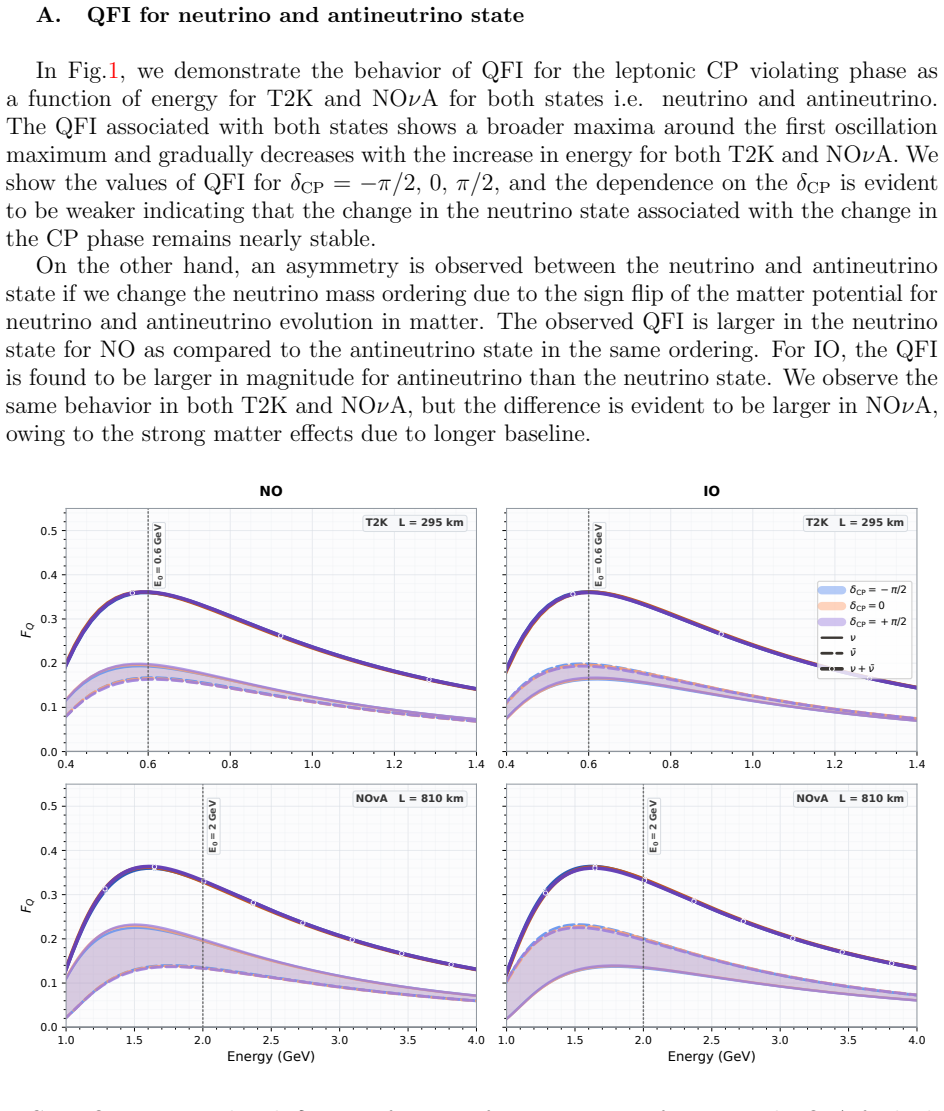
T2K and NOνA extract only a small fraction of the quantum information about the leptonic CP phase δ_CP.
A machine-rendered reading of the paper's core claim, the machinery that carries it, and where it could break.
Core claim
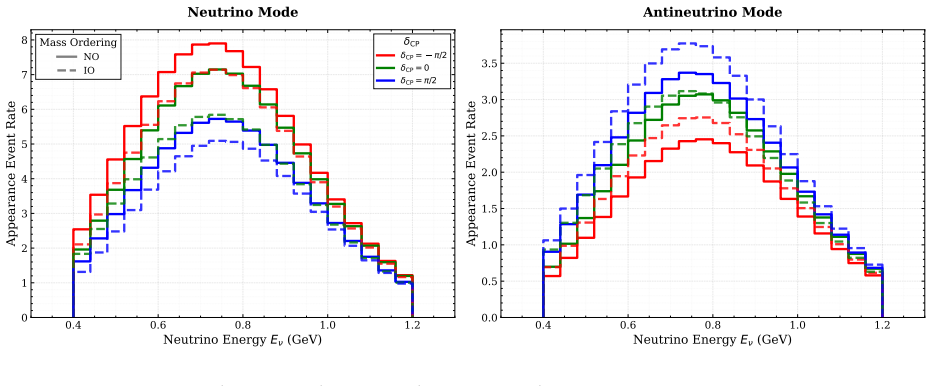
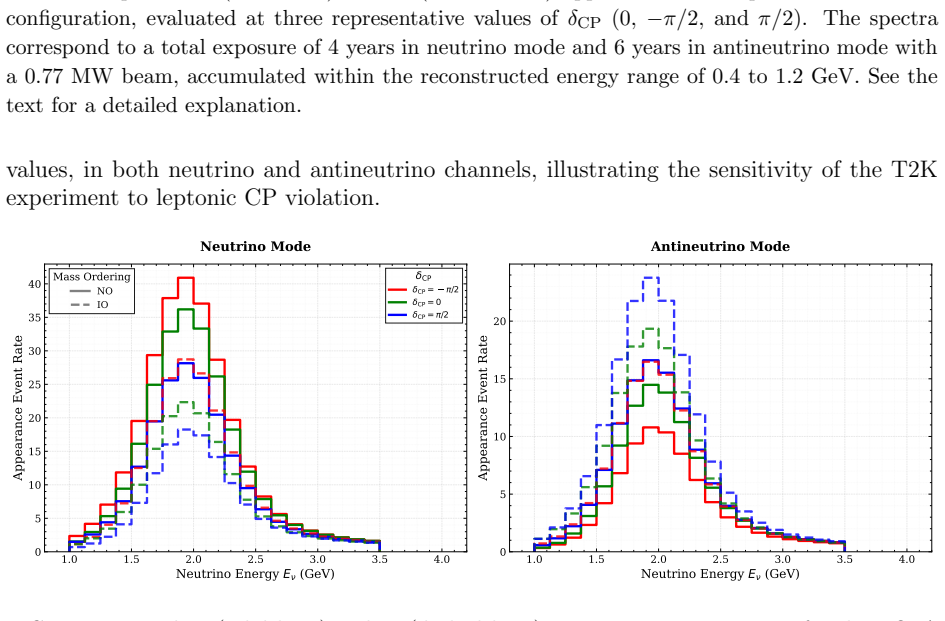
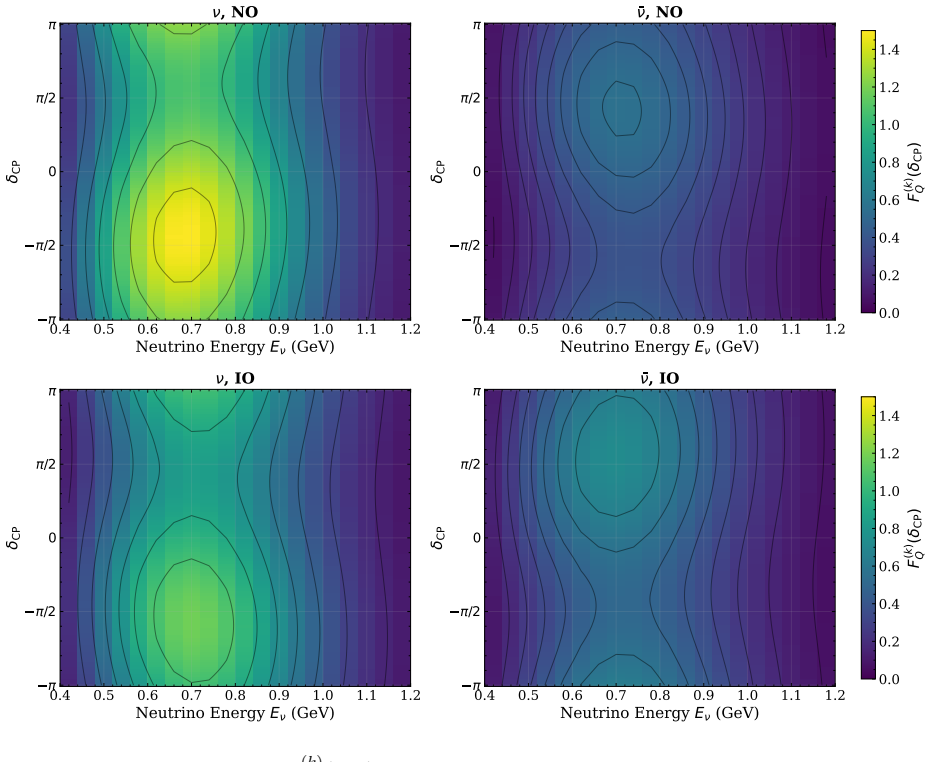
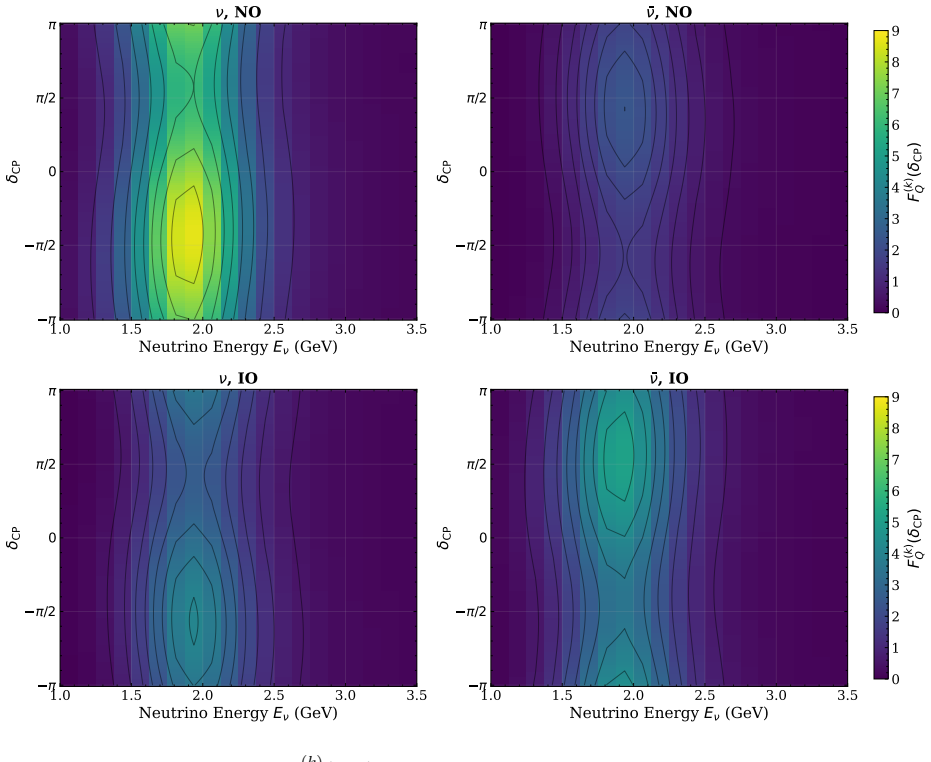
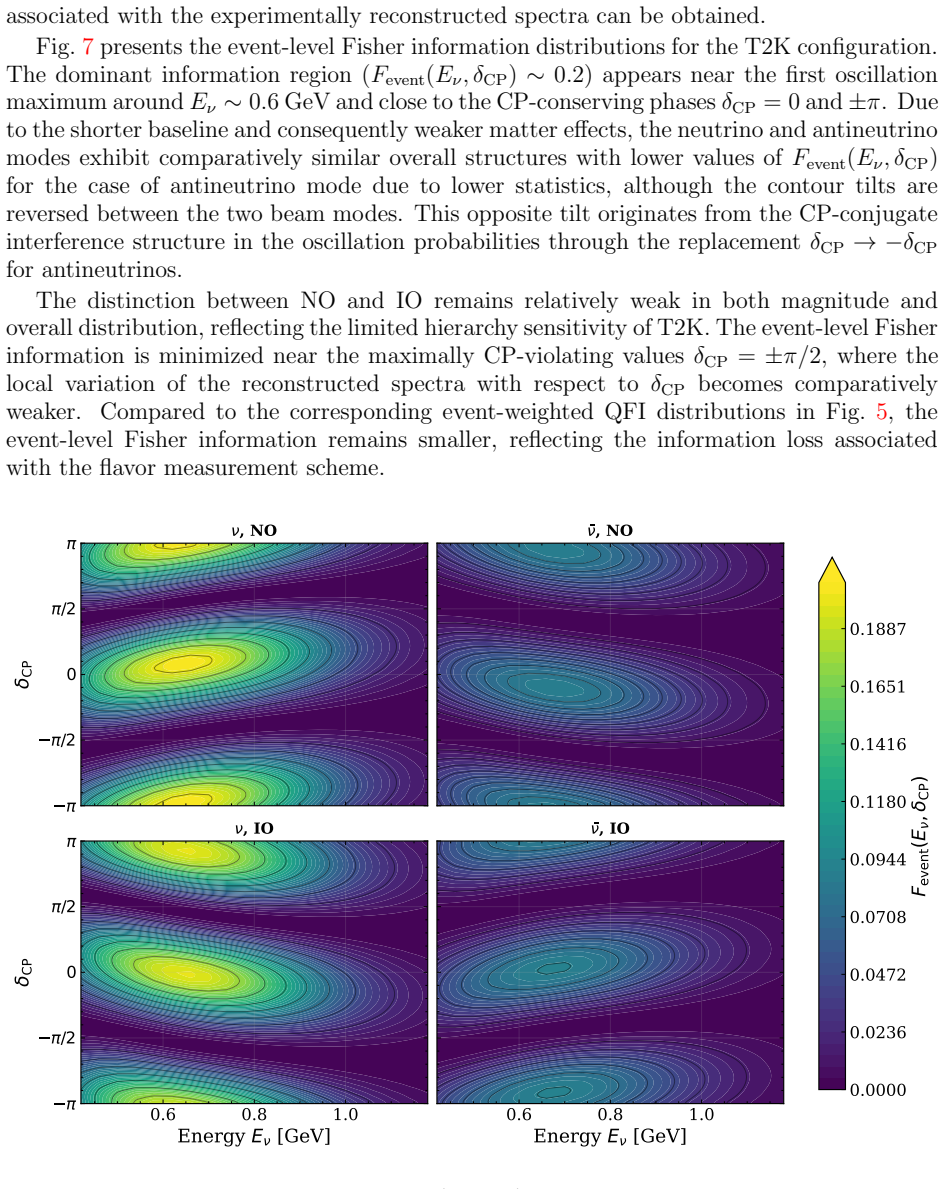
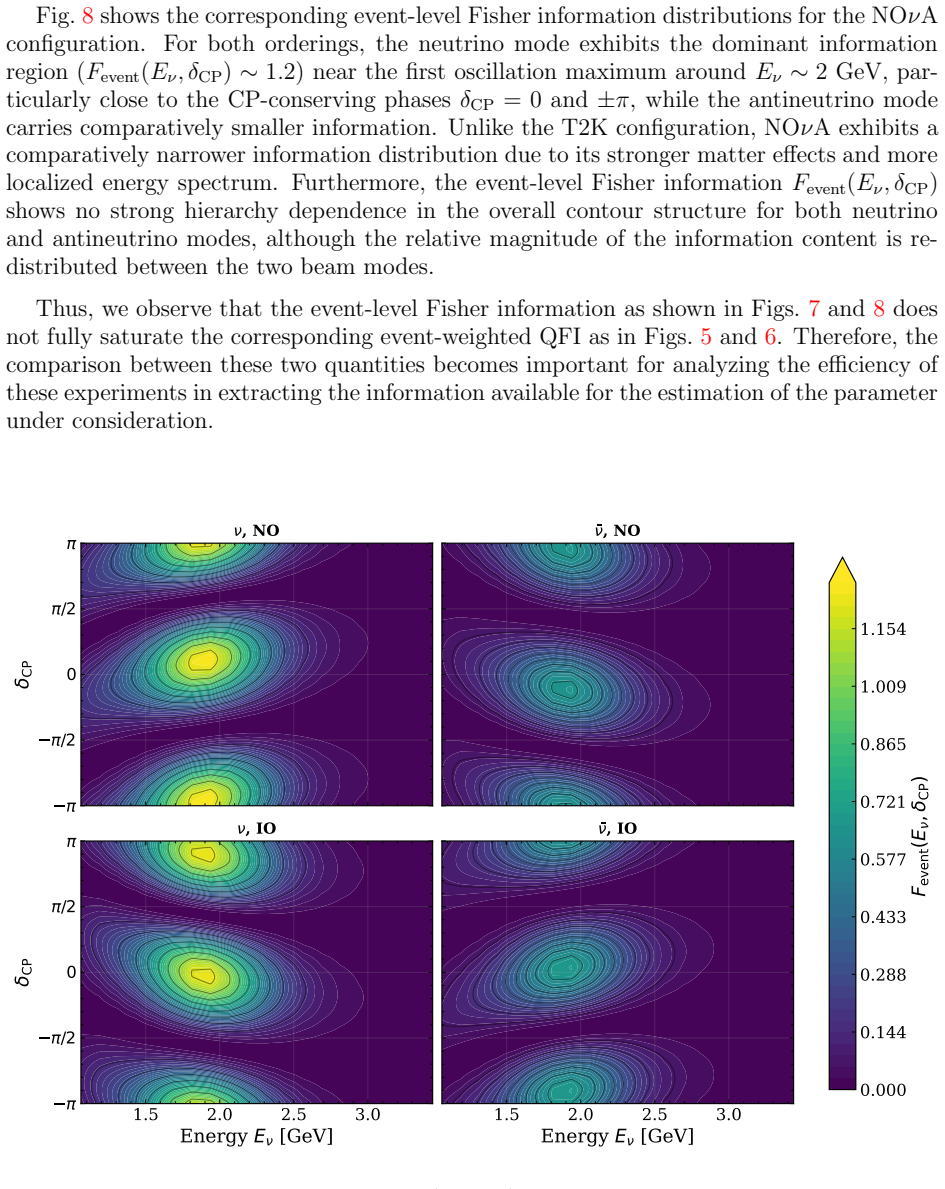
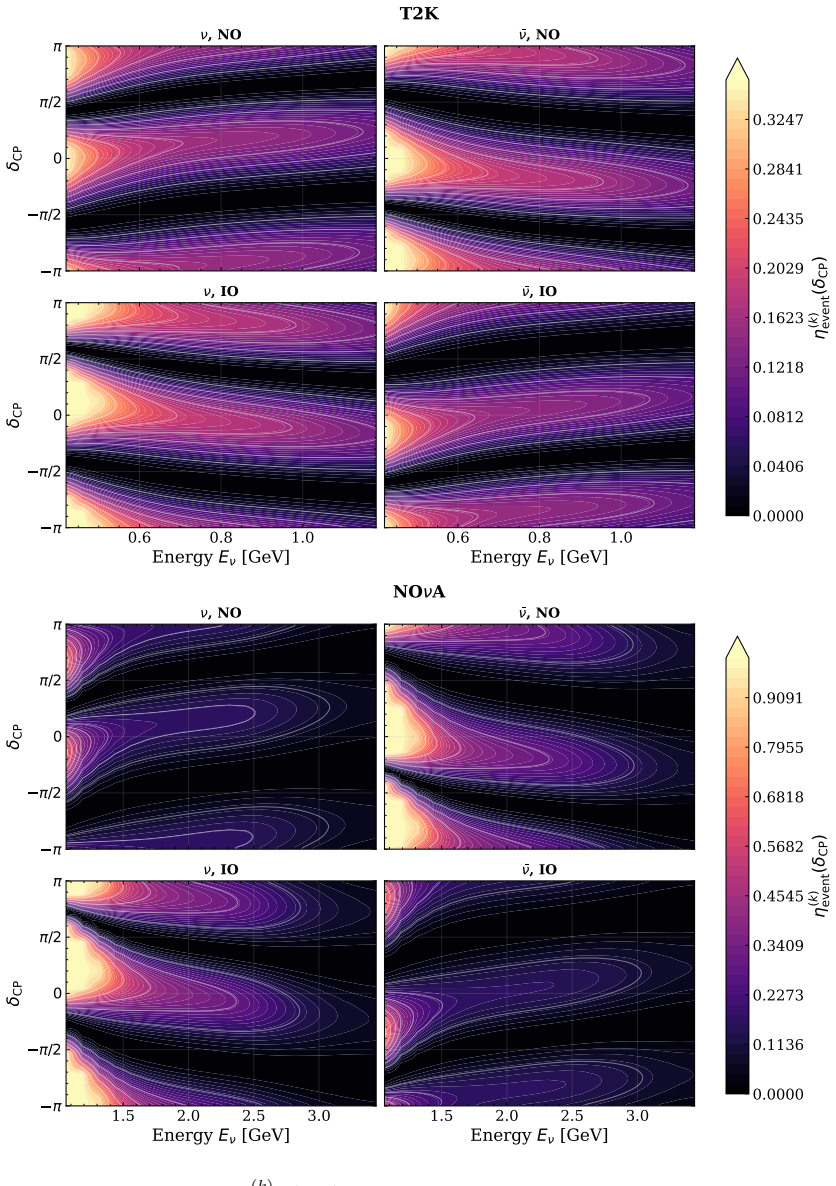
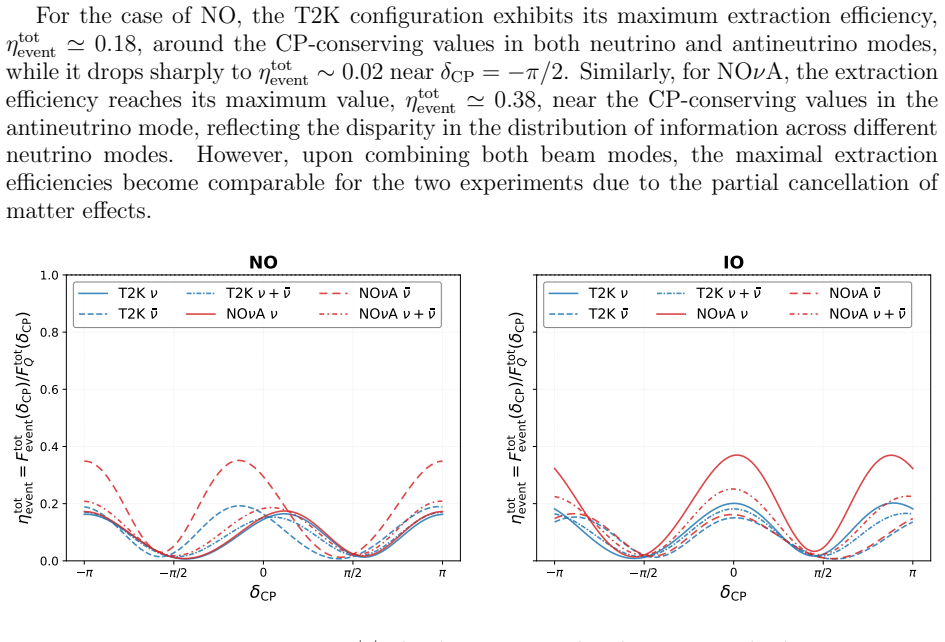
The authors show that the quantum states of neutrinos encode a finite amount of information about δ_CP whose structure depends on matter effects and the mass ordering. When this intrinsic content is compared with the event-level Fisher information extracted from the actual reconstructed spectra in T2K and NOνA, the experiments are found to access only a small fraction of the available information, with the shortfall most pronounced near maximally CP-violating values of the phase where spectral variations with δ_CP are reduced.
What carries the argument
Quantum Fisher information of the neutrino state with respect to δ_CP, set against the classical Fisher information obtained from binned event rates under Poisson statistics.
If this is right
- The ultimate precision on δ_CP remains bounded by the fraction of quantum information that can be extracted from flavor-tagged event counts.
- Near maximal CP violation the reconstructed spectra lose sensitivity, directly reducing the ability to resolve small changes in the phase.
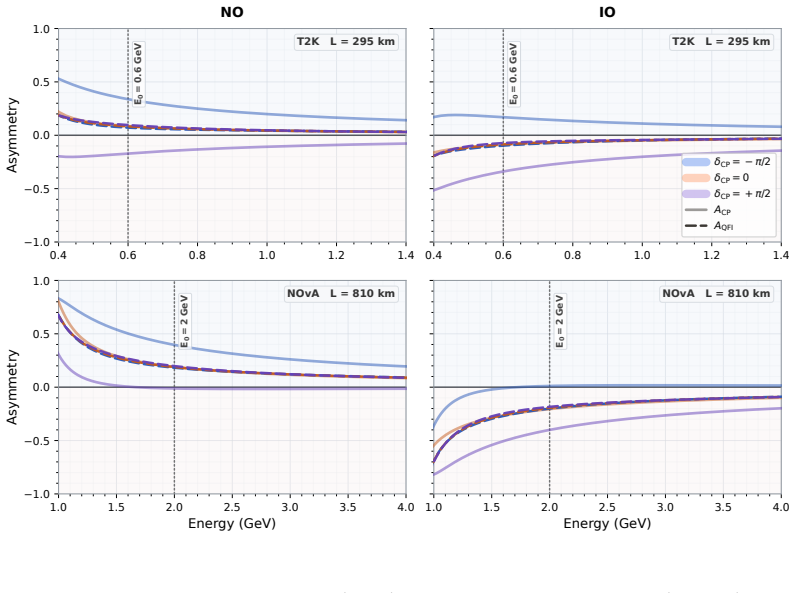
- Matter effects produce distinct information patterns for normal and inverted mass orderings, affecting how much information each experiment can access.
- Even the combined T2K plus NOνA data set still leaves most of the quantum information about δ_CP unused.
Where Pith is reading between the lines
- Measurements that go beyond standard flavor identification, such as more complete reconstruction of the final-state kinematics, could in principle recover a larger share of the quantum information.
- The same comparison between quantum and event-level Fisher information could be applied to proposed future experiments to identify design choices that raise extraction efficiency.
- The reduced sensitivity near maximal CP violation suggests that statistical power alone does not explain the full experimental difficulty; the shape of the likelihood surface itself is the limiting factor.
- If the gap between quantum and classical information persists across different analysis methods, it would indicate that new observable channels, rather than larger statistics, are needed to improve constraints on δ_CP.
Load-bearing premise
That the Poisson likelihood constructed from reconstructed energy and flavor spectra fully represents all experimentally accessible information about δ_CP.
What would settle it
A re-analysis of T2K or NOνA data near δ_CP = ±π/2 that finds the event distributions vary more rapidly with small phase shifts than the computed event-level Fisher information predicts.
Figures
read the original abstract
The precise determination of the leptonic CP phase $\delta_{\rm CP}$ remains one of the central objectives of current and future long-baseline (LBL) neutrino oscillation experiments. Quantum estimation theory provides a natural framework to quantify the ultimate precision limits for estimating physical parameters encoded in quantum states. In this work, we employ the quantum Fisher information to investigate how much information about $\delta_{\rm CP}$ is intrinsically encoded in neutrino states and how efficiently it is extracted in present LBL experiments such as T2K and NO$\nu$A. We first analyze the intrinsic quantum sensitivity of neutrino and antineutrino states and demonstrate how matter effects generate a neutrino mass-ordering dependent information structure. To compare the intrinsic information content of the quantum state with the information experimentally accessible through flavor measurements, we compute the event-level Fisher information from reconstructed event spectra using Poisson statistics. We find that both experiments extract only a small fraction of the total information available in the underlying quantum state. This extraction efficiency becomes particularly suppressed near maximally CP-violating regions, where the reconstructed event spectra exhibit reduced sensitivity to small variations in $\delta_{\rm CP}$. Our analysis provides a complementary information-theoretic perspective on precise estimation of oscillation parameters in LBL neutrino experiments.
Editorial analysis
A structured set of objections, weighed in public.
Referee Report
Summary. The manuscript applies quantum estimation theory to long-baseline neutrino experiments, computing the quantum Fisher information (QFI) for the CP phase δ_CP encoded in neutrino and antineutrino states (including matter effects) and comparing it to the classical Fisher information extracted from binned event spectra via Poisson statistics in T2K and NOνA. The central claim is that both experiments capture only a small fraction of the intrinsic information, with extraction efficiency particularly suppressed near maximal CP violation.
Significance. If the numerical results hold, the work supplies a concrete information-theoretic benchmark for the efficiency of flavor measurements in current LBL experiments. It quantifies the gap between the quantum limit and the practically accessible information under the standard POVM, and the mass-ordering dependence arising from matter effects is a useful addition. The approach is standard for quantum-vs-classical estimation comparisons and could inform detector or analysis upgrades.
major comments (2)
- [Abstract] The abstract states that experiments 'extract only a small fraction' and that efficiency is 'particularly suppressed' near maximal CP violation, but supplies no numerical values, error estimates, or validation against known limits (e.g., the δ_CP-independent case or the vacuum limit). Without these in the main text or figures, the magnitude of the claimed suppression cannot be assessed.
- The comparison assumes that the Poisson-based event Fisher information on reconstructed spectra fully represents the experimentally accessible information. While this is the correct benchmark for the chosen measurement, the manuscript should explicitly state the binning, energy resolution, and efficiency assumptions used to compute the classical FI, as these directly affect the reported extraction efficiency.
minor comments (2)
- Notation for the quantum state propagation (including matter Hamiltonian) and the explicit form of the QFI matrix element for δ_CP should be given in an early section to allow readers to reproduce the mass-ordering dependence.
- [Abstract] The abstract would be strengthened by a single quantitative statement (e.g., 'extraction efficiency drops to X% near δ_CP = 3π/2') even if the detailed plots appear later.
Simulated Author's Rebuttal
We thank the referee for the constructive comments and positive assessment of the significance of our work. We address each major comment below and have revised the manuscript to improve clarity and completeness.
read point-by-point responses
-
Referee: [Abstract] The abstract states that experiments 'extract only a small fraction' and that efficiency is 'particularly suppressed' near maximal CP violation, but supplies no numerical values, error estimates, or validation against known limits (e.g., the δ_CP-independent case or the vacuum limit). Without these in the main text or figures, the magnitude of the claimed suppression cannot be assessed.
Authors: The main text and figures already contain the detailed numerical comparisons of quantum and classical Fisher information, including the δ_CP dependence and matter-effect-induced mass-ordering structure, with explicit results for both T2K and NOνA. However, we agree that the abstract would benefit from summarizing key quantitative benchmarks to allow immediate assessment of the claimed suppression. In the revised manuscript we have updated the abstract to include approximate extraction efficiencies drawn from our calculations and a brief reference to the vacuum-limit validation (where the two Fisher informations coincide in the absence of matter effects). revision: yes
-
Referee: The comparison assumes that the Poisson-based event Fisher information on reconstructed spectra fully represents the experimentally accessible information. While this is the correct benchmark for the chosen measurement, the manuscript should explicitly state the binning, energy resolution, and efficiency assumptions used to compute the classical FI, as these directly affect the reported extraction efficiency.
Authors: We agree that the assumptions entering the classical Fisher information must be stated explicitly. The original manuscript references the standard T2K and NOνA configurations, but we have now added a dedicated paragraph (in the section describing the classical FI calculation) that specifies the energy binning, energy-resolution smearing model, and detection-efficiency parametrizations employed. This addition ensures full reproducibility and clarifies the precise scope of the reported extraction efficiencies. revision: yes
Circularity Check
No significant circularity identified
full rationale
The derivation computes the quantum Fisher information directly from the neutrino state evolution (including matter effects) and the classical event-level Fisher information from Poisson statistics on reconstructed flavor spectra. These are independent quantities by construction: QFI bounds the precision over any measurement while the Poisson FI is the information for the specific flavor POVM used in the experiments. No equation reduces a claimed result to a fitted parameter, self-citation chain, or input by definition. The comparison of extraction efficiency is a standard quantum-vs-classical estimation exercise and remains self-contained without load-bearing self-citations or ansatz smuggling.
Axiom & Free-Parameter Ledger
Forward citations
Cited by 1 Pith paper
-
Revealing precision bounds on neutrino oscillation parameters with quantum estimation theory
Quantum Fisher information matrix is derived for neutrino flavor states to obtain Cramér-Rao bounds on oscillation parameters for reactor and accelerator experiments.
Reference graph
Works this paper leans on
-
[1]
The matter potential is computed as: VCC = √ 2GF ne = 7.56 × 10⁻¹⁴ eV · ρ [g/cm3] · Ye, (14) where GF is the Fermi constant and ne is the electron number density
U † + diag(VCC , 0, 0), (13) where U is the PMNS matrix and VCC is the matter potential. The matter potential is computed as: VCC = √ 2GF ne = 7.56 × 10⁻¹⁴ eV · ρ [g/cm3] · Ye, (14) where GF is the Fermi constant and ne is the electron number density. 5 The neutrino state evolution is obtained by |ν(L)⟩ = e−iHL|ν(0)⟩, where L is the propa- gation length. ...
2029
-
[2]
Review of particle physics,
S. Navas et al. [Particle Data Group], “Review of particle physics,” Phys. Rev. D 110 (2024) no.3, 030001
2024
-
[3]
First measurement of reactor neutrino oscillations at JUNO,
A. Abusleme et al. [JUNO], “First measurement of reactor neutrino oscillations at JUNO,” [arXiv:2511.14593 [hep-ex]]. 24
-
[4]
Inverse Beta Processes and Nonconservation of Lepton Charge,
B. Pontecorvo, “Inverse Beta Processes and Nonconservation of Lepton Charge,” Sov. Phys. JETP 7 (1958), 172-173
1958
-
[5]
Remarks on the unified model of elementary particles,
Z. Maki, M. Nakagawa and S. Sakata, “Remarks on the unified model of elementary particles,” Prog. Theor. Phys. 28 (1962), 870-880
1962
-
[6]
Feasibility of using high-energy neutrinos to study the weak interactions,
M. Schwartz, “Feasibility of using high-energy neutrinos to study the weak interactions,” Phys. Rev. Lett. 4 (1960), 306-307
1960
-
[7]
THEORETICAL DISCUSSIONS ON POSSIBLE HIGH- ENERGY NEUTRINO EXPERIMENTS,
T. D. Lee and C. N. Yang, “THEORETICAL DISCUSSIONS ON POSSIBLE HIGH- ENERGY NEUTRINO EXPERIMENTS,” Phys. Rev. Lett. 4 (1960), 307-311
1960
-
[8]
Constraint on the matter–antimatter symmetry-violating phase in neu- trino oscillations,
K. Abe et al. [T2K], “Constraint on the matter–antimatter symmetry-violating phase in neu- trino oscillations,” Nature 580 (2020) no.7803, 339-344 [erratum: Nature 583 (2020) no.7814, E16] [arXiv:1910.03887 [hep-ex]]
-
[9]
Improved measurement of neutrino oscillation parameters by the NOvA experiment,
M. A. Acero et al. [NOvA], “Improved measurement of neutrino oscillation parameters by the NOvA experiment,” Phys. Rev. D 106 (2022) no.3, 032004 [arXiv:2108.08219 [hep-ex]]
-
[10]
K. Abe et al. [T2K], “Measurements of neutrino oscillation parameters from the T2K experi- ment using 3.6×10²¹ protons on target,” Eur. Phys. J. C83 (2023) no.9, 782 [arXiv:2303.03222 [hep-ex]]
-
[11]
Expanding neutrino oscillation parameter measurements in NOvA using a Bayesian approach,
M. A. Acero et al. [NOvA], “Expanding neutrino oscillation parameter measurements in NOvA using a Bayesian approach,” Phys. Rev. D 110 (2024) no.1, 1 [arXiv:2311.07835 [hep-ex]]
-
[12]
Joint neutrino oscillation analysis from the T2K and NOvA experiments,
S. Abubakar et al. [T2K and NOvA], “Joint neutrino oscillation analysis from the T2K and NOvA experiments,” Nature 646 (2025) no.8086, 818-824 [arXiv:2510.19888 [hep-ex]]
-
[13]
CP -Violating Neutrino Nonstandard Interactions in Long-Baseline-Accelerator Data,
P. B. Denton, J. Gehrlein and R. Pestes, “CP -Violating Neutrino Nonstandard Interactions in Long-Baseline-Accelerator Data,”Phys. Rev. Lett. 126 (2021) no.5, 051801 [arXiv:2008.01110 [hep-ph]]
-
[14]
Nonstandard Neutrino Interactions as a Solution to the N OνA and T2K Discrepancy,
S. S. Chatterjee and A. Palazzo, “Nonstandard Neutrino Interactions as a Solution to the N OνA and T2K Discrepancy,” Phys. Rev. Lett. 126 (2021) no.5, 051802 [arXiv:2008.04161 [hep-ph]]
-
[15]
Information Theory and Statistical Mechanics,
E. T. Jaynes, “Information Theory and Statistical Mechanics,” Phys. Rev. 106 (1957), 620- 630
1957
-
[16]
Information and the accuracy attainable in the estimation of statistical parame- ters,
C. R. Rao, “Information and the accuracy attainable in the estimation of statistical parame- ters,” Bull. Calcutta Math. Soc. 37 (1945), 81-89
1945
-
[17]
Theory of statistical estimation,
R. A. Fisher, “Theory of statistical estimation,” Math. Proc. Cambridge Philos. Soc.22 (1925) no.5, 700-725
1925
-
[18]
Quantum detection and estimation theory,
C. W. Helstrom, “Quantum detection and estimation theory,” J. Stat. Phys. 1 (1969), 231-252
1969
-
[19]
Quantum estimation for quantum technology
M. G. A. Paris, “Quantum Estimation for Quantum Technology,” Int. J. Quant. Inf. 7 (2009), 125-137 [arXiv:0804.2981 [quant-ph]]
work page internal anchor Pith review Pith/arXiv arXiv 2009
-
[20]
Quantum Fisher information matrix and multipa- rameter estimation,
J. Liu, H. Yuan, X. M. Lu and X. Wang, “Quantum Fisher information matrix and multipa- rameter estimation,” J. Phys. A 53 (2020) no.2, 023001 [arXiv:1907.08037 [quant-ph]]
-
[21]
Quantum Fisher Information Flow in Non-Markovian Processes of Open Systems
X. M. Lu, X. Wang and C. P. Sun, “Quantum Fisher information flow and non-Markovian processes of open systems,” Phys. Rev. A 82 (2010), 042103 [arXiv:0912.0587 [quant-ph]]
work page internal anchor Pith review Pith/arXiv arXiv 2010
-
[22]
Quantum theory of phase estimation
L. Pezze and A. Smerzi, “Quantum theory of phase estimation,” [arXiv:1411.5164 [quant-ph]]
work page internal anchor Pith review Pith/arXiv arXiv
-
[23]
Quantum estimation in neutrino oscillations
E. C. Nogueira, G. de Souza, A. D. Varizi and M. D. Sampaio, “Quantum estimation in neutrino oscillations,” Int. J. Quant. Inf. 15 (2017) no.6, 1750045 [arXiv:1610.05388 [quant- ph]]
work page internal anchor Pith review Pith/arXiv arXiv 2017
-
[24]
Is the large uncertainty of δCP fundamentally encoded in the neutrino quantum state?,
M. Ignoti, C. Frugiuele, M. G. A. Paris and M. G. Genoni, “Is the large uncertainty of δCP fundamentally encoded in the neutrino quantum state?,” [arXiv:2511.20148 [hep-ph]]. 25
-
[25]
Quantum Estimation Theory Limits in Neutrino Oscillation Experiments,
C. Frugiuele, M. G. Genoni, M. Ignoti and M. G. A. Paris, “Quantum Estimation Theory Limits in Neutrino Oscillation Experiments,” [arXiv:2602.16534 [hep-ph]]
-
[26]
Information-Theoretic Gaps in Solar and Reactor Neutrino Oscillation Measurements,
N. R. S. Chundawat and Y. F. Li, “Information-Theoretic Gaps in Solar and Reactor Neutrino Oscillation Measurements,” [arXiv:2602.07991 [hep-ph]]
-
[27]
Quantum Fisher Information Revealing Parameter Sensi- tivity in Long-Baseline Neutrino Experiments,
B. Yadav, A. Subba and Y. Shi, “Quantum Fisher Information Revealing Parameter Sensi- tivity in Long-Baseline Neutrino Experiments,” [arXiv:2602.05221 [hep-ph]]
-
[28]
B. W. Farooq, B. Singh Koranga and A. Chatterjee, “Quantum Fisher Information as a Probe of Sterile Neutrino New Physics:Geometric Advantage of KM3NeT over IceCube,” [arXiv:2604.01256 [hep-ph]]
-
[29]
Multipartite entangled states in particle mixing
M. Blasone, F. Dell’Anno, S. De Siena, M. Di Mauro and F. Illuminati, “Multipartite entangled states in particle mixing,” Phys. Rev. D 77 (2008), 096002 [arXiv:0711.2268 [quant-ph]]
work page internal anchor Pith review Pith/arXiv arXiv 2008
-
[30]
Entanglement in neutrino oscillations
M. Blasone, F. Dell’Anno, S. De Siena and F. Illuminati, “Entanglement in neutrino oscilla- tions,” EPL 85 (2009) no.5, 50002 [arXiv:0707.4476 [hep-ph]]
work page internal anchor Pith review Pith/arXiv arXiv 2009
-
[31]
Quantum correlations in terms of neutrino oscillation probabilities
A. K. Alok, S. Banerjee and S. U. Sankar, “Quantum correlations in terms of neutrino oscil- lation probabilities,” Nucl. Phys. B 909 (2016), 65-72 [arXiv:1411.5536 [hep-ph]]
work page internal anchor Pith review Pith/arXiv arXiv 2016
-
[32]
A quantum information theoretic analysis of three flavor neutrino oscillations
S. Banerjee, A. K. Alok, R. Srikanth and B. C. Hiesmayr, “A quantum information theo- retic analysis of three flavor neutrino oscillations,” Eur. Phys. J. C 75 (2015) no.10, 487 [arXiv:1508.03480 [hep-ph]]
work page internal anchor Pith review Pith/arXiv arXiv 2015
-
[33]
Violation of the Leggett-Garg Inequality in Neutrino Oscillations
J. A. Formaggio, D. I. Kaiser, M. M. Murskyj and T. E. Weiss, “Violation of the Leggett-Garg inequality in neutrino oscillations,” Phys. Rev. Lett. 117 (2016) no.5, 050402 [arXiv:1602.00041 [quant-ph]]
work page internal anchor Pith review Pith/arXiv arXiv 2016
-
[34]
Q. Fu and X. Chen, “Testing violation of the Leggett-Garg-type inequality in neutrino oscilla- tions of the Daya Bay experiment,” Eur. Phys. J. C 77 (2017) no.11, 775 [arXiv:1705.08601 [hep-ph]]
work page internal anchor Pith review Pith/arXiv arXiv 2017
-
[35]
A quantum information theoretic quantity sensitive to the neutrino mass-hierarchy,
J. Naikoo, A. K. Alok, S. Banerjee, S. U. Sankar, G. Guarnieri, C. Schultze and B. C. Hiesmayr, “A quantum information theoretic quantity sensitive to the neutrino mass-hierarchy,” Nucl. Phys. B 951 (2020), 114872 [arXiv:1710.05562 [hep-ph]]
-
[36]
Study of temporal quantum correlations in decohering B and K meson systems
J. Naikoo, A. K. Alok and S. Banerjee, “Study of temporal quantum correlations in decohering B and K meson systems,” Phys. Rev. D 97 (2018) no.5, 053008 [arXiv:1802.04265 [hep-ph]]
work page internal anchor Pith review Pith/arXiv arXiv 2018
-
[37]
Leggett-Garg inequality in the context of three flavour neutrino oscillation
J. Naikoo, A. K. Alok, S. Banerjee and S. U. Sankar, “Leggett-Garg inequality in the context of three flavour neutrino oscillation,” Phys. Rev. D 99 (2019) no.9, 095001 [arXiv:1901.10859 [hep-ph]]
work page internal anchor Pith review Pith/arXiv arXiv 2019
-
[38]
Quantification of quantumness in neutrino oscillations,
F. Ming, X. K. Song, J. Ling, L. Ye and D. Wang, “Quantification of quantumness in neutrino oscillations,” Eur. Phys. J. C 80 (2020) no.3, 275
2020
-
[39]
Leggett-Garg inequalities in the quantum field theory of neutrino oscillations,
M. Blasone, F. Illuminati, L. Petruzziello and L. Smaldone, “Leggett-Garg inequalities in the quantum field theory of neutrino oscillations,” Phys. Rev. A 108 (2023) no.3, 032210 [arXiv:2111.09979 [quant-ph]]
-
[40]
A. K. Jha, M. Dutta, M. Pathak, S. Banerjee and B. Mukhopadhyay, “Probing the quantum speed limit and entanglement in flavor oscillations of neutrino-antineutrino system in curved spacetime,” Phys. Rev. D 112 (2025) no.4, 043045 [arXiv:2504.20236 [gr-qc]]
-
[41]
Quantum mismatch: A powerful measure of quantumness in neutrino oscillations,
D. S. Chattopadhyay and A. Dighe, “Quantum mismatch: A powerful measure of quantumness in neutrino oscillations,” Phys. Rev. D 108 (2023) no.11, 112013 [arXiv:2304.02475 [hep-ph]]
-
[42]
Exploring Quantumness at Long-Baseline Neutrino Experiments
M. Alam, V. Brdar and D. S. Chattopadhyay, “Exploring Quantumness at Long-Baseline Neutrino Experiments,” [arXiv:2601.15375 [hep-ph]]
work page internal anchor Pith review Pith/arXiv arXiv
-
[43]
Quantum coherence in neutrino spin-flavor oscillations,
A. K. Alok, T. J. Chall, N. R. S. Chundawat, S. Gangal and G. Lambiase,“Quantum coherence in neutrino spin-flavor oscillations,” Phys. Rev. D 111 (2025) no.3, 036015 [arXiv:2407.16742 26 [hep-ph]]
-
[44]
S. Bouri, A. K. Jha and S. Banerjee, “Probing CP violation and mass ordering in neutrino oscillations in matter through quantum speed limits,” Phys. Rev. D 112 (2025) no.3, 036007 [arXiv:2405.13114 [hep-ph]]
-
[45]
Coherent dynamics of flavor mode entangled neutrinos,
A. K. Alok, M. Blasone, T. J. Chall, N. R. S. Chundawat and G. Lambiase, “Coherent dynamics of flavor mode entangled neutrinos,” [arXiv:2501.06311 [hep-ph]]
-
[46]
Quantifying Imaginarity in Neutrino Systems
A. K. Alok, T. J. Chall, N. R. S. Chundawat and Y. F. Li, “Quantifying Imaginarity in Neutrino Systems,” [arXiv:2412.01871 [hep-ph]]
work page internal anchor Pith review Pith/arXiv arXiv
-
[47]
Concurrence fill and mode dis- tribution of entanglement in neutrino oscillation,
R. Banerjee, P. K. Panigrahi, H. Mishra and S. Patra, “Concurrence fill and mode dis- tribution of entanglement in neutrino oscillation,” Phys. Rev. D 113 (2026) no.7, 073005 [arXiv:2512.11320 [hep-ph]]
-
[48]
Quantum Computation and Quantum Information: 10th Anniversary Edition,
M. A. Nielsen and I. L. Chuang, “Quantum Computation and Quantum Information: 10th Anniversary Edition,” (Cambridge University Press, 2010)
2010
-
[49]
Testing for Large Extra Dimensions with Neutrino Oscillations
P. A. N. Machado, H. Nunokawa and R. Zukanovich Funchal,“Testing for Large Extra Dimen- sions with Neutrino Oscillations,” Phys. Rev. D 84 (2011), 013003 [arXiv:1101.0003 [hep-ph]]
work page internal anchor Pith review Pith/arXiv arXiv 2011
-
[50]
Search for heavy neutrinos with the T2K near detector ND280,
K. Abe et al. [T2K], “Search for heavy neutrinos with the T2K near detector ND280,” Phys. Rev. D 100 (2019) no.5, 052006 [arXiv:1902.07598 [hep-ex]]
-
[51]
Generalized $\mu-\tau$ reflection symmetry and leptonic CP violation
P. Chen, G. J. Ding, F. Gonzalez-Canales and J. W. F. Valle, “Generalized µ − τ reflection symmetry and leptonic CP violation,” Phys. Lett. B 753 (2016), 644-652 [arXiv:1512.01551 [hep-ph]]
work page internal anchor Pith review Pith/arXiv arXiv 2016
-
[52]
Discovery Potential of T2K and NOvA in the Presence of a Light Sterile Neutrino
S. K. Agarwalla, S. S. Chatterjee, A. Dasgupta and A. Palazzo, “Discovery Potential of T2K and NOvA in the Presence of a Light Sterile Neutrino,” JHEP 02 (2016), 111 [arXiv:1601.05995 [hep-ph]]
work page internal anchor Pith review Pith/arXiv arXiv 2016
-
[53]
Hints for leptonic CP violation or New Physics?
D. V. Forero and P. Huber, “Hints for leptonic CP violation or New Physics?,” Phys. Rev. Lett. 117 (2016) no.3, 031801 [arXiv:1601.03736 [hep-ph]]
work page internal anchor Pith review Pith/arXiv arXiv 2016
-
[54]
New ambiguity in probing CP violation in neutrino oscillations
O. G. Miranda, M. Tortola and J. W. F. Valle, “New ambiguity in probing CP violation in neutrino oscillations,” Phys. Rev. Lett. 117 (2016) no.6, 061804 [arXiv:1604.05690 [hep-ph]]
work page internal anchor Pith review Pith/arXiv arXiv 2016
-
[55]
P. Pasquini, S. C. Chuli´ a and J. W. F. Valle, “Neutrino oscillations from warped flavor sym- metry: predictions for long baseline experiments T2K, NOvA and DUNE,” Phys. Rev. D 95 (2017) no.9, 095030 [arXiv:1610.05962 [hep-ph]]
work page internal anchor Pith review Pith/arXiv arXiv 2017
-
[56]
Study of parameter degeneracy and hierarchy sensitivity of NO$\nu$A in presence of sterile neutrino
M. Ghosh, S. Gupta, Z. M. Matthews, P. Sharma and A. G. Williams, “Study of parameter degeneracy and hierarchy sensitivity of NO νA in presence of sterile neutrino,” Phys. Rev. D 96 (2017) no.7, 075018 [arXiv:1704.04771 [hep-ph]]
work page internal anchor Pith review Pith/arXiv arXiv 2017
-
[57]
Can we probe intrinsic CP/T violation and non-unitarity at long baseline accelerator experiments?
J. Rout, M. Masud and P. Mehta, “Can we probe intrinsic CP and T violations and nonuni- tarity at long baseline accelerator experiments?,” Phys. Rev. D 95 (2017) no.7, 075035 [arXiv:1702.02163 [hep-ph]]
work page internal anchor Pith review Pith/arXiv arXiv 2017
-
[58]
Fuzzy Dark Matter and Non-Standard Neutrino Interactions
V. Brdar, J. Kopp, J. Liu, P. Prass and X. P. Wang, “Fuzzy dark matter and nonstandard neutrino interactions,” Phys. Rev. D 97 (2018) no.4, 043001 [arXiv:1705.09455 [hep-ph]]
work page internal anchor Pith review Pith/arXiv arXiv 2018
-
[59]
Neutrino Mass Ordering Obscured by Nonstan- dard Interactions,
F. Capozzi, S. S. Chatterjee and A. Palazzo, “Neutrino Mass Ordering Obscured by Nonstan- dard Interactions,” Phys. Rev. Lett. 124 (2020) no.11, 111801 [arXiv:1908.06992 [hep-ph]]
-
[60]
Very light sterile neutrinos at NOvA and T2K,
A. de Gouvˆ ea, G. Jusino S´ anchez and K. J. Kelly,“Very light sterile neutrinos at NOvA and T2K,” Phys. Rev. D 106 (2022) no.5, 055025 [arXiv:2204.09130 [hep-ph]]
-
[61]
Stringent constraint on CPT violation with the synergy of T2K-II, NO νA extension, and JUNO,
T. V. Ngoc, S. Cao, N. T. H. Van and P. T. Quyen, “Stringent constraint on CPT violation with the synergy of T2K-II, NO νA extension, and JUNO,” Phys. Rev. D 107 (2023) no.1, 016013 [arXiv:2210.13044 [hep-ph]]. 27
-
[62]
Majorana CP-violating phases and NSI effects in neutrino decay,
A. K. Alok, N. R. Singh Chundawat, A. Mandal and B. Soni, “Majorana CP-violating phases and NSI effects in neutrino decay,” J. Phys. G 51 (2024) no.8, 085006 [arXiv:2208.14881 [hep-ph]]
-
[63]
Alleviating the present tension between T2K and NO νA with nonstandard neutrino interac- tions,
A. Cherchiglia, P. Pasquini, O. L. G. Peres, F. F. Rodrigues, R. R. Rossi and E. S. Souza, “Alleviating the present tension between T2K and NO νA with nonstandard neutrino interac- tions,” Phys. Rev. D 112 (2025) no.9, 093004 [arXiv:2310.18401 [hep-ph]]
-
[64]
Ultralight dark matter in long-baseline accelerator neutrino oscillations
X. Q. Li, H. X. Lin, J. Tang and S. Vihonen,“Ultralight dark matter in long-baseline accelerator neutrino oscillations,” [arXiv:2312.11704 [hep-ph]]
work page internal anchor Pith review Pith/arXiv arXiv
-
[65]
Violation of LGtI inequalities in the light of NO νA and T2K anomaly,
L. Konwar, J. Vardani and B. Yadav, “Violation of LGtI inequalities in the light of NO νA and T2K anomaly,” Eur. Phys. J. C 84 (2024) no.10, 1103 [arXiv:2401.02886 [hep-ph]]
-
[66]
Search for CP-Violating Neutrino Nonstandard Interactions with the NOvA Experiment,
M. A. Acero et al. [NOvA], “Search for CP-Violating Neutrino Nonstandard Interactions with the NOvA Experiment,” Phys. Rev. Lett. 133 (2024) no.20, 201802 [arXiv:2403.07266 [hep- ex]]
-
[67]
Update on non-unitary mixing in the recent NO$\nu$A and T2K data
X. Y. Yu, Z. Guan, U. Rahaman and N. Ilic, “Update on non-unitary mixing in the recent NOνA and T2K data,” Nucl. Phys. B 1023 (2026), 117303 [arXiv:2501.00146 [hep-ph]]
work page internal anchor Pith review Pith/arXiv arXiv 2026
-
[68]
Invisible neutrino decay at long-baseline neutrino oscillation experiments,
C. A. Ternes and G. Pagliaroli, “Invisible neutrino decay at long-baseline neutrino oscillation experiments,” Phys. Rev. D 109 (2024) no.7, L071701 [arXiv:2401.14316 [hep-ph]]
-
[69]
Dark photon distortions of NOνA and T2K neutrino oscillations,
G. Alonso- ´Alvarez, J. M. Cline, B. Laurent and U. Rahaman, “Dark photon distortions of NOνA and T2K neutrino oscillations,” Eur. Phys. J. C 85 (2025) no.6, 635 [arXiv:2407.13817 [hep-ph]]
-
[70]
Impact of New Physics on the JUNO-Long-Baseline Synergy in Neutrino Mass Ordering Determination,
G. F. S. Alves, H. Nunokawa and R. Zukanovich Funchal, “Impact of New Physics on the JUNO-Long-Baseline Synergy in Neutrino Mass Ordering Determination,” [arXiv:2603.17181 [hep-ph]]
-
[71]
Smallness of matter effects in long-baseline muon neutrino disappearance,
P. B. Denton and S. J. Parke, “Smallness of matter effects in long-baseline muon neutrino disappearance,” Phys. Rev. D 109 (2024) no.5, 053002 [arXiv:2401.10326 [hep-ph]]
-
[72]
From parameter space constraints to the precision determination of the leptonic Dirac CP phase
P. Huber, M. Lindner and W. Winter, “From parameter space constraints to the precision determination of the leptonic Dirac CP phase,” JHEP 05 (2005), 020 [arXiv:hep-ph/0412199 [hep-ph]]
work page internal anchor Pith review Pith/arXiv arXiv 2005
-
[73]
Another possible way to determine the Neutrino Mass Hierarchy
H. Nunokawa, S. J. Parke and R. Zukanovich Funchal, “Another possible way to determine the neutrino mass hierarchy,” Phys. Rev. D 72 (2005), 013009 [arXiv:hep-ph/0503283 [hep-ph]]
work page internal anchor Pith review Pith/arXiv arXiv 2005
-
[74]
Unambiguous Determination of the Neutrino Mass Hierarchy Using Reactor Neutrinos
Y. F. Li, J. Cao, Y. Wang and L. Zhan, “Unambiguous Determination of the Neutrino Mass Hierarchy Using Reactor Neutrinos,” Phys. Rev. D 88 (2013), 013008 [arXiv:1303.6733 [hep- ex]]
work page internal anchor Pith review Pith/arXiv arXiv 2013
-
[75]
F. An et al. [JUNO], “Neutrino Physics with JUNO,” J. Phys. G 43 (2016) no.3, 030401 [arXiv:1507.05613 [physics.ins-det]]
work page internal anchor Pith review Pith/arXiv arXiv 2016
-
[76]
B. Abi et al. [DUNE], “Deep Underground Neutrino Experiment (DUNE), Far Detector Tech- nical Design Report, Volume II: DUNE Physics,” doi:10.2172/1599307 [arXiv:2002.03005 [hep-ex]]
-
[77]
Hyper-Kamiokande Design Report
K. Abe et al. [Hyper-Kamiokande], [arXiv:1805.04163 [physics.ins-det]]
work page internal anchor Pith review Pith/arXiv arXiv
-
[78]
A. Alekou, E. Baussan, A. K. Bhattacharyya, N. Blaskovic Kraljevic, M. Blennow, M. Bo- gomilov, B. Bolling, E. Bouquerel, O. Buchan and A. Burgman, et al. Eur. Phys. J. ST 231 (2022) no.21, 3779-3955 [erratum: Eur. Phys. J. ST 232 (2023), 15-16] [arXiv:2206.01208 [hep-ex]]
-
[79]
Gain fractions of future neutrino oscillation facilities over T2K and NOvA
M. Blennow, P. Coloma, A. Donini and E. Fernandez-Martinez, “Gain fractions of future neutrino oscillation facilities over T2K and NOvA,” JHEP 07 (2013), 159 [arXiv:1303.0003 [hep-ph]]. 28
work page internal anchor Pith review Pith/arXiv arXiv 2013
-
[80]
Synergies and prospects for early resolution of the neutrino mass ordering,
A. Cabrera, Y. Han, M. Obolensky, F. Cavalier, J. Coelho, D. Navas-Nicol´ as, H. Nunokawa, L. Simard, J. Bian and N. Nayak, et al. “Synergies and prospects for early resolution of the neutrino mass ordering,” Sci. Rep. 12 (2022) no.1, 5393 [arXiv:2008.11280 [hep-ph]]
discussion (0)
Sign in with ORCID, Apple, or X to comment. Anyone can read and Pith papers without signing in.