REVIEW 2 major objections 1 minor 13 references
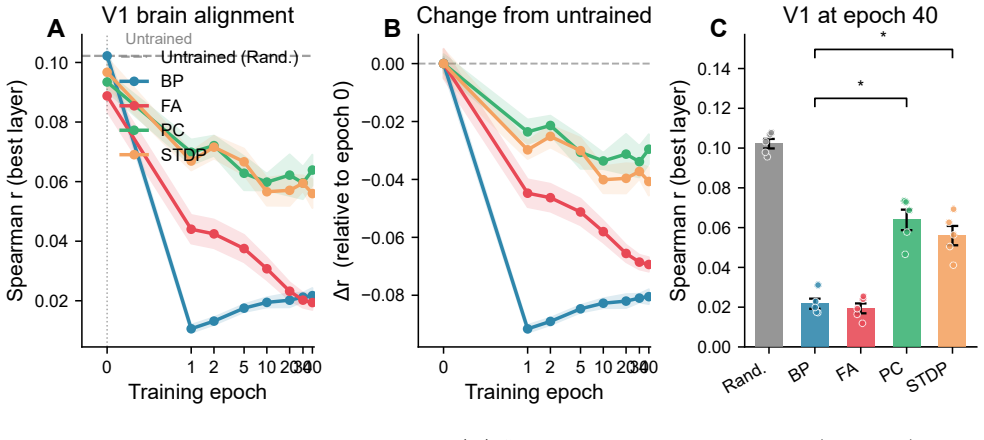
Supervised training reduces alignment between neural network representations and human early visual cortex after just one epoch.
Reviewed by Pith at T0; open to challenge. T0 means a machine referee read the full paper against a public rubric. the ladder, T0–T4 →
T0 review · grok-4.3
2026-06-29 08:43 UTC pith:TTHTQOSG
load-bearing objection One epoch of training cuts V1 alignment 25-90% depending on the rule, BP worst, but N=3 subjects makes the deltas hard to trust. the 2 major comments →
Supervised Training Rapidly Degrades Early Visual Cortex Alignment Across Biologically Plausible Learning Rules
The pith
A machine-rendered reading of the paper's core claim, the machinery that carries it, and where it could break.
Core claim
Random untrained networks match or exceed trained networks in representational similarity to early visual cortex. Tracking Spearman correlations between model and brain representational dissimilarity matrices across eight checkpoints shows that a single epoch of training reduces V1 alignment by 25-90 percent depending on the rule, with backpropagation producing the largest drop and predictive coding and STDP the smallest. A weaker opposite pattern holds in object-selective cortex where backpropagation yields the largest gain.
What carries the argument
Representational similarity analysis that computes Spearman correlations between model and brain representational dissimilarity matrices on the same set of images and fMRI regions of interest.
Load-bearing premise
Spearman correlations between model and brain representational dissimilarity matrices on the THINGS images and fMRI from three subjects provide a stable measure of early visual cortex alignment not driven by dataset-specific artifacts or subject variability.
What would settle it
Re-running the same RSA pipeline on a new image set or additional fMRI subjects and observing no drop in V1 alignment after the first training epoch would falsify the central result.
If this is right
- Untrained network architectures already capture low-level visual statistics through inductive biases alone.
- Global error signals reshape early representations more aggressively than local learning rules.
- Local rules such as predictive coding and STDP preserve more of the initial brain-like structure in V1.
- Training produces a small increase in alignment for higher areas like LOC rather than early cortex.
- The initial random state of the network is closer to brain data than the state after supervised updates.
Where Pith is reading between the lines
- Models intended to match early visual cortex may need to avoid standard end-to-end supervised objectives.
- Hybrid training that combines local rules with limited global signals could maintain alignment longer.
- The result raises the question of whether different image statistics or unsupervised pre-training would reverse the drop.
- Architectural choices that set the untrained baseline may matter more for biological fidelity than the choice of optimizer.
Editorial analysis
A structured set of objections, weighed in public.
Referee Report
Summary. The paper claims that a single epoch of training on 720 THINGS images rapidly degrades representational alignment (measured via Spearman RSA) between neural networks and human fMRI data from three subjects in six visual ROIs, with the drop in V1 ranging from 25-90% depending on the learning rule; backpropagation produces the largest reduction (delta r = -0.080) while predictive coding and STDP produce smaller drops (~ -0.04), and a weaker opposite trend appears in LOC.
Significance. If robust, the result would indicate that inductive biases in random networks already capture low-level visual statistics better than trained representations, and that global error signals reshape early cortex more aggressively than local rules. This would shift emphasis in model-brain alignment studies toward architecture and initialization rather than supervised optimization.
major comments (2)
- [Abstract] Abstract and results: the headline deltas (e.g., delta r = -0.080 for BP in V1) are computed from Spearman correlations between model and brain RDMs using only three fMRI subjects. No per-subject RDMs, bootstrap CIs, or leave-one-subject-out analyses are described, so it is impossible to determine whether the reported ordering across learning rules survives subject-level noise.
- [Abstract] Abstract: the numerical claims rest on unstated choices for model depth/width, optimizer settings, number of random seeds, and exact ROI definitions; without these, the 25-90% range and the BP vs. PC/STDP contrast cannot be reproduced or stress-tested.
minor comments (1)
- [Abstract] Abstract: the statement that alignment is tracked at eight checkpoints (epochs 0-40) does not indicate whether the degradation plateaus after epoch 1 or continues, which is needed to interpret the 'rapidly degrades' claim.
Simulated Author's Rebuttal
We thank the referee for their constructive comments. We address each major point below and indicate the revisions we will incorporate.
read point-by-point responses
-
Referee: [Abstract] Abstract and results: the headline deltas (e.g., delta r = -0.080 for BP in V1) are computed from Spearman correlations between model and brain RDMs using only three fMRI subjects. No per-subject RDMs, bootstrap CIs, or leave-one-subject-out analyses are described, so it is impossible to determine whether the reported ordering across learning rules survives subject-level noise.
Authors: We agree that the small number of subjects (n=3) limits the ability to quantify inter-subject variability and that additional statistical reporting is warranted. In the revised manuscript we will add per-subject RSA correlations, bootstrap confidence intervals computed by resampling over the 720 images, and the range of deltas observed across the three subjects. Leave-one-subject-out analysis is not informative with n=3, but the ordering of learning rules is preserved in each individual subject. These additions will allow readers to evaluate robustness directly. revision: yes
-
Referee: [Abstract] Abstract: the numerical claims rest on unstated choices for model depth/width, optimizer settings, number of random seeds, and exact ROI definitions; without these, the 25-90% range and the BP vs. PC/STDP contrast cannot be reproduced or stress-tested.
Authors: The full Methods section specifies the model architecture, optimizer settings, number of random seeds, and ROI definitions from the THINGS fMRI dataset. To improve accessibility we will add a concise summary of these parameters to the abstract (or a methods summary box) in the revision. revision: yes
Circularity Check
No circularity: results are direct empirical measurements against independent fMRI data
full rationale
The paper reports experimental outcomes from training neural networks under four learning rules and computing Spearman correlations between model representational dissimilarity matrices and separate human fMRI RDMs on the THINGS image set. No derivation chain exists that reduces a claimed result to its own inputs by definition, fitted parameters renamed as predictions, or load-bearing self-citations. The central findings (alignment drops after one epoch, differential effects by rule) are obtained by applying standard RSA to held-out brain data and are therefore self-contained against external benchmarks rather than internally forced.
Axiom & Free-Parameter Ledger
axioms (1)
- domain assumption Spearman correlation of representational dissimilarity matrices computed on the chosen image set and fMRI ROIs accurately captures alignment between model and early visual cortex representations
read the original abstract
Random, untrained neural networks consistently match or exceed trained networks in representational similarity to early visual cortex. This puzzling finding challenges the assumption that learning improves brain alignment. We investigate it by tracking representational similarity analysis (RSA) alignment to human fMRI data across training for four learning rules: backpropagation (BP), feedback alignment (FA), predictive coding (PC), and spike-timing-dependent plasticity (STDP). Using 720 object images from the THINGS database and fMRI data from three subjects across six visual ROIs, we measure Spearman correlations between model and brain representational dissimilarity matrices at eight training checkpoints (epochs 0-40). We find that (1) a single epoch of training reduces V1 alignment by 25-90%, depending on the learning rule; (2) backpropagation reduces V1 alignment most severely (delta r = -0.080), while predictive coding and STDP preserve substantially more (delta r ~ -0.04); and (3) a weaker, opposite tendency appears in object-selective cortex (LOC), where BP shows the largest increase in alignment during training, although the absolute change is small. These results suggest that untrained architectures capture low-level visual statistics through inductive biases alone, and that global error signals (BP) reshape early representations more aggressively than local learning rules (PC, STDP), which better preserve brain-like structure.
Figures


Reference graph
Works this paper leans on
-
[1]
and Poo, M.-m
Bi, G.-q. and Poo, M.-m. (1998). Synaptic modifications inculturedhippocampalneurons: dependenceonspike timing, synaptic strength, and postsynaptic cell type. Journal of Neuroscience, 18(24):10464–10472
1998
-
[2]
Oliva, A. (2016). Comparison of deep neural networks to spatio-temporal cortical dynamics of human visual object recognition reveals hierarchical correspondence. Scientific Reports, 6:27755
2016
-
[3]
Corriveau, A., Van Wicklin, C., and Baker, C. I. (2019). THINGS: A database of 1,854 object con- cepts and more than 26,000 naturalistic object images. PLOS ONE, 14(10):e0223792
2019
-
[4]
Pashkam, M., and Baker, C. I. (2023). THINGS-data, a multimodal collection of large-scale datasets for in- vestigating object representations in human brain and behavior.eLife, 12:e82580
2023
-
[5]
and Kriegeskorte, N
Khaligh-Razavi, S.-M. and Kriegeskorte, N. (2014). Deep supervised, but not unsupervised, models may explain IT cortical representation.PLOS Computational Bi- ology, 10(11):e1003915
2014
-
[6]
Leutenegger, N. (2026). Untrained CNNs match back- propagation at V1: A systematic RSA comparison of four learning rules against human fMRI.arXiv preprint arXiv:2604.16875
work page internal anchor Pith review Pith/arXiv arXiv 2026
-
[7]
P., Cownden, D., Tweed, D
Lillicrap, T. P., Cownden, D., Tweed, D. B., and Aker- man, C. J. (2016). Random synaptic feedback weights support error backpropagation for deep learning.Na- ture Communications, 7:13276
2016
-
[8]
and Thorpe, S
Masquelier, T. and Thorpe, S. J. (2007). Unsuper- vised learning of visual features through spike timing dependent plasticity.PLOS Computational Biology, 3(2):e31
2007
-
[9]
A., and Naud, R
Payeur, A., Guerguiev, J., Zenke, F., Richards, B. A., and Naud, R. (2021). Burst-dependent synaptic plas- ticity can coordinate learning in hierarchical circuits. Nature Neuroscience, 24(7):1010–1019
2021
-
[10]
Rao, R. P. and Ballard, D. H. (1999). Predictive cod- ing in the visual cortex: a functional interpretation of some extra-classical receptive-field effects.Nature Neuroscience, 2(1):79–87
1999
-
[11]
A., Restivo, K., Denfield, G., Tolias, A
Safarani, S., Nix, A., Willeke, K., Cadena, S. A., Restivo, K., Denfield, G., Tolias, A. S., and Sinz, F. H. (2021). 6 Towards robust vision by multi-task learning on mon- key visual cortex.Advances in Neural Information Processing Systems, 34:739–751
2021
-
[12]
Whittington, J. C. and Bogacz, R. (2017). An approx- imation of the error backpropagation algorithm in a predictive coding network with local Hebbian synap- tic plasticity.Neural Computation, 29(5):1229–1262
2017
-
[13]
Seibert, D., and DiCarlo, J. J. (2014). Performance- optimized hierarchical models predict neural responses in higher visual cortex.Proceedings of the National Academy of Sciences, 111(23):8619–8624. 7
2014
discussion (0)
Sign in with ORCID, Apple, or X to comment. Anyone can read and Pith papers without signing in.