Rigorous extension of semilocal collinear functionals to noncollinear DFT using SU(2) rotations
Pith reviewed 2026-06-28 20:07 UTC · model grok-4.3
The pith
A u(2) matrix representation establishes a locally exact mapping from collinear to noncollinear exchange-correlation functionals using SU(2) rotations.
A machine-rendered reading of the paper's core claim, the machinery that carries it, and where it could break.
Core claim
Within a u(2) matrix representation of the exchange-correlation energy, a locally exact relation exists that extends any semilocal collinear functional to the noncollinear case by letting its variables depend differently on the transverse and longitudinal parts of the magnetization-density gradient; the extension is realized through SU(2) rotations that convert the collinear functional derivatives into noncollinear space.
What carries the argument
The u(2) matrix representation of the energy functional together with SU(2) rotations that map between collinear and noncollinear magnetization directions.
If this is right
- Collinear semilocal variables acquire distinct dependencies on transverse and longitudinal magnetization gradient components.
- The Scalmani-Frisch scheme appears as a first-order approximation to the exact relation.
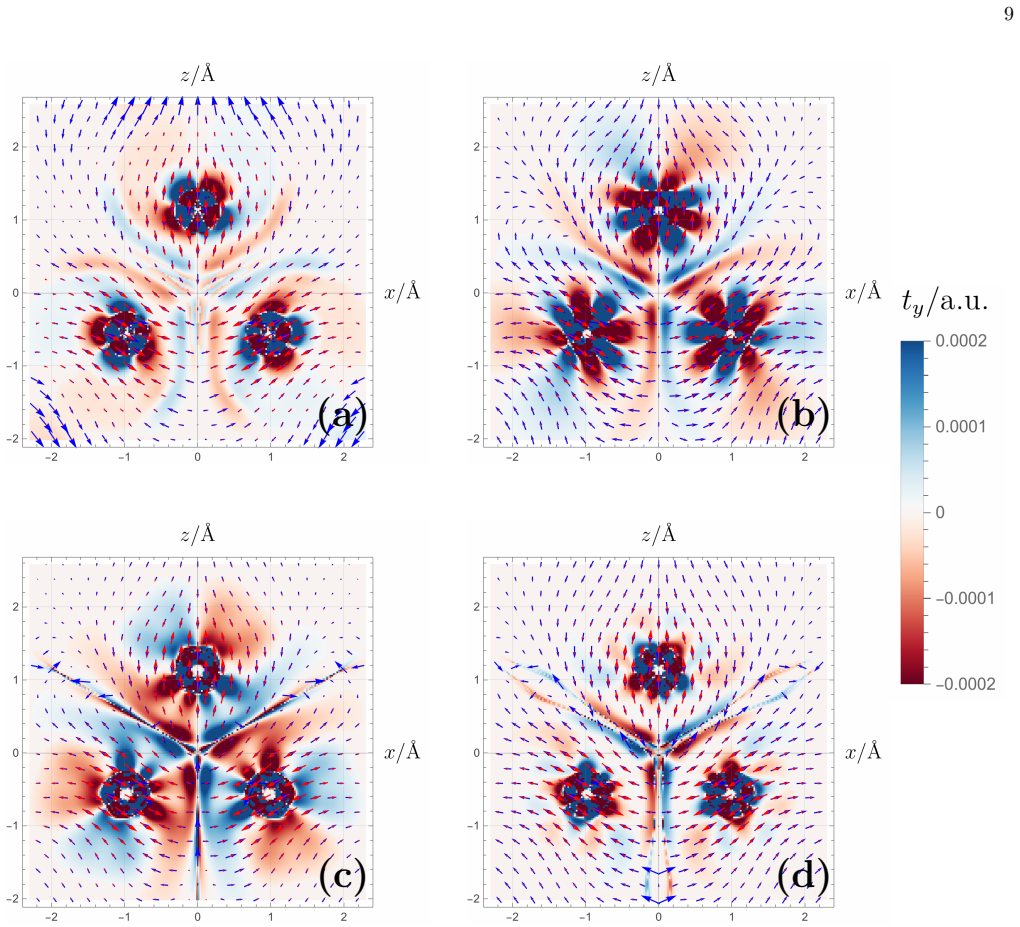
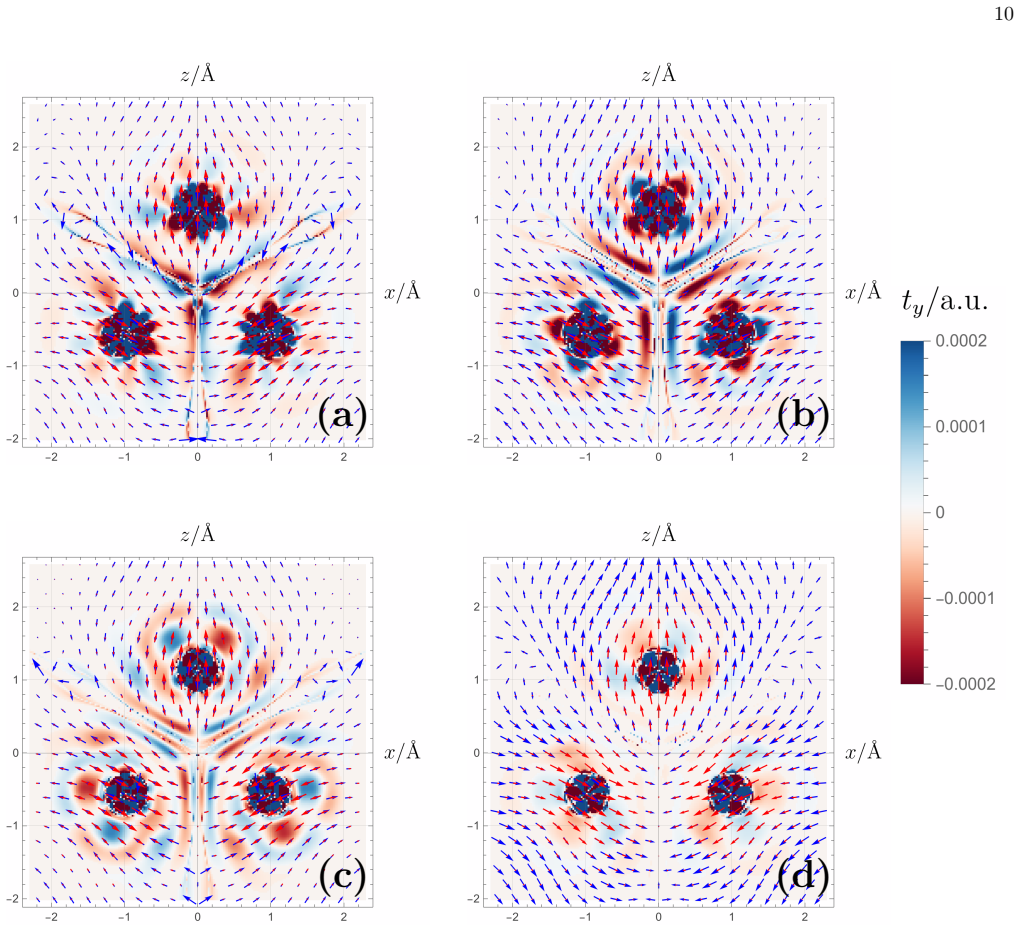
- Local magnetic torques are described consistently for the prototypical spin-frustrated Cr3 cluster.
- The same transformation extends directly to fully nonlocal functionals and supports stable relativistic response calculations.
- Computed magnetic properties such as hyperfine couplings change when spin-orbit coupling is present.
Where Pith is reading between the lines
- The framework offers a concrete way to test whether gradient-level distinctions between transverse and longitudinal gradients are sufficient by comparing results against fully relativistic four-component calculations.
- Periodic solids with geometric magnetic frustration could be revisited to see whether the new gradient dependencies alter predicted ground-state spin textures.
- Because the SU(2) rotations are numerically robust, the method may make routine noncollinear DFT practical for large magnetic molecules without ad-hoc stabilization tricks.
Load-bearing premise
The gradient expansion supplies the essential functional dependence needed for the noncollinear extension without requiring higher-order terms or extra constraints.
What would settle it
A side-by-side numerical evaluation, on a system with known noncollinear magnetization, of the energy and local torques produced by the SU(2)-extended functional versus those obtained from an exact noncollinear reference or from a higher-order gradient expansion.
Figures
read the original abstract
In the presence of spin-orbit coupling and in geometrically frustrated materials, a noncollinear treatment the magnetization density is essential. However, in density functional theory most exchange--correlation functional approximations were originally developed for locally collinear magnetization. Many practical approaches to noncollinear DFT have emerged over the past decade. However, a first-principles connection between widely used semilocal collinear functionals and their noncollinear generalizations remains lacking. In this work, a locally exact relation between collinear and noncollinear exchange--correlation functionals is derived at the level of gradient expansions within a $u(2)$ matrix representation of the energy functional. Within this framework, collinear semilocal variables naturally acquire distinct dependencies on transverse and longitudinal magnetization gradient components. The widely used Scalmani--Frisch scheme emerges as a first-order approximation. The transformation of collinear functional derivatives to noncollinear space is implemented through numerically robust $SU(2)$ rotations. A consistent description of local magnetic torques is demonstrated for the prototypical spin-frustrated Cr$_3$ cluster. The approach further extends to fully nonlocal functionals and provides a direct route towards numerically stable relativistic response calculations. The influence on magnetic properties in presence of spin-orbit coupling is illustrated through calculations of hyperfine couplings in the high-spin ground states of uranium and the uranium ion.
Editorial analysis
A structured set of objections, weighed in public.
Referee Report
Summary. The manuscript derives a locally exact relation between collinear and noncollinear exchange-correlation functionals at the gradient-expansion level inside a u(2) matrix representation of the energy functional. Collinear semilocal variables acquire distinct dependencies on transverse and longitudinal magnetization gradient components. The Scalmani-Frisch scheme is recovered as the leading-order case. SU(2) rotations are used to transform collinear functional derivatives into noncollinear space. Numerical demonstrations include consistent local magnetic torques on the Cr3 cluster and hyperfine-coupling calculations for high-spin uranium systems.
Significance. If the derivation holds, the work supplies a first-principles, parameter-free route to extend widely used semilocal functionals to noncollinear magnetization, which is significant for DFT treatments of spin-orbit-coupled and geometrically frustrated systems. The explicit construction, recovery of a known approximation as a special case, and numerical illustrations on Cr3 and uranium hyperfine couplings are concrete strengths. The scope is clearly limited to gradient expansions, and the approach is noted to generalize toward nonlocal functionals and relativistic response calculations.
minor comments (2)
- [Abstract] Abstract: the statement that the approach 'further extends to fully nonlocal functionals' is asserted without any supporting outline or reference to a later section; a single clarifying sentence would improve the summary.
- [Numerical results] Numerical results: the Cr3 torque demonstration and uranium hyperfine results would be easier to assess if a short table compared the new scheme against the Scalmani-Frisch baseline and against experiment or other codes.
Simulated Author's Rebuttal
We thank the referee for the positive summary, significance assessment, and recommendation of minor revision. No specific major comments were provided in the report.
Circularity Check
No significant circularity; derivation self-contained
full rationale
The paper presents an explicit derivation of a locally exact relation at the gradient-expansion level inside a u(2) matrix representation, using SU(2) rotations to map collinear functionals to noncollinear space. This construction recovers the Scalmani–Frisch scheme as a leading-order case and supplies the functional derivatives directly; no step reduces by definition to a fitted parameter, a self-citation chain, or an ansatz smuggled from prior work by the same authors. The numerical demonstrations on Cr3 and uranium systems serve as consistency checks rather than load-bearing inputs. The derivation therefore remains independent of its own outputs.
Axiom & Free-Parameter Ledger
Reference graph
Works this paper leans on
-
[1]
Relative Bloch-sphere orientation and collinear limit In Ref. [3] it was pointed out that locally collinear ap- proaches can not generally retain the correct collinear limit for nonlocal functionals, because information about relative spin orientations is lost locally when using eigen- value densities. This statement is only correct if the rel- ative phas...
-
[2]
The collinear gradient tensoreγis constructed as eγcan =∂ k ˜ρ⊗∂ k ˜ρ(17) by direct application of the chain rule
Canonical approach The canonical approach assumes that ˜ρvaries smoothly in the local eigenbasis. The collinear gradient tensoreγis constructed as eγcan =∂ k ˜ρ⊗∂ k ˜ρ(17) by direct application of the chain rule. In general, eγcan cannot be expressed as a purely unitary transformation ofγ: eγcan =U † 0 γU0 +O(∂U 0∂ρ) +O([∂U 0]2) (18) U0 does not simultane...
-
[3]
Scalmani–Frisch variables The exact tensor variable ˜γcan be related to the collinear variables introduced by Scalmani and Frisch
-
[4]
All terms bilinear in magnetization-density gradients are treated as small per- turbations
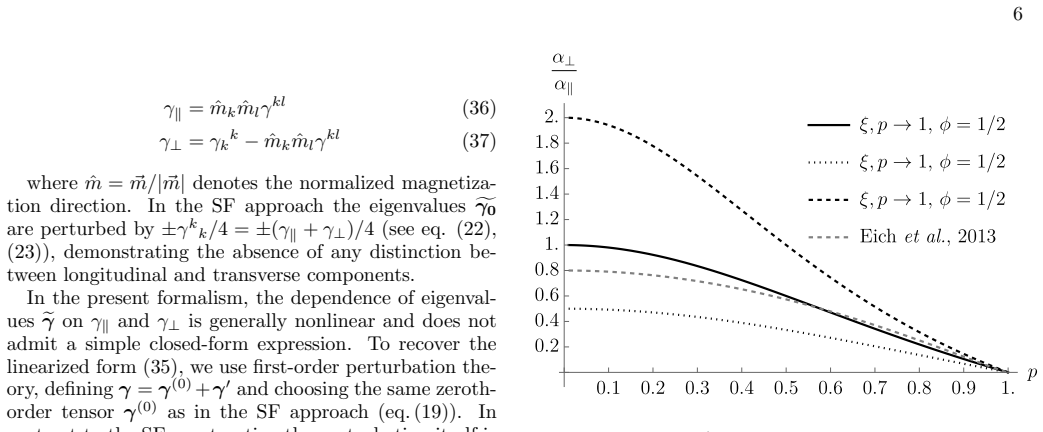
by introducing a zeroth-order tensorγ (0) = γµ0 Gµ ⊗G 0 + (1−δ µ0)G0 ⊗G µ . All terms bilinear in magnetization-density gradients are treated as small per- turbations. In addition, near-collinearity is assumed by restricting the perturbation to diagonal spin components γ′ ≈γ mmGm ⊗Gm, while all spin odd-diagonal terms are neglected. The diagonalization gγ...
-
[5]
Once the fullnth-order derivative tensor in eigenspace Dn i1...in is formulated, the corresponding noncollinear derivatives follow immediately: δnF δβi1
Transformation of collinear functional derivatives to noncollinear space A practical advantage of the present formalism is tht noncollinear derivatives are obtained directly through unitary transformation of the eigenspace derivatives. Once the fullnth-order derivative tensor in eigenspace Dn i1...in is formulated, the corresponding noncollinear derivativ...
-
[6]
Using the spectral representation of Fr´ echet deriva- tives for matrix functions, the corresponding eigenspace derivatives can be expressed in terms of divided differ- ences
Eigenspace derivatives The first-order eigenspace derivative tensorD (1) is di- agonal and can be constructed from the collinear func- tional derivatives with respect to eigenspace variable ˜β inu(2) ⊗m representation space as (D(1))⃗ a⃗b =δ ⃗ a⃗b δ ˜F δ ˜β⃗ a ,(28) whereδ ⃗ a⃗b = mQ k=1 δak δbk and indices⃗ a,⃗b, ⃗ c,⃗drepresents spin configurations ofms...
-
[7]
in calculations ofA. MethodS z/ℏ D ˆS2 E /ℏ2 A/MHzI/eV U,5L6 HF 2.17 8.15−46.50 5.980 60 % Fock exchange OLYP-SU(2) 1.71 5.77 96.81 6.067 OLYP-SU(2)-PT1 1.70 5.74 96.55 6.067 OLYP-SU(2)-SF 1.69 5.86 76.02 6.120 OLYP-Can. 1.71 5.76 96.75 6.059 LDA 1.68 5.70 98.03 6.472 40 % Fock exchange OLYP-SU(2) 1.71 5.77 98.47 5.976 OLYP-SU(2)-PT1 1.68 5.71 98.08 5.977...
-
[8]
W. P. Comaskey, F. Bodo, A. Erba, J. L. Mendoza- Cortes, and J. K. Desmarais, Phys. Rev. B106, L201109 (2022)
2022
-
[9]
F. Bodo, J. K. Desmarais, and A. Erba, Phys. Rev. B 105, 125108 (2022)
2022
-
[10]
Z. Pu, H. Li, N. Zhang, H. Jiang, Y. Gao, Y. Xiao, Q. Sun, Y. Zhang, and S. Shao, Phys. Rev. Res.5, 013036 (2023)
2023
-
[11]
H. Chen, P. Qin, H. Yan, Z. Feng, X. Zhou, X. Wang, Z. Meng, L. Liu, and Z. Liu, Mater. Lab1, 220032 (2022)
2022
-
[12]
Eschrig and V
H. Eschrig and V. D. P. Servedio, J. Comput. Chem.20, 23 (1999)
1999
-
[13]
C. van W¨ ullen, J. Comput. Chem.23, 779 (2002), https://onlinelibrary.wiley.com/doi/pdf/10.1002/jcc.10043
-
[14]
F. Wang and W. Liu, J. Chin. Chem. Soc.50, 597 (2003), https://onlinelibrary.wiley.com/doi/pdf/10.1002/jccs.200300087
-
[15]
R. Bast, H. J. A. Jensen, and T. Saue, Int. J. Quantum Chem.109, 2091 (2009), https://onlinelibrary.wiley.com/doi/pdf/10.1002/qua.22065
-
[16]
von Barth and L
U. von Barth and L. Hedin, J. Phys. C5, 1629 (1972)
1972
-
[17]
A. K. Rajagopal and J. Callaway, Phys. Rev. B7, 1912 (1973)
1912
-
[19]
J. K¨ ubler, K.-H. H¨ ock, J. Sticht, and A. R. Williams, J. Appl. Phys.63, 3482 (1988), https://doi.org/10.1063/1.340744
-
[20]
Anton, T
J. Anton, T. Jacob, B. Fricke, and E. Engel, Phys. Rev. Lett.89, 213001 (2002)
2002
-
[21]
Anton, B
J. Anton, B. Fricke, and E. Engel, Phys. Rev. A69, 012505 (2004)
2004
-
[22]
J. E. Peralta and G. E. Scuseria, J. Chem. Phys. 120, 5875 (2004), https://pubs.aip.org/aip/jcp/article- pdf/120/13/5875/19266498/5875 1 online.pdf
2004
-
[23]
J. E. Peralta, G. E. Scuseria, and M. J. Frisch, Phys. Rev. B75, 125119 (2007)
2007
-
[24]
C. van W¨ ullen and N. Langermann, J. Chem. Phys.126, 114106 (2007), https://doi.org/10.1063/1.2711197
-
[25]
G. Scalmani and M. J. Frisch, J. Chem. Theory Comput. 8, 2193 (2012), https://doi.org/10.1021/ct300441z
-
[26]
Z. Pu, N. Zhang, H. Jiang, and Y. Xiao, Phys. Rev. B 105, 035114 (2022)
2022
-
[27]
F. G. Eich and E. K. U. Gross, Phys. Rev. Lett.111, 156401 (2013)
2013
-
[28]
Tancogne-Dejean, A
N. Tancogne-Dejean, A. Rubio, and C. A. Ullrich, Phys. Rev. B107, 165111 (2023)
2023
-
[29]
Capturing exchange-correlation spin-torque effects with a semilocal functional
M.-T. Huebsch, F. Tran, and M. Marsman, arXivcond- mat.mtrl-sci, 2501.04124 (2025)
work page internal anchor Pith review Pith/arXiv arXiv 2025
-
[30]
Sharma, J
S. Sharma, J. K. Dewhurst, C. Ambrosch-Draxl, S. Kurth, N. Helbig, S. Pittalis, S. Shallcross, L. Nord- str¨ om, and E. K. U. Gross, Phys. Rev. Lett.98, 196405 (2007)
2007
-
[31]
C. A. Ullrich, Phys. Rev. B98, 035140 (2018)
2018
-
[32]
I. W. Bulik, G. Scalmani, M. J. Frisch, and G. E. Scuse- ria, Phys. Rev. B87, 035117 (2013)
2013
-
[33]
F. Egidi, S. Sun, J. J. Goings, G. Scalmani, M. J. Frisch, and X. Li, J. Chem. Theory Comput.13, 2591 (2017), https://doi.org/10.1021/acs.jctc.7b00104
-
[34]
S. Komorovsky, P. J. Cherry, and M. Repisky, J. Chem. Phys.151, 184111 (2019), https://doi.org/10.1063/1.5121713
-
[35]
J. K. Desmarais, S. Komorovsky, J.-P. Fla- ment, and A. Erba, J. Chem. Phys.154, 204110 (2021), https://pubs.aip.org/aip/jcp/article- pdf/doi/10.1063/5.0051447/14004235/204110 1 online.pdf
-
[36]
F. G. Eich, S. Pittalis, and G. Vignale, Phys. Rev. B88, 245102 (2013)
2013
-
[37]
Hohenberg and W
P. Hohenberg and W. Kohn, Phys. Rev. B136, 864 (1964)
1964
-
[38]
D. C. Langreth and J. P. Perdew, Phys. Rev. B21, 5469 (1980)
1980
-
[39]
D. C. Langreth and M. J. Mehl, Phys. Rev. B28, 1809 (1983)
1983
-
[40]
J. P. Perdew, K. Burke, and M. Ernzerhof, Phys. Rev. Lett.77, 3865 (1996)
1996
-
[41]
C. Lee, W. Yang, and R. G. Parr, Phys. Rev. B37, 785 (1988)
1988
-
[42]
van W¨ ullen, J
C. van W¨ ullen, J. Chem. Phys.109, 392 (1998)
1998
-
[43]
Gaul and R
K. Gaul and R. Berger, Phys. Rev. A101, 012508 (2020)
2020
-
[44]
M. T. Colombo Jofr´ e, K. Kozio l, I. A. Aucar, K. Gaul, R. Berger, and G. A. Aucar, J. Chem. Phys.157, 064103 (2022), https://doi.org/10.1063/5.0095586
-
[45]
S. A. Br¨ uck, N. Sahu, K. Gaul, and R. Berger, J. Chem. Phys.158, 194109 (2023), https://pubs.aip.org/aip/jcp/article- pdf/doi/10.1063/5.0141271/17642677/194109 1 5.0141271.pdf
-
[46]
van W¨ ullen, Z
C. van W¨ ullen, Z. Phys. Chem224, 413 (2010)
2010
-
[47]
Ahlrichs, M
R. Ahlrichs, M. B¨ ar, M. H¨ aser, H. Horn, and C. K¨ olmel, Chem. Phys. Lett.162, 165 (1989)
1989
-
[48]
J. L. Stuber and J. Paldus, inFundamental World of Quantum Chemistry, Vol. 1, edited by E. J. Br¨ andas and E. S. Kryachko (Kluwer Academic Publishers, Dordrecht, The Netherlands, 2003) pp. 67–139. 14
2003
-
[49]
H. Fukutome, Int. J. Quantum Chem.20, 955 (1981), https://onlinelibrary.wiley.com/doi/pdf/10.1002/qua.560200502
-
[50]
M. Dolg, U. Wedig, H. Stoll, and H. Preuss, J. Chem. Phys.86, 866 (1987)
1987
-
[51]
P. A. M. Dirac, Proc. Cambridge Phil. Soc.26, 376 (1930)
1930
-
[52]
J. C. Slater, Phys. Rev.81, 385 (1951)
1951
-
[53]
S. H. Vosko, L. Wilk, and M. Nuisar, Can. J. Phys.58, 1200 (1980)
1980
-
[54]
A. D. Becke, J. Chem. Phys.98, 1372 (1993)
1993
-
[55]
A. D. Becke, Phys. Rev. A38, 3098 (1988)
1988
-
[56]
N. C. HANDY and A. J. COHEN, Mol. Phys.99, 403 (2001), https://doi.org/10.1080/00268970010018431
-
[57]
T. W. Keal and D. J. Tozer, J. Chem. Phys.121, 5654 (2004)
2004
-
[58]
Adamo and V
C. Adamo and V. Barone, J. Chem. Phys.110, 6158 (1999)
1999
-
[59]
Capelle, G
K. Capelle, G. Vignale, and B. L. Gy¨ orffy, Phys. Rev. Lett.87, 206403 (2001)
2001
-
[60]
J. Stricker, K. Gaul, P. Fischer, L. M. Arndt, F. Kraus, D. Krug, D. Renisch, F. Schmidt-Kaler, L. Schweikhard, J. Velten, and C. E. D¨ ullmann, arXivphysics.chem- ph, 2512.14924 (2025)
-
[61]
W. Liu, C. van W¨ ullen, F. Wang, and L. Li, J. Chem. Phys.116, 3626 (2002)
2002
-
[62]
Visscher and K
L. Visscher and K. G. Dyall, At. Data Nucl. Data Tables 67, 207 (1997)
1997
-
[63]
K. G. Dyall, Theor. Chem. Acc.108, 335 (2002)
2002
-
[64]
K. G. Dyall, Theor. Chem. Acc.115, 441 (2006)
2006
-
[65]
K. Gaul and R. Berger, J. Chem. Phys.152, 044101 (2020), arXiv:1907.10432 [physics.chem-ph]
-
[66]
Stone, At
N. Stone, At. Data Nucl. Data Tables90, 75 (2005)
2005
-
[67]
Coste, R
A. Coste, R. Avril, P. Blancard, J. Chatelet, D. Lambert, J. Legre, S. Liberman, and J. Pinard, J. Opt. Soc. Am. 72, 103 (1982)
1982
-
[68]
Y. P. Gangrskij, S. G. Zemlyanoj, B. N. Markov, N. N. Kolesnikov, B. K. Kul’dzhanov, and K. P. Marinova, Optika i Spektroskopiya83, 191 (1997)
1997
-
[69]
S. G. Porsev, C. Cheung, and M. S. Safronova, Phys. Rev. A106, 042810 (2022)
2022
discussion (0)
Sign in with ORCID, Apple, or X to comment. Anyone can read and Pith papers without signing in.